

Automotive Sunroof Market Analysis & Forecast: 2026-2033
Global automotive sunroof market is estimated to be valued at USD 9,907.8 Mn in 2026 and is expected to reach USD 19,930.2 Mn by 2033, exhibiting a compound annual growth rate (CAGR) of 10.5% from 2026 to 2033.
Key Takeaways
- By Component, the drive cables segment accounted for 31.6% of the market in 2026, supported by its essential role in sunroof panel actuation, high durability under repeated use, and compatibility with both panoramic and tilt-and-slide mechanisms across mid-range and premium vehicles.
- By Material Type, glass-based sunroofs dominated the market in 2026, driven by their durability, enhanced visibility, and consumer preference for panoramic transparency—particularly in mid-to-premium passenger vehicles.
- By Sunroof Type, the panoramic sunroof segment led the market in 2026, supported by rising demand for open-air cabin experiences, luxury vehicle adoption, and the ability to improve vehicle resale value through premium features.
- By Vehicle Type, SUVs held the largest share in 2026, driven by higher roof profiles that accommodate larger sunroof structures, increased consumer demand for comfort and visibility, and the segment’s global growth momentum.
- By Region, Asia Pacific dominates the global reach stacker market with a 42.3% share in 2026, supported by surging vehicle production, rising disposable income, and increased consumer demand for comfort-enhancing features across China, India, and Southeast Asia.
Market Overview
The market growth is driven by increasing demand for open-air and enhanced ventilation in vehicles. Customers are willing to pay extra for automotive sunroofs due to their aesthetic appeal and comfort benefits. Emerging economies are expected to account for a major chunk of the incremental growth due to rising affordability and purchase power. Increasing demand for premium and luxury vehicles equipped with advanced automation features including sunroofs is driving the automotive sunroof market growth.
Current Events and their Impact on the Automotive Sunroof Market
Current Events | Description and its impact |
China's Automotive Industry Slowdown and EV Transition |
|
European Union's Green Deal and Automotive Regulations |
|
Advanced Glass Technology and Smart Sunroof Innovation |
|
Role of Artificial Intelligence (AI) in Automotive Sunroof
Artificial Intelligence (AI) is playing a transformative role in the automotive sunroof market by enhancing safety, convenience, and user experience. AI-powered systems can automatically control sunroof operations based on weather conditions, cabin temperature, or air quality. For instance, the sunroof can close during rain or reduce glare based on sunlight intensity. AI also enables voice-activated controls and personalized settings, adapting to user preferences over time.
Hyundai has launched the 2025 Creta in India, bringing major upgrades to the popular mid-size SUV. The new model features a refreshed design, AI-powered tech, a more powerful and efficient engine, and a panoramic sunroof—strengthening its position as a segment leader.
- Current Industry Events of 2026
- Market Size Estimation
- Regional Breakdown
- Competitive Landscape
- Customer Intelligence
- Segmental Analysis
- Pricing Analysis
- Key Market Drivers, Challenges & Future Trends
- Customized Insights Section
Pricing Analysis of Automotive Sunroof Market
Automotive sunroof pricing varies widely depending on type, vehicle class, and installation method. Basic manual tilt-and-slide sunroofs in entry-level vehicles add approximately ₹35,000 to ₹80,000 (USD 400 to 950) to the ex-showroom price, making them an accessible upgrade for compact and mid-size cars. Electric single-panel or dual-panel systems, common in mid-range sedans and SUVs, typically increase vehicle cost by ₹90,000 to ₹1.5 lakh (USD 1,000 to 1,800), factoring in factory integration and wiring complexity. Panoramic sunroofs, often found in premium SUVs and high-end sedans, command a higher premium ranging from ₹1.8 lakh to ₹3.5 lakh (USD 2,200 to 4,200), depending on glass size, smart tinting, and structural reinforcements. Aftermarket installations, particularly for panoramic systems, can cost ₹2 lakh to ₹4.5 lakh (USD 2,400 to 5,500), influenced by vehicle model, sunroof brand, and service provider. Replacement costs for damaged or malfunctioning units also vary: standard sunroof repairs range from ₹60,000 to ₹1.2 lakh, while full panoramic replacements can exceed ₹3 lakh (USD 3,600+).
Segmental Insights
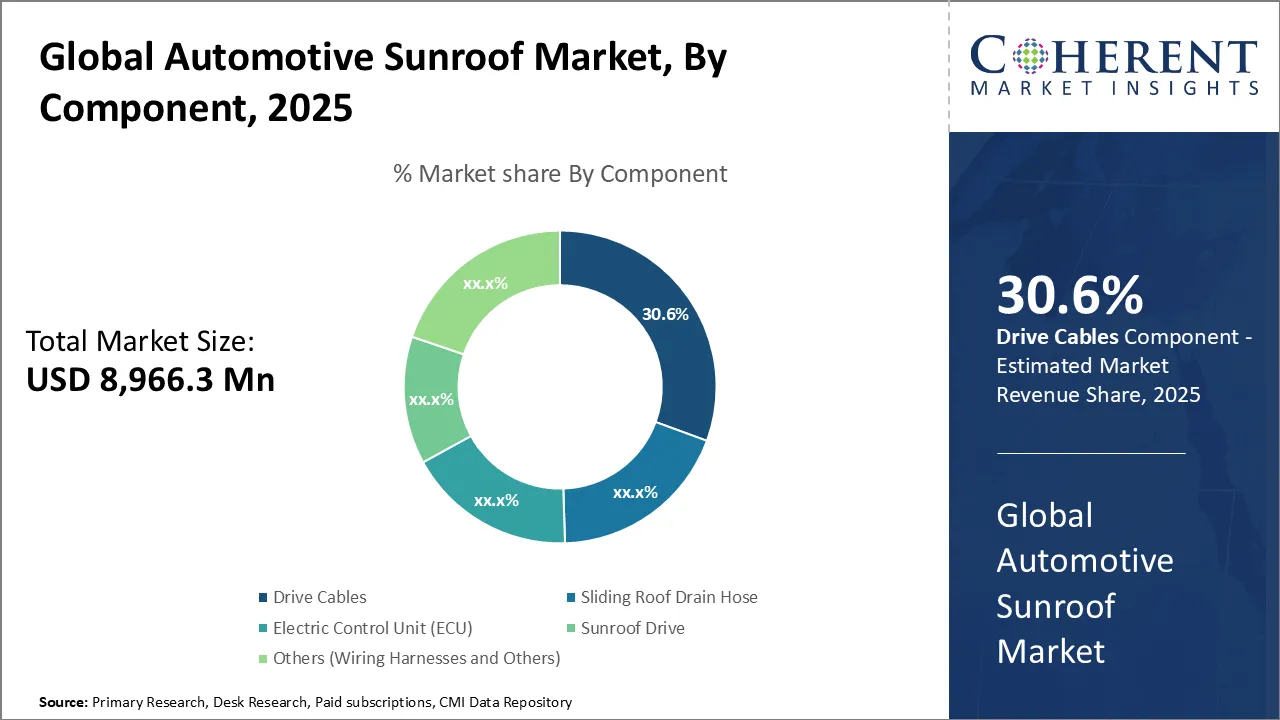
Automotive Sunroof Market Insights, By Component: Drive cables segment holds the largest market share in 2026 owing to its essential role in panel actuation and compatibility with premium sunroof systems
The drive cables segment accounted for a notable 31.6% share of the global automotive sunroof market in 2026. Drive cables serve as a critical mechanical component enabling smooth actuation of the sunroof panel during opening and closing operations. Their robustness under repeated mechanical stress, high tensile strength, and compatibility with both panoramic and tilt-and-slide sunroof mechanisms make them essential in delivering long-term reliability and user comfort. These components are especially favored in mid-range and premium vehicles where precision and quiet operation are key consumer expectations. However, increasing trends toward frameless and motor-integrated systems may reduce future reliance on traditional cable-based actuation. For instance, Brose enhanced its modular drive systems in 2025 by integrating reinforced cable tracks, improving both torque transmission and noise dampening performance in luxury models.
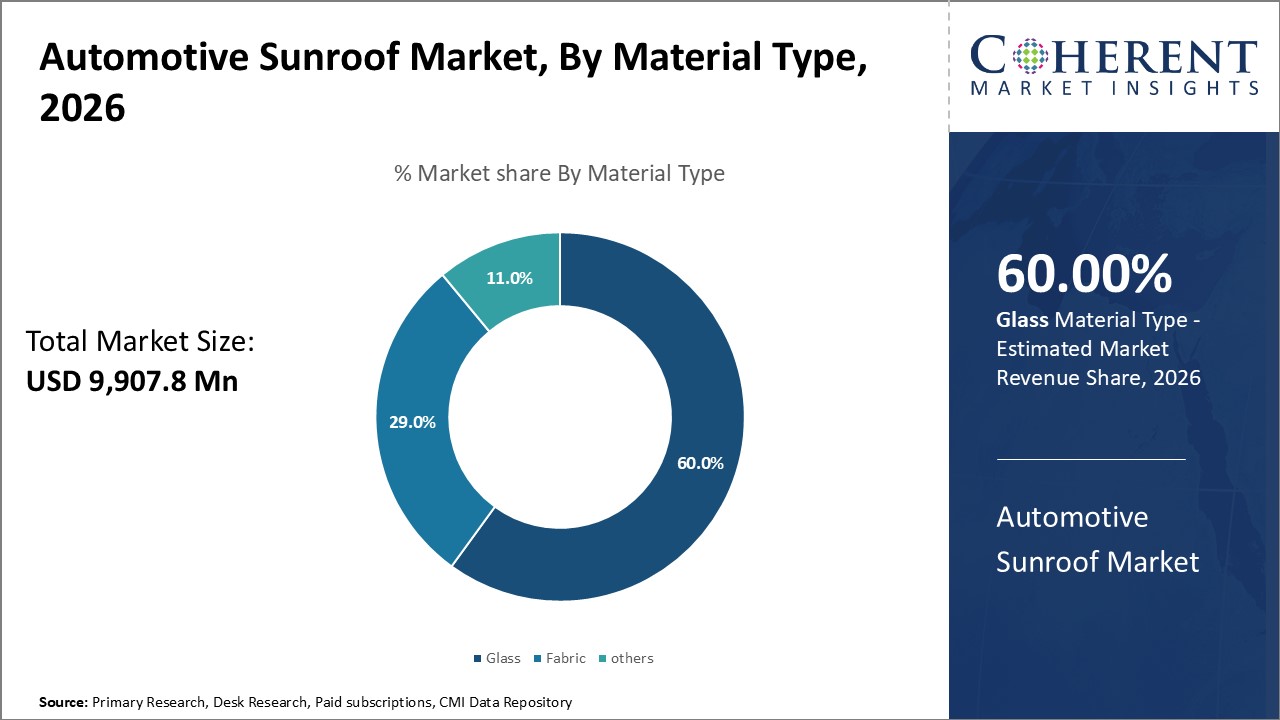
Automotive Sunroof Market Insights, By Material Type: Glass-based sunroofs dominate the material type segment in 2026 due to consumer preference for transparency, durability, and premium aesthetics
Glass-based sunroofs dominated the material segment in 2026, driven by their superior durability, thermal insulation properties, and consumer preference for transparent, panoramic cabin experiences. Laminated or tempered glass options offer enhanced UV protection and noise insulation, making them highly attractive for OEMs seeking to elevate cabin quality. Glass materials are particularly well suited for both fixed and sliding sunroof configurations, often featuring tints or UV coatings for added comfort. Despite their weight, ongoing developments in lightweight glass composites have mitigated their impact on vehicle efficiency.
For instance, Saint-Gobain Sekurit introduced a thinner, lightweight laminated glass solution in Q1 2025 aimed at reducing sunroof system weight by up to 15% while maintaining structural strength.
Automotive Sunroof Market Insights, By Sunroof Type: Panoramic sunroofs lead the sunroof type segment in 2026 owing to increased demand for open-air cabin experiences and luxury vehicle adoption
The panoramic sunroof segment held the largest share in 2026, reflecting strong demand for full-roof glass designs that enhance the cabin experience through increased natural lighting and a sense of spaciousness. These sunroofs are widely adopted across luxury and mid-range SUVs and sedans, offering a strong resale value and perceived vehicle sophistication. Dual-panel and fixed panoramic options allow for flexibility in design while retaining structural rigidity. However, the higher system complexity and cost make panoramic sunroofs less common in entry-level vehicles. For instance, Hyundai launched its 2025 Tucson with a dual-pane panoramic sunroof system featuring integrated wind deflectors and retractable shades, appealing to consumers seeking premium features in compact SUVs.
Automotive Sunroof Market Insights, By Vehicle Type: SUVs dominate the vehicle type segment in 2026 due to their roof space compatibility with larger sunroof designs and rising global popularity
SUVs led the automotive sunroof market by vehicle type in 2026, benefiting from their inherently larger roof surfaces that support wider sunroof installations. With increasing global demand for SUVs across both developed and emerging markets, manufacturers have prioritized integrating panoramic or tilt-and-slide sunroofs as standard or optional features. The SUV segment’s growth, fueled by outdoor lifestyle marketing and family-use utility, makes it an ideal platform for expansive sunroof systems. However, adoption in compact SUVs must balance cost and structural integrity.
For instance, Toyota’s 2025 RAV4 Hybrid model introduced an updated panoramic roof package, offering a wider opening area and automated wind control for enhanced passenger comfort.
Regional Insights
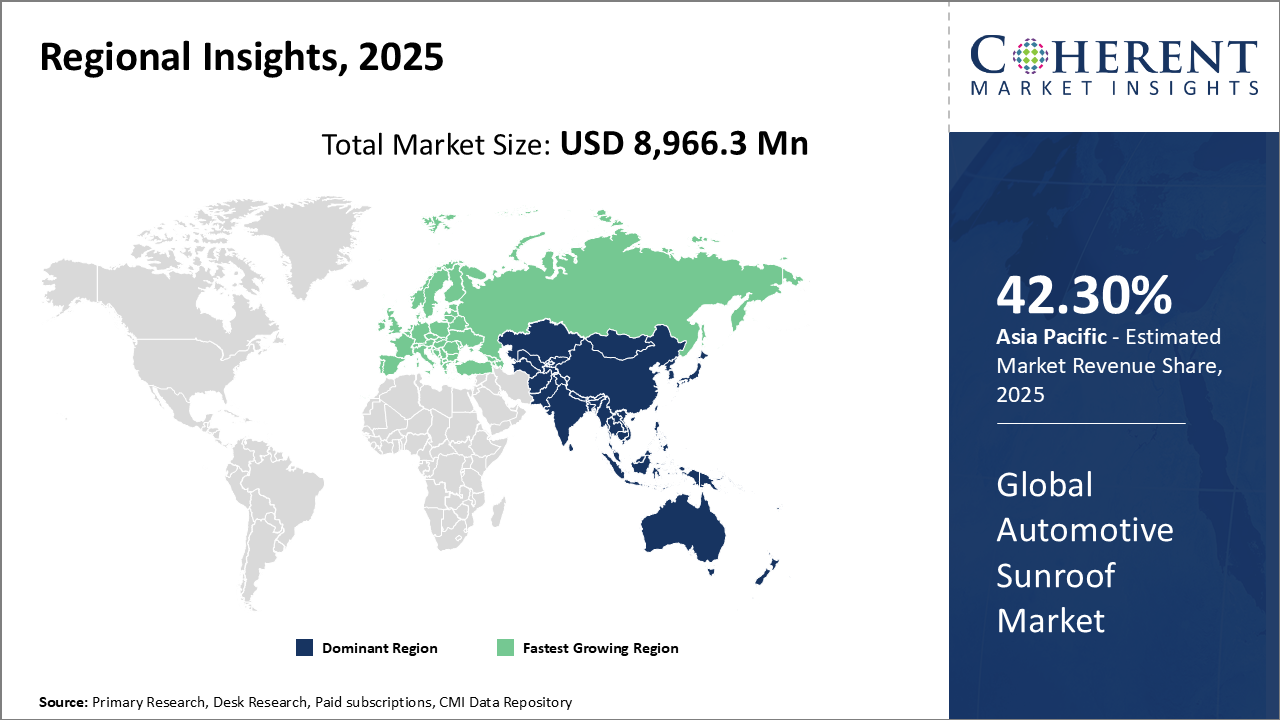
Asia Pacific Automotive Sunroof Market Trends
Asia Pacific dominates the automotive sunroof market with an estimated share of 42.30% in 2026, driven by rapid vehicle production growth, expanding middle-class consumer base, and increasing demand for in-cabin comfort features. Key markets such as China and India continue to play a central role, supported by rising adoption of SUVs and sedans with premium specifications.
Webasto Group invested in a new manufacturing facility in Chennai in 2026, dedicated to producing panoramic sunroofs with an initial annual capacity of 250,000 units—highlighting how major suppliers are localizing production to cater to rising demand in India and wider APAC.
Europe Automotive Sunroof Market Trends
Europe holds a significant 26.6% share of the global automotive sunroof market in 2026, supported by a mature automotive sector, increasing integration of panoramic roofs in premium vehicles, and regulatory incentives promoting sustainable and lightweight automotive components. Countries like Germany, France, and the U.K. are major contributors, with a rising trend toward glass and solar-integrated sunroof systems in hybrid and electric vehicles. In July 2026, a new EU directive encouraged the use of recyclable glazing materials in vehicle roof systems, prompting several European OEMs to announce updated sunroof platforms with reduced environmental impact. This is further accelerating the automotive sunroof market share.
China Automotive Sunroof Market Trends
China alone accounts for 17.9% of the global market, propelled by strong domestic OEM activity, government support for electric vehicles, and consumer preferences shifting toward panoramic and smart sunroofs. For instance, in March 2026, SAIC Motor expanded production of its premium SUV lineup featuring full-roof panoramic sunroofs, targeting urban buyers across Tier 1 and Tier 2 cities.
United States Automotive Sunroof Market Trends
The United States accounts for 17.9% of the global automotive sunroof market in 2026, reflecting strong consumer preference for SUVs and light trucks equipped with panoramic and tilt-and-slide sunroof options. High average vehicle pricing and demand for premium upgrades support widespread adoption of large-format glass roofs. Additionally, the rise of electric vehicles in the U.S. has accelerated interest in energy-efficient sunroof systems with smart glass technologies. For instance, Ford’s 2026 Mustang Mach-E now features an electrochromic panoramic roof as a factory option, addressing both thermal comfort and style expectations of the U.S. EV consumer base.
Market Report Scope
Automotive Sunroof Market Report Coverage
| Report Coverage | Details | ||
|---|---|---|---|
| Base Year: | 2025 | Market Size in 2026: | USD 9,907.8 Mn |
| Historical Data for: | 2020 To 2024 | Forecast Period: | 2026 To 2033 |
| Forecast Period 2026 to 2033 CAGR: | 10.5% | 2033 Value Projection: | USD 19,930.2 Mn |
| Geographies covered: |
| ||
| Segments covered: |
| ||
| Companies covered: | Robert Bosch GmbH., Inalfa Roof Systems Group B.V, Continental AG, Yachiyo Industry Co., Ltd, Webasto Group, KÜSTER Unternehmensgruppe | ||
| Growth Drivers: |
| ||
| Restraints & Challenges: |
| ||
Market Opportunity
Growing popularity of open-air driving experiences
Rising income in developing nations allows drivers to afford vehicles with optional features. Manufacturers can tap into this emerging demand by offering affordable sunroof models.
Growing popularity of open-air driving experiences also allows opportunities to market sunroofs as a way for customers to feel more connected to the outdoors from within their vehicles.
Automotive Sunroof Market News
- In August 2025, AGC Automotive Europe unveiled its vehicle-integrated photovoltaic (VIPV) panoramic sunroof a glass-roof system that integrates solar cells to enhance energy efficiency and contribute to greener vehicle power systems.
- In March 2025, Mahindra & Mahindra, in partnership with Webasto, unveiled the "Infinity Roof"—a panoramic sunroof with integrated ambient lighting—for its Electric Origin SUVs, the BE 6 and XEV 9e, showcasing enhanced in-cabin comfort and customization.
- In February 2025, MG Motor India refreshed its Astor compact SUV, adding a panoramic sunroof to the Shine and Select trims making it the only SUV in its segment to offer this feature under ₹12.5 lakh.
- In June 2025, Hyundai updated its Alcazar with a new corporate trim that finally includes a panoramic sunroof in diesel models priced starting at ₹17.87 lakh and available in both manual and automatic versions.
Analyst Opinion (Expert Opinion)
- The automotive sunroof market continues to evolve as consumer preferences shift toward enhanced driving experiences and vehicle aesthetics. Premium vehicle segments are driving significant adoption, with panoramic sunroofs becoming increasingly popular among consumers seeking luxury features and improved cabin ambiance. The growing demand for electric vehicles presents substantial opportunities, as manufacturers leverage sunroofs to differentiate their offerings while potentially integrating solar panel technology for auxiliary power generation.
- However, several restraints challenge market expansion, including increased vehicle weight affecting fuel efficiency, higher manufacturing costs, and potential structural integrity concerns. Climate considerations also influence adoption patterns, with extreme weather conditions in certain regions limiting consumer appeal due to heat management and maintenance issues.
- The Asia-Pacific region dominates market dynamics, driven by robust automotive production in China, India, and Southeast Asia, where rising disposable incomes fuel demand for premium vehicle features. European markets demonstrate strong growth momentum, particularly in Germany and France, where consumers increasingly prioritize luxury amenities and innovative automotive technologies.
Speak to the analyst
Want personalized insights?
Take the findings above to one of our principal consultants, or have the report rebuilt around the segments, geographies and competitors you actually track.
Market Segmentation
- Component Insights (Revenue, USD Mn, 2021 - 2033)
- Drive Cables
- Sliding Roof Drain Hose
- Electric Control Unit (ECU)
- Sunroof Drive
- Others (Wiring Harnesses and Others)
- Material Type Insights (Revenue, USD Mn, 2021 - 2033)
- Glass
- Fabric
- others
- Sunroof Insights (Revenue, USD Mn, 2021 - 2033)
- Built-in Sunroof
- Tilt and Slide Sunroof
- Panoramic Sunroof
- Popup Sunroof
- Vehicle Type Insights (Revenue, USD Mn, 2021 - 2033)
- Hatchback
- Sedan
- Sports Utility Vehicle (SUV)
- Regional Insights (Revenue, USD Mn, 2021 - 2033)
- North America
- U.S.
- Canada
- Latin America
- Brazil
- Argentina
- Mexico
- Rest of Latin America
- Europe
- Germany
- U.K.
- France
- Italy
- Russia
- Rest of Europe
- Asia Pacific
- China
- India
- Japan
- Australia
- South Korea
- ASEAN
- Rest of Asia Pacific
- Middle East & Africa
- GCC Countries
- South Africa
- Rest of Middle East & Africa
- North America
- Key Players
- Robert Bosch GmbH.
- Inalfa Roof Systems Group B.V
- Continental AG
- Yachiyo Industry Co., Ltd.
- Webasto Group
- KÜSTER Unternehmensgruppe
Sources
Primary Research Interviews
- Automotive Sunroof Manufacturers
- Automotive OEMs and Tier 1 Suppliers
- Automotive Aftermarket Distributors
- Industry Consultants and Technical Experts
- Others
Databases
- MarkLines Automotive Database
- IHS Markit Automotive Intelligence
- OICA (International Organization of Motor Vehicle Manufacturers)
- Global Trade Atlas
- Others
Magazines
- Automotive News
- Ward's AutoWorld
- Automotive Design & Production
- Auto Industry Magazine
- Others
Journals
- SAE International Journal of Passenger Cars
- International Journal of Automotive Technology
- Automotive Engineering International
- Others
Newspapers
- Financial Times
- The Wall Street Journal
- Reuters Business News
- Bloomberg Automotive
- Others
Associations
- Society of Automotive Engineers (SAE)
- Automotive Industry Association (AIA)
- International Automotive Components Group (IAC)
- Automotive Parts Manufacturers' Association (APMA)
- Others
Public Domain Sources
- Company Annual Reports and SEC Filings
- Government Statistical Offices
- Industry White Papers and Technical Publications
- Patent Databases and Technical Literature
- Others
Proprietary Elements
- Proprietary CMI Existing Repository of information for last 8 years
Get access to 250+ pages report
Every segment, forecast, competitor profile and data table behind the analysis above — available for instant download.
- ESOMAR Member
- ISO 9001:2015 Certified
- D-U-N-S Registered
- GDPR & CCPA Compliant
Missing comfort of reading report in your local language? Find your preferred language:
Transform your Strategy with Exclusive Trending Reports
Frequently Asked Questions
The Automotive Sunroof Market is estimated to be valued at USD 9,907.8 Mn in 2026, and is expected to reach USD 19,930.2 Mn by 2033.
The CAGR of the Automotive Sunroof Market is projected to be 10.5% from 2026 to 2033.
Increased preference for open-air driving experience and Increased demand due to vehicle design and technology advancements are the major factors driving the growth of global automotive sunroof market.
Increasing raw material prices and new safety regulations and concerns regarding reduction in vehicle strength are the major factors hampering the growth of global automotive sunroof market.
In terms of component, drive cables segment is estimated to dominate the market in 2026.
Robert Bosch GmbH., Inalfa Roof Systems Group B.V, Continental AG, Yachiyo Industry Co., Ltd, Webasto Group, KÜSTER Unternehmensgruppe are the major players.
Asia Pacific is expected to lead the global automotive sunroof market in 2026.