

Exhaust Gas Recirculation (EGR) Valve Market Size and Forecast — 2026 - 2033
The Global Exhaust Gas Recirculation (EGR) Valve Market size is estimated to be valued at USD 3.2 billion in 2026 and is expected to reach USD 5.7 billion by 2033, exhibiting a compound annual growth rate (CAGR) of 8.1% from 2026 to 2033.
Overview
The Exhaust Gas Recirculation (EGR) valve market is primarily driven by stringent emission regulations aimed at reducing nitrogen oxide (NOx) emissions from internal combustion engines. Growing environmental concerns and government mandates across regions are pushing automakers to adopt advanced emission control technologies. Increasing vehicle production, especially in emerging economies, further fuels demand. Additionally, the continued reliance on diesel engines in commercial vehicles supports EGR adoption. Technological advancements improving engine efficiency and fuel economy also contribute to market growth. Rising awareness about air pollution and the need for sustainable automotive solutions are accelerating the integration of EGR systems across passenger and commercial vehicle segments globally.
Key Takeaways
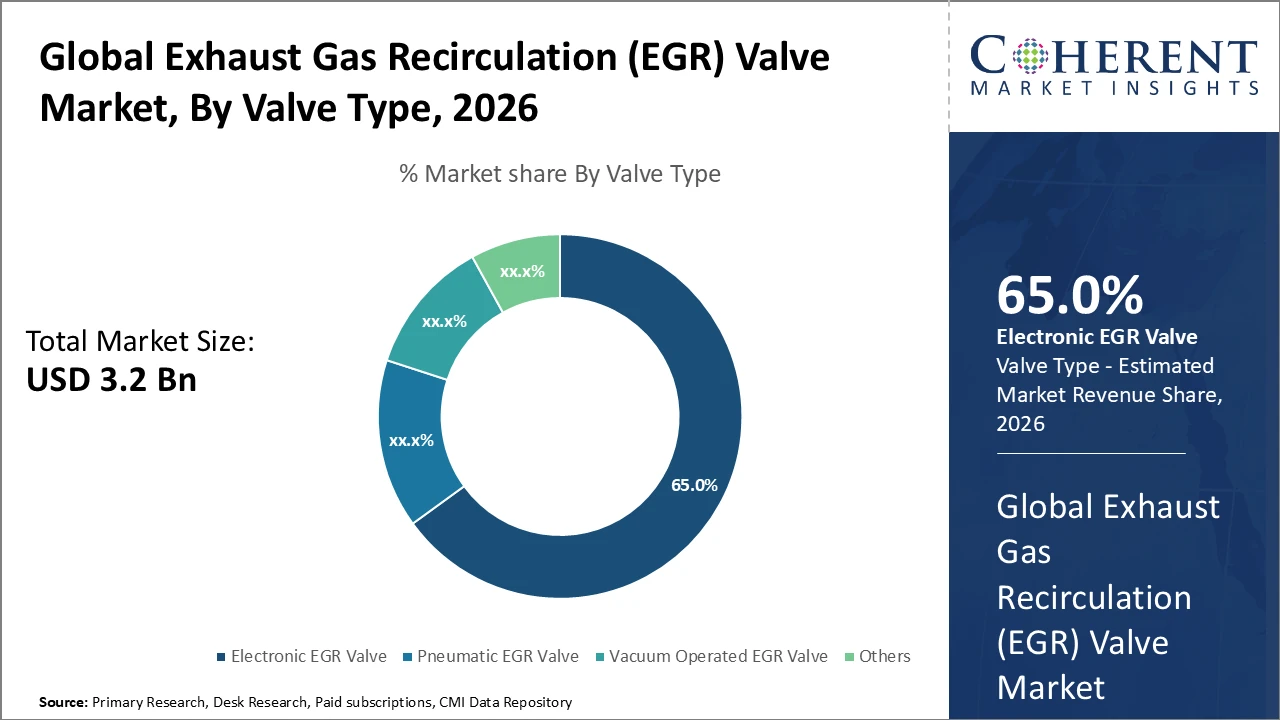
The Electronic EGR Valve segment dominates the market with a 65% share, driven by superior precision, efficiency, and compliance with modern emission standards.
Pneumatic and Vacuum-Operated EGR valves hold smaller but steady market shares, constrained by cost and limited application scope.
Passenger vehicles are the largest application segment, with growing adoption in both diesel and gasoline engines due to evolving emission regulations and demand for fuel efficiency.
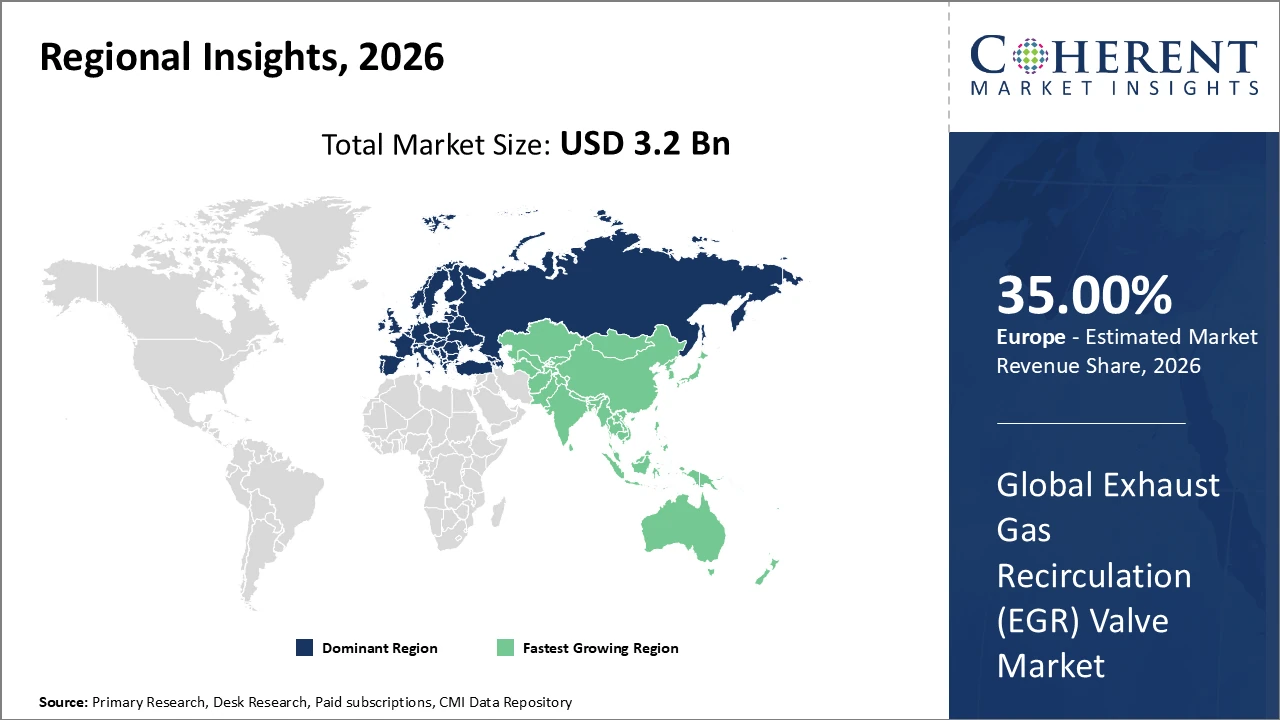
Europe leads in market revenue, capturing over 35% share, supported by stringent environmental policies and high adoption of advanced EGR technologies.
Asia Pacific shows the fastest CAGR, driven by rising automotive production and expanding regulations in India and China.
North America offers growth opportunities through its advanced automotive sector and retrofit market, bolstered by innovation-focused investments from leading EGR valve manufacturers.
Exhaust Gas Recirculation (EGR) Valve Market Segmentation Analysis
Exhaust Gas Recirculation (EGR) Valve Market Insights, By Valve Type
The Electronic EGR Valve segment dominates the market due to its precision control, which optimizes exhaust gas flow, reduces emissions, and improves fuel efficiency. Its leadership is driven by stringent regulatory requirements and automakers’ preference for electronically controlled components to meet emission standards. Advancements enhancing durability and reducing failure rates further support growth. Pneumatic EGR valves remain relevant for their simplicity and cost-effectiveness, mainly in older vehicles and price-sensitive markets. Vacuum-operated valves serve niche applications in light commercial vehicles and specific engine types.
Exhaust Gas Recirculation (EGR) Valve Market Insights, By Application
The Passenger Vehicles segment holds the largest market share, driven by strict personal vehicle emission regulations globally. Rapid adoption of electronic EGR valves in gasoline and diesel engines for mid- to high-end models supports fuel efficiency and regulatory compliance. Commercial Vehicles constitute another significant segment, fueled by growth in global freight and logistics, with heavy-duty trucks requiring robust EGR systems to meet NOx emission standards and fuel economy targets, particularly in the U.S. and Europe. Off-Highway Vehicles, including agricultural and construction machinery, show steady niche demand as emission norms expand to non-road mobile machinery.
Exhaust Gas Recirculation (EGR) Valve Market Insights, By Fuel Type
The Diesel Engine segment dominates the market due to widespread use in commercial and heavy-duty vehicles, where EGR valves effectively reduce NOx emissions and ensure compliance with environmental regulations. While diesel passenger vehicle adoption has declined in some regions, heavy-duty diesel applications remain strong. Gasoline engines are increasingly integrating EGR valves to enhance combustion efficiency and meet stricter fuel economy and emission standards in light-duty vehicles. The Hybrid Engine segment is the fastest-growing, driven by the shift toward electrification, requiring advanced EGR systems for optimal fuel savings and emission control under variable loads.
Exhaust Gas Recirculation (EGR) Valve Market Trends
The market is increasingly shifting toward electronic EGR valve technologies, with over 65% of new installations in 2026 being electronic valves, driven by stricter emission regulations and fuel efficiency mandates.
North America’s EPA Tier 3 standards, introduced in 2024, accelerated the replacement of pneumatic valves with electronic variants across light and heavy-duty vehicles.
EGR valve integration in hybrid and alternative fuel vehicles is expanding, particularly in Asia Pacific, where automakers in China and India incorporated advanced EGR systems in hybrid models launched in 2025.
Aftermarket retrofit solutions are growing globally, with North America seeing an 8% increase in retrofitted EGR valve sales in 2025, driven by aging fleets and tighter emission standards.
Exhaust Gas Recirculation (EGR) Valve Market Insights, By Geography
North America Exhaust Gas Recirculation (EGR) Valve Market Analysis and Trends
North America holds a significant share of 35% in the Exhaust Gas Recirculation (EGR) Valve market, driven by a mature automotive sector, stringent emission standards, and high consumer demand for fuel-efficient vehicles. The implementation of EPA Tier 3 and state-level emission regulations has accelerated the adoption of electronic EGR valves in light and heavy-duty vehicles. Retrofit and replacement markets are also expanding due to aging fleets and compliance requirements. Leading manufacturers, including BorgWarner and Denso, invest in innovation and advanced valve technologies to maintain market leadership. Additionally, strong R&D infrastructure and supportive government policies continue to drive growth and product development in the region.
Asia Pacific Exhaust Gas Recirculation (EGR) Valve Market Analysis and Trends
Asia Pacific is the fastest-growing region in the Exhaust Gas Recirculation (EGR) Valve market, with a CAGR exceeding 9%. This growth is driven by rapid expansion in vehicle production, particularly in China and India, coupled with government incentives promoting cleaner and more efficient technologies. Rising demand for both commercial and passenger vehicles that comply with increasingly stringent local emission standards further supports market expansion. Additionally, automakers in the region are increasingly integrating advanced electronic and cooled EGR valves into new models to meet fuel efficiency and environmental regulations, creating significant opportunities for both domestic manufacturers and international EGR valve suppliers.
Exhaust Gas Recirculation (EGR) Valve Market Outlook for Key Countries
USA Exhaust Gas Recirculation (EGR) Valve Market Analysis and Trends
The U.S. Exhaust Gas Recirculation (EGR) Valve market benefits from advanced automotive manufacturing and strong participation by major OEMs. Implementation of EPA Tier 3 standards drove the adoption of electronically controlled EGR valves in over 70% of new vehicle models by 2025. Leading companies such as BorgWarner and Continental AG increased R&D investments to develop high-efficiency, durable valve solutions tailored to U.S. emission regulations and fuel efficiency requirements. These efforts have strengthened their competitive positioning, expanded product portfolios, and enabled significant market revenue capture. The combination of regulatory compliance, technological innovation, and fleet modernization continues to support market growth.
Germany Exhaust Gas Recirculation (EGR) Valve Market Analysis and Trends
Germany is a key market in Europe for Exhaust Gas Recirculation (EGR) valves, driven by stringent EU emission standards and the country’s strong automotive manufacturing base. The adoption of advanced electronic and cooled EGR valves is widespread in both passenger and commercial vehicles to meet Euro 6 and upcoming Euro 7 regulations. German OEMs, including Bosch and Mahle, invest heavily in R&D to enhance valve efficiency, durability, and emission reduction capabilities. Additionally, the country’s focus on hybrid and alternative fuel vehicles is fostering EGR integration in new models. Robust supply chains and regulatory compliance continue to reinforce Germany’s leadership in the European market.
Analyst Opinion
Rising demand for advanced automotive emission control technologies is driving market growth; for example, U.S. EPA emission norms in 2024 led manufacturers to increase EGR valve deployments by nearly 15% year-over-year.
EGR valve manufacturers have expanded production capacity, with a leading company reporting a 20% output increase in 2025, contributing to a 12% rise in revenue and demonstrating industry responsiveness to growing demand.
Increased adoption of heavy-duty diesel engines in logistics and transportation boosted imports of high-performance EGR valves by over 10% in 2026, diversifying demand beyond passenger vehicles.
Technological enhancements, including electronically controlled EGR valves, improved fuel economy by up to 5% in 2025, positioning electronic valves as a growth driver in premium vehicle segments.
- Current Industry Events of 2026
- Market Size Estimation
- Regional Breakdown
- Competitive Landscape
- Customer Intelligence
- Segmental Analysis
- Pricing Analysis
- Key Market Drivers, Challenges & Future Trends
- Customized Insights Section
Market Scope
| Report Coverage | Details | ||
|---|---|---|---|
| Base Year: | 2025 | Market Size in 2026: | USD 3.2 billion |
| Historical Data for: | 2020 To 2024 | Forecast Period: | 2026 To 2033 |
| Forecast Period 2026 to 2033 CAGR: | 8.1% | 2033 Value Projection: | USD 5.7 billion |
| Geographies covered: |
| ||
| Segments covered: |
| ||
| Companies covered: | BorgWarner Inc., Cummins Inc., Denso Corporation, Valeo SA, Webasto SE, Mahle GmbH, Robert Bosch GmbH, Honeywell International Inc., Tenneco Inc., Delphi Technologies | ||
| Growth Drivers: |
| ||
Exhaust Gas Recirculation (EGR) Valve Market Growth Factors
The increasing stringency of emission standards worldwide continues to drive growth in the Exhaust Gas Recirculation (EGR) Valve market. Regulations such as Europe’s Euro 7 and North America’s EPA Tier 3, enforced since 2024, have prompted manufacturers to adopt advanced EGR valve systems. Rising production of diesel and gasoline vehicles equipped with modern EGR technology, particularly in emerging markets like India and Southeast Asia, contributed to a 7% increase in vehicle output in 2025. Technological innovations, including electronically actuated valves and variable geometry designs, have improved fuel economy, reduced maintenance, and enhanced adoption, as demonstrated by a pilot program in Japan achieving a 4% CO2 reduction in 2026. Additionally, expanding applications in off-highway and marine engines have broadened the market and bolstered revenue streams.
Exhaust Gas Recirculation (EGR) Valve Market Development
Starting in January 2026, the technology group Rheinmetall began producing exhaust gas recirculation (EGR) valves for a major automobile manufacturer, with the contract scheduled to run for six years through December 2031.
Key Players
Leading Companies of the Market
BorgWarner Inc.
Cummins Inc.
Denso Corporation
Robert Bosch GmbH
Valeo SA
Keihin Corporation
Tenneco Inc.
Honeywell International Inc.
Mahle GmbH
Delphi Technologies
Several market companies have reinforced their positions through strategic acquisitions and technology partnerships. For instance, BorgWarner’s acquisition of Delphi Technologies in 2025 strengthened its electronic powertrain portfolio, enabling integrated EGR valve solutions and expanding its market footprint across key regions. Similarly, Denso Corporation increased investment in R&D to enhance valve durability, resulting in a 10% reduction in maintenance costs for fleet operators in 2026. These initiatives not only improved operational efficiency and product performance but also strengthened customer loyalty, enhanced competitive positioning, and contributed to sustained revenue growth within the global EGR valve market.
Exhaust Gas Recirculation (EGR) Valve Market Future Outlook
The future of the Exhaust Gas Recirculation (EGR) Valve market is poised for sustained growth, driven by increasingly stringent global emission standards and rising demand for fuel-efficient vehicles. Technological advancements, including electronically controlled and variable geometry EGR valves, will continue to enhance performance, reduce emissions, and improve engine efficiency. The shift toward hybrid and alternative fuel vehicles will further accelerate adoption, particularly in Asia Pacific and emerging markets. Additionally, aftermarket retrofit opportunities and industrial applications in off-highway and marine engines will expand revenue streams. Companies investing in R&D, digital integration, and strategic collaborations are expected to secure long-term competitive advantages in the evolving market landscape.
Exhaust Gas Recirculation (EGR) Valve Market Historical Analysis
The Exhaust Gas Recirculation (EGR) Valve market has experienced steady growth over the past decade, primarily driven by tightening emission regulations and rising environmental awareness. Early adoption focused on pneumatic and vacuum-operated valves, mainly in diesel engines, to reduce NOx emissions in commercial and passenger vehicles. The transition to electronic EGR valves began around 2018, offering improved precision, durability, and fuel efficiency. Europe and North America led early growth due to strict emission standards, while Asia Pacific emerged as a significant market with increasing automotive production. Historical trends highlight technology evolution, regulatory influence, and growing demand for cleaner, more efficient engines globally.
Sources
Primary Research Interviews:
Automotive engineers, powertrain designers, and emission control specialists in passenger and commercial vehicle sectors
Plant managers, R&D managers, and quality assurance professionals focusing on EGR valve production and testing
Researchers and technology experts in engine efficiency, emission reduction technologies, and hybrid vehicle integration
Magazines:
Automotive Engineering – Innovations in EGR Systems and Engine Technologies
Engine Technology International – Emission Control Solutions and EGR Developments
Motor Trend – Automotive Powertrain Trends and Vehicle Efficiency Updates
SAE International News – Advanced Engine Technologies and Regulatory Compliance
Journals:
SAE International Journal of Engines – EGR Design, Performance, and Emission Studies
International Journal of Automotive Technology – Engine Efficiency and EGR Valve Research
Journal of Vehicle Engineering & Technology – EGR Valve Adoption and Performance Analysis
Newspapers:
The Wall Street Journal – Automotive Industry Developments and Emission Regulation Impacts
Financial Times – Vehicle Manufacturing, Regulatory Updates, and Market Trends
Automotive News – EGR Valve Market Updates, Innovations, and Competitive Insights
TechCrunch – Emerging Automotive Technologies and Emission Control Innovations
Associations:
Society of Automotive Engineers (SAE) – Standards, Guidelines, and Research on Engine and EGR Technologies
European Automobile Manufacturers Association (ACEA) – Emission Regulations, Compliance, and Automotive Innovation
International Organization for Standardization (ISO) – Safety Standards and Certification for Engine Components
Get access to 250+ pages report
Every segment, forecast, competitor profile and data table behind the analysis above — available for instant download.
- ESOMAR Member
- ISO 9001:2015 Certified
- D-U-N-S Registered
- GDPR & CCPA Compliant
Missing comfort of reading report in your local language? Find your preferred language:
Transform your Strategy with Exclusive Trending Reports
Frequently Asked Questions
Leading companies include BorgWarner Inc., Cummins Inc., Denso Corporation, and Robert Bosch GmbH, known for their strong production capabilities, continuous technological innovation, and strategic global partnerships.
The market is expected to grow from USD 3.2 billion in 2026 to around USD 5.7 billion by 2033, driven by rising emission regulations and expanding automotive production worldwide.
Passenger vehicles represent the largest demand segment due to stringent emission standards, followed by commercial vehicles and off-highway engines increasingly adopting EGR solutions.
Trends include rapid adoption of electronic EGR valves, growth in hybrid and alternative fuel vehicle applications, and increased retrofit activity to meet stricter emission norms.
The market is competitive, with companies emphasizing innovation and alliances; challenges include raw material price volatility, technological complexity, and adapting valves to evolving engine platforms.
Companies focus on expanding production facilities, investing in R&D for next-generation EGR valves, pursuing mergers and acquisitions, and targeting emerging markets with region-specific product offerings.