

Outboard Engines Market Size and Forecast — 2026-2033
The Global Outboard Engines Market size is estimated to be valued at USD 5.58 billion in 2026 and is expected to reach USD 9.21 billion by 2033, exhibiting a compound annual growth rate (CAGR) of 7.4% from 2026 to 2033. This steady market expansion is buoyed by evolving consumer preferences and increasing availability of advanced engine variants across emerging economies.
Overview
Outboard engines are self-contained propulsion systems mounted externally on the stern of boats, combining the engine, gearbox, and propeller in a single unit. They are widely used for powering small to medium-sized watercraft such as fishing boats, speedboats, and leisure vessels. Outboard engines are valued for their portability, ease of installation, and simple maintenance, allowing users to tilt or remove them when not in use.
These engines are available in different power ranges and fuel types, including two-stroke and four-stroke gasoline engines, with electric outboards emerging as eco-friendly alternatives. Modern outboard engines feature advanced fuel injection systems, electronic controls, and noise-reduction technologies to improve fuel efficiency, performance, and operator comfort.
Key Takeaways
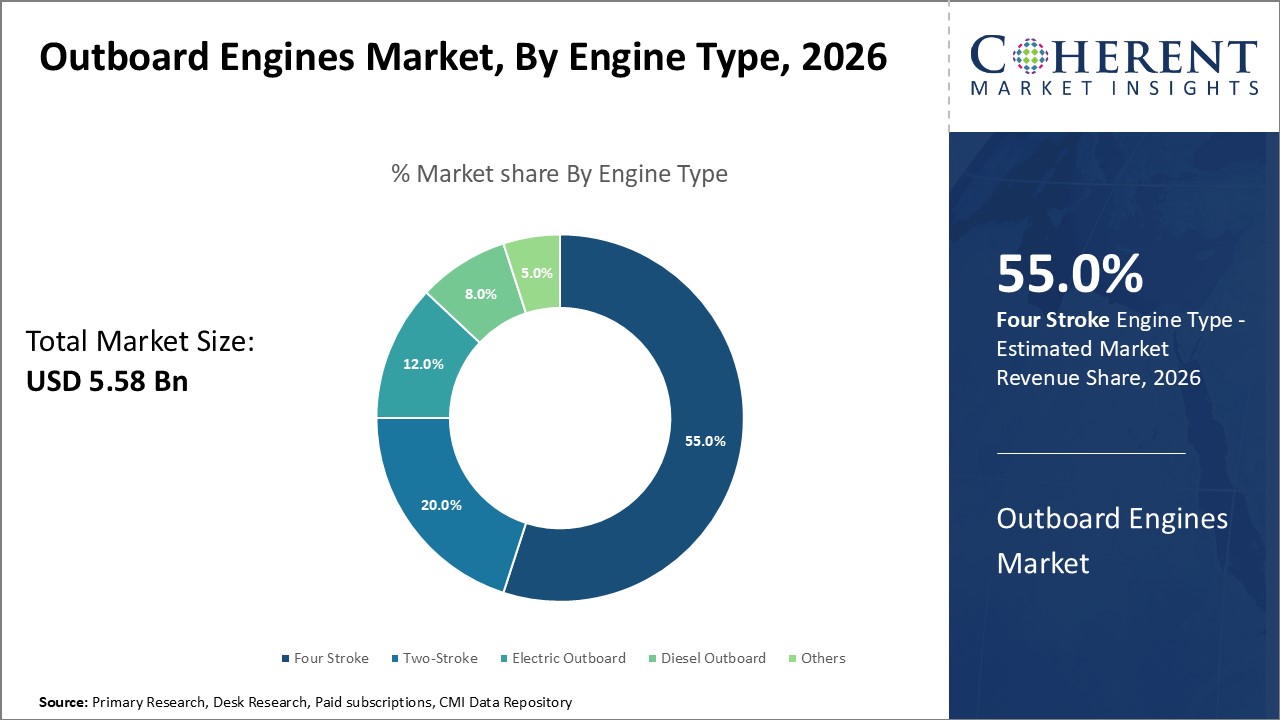
Four-stroke engines dominate the market with over 55% share, driven by superior fuel efficiency and compliance with environmental standards.
The recreational application segment is a major growth contributor, capitalizing on increasing global boating leisure activities and favorable economic conditions.
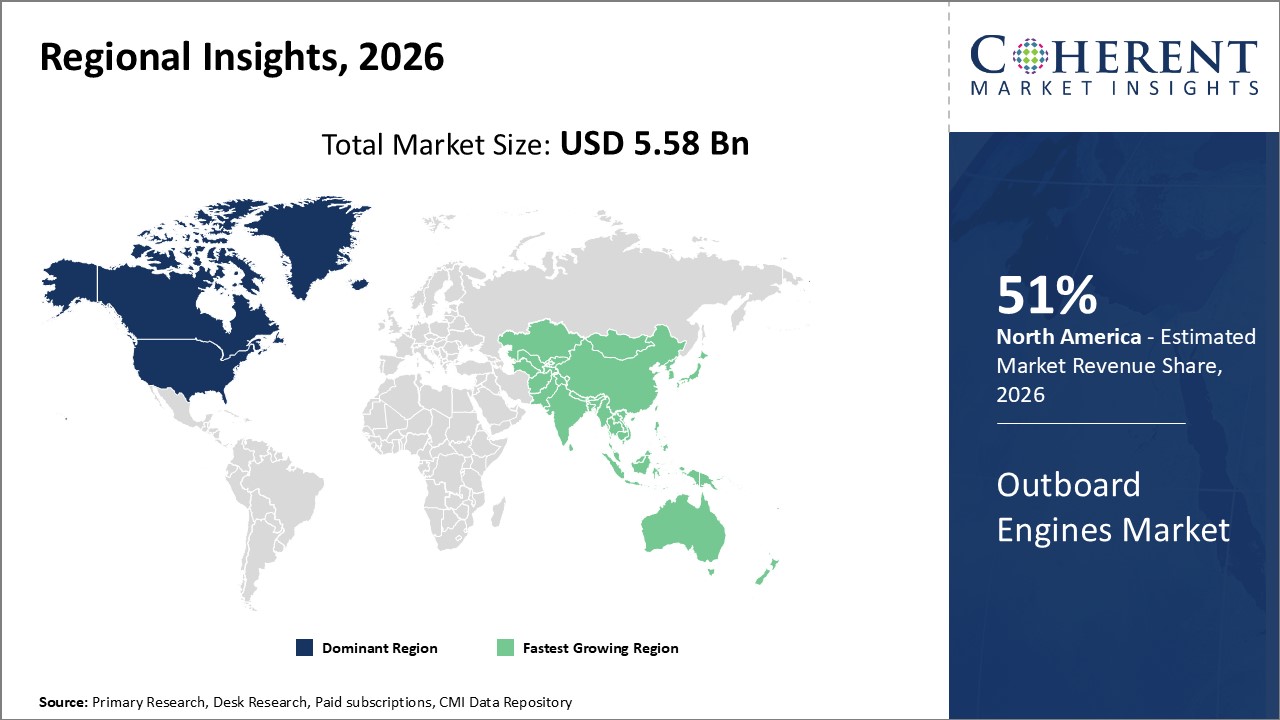
North America holds the largest market share at 51% in the market, backed by an established marine industry and active boating community, followed closely by Asia Pacific showing rapid CAGR due to expanding maritime infrastructure.
The Asia Pacific region presents significant growth opportunities, especially in countries like India and China, supported by government initiatives promoting water transport and fishing industry modernization.
Outboard Engines Market Segmentation Analysis
Outboard Engines Market Insights, By Engine Type
Four-stroke engines continue to dominate due to their superior fuel efficiency, reduced emissions, and durability. They account for over 55% of the market share, being the preferred choice among recreational and commercial vessel operators globally. The increasing regulatory restrictions on emissions particularly fuel the dominance of four-stroke engines, as reflected in the U.S. market, where their adoption surpassed 60% in 2025.
Outboard Engines Market Insights, By Horsepower
The <50 HP segment dominates the market share due to its extensive use in recreational boats and small commercial crafts. The <50 HP segment’s prominence is explained by its balance of power and portability, ideal for small fishing vessels, leisure crafts, and personal watercraft. This segment accounted for over 45% of the market share in 2025, driven by demand for lightweight, fuel-efficient engines. Meanwhile, the 50-150 HP segment is the fastest-growing subsegment, favored in larger recreational vessels and commercial crafts requiring more power and reliability.
Outboard Engines Market Insights, By Application
Recreational applications constitute the largest market share, exceeding 60%, powered by growing consumer interest in water sports, leisure boating, and fishing activities. Economic growth and increased disposable incomes in developed and emerging markets are significant contributing factors. Commercial applications represent the fastest-growing subsegment, reflecting demand from fishing fleets, passenger boats, and small cargo crafts undergoing fleet modernization.
Outboard Engines Market Trends
Recent Trends include a shift towards sustainable power sources, with electric and hybrid engines gaining traction in the last two years.
For example, a 2025 survey of Europe-based marine fleets indicated that electric outboard engine adoption doubled compared to 2022, driven by stringent emission regulations and subsidies.
Simultaneously, digital connectivity is emerging as a key trend with smart outboard engines offering remote diagnostics and enhanced safety features, gaining market interest.
Moreover, the trend towards lightweight composite materials in engine manufacturing is facilitating portability while enhancing durability, thereby appealing to recreational users.
The competitive landscape is also evolving with mergers and strategic alliances accelerating technology exchange, leading to faster innovations that influence market dynamics and fuel robust growth through 2033.
Outboard Engines Market Insights, By Geography
North America Outboard Engines Market Analysis and Trends
In North America, dominance in the market stems from a well-established recreational and commercial boating ecosystem. The U.S. Coast Guard's registry recorded over 12 million recreational boats in 2025, fueling steady demand for outboard engines. Strong regulatory frameworks promoting emission reductions have catalyzed adoption of four-stroke and electric engines, with companies such as Yamaha and Mercury Marine leading innovation. The robust marine accessories market and extensive distribution networks further reinforce North America’s industry share.
Asia Pacific Outboard Engines Market Analysis and Trends
Asia Pacific exhibits the fastest growth, driven by burgeoning maritime commerce and the modernization of traditional fishing fleets, particularly in India and China. Government initiatives supporting cleaner marine propulsion and infrastructure projects like port expansions stimulate regional market revenue. The expanding middle-class consumer base in Southeast Asia also fuels recreational boating, intensifying demand for efficient and affordable outboard engines.
Outboard Engines Market Outlook for Key Countries
USA Outboard Engines Market Analysis and Trends
The USA's outboard engines market benefits from a large existing fleet and thriving recreational boating culture, with annual registrations increasing by 5% in 2025 compared to 2023. Leading companies, including Mercury Marine and Honda, have heavily invested in electric engine R&D within the country, fostering technological advancements and boosting export potential. The U.S. government’s strict emission standards have accelerated the phase-out of two-stroke engines, making room for cleaner four-stroke and hybrid models. This regulatory environment, combined with strong consumer demand, makes the U.S. a pivotal market propelling overall industry growth.
India Outboard Engines Market Analysis and Trends
India's outboard engines market is witnessing exponential growth, aided by governmental incentives promoting technological upgrades in fishing vessels, a sector employing over 14 million people as per 2023 data. Domestic manufacturers are increasingly partnering with international firms to introduce efficient and affordable engines tailored to regional needs. Additionally, rising private boating and water sports activities among India’s urban elite have diversified demand.
Analyst Opinion
Production capacity of outboard engines has surged substantially to meet the growing demand from both commercial shipping and recreational boating sectors. For instance, recent data from the U.S. Coast Guard noted a 16% increase in registered motorboats equipped with outboard engines between 2023 and 2025, highlighting the sector’s expanding production footprint.
Pricing trends indicate a moderate increase driven by raw material costs and integration of clean energy technologies in outboard engines. In 2025, manufacturers reported an average price uptick of 5.5%, reflecting the incorporation of electric and hybrid systems that command premium pricing yet offer long-term fuel savings.
Imports of outboard engines have seen a notable rise in the Asia Pacific, particularly in India and Southeast Asia, where the marine transport and fishing industries are growing rapidly. Import volumes increased by 12% in 2025 compared to the previous year, emphasizing the demand-side momentum in developing markets.
- Current Industry Events of 2026
- Market Size Estimation
- Regional Breakdown
- Competitive Landscape
- Customer Intelligence
- Segmental Analysis
- Pricing Analysis
- Key Market Drivers, Challenges & Future Trends
- Customized Insights Section
Market Scope
| Report Coverage | Details | ||
|---|---|---|---|
| Base Year: | 2025 | Market Size in 2026: | USD 5.58 billion |
| Historical Data for: | 2020 To 2024 | Forecast Period: | 2026 To 2033 |
| Forecast Period 2026 to 2033 CAGR: | 7.4% | 2033 Value Projection: | USD 9.21 billion |
| Geographies covered: |
| ||
| Segments covered: |
| ||
| Companies covered: | Yamaha Motor Co., Ltd.; Mercury Marine; Honda Motor Co., Ltd.; BRP Inc.; Suzuki Motor Corporation; Tohatsu Corporation; Evinrude Outboard Motors; Parsun Motors; Hidea; Selva Marine; Mariner Engines. | ||
| Growth Drivers: |
| ||
Outboard Engines Market Growth Factors
The market growth is primarily driven by the increased adoption of eco-friendly outboard engines, responding directly to global regulatory pressures, reducing carbon footprints in marine transportation. In 2025 alone, new emission norms in the U.S. and Europe led to a 20% rise in hybrid and electric engine sales. Additionally, expanding recreational boating activities supported by rising disposable incomes in emerging economies like India and Brazil contribute significantly to market revenue.
Another vital growth factor is the continuous advancements in engine efficiency and power-to-weight ratios, which reduce fuel consumption and operating costs, appealing to commercial fleet operators. Furthermore, expanding exports of outboard engines to Southeast Asia and Latin America are pushing market revenue by nearly 15% annually, fueled by growing maritime transportation infrastructure investment in these regions.
Outboard Engines Market Development
In April 2026, Yamaha introduced the H2 hydrogen outboard concept, built on its XTO Offshore platform, representing its first hydrogen-powered outboard for recreational applications. This move reflects Yamaha’s strategies toward low-emission propulsion and eco-friendly boating options.
In July 2026, Mercury released new 25-hp and 30-hp FourStroke outboard engines, as well as a 25-hp SeaPro™ model aimed at commercial use. The lineup also features the first-ever 25-hp ProKicker™ outboard, designed for precision trolling control in both freshwater and saltwater environments.
Key Players
Ltd., Mercury Marine
Honda Motor Co.
Ltd., BRP Inc.
Suzuki Motor Corporation
Tohatsu Corporation
Evinrude Outboard Motors.
Parsun Motors
Hidea
Selva Marine
Mariner Engines.
Competitive strategies are notably focused on product innovation and sustainable technology adoption. For example, Yamaha launched a new series of eco-friendly four-stroke outboard engines in 2025, resulting in a 8% increase in their market share in North America within six months post-launch. Similarly, Mercury Marine's strategic partnership with battery technology firms has accelerated their electric outboard engine development, expanding their presence in Europe and Asia Pacific by 11% year-over-year.
Outboard Engines Market Future Outlook
The future of the outboard engines industry is increasingly tied to sustainability, electrification, and digital integration. Hybrid and electric propulsion systems are expected to see stronger adoption as emission standards tighten and customers seek eco-friendly alternatives. Integration with GPS systems, smart sensors, and IoT-enabled monitoring platforms will enhance performance and user experience. Coastal tourism, marine leisure activities, and demand from developing economies are likely to support growth, while stricter global environmental policies will push manufacturers to innovate further in clean energy technologies.
Outboard Engines Market Historical Analysis
The Outboard Engines Industry has historically developed alongside the global boating and marine recreation industries. Early outboard engines were heavy, difficult to maintain, and limited in performance, but technological advances through the 20th century improved power output, fuel efficiency, and durability. Two-stroke engines were the dominant design for decades, although their environmental drawbacks prompted a transition toward cleaner four-stroke alternatives. The 2000s saw regulatory changes, especially in North America and Europe, that accelerated the adoption of lower-emission, fuel-efficient models. More recently, manufacturers have explored hybridization and electrification, reflecting both consumer interest and regulatory mandates.
Sources
Databases:
International Council of Marine Industry Associations (ICOMIA) Database
U.S. National Marine Manufacturers Association (NMMA) Reports
European Boating Industry (EBI) Database
Magazines:
Boating Magazine
Motor Boat & Yachting
Trade Only Today
Marine Industry News
Journals:
Journal of Marine Science and Engineering
International Journal of Naval Architecture and Ocean Engineering
Marine Technology Society Journal
Newspapers:
The Guardian (Transport & Marine Section)
The Japan Times (Marine Industry News)
The Economic Times (Automotive & Marine)
Associations:
International Council of Marine Industry Associations (ICOMIA)
National Marine Manufacturers Association (NMMA)
European Boating Industry (EBI)
American Boat and Yacht Council (ABYC)
Get access to 250+ pages report
Every segment, forecast, competitor profile and data table behind the analysis above — available for instant download.
- ESOMAR Member
- ISO 9001:2015 Certified
- D-U-N-S Registered
- GDPR & CCPA Compliant
Missing comfort of reading report in your local language? Find your preferred language:
Transform your Strategy with Exclusive Trending Reports
Frequently Asked Questions
Dominant players include Yamaha Motor Co., Ltd.; Mercury Marine; Honda Motor Co., Ltd.; BRP Inc.; Suzuki Motor Corporation; Tohatsu Corporation; Evinrude Outboard Motors; Parsun Motors; Hidea; Selva Marine; Mariner Engines, known for their innovative product offerings and strategic expansions worldwide.
The market size is expected to grow from USD 5.58 billion in 2026 to USD 9.21 billion by 2033, reflecting a CAGR of 7.4%, driven by rising demand for eco-friendly engines and expanding marine application sectors.
The recreational boating sector shows the largest growth opportunity due to increased consumer spending on leisure activities and favorable regulations supporting boating infrastructure development.
Market trends indicate a pivot towards electric and hybrid power technologies, increased digital integration, and lightweight materials, reshaping market dynamics with sustainability at the forefront.
The competitive landscape is highly dynamic, focusing on technology innovation and sustainability, while challenges include rising raw material prices and stringent emission norms impacting production costs.
Companies are emphasizing product diversification, strategic partnerships for technology development, and regional expansion to capitalize on emerging markets with customization and after-sales services.