

Hydrogen Trucks Market Size and Forecast – 2026 to 2033
The global hydrogen trucks market is estimated to be valued at USD 10.30 Bn in 2026 and is expected to reach USD 131.64 Bn by 2033, exhibiting a compound annual growth rate (CAGR) of 43.9% from 2026 to 2033.
Key Takeaways
- Based on Product Type, the Fuel Cell Electric Trucks segment lead the market holding an estimated share of 65.8% in 2026, owing to various advantages offered by the technology over conventional powertrains in long-haul trucking applications.
- Based on Tonnage, the Heavy-Duty Hydrogen Trucks (> 16 Tons) segment is expected to capture 47.7% share in 2026, owing to their widespread usage in long-haul transportation.
- Based on Application, the Long-Haul Transportation segment is expected to hold 49.6% share of the market in 2026, as hydrogen fuel addresses key challenges faced by freight operators.
- Based on Region, North America is estimated to lead the market with a share of 37.2% n 2026. While, Europe is projected to be the fastest growing region.
Market Overview
Stricter emission norms and growing emphasis on developing zero-emission logistics are fueling the hydrogen trucks market demand. Many commercial vehicle manufacturers have started developing hydrogen fuel cell electric trucks and several pilot projects have been initiated globally to test the viability of these trucks for heavy-duty transportation.
Falling battery prices and improving charging infrastructure are making electric trucks a strong alternative. However, hydrogen trucks have greater range capabilities, making them more suitable for long-haul applications. Continuous technological advancements are expected to make hydrogen trucks cost-competitive with diesel trucks, attracting more commercial fleet owners in the coming years.
Current Events and Its Impact
Current Event | Description and its Impact |
Regulatory Uncertainty and Policy Reversals in North America |
|
Industry Consolidation and Manufacturing Crisis |
|
Pricing Analysis
Fuel Cell Advancements
Hydrogen trucks are significantly more expensive than conventional diesel trucks today. For example, India’s Eicher Pro 3015 Hydrogen Fuel Cell 6‑wheeler (17,500 kg GVW) is priced between ₹21.25‑26.20 lakh ex-showroom.
In the U.S. and global heavy‑duty market, fuel cell trucks can cost US$ 400,000‑500,000 for a Class‑8 model compared to $180,000‑200,000 for an equivalent diesel truck.
- Current Industry Events of 2026
- Market Size Estimation
- Regional Breakdown
- Competitive Landscape
- Customer Intelligence
- Segmental Analysis
- Pricing Analysis
- Key Market Drivers, Challenges & Future Trends
- Customized Insights Section
Segmental Insights
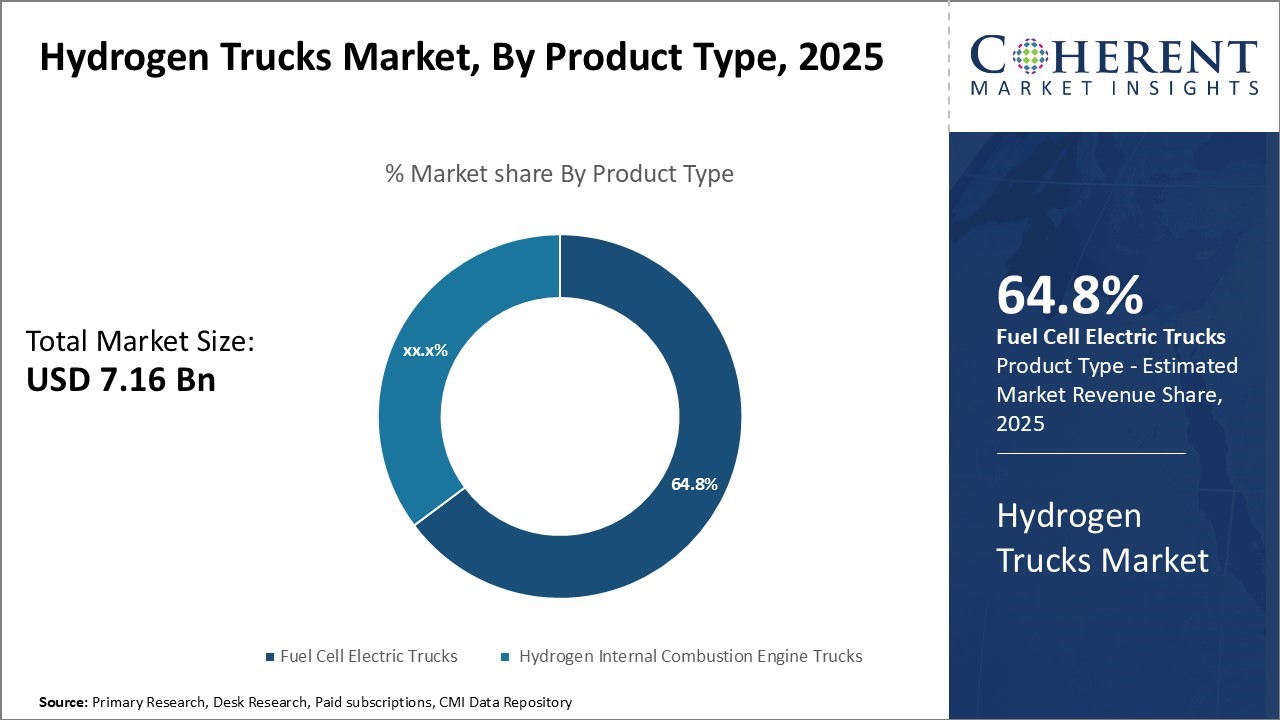
Hydrogen Trucks Market Insights, By Product Type - Fuel Cell Electric Trucks is Dominating Owing to Its Advantages Over Conventional Powertrains in Long-Haul Trucking
In terms of product type, the fuel cell electric trucks segment is expected to contribute 65.8% share of the market in 2026 owing to various advantages offered by the technology over conventional powertrains in long-haul trucking applications. Fuel cell electric trucks provide zero local emissions, high fuel efficiency, and long range due to their ability to refuel quickly comparable to conventional trucks. The technology allows trucking fleets to transition to clean mobility and lower their carbon footprint in line with sustainability goals without compromising on operations. Growing concerns regarding air pollution and carbon emissions from diesel trucks are driving regulations to incentivize adoption of zero-emission fuel cell vehicles. Also, technological advancements are steadily enhancing the efficiency and reliability of fuel cells while lowering costs. This growing appeal of fuel cell trucks to meet environmental and economic imperatives is propelling the segment's lead in market share.
For instance, in May 2025, the Adani Group deployed India’s first hydrogen-powered truck for mining logistics, marking a shift from diesel trucks to cleaner fuel. Designed with three hydrogen tanks, the fuel-cell vehicle transports 40 tonnes of cargo over 200 km. The launch took place at Gare Pelma III Block in Chhattisgarh, transporting coal to a nearby power plant.
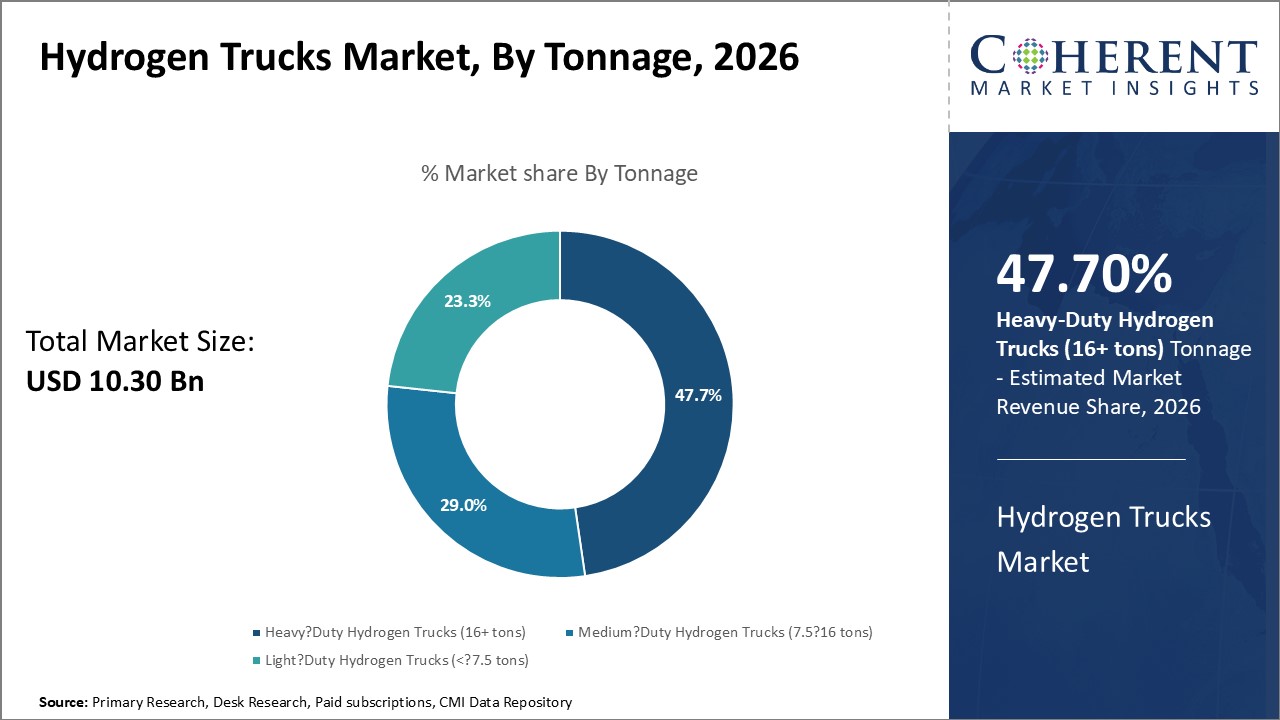
Hydrogen Trucks Market Insights, By Tonnage - Heavy-Duty Hydrogen Trucks (> 16 Tons) Propel Growth Due to Their Extensive Use in Long-Haul Transportation
In terms of tonnage, heavy-duty hydrogen trucks (> 16 tons) segment is expected to contribute 47.7% share of the market in 2026 owing to their widespread usage in long-haul transportation. Heavy-duty trucks above 16 tons are primarily used for transporting freight over long distances across regional and national boundaries. These operations require high energy density to cover hundreds of kilometers on a single refuel with heavy payloads. Hydrogen fuel cells easily meet this need while emission-free operation allows compliance with stringent emission norms. However, limited refueling infrastructure remains a hurdle for modal shift to hydrogen especially in cross-border routes. Concerted efforts by governments as well as industry collaboration to develop hydrogen corridors with sufficient refueling stations are expected to further accelerate the segment's growth.
For instance, in March 2025, Union Ministers Nitin Gadkari and Pralhad Joshi flagged off India’s first-ever trials of hydrogen-powered heavy-duty trucks, developed by Tata Motors, in New Delhi. The 24-month pilot will deploy 16 trucks featuring Hydrogen Internal Combustion Engine (H2-ICE) and Fuel Cell (H2-FCEV) technologies on major freight routes including Mumbai, Pune, Delhi-NCR and Surat.
Hydrogen Trucks Market Insights, By Application - Long-Haul Transportation Dominates as Hydrogen Enables Faster Refueling and Longer Range, Making It Better Suited for Intercity Freight Than Battery-Electric Trucks
In terms of application, long-haul transportation is expected to contribute 49.6% share of the market in 2026. The long-haul transportation dominates the hydrogen trucks market as hydrogen fuel addresses key challenges faced by freight operators. Unlike battery-electric alternatives that require long charging times and offer limited range, hydrogen trucks provide quick refueling and extended mileage. This makes them highly efficient for intercity and cross-border logistics, aligning with global decarbonization goals for heavy-duty freight movement.
For instance, in April 2025, Hyundai Motor Company and Plus introduced a concept for autonomous hydrogen fuel cell trucks designed for long-haul transportation. These trucks aim to offer zero tailpipe emissions, fast refueling, extended driving range, quieter operation, and reduced driver fatigue. The collaboration underscores Hyundai's commitment to advancing sustainable and intelligent mobility solutions in the logistics sector.
Regional Insights
Hydrogen Trucks Market Analysis & Trends
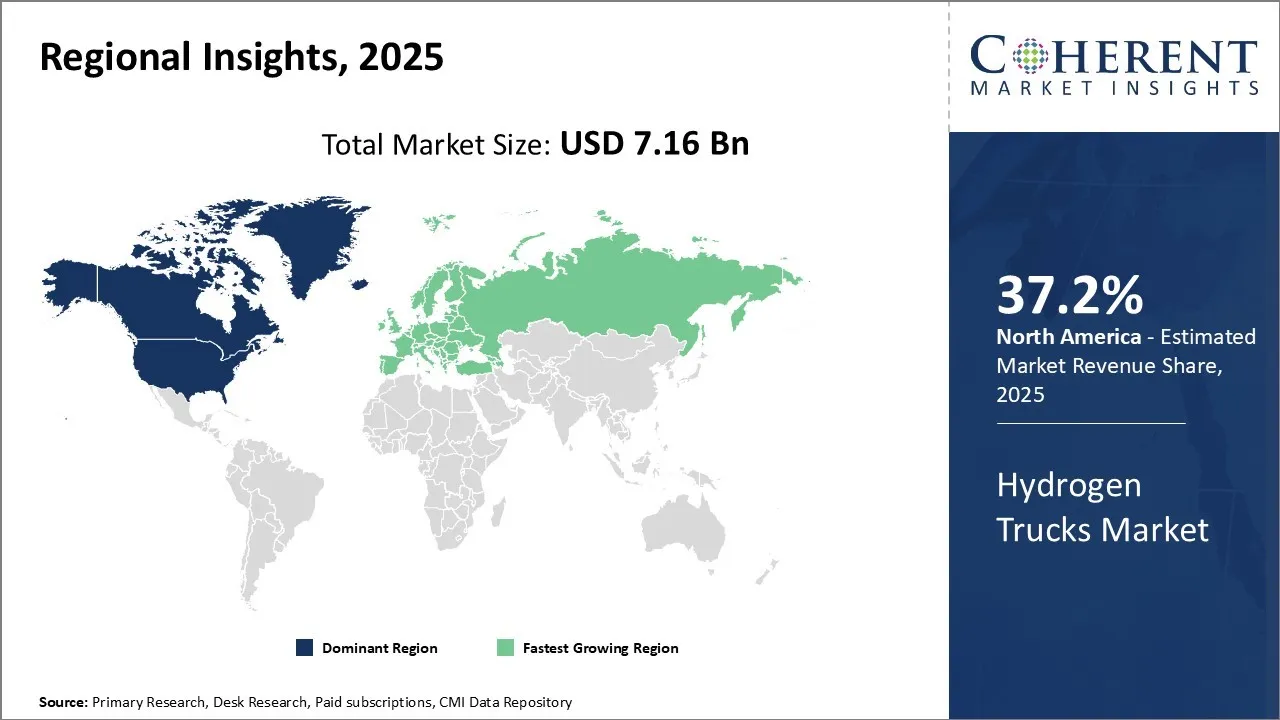
North America is expected to dominate the global hydrogen trucks market. The region is expected to account for 37.2% of the market share in 2026. The region is home to several leading truck original equipment manufacturers (OEMs) such as Freightliner, Kenworth, Peterbilt, and International that are actively investing in developing hydrogen fuel cell trucks. These trucks are well-suited for medium- and heavy-duty freight applications that require long ranges. California has played a pioneering role by offering substantial subsidies and setting stringent zero-emission vehicle mandates that make hydrogen trucks commercially viable in the state. Its ports and logistics infrastructure make it an ideal testing ground for fuel-cell trucks to replace diesel-powered vehicles.
For instance, in July 2026, Australian clean energy firm Pure Hydrogen bolstered its North American footprint by selling its first hydrogen-powered refuse truck in the U.S. The vehicle was delivered to Riverview International, a waste management company in California. This move aligns with the company's strategy to expand its presence in the growing hydrogen vehicle market revenue in North America.
Europe Hydrogen Trucks Market Analysis & Trends
Europe has emerged as the fastest-growing regional market for hydrogen trucks over the past few years. Supportive policies by countries like Germany and Sweden coupled with the presence of leading hydrogen systems suppliers have accelerated deployments. Leading trucking companies active across the European Union are trialing fuel-cell electric trucks to gain more insights. Major ports in Rotterdam and Hamburg have initiated pilot projects involving fuel-cell yard tractors and cargo container handling equipment. The extensive natural gas pipeline network in Europe provides an advantage to build out the hydrogen refueling infrastructure. Trucking operators are also incentivized to shift to zero-tailpipe emission vehicles by the proposed Euro 7 emission norms. All these factors indicate that Europe will be an important battleground for hydrogen trucks going forward.
For instance, in June 2026, Toyota Motor Europe commenced operations of five hydrogen fuel cell-powered trucks in its logistics network. These 40-tonne vehicles, developed in collaboration with Dutch manufacturer VDL Groep, are deployed on key routes in Belgium, France, Germany, and the Netherlands. Each truck offers a range of up to 400 km per refueling, contributing to Toyota's commitment to achieving carbon neutrality in its European logistics operations by 2040.
Hydrogen Trucks Market Outlook Country-Wise
The U.S. Hydrogen Trucks Market Trends
The U.S. is prioritizing zero-emission freight corridors, with major investments in hydrogen refueling infrastructure along key highways. Leading truck manufacturers are conducting pilot programs to test hydrogen fuel cell electric trucks for long-haul operations. This focus on clean energy logistics, combined with supportive policies, drives growing interest and adoption of hydrogen trucks across the country.
For instance, in December 2024, a hydrogen-powered heavy-duty truck, the H2Rescue, achieved a Guinness World Record by traveling 1,806 miles on a single fill of hydrogen fuel. Developed by Accelera, a subsidiary of Cummins, with support from the U.S. Department of Energy, the truck emitted zero carbon dioxide during its journey. This milestone underscores the potential of hydrogen fuel cell technology in reducing emissions and advancing clean transportation.
Germany Hydrogen Trucks Market Trends
The German government is aggressively promoting hydrogen fuel cell technology through subsidies, tax incentives, and funding for research and development. Strict emission regulations for commercial vehicles push logistics companies to adopt cleaner alternatives. Hydrogen-powered trucks are increasingly being integrated into public transport fleets and freight operations, positioning Germany as a key adopter in Europe’s push for zero-emission transportation.
For instance, in March 2026, EDEKA Nord introduced its first two green hydrogen-powered trucks, marking a significant advancement in sustainable logistics. The Hyundai XCIENT Fuel Cell trucks are now operational, delivering goods to stores across northern Germany. This initiative is part of EDEKA Nord's broader strategy to reduce CO₂ emissions and promote eco-friendly transportation solutions.
Market Report Scope
Hydrogen Trucks Market Report Coverage
| Report Coverage | Details | ||
|---|---|---|---|
| Base Year: | 2025 | Market Size in 2026: | USD 10.30 Bn |
| Historical Data for: | 2020 To 2024 | Forecast Period: | 2026 To 2033 |
| Forecast Period 2026 to 2033 CAGR: | 43.9% | 2033 Value Projection: | USD 131.64 Bn |
| Geographies covered: |
| ||
| Segments covered: |
| ||
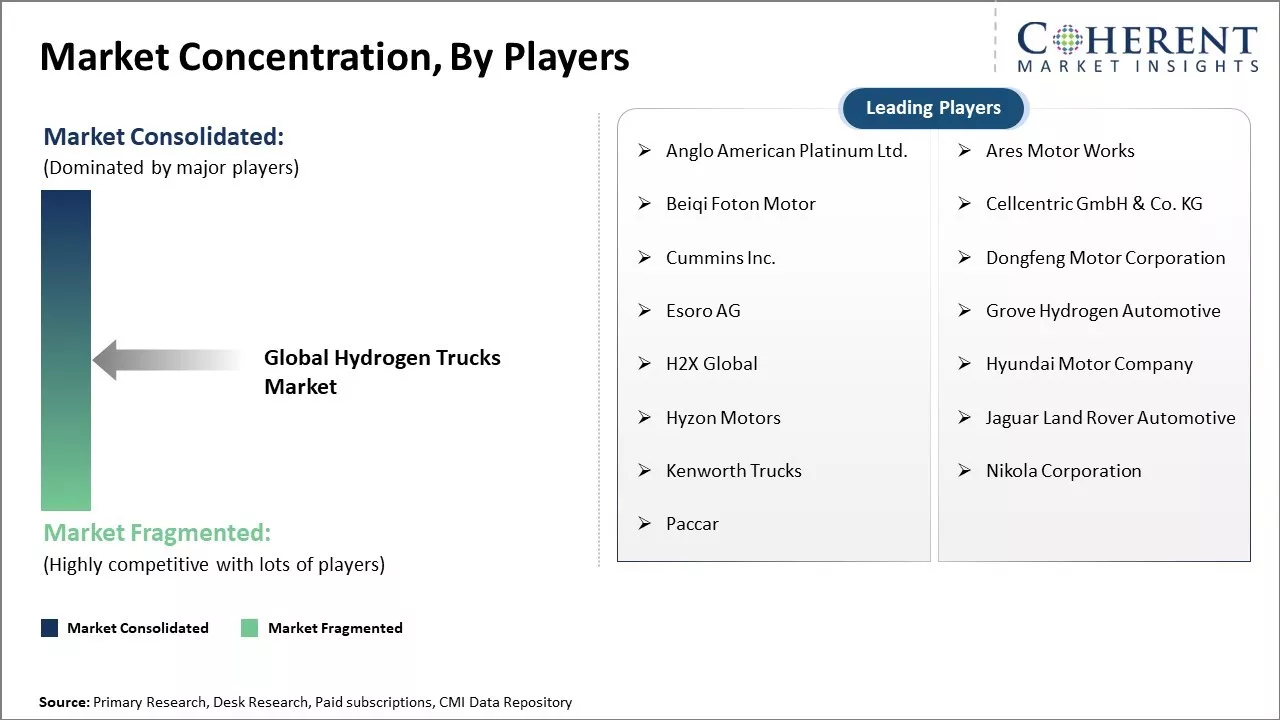
| Companies covered: | Anglo American Platinum Ltd., Ares Motor Works, Beiqi Foton Motor, Cellcentric GmbH & Co. KG, Cummins Inc., Dongfeng Motor Corporation, Esoro AG, Grove Hydrogen Automotive, H2X Global, Hyundai Motor Company, Hyzon Motors, Jaguar Land Rover Automotive, Kenworth Trucks, Nikola Corporation, and Paccar | ||
| Growth Drivers: |
| ||
| Restraints & Challenges: |
| ||
Hydrogen Trucks Market Driver
Rising Concerns Over Environmental Impacts of Transportation
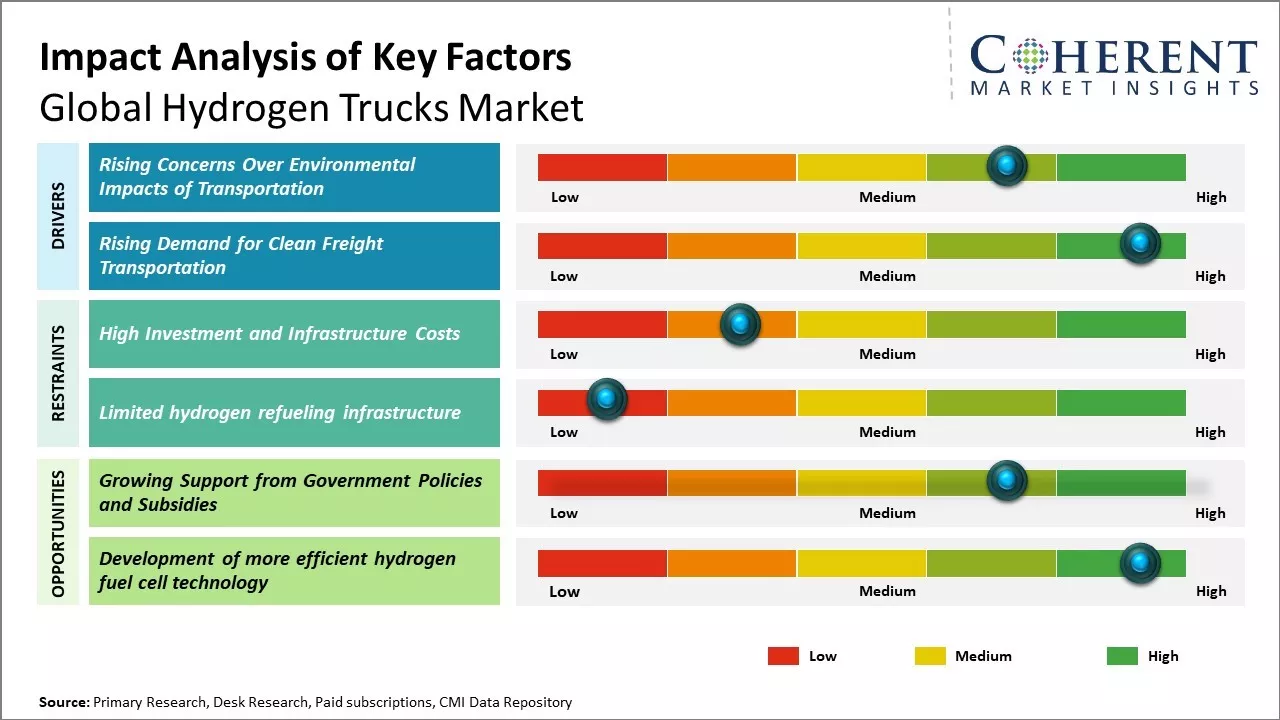
With rising concerns over climate change and reduction in greenhouse gas emissions globally, hydrogen fuel cell technology is gaining significant attention as one of the promising alternative for commercial vehicles. Heavy duty trucks and buses are known to contribute significantly to air pollution and carbon emissions due to their high fuel consumption. While battery powered electric trucks are still facing challenges over range anxiety and longer recharge times, fuel cell truck offers a viable zero emission solution. The fact that hydrogen can be produced from renewable resources like solar and wind makes it appealing for sustainable transportation. Many countries and regional governments have drafted ambitious plans to promote the use of fuel cell trucks as part of their strategies to reduce carbon footprint of freight transportation sector. Major truck manufacturers are actively working to launch fuel cell models in next few years recognizing future potential of this technology. With growing regulations on emission norms, hydrogen trucks are expected to gain more traction compared to diesel variants in long run.
Market Concentration and Competitive Landscape
Analyst Opinion (Expert Opinion)
The hydrogen trucks market value is advancing from proof-of-concept to tactical, corridor-based commercialization, but remains a capital- and ecosystem-driven proposition rather than a market that will displace alternatives quickly. Recent real-world deployments demonstrate technical viability and customer interest, yet infrastructure density, hydrogen sourcing, and total energy-system economics constrain scaling beyond targeted long-haul and high-utilization niches in the near to medium term.
Infrastructure remains the chokepoint. The global refuelling network is still small: slightly more than one thousand hydrogen refuelling stations were in operation by the end of 2024 (about 1,160 reported), with roughly 125 new stations opened during 2024 — a pattern that evidences steady but localized network growth rather than broad coverage. That topology favours corridor pilots and regionally concentrated fleets rather than widespread, unfettered adoption.
OEMs are validating real-world performance with commercial partners, but volumes are modest and deliberately incremental. Hyundai’s XCIENT deployments in Switzerland (48 trucks in operation, with the fleet accumulating more than 10 million kilometres) illustrate that fuel-cell trucks can meet severe duty cycles and logistics schedules when the refuelling and hydrogen-supply chain is orchestrated. At the same time, Daimler Truck’s GenH2 customer trials (deployed with customers such as Air Products, Amazon and Holcim) show OEMs are pursuing operational pilots with large fleets before committing to mass production. These programs prove durability and route economics at small scale but do not yet resolve the network and cost dilemmas for broad regional rollouts.
Speak to the analyst
Want personalized insights?
Take the findings above to one of our principal consultants, or have the report rebuilt around the segments, geographies and competitors you actually track.
Hydrogen Trucks Industry News
- In September 2025, Ashok Leyland, the Hinduja Group's flagship company, unveiled its first hydrogen-powered trucks in India by 2027. The initiative aims to advance clean mobility solutions, supported by government reforms and the National Green Hydrogen Mission. The company is also piloting 37 hydrogen trucks across 10 routes nationwide, including both fuel-cell and hydrogen internal combustion engine variants.
- In February 2025, India initiated pilot trials for hydrogen-powered buses and trucks as part of its National Green Hydrogen Mission. The program will deploy 37 vehicles across 10 key routes over the next 18 months to two years and includes nine hydrogen refueling stations. Companies including Tata Motors, Ashok Leyland, Reliance Industries, and Indian Oil Corporation are participating, with government funding of $25 million. The trials aim to showcase the potential of green hydrogen in decarbonizing India's transportation sector.
- In April 2024, MAN Truck & Bus, a leading commercial vehicle manufacturer based in Germany, announced plans to be the first European truck producer to launch a small series with a hydrogen combustion engine. The initially planned small series of around 200 units of the "MAN hTGX" will be delivered to customers in Germany, the Netherlands, Norway, Iceland, and selected non-European countries as early as 2025. The MAN hTGX offers an alternative zero-emission drive variant for special applications such as transporting heavy goods like construction materials, tanks, or timber. It can also serve as an environment-friendly alternative to battery-electric trucks in areas with insufficient charging infrastructure or markets where sufficient hydrogen is already available.
Market Segmentation
- Product Type Insights (Revenue, US$ Bn, 2026 - 2033)
- Fuel Cell Electric Trucks
- Hydrogen Internal Combustion Engine Trucks
- Tonnage Insights (Revenue, US$ Bn, 2026 - 2033)
- Light-Duty Hydrogen Trucks (< 7.5 tons)
- Medium-Duty Hydrogen Trucks (7.5 - 16 tons)
- Heavy-Duty Hydrogen Trucks (16 tons)
- Application Insights (Revenue, US$ Bn, 2026 - 2033)
- Long-Haul Transportation
- Last-Mile Delivery
- Refuse Collection
- Others (Mining, Construction, etc.)
- Regional Insights (Revenue, US$ Bn, 2026 - 2033)
- U.S.
- Canada
- Brazil
- Argentina
- Mexico
- Rest of Latin America
- Germany
- U.K.
- Spain
- France
- Italy
- Russia
- Rest of Europe
- China
- India
- Japan
- Australia
- South Korea
- ASEAN
- Rest of Asia Pacific
- GCC Countries
- Israel
- South Africa
- Rest of Middle East & Africa
- North America
- Latin America
- Europe
- Asia Pacific
- Middle East & Africa
- Key Players Insights
- Anglo American Platinum Ltd.
- Ares Motor Works
- Beiqi Foton Motor
- Cellcentric GmbH & Co. KG
- Cummins Inc.
- Dongfeng Motor Corporation
- Esoro AG
- Grove Hydrogen Automotive
- H2X Global
- Hyundai Motor Company
- Hyzon Motors
- Jaguar Land Rover Automotive
- Kenworth Trucks
- Nikola Corporation
- Paccar
Sources
Primary Research
Interviews from the following stakeholders
Stakeholders
- Interviews with hydrogen truck OEMs, fuel cell system integrators, fleet operators, logistics companies, refueling station developers, and government transport authorities across leading global markets.
Specific stakeholders
- Fleet and sustainability managers at logistics firms (e.g., DHL, UPS, FedEx)
- Procurement heads at retail and e-commerce distribution companies (e.g., Walmart, Amazon Logistics)
- Operations managers at public transport agencies and municipal fleets (e.g., Transport for London, Los Angeles Department of Transportation)
- Technology and engineering leads at fuel cell OEMs and truck manufacturers (e.g., Toyota, Hyundai, Nikola, Daimler Truck, Volvo)
- Energy infrastructure developers and refueling station operators (e.g., Air Liquide, Linde, Shell Hydrogen)
- Government transport & energy officials (e.g., U.S. Department of Energy, European Commission DG MOVE, Japan’s MLIT)
- Component suppliers (e.g., hydrogen storage tanks, fuel cells, power electronics, drivetrains)
Databases
- International Energy Agency (IEA) Hydrogen Statistics
- UN Comtrade Database
- Eurostat – Transport and Energy Statistics
- U.S. Energy Information Administration (EIA)
- Japan External Trade Organization (JETRO) – Hydrogen Fuel Cell Trade Data
- Korea Energy Economics Institute (KEEI)
- China Automotive Technology and Research Center (CATARC)
- Directorate General of Commercial Intelligence and Statistics (DGCIS), India
- World Trade Organization (WTO) Trade Statistics
- European Alternative Fuels Observatory (EAFO)
Magazines
- Hydrogen Insight
- H2 View
- Green Car Reports (Commercial Vehicles Section)
- Commercial Fleet Magazine
- Transport Topics
- Fleet Owner
- Sustainable Trucking Magazine
- Energy Monitor (Hydrogen & Mobility section)
Journals
- International Journal of Hydrogen Energy (Elsevier)
- Journal of Power Sources
- Energy Policy (Elsevier)
- Renewable & Sustainable Energy Reviews
- Journal of Cleaner Production
- Transportation Research Part D: Transport and Environment
- Applied Energy (Elsevier)
Newspapers
- The Wall Street Journal – Energy & Transport
- Financial Times – Transport & Clean Energy Reports
- The Economic Times – Energy & Auto Industry
- Nikkei Asia – Mobility & Hydrogen Economy
- The Hindu Business Line – Energy & Logistics
- South China Morning Post – Clean Transport & Industry
- The Guardian – Environment & Sustainable Mobility
Associations
- Hydrogen Council
- Fuel Cell & Hydrogen Energy Association (FCHEA)
- International Council on Clean Transportation (ICCT)
- European Hydrogen Association (EHA)
- California Fuel Cell Partnership (CaFCP)
- International Transport Forum (ITF) – OECD
- Society of Automotive Engineers (SAE) – Hydrogen Vehicle Standards Committee
- International Association for Hydrogen Energy (IAHE)
Public Domain Sources
- U.S. Department of Energy – Hydrogen and Fuel Cell Technologies Office (HFTO)
- European Commission – Directorate-General for Mobility and Transport (DG MOVE)
- Ministry of Economy, Trade and Industry (METI), Japan
- National Renewable Energy Laboratory (NREL), U.S.
- International Renewable Energy Agency (IRENA)
- India’s Ministry of Heavy Industries – National Hydrogen Mission
- EU Alternative Fuels Infrastructure Regulation (AFIR) database
- World Bank – Hydrogen for Development Partnership (H4D)
- NITI Aayog – Green Hydrogen Reports
- International Organization for Standardization (ISO) – Hydrogen Fueling Standards
Proprietary Elements
- CMI Data Analytics Tool, and Proprietary CMI Existing Repository of information for last 8 years
*Definition: The global hydrogen trucks market consists of medium and heavy-duty trucks that use hydrogen as a fuel for their fuel cells to generate electricity. These hydrogen fuel cell electric trucks have zero direct emissions and can operate for long distances on a single fuel fill comparable to diesel trucks. Major truck manufacturers are developing hydrogen fuel cell electric trucks to reduce environmental pollution from commercial vehicles. The global hydrogen trucks market is expected to grow significantly in the coming years as countries invest in building the hydrogen refueling infrastructure.
Get access to 250+ pages report
Every segment, forecast, competitor profile and data table behind the analysis above — available for instant download.
- ESOMAR Member
- ISO 9001:2015 Certified
- D-U-N-S Registered
- GDPR & CCPA Compliant
Missing comfort of reading report in your local language? Find your preferred language:
Transform your Strategy with Exclusive Trending Reports
Frequently Asked Questions
The Hydrogen Trucks Market is estimated to be valued at USD 10.30 Bn in 2026, and is expected to reach USD 131.64 Bn by 2033.
The CAGR of the Hydrogen Trucks Market is projected to be 43.9% from 2026 to 2033.
Rising concerns over environmental impacts of transportation and rising demand for clean freight transportation are the major factor driving the growth of the global hydrogen trucks market.
High investment and infrastructure costs and limited hydrogen refueling infrastructure are the major factors hampering the growth of the global hydrogen trucks market.
In terms of product type, fuel cell electric trucks is estimated to dominate the market revenue share in 2026.
Anglo American Platinum Ltd., Ares Motor Works, Beiqi Foton Motor, Cellcentric GmbH & Co. KG, Cummins Inc., Dongfeng Motor Corporation, Esoro AG, Grove Hydrogen Automotive, H2X Global, Hyundai Motor Company, Hyzon Motors, Jaguar Land Rover Automotive, Kenworth Trucks, Nikola Corporation, and Paccar are the major players.
North America is expected to lead the Global Hydrogen Trucks Market.