

Hydrogen Fuel Cell Vehicle Market Size and Forecast – 2026 to 2033
Hydrogen Fuel Cell Vehicle Market is estimated to be valued at USD 8.27 Bn in 2026 and is expected to reach USD 173.69 Bn in 2033, exhibiting a compound annual growth rate (CAGR) of 54.5% from 2026 to 2033.
Key Takeaways
- By Vehicle Type, Passenger Vehicle hold the largest market share in 2026 owing to the push for sustainable, low-emission transport.
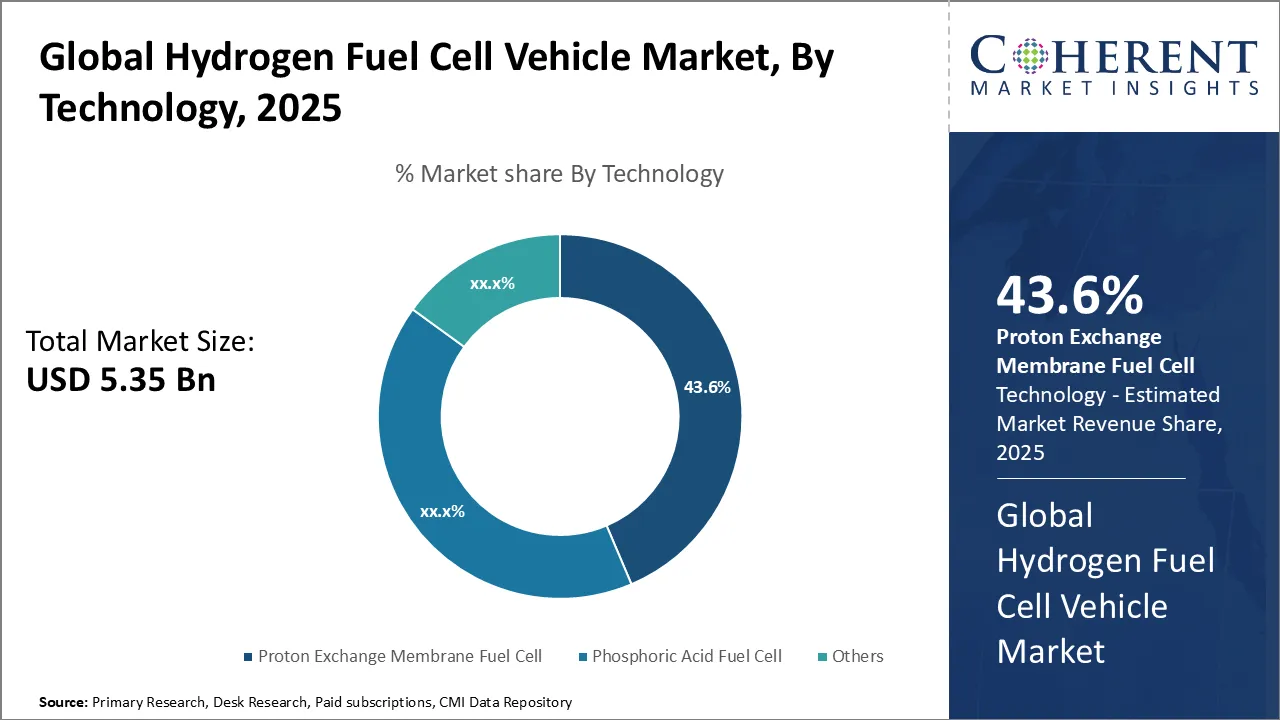
- By Technology, Proton Exchange Membrane Fuel Cell expected to hold largest market share of 44.6% in 2026 owing to its high efficiency suitable performance for vehicles.
- By Region, North America dominates the overall market with an estimated share of 42.2% in 2026 owing to the strong government policy support, incentives & regulatory push.
Market Overview
The hydrogen fuel cell vehicle market continues to grow as governments and industries actively pursue cleaner transportation. Expanding investments in hydrogen production, refueling networks, and fuel cell technologies are enabling broader adoption across passenger and commercial vehicles. Automakers are rapidly developing new fuel cell models, driven by supportive regulations, improved system efficiency, and rising demand for zero-emission mobility. Ongoing progress in fuel cell durability, cost reduction, and green hydrogen supply further reinforces the market’s long-term growth outlook.
Current Events and Its Impact on the Hydrogen Fuel Cell Vehicle Market
Current Events | Description and its impact |
Geopolitical Shifts in Energy Policy |
|
Technological Innovations and Advancements |
|
Macro-level Economic Trends |
|
Segmental Insights
- Current Industry Events of 2026
- Market Size Estimation
- Regional Breakdown
- Competitive Landscape
- Customer Intelligence
- Segmental Analysis
- Pricing Analysis
- Key Market Drivers, Challenges & Future Trends
- Customized Insights Section
Hydrogen Fuel Cell Vehicle Market Insights, By Technology: Proton Exchange Membrane Fuel Cell contribute the highest share of the market owing to its Environmental & regulatory push toward zero-emission mobility.
Proton Exchange Membrane Fuel Cell expected to hold largest market share of 44.6% in 2026. High efficiency, compact design, and rapid start-up capability drive the adoption of Proton Exchange Membrane (PEM) fuel cells in hydrogen vehicles, making them ideal for automotive applications. Governments actively support PEM fuel cell development through incentives and policies that promote zero-emission transportation. Advances in materials, catalysts, and system integration enhance durability, performance, and cost-effectiveness. Expanding hydrogen infrastructure and increased investment in research and development further enable widespread deployment of PEM fuel cells, accelerating the adoption of hydrogen fuel cell vehicles. For instance, in September 2025, Horizon Fuel Cell launched a 3MW Horizon Packs module to serve as backup power for data centers. The 40-foot containerized system delivers double the power of proton-exchange membrane (PEM) fuel cells and triple that of solid oxide fuel cells (SOFC), the latter being the most common in data center applications.
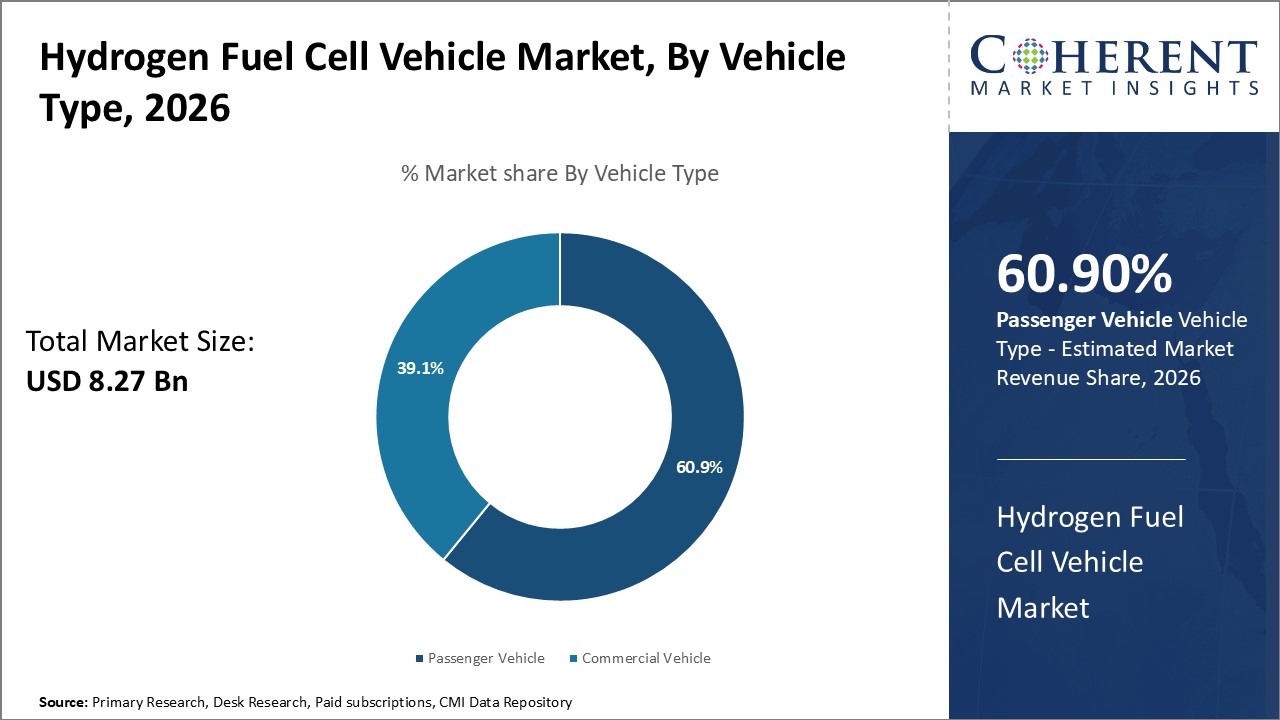
Hydrogen Fuel Cell Vehicle Market Insights, By Vehicle Type: Passenger Vehicle contribute the highest share of the market owing to its increasing consumer demand for private mobility with improved living standards.
Increasing environmental awareness and the growing demand for zero-emission transportation are driving the passenger vehicle segment in the hydrogen fuel cell vehicle market. Governments actively promote adoption through incentives, subsidies, and supportive regulations, while automakers expand their fuel cell model offerings. Advances in technology enhance vehicle efficiency, driving range, and refueling convenience, making hydrogen cars more practical. Rising consumer interest in sustainable mobility, along with the expansion of hydrogen refueling infrastructure, further accelerates the global adoption of fuel cell passenger vehicles. For instance, in April 2025, in Toyota City, Japan, Toyota Motor Corporation announced the development of its third-generation fuel cell system (3rd Gen FC System) to advance a hydrogen society. The company’s fuel cell technology is already deployed in passenger cars, buses, trucks, trains, marine vessels, and stationary applications for business clients and other OEMs.
Regional Insights
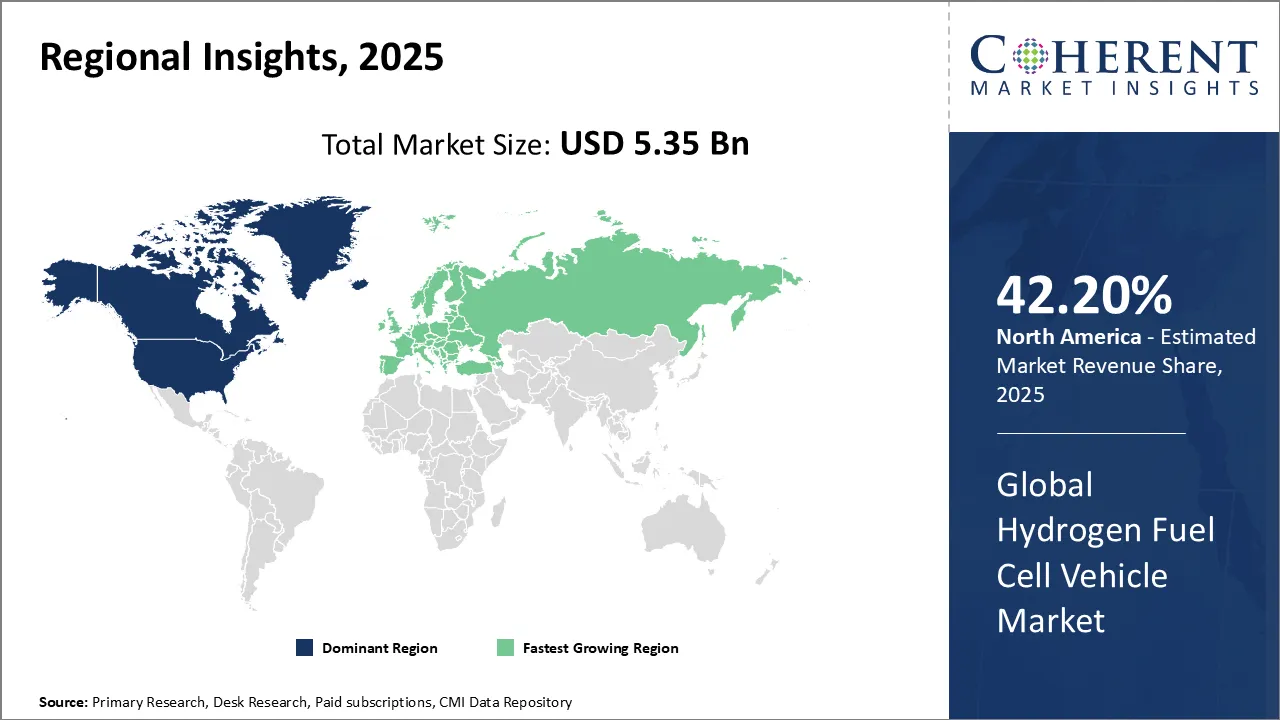
North America Hydrogen Fuel Cell Vehicle Market Trends
North America dominates the overall market with an estimated share of 42.2% in 2026. Automakers are accelerating the North America hydrogen fuel cell vehicle market by expanding fuel-cell models, while governments intensify clean-transport initiatives. Fleet operators increasingly adopt zero-emission options, especially for commercial trucks and buses, prompting stronger investment in refueling infrastructure and collaborations with energy providers. Ongoing technological improvements boost driving range, durability, and fuel efficiency, and regional efforts to scale renewable-based hydrogen production further encourage wider use of fuel-cell vehicles across transportation and logistics. For instance, in March 2026, U-M and UCR launched a new alliance to advance hydrogen use in internal combustion engine (ICE) vehicles. Hydrogen can power on-road and off-road vehicles, equipment, and large marine engines, offering reduced carbon dioxide and pollutant emissions, yet it remains largely underutilized in the United States.
Europe Hydrogen Fuel Cell Vehicle Market Trends
European governments are propelling the hydrogen fuel cell vehicle market by strengthening clean mobility initiatives, while leading automakers accelerate fuel-cell innovation. Increasing demand for zero-emission options across public transit, logistics, and long-haul travel is pushing the deployment of hydrogen-powered buses and trucks. Companies and regulators are expanding green hydrogen production and building cross-border refueling corridors to enhance infrastructure. Advancing technologies and unified industry actions are driving broader adoption and positioning hydrogen as a central component of Europe’s sustainable transportation landscape. For instance, in September 2026, BMW Group confirmed that it will begin series production of its third-generation hydrogen fuel cell system at the Steyr plant in Austria. Developed with Toyota, the new system features a 25% smaller footprint, higher power density, longer driving range, lower energy consumption, and zero tailpipe emissions.
United States Hydrogen Fuel Cell Vehicle Market Trends
Federal and state agencies in the United States are driving momentum in the hydrogen fuel cell vehicle market by expanding clean transportation programs and advancing hydrogen infrastructure. Commercial fleet operators, transit agencies, and heavy-duty trucking companies are increasingly adopting zero-emission options. Automakers and energy providers are working together to grow refueling networks and enhance fuel-cell efficiency. Rising investment in domestic, renewable-based hydrogen production is reinforcing market growth and promoting wider use of fuel-cell vehicles across logistics and transportation applications. For instance, in May 2024, Hyundai Motor Company, actively collaborating with partners to develop a hydrogen value chain in North America, is supplying 30 Xcient fuel cell trucks for California’s 'NorCAL ZERO Project' at the port.
United Kingdom Hydrogen Fuel Cell Vehicle Market Trends
The UK government is advancing the hydrogen fuel cell vehicle market by reinforcing clean mobility policies and expanding hydrogen infrastructure. Demand for zero-emission transport is rising, particularly for buses, delivery fleets, and heavy-duty vehicles, which is driving broader adoption. Automakers and energy providers are collaborating to enhance refueling access and push fuel-cell technology forward. Growing investments in green hydrogen production and regional pilot initiatives are accelerating market growth and establishing hydrogen as a key pillar of the nation’s sustainable transport strategy. For instance, in September 2026, British hydrogen start-up Riversimple replaced car ownership with a full-service hydrogen car subscription in the UK, offering an all-inclusive monthly fee covering insurance, servicing, MOTs, road tax, breakdown cover, tyres, and hydrogen fuel, plus a separate per-mile charge.
End-user Feedback and Unmet Needs in the Hydrogen Fuel Cell Vehicle Market
- Infrastructure Availability: Users consistently highlight the need for a more reliable and widespread hydrogen refueling network. Limited station coverage creates range anxiety, restricts long-distance travel, and discourages adoption. Drivers also report inconsistent station uptime and slow repair response times, emphasizing the importance of expanding and maintaining dependable nationwide refueling infrastructure.
- Vehicle Cost and Accessibility: End users note that high purchase prices and limited model options remain significant barriers. Many express interests in hydrogen vehicles but need more affordable choices and diverse body styles. Consumers also want clearer ownership benefits, lower operating costs, and accessible financing or leasing programs to make fuel-cell vehicles more attainable.
- Performance and Durability Improvements: Users appreciate the fast refueling and smooth driving experience but request longer driving ranges and improved fuel-cell durability. Some report concerns about cold-weather performance and component lifespan. Greater transparency on maintenance requirements and enhanced long-term reliability would help build trust and support wider adoption among both individual and fleet customers.
Hydrogen Fuel Cell Vehicle Market Trend
Growing Government Support
Governments worldwide are increasingly implementing policies, subsidies, and incentives to promote hydrogen fuel cell vehicles. Initiatives focus on building refueling infrastructure, encouraging fleet electrification, and supporting research in green hydrogen production. Public-private partnerships are expanding, enabling automakers, energy providers, and policymakers to collaborate on advancing technology adoption. These efforts are creating favorable regulatory environments and stimulating market growth by addressing key barriers like infrastructure limitations and high initial costs, making fuel-cell vehicles more viable for commercial and personal use.
Expansion of Commercial and Public Transport Fleets
The adoption of hydrogen fuel cell vehicles is rising in commercial transport, buses, and logistics fleets due to zero-emission mandates and operational efficiency. Companies are investing in heavy-duty trucks and public transit buses to reduce emissions while meeting sustainability goals. The focus on fleet electrification drives demand for reliable hydrogen production, storage, and refueling networks. These developments enable large-scale implementation, encourage technological advancements, and help reduce carbon footprints across urban and long-haul transport operations globally.
Hydrogen Fuel Cell Vehicle Market Opportunity
Expansion of Green Hydrogen Production
Increasing global emphasis on renewable energy creates opportunities to scale green hydrogen production. By producing hydrogen from solar, wind, and other sustainable sources, companies can supply cleaner fuel for vehicles while reducing carbon emissions. This not only supports regulatory compliance but also strengthens consumer appeal. Investments in electrolysis technologies and hydrogen storage solutions can drive cost reductions and enhance supply chain efficiency, enabling broader adoption across passenger vehicles, commercial fleets, and heavy-duty transportation sectors.
Market Report Scope
Hydrogen Fuel Cell Vehicle Market Report Coverage
| Report Coverage | Details | ||
|---|---|---|---|
| Base Year: | 2025 | Market Size in 2026: | USD 8.27 Bn |
| Historical Data for: | 2020 To 2024 | Forecast Period: | 2026 To 2033 |
| Forecast Period 2026 to 2033 CAGR: | 54.5% | 2033 Value Projection: | USD 173.69 Bn |
| Geographies covered: |
| ||
| Segments covered: |
| ||
| Companies covered: | Audi AG, Ballard Power Systems Inc., BMW Group, Daimler AG, General Motors Company, Honda Motor Co., Ltd., and Hyundai Motor Group | ||
| Growth Drivers: |
| ||
| Restraints & Challenges: |
| ||
Hydrogen Fuel Cell Vehicle Market News
- In November 2025, Hyundai Motor Company unveiled the second-generation NEXO Hydrogen Fuel Cell Electric Vehicle (FCEV), featuring a full redesign, upgraded hydrogen storage, improved performance, and extended driving range, advancing the automaker’s zero-emission mobility goals.
- In June 2025, Huangshi, Hubei, hosted a grand launch ceremony for a hydrogen two-wheeler under the theme "Hydrogen Starts a New Journey, Green Shines the Copper City," organized by Wuhan Zhongyu Power System Technology, Hubei Hydrogen Travel New Energy Technology, and Hubei Engineering Vocational College.
Analyst Opinion (Expert Opinion)
- The momentum in hydrogen fuel‑cell mobility seems promising on paper, but a closer look reveals structural contradictions undermining long‑term viability. On one hand, the global network of hydrogen refuelling stations recently surpassed 1,160, showing tangible progress in infrastructure build‑out. Meanwhile, over 88,000 fuel‑cell vehicles were reported operational globally by end‑2023 — and the U.S. remains one of the top four markets for these deployments.
- In major regions like Europe and North America, adoption remains overwhelmingly concentrated in niche segments — primarily hydrogen buses or commercial fleets — while passenger uptake stays marginal. For instance, hydrogen buses in Europe made up only around 5% of the new zero‑emission bus registrations in early 2025, with battery‑electric models continuing to dominate. Even though heavy‑duty hydrogen trucks are often touted as the future of decarbonized freight, widespread rollout is stalled; one recent analysis flags limited refuelling infrastructure and high lifetime costs as persistent challenges.
- Moreover, recent strategic decisions by major automakers highlight the technology’s uncertain economic case. Notably, a leading global manufacturer recently discontinued its hydrogen fuel‑cell programme and cancelled planned hydrogen‑powered van launches, citing insufficient demand, prohibitive refueling infrastructure gaps, and unattractive investment returns. This signal growing industry skepticism about mass-market hydrogen for light vehicles.
- Thus, while hydrogen fuel‑cell vehicles retain value in specialized niches — heavy‑duty transport, fleet, or regions with concentrated infrastructure — the broader vision of hydrogen replacing conventional and electric mobility at scale appears increasingly unrealistic under current economic and infrastructure conditions. Unless costs drop sharply or refuelling coverage undergoes a dramatic expansion, fuel‑cell vehicles seem destined to remain a peripheral component — not the backbone — of sustainable transport portfolios.
Speak to the analyst
Want personalized insights?
Take the findings above to one of our principal consultants, or have the report rebuilt around the segments, geographies and competitors you actually track.
Market Segmentation
- Global Hydrogen Fuel Cell Vehicle Market, By Vehicle Type
- Passenger Vehicle
- Commercial Vehicle
- Global Hydrogen Fuel Cell Vehicle Market, By Technology
- Proton Exchange Membrane Cell
- Phosphoric Acid Fuel Cell
- Others
- Regional Insights (Revenue, USD Bn, 2021 - 2033)
- North America
- U.S.
- Canada
- Latin America
- Brazil
- Argentina
- Mexico
- Rest of Latin America
- Europe
- Germany
- U.K.
- Spain
- France
- Italy
- Russia
- Rest of Europe
- Asia Pacific
- China
- India
- Japan
- Australia
- South Korea
- ASEAN
- Rest of Asia Pacific
- Middle East
- GCC Countries
- Israel
- Rest of Middle East
- Africa
- South Africa
- North Africa
- Central Africa
- North America
- Key Players Insights
- Audi AG
- Ballard Power Systems Inc.
- BMW Group
- Daimler AG
- General Motors Company
- Honda Motor Co., Ltd.
- Hyundai Motor Group
Sources
Primary Research interviews
- Industry experts from automotive manufacturers (Toyota, Hyundai, Nikola, Honda)
- Fleet operators using hydrogen-powered buses and trucks
- Hydrogen infrastructure and refueling network providers
- Government officials involved in clean transportation initiatives
Databases
- International Energy Agency (IEA) hydrogen and fuel-cell databases
- H2stations.org database for global refueling stations
- U.S. Department of Energy (DOE) Hydrogen and Fuel Cell Technical Advisory Committee (HTAC) reports
- European Alternative Fuels Observatory (EAFO) datasets
Magazines
- Green Car Reports
- Automotive News
- Hydrogen Fuel News
- CleanTechnica
Journals
- International Journal of Hydrogen Energy
- Journal of Power Sources
- Energy Policy
- Renewable and Sustainable Energy Reviews
Newspapers
- The Guardian – Environment Section
- The New York Times – Climate & Energy Section
- Financial Times – Automotive & Energy Section
- The Telegraph – Technology & Transport Section
Associations
- Hydrogen Council
- Fuel Cell & Hydrogen Energy Association (FCHEA)
- European Hydrogen Association
- World Hydrogen Leaders
Public Domain sources
- Government policy documents on clean transport (US, EU, UK)
- Publicly released annual reports of automakers
- UN and IEA publications on energy transition and hydrogen adoption
- Open-access scientific articles on fuel-cell technology
Proprietary Elements
- CMI Data Analytics Tool
- Proprietary CMI Existing Repository of information for last 8 years
Get access to 250+ pages report
Every segment, forecast, competitor profile and data table behind the analysis above — available for instant download.
- ESOMAR Member
- ISO 9001:2015 Certified
- D-U-N-S Registered
- GDPR & CCPA Compliant
Missing comfort of reading report in your local language? Find your preferred language:
Transform your Strategy with Exclusive Trending Reports
Frequently Asked Questions
The Hydrogen Fuel Cell Vehicle Market is estimated to be valued at USD 8.27 Bn in 2026, and is expected to reach USD 173.69 Bn by 2033.
The CAGR of the Hydrogen Fuel Cell Vehicle Market is projected to be 54.5% from 2026 to 2033.
Rise in concerns regarding environment and growing initiatives from governments are fuelling the growth of market.
The Proton Exchange Membrane Fuel Cell segment is the leading component segment in the market.
High investment required for the infrastructure and high reactivity and flammability of hydrogen gas are the major factors restraining growth of the market.
Audi AG, Ballard Power Systems Inc., BMW Group, Daimler AG, General Motors Company, Honda Motor Co., Ltd., and Hyundai Motor Group