

Low Bed Trailer Market Size and Forecast — 2026 - 2033
The Global Low Bed Trailer Market size is estimated to be valued at USD 5.76 billion in 2026 and is expected to reach USD 9.48 billion by 2033, exhibiting a compound annual growth rate (CAGR) of 7.5% from 2026 to 2033.
Overview
The Low Bed Trailer market comprises various types designed to transport heavy and oversized loads efficiently. Standard low bed trailers feature a fixed deck and are widely used for construction equipment and industrial machinery. Extendable low bed trailers offer adjustable lengths, accommodating longer cargo such as wind turbine components and large pipes. Multi-axle and modular low bed trailers provide enhanced load distribution, enabling safe transport of extremely heavy machinery while complying with road regulations. Hydraulic drop-deck trailers allow easy loading and unloading of tall equipment. Other specialized variants, including double-drop and low loader trailers, cater to niche industrial applications, ensuring versatility across logistics and transportation sectors.
Key Takeaways
The Low Bed Semi Trailer segment dominates the market with a 48% share, driven by versatility and high load capacity, making it ideal for heavy machinery transportation.
Construction is the leading application segment due to booming infrastructure projects, while the energy sector shows the fastest growth, supported by transportation of equipment for oil and gas exploration.
North America leads regionally in market share, attributed to high infrastructural spending, whereas Asia Pacific exhibits the fastest CAGR, fuelled by industrial expansion and rising imports in countries such as India and China.
Europe serves as a key innovation hub, with companies focusing on advanced materials and stringent safety compliance to maintain competitive advantage.
Low Bed Trailer Market Segmentation Analysis
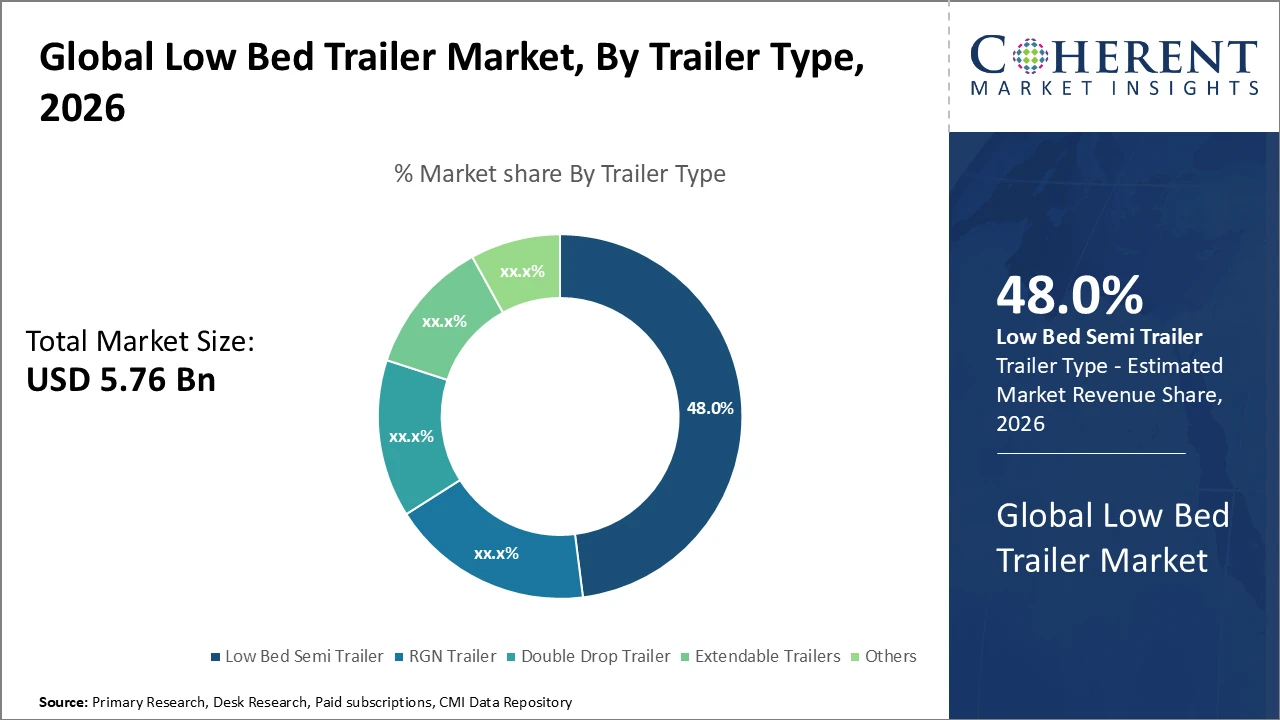
Low Bed Trailer Market Insights, By Trailer Type
Low Bed Semi Trailers dominate the market with a 48% share, owing to their versatility in carrying heavy and oversized cargo and their simpler design, which lowers maintenance costs.
The fastest-growing segment is RGN Trailers, featuring a detachable gooseneck that enables easy loading of heavy machinery, particularly in construction and mining. Double Drop Trailers, offering low deck heights for tall cargo, maintain steady demand in mining applications. Extendable Trailers provide adjustable lengths for transporting elongated equipment but hold a smaller market share due to specialized demand. Other variants, such as low loaders, serve highly specific industrial transport requirements.
Low Bed Trailer Market Insights, By Load Capacity
The 1–40 Tons segment dominates the Low Bed Trailer market due to its adaptability in transporting mid-weight machinery commonly used in construction and industrial sectors. The Above 80 Tons segment is the fastest-growing, driven by increasing demand for ultra-heavy cargo transport in energy infrastructure, large-scale mining, and industrial projects requiring specialized trailers.
The 41–80 Tons segment provides a middle ground for heavier loads with moderate flexibility, sustaining consistent demand across industries. Other categories, including load capacities exceeding 120 tons, cater to niche and exceptional transport needs, representing a small but strategically important component of the overall market.
Low Bed Trailer Market Insights, By Application
Construction holds the dominant market share in the Low Bed Trailer market, driven by ongoing urbanization and large-scale public infrastructure projects. The Energy & Oil & Gas segment is the fastest-growing, fuelled by rising exploration and equipment transport needs, particularly in North America and the Middle East, requiring trailers capable of handling heavy and complex machinery. Heavy Machinery Transportation serves multiple industries, maintaining a significant but cyclical market presence influenced by economic trends. Mining applications demand highly durable trailers, representing a specialized yet stable segment. Other sectors, including agriculture and defense, rely on customized transport solutions but contribute minimally to overall market revenue.
Low Bed Trailer Market Trends
The Low Bed Trailer market is evolving with a strong emphasis on digital transformation and sustainability.
IoT-based fleet management solutions have improved operational efficiency, reducing trailer idle times by 20% in North America in 2026.
Adoption of eco-friendly propulsion systems in trucking is driving trailer reengineering, particularly in Europe, where stricter emission regulations are accelerating uptake.
Modular trailer components allow customization for diverse cargo types, enabling manufacturers to cater to niche industry requirements.
Increased demand for bespoke trailers is evident in the Middle East’s oil and gas sector, contributing to higher market revenue.
Low Bed Trailer Market Insights, By Geography
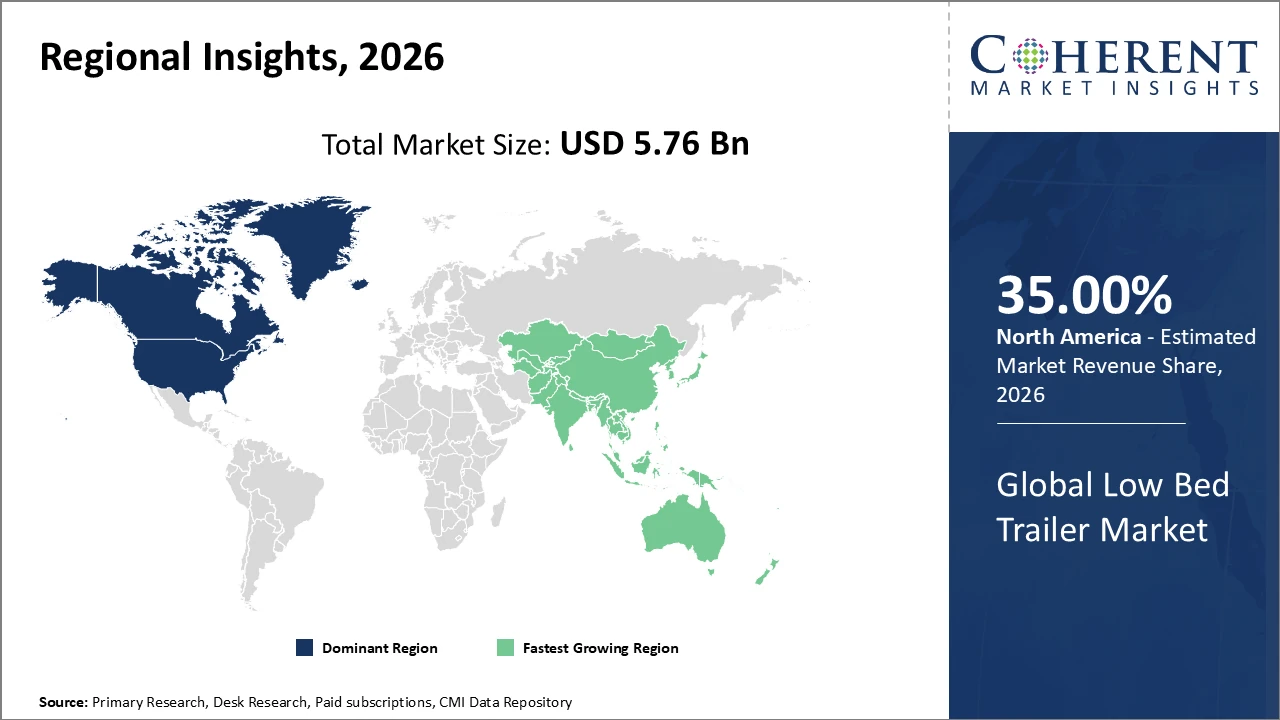
North America Low Bed Trailer Market Analysis and Trends
In North America, the Low Bed Trailer market is dominated by extensive infrastructure development and modernization of transportation logistics, accounting for approximately 35% of the regional market share. Government incentives promoting fleet upgrades and the rising import of specialized trailers support ongoing revenue growth. The construction, energy, and heavy machinery sectors drive consistent demand for versatile and high-capacity trailers. Additionally, the presence of leading manufacturers such as Kalmar and Broshuis strengthens the region’s market leadership through advanced product offerings, strategic partnerships, and localized service networks. These factors collectively maintain North America’s competitive advantage and sustained growth in the global low bed trailer market.
Asia Pacific Low Bed Trailer Market Analysis and Trends
The Asia Pacific region exhibits the fastest growth in the low bed trailer market, with a CAGR exceeding 9%, driven by rapid industrialization in countries such as India and China. Expanding construction activities, large-scale infrastructure projects, and increasing investments in energy and mining sectors significantly boost demand for heavy-duty transportation solutions. Manufacturers leverage lower production costs, expanding domestic supply chains, and growing urbanization to meet rising regional requirements. Additionally, government initiatives supporting logistics modernization and import facilitation for specialized trailers further enhance market potential. These factors collectively position Asia Pacific as a high-growth region with strong long-term forecast prospects in the low bed trailer industry.
Low Bed Trailer Market Outlook for Key Countries
USA Low Bed Trailer Market Analysis and Trends
The USA Low Bed Trailer market is fuelled by substantial infrastructure investments exceeding USD 1 trillion annually, generating strong demand for heavy-duty trailer solutions. Leading manufacturers have focused on technological innovations to comply with strict safety and environmental regulations, resulting in a 15% increase in trailer production in 2025. Growth in logistics-intensive sectors such as oil & gas, construction, and energy infrastructure further drives market revenue. Additionally, ongoing fleet modernization programs and adoption of digital fleet management solutions enhance operational efficiency and reliability. These factors position the United States as a pivotal and high-revenue market in the global low bed trailer industry.
Germany Low Bed Trailer Market Analysis and Trends
Germany’s Low Bed Trailer market is shaped by advanced manufacturing capabilities, stringent safety regulations, and a strong emphasis on high-quality engineering. The country serves as a hub for innovation, with manufacturers adopting lightweight materials, modular designs, and enhanced suspension systems to improve fuel efficiency and cargo safety. Construction and industrial sectors drive steady demand, while the energy and heavy machinery industries contribute to specialized trailer requirements. Sustainability initiatives and compliance with European emission standards are prompting upgrades to eco-friendly trailer designs. Additionally, Germany’s strategic position in Europe facilitates exports and supports integration with regional logistics networks, reinforcing its market prominence.
Analyst Opinion
Global infrastructure spending is a key market driver, with China investing around USD 1.5 trillion in 2025, boosting demand for specialized transport equipment like low bed trailers and prompting increased production capacity.
Emerging economies in Asia-Pacific and Latin America are increasingly importing advanced low bed trailers to support cross-border heavy equipment transport; India’s import volume of specialized trailers rose 18% in 2024, highlighting growing regional demand.
Pricing dynamics remain competitive as rising raw material costs and lightweight material innovations drive design efficiency; in 2025, average trailer prices increased 4%, supported by advancements in steel alloys.
Diverse industrial adoption from oil & gas to mining has expanded market strategies, with North America recording a 12% increase in low bed trailer utilization in the energy sector in 2026.
- Current Industry Events of 2026
- Market Size Estimation
- Regional Breakdown
- Competitive Landscape
- Customer Intelligence
- Segmental Analysis
- Pricing Analysis
- Key Market Drivers, Challenges & Future Trends
- Customized Insights Section
Market Scope
| Report Coverage | Details | ||
|---|---|---|---|
| Base Year: | 2025 | Market Size in 2026: | USD 5.76 billion |
| Historical Data for: | 2020 To 2024 | Forecast Period: | 2026 To 2033 |
| Forecast Period 2026 to 2033 CAGR: | 7.5% | 2033 Value Projection: | USD 9.48 billion |
| Geographies covered: |
| ||
| Segments covered: |
| ||
| Companies covered: | Kalmar, TII Group, CIMC, MAN Trucks, Goldhofer AG, Broshuis, XL Specialized Trailer, Faymonville Group, Stoughton Trailers, Talbert Manufacturing | ||
| Growth Drivers: |
| ||
Low Bed Trailer Market Growth Factors
Several key factors are driving growth in the low bed trailer market. Rising global infrastructure investments continue to fuel demand for trailers capable of transporting heavy equipment, with worldwide spending projected to surpass USD 5 trillion by 2026. The growing use of modular construction and prefabricated components further increases the need for specialized transport solutions, especially in North America and Europe. Technological advancements, including lightweight materials and improved suspension systems, enhance load efficiency and reduce fuel consumption, boosting market appeal. Additionally, stringent government regulations on transportation safety and load management encourage manufacturers to innovate, driving demand for compliant, high-performance low bed trailers.
Low Bed Trailer Market Development
In 2025, Broshuis, a leading trailer manufacturer, launched a new range of modular low bed trailers with adjustable deck lengths and advanced hydraulic suspension systems. This development catered to the growing demand from construction and energy sectors for versatile and high-capacity transport solutions, resulting in a 12% increase in the company’s regional sales in Europe.
Key Players
Leading Companies of the Market
Kalmar
TII Group
CIMC
MAN Trucks
Broshuis
XL Specialized Trailers
Faymonville Group
Goldhofer AG
Talbert Manufacturing
Stoughton Trailers
Competitive strategies in the Low Bed Trailer market focus on broadening product portfolios, advancing technology, and forming strategic partnerships. For instance, Faymonville Group’s investment in modular trailer designs resulted in a 15% increase in market penetration across Europe in 2025. Similarly, CIMC Vehicles Group collaborated with logistics providers to offer customized trailer solutions tailored to regional industrial needs, which boosted revenue by 10% in the Asia Pacific region. These approaches enable companies to address diverse customer requirements, enhance operational efficiency, and strengthen their market position amid growing demand for high-capacity, specialized low bed trailers worldwide.
Low Bed Trailer Market Future Outlook
The Low Bed Trailer market is expected to experience sustained growth driven by continued global infrastructure development, industrial expansion, and increasing demand for specialized heavy equipment transport. Technological advancements, including lightweight materials, modular designs, and IoT-enabled fleet management systems, will enhance operational efficiency and safety, further fuelling adoption. Rising environmental regulations are likely to accelerate the shift toward eco-friendly trailer designs and optimized fuel consumption. Emerging markets in Asia Pacific and Latin America are projected to contribute significantly to revenue growth due to urbanization and industrialization. Overall, innovation, regulatory compliance, and expanding industrial applications will shape a robust future outlook for the market.
Low Bed Trailer Market Historical Analysis
The Low Bed Trailer market has experienced steady growth over the past decade, driven by rising infrastructure projects, industrialization, and expanding energy and mining sectors. Between 2015 and 2025, the market saw increased adoption of high-capacity trailers, particularly in North America and Europe, supported by technological innovations such as reinforced chassis, modular designs, and improved suspension systems. Demand for specialized trailers, including RGN and double drop variants, grew alongside heavy machinery transport needs. Asia Pacific emerged as a key growth region due to rapid urbanization and industrial expansion. Overall, historical trends reflect consistent market expansion fuelled by infrastructure development and evolving logistics requirements.
Sources
Primary Research Interviews:
Executives and operations managers at low bed trailer manufacturing plants
Logistics and heavy machinery transport managers
Technology providers for trailer design, modular systems, and suspension innovations
Industry analysts and consultants specializing in transport, construction, and heavy equipment logistics
Databases:
Bloomberg Terminal
Thomson Reuters Eikon
IHS Markit
Euromonitor International
Others
Magazines:
Transport Topics – Heavy Equipment Transport Updates
Fleet Owner – Trailer Technology and Logistics News
Heavy Duty Trucking – Specialized Trailer and Fleet Developments
Equipment World – Construction and Industrial Hauling Innovations
Journals:
Journal of Transportation Engineering – Trailer Design and Load Optimization
Journal of Logistics and Supply Chain Management – Heavy Haul Solutions
Transportation Research Part C – Advanced Trailer Technologies
International Journal of Heavy Vehicle Systems – Trailer Safety and Efficiency Studies
Newspapers:
The Wall Street Journal – Transport and Infrastructure Markets
Financial Times – Heavy Equipment Logistics and Industry Insights
Logistics Management – Trailer Utilization and Market Trends
Construction Equipment Guide – Heavy Hauling Developments
Associations:
American Trucking Associations (ATA) – Heavy Haul and Trailer Division
European Trailer Manufacturers Association (ETMA)
World Road Transport Organization (IRU) – Heavy Equipment Transport Committees
International Heavy Haul Association (IHHA) – Specialty Trailer & Low Bed Guidelines
Get access to 250+ pages report
Every segment, forecast, competitor profile and data table behind the analysis above — available for instant download.
- ESOMAR Member
- ISO 9001:2015 Certified
- D-U-N-S Registered
- GDPR & CCPA Compliant
Missing comfort of reading report in your local language? Find your preferred language:
Transform your Strategy with Exclusive Trending Reports
Frequently Asked Questions
Leading companies include Kalmar, Faymonville Group, CIMC, Goldhofer AG, and TII Group, recognized for their technological innovation, extensive product portfolios, and global presence.
The market is projected to grow from USD 5.76 billion in 2026 to USD 9.48 billion by 2033, representing a CAGR of 7.5% driven by infrastructure development and industrial expansion.
Construction remains the largest segment, while energy, oil & gas, and mining industries show strong growth due to demand for specialized heavy haul transportation.
Trends include digital fleet integration, adoption of eco-friendly propulsion and materials, and modular trailer designs catering to diverse cargo and regulatory requirements.
The market is highly competitive, with players emphasizing innovation, customization, and cost optimization, while facing challenges such as raw material price volatility and strict safety regulations.
Companies focus on geographic expansion, strategic partnerships, diversified product offerings, and enhanced after-sales support to strengthen market position and revenue growth.