

Automotive HUD Market Size and Forecast
Automotive HUD Market is estimated to be valued at USD 3.78 Bn in 2026 and is expected to reach USD 17.72 Bn in 2033, exhibiting a compound annual growth rate (CAGR) of 24.7% from 2026 to 2033.
Key Takeaways
- Based on Product Type, the Windshield segment leads the market holding an estimated share of 68% in 2026, fueled by its immersive, safer, and technologically advanced driver experience.
- Based on Passenger Car Type, the premium segment is projected to dominate with a largest share in 2026, driven by consumer expectations, safety priorities, and technological readiness.
- Based on Region, Asia Pacific is estimated to lead the market with a share of 34. 2% in 2026. While, Europe is anticipated to be the fastest growing region during the forecast period.
Market Overview
Automotive head-up display or also referred as auto HUD is any transparent display that shows information exactly when user needs it, which is aligned directly in the line of sight. Auto HUD displays crucial information including speed, warning signals, and navigation signals without looking down instrument cluster. As the driver gets all the important information, it reduces chances of potential road accidents. Advanced HUD systems also display advanced driver assistance system (ADAS) data, enabling driver to gain important information, without taking their attention off the road. In the recent past, augmented reality has revolutionized head-displays with information being projected on windshield and layer of information right in front of the car.
Current Events and their Impact on the Automotive HUD Market
Current Event | Description and its Impact |
Regulatory Shifts in Key Markets |
|
Technological Innovations |
|
Role of Artificial Intelligence (AI) in the Automotive HUD Market
The integration of artificial intelligence into automotive HUD market is making driving safer, more efficient, and increasingly personalized. AI powers real-time object recognition, enabling AR-HUDs to project dynamic visuals like highlighting pedestrians, road signs, or lane boundaries, directly onto the windshield. For instance, AI can detect a cyclist in a blind spot and alert the driver via a highlighted overlay, improving safety. AI algorithms analyze data from various sensors (cameras, LiDAR, GPS) to predict road conditions and driving behavior. HUDs can then proactively display speed recommendations, potential hazards, or route adjustments before the driver even notices a change.
Moreover, AI allows HUDs to adapt content based on driver preferences, habits, and behavior. For example, a driver who frequently uses navigation and music controls might see those features prioritized in their field of view, improving ease of use and reducing distraction. Integration of AI-powered voice assistants (like Alexa Auto or Google Assistant) into HUD systems enables hands-free control. Drivers can request route changes, call contacts, or ask for weather updates, which are then displayed contextually on the HUD interface.
In January 2025, BMW introduced AI‑driven Panoramic iDrive system across all upcoming models. First debuting on the Neue Klasse EVs and next‑generation 3 Series, the system integrates a sweeping heads‑up display that stretches across the windshield, a customizable center screen, and an intelligent, LLM‑powered assistant. The panoramic display features AR navigation cues, speed, and vehicle data in the driver’s view, with content accessible to passengers.
- Current Industry Events of 2026
- Market Size Estimation
- Regional Breakdown
- Competitive Landscape
- Customer Intelligence
- Segmental Analysis
- Pricing Analysis
- Key Market Drivers, Challenges & Future Trends
- Customized Insights Section
Segmental Insights
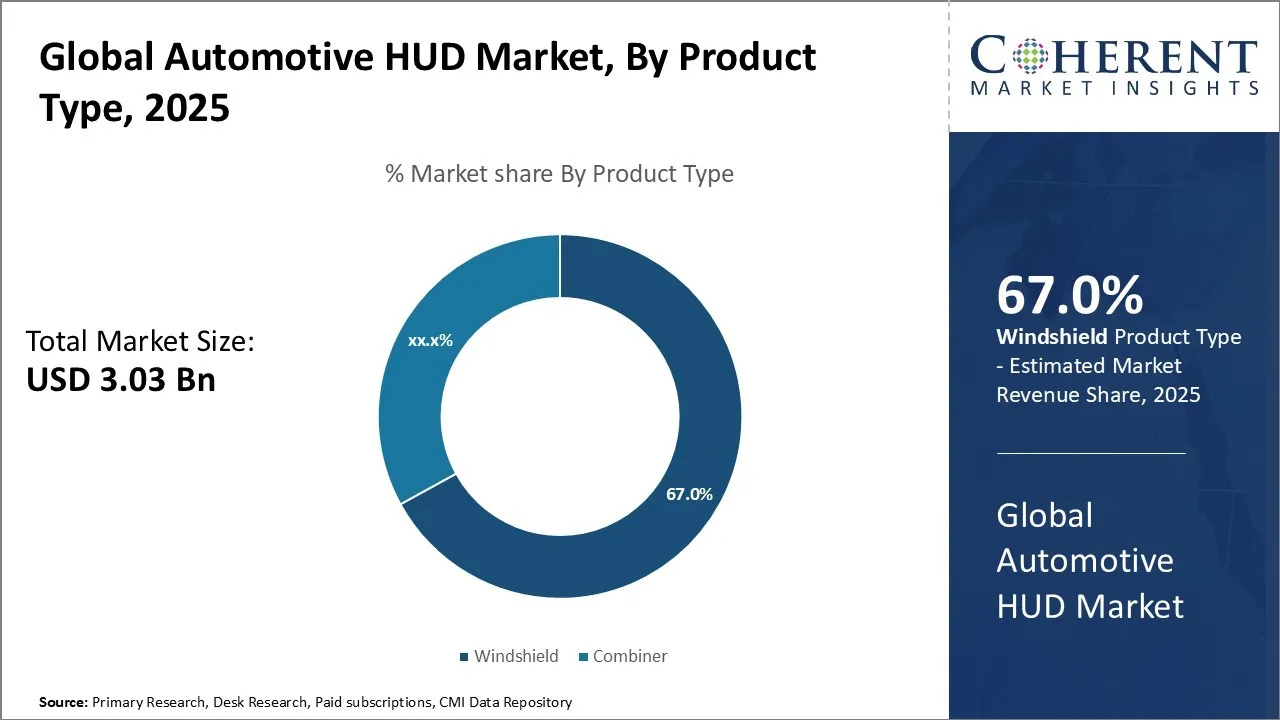
Automotive HUD Market Insights, By Product Type
Windshield Holds the Dominant Share owing to Immersive and Technologically Advanced Driver Experience
In terms of product, the windshield segment is expected to dominate, holding an estimated share of 68.0% in 2026, fueled by its immersive, safer, and technologically advanced driver experience. Windshield HUDs project critical driving information directly onto the driver’s line of sight, allowing them to keep their eyes on the road. Speed, navigation, lane guidance, and ADAS alerts appear as if they are floating just ahead of the vehicle, reducing the need to glance down at the dashboard. Modern vehicles increasingly incorporate augmented reality HUDs, which overlay real-time graphics such as turn arrows and hazard warnings onto the actual road view through the windshield. This is only possible with full windshield HUD projection, not small combiner systems.
Moreover, with growing adoption of HUDs in premium and electric vehicles, automakers are favoring windshield HUDs for their aesthetic integration and scalability. Brands like BMW, Mercedes-Benz, Tesla, and Hyundai are already offering large-format windshield HUDs in their latest models. Unlike combiner HUDs, windshield HUDs offer greater projection area, supporting more data types, clearer visibility in varied lighting conditions, and multi-layered information delivery which is ideal for integrating navigation, speed, traffic alerts, and driver-assist features all at once.
In June 2025, in a collaboration, Huawei and Chinese EV maker XPeng unveiled a revolutionary AR‑HUD system in Guangzhou. The tech projects an 87‑inch augmented‑reality heads‑up display directly onto the windshield of XPeng’s upcoming G7 SUV, delivering AI‑driven speed, navigation, lane guidance, and smart‑driving cues without requiring drivers to glance away. It boasts towering specs with 12,000 nits brightness and 1,800:1 contrast to ensure visibility in any lighting. the duo aims to enhance safety by overlaying real‑world hazards and vehicle actions in real time.
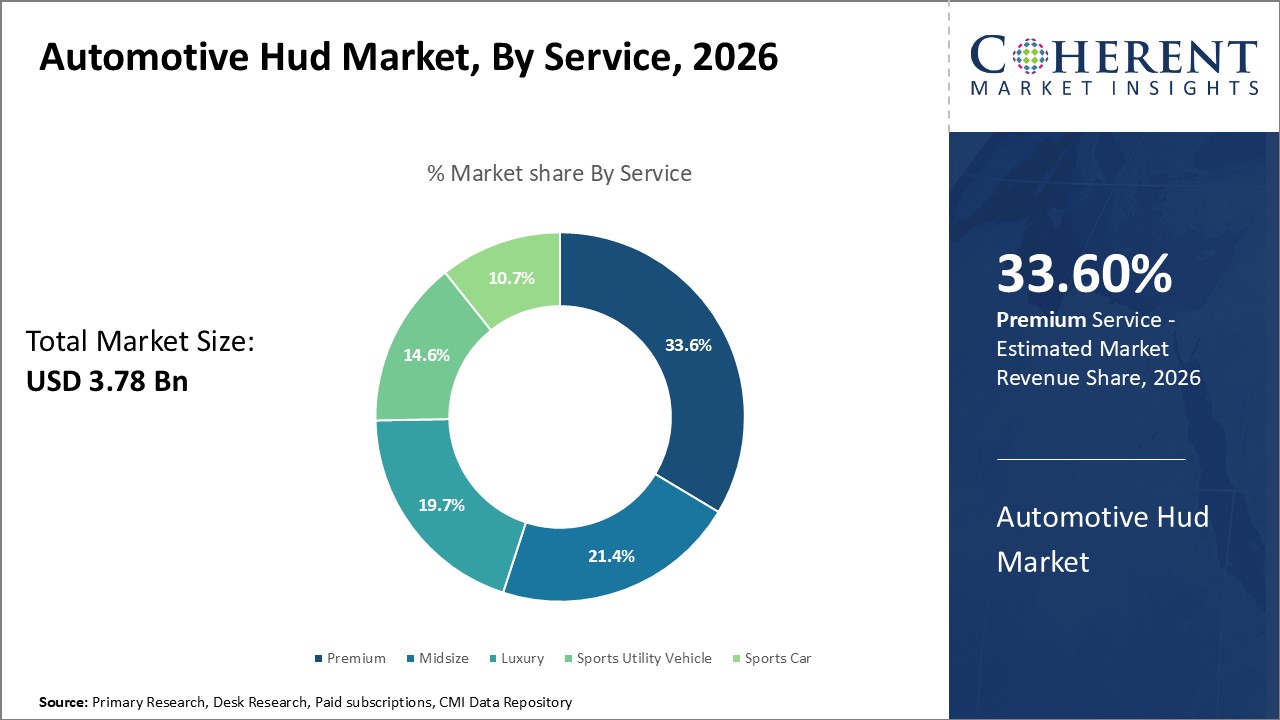
Automotive HUD Market Insights, By Service
Premium Segment Acquires the Largest share owing to Evolving Consumer Expectations
In terms of service, the premium segment is expected to contribute the highest share of the market in 2026, driven by consumer expectations, safety priorities, and technological readiness. Consumers in the premium segment prioritize driver assistance systems and safety enhancements, which HUDs support by projecting crucial data like speed, navigation, and lane-keeping alerts, directly onto the windshield. This minimizes distraction and helps maintain focus on the road, aligning with the advanced safety packages that are standard in premium models. Premium vehicles serve customers who expect a more sophisticated in-cabin technology experience. HUDs enhance the sense of high-tech, futuristic design while offering functional value. Automakers use HUDs to differentiate their models, providing a semi-luxury experience without entering the ultra-premium price range.
Additionally, the premium category often features fully digital instrument clusters, advanced infotainment systems, and semi-autonomous driving, all of which integrate seamlessly with HUDs. HUDs act as a central interface, merging vehicle data with real-time feedback from driver assistance systems, which is not always viable in lower-end vehicles due to tech limitations. Unlike midsize or entry-level models, premium vehicles offer greater flexibility in terms of design, dashboard architecture, and space allocation, making it easier to integrate HUD units, whether conventional, combiner-type, or augmented-reality windshield projections.
In January 2025, Mercedes‑Benz India unveiled the EQS 580 4MATIC Celebration Edition, a limited run of just 50 units. The cabin upgrades include multi‑contour rear seats with massage, lumbar support, and up to 38° recline, wrapped in full Nappa leather; the Chauffeur Package enables the front seat to tilt electronically for added rear legroom. Tech highlights feature the MBUX Hyperscreen with augmented‑reality navigation, and a coloured AR heads‑up display (HUD) projecting directions directly onto the windscreen.
Regional Insights
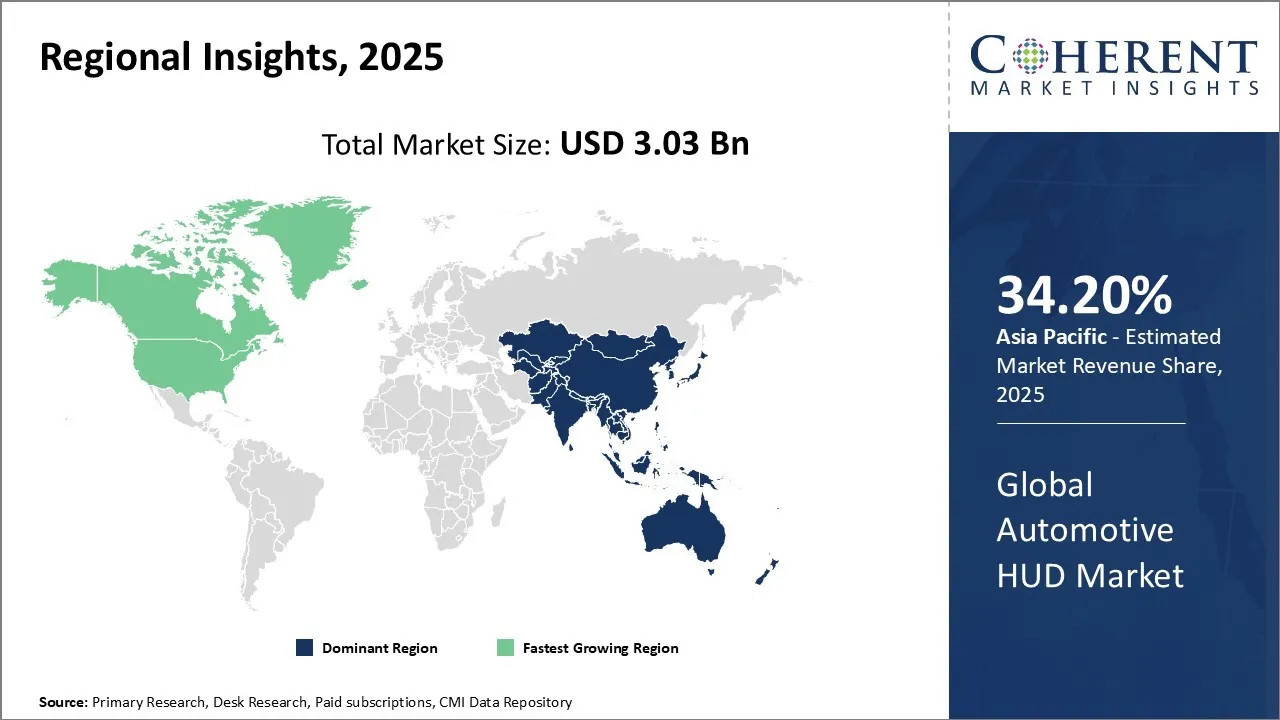
Asia Pacific Automotive HUD Market Analysis & Trends
Asia Pacific, holding a share of 34.20% in 2026, is expected to dominate the global automotive HUD market share, primarily driven by rapid advancements in in-car technologies and a strong manufacturing base. Automakers in countries such as China, Japan, and South Korea are leading the way in integrating cutting-edge HUD features like Augmented Reality (AR), voice assistance, satellite navigation, and real-time traffic visualization into both luxury and mid-range vehicles.
A recent example is BYD’s premium EV models in China, which have begun integrating AR HUDs that project real-time navigation cues, speed data, and lane guidance directly onto the windshield. This technology enhances driver safety by minimizing distractions and offering situational awareness without requiring the driver to look away from the road.
In South Korea, Hyundai Mobis unveiled its next-generation holographic HUD system, which expands the field of view across the full windshield using micro-optics, aimed at supporting semi-autonomous driving features. Similarly, Japanese manufacturers are equipping vehicles with voice-enabled HUDs that interact with onboard AI assistants, allowing drivers to manage routes, calls, and vehicle settings through simple commands, which is further accelerating the automotive HUD market demand.
Europe Automotive HUD Market Analysis & Trends
Europe is expected to exhibit the fastest growth in the global automotive HUD market, driven by rising consumer demand for advanced vehicle technologies and increasing awareness around driving safety. Modern European car buyers expect seamless integration of features such as mobile connectivity, real-time navigation, and driver assistance systems. HUDs are increasingly seen as a key interface that delivers critical driving information, like speed, battery level, warning alerts, and navigation cues, directly in the driver’s line of sight, reducing distraction and enhancing road safety.
Luxury and electric vehicle manufacturers such as BMW, Audi, and Mercedes-Benz have already integrated augmented reality (AR) HUDs into their latest models, offering real-time lane guidance and hazard alerts projected onto the windshield. Additionally, regulatory pressures and consumer safety expectations in Europe are pushing OEMs to adopt HUDs to improve Euro NCAP safety ratings. Companies like FUTURUS and Basemark are showcasing next-gen HUD innovations across European auto expos, featuring AR capabilities and sunlight-resilient displays. As digital cockpit trends grow and connected car infrastructure expands, the automotive HUD market in Europe is expected to gain strong momentum over the forecast period.
In June 2026, Ultraviolette Automotive entered into European markets including the UK, Germany, Spain, Italy, Portugal and France by launching its first overseas retail outlets.
Automotive HUD Market Outlook Country-Wise
China Automotive HUD Market Trends
China is a leading force in the global automotive HUD market, driven by its position as the largest auto market and its strong focus on vehicle digitization. Consumers increasingly expect premium features, including HUDs, even in mid-range cars. Domestic EV giants like NIO and XPeng are integrating augmented reality HUDs (AR-HUDs) to enhance safety and driving experience. Government incentives for electric and smart vehicles such as subsidies and tax breaks are further boosting adoption. Combined with national goals for intelligent transportation, China is rapidly advancing HUD integration across both premium and mass-market segments.
In May 2023, China’s Raythink unveiled a next‑generation smart vehicle AR head‑up display (AR‑HUD), featuring its OpticalCore picture generation unit combined with wave‑layer 3D technology. The system projects stereoscopic, naked‑eye 3D images including speed, navigation, and ADAS data directly onto the windshield, expanding the field of view across three lanes and enhancing contrast via laser‑beam scanning. Compared to TFT or DLP systems, it promises reduced power consumption, superior image quality, and lower costs, with decreased risk of chip shortages due to broader supplier access.
Germany Automotive HUD Market Trends
Germany is a leading market for automotive head-up displays (HUDs), driven by its premium carmakers such as BMW, Audi, and Mercedes-Benz, who consistently integrate HUDs into executive and performance models. German consumers demand high-tech, safety-enhancing features, making HUDs increasingly standard across vehicle segments. The country’s focus on innovation, advanced driver assistance systems (ADAS), and in-car digital experiences has positioned it at the forefront of AR-HUD adoption. With a strong push toward connected and autonomous driving, Germany continues to set global benchmarks for HUD design, functionality, and integration.
Market Report Scope
Automotive HUD Market Report Coverage
| Report Coverage | Details | ||
|---|---|---|---|
| Base Year: | 2025 | Market Size in 2026: | USD 3.78 Bn |
| Historical Data for: | 2020 To 2024 | Forecast Period: | 2026 To 2033 |
| Forecast Period 2026 to 2033 CAGR: | 24.7% | 2033 Value Projection: | USD 17.72 Bn |
| Geographies covered: |
| ||
| Segments covered: |
| ||
| Companies covered: | Continental AG, Delphi Automotive LLP, Denso Corporation, MicroVision Inc., Nippon Seiki Co. Ltd., Robert Bosch GmbH, YAZAKI Corporation, Visteon Corporation. | ||
| Growth Drivers: |
| ||
| Restraints & Challenges: |
| ||
Global Automotive HUD Market Drivers
Enhanced Driving Safety
Enhanced driving safety is one of the primary factors fueling the growth and expansion of the automotive head-up display (HUD) market. HUD systems project critical real-time information such as vehicle speed, navigation directions, lane departure warnings, collision alerts, and traffic sign recognition—directly into the driver’s line of sight, typically on the windshield or a transparent display. This setup allows drivers to access essential driving data without diverting their eyes from the road, thereby minimizing cognitive distraction and reaction time delays.
With increasing traffic density and a global emphasis on reducing road accidents, HUDs are becoming a vital component of modern vehicle safety systems. They are especially valuable in urban environments and high-speed driving, where rapid decisions are necessary and visual distractions can lead to severe consequences. Augmented reality HUDs (AR-HUDs), which enhance the visual experience by integrating contextual graphics over real-world views, are taking this a step further by improving situational awareness and enabling more intuitive interactions with the vehicle's ADAS features.
As governments enforce stricter vehicle safety regulations and consumers demand smarter in-car technology, the automotive HUD market size is expected to grow substantially. Automakers across the globe are integrating HUD systems not just in luxury cars, but increasingly in mid-segment and electric vehicles, making the technology more accessible. This shift is a strong indicator of HUDs transitioning from a luxury feature to a safety-driven standard in the automotive industry.
Growing Demand for Advanced Driver Assistance Systems (ADAS)
The growing demand for Advanced Driver Assistance Systems (ADAS) is playing a key role in accelerating the automotive HUD market demand. As automakers continue to enhance vehicle safety and automation features, technologies like lane departure warning, adaptive cruise control, blind spot detection, and forward collision alert are becoming standard even in non-luxury segments. These systems generate a constant stream of real-time driving data that needs to be delivered to the driver without distraction.
This is where head-up displays (HUDs) offer a significant advantage. By projecting crucial ADAS information such as lane drift alerts, safe following distances, pedestrian detection, or emergency braking prompts, directly onto the windshield or combiner, HUDs allow drivers to keep their eyes on the road while staying fully informed. This improves reaction times, enhances situational awareness, and supports the broader trend toward semi-autonomous driving.
As global safety regulations tighten and consumer expectations for intelligent driving aids rise, the demand for automotive HUD systems is increasing. Manufacturers are now designing HUDs not just as luxury add-ons, but as essential interfaces for ADAS communication, making them a central component of modern vehicle architecture. This shift is fueling a strong and sustained automotive HUD market growth worldwide.
Global Automotive HUD Market Opportunities
Integration with Advanced Technologies
The integration of automotive head-up displays (HUDs) with advanced technologies like augmented reality (AR) and, to a lesser extent, virtual reality (VR) is significantly shaping the future of in-car experiences. This technological convergence is not just enhancing basic HUD functionality—it is transforming how drivers interact with their vehicles and the road. Modern AR-HUDs can project dynamic navigation cues, lane guidance, and hazard alerts directly onto the windshield, aligned precisely with the real-world environment. This enables drivers to receive real-time data without taking their eyes off the road, thus improving both safety and situational awareness.
Moreover, automakers are exploring VR-enabled simulation and infotainment systems, particularly for autonomous or semi-autonomous vehicles, where immersive environments may play a role in passenger entertainment or driver training. The potential to sync HUDs with ADAS, vehicle-to-everything (V2X) communication, and cloud-based services opens up further opportunities to personalize content, predict driving behavior, and support proactive safety measures.
As HUD systems become smarter, thinner, and more integrated with AI and connectivity platforms, their role is expanding from a driver-assist tool to a central interface of next-gen mobility. According to the automotive HUD market forecast, this integration of AR/VR capabilities is expected to drive substantial growth, particularly in premium and electric vehicles, where consumer expectations for intelligent and immersive interfaces are highest.
Expansion into Mid and Entry-Level Vehicle Segments
Expansion into Mid and Entry-Level Vehicle Segments is emerging as a key growth avenue in the Automotive HUD Market, according to recent automotive HUD market research. Historically, head-up displays (HUDs) have been featured predominantly in luxury and premium vehicles due to their high cost and advanced integration requirements. However, as HUD technology matures, the cost of components such as microprojectors, transparent displays, and AR software, continues to decline, making it feasible for manufacturers to include HUDs in mid-range and even entry-level models.
This shift is being driven by growing consumer demand for driver-assistance technologies, improved safety features, and enhanced user experience across all vehicle categories—not just in high-end models. With increasing awareness of distracted driving and the value of real-time, in-line-of-sight information (e.g., navigation, speed, and ADAS alerts), automakers are recognizing the potential to use HUDs as a value-added feature even in budget-conscious vehicles.
Moreover, competition among automakers to differentiate their offerings is accelerating the trickle-down effect of HUD adoption. Compact SUVs, hatchbacks, and sedans are now being designed with simplified HUD systems, such as combiner-based or mini windshield HUDs, tailored for cost efficiency without compromising core functionality.
As a result, the automotive HUD market research highlights this democratization of HUD technology as a transformative trend that could significantly broaden the market base, drive volume sales, and reshape consumer expectations for in-vehicle technology across all price points.
In Feb, 2023, Maruti Suzuki announced a series of upgrades for the Baleno hatchback, XL6 and Ertiga MPVs. As part of the upgrades, variants of the three models that feature the automaker’s SmartPlay Pro and Pro+ infotainment systems will now get Wireless Android Auto and AppleCarPlay connectivity.
Global Automotive HUD Market Trends
Augmented Reality (AR) HUDs
The adoption of AR HUDs is on the rise. AR HUDs overlay digital information onto the real-world view, providing drivers with enhanced navigation, safety alerts, and entertainment options. This trend offers a more immersive and intuitive driving experience.
Growing Demand for Connected Car Features
With the increasing connectivity of vehicles, automotive HUDs are becoming more integrated with connected car features. HUDs can display information related to vehicle diagnostics, real-time traffic updates, smartphone connectivity, and multimedia content, providing a seamless connected experience.
Analyst Opinion (Expert Opinion)
The Automotive HUD market value is at a decisive inflection point, one where the discussion must move beyond traditional premium segmentation and begin recognizing HUDs as a central driver of next-generation cockpit architecture. From my analysis, the technology’s evolution is no longer a matter of "if" but "how rapidly and deeply" it will penetrate mid-tier vehicle segments, driven by a sharp convergence of driver safety expectations, user experience differentiation, and OEM digital cockpit strategies.
The shift from combiner HUDs to windshield-projected HUDs, particularly in vehicles priced below the luxury segment is driving the industry growth. According to data from the European New Car Assessment Programme (Euro NCAP), visual distraction contributes to over 25% of all accidents across tested vehicles. HUD systems directly address this by reducing visual-cognitive load projecting critical driving information like speed, ADAS alerts, and navigation within the driver’s line of sight. Manufacturers such as Hyundai and Toyota have already integrated compact windshield HUDs in models like the Tucson and Prius, respectively, proving the commercial viability of scaling down costs without sacrificing core safety functions.
Equally important is the accelerated convergence of HUDs with AR (Augmented Reality), which will redefine the very design philosophy of human-machine interaction in vehicles. The deployment of AR HUDs in the Mercedes-Benz S-Class and EQS, which spatially anchor navigation cues and hazard alerts on the real-world driving environment, is not a novelty, it is a paradigm shift. It indicates a directional commitment by OEMs to reduce screen clutter and consolidate the user interface across the windshield. I strongly believe that within the next development cycle, AR HUDs will become a decision-making variable not only for premium buyers but for tech-savvy customers in upper-midrange segments.
From a Tier-1 supplier perspective, the strategic moves of Continental AG and Nippon Seiki reflect a deeper transformation. Both companies are transitioning from standalone HUD providers to full-stack cockpit solution vendors. Continental’s display division has gone beyond projection units to integrate 3D object rendering and real-time driver monitoring, a clear sign that HUDs are becoming embedded in a holistic cabin intelligence strategy.
Furthermore, the role of HUDs in ADAS (Advanced Driver Assistance Systems) compliance should not be understated. In regulatory-heavy regions such as the EU and Japan, HUD integration is being quietly incentivized as part of broader safety score evaluations. Although not always made explicit in consumer-facing communications, this trend has significant procurement implications, particularly as L2 and L2+ systems proliferate across passenger cars.
Speak to the analyst
Want personalized insights?
Take the findings above to one of our principal consultants, or have the report rebuilt around the segments, geographies and competitors you actually track.
Key Developments
- In July 2025, Audi introduced its first augmented‑reality (AR) head‑up display in the Q4 e‑tron EV, projecting navigation arrows, lane guidance, and safety alerts directly onto the windshield, appearing to float roughly ten meters ahead within a 70‑inch field of view. Powered by a high‑brightness LCD, dual‑mirror optics, and a curved reflector in the dashboard’s picture‑generation unit, the system renders images at 60 fps with “shake compensation” to ensure stable overlay during bumps.
- In 15 March, 2025 BMW revealed a new head-up display, called BMW Panoramic Vision, which will launch alongside the first models built on its Neue Klasse platform. The new HUD projects across the full width of the windscreen, offering a unique interaction point and information surface for all vehicle occupants.
- In March 2023, Genesis broadened HUD horizons with larger, crisper, more data-rich displays. Powered by Qualcomm processing and AI navigation software from Phiar Technologies, hopes to push into the mainstream with its AR HUD 2.0. Its advances include an integrated eye-tracking camera to accurately match AR images to a driver’s line of sight.
- In January 2023, HARMAN, an automotive technology company and subsidiary of Samsung Electronics Co., Ltd. focused on designing consumer experiences at automotive grade, unveiled HARMAN Ready Vision, a set of Augmented Reality (AR) head-up display (HUD) hardware and AR software products to enhance driver safety and awareness.
Market Segmentation
- Global Automotive HUD Market, By Product Type (Revenue, USD Bn, 2021 - 2033)
- Windshield
- Combiner
- Global Automotive HUD Market, By Passenger Car Type (Revenue, USD Bn, 2021 - 2033)
- Midsize
- Premium
- Luxury
- Sports Utility Vehicle
- Sports Car
- Global Automotive HUD Market, By Geography (Revenue, USD Bn, 2021 - 2033)
- North America
- U.S.
- Canada
- Latin America
- Brazil
- Argentina
- Mexico
- Rest of Latin America
- Europe
- Germany
- U.K.
- Spain
- France
- Italy
- Russia
- Rest of Europe
- Asia Pacific
- China
- India
- Japan
- Australia
- South Korea
- ASEAN
- Rest of Asia Pacific
- Middle East
- GCC Countries
- Israel
- Rest of Middle East
- Africa
- South Africa
- North Africa
- Central Africa
- North America
- Global Automotive HUD Market: Key Companies Insights (Revenue, USD Bn, 2021 - 2033)
- Continental AG
- Delphi Automotive LLP
- Denso Corporation
- MicroVision Inc.
- Nippon Seiki Co. Ltd.
- Robert Bosch GmbH
- YAZAKI Corporation
- Visteon Corporation
Sources
Primary Research Interviews from the following stakeholders
Stakeholders
- Interviews with Tier-1 automotive HUD suppliers, HUD component manufacturers, OEM design engineers, product innovation heads, and procurement managers across major automotive manufacturing hubs.
Specific stakeholders
- Advanced cockpit and HMI lead at global automotive OEMs
- Embedded systems and display technology leads at Tier-1 suppliers
- Procurement managers and R&D heads at HUD component suppliers
- Innovation and UX teams at autonomous driving units
- Heads of telematics and in-vehicle infotainment (IVI) development teams at automakers
- Aftermarket automotive accessory manufacturers and distributors
- Heads of vehicle safety compliance and regulatory affairs in auto OEMs
Databases
- Organisation Internationale des Constructeurs d'Automobiles (OICA) Statistics
- UN Comtrade Database
- European Automobile Manufacturers Association (ACEA)
- U.S. Department of Transportation – NHTSA
- Society of Indian Automobile Manufacturers (SIAM)
- Japan Automobile Manufacturers Association (JAMA)
- Korea Automobile Manufacturers Association (KAMA)
- China Association of Automobile Manufacturers (CAAM)
- European Union Intellectual Property Office – Automotive Patents Database
Magazines
- Automotive News
- Car and Driver – Tech Section
- Automotive Engineering Magazine
- AutoTech Review
- Embedded.com – Automotive & Infotainment
- EE Times – Automotive Electronics
- Display Daily – Automotive Displays
- UX Magazine – In-Vehicle UX Design
- Automotive World – HUD and ADAS Features
Journals
- IEEE Transactions on Intelligent Transportation Systems
- Journal of the Society for Information Display (SID)
- Displays (Elsevier)
- IEEE Transactions on Vehicular Technology
- Journal of Automotive Safety and Design
- Optical Engineering (SPIE)
- Transportation Research Part C – Emerging Technologies
Newspapers
- The Economic Times – Auto & Mobility
- Nikkei Asia – Mobility and Electronics Supply Chain
- The Wall Street Journal – Auto Tech and Innovation
- The Hindu Business Line – Automotive Engineering
- Financial Times – Automotive UX and In-Vehicle Tech
- South China Morning Post – Advanced Automotive Components
Associations
- Society for Information Display (SID) – Automotive Display Group
- International Automotive Task Force (IATF)
- Automotive Electronics Council (AEC)
- Society of Automotive Engineers (SAE International)
- Intelligent Transportation Society of America (ITS America)
- Confederation of Indian Industry (CII) – Automotive & Mobility Innovation Forum
- Japan Automotive Software Platform and Architecture (JASPAR)
Public Domain Sources
- Ministry of Heavy Industries, Government of India – Automotive Mission Plan Reports
- U.S. Department of Transportation (DOT) – Vehicle Safety Technology Reports
- Ministry of Economy, Trade and Industry (METI), Japan – Smart Mobility Initiatives
- National Highway Traffic Safety Administration (NHTSA) – Human Factors in HUD
- Reserve Bank of India – Automotive Component Sector Analysis
- EU Automotive Industry Observatory Reports
- India Investment Grid – Auto Electronics & Components
- Korea Ministry of Trade, Industry and Energy (MOTIE) – Vehicle Display Exports
Proprietary Elements
- CMI Data Analytics Tool, and Proprietary CMI Existing Repository of information for last 8 years
*Definition: An automotive Head-Up Display (HUD) is a technology that projects essential information onto the windshield or a transparent display panel in the driver's line of sight, allowing them to access crucial data without needing to look away from the road.
Get access to 250+ pages report
Every segment, forecast, competitor profile and data table behind the analysis above — available for instant download.
- ESOMAR Member
- ISO 9001:2015 Certified
- D-U-N-S Registered
- GDPR & CCPA Compliant
Missing comfort of reading report in your local language? Find your preferred language:
Transform your Strategy with Exclusive Trending Reports
Frequently Asked Questions
The Automotive HUD Market is estimated to be valued at USD 3.78 Bn in 2026, and is expected to reach USD 17.72 Bn by 2033.
The CAGR of the Automotive HUD Market is projected to be 24.7% from 2026 to 2033.
Major factor driving the growth of Market during the forecast period is enhanced driving safety.
Major factors hampering the growth of the Market during the forecast period is Display Quality and Visibility.
Asia Pacific Automotive HUD Market is expected to generate the highest revenue during the forecast period.
HUDs enhance driver awareness in trucks, buses, agricultural, and construction vehicles by displaying navigation, diagnostics, and hazard alerts.
Efficient HUDs minimize vehicle battery drain; advanced designs prioritize low-power displays, optimized processors, and intelligent brightness control.