

Battery Alloys Market Size and Forecast — 2026-2033
The Global Battery Alloys Market size is estimated to be valued at USD 5.30 billion in 2026 and is expected to reach USD 10.9 billion by 2033, exhibiting a compound annual growth rate (CAGR) of 12.7% from 2026 to 2033.
Overview
Battery alloys are engineered metal blends designed to improve electrical conductivity, structural integrity, corrosion resistance, and charge–discharge performance within battery systems. Common formulations include lead–calcium and lead–antimony alloys for lead-acid batteries, nickel-based alloys for rechargeable industrial cells, and lightweight lithium–aluminum or magnesium alloys for advanced energy storage solutions. These alloys are used to manufacture current collectors, grids, terminals, and casings, and are tailored to withstand electrochemical stress, thermal cycling, and long operating lifespans.
Key Takeaways
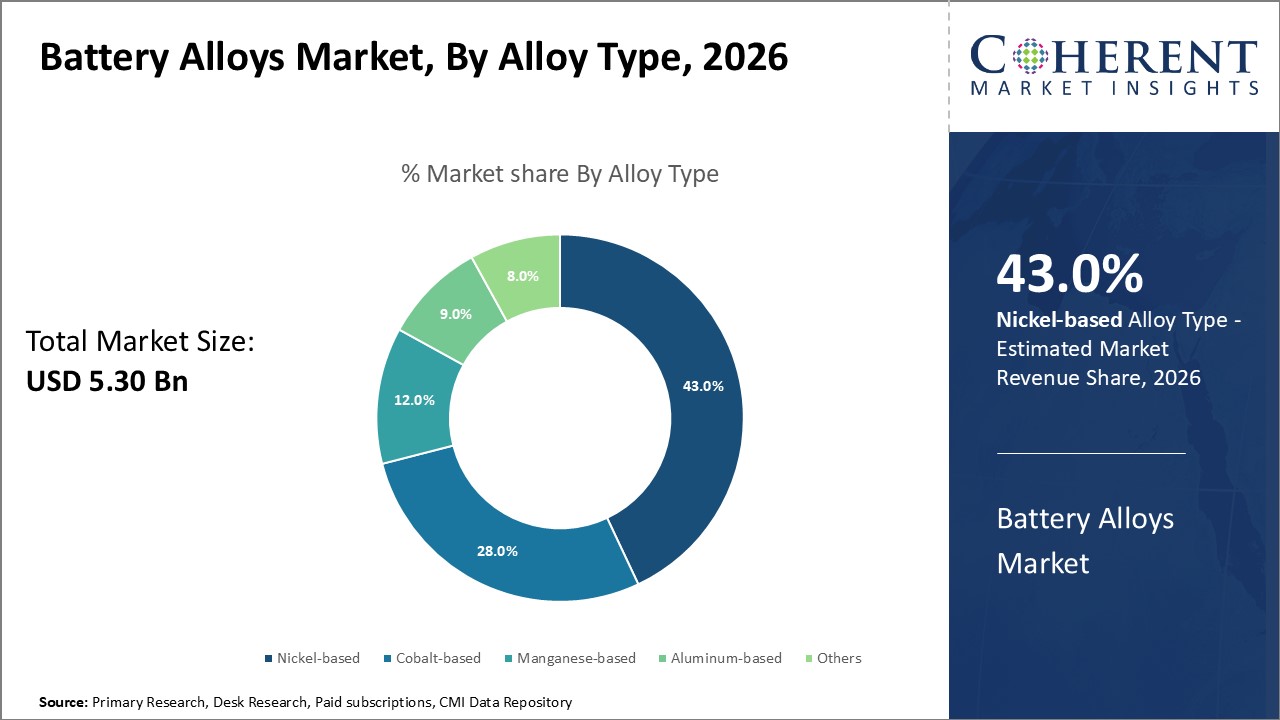
The nickel-based alloy segment holds a dominant 43% industry share, driven by its superior energy density benefits in lithium-ion batteries. Manganese-based alloys demonstrate rapid growth due to cost-effectiveness and environmental friendliness.
The Electric Vehicles application segment leads market revenue generation, supported by accelerating EV adoption worldwide, whereas energy storage systems represent the fastest-growing market segment given increasing grid-scale renewable integration.
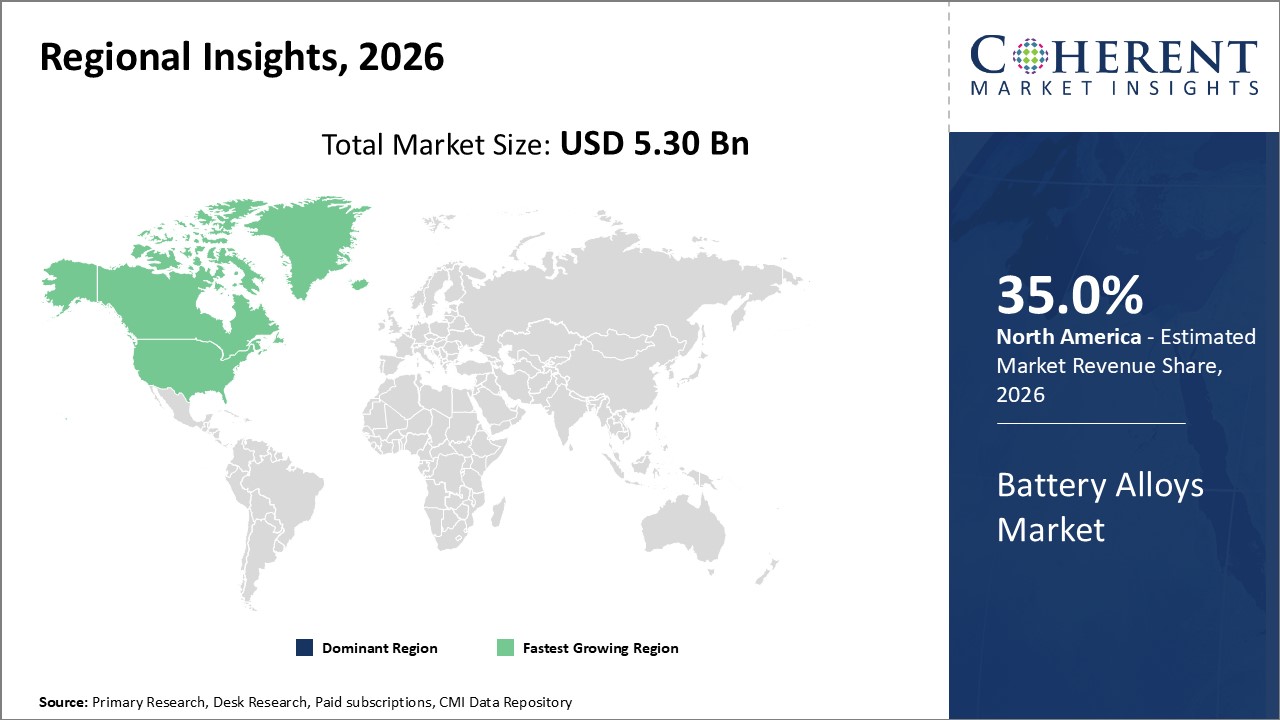
North America dominates the regional market with approximately 35% market share, bolstered by strong EV manufacturing hubs and extensive investment in battery research ecosystems.
Asia Pacific exhibits the fastest regional CAGR, underpinned by China’s robust battery alloy manufacturing and governmental support.
Battery Alloys Market Segmentation Analysis
Battery Alloys Market Insights, By Alloy Type
Nickel-based alloys lead because of their high energy density and performance stability, making them indispensable in lithium-ion batteries powering electric vehicles. Their thermal stability reduces fire risks, a critical safety factor prioritized by automakers. Manganese-based alloys are witnessing the fastest growth as they offer a cost-effective and environmentally friendlier alternative while maintaining adequate electrochemical performance. Cobalt-based alloys remain vital for their high energy and longevity benefits but face supply restraints and ethical sourcing challenges. Aluminum-based alloys play a niche role, predominantly in enhancing battery structural integrity and heat dissipation.
Battery Alloys Market Insights, By Application
The dominance of the Electric Vehicles segment is anchored in the global push towards decarbonization, extensive EV adoption incentives, and rapid urbanization trends. Battery alloys in this segment require high durability and energy density, propelling demand for nickel and manganese-based alloys. Energy Storage Systems represent the fastest-growing application, fueled by renewable energy integration and increasing demand for grid stabilization solutions. Consumer Electronics maintain steady growth, emphasizing miniaturization and power density. Industrial Batteries are expanding with the rise in automation and industrial electrification.
Battery Alloys Market Insights, By Battery Type
Lithium-ion Batteries retain dominance owing to their established manufacturing base and superior performance in electric vehicles and electronics. Advances in nickel and cobalt alloy formulations have improved cycle life and charge efficiency, enhancing lithium-ion battery appeal. Solid-state Batteries exhibit the fastest growth trajectory due to their promise of higher energy density and safety features; R&D investments targeting compatible battery alloys have surged accordingly. Nickel-metal Hydride Batteries are relevant mainly in industrial and hybrid vehicle applications with moderate growth.
Battery Alloys Market Trends
Recent battery alloy industry trends emphasize sustainability and high-performance innovations.
For instance, the transition to low-cobalt and cobalt-free battery alloys is a notable development, evidenced by battery manufacturers reducing cobalt content by over 26% in 2025 to address ethical sourcing concerns.
Nanostructured alloy technology is another rising trend, enhancing charge efficiency and thermal management; this is supported by a 21% year-over-year increase in related patent applications.
Additionally, government regulations globally have catalyzed investment in battery recycling infrastructures, fostering a circular economy around battery metals.
Battery Alloys Market Insights, By Geography
North America Battery Alloys Market Analysis and Trends
North America is the fastest-growing region with a CAGR exceeding 14%. This acceleration is supported by aggressive EV policies in the U.S., increased investment in battery research clusters, and growing alliances between battery alloy producers and automotive firms such as Panasonic and Johnson Matthey. The region’s innovation-driven ecosystem and established industrial infrastructure spur this rapid growth trajectory.
Asia Pacific Battery Alloys Market Analysis and Trends
Asia Pacific holds dominance in the Battery Alloys market, representing nearly 40% of the global market share. The region’s market leadership stems from its vast manufacturing base, abundant raw material reserves, particularly in China and Australia, and strong governmental policy support fostering electric vehicle adoption and battery production. Major players like CNMC and POSCO have significantly contributed to Asia Pacific’s stronghold by expanding alloy production facilities and innovation hubs.
Battery Alloys Market Outlook for Key Countries
USA Battery Alloys Market Analysis and Trends
The U.S. battery alloys market benefits from federal incentives under the Inflation Reduction Act, encouraging EV adoption and domestic battery manufacturing, fueling demand for advanced battery alloys. American companies such as Johnson Matthey and American Battery Materials Corporation focus on localized processing and shape alloy technology advancements, enhancing battery performance. Additionally, partnerships with universities and national labs increase R&D efficiency, positioning the U.S. as a critical market player influencing global market dynamics.
China Battery Alloys Market Analysis and Trends
China’s market remains the largest in Asia Pacific, driven by its dominance in EV production and battery manufacturing sectors. Chinese companies like CNMC and CATL not only supply raw materials but also invest heavily in alloy innovation and scale production to meet domestic and export demand. Government initiatives promoting clean energy vehicles and substantial infrastructure investments reinforce China’s commanding market presence and the trajectory of the battery alloys industry.
Analyst Opinion
The demand-side dynamics prominently influence market size as the rapid adoption of electric vehicles in markets like China and Europe has driven the requirement for high-performance battery alloys. For instance, in 2025, battery alloy consumption in EVs grew approximately 30% year-over-year, indicating strong use-case penetration across automotive sectors.
On the supply side, recent expansions in alloy processing capacities, particularly in North America and East Asia, have increased market revenue streams. The production capacity for nickel-based battery alloys in 2026 is projected to exceed 150,000 metric tons globally, supporting robust industrial demand.
Pricing volatility in raw materials such as cobalt and nickel has emerged as a critical market challenge. Price fluctuations in 2025 reached a 21% variance, compressing margins and prompting market players to optimize alloy compositions for cost-efficiency without compromising performance.
Micro-indicators like the rise in research and development investments focused on solid-state and lithium-ion batteries are increasingly shaping market trends. For example, funding in battery alloy innovation rose by 16% in 2025, signaling strategic intent to overcome current alloy limitations.
- Current Industry Events of 2026
- Market Size Estimation
- Regional Breakdown
- Competitive Landscape
- Customer Intelligence
- Segmental Analysis
- Pricing Analysis
- Key Market Drivers, Challenges & Future Trends
- Customized Insights Section
Market Scope
| Report Coverage | Details | ||
|---|---|---|---|
| Base Year: | 2025 | Market Size in 2026: | USD 5.30 billion |
| Historical Data for: | 2020 To 2024 | Forecast Period: | 2026 To 2033 |
| Forecast Period 2026 to 2033 CAGR: | 12.7% | 2033 Value Projection: | USD 10.9 billion |
| Geographies covered: |
| ||
| Segments covered: |
| ||
| Companies covered: | Panasonic Corporation, BASF SE, Umicore, Johnson Matthey plc, Sumitomo Metal Mining Co., Ltd., JFE Steel Corporation, Glencore International AG, Freeport-McMoRan Inc., Eldorado Lithium, American Battery Materials Corporation. | ||
| Growth Drivers: |
| ||
Battery Alloys Market Growth Factors
The escalating adoption of EVs worldwide is the primary growth driver, with countries such as China and the U.S. announcing extensive EV incentives fueling demand for battery alloys. Secondly, advances in alloy technology that enhance battery safety and longevity directly contribute to market growth, as witnessed by the 18% increase in battery life cycles reported by automotive manufacturers in 2025. Thirdly, governmental policies promoting clean energy have stimulated investments in battery recycling, thereby optimizing alloy reuse and reducing environmental burdens. Additionally, the rising penetration of energy storage systems in grid applications has expanded the application scope, enhancing market revenue potential.
Battery Alloys Market Development
In October 2026, East Penn Manufacturing introduced its proprietary Armor Alloy Technology for Deka HRC lead batteries, engineered for mission-critical data center applications. The technology blends pure lead with a specialized alloy formulation to enhance conductivity, mechanical strength, and long-term durability under high-load, high-temperature operating environments.
In October 2026, at the Battery Show, Boway Alloy unveiled a new lineup of high-performance copper alloys for electric and new energy vehicles, designed to improve electrical efficiency, reduce system costs, and strengthen global supply chain competitiveness for automakers and battery manufacturers.
In April 2026, Hindalco delivered 10,000 low-carbon aluminum battery enclosures to Mahindra from its Chakan, India, facility, marking a major milestone in domestic EV component manufacturing. The company aims to scale production for additional global OEMs as demand grows for lightweight, thermally efficient, and sustainable battery-grade aluminum solutions.
Key Players
Leading Companies of the Market
Panasonic Corporation
BASF SE
Umicore
Johnson Matthey plc
Sumitomo Metal Mining Co., Ltd.
JFE Steel Corporation
Glencore International AG
Freeport-McMoRan Inc.
Eldorado Lithium
American Battery Materials Corporation
Several market players like Panasonic and BASF SE are adopting aggressive growth strategies, including vertical integration and strategic partnerships to secure raw material supply chains. For instance, Panasonic’s recent alliance with nickel mining firms led to a 16% reduction in production lead times and enhanced alloy quality control. Similarly, Johnson Matthey’s investment in new refining technologies delivered a 11% improvement in alloy purity, driving product differentiation and higher market share.
Battery Alloys Market Future Outlook
In the coming years, rapid electrification—particularly electric vehicles, renewable energy storage, and grid resilience initiatives—will redefine alloy demand and innovation. Manufacturers are expected to shift toward lightweight, high-conductivity, and recyclable alloy compositions, including aluminum-, magnesium-, and advanced lithium-based blends. Government sustainability policies, circular economy strategies, and technological progress in solid-state and sodium-ion batteries will influence alloy formulation, sourcing, and manufacturing. Competitive advantage will increasingly depend on material efficiency, supply-chain resilience, and environmental footprint reduction.
Battery Alloys Market Historical Analysis
Historically, the battery alloys market grew in parallel with the widespread adoption of lead-acid batteries for automotive starting, lighting, and ignition systems. Lead–antimony and lead–calcium alloys dominated the early decades due to cost efficiency and proven performance in grid casting and current collection. The rise of consumer electronics and industrial backup power further expanded alloy diversification, introducing nickel- and lithium-based alloy applications. Market maturity accelerated as battery reliability, lifecycle performance, and corrosion control became commercial priorities.
Sources
Primary Research Interviews:
Battery Materials Scientists
Automotive Battery Engineers
Metals & Mining Analysts
Energy Storage System Integrators
Databases:
BloombergNEF Battery Materials Data
USGS Mineral Commodity Summaries
Magazines:
Battery Power Magazine
Mining Weekly
Renewable Energy World
Materials Today
Journals:
Journal of Power Sources
Electrochimica Acta
Advanced Energy Materials
Journal of Alloys and Compounds
Newspapers:
Financial Times (Energy & Metals)
The Wall Street Journal (Automotive & Technology)
Nikkei Asia (Manufacturing)
The Economic Times (EV & Materials)
Associations:
International Battery Association (IBA)
Battery Council International (BCI)
International Energy Agency (IEA)
Society of Automotive Engineers (SAE)
Get access to 250+ pages report
Every segment, forecast, competitor profile and data table behind the analysis above — available for instant download.
- ESOMAR Member
- ISO 9001:2015 Certified
- D-U-N-S Registered
- GDPR & CCPA Compliant
Missing comfort of reading report in your local language? Find your preferred language:
Transform your Strategy with Exclusive Trending Reports
Frequently Asked Questions
The dominant players include Panasonic Corporation, BASF SE, Umicore, Johnson Matthey plc, and Sumitomo Metal Mining Co., Ltd., who lead through innovation, supply chain integration, and strategic partnerships.
The Battery Alloys market size is projected to reach USD 10.9 billion by 2033, growing at a CAGR of 12.7% from 2026 to 2033, driven by escalating demand in electric vehicles and energy storage applications.
The Electric vehicle industry presents the largest growth opportunity due to increased global adoption and supportive policies encouraging EV production and usage.
Market trends will shift towards sustainable alloy compositions, recycling innovations, and nanostructured alloys, enhancing battery capacity and reducing environmental impact.
The competitive landscape is characterized by technological advancements and raw material supply constraints, with challenges including pricing volatility and regulatory pressures on material sourcing.
Market players adopt vertical integration, strategic partnerships, and investment in R&D to improve alloy performance and secure raw material supply chains.