

Global Building Insulation Materials Market Size and Forecast – 2026-2033
The global building insulation materials market is expected to grow from USD 35.55 Bn in 2026 to USD 52.00 Bn by 2033, registering a compound annual growth rate (CAGR) of 6% from 2026 to 2033. The global building insulation materials market is driven by growing construction activity in emerging economies. On June 11, 2025, Armacell, a global leader in flexible foam for the equipment insulation market and a leading provider of engineered foams, officially inaugurated its newest manufacturing facility in Pune, India. The new ArmaGel XG product line in Pune is available for high temperature applications, plus cryogenic and dual-temperature conditions.
Key Takeaways of the Global Building Insulation Materials Market
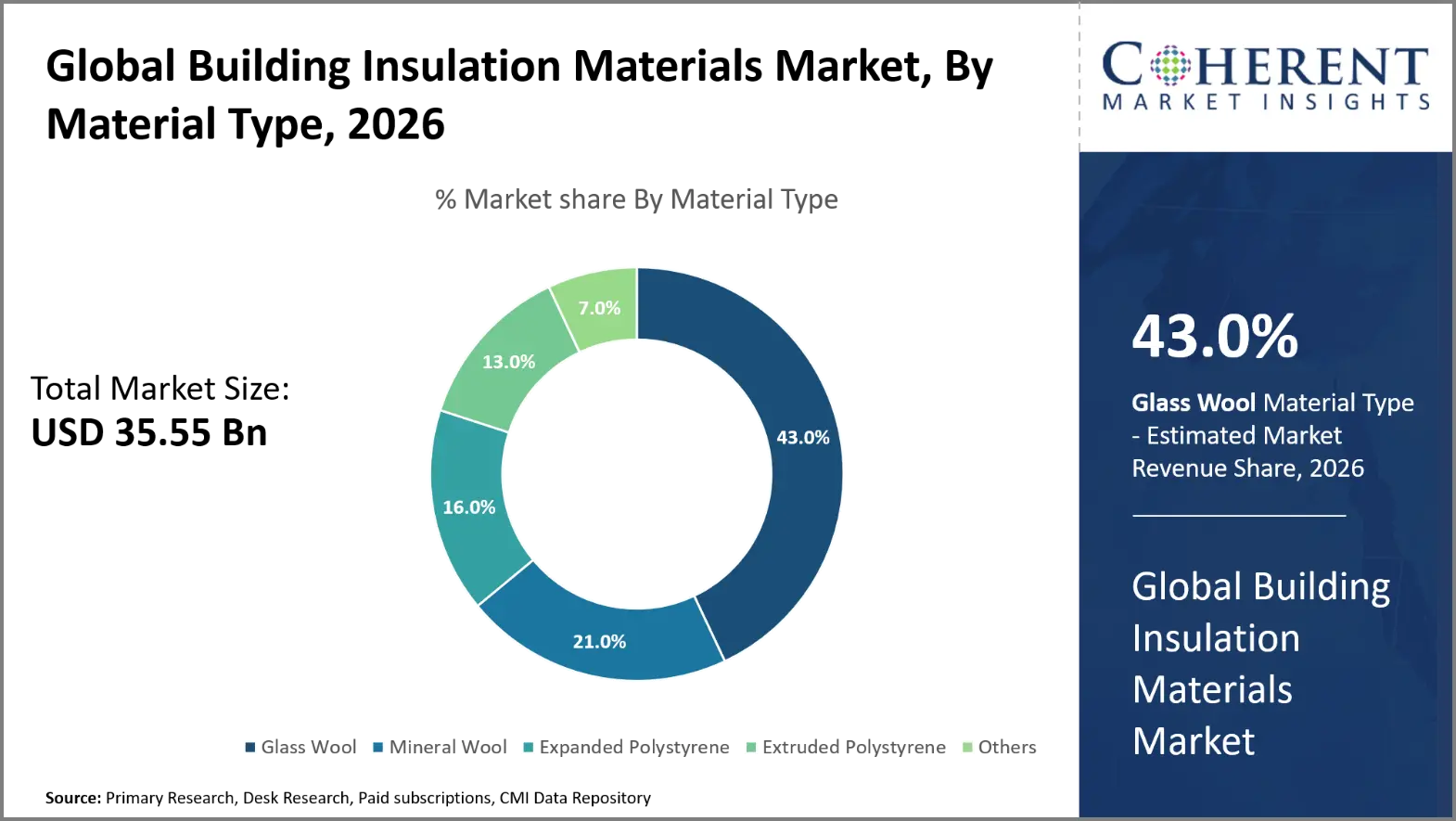
- The Glass Wool segment is expected to account for 43.0% of the global building insulation materials market share in 2026. Rising demand for temperature control and indoor comfort is driving the growth of the segment. On February 20, 2025, Panasonic Industry introduced its Vacua series vacuum insulation panels at ACREX India 2025. The panels target buildings, housing, container houses, and temperature-sensitive applications.
- The New Construction segment is estimated to capture 57.0% of the market share in 2026. Rising demand for insulation in affordable housing projects is majorly driving the growth of the segment. On March 4, 2025, Saint-Gobain launched EnveoVent, an integrated insulated wall system designed partly for social housing construction. The system combines a timber frame with mineral wool insulation containing up to 65% recycled glass.
- The Residential Buildings segment is estimated to capture 32.0% of the market share in 2026. Increasing adoption of high-performance insulation in passive buildings is majorly driving the growth of the segment. In August 2025, Cross Construction completed Project One in Utah, which received certification from the Passive House Institute United States. The residence incorporates roof insulation rated R-60 and below-grade wall insulation rated R-32.
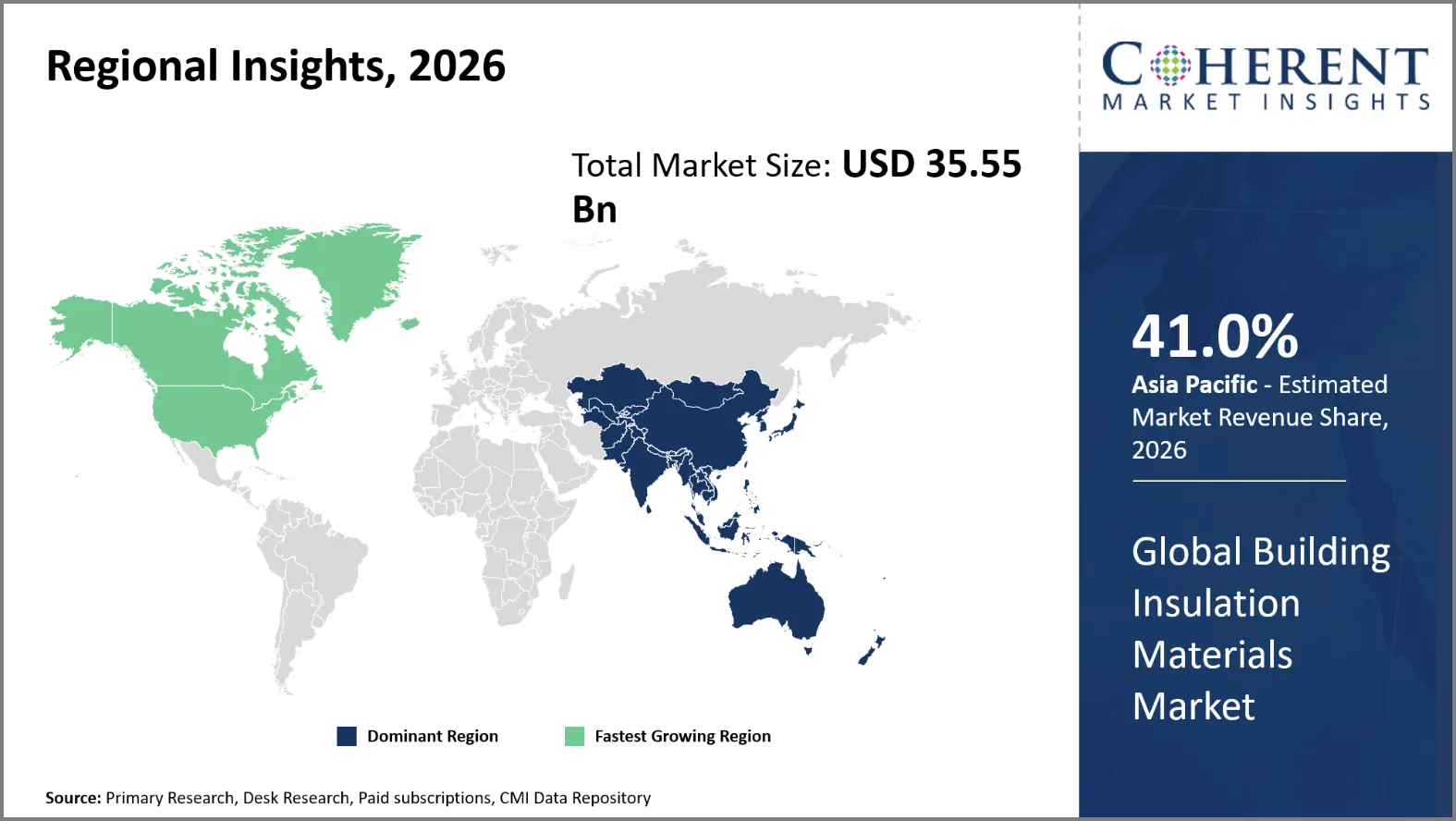
- Asia Pacific is expected to dominate the building insulation materials market in 2026 with a market share of 41.0%. Increasing renovation and retrofitting of older buildings in Asia Pacific is driving the growth of the regional market. On April 8, 2025, Nikken Sekkei announced the environmental renovation of its 57-year-old Building No. 1 in Japan. The project combined sprayed polyurethane foam insulation on roofs and exterior walls with interior secondary glazing.
- North America is expected to account for 35.0% share in 2026 and is projected to record the fastest growth over the forecast period. Greater adoption of sustainable and recycled insulation materials in North America is driving the growth of the regional market. On June 13, 2025, CertainTeed introduced Lanaé glass fiber insulation in Canada, made with up to 82% recycled material and a bio-based binder. Made at its Alberta and Ontario plants, the product is meant to provide thermal insulation and acoustic comfort without formaldehyde-based binders.
Segmental Insights
Why Does Glass Wool Dominate the Global Building Insulation Materials Market?
The glass wool segment is expected to account for 43.0% of the global building insulation materials market share in 2026. Glass wool is dominant because it combines thermal insulation, sound absorption and fire resistance. Being light in nature, it may be easily transported, handled and installed on walls, roofs, ceilings and floors. Manufacturers use recycled glass and mineral raw materials to manufacture glass wool, therefore contributing to resource efficiency. Flexible, it may be installed between wall studs and roof structures with little modifications. Further, glass wool allows buildings to save on heating and cooling, hence promoting energy efficiency. It is available in rolls, batts and loose-fill for a variety of building uses.
On August 13, 2025, Saint-Gobain announced the start of building of its 7th float glass factory and its 5th mineral wool insulation line in Chennai, India. This expansion is a key milestone, reinforcing the Group’s strategic commitment to improve local manufacturing capabilities and grow in the Indian market.
- Current Industry Events of 2026
- Market Size Estimation
- Regional Breakdown
- Competitive Landscape
- Customer Intelligence
- Segmental Analysis
- Pricing Analysis
- Key Market Drivers, Challenges & Future Trends
- Customized Insights Section
Why is New Construction the Most Crucial Installation Type?
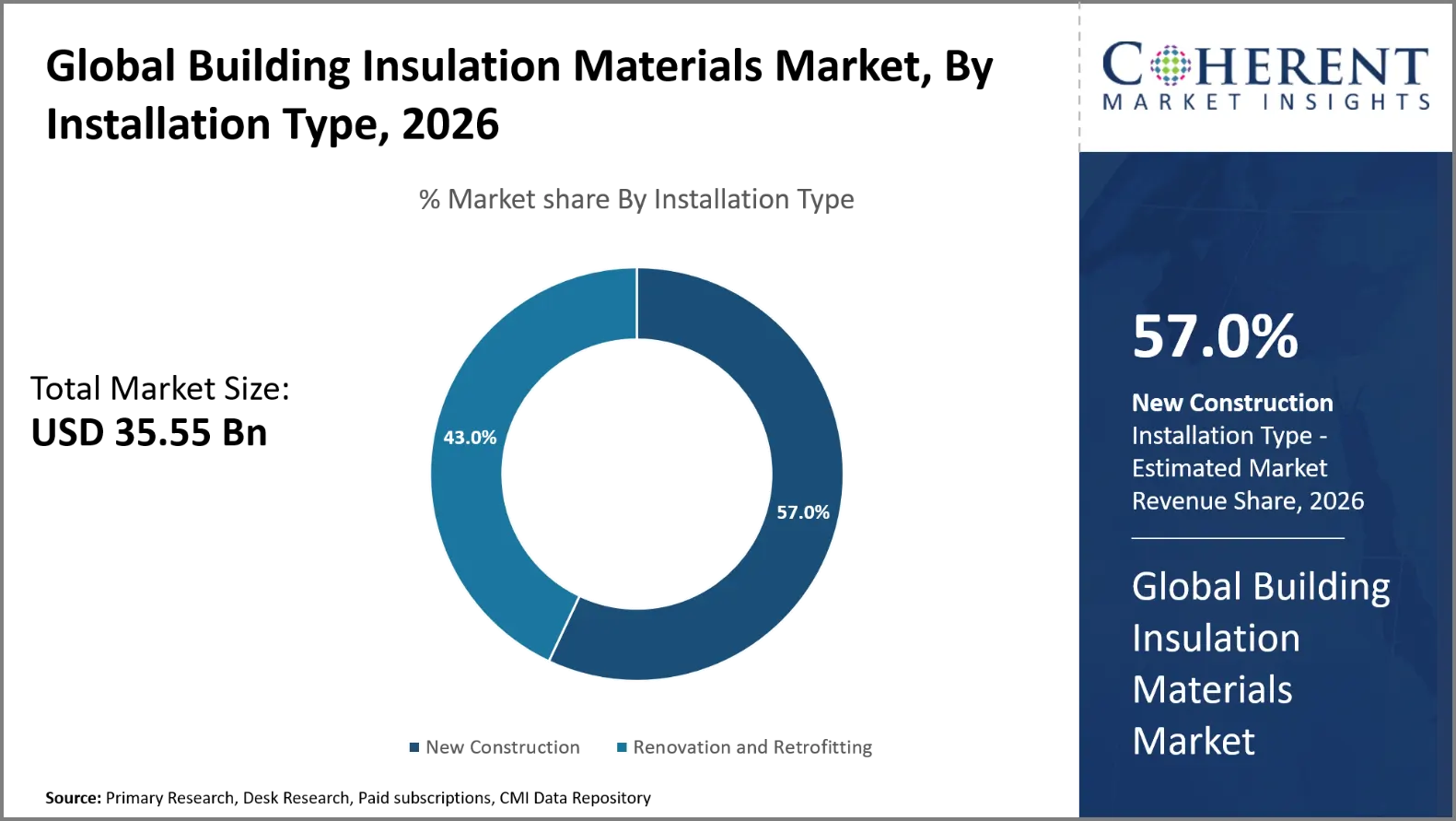
The new construction segment is expected to account for 57.0% of the global building insulation materials market share in 2026. New construction is an important installation type since insulation can be installed during the original building phase. Architects and contractors can install insulation in walls, roofs, floors and foundations before interior finishes are put in. This provides better consistency of installation and causes less interruption than upgrading occupied structures. Increasingly, building codes and energy-efficiency standards are affecting insulation criteria for new residential and commercial construction. Insulation is also a consideration for developers in increasing indoor comfort, minimizing energy costs and satisfying sustainability goals.
On July 4, 2025, Knauf Insulation opened a new mineral wool manufacturing facility in Tashkent, Uzbekistan. The plant can produce enough insulation to serve up to 40,000 homes annually. The investment strengthens regional supply for residential construction and building energy-efficiency improvements.
Residential Buildings Dominates the Global Building Insulation Materials Market
The residential Buildings segment is expected to account for 32.0% of the global building insulation materials market share in 2026. Residential buildings dominate the global building insulation materials market because homes require effective temperature control and comfortable indoor environments. Insulation minimizes the amount of heat that moves through the walls, roofs, floors and other parts of buildings. This helps homeowners control heating and cooling costs while boosting year-round comfort. Urban populations are growing and housing is being built, so the demand for insulating materials is rising. Developers and homeowners are becoming more conscious of energy efficiency in terms of choosing building materials and designing their buildings. Residential insulation also helps reduce outside noise and meet relevant building energy requirements. In November 2025, BASF announced that its Cavipor clay foam insulation had gained approval for floor slabs and roofs. The mineral-based material can also fill cavities within double-wall masonry. Its application range supports thermal insulation across several parts of residential building envelopes.
Current Events and their Impact
Current Events | Description and its Impact |
European Union Energy Performance of Buildings Directive (EU) 2024/1275 |
|
India Energy Conservation and Sustainable Building Code for Residential Buildings |
|
Building Insulation Materials Market Dynamics
Market Drivers
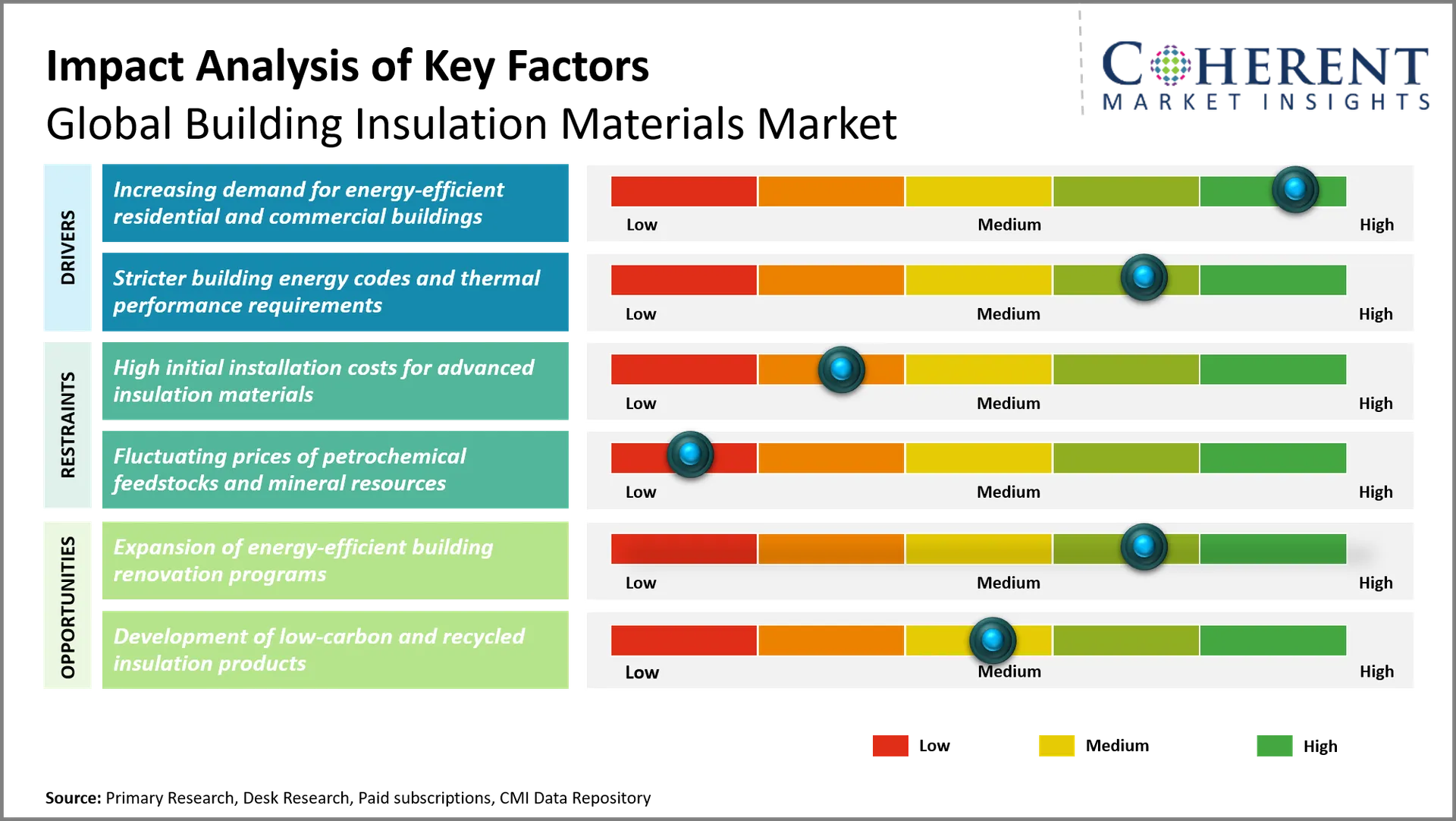
Increasing demand for energy-efficient residential and commercial buildings
The rising demand for energy-efficient residential and commercial buildings is boosting the adoption of sophisticated insulation materials across the globe. Building owners are starting to see the benefits of lower energy usage, increased interior comfort, and reduced heating and cooling costs. Glass wool, mineral wool, cellulose and rigid foam boards reduce heat transfer through walls, roofs and floors. The need for insulation in residential complexes, offices, hospitals and educational institutions is further reinforced with rising pace of urbanization and mounting construction activity. Sustainability commitments also push developers to use materials that can enhance building performance. The demand for effective insulation solutions in new building and renovation projects continues to be driven by these considerations.
On February 25, 2025, GAF announced that the full line of GAF EnergyGuard NH TCPP-Free Polyiso products is now available at standard polyiso pricing. GAF was the first in the marketplace to launch a full line of polyiso insulation solutions utilizing a non-halogenated flame retardant that is TCPP-Free.
Stricter building energy codes and thermal performance requirements
Stricter building energy codes and thermal performance standards are leading to increased use of insulation in global construction markets. Governments are upgrading building standards to reduce operating energy use and increase thermal efficiency. Insulation resistance, building-envelope performance, airtightness and energy-efficiency certification are increasingly being mandated by regulations. These considerations influence material selection in design and realization of architecture. To attain required levels of thermal efficiency, builders are using glass wool, mineral wool and rigid insulation boards. And compliance requirements make verified product specifications and proper installation techniques even more important.
On October 29, 2025, Saint-Gobain published updated Environmental Product Declarations for its principal insulation products made in Vamdrup, Denmark. The declarations recorded an average cut of more than 20% in carbon footprint.
Market Restraints
- High Initial Installation Costs: Building insulation projects have upfront costs for supplies, trained labor, installation equipment, and building changes. These costs can be prohibitive for budget-conscious households and developers, especially in price-sensitive areas where long-term energy savings are not given any financial consideration.
- Moisture Management and Installation Complexity: Improperly installed insulation can lead to condensation and moisture build up and lower thermal performance. The choice of acceptable materials is determined by the environment, the ventilation system and the architecture of the structure. These technical constraints lead to higher inspection needs, higher maintenance costs and hazards of premature deterioration of materials.
Emerging Trends
- Growing Adoption of Low-Carbon Insulation Materials: Insulation manufacturers are creating solutions made with recycled glass, recovered industrial resources, and bio-based feedstocks. These solutions assist to reduce embodied carbon, encourage circular construction methods and meet growing demand for ecologically responsible building materials.
- Increasing Demand for High-Performance Insulation Systems: Construction professionals have started using innovative insulation materials with enhanced thermal resistance and slim profiles. Aerogel blankets, vacuum insulation panels and high-performance foam boards assist maximize usable interior space and meet strict energy efficiency requirements.
- Integration of Smart Building Technologies: Building insulation is more frequently being integrated into smart thermostats, energy management systems, and connected building controls. This combination helps to better control the inside temperatures, lower the demand of heating and cooling, and improve the overall building efficiency using coordinated energy management.
- Expansion of Insulation Retrofitting and Renovation: Governments and property owners are focusing on upgrading insulation in current buildings to boost energy efficiency. Retrofitting external walls, attics, roofs and floors helps reduce heat transmission and increase occupant comfort, and supports building decarbonization aims.
Regional Insights
Why is Asia Pacific a Strong Market for Building Insulation Materials?
Asia Pacific is expected to account for a market share of 41.0% in 2026. Factors supporting growth of the Asia Pacific building insulation materials market include widespread urban expansion, industrialized construction and different climatic conditions. China’s prefabricated housing efforts promote factory-installed insulation in wall panels and roofing systems. Japan’s energy-efficiency laws are increasing the demand for thermal efficiency in the building envelope. Cooling requirements in India drive reflective roof systems and insulation in commercial structures. Australia’s National Construction Code has provisions for building energy efficiency and thermal performance. South Korea’s apartment construction and building retrofitting plans promote insulation retrofits. Insulation in South East Asian countries also needs to be suitable for humid climates, prevent condensation and work with air-conditioned structures. These distinct construction priorities support demand for glass wool, mineral wool, expanded polystyrene, and polyurethane insulation.
Why Does North America Building Insulation Materials Market Exhibit High Growth?
North America is expected to register the fastest growth with a CAGR of 7.2% over the forecast period. It is projected to account for 35.0% of the global building insulation materials market in 2026. The North American building insulation materials market benefits from cold-climate housing, energy retrofits, and stringent fire-safety requirements. Canada’s National Energy Code for Buildings 2025 updates model-code requirements for energy-efficient building design. Provinces and territories will decide whether to take it up. In the U.S., energy rules based on climate affect how much insulation is needed in residential walls, attics, crawl spaces, and business roofs. Fiberglass batts still make sense in framed homes and spray polyurethane foam for irregular voids and air sealing. Mineral wool is also well suited to tasks needing fire resistance and acoustic separation. Demand additionally comes from basement insulation, frozen-weather protection, and upgrades to older housing stock.
Global Building Insulation Materials Market Outlook for Key Countries
Why is China Emerging as a Major Hub in the Building Insulation Materials Market?
China’s building insulation materials market is shaped by prefabricated construction, district heating requirements, and fire-safety considerations in high-rise residential developments. Factory-produced wall panels allow insulation layers to be incorporated before buildings reach construction sites. Expanded and extruded polystyrene boards are used for exterior wall, roof and foundation applications. Mineral wool is ideal for applications where non-combustible insulation and enhanced fire performance are required. In the North, cities need to have good envelope insulation to limit the loss of heat in the winter, whereas in the South, the focus is on cooling efficiency and controlling solar heat. China’s large-scale apartment construction also drives the demand for insulation suitable for concrete façades and exterior finishing systems. Domestic manufacturing capacity supports material availability across large construction programs.
Is U.S. the Next Growth Engine for the Building Insulation Materials Market?
U.S. building insulation materials industry is driven by climate-zone requirements, home energy audits and federal residential energy-efficiency measures. In cold northern areas, sufficient attic, basement and external wall insulation is necessary to control winter heat loss. More and more, hot southern areas need roof and attic insulation to reduce cooling demands. Fiberglass batts are a good choice for traditional timber-frame construction, and blown-in cellulose is a good option for retrofitting existing attics without much interior destruction. Spray foam works well for tasks that require air sealing complex architectural shapes. Insulation contractors also support weatherization programs for qualifying households. Local building codes determine applicable thermal-performance requirements, creating different product specifications across states and municipalities.
Germany Building Insulation Materials Market Analysis and Trends
Germany’s building insulation materials market is strongly influenced by energy-efficient renovation, heating-system modernization, and European building decarbonization policies. The Building Energy Act, for short the Building Energy Act, contains provisions which affect building energy efficiency and heating systems. The external thermal insulation composite solutions are frequently employed for the upgrade of the existing brick facades. Mineral wool boards are especially applicable in those cases where fire performance and sound insulation are important, e.g. in multifamily housing. Glass wool is used for pitched roofs, lofts and internal barriers. In older residential structures with high heat losses, it is vital to improve the roof insulation. Germany’s established building renovation sector also supports demand for insulation compatible with brick façades, timber roofs, and heritage-sensitive refurbishment.
Japan Building Insulation Materials Market Analysis and Trends
Japan’s building insulation materials market benefits from mandatory energy-efficiency standards for new buildings, residential reconstruction, and demand for improved thermal comfort. Energy-efficiency rules have usually applied to new buildings, including smaller residential buildings from April 2025. Insulation requirements need to include Japan’s many temperature zones, from frigid Hokkaido to humid southern areas. Glass wool has an extensive range of applications for timber framed structures. Rigid foam boards are used for foundation insulation and floor assemblies. Refurbishment projects also include older residences with poor thermal performance. Better insulation helps reduce winter indoor temperature differences and summer cooling demand. Earthquake-conscious construction further encourages lightweight insulation systems compatible with timber framing and modern building assemblies.
India Building Insulation Materials Market Analysis and Trends
India’s building insulation materials market is influenced by extreme summer temperatures, commercial air-conditioning demand, and the expansion of industrialized construction. The Energy Conservation and Sustainable Building Code for Residential Buildings 2024 addresses residential energy performance and building-envelope design. Reflective roof systems and roof insulation are particularly relevant in hot locations, like Rajasthan and Gujarat. Commercial construction, industrial facilities and air-conditioning ducts use glass and mineral wool. Polyurethane panels support temperature-controlled warehouses, food processing facilities and cold-chain infrastructure. Insulated metal panels are also used for prefabricated manufacturing and logistical facilities. India's booming pharmaceutical manufacturing industry translates into increased demand for controlled interior environments and thermally efficient building envelopes.
Global Building Insulation Materials Market - Insulation Adoption in Existing Buildings vs. New Construction
Metric | Existing Buildings | New Construction |
Main insulation opportunity | Energy-efficiency retrofits and replacement of inadequate insulation | Integrating insulation during initial building construction |
Global annual renovation rate | Approximately 1–2% of the building stock annually | Not directly comparable with renovation rates |
European Union building indicator | Approximately 75% of buildings have poor energy performance | New buildings must comply with applicable national energy requirements |
Global energy-code coverage | Existing buildings increasingly face renovation and performance policies | Around 60% of new buildings globally were covered by building energy codes in mid-2025 |
Primary insulation applications | Roof upgrades, external wall insulation, attic insulation, and basement improvements | Walls, roofs, floors, foundations, and insulated façade systems |
How is Expansion of Energy-Efficient Building Renovation Programs Creating New Growth Opportunities in the Building Insulation Materials Market?
The expansion of energy-efficient building rehabilitation programs is offering growth potential by expanding insulation upgrades to older buildings with poor walls, roofs and attic areas. The EU’s Energy Performance of Buildings Directive (EU) 2024/1275 enhances national renovation planning and building decarbonization activities. Germany’s building restoration programs promote the use of external wall insulation systems and mineral wool roof upgrades. In the US, qualifying homes can benefit from residential weatherization programs to enhance insulation and reduce heating losses. Japan's energy efficiency measures for housing promote thermal improvements to older timber-framed homes. These programs create specific opportunities for glass wool batts, blown-in cellulose, rigid foam boards, and mineral wool systems suited to existing building structures.
On September 30, 2025, Trane, a global climate innovator, completed a groundbreaking electrification and decarbonization retrofit at 55 Water Street, New York City’s largest office building. In a first for a U.S. commercial building, Trane installed a cutting-edge Storage Source Heat Pump heat recovery system, creating a highly efficient, flexible and resilient energy solution that sets a blueprint for modernizing large-scale commercial properties.
Market Players, Key Development, and Competitive Landscape
Key Developments
- On June 4, 2025, Saint-Gobain announces the launch of very low-carbon glass wool production at its Isover plant in Forssa, Finland. The Forssa plant is now powered exclusively by decarbonized energy owing to the installation of 3 pressurized biogas tanks.
- On December 10, 2024, ROCKWOOL approved an investment in a new production line in Mississippi, U.S., for industrial insulation products. The new production line will help meet the growing demand from the process industry in the Gulf of Mexico region.
- On May 14, 2024, Knauf Insulation announced a major investment of in a new state-of-the-art rock mineral wool factory to serve the UK market. The large-scale facility, with an annual capacity in excess of 100,000 tons, will utilize cutting-edge, low-carbon electric melting technology, demonstrating a strong commitment to meet the growing market demand for sustainable, non-combustible insulation solutions.
Competitive Landscape
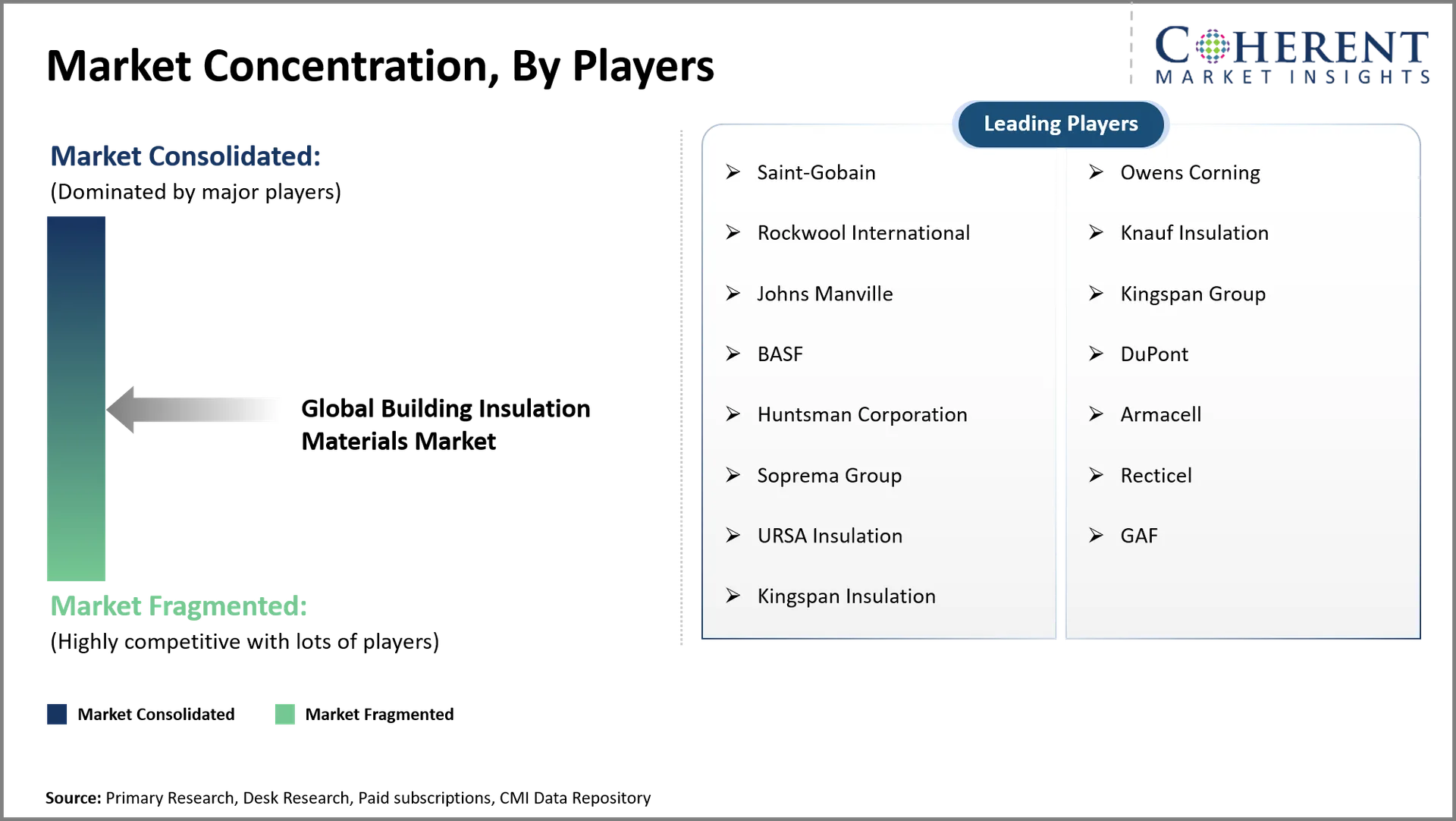
The worldwide building insulation materials market is dominated by established players competing on the parameters of product innovation, fire safety, thermal performance and sustainable material development. Saint-Gobain reinforces its position with ISOVER glass wool and mineral wool solutions for residential insulation and building envelopes for the commercial sector. Owens Corning is a leading producer of fiberglass insulation, air sealing and residential energy-efficiency applications. ROCKWOOL offers non-combustible materials made of stone wool for façades, roofs, partitions and industrial buildings. Kingspan Group is a leader in insulated panels and high-performance building envelope systems for the industrial and commercial building sectors. Knauf Insulation makes mineral and glass wool for new build and refurbishment projects. These companies differentiate themselves through regional manufacturing, specialist product portfolios, technical support, and solutions tailored to local building regulations.
Top Manufacturers and Notable Products in the Building Insulation Materials Market
Manufacturer | Notable Product | Key features |
Saint-Gobain Isover | Lanaé Glass Wool Insulation | Bio-based binder, thermal insulation, sound absorption, lightweight handling, and recycled glass content |
Owens Corning | PINK Next Gen Fiberglas Insulation | Fiberglass thermal insulation, lightweight batts, flexible installation, and residential energy-efficiency applications |
ROCKWOOL | ROCKWOOL Stone Wool Insulation Boards | Fire resistance, sound absorption, thermal performance, dimensional stability, and moisture management |
Knauf Insulation | ECOSE Glass Mineral Wool Insulation | Formaldehyde-free binder technology, thermal and acoustic insulation, lightweight structure, and easier handling |
Kingspan | Kooltherm Phenolic Insulation Boards | High thermal resistance per unit thickness, rigid board construction, space-saving insulation, and building-envelope applications |
Market Report Scope
Report Coverage | Details | ||
Base Year | 2025 | Market Size in 2026: | USD 35.55 Bn |
Historical Data For: | 2020 To 2024 | Forecast Period: | 2026 To 2033 |
Forecast Period 2026 To 2033 CAGR: | 6% | 2033 Value Projection: | USD 52.00 Bn |
Geographies covered: |
| ||
Segments covered: |
| ||
Companies covered: | Saint-Gobain, Owens Corning, Rockwool International, Knauf Insulation, Johns Manville, Kingspan Group, BASF, DuPont, Huntsman Corporation, Armacell, Soprema Group, Recticel, URSA Insulation, GAF, Kingspan Insulation | ||
Growth Drivers: |
| ||
Restraints & Challenges: |
| ||
Analyst Opinion (Expert Opinion)
- The future of the building insulation materials industry will depend on building renovation, energy-efficiency enforcement, and demand for specialized insulation systems. Existing buildings present opportunities because many require roof, wall, and cavity insulation upgrades without complete reconstruction. Glass wool should remain relevant for residential roofs and wall cavities because installers can adapt it to conventional building structures. Mineral wool offers opportunities in high-rise façades, fire-rated partitions, and commercial buildings requiring acoustic performance. Manufacturers also need create insulating technologies that can be incorporated into prefabricated structures, where factory integration can simplify the complexity of assembly on site.
- Renovation in Europe, residential development in India and energy efficient commercial buildings in the U.S. will offer the greatest prospects. In older dwelling stock in Germany, there are possibilities for external wall insulation and roof renovation. In India, there are particular opportunities for roof insulation, insulated metal panels and polyurethane systems for cold-storage facilities. Attic renovations, basement insulation and duct insulation in the U.S. serve different residential and business needs. Manufacturers should focus on products that fit the local environment, fire safety needs, moisture exposure, and installation techniques in these areas, instead of depending on a single insulating formulation.
- Material innovation combined with application-specific technical support and reliable local distribution can give market players a competitive edge. Manufacturers should increase recycled material, record embodied carbon, and publish transparent thermal-resistance and fire-performance data. Product development should focus on installation issues such as moisture control, uneven retrofit cavities, and thermal bridging at windows. Complete systems can also be designed and manufactured by companies including insulating boards, membranes, fasteners and appropriate façade finishes. Specifying opportunities can be strengthened by strategic alliances with architects, contractors, housing remodelers and manufacturers of pre-fabricated buildings. Affordable product formats and installation training can increase acceptance in emerging markets without compromising building performance.
Speak to the analyst
Want personalized insights?
Take the findings above to one of our principal consultants, or have the report rebuilt around the segments, geographies and competitors you actually track.
Market Segmentation
- Material Type Insights (Revenue, USD Billion, 2021 - 2033)
- Glass Wool
- Mineral Wool
- Expanded Polystyrene
- Extruded Polystyrene
- Others
- Installation Type Insights (Revenue, USD Billion, 2021 - 2033)
- New Construction
- Renovation and Retrofitting
- Building Type Insights (Revenue, USD Billion, 2021 - 2033)
- Residential Buildings
- Commercial Buildings
- Industrial Buildings
- Institutional Buildings
- Product Type Insights (Revenue, USD Billion, 2021 - 2033)
- Batt and Roll Insulation
- Rigid Board Insulation
- Loose-Fill Insulation
- Spray Foam Insulation
- Reflective Insulation
- Structural Insulated Panels
- Application Insights (Revenue, USD Billion, 2021 - 2033)
- Wall Insulation
- Roof and Ceiling Insulation
- Floor Insulation
- Basement Insulation
- Foundation Insulation
- Others
- Regional Insights (Revenue, USD Billion, 2021 - 2033)
- North America
- U.S.
- Canada
- Latin America
- Brazil
- Argentina
- Mexico
- Rest of Latin America
- Europe
- Germany
- U.K.
- Spain
- France
- Italy
- Russia
- Rest of Europe
- Asia Pacific
- China
- India
- Japan
- Australia
- South Korea
- ASEAN
- Rest of Asia Pacific
- Middle East
- GCC Countries
- Israel
- Rest of Middle East
- Africa
- South Africa
- North Africa
- Central Africa
- North America
- Key Players Insights
- Saint-Gobain
- Owens Corning
- Rockwool International
- Knauf Insulation
- Johns Manville
- Kingspan Group
- BASF
- DuPont
- Huntsman Corporation
- Armacell
- Soprema Group
- Recticel
- URSA Insulation
- GAF
- Kingspan Insulation
Sources
Primary Research Interviews
- Insulation Material Manufacturers & Suppliers
- Construction Contractors & Builders
- Architects & Building Design Consultants
- Green Building Certification Experts & Energy Efficiency Consultants
Magazines
- Insulation Outlook Magazine
- Construction Today Magazine
- Building Products Digest
- Green Building & Design Magazine
Journals
- Energy and Buildings Journal (Elsevier)
- Journal of Building Engineering
- Construction and Building Materials Journal (Elsevier)
Associations
- North American Insulation Manufacturers Association (NAIMA)
- European Insulation Manufacturers Association (EURIMA)
- Insulation Contractors Association of America (ICAA)
- U.S. Green Building Council (USGBC)
Public Domain Sources
- U.S. Department of Energy (DOE) – Building Technologies Office
- European Commission – Energy Efficiency in Buildings Reports
- International Energy Agency (IEA) – Buildings Sector Data
- United Nations Environment Program (UNEP) – Sustainable Buildings Reports
Proprietary Elements
- CMI Data Analytics Tool
- Proprietary CMI Existing Repository of Information for the last 10 years
Get access to 250+ pages report
Every segment, forecast, competitor profile and data table behind the analysis above — available for instant download.
- ESOMAR Member
- ISO 9001:2015 Certified
- D-U-N-S Registered
- GDPR & CCPA Compliant
Frequently Asked Questions
The global building insulation materials market is expected to stand at USD 35.55 Bn in 2026 and is expected to reach USD 52.00 Bn by 2033.
The CAGR of the global building insulation materials market is projected to be 6% from 2026 to 2033.
Increasing demand for energy-efficient residential and commercial buildings and Stricter building energy codes and thermal performance requirements are the major factors driving the growth of the global building insulation materials market.
High initial installation costs for advanced insulation materials and Fluctuating prices of petrochemical feedstocks and mineral resources are the major factors hampering the growth of the global building insulation materials market.
In terms of material type, glass wool segment is estimated to dominate the market revenue share in 2026.
Building insulation materials reduce heat transfer through walls, roofs, floors, ceilings, and other building components.
Building insulation slows heat transfer through the building envelope, reducing heating and cooling requirements.