

Global Capacitor Films Market Size and Forecast – 2026 To 2033
The Global Capacitor Films Market is estimated to be valued at USD 3.72 Bn in 2026 and is expected to reach USD 5.41 Bn by 2033, growing at a compound annual growth rate (CAGR) of 5.5% from 2026 to 2033. Market expansion is supported by the increasing use of film capacitors in electric vehicle traction systems, renewable energy converters, industrial drives, charging infrastructure, and high-power electronic equipment, where low dielectric losses, high current-handling capability, and long operating life are critical.
Demand is also shifting toward compact, high-voltage capacitor designs as power electronics operate at greater power densities and switching frequencies. In April 2026, KYOCERA AVX released its FFLK series traction-grade DC filtering film capacitors for electric vehicle traction systems and industrial motor-control applications, designed to provide higher current handling in compact packages under high-power and high-temperature operating conditions. This development highlights the growing requirement for advanced capacitor-film technologies in demanding power-conversion applications.
Key Takeaways of the Global Capacitor Films Market
- Biaxially Oriented Polypropylene (BOPP) Films are expected to register a 6.1% CAGR during 2026–2033, while holding 52.8% of the global capacitor films market in 2026. Their low dielectric loss, self-healing suitability, thermal stability, and efficient high-volume processing make BOPP the preferred dielectric for DC-link and power capacitors. In April 2025, Zhejiang Nanyang Huacheng and Brückner signed an agreement covering ten additional PP capacitor-film lines for EV applications.
- 4 or 9 Micron films are expected to record a 5.8% CAGR during 2026–2033 and account for 46.8% of the global capacitor films market in 2026. This gauge range offers a practical balance between dielectric strength, winding stability, metallization efficiency, and capacitor compactness across power-electronics applications. In July 2026, Dafu detailed its Brückner capacitor-film line producing 2.4–8 μm BOPP grades, directly covering much of this commercially important thickness window.
- Automotive and Electric Vehicles are expected to post a 7.2% CAGR during 2026–2033 and represent 28.6% of the market in 2026. Film capacitors are increasingly embedded in traction inverters, onboard chargers, DC-DC converters, and high-voltage filtering because they tolerate repetitive electrical and thermal stress. In February 2026, TDK introduced polypropylene DC-link film capacitors designed for demanding xEV traction-inverter, onboard-charger, and industrial power-electronics environments.
- Asia Pacific is expected to expand at a 5.9% CAGR during 2026–2033 while accounting for 47.8% of the global capacitor films market in 2026. Its leadership reflects concentrated film manufacturing, capacitor assembly, EV production, renewable-energy equipment, and electronics supply chains, allowing faster qualification and lower procurement friction. In May 2026, India-based SRF reported trial runs at its KAPLAR plant, marking its entry into capacitor-grade BOPP film production.
- Europe is expected to grow at a 6.6% CAGR during 2026–2033 and hold 24.6% of the global capacitor films market in 2026, making it the fastest-growing region. Expansion is supported by deeper electrification of transport and industry, grid modernization, renewable integration, and demand for high-reliability power electronics. In July 2026, the European Commission unveiled an electrification action plan targeting a substantially higher electricity share across European energy use.
Segmental Insights
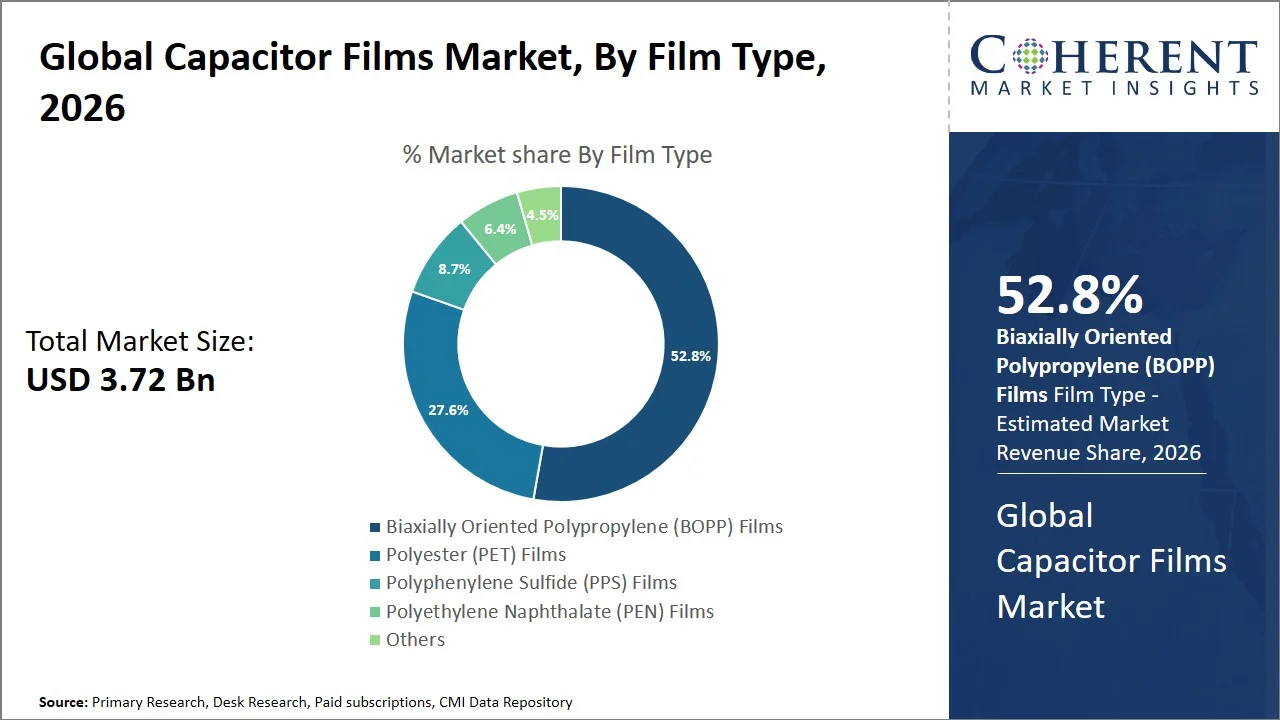
Why Do Biaxially Oriented Polypropylene (BOPP) Films Dominate the Global Capacitor Films Market?
Biaxially Oriented Polypropylene (BOPP) Films are expected to hold 52.8% of the global capacitor films market in 2026. Their leadership comes from low dielectric loss, strong insulation resistance, self-healing compatibility after metallization, and favorable material economics for high-volume capacitor production. BOPP also tolerates repeated charge-discharge cycles while supporting thin-gauge winding, making it suitable for DC-link, power-factor correction, renewable-energy, and industrial-drive capacitors. On the supply side, established stretching and metallization infrastructure gives BOPP producers a scale advantage over higher-cost specialty polymers. This keeps the material commercially attractive for capacitor manufacturers requiring dependable electrical performance without excessive system cost. In November 2025, Xiamen Changsu Industrial globally launched its new-generation high-end BOPP capacitor film, demonstrating continued supplier investment in advanced polypropylene dielectric grades for new-energy applications.
- Current Industry Events of 2026
- Market Size Estimation
- Regional Breakdown
- Competitive Landscape
- Customer Intelligence
- Segmental Analysis
- Pricing Analysis
- Key Market Drivers, Challenges & Future Trends
- Customized Insights Section
Why Does the 4 or 9 Micron Segment Represent the Largest Thickness Category in the Global Capacitor Films Market?
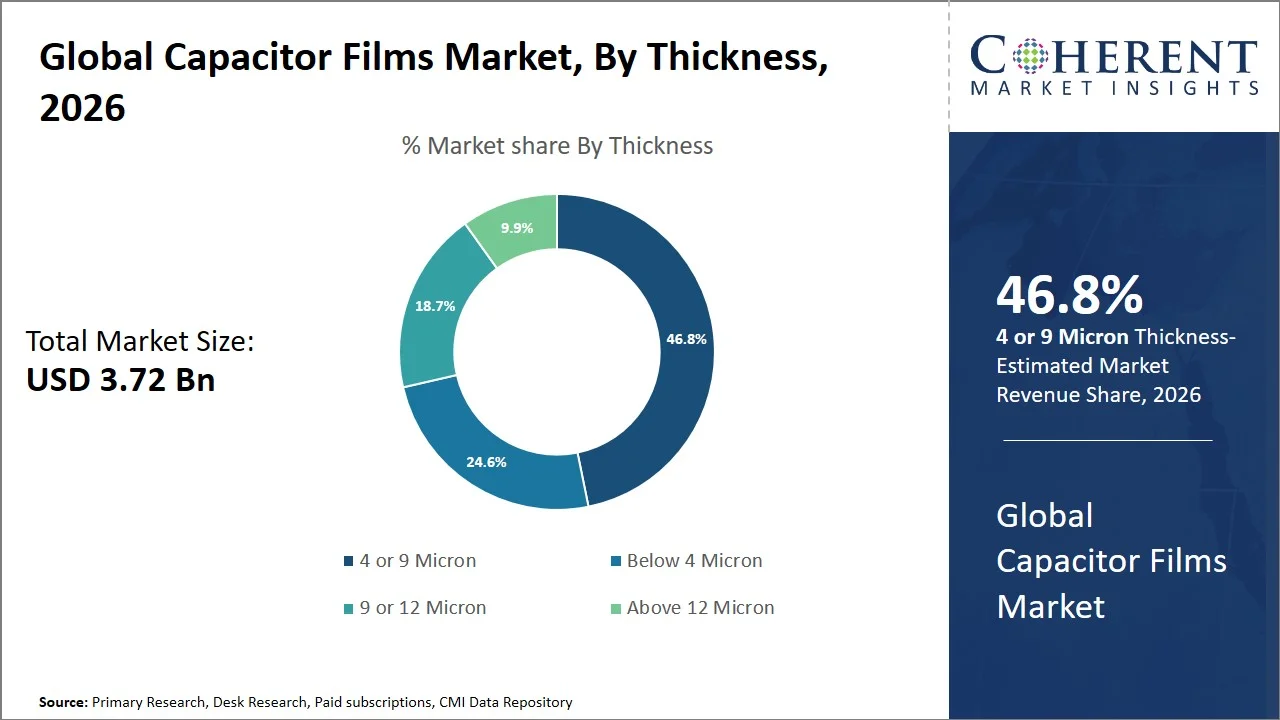
The 4 or 9 Micron segment is expected to account for 46.8% of the global capacitor films market in 2026. This thickness band occupies a practical design window between electrical insulation, capacitance density, winding stability, and manufacturing yield. Films within this range can reduce capacitor volume compared with thicker gauges without imposing the extreme handling, defect-control, and web-tension challenges associated with ultra-thin films. The segment therefore fits a broad installed base of metallized capacitors used in industrial drives, renewable inverters, power-correction systems, and vehicle electronics. For film producers, this range also supports efficient slitting and metallization across multiple voltage classes, improving asset utilization and customer coverage. In March 2026, Xpro India commissioned a new dielectric-film line at Barjora; its disclosed capability covers precision-engineered films from 2 to 16 microns, directly encompassing the commercially important 4–9 micron range.
Why Do Automotive and Electric Vehicles Dominate the Application Segment of the Global Capacitor Films Market?
Automotive and Electric Vehicles are expected to represent 28.6% of the global capacitor films market in 2026. The segment leads because modern vehicles contain multiple power-conversion stages where film capacitors provide DC-link stabilization, ripple-current handling, filtering, and protection against voltage fluctuations. Electrified powertrains intensify these requirements through traction inverters, onboard chargers, DC/DC converters, electric compressors, and thermal-management systems. Automotive qualification also favors capacitor films with controlled dielectric behavior, humidity resistance, thermal endurance, and consistent metallization, creating higher technical entry barriers than many general electrical applications. Suppliers meeting these specifications can secure longer design cycles and deeper OEM or Tier-1 relationships. In September 2025, Vishay introduced its AEC-Q200-qualified MKP1848e metallized polypropylene DC-link capacitor for automotive power conversion, including onboard chargers, powertrains, HVAC systems, e-compressors, and DC/DC converters.
Current Events and their Impact
Current Event | Description and Its Impact |
FERC Order No. 1920 – May 2024 |
|
India Approves PM E-DRIVE Scheme – September 2024 |
|
U.S. DOE Transmission Facilitation Investment – October 2024 |
|
Global Capacitor Films Market Dynamics
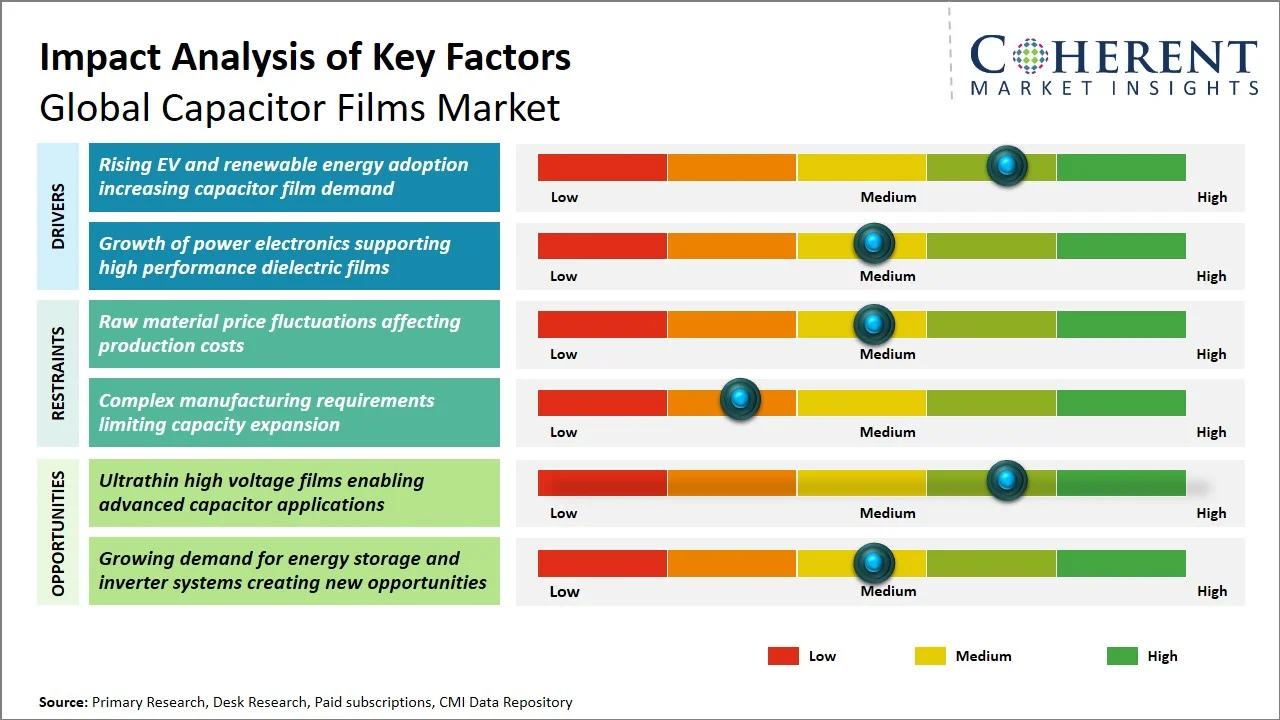
Key Market Drivers
- Rising EV and renewable energy adoption increasing capacitor film demand: Rising EV and renewable energy adoption is widening the installed base of traction inverters, onboard chargers, fast-charging systems, solar inverters, and wind-power converters that rely on stable DC-link and filtering performance. This raises demand for low-loss capacitor films with controlled thickness, high dielectric strength, and dependable self-healing behavior. Film extruders, metallizers, and capacitor manufacturers with automotive and energy qualifications stand to gain most. In March 2025, BYD unveiled its 1000V Super e-Platform with megawatt-class charging, reinforcing the move toward higher-voltage EV power architectures that increase dielectric-performance requirements.
- Growth of power electronics supporting high performance dielectric films: Growth in high-frequency power electronics is changing the performance threshold for dielectric films. Silicon carbide and gallium nitride devices switch faster, run at higher temperatures, and enable denser inverter designs, placing greater electrical and thermal stress on DC-link capacitors. This favors suppliers able to deliver tighter gauge control, lower dissipation, better thermal stability, and application-specific metallization. In February 2025, Infineon began releasing products based on its 200 mm silicon carbide manufacturing technology for high-voltage applications including electric vehicles, renewable energy, and trains, accelerating the ecosystem for advanced power conversion.
Emerging Market Trends
- Application-Specific Dielectric Engineering Replacing Standardized Film Procurement: Capacitor-film procurement is moving away from standardized gauge-and-width buying toward application-specific dielectric engineering. Buyers increasingly evaluate film roughness, thermal endurance, metallization compatibility, winding behavior, partial-discharge resistance, and long-duration electrical stability as an integrated performance package rather than as isolated specifications. This is pushing film producers closer to capacitor designers during qualification and prototyping. Suppliers with flexible pilot-scale capability, narrow process windows, and fast customization cycles should gain pricing power, while commodity producers may face greater difficulty entering demanding automotive, traction, and grid applications.
- Qualification-Led Localization Reshaping Capacitor Film Sourcing: Qualification-led localization is becoming a structural procurement trend rather than a temporary response to logistics disruption. Capacitor manufacturers and Tier suppliers are increasingly seeking geographically diversified film sources, traceable resin inputs, regional metallization options, and backup capacity that can be qualified before shortages occur. Because dielectric changes can trigger lengthy validation work, buyers are likely to favor suppliers that support dual-sourcing without altering electrical performance. Over the forecast period, this should reward regional producers with consistent quality systems and penalize suppliers competing mainly on spot pricing or long-distance availability.
Regional Insights
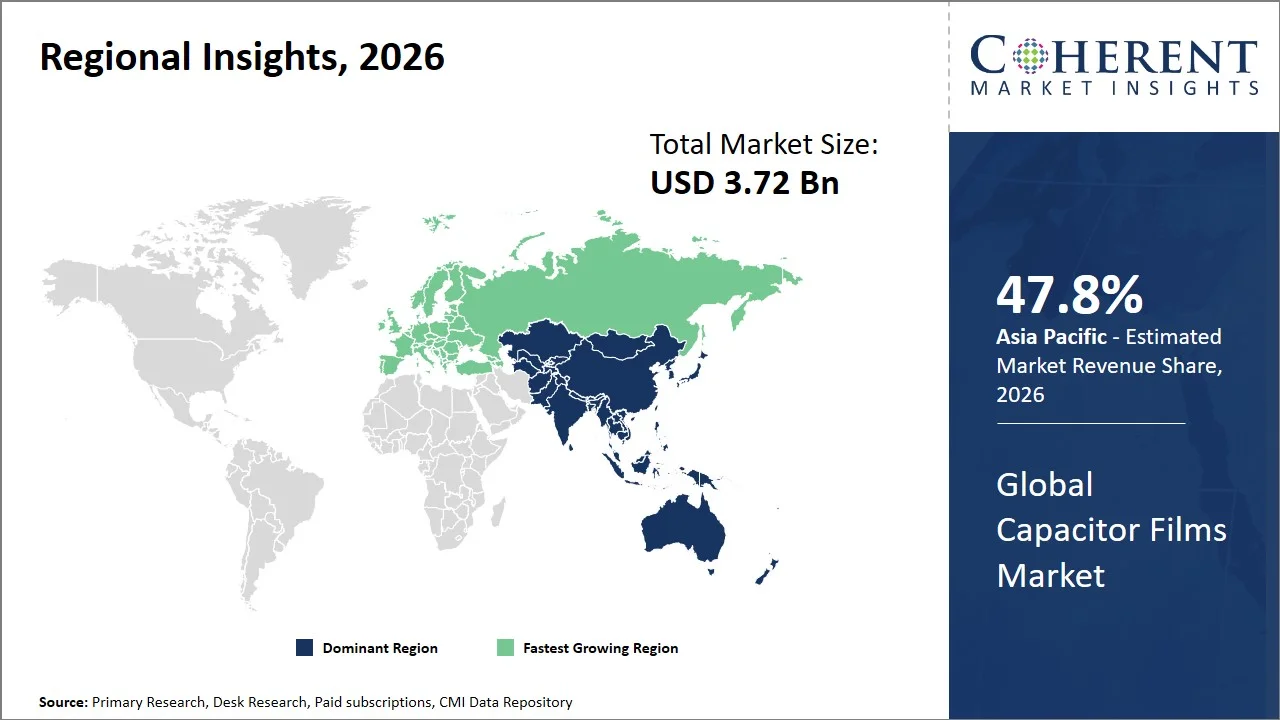
Why Does Asia Pacific Dominate the Global Capacitor Films Market?
Asia Pacific is expected to account for 47.8% of the global capacitor films market in 2026, supported by the region’s unusually dense combination of dielectric-film production, capacitor manufacturing, electric-vehicle assembly, consumer electronics, renewable-energy equipment, and power-electronics supply chains. China, Japan, and South Korea provide large downstream demand while also supporting BOPP and PET film conversion, metallization, precision slitting, and capacitor qualification capabilities. This concentration reduces lead times between film producers and component manufacturers and allows faster development of thinner, higher-voltage grades for DC-link and inverter applications. In May 2026, the International Energy Agency reported that electric-car sales across Asia Pacific countries excluding China were expected to grow by more than 50% during 2026, while China remained the world’s largest EV market. This expanding electrification base reinforces regional demand for high-performance capacitor dielectric materials.
Why Is Europe Emerging as the Fastest-Growing Region in the Global Capacitor Films Market?
Europe is expected to hold 24.6% of the global capacitor films market in 2026 and emerge as the fastest-growing region as automotive electrification, grid modernization, offshore wind, industrial automation, and energy-storage deployment raise requirements for high-reliability film capacitors. European customers typically place strong emphasis on thermal endurance, lifetime validation, traceability, and compliance, creating attractive conditions for premium BOPP, PET, PPS, and specialized metallized films rather than purely commodity grades. The region also benefits from established capacitor, inverter, automotive, rail, and industrial-drive engineering clusters. In January 2026, the European Automobile Manufacturers’ Association reported that 1.88 million battery-electric cars were registered in the EU during 2025, with Germany recording 43.2% growth. The expanding electrified vehicle base increases demand for DC-link, filtering, charging, and power-conversion capacitors, supporting faster consumption growth for qualified capacitor films across Europe.
Global Capacitor Films Market Outlook for Key Countries
Why Is the U.S. a Key Market for the Global Capacitor Films Market?
The U.S. is estimated to represent 15.8% of the global capacitor films market in 2026, reflecting a broad demand base spanning electric mobility, utility-scale renewable energy, battery storage, industrial drives, charging infrastructure, aerospace electronics, and rapidly expanding data-center power systems. The country’s strength lies less in commodity film conversion and more in high-value applications where capacitor reliability, voltage endurance, low losses, and long operating life are critical. Domestic power-semiconductor investment is also pushing inverter designs toward higher switching frequencies and power densities, which increases performance requirements for DC-link films. In January 2025, Wolfspeed introduced its Gen 4 silicon-carbide MOSFET platform for 750V, 1200V, and 2300V applications across EVs, renewable energy, storage, and AI data centers. Such high-voltage power architectures create a stronger addressable market for advanced polypropylene and other engineered dielectric films.
Why Does China Support Growth in the Global Capacitor Films Market?
China is estimated to account for 25.6% of the global capacitor films market in 2026, making it the largest individual country market because it combines substantial BOPP film capacity with the world’s deepest electric-vehicle, inverter, solar, wind, consumer-electronics, and industrial-electronics manufacturing ecosystem. Local capacitor producers benefit from nearby polymer suppliers, metallizers, film converters, equipment makers, and high-volume OEM customers, allowing rapid scale-up and aggressive cost optimization. China’s export-oriented electronics and energy-equipment industries further extend capacitor-film demand beyond domestic consumption. In August 2026, official Chinese government data showed that the country’s EV charging infrastructure had reached 23.68 million charging points by the end of July, while new-energy vehicles exceeded 60% of monthly new-car sales for the first time. This scale of electrification supports sustained requirements for DC-link, filtering, charger, and power-conversion capacitors.
Why Is South Korea Important in the Global Capacitor Films Market?
South Korea is estimated to hold 5.9% of the global capacitor films market in 2026, supported by its concentrated automotive, battery, consumer-electronics, semiconductor, and power-electronics industries. Korean manufacturers increasingly design high-efficiency traction systems, onboard chargers, energy-storage converters, and compact industrial electronics, creating demand for dielectric films with tighter thickness tolerance, low dissipation, strong humidity resistance, and reliable high-frequency performance. The country’s export-oriented production model also encourages suppliers to meet global automotive and electronics qualification standards. In November 2025, Hyundai Motor Group announced KRW 125.2 trillion of domestic investment through 2030, including new EV production facilities, electrification technologies, R&D, and manufacturing upgrades. The investment reinforces South Korea’s role as a mobility production hub and expands the downstream equipment base in which film capacitors are used for power conversion and electrical stabilization.
Why Is Germany a Strategic Country in the Global Capacitor Films Market?
Germany is estimated to represent 6.7% of the global capacitor films market in 2026, supported by its premium automotive industry, industrial automation base, renewable-power integration, railway engineering, charging infrastructure, and advanced electrical-equipment manufacturing. German buyers typically demand long service life, stable performance under thermal cycling, precise electrical specifications, and documented quality systems, favoring higher-value capacitor films rather than low-cost general-purpose grades. The country is also advancing vehicle-to-grid and bidirectional charging concepts, which increase the number and complexity of power-conversion stages requiring reliable DC-link and filtering capacitors. In March 2025, Germany’s Federal Ministry for Economic Affairs announced the start of an industry pilot for grid-supportive bidirectional EV charging across multiple network levels. Wider deployment of bidirectional charging would increase demand for durable capacitors capable of repeated high-frequency charge and discharge power conversion.
Why Is Japan an Important Market for the Global Capacitor Films Market?
Japan is estimated to account for 8.1% of the global capacitor films market in 2026, underpinned by its long-standing expertise in polymer film engineering, precision capacitor manufacturing, automotive electronics, railway systems, factory automation, and high-reliability power equipment. Japanese suppliers compete strongly in ultra-thin dielectric control, patterned metallization, thermal stability, and quality consistency, capabilities that are particularly important in compact xEV inverters and industrial power modules. The country’s strong hybrid and electrified-vehicle manufacturing base also sustains demand even where full battery-electric adoption is comparatively gradual. In April 2026, Panasonic Industry commercialized its EZPV-D metallized polypropylene film-capacitor series for automotive, industrial, and infrastructure applications. The launch illustrates continued Japanese investment in high-voltage film-capacitor platforms and supports demand for thin, electrically stable polypropylene films engineered for demanding conversion and filtering circuits.
Innovation, Production & Manufacturing Landscape
Technology / Manufacturing Capability | Current Adoption | Relevance to Capacitor Films | Commercial Impact |
Simultaneous Biaxial Stretching / LISIM Processing | Moving into advanced commercial production | Enables highly uniform ultra-thin polypropylene films while improving control over film orientation and mechanical properties | Supports thinner capacitor designs, higher capacitance density, improved production consistency, and entry into demanding EV and power-electronics applications |
High-Vacuum Al/Zn Metallization & Segmented Electrode Profiles | Widely adopted with increasing customization | Controls electrode resistance, self-healing behavior, current handling, and failure isolation | Allows suppliers to differentiate through application-specific metallization rather than competing solely on base-film thickness |
High-Temperature Dielectric Polymer Engineering | Expanding in automotive and high-power applications | Enhances dielectric stability where conventional films face elevated temperature and electrical stress | Opens premium opportunities in traction inverters, industrial drives, renewable converters, and other harsh-duty electronics |
Nanolayer and Multilayer Dielectric Architectures | Early commercial adoption | Uses controlled polymer-layer structures to improve electrical, thermal, or energy-density characteristics | Could create a performance tier above conventional film grades and support more compact high-voltage capacitor architectures |
Corona/Plasma Surface Treatment | Established but increasingly precision-controlled | Improves surface energy and metallization adhesion while maintaining dielectric integrity | Better surface control can improve downstream metallizing yield, winding consistency, and customer-specific film performance |
Inline Optical & Electrical Defect Inspection | Increasingly integrated into high-specification production | Detects gels, pinholes, thickness deviations, contamination, and electrical weak points before downstream conversion | Higher defect visibility improves qualification consistency, reduces customer rejection risk, and becomes particularly valuable as films become thinner |
How Are Advanced Grid-Conversion Applications Creating New Growth Opportunities in the Global Capacitor Films Market?
The underdeveloped opportunity is not simply supplying more film, but engineering dielectric grades specifically for HVDC converters, STATCOMs, grid-forming inverters, energy-storage power conversion, and high-density data-center power systems. These applications place sustained electrical, thermal, and ripple-current stress on capacitors and create room for films differentiated by low dissipation, thermal stability, controlled surface morphology, and metallization compatibility. Suppliers can capture this opportunity by developing application-specific grades jointly with capacitor OEMs, offering pilot rolls for qualification, supporting patterned metallization, and documenting long-duration performance under realistic duty cycles. Participation requires clean extrusion, tight thickness control, advanced slitting, electrical defect inspection, and technical teams capable of translating converter requirements into film specifications. The opportunity should favor specialist and vertically integrated producers rather than commodity film manufacturers, because qualification depth and repeatability matter more than nominal capacity. Companies that combine base-film know-how with metallization support and regional technical service can build defensible positions before these grid and digital-power applications become fully standardized.
Market Players, Key Development, and Competitive Landscape
Key Developments
- In March 2026, Tervakoski Films Group launched its LISIM line in Svit, Slovakia, after completing installation and initial qualification runs. The line expands ultra-thin capacitor-film capability, supports automotive-grade thickness requirements, and strengthens European supply availability for customers seeking high-performance dielectric films from a locally integrated production base.
- In June 2026, Peak Nano announced that Advanced Conversion had selected NanoPlex LDF film for a new 800V+ silicon-carbide DC-link inverter platform. The design-in moves nanolayer dielectric technology into a demanding e-mobility application and demonstrates a commercialization pathway for films engineered around higher temperature and switching-frequency requirements.
- In June 2025, Cosmo Films announced its advanced Al-Zn metallized polypropylene capacitor films for electric and hybrid vehicle applications. The portfolio targets high-voltage automotive operating conditions with dielectric, thermal, and self-healing performance, strengthening Cosmo's position with EV system integrators seeking application-specific metallized film rather than general-purpose capacitor material.
Competitive Landscape
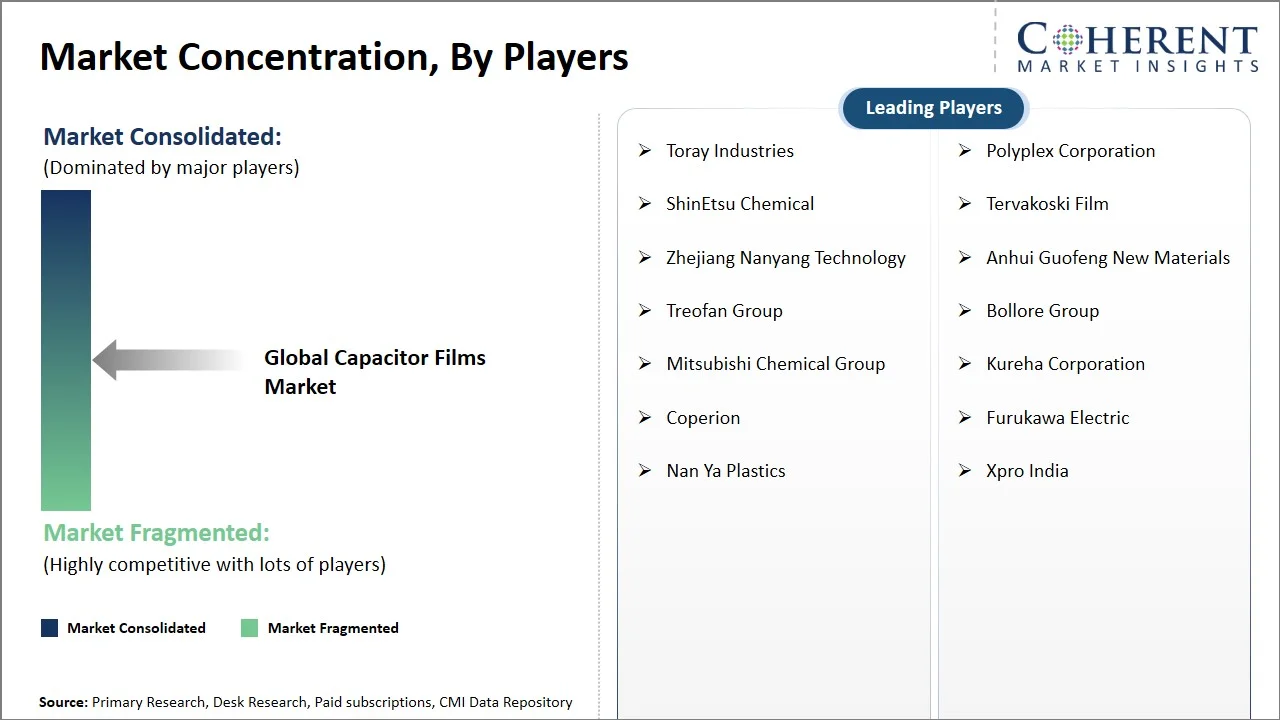
The global capacitor films market is moderately consolidated because high-quality dielectric film production requires specialized stretching, clean processing, precise gauge control, metallization compatibility, and long customer qualification cycles. Global specialists compete alongside regional film producers and capacitor-linked suppliers. Competitive advantage rests less on headline capacity alone and more on consistent electrical performance, ultra-thin yield, reliable supply, customization, traceability, and technical support through customer validation.
Key focus areas include
- Dielectric consistency and breakdown performance: Lot-to-lot uniformity is critical for manufacturers serving high-voltage and long-life capacitor programs.
- Ultra-thin film manufacturing yield: Competitors that reduce film thickness without materially increasing defects gain both performance and cost advantages.
- Metallization flexibility: Custom Al/Zn profiles, margins, resistance gradients, and segmented patterns support application-specific differentiation.
- Automotive and industrial qualification capability: Long validation cycles favor suppliers already embedded with capacitor manufacturers and Tier suppliers.
- Manufacturing capacity and supply continuity: Customers increasingly assess usable qualified capacity rather than installed nameplate capacity alone.
- Regional production and resin security: Local manufacturing, dual sourcing, and dependable access to electrical-grade polymers reduce supply-chain exposure.
- Technical co-development and customer support: Suppliers capable of converting electrical-system requirements into film specifications can secure longer and more defensible customer relationships.
Market Report Scope
Capacitor Films Market Report Coverage
| Report Coverage | Details | ||
|---|---|---|---|
| Base Year: | 2025 | Market Size in 2026: | USD 3.72 Bn |
| Historical Data for: | 2020 To 2024 | Forecast Period: | 2026 To 2033 |
| Forecast Period 2026 to 2033 CAGR: | 5.5% | 2033 Value Projection: | USD 5.41 Bn |
| Geographies covered: |
| ||
| Segments covered: |
| ||
| Companies covered: | Toray Industries, Polyplex Corporation, ShinEtsu Chemical, Tervakoski Film, Zhejiang Nanyang Technology, Anhui Guofeng New Materials, Treofan Group, Bollore Group, Mitsubishi Chemical Group, Kureha Corporation, Coperion, Furukawa Electric, Nan Ya Plastics, Xpro India | ||
| Growth Drivers: |
| ||
| Restraints & Challenges: |
| ||
Analyst Opinion (Expert Opinion)
- The global capacitor films market leadership is likely to shift from selling dielectric film as a specification-based input toward securing design-in positions through qualification data, co-engineering, and lifetime-performance support. Suppliers that can influence capacitor architecture early in the development cycle should become harder to displace, while producers that enter only at the price-negotiation stage may see weaker margins and shorter customer relationships.
- A potentially transformative disruption is the emergence of power systems in which switching speed, heat density, and compact packaging advance faster than conventional dielectric materials can comfortably follow. If that gap widens, buyers may create a distinct premium category for engineered polymer architectures rather than treating capacitor film as a largely interchangeable substrate. Material-science capability could therefore become a direct determinant of system design freedom.
- Market participants should prioritize ultra-thin yield, high-temperature validation, flexible metallization profiles, resin security, and regional qualification support. The strongest investment cases are capabilities that shorten customer approval cycles or improve reliability under demanding duty conditions. Companies should be cautious about adding undifferentiated commodity capacity, because price pressure can quickly erode returns when technical barriers are low and supply becomes abundant.
Speak to the analyst
Want personalized insights?
Take the findings above to one of our principal consultants, or have the report rebuilt around the segments, geographies and competitors you actually track.
Market Segmentation
- Film Type Insights (Revenue, USD Bn, 2021 - 2033)
- Biaxially Oriented Polypropylene (BOPP) Films
- Polyester (PET) Films
- Polyphenylene Sulfide (PPS) Films
- Polyethylene Naphthalate (PEN) Films
- Others
- Thickness Insights (Revenue, USD Bn, 2021 - 2033)
- 4 or 9 Micron
- Below 4 Micron
- 9 or 12 Micron
- Above 12 Micron
- Application Insights (Revenue, USD Bn, 2021 - 2033)
- Automotive and Electric Vehicles
- Renewable Energy Systems
- Consumer Electronics
- Industrial Power Electronics
- Others
- End User Insights (Revenue, USD Bn, 2021 - 2033)
- Automotive
- Electronics and Electrical
- Energy and Power
- Industrial Equipment
- Others
- Distribution Channel Insights (Revenue, USD Bn, 2021 - 2033)
- Direct Sales
- Indirect Sales
- Regional Insights (Revenue, USD Bn, 2021 - 2033)
- North America
- U.S.
- Canada
- Latin America
- Brazil
- Argentina
- Mexico
- Rest of Latin America
- Europe
- Germany
- U.K.
- Spain
- France
- Italy
- Russia
- Rest of Europe
- Asia Pacific
- China
- India
- Japan
- Australia
- South Korea
- ASEAN
- Rest of Asia Pacific
- Middle East
- GCC Countries
- Israel
- Rest of Middle East
- Africa
- South Africa
- North Africa
- Central Africa
- North America
- Key Players Insights
- Toray Industries
- Polyplex Corporation
- ShinEtsu Chemical
- Tervakoski Film
- Zhejiang Nanyang Technology
- Anhui Guofeng New Materials
- Treofan Group
- Bollore Group
- Mitsubishi Chemical Group
- Kureha Corporation
- Coperion
- Furukawa Electric
- Nan Ya Plastics
- Xpro India
Sources
Primary Research Interviews
- Capacitor film manufacturers, metallizers, capacitor producers, power-electronics suppliers, distributors, and OEM procurement teams
- Material scientists, production engineers, R&D professionals, electrical engineers, sourcing managers, and industry executives
Stakeholders
- BOPP, PET, PPS, and PEN capacitor film manufacturers
- Polymer resin suppliers, metallization companies, slitting/converting firms, capacitor manufacturers, distributors, and component suppliers
- Automotive, renewable energy, electronics, industrial equipment, and power-system manufacturers
End-use Sectors
- Automotive and electric vehicles
- Renewable energy systems
- Consumer electronics
- Industrial power electronics
- Electrical and energy infrastructure
Regulatory and Industry Bodies
- Electrical and electronic standards organizations
- Automotive and power-electronics associations
- Environmental and chemical compliance authorities
- Energy and renewable power agencies
- National manufacturing and trade bodies
Databases
- Company annual reports, investor presentations, and corporate filings
- Import-export and polymer-film trade databases
- Capacitor and electronic component databases
- Automotive, renewable energy, and power-electronics datasets
- Product portfolio, pricing, capacity, and competitive intelligence databases
Magazines and Journals
- Electrical and electronic engineering publications
- Polymer and advanced materials journals
- Power electronics and capacitor technology publications
- Automotive electronics journals
- Renewable energy and industrial automation publications
Associations
- IEEE
- International Electrotechnical Commission (IEC)
- Electronic Industries Alliance and regional electronics associations
- Automotive industry associations
- Plastics, polymer-film, and flexible-packaging industry associations
Public Domain Sources
- EV production and charging infrastructure developments
- Renewable energy and grid modernization projects
- Power-electronics and inverter technology developments
- Capacitor film capacity expansions and product launches
- Semiconductor, industrial automation, and electronics manufacturing trends
Key Standards and Regulations
- IEC standards for power capacitors and electronic components
- Automotive electrical component qualification requirements
- RoHS and REACH chemical compliance requirements
- Electrical safety and dielectric performance standards
- Environmental, recycling, and polymer-material regulations
- International trade and customs requirements for capacitor films and electronic components
Proprietary Elements
- CMI Data Analytics Tool and proprietary CMI repository containing 10+ years of electronics, advanced materials, automotive, renewable energy, power equipment, and industrial market intelligence.
Get access to 250+ pages report
Every segment, forecast, competitor profile and data table behind the analysis above — available for instant download.
- ESOMAR Member
- ISO 9001:2015 Certified
- D-U-N-S Registered
- GDPR & CCPA Compliant
Missing comfort of reading report in your local language? Find your preferred language:
Frequently Asked Questions
The global capacitor films market is estimated to be valued at USD 3.72 billion in 2026 and is expected to reach USD 5.41 billion by 2033
The CAGR of global capacitor films market is projected to be 5.5% from 2026 to 2033.
Capacitor films are widely used in electric vehicles, renewable energy systems, industrial power electronics, consumer electronics, power supplies, and high-voltage electrical equipment.
Key purchasing considerations include dielectric strength, thermal stability, dielectric loss, thickness uniformity, metallization compatibility, operating voltage, reliability, and supplier quality consistency.
Thinner dielectric films, advanced metallization techniques, high-temperature materials, and improved defect inspection are enabling more compact and reliable capacitors for high-voltage and high-frequency power electronics.
Major end users include automotive manufacturers, electronics and electrical equipment producers, renewable energy companies, industrial equipment manufacturers, capacitor producers, and power-conversion system suppliers.
Raw material price fluctuations affecting production costs and complex manufacturing requirements limiting capacity expansions are the major factors hampering the growth of global capacitor films market.