

Global Carbon Farming Market Size and Forecast – 2026 To 2033
The Global Carbon Farming Market is estimated to be valued at USD 1.88 Bn in 2026 and is expected to reach USD 4.82 Bn by 2033, exhibiting a compound annual growth rate (CAGR) of 14.40% during the forecast period. Market expansion is supported by increasing investments in regenerative agriculture, growing corporate demand for verified agricultural carbon credits, and the adoption of sustainable farming practices such as conservation tillage, cover cropping, agroforestry, and soil carbon management.
Improvements in digital carbon monitoring and verification are also helping agricultural producers participate in carbon credit programs and access additional revenue opportunities. In September 2026, Agreena announced a seven-year agreement covering 4.45 million tons of soil carbon credits from a project targeting 1.6 million hectares of farmland in Kazakhstan by 2028. The project was undergoing validation, demonstrating how long-term purchasing commitments can support investment in agricultural carbon sequestration.
Key Takeaways of the Global Carbon Farming Market
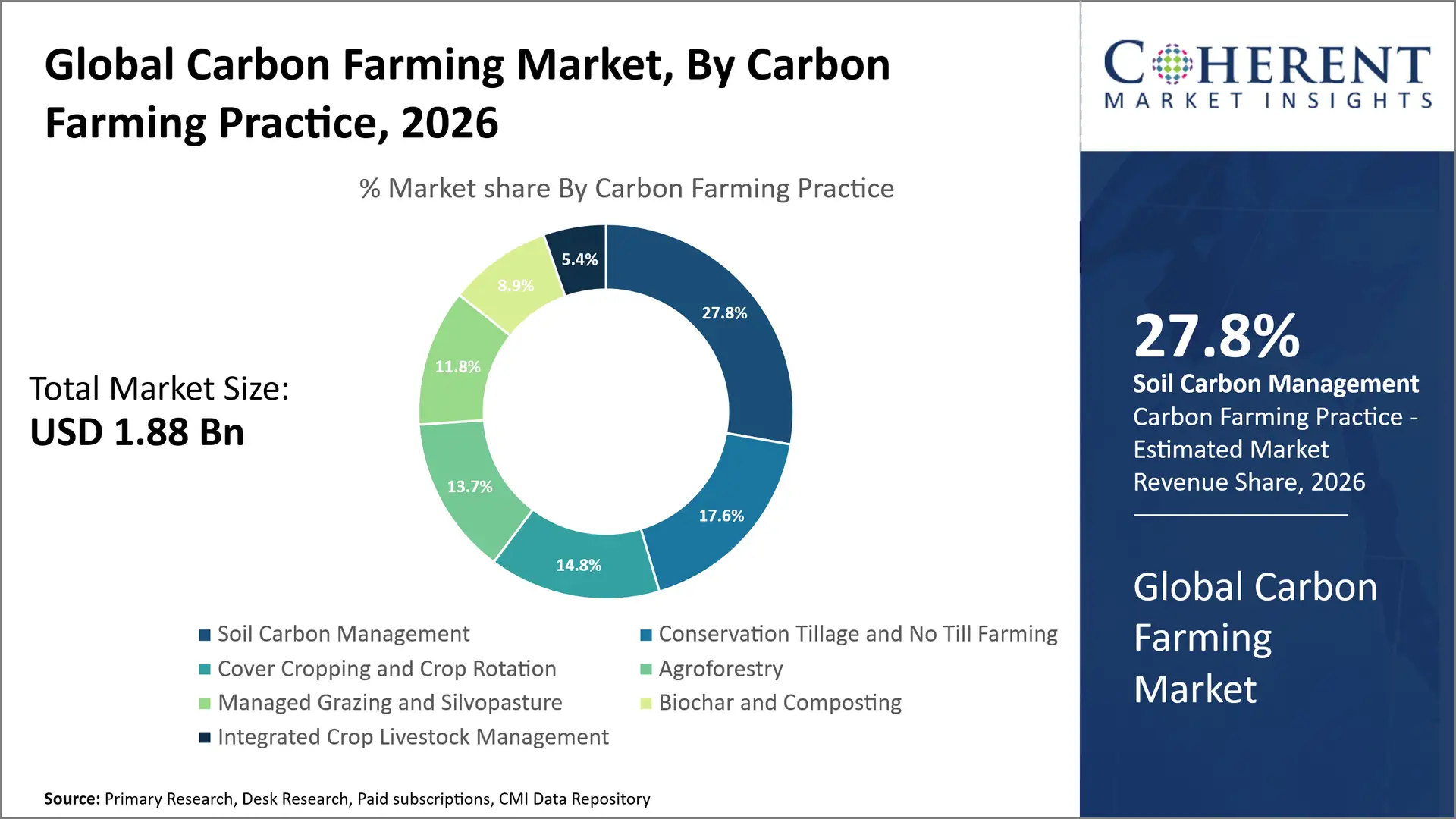
- Soil Carbon Management is expected to record an estimated CAGR of 15.0% during 2026–2033 and account for 27.8% of the global carbon farming market in 2026. Its leadership reflects the ability to combine improved soil fertility with measurable carbon benefits and farmer payments. In November 2024, Cargill reported more than one million acres enrolled in its RegenConnect program for the 2025 U.S. planting season.
- Cropland is projected to grow at an estimated CAGR of 14.7% through 2033, representing 52.8% of the global carbon farming market in 2026. Its established planting cycles and farm records make it suitable for aggregating carbon farming projects across large cultivated areas. In November 2025, PepsiCo announced plans to extend regenerative practices across an additional 240,000 acres of Canadian farmland, highlighting corporate investment in crop supply chains.
- Soil Organic Carbon Sequestration is forecast to achieve an estimated CAGR of 15.3% during 2026–2033, capturing 48.6% of the global carbon farming market in 2026. Its commercial importance rests on converting changes in agricultural soil carbon stocks into verifiable climate outcomes. In January 2025, Verra approved the first verified carbon units under its VM0042 agricultural land management methodology, establishing a practical route from field management to credit issuance.
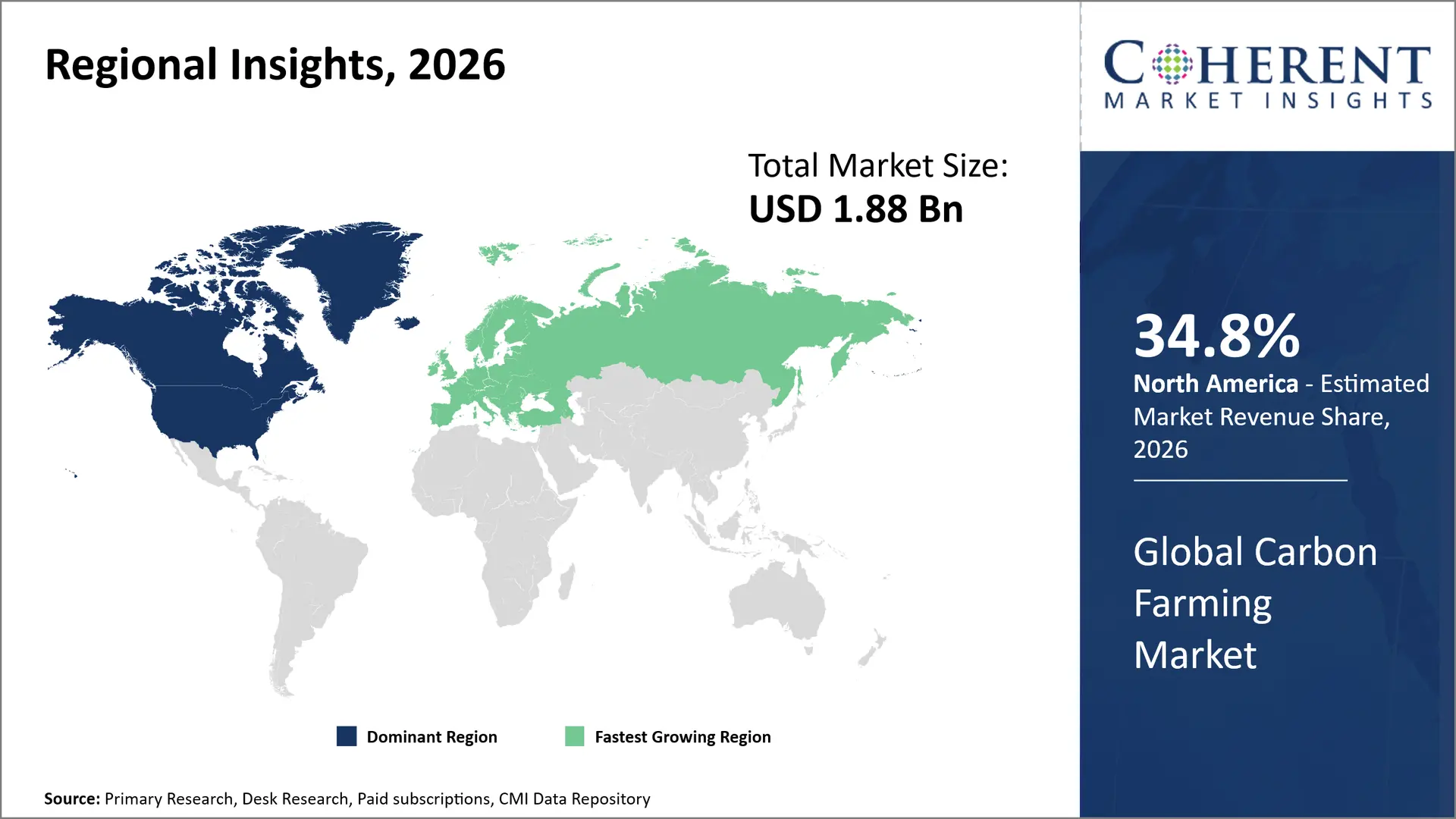
- North America is expected to expand at an estimated CAGR of 13.8% through 2033 while retaining 34.8% of global carbon farming market revenue in 2026. Its lead reflects established project aggregation, registry infrastructure, and access to corporate carbon buyers. In February 2026, Climate Action Reserve announced that cumulative issuances under its U.S. Soil Enrichment Protocol had exceeded two million credits, demonstrating commercially active verification pathways.
- Europe is projected to post an estimated CAGR of 16.4% during 2026–2033, the fastest regional pace, and hold 25.6% of the global carbon farming market in 2026. Common certification rules could lower uncertainty for project developers and make agricultural carbon outcomes easier to compare across countries. In July 2026, the European Commission adopted certification methodologies covering agricultural mineral soils, peatland restoration, and afforestation under its carbon removals framework.
Segmental Insights
Why Does Soil Carbon Management Dominate the Global Carbon Farming Market?
Soil Carbon Management is expected to account for 27.8% of the global carbon farming market in 2026, leading the carbon farming practice category. Growers can adjust residue retention, nutrient management, and ground cover within existing operations rather than convert productive farmland to another use. This flexibility creates demand for tailored agronomic planning and field-level implementation support, particularly among grain producers seeking to control transition costs. In March 2025, BASF and Boortmalt reported generating independently verified impact units through a barley farming program in Ireland, where participating growers adopted practices including cover cropping and achieved lower on-farm greenhouse gas emissions. The development illustrates how practical soil management interventions can be integrated into commercial crop production. For agricultural advisers and input providers, recurring farm-management services could offer more reliable revenue than one-off project enrollment.
- Current Industry Events of 2026
- Market Size Estimation
- Regional Breakdown
- Competitive Landscape
- Customer Intelligence
- Segmental Analysis
- Pricing Analysis
- Key Market Drivers, Challenges & Future Trends
- Customized Insights Section
Why Does Cropland Represent the Largest Land System in the Global Carbon Farming Market?
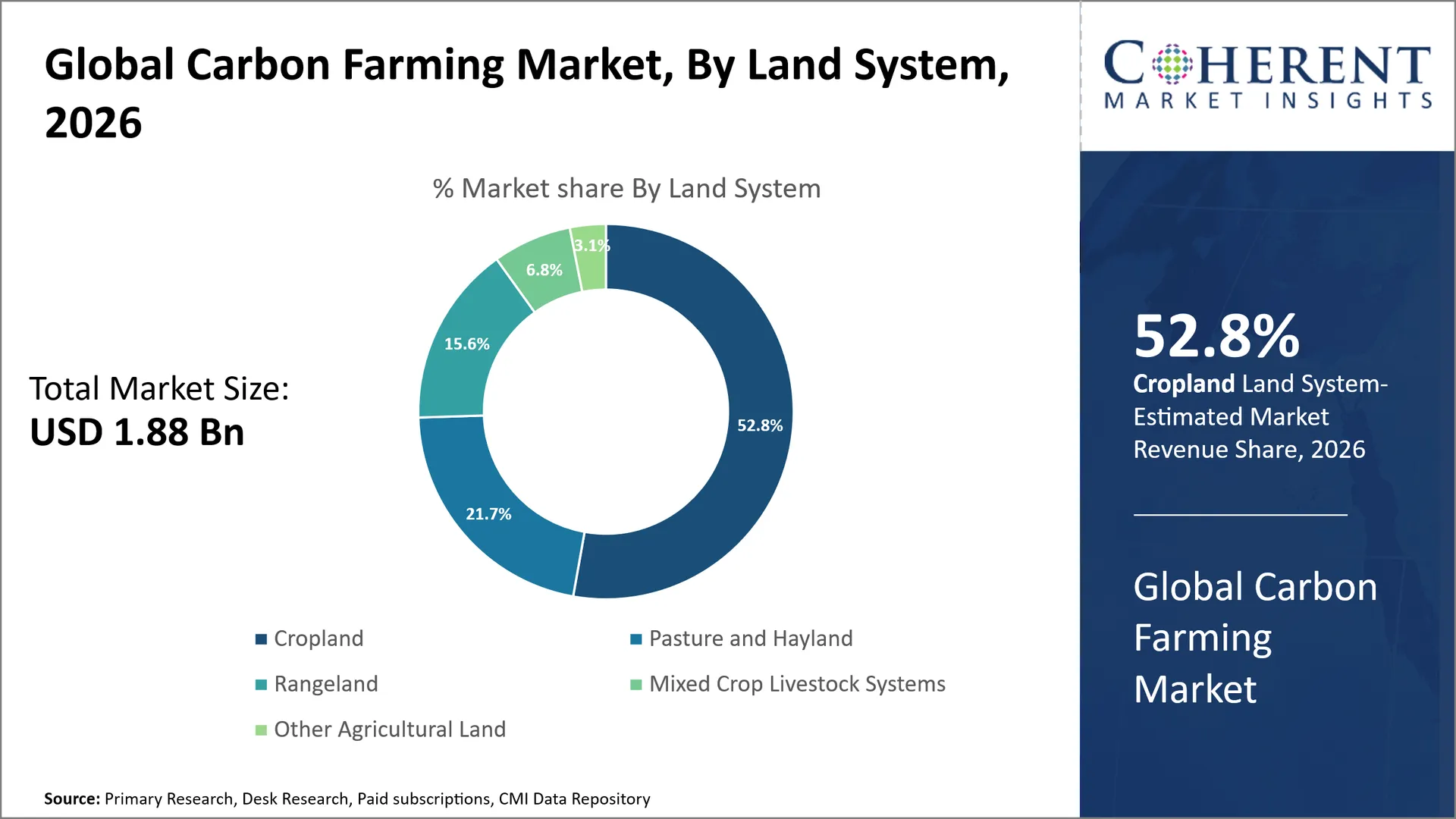
Cropland is expected to hold 52.8% of the global carbon farming market in 2026, making it the largest land-system category. Its advantage lies in existing commercial relationships between crop growers, grain handlers, and agricultural processors, which can facilitate coordinated changes in cultivation practices. Buyers can support implementation through sourcing arrangements while farmers continue producing marketable crops, reducing the need for separate land-based business models. In September 2025, ADM and Kellanova reported results from a regenerative agriculture initiative covering approximately 120,000 acres of cotton-growing farmland across Alabama, Florida, and Georgia. The program encouraged cover cropping and reduced tillage among participating growers. This demonstrates how cropland projects can be organized through agricultural supply chains. Developers with access to established procurement networks may benefit from lower farmer recruitment costs and more coordinated project delivery.
Why Does Soil Organic Carbon Sequestration Dominate the Carbon Outcome Category of the Global Carbon Farming Market?
Soil Organic Carbon Sequestration is expected to represent 48.6% of the global carbon farming market in 2026, leading the carbon outcome category. Its appeal is the capacity to quantify changes in a defined soil carbon stock across different agricultural land systems, rather than depend on a single crop or livestock emission source. However, sampling design, baseline selection, measurement uncertainty, and long-term storage obligations materially influence project costs and the volume of outcomes that can be credited. In February 2026, Australia's Clean Energy Regulator reported that its method for estimating soil organic carbon sequestration using measurement and models had led all Australian carbon credit project registration methods during 2025. This demonstrates developer interest in formal soil-carbon accounting pathways, although registration does not establish that credits have been issued. Specialized measurement providers can differentiate through transparent quantification and defensible uncertainty management.
Current Events and their Impact
Current Event | Description and Its Impact |
India Formalizes Its Carbon Credit Trading Framework – December 2025 |
|
United Kingdom Introduces Nature Investment Standards – March 2026 |
|
USDA Restructures Climate-Smart Agriculture Funding – April 2025 |
|
Global Carbon Farming Market Dynamics
Key Market Drivers
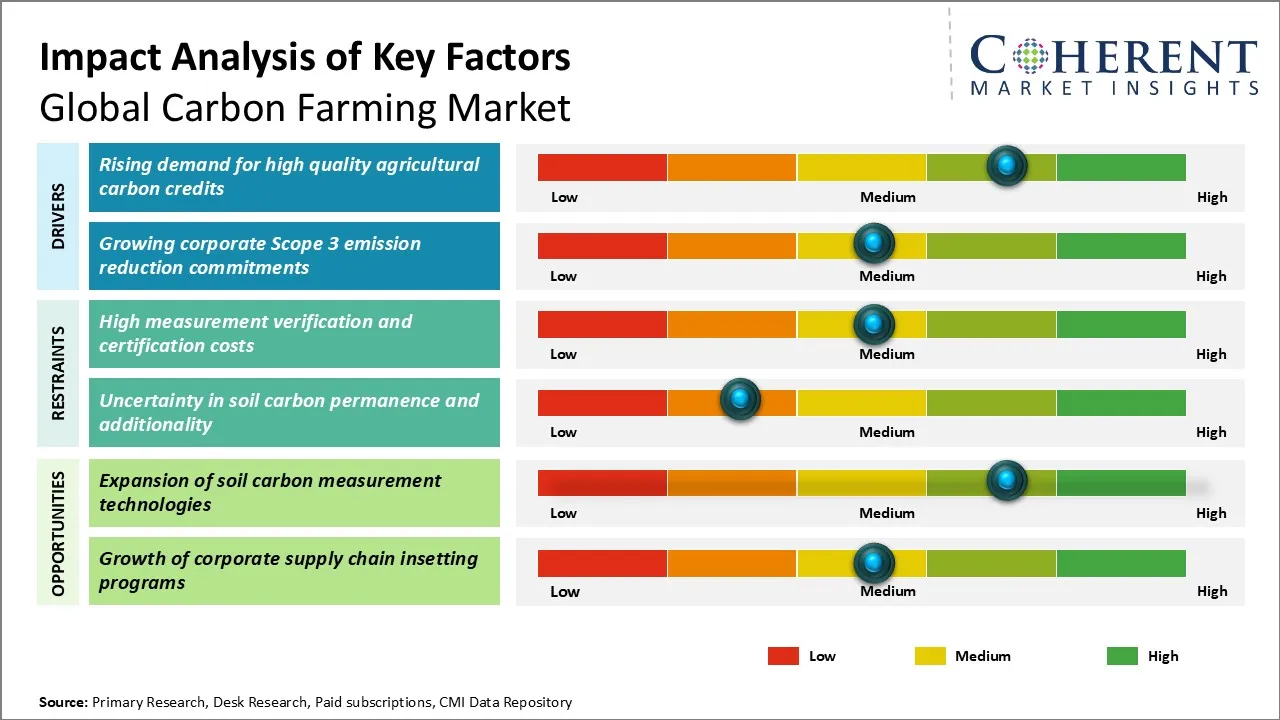
- Rising Demand for High-Quality Agricultural Carbon Credits: Growing interest in independently verified agricultural carbon credits is encouraging long-term purchasing agreements between corporate buyers and project developers. Such agreements can improve revenue visibility, support farmer enrollment, and provide financing for carbon measurement and certification. In January 2026, Indigo Carbon announced a 12-year agreement under which Microsoft would purchase 2.85 million soil carbon removal credits generated through its U.S. agricultural program. This commitment demonstrates how advance purchasing arrangements can strengthen project economics and create opportunities for developers capable of delivering verified carbon removals.
- Growing Corporate Scope 3 Emission Reduction Commitment: Food and beverage manufacturers are incorporating agricultural emission reductions into their procurement strategies to address emissions associated with purchased raw materials. This creates opportunities for carbon farming providers offering supplier engagement, farm assessments, emission accounting, and agronomic support. In November 2024, Diageo India launched a regenerative agriculture program covering an initial 500 hectares of rice cultivation in Telangana, involving more than 220 farmers. The initiative illustrates how corporate value-chain commitments can translate into funded agricultural interventions and recurring demand for carbon management services.
Emerging Market Trends
- Greater Emphasis on Farmer Data Ownership and Contract Transparency: Carbon farming programs are gradually introducing clearer provisions governing agricultural data ownership, environmental claims, and farmer compensation. Producers increasingly need visibility into how project information is collected, shared, and used to generate commercial value. This shift is encouraging developers to offer transparent agreements, interoperable recordkeeping, and accessible payment structures. Agricultural cooperatives and farmer-focused platforms could strengthen their competitive positions by protecting producer interests. During the forecast period, contractual transparency is likely to become an important factor influencing farmer participation and project retention.
- Integration of Environmental Co-Benefits into Carbon Project Valuation: Carbon farming project evaluations are expanding beyond carbon removal to consider improvements in biodiversity, water management, erosion control, and agricultural resilience. Buyers increasingly seek projects that can demonstrate broader environmental outcomes alongside credible carbon accounting. This is encouraging developers to incorporate additional ecological indicators into project design and reporting. Agronomic service providers with multidisciplinary expertise may benefit from this transition, while projects offering limited evidence of environmental improvements could face pricing pressure. These additional outcomes may increasingly influence purchasing decisions and project differentiation.
Regional Insights
Why Does North America Dominate the Global Carbon Farming Market?
North America is expected to account for 34.8% of the global carbon farming market in 2026, supported by agricultural enterprises that can coordinate land management across extensive grazing and cropping operations. Food supply chains are increasingly treating healthier working landscapes as a procurement concern, creating opportunities for land managers, technical advisers, and project aggregators. In September 2025, McDonald’s USA announced its participation in the Grassland Resilience and Conservation Initiative, which aims to mobilize more than USD 200 million over seven years for regenerative grazing and conservation across 4 million acres in the United States. Although the initiative does not establish carbon credit issuance, it shows the scale of corporate investment available for farm-level environmental improvements. North America's commercial advantage lies in linking such investment commitments with implementation services and credible measurement systems.
Why Is Europe Emerging as the Fastest-Growing Region in the Global Carbon Farming Market?
Europe is expected to represent 25.6% of the global carbon farming market in 2026 and is projected to be its fastest-growing region. The growth opportunity differs from North America's large-scale projects: Europe's many smaller holdings require affordable enrollment, shared advisory resources, and simplified carbon accounting to make participation commercially worthwhile. In September 2025, the EIT Food-supported PATH2CC project began working toward practical pathways for small European farms to participate in carbon credit markets. The initiative focuses on training, tailored methods, and peer learning rather than assuming that conventional credit programs fit every farm. Across Europe, developers capable of coordinating small producers and meeting rigorous environmental reporting expectations could access a wider project base. However, fragmented landholdings and administrative costs may continue to constrain profitability without effective aggregation models.
Global Carbon Farming Market Outlook for Key Countries
Why Is the U.S. a Key Market for the Global Carbon Farming Market?
The United States is a key carbon farming market because its agricultural finance system is beginning to recognize soil and water stewardship within conventional lending arrangements. Farmers seeking to change cropping practices often face upfront equipment and management costs before environmental revenues are realized. Connecting favorable lending terms to verified farm practices could reduce this adoption barrier independently of carbon credit sales. In January 2025, Farmers Business Network launched a regenerative agriculture land-loan pilot offering eligible growers interest-rate discounts for implementing specified soil and water health practices. The initiative illustrates a distinct financing pathway for sustainable land management, although it remains a limited pilot rather than a nationwide product. U.S. service providers that can document implementation and provide dependable farm-level records may benefit as lenders examine environmental performance alongside creditworthiness.
Why Is Canada Important in the Global Carbon Farming Market?
Canada occupies an important position in the global carbon farming market because public agricultural support can help producers absorb the cost of changing farm practices before carbon-related benefits materialize. Cover crops, improved nitrogen management, and rotational grazing are relevant to the country's grain-producing provinces and livestock operations. In January 2025, Agriculture and Agri-Food Canada announced an additional CAD 300 million for the On-Farm Climate Action Fund, extending support through existing delivery organizations over the following three years. This funding targets practice adoption rather than guaranteeing saleable carbon credits. Canada's agricultural associations and implementation advisers can use such programs to assist growers with practice planning, recordkeeping, and technical guidance. The commercial opportunity lies in turning supported field-level changes into sustained management services while preserving realistic expectations about credit certification.
Why Is Australia a Strategic Country in the Global Carbon Farming Market?
Australia is strategically significant in the global carbon farming market because land managers can participate in a national carbon credit system with defined methods for eligible agricultural projects. The country's varied soil types and climatic conditions, however, create substantial uncertainty when estimating additional carbon storage. Verification quality therefore has a direct influence on project economics, developer liabilities, and buyer confidence. In April 2026, the Emissions Reduction Assurance Committee completed a periodic review of Australia's soil organic carbon method and found that it met five of six integrity standards, recommending stronger conservative crediting safeguards. This highlights the need to avoid overstating recoverable carbon volumes. Australian project developers and soil measurement specialists may gain from investments in representative sampling, cautious baseline modelling, and contract provisions that account for possible methodology changes.
Why Does Brazil Support Growth in the Global Carbon Farming Market?
Brazil presents a distinct opportunity within the global carbon farming market through the restoration of degraded pasture and integration of crop, livestock, and forest production systems. These approaches can improve land productivity while creating potential carbon benefits, which is especially relevant for cattle producers and agricultural businesses managing extensive rural properties. In June 2025, Brazil's Ministry of Agriculture and Livestock established a Sustainable Projects Program under the ABC+ Plan to encourage initiatives combining lower greenhouse gas emissions, productivity improvements, and climate adaptation. The measure supports project development but does not itself certify carbon credits. Commercial progress will depend on converting eligible land-management activities into measurable outcomes and financially workable contracts. Brazilian agronomic advisers and rural project developers are positioned to assist with implementation, monitoring, and farmer engagement.
Why Is India an Important Growth Market for the Global Carbon Farming Market?
India is becoming an important global carbon farming market because fragmented agricultural holdings require shared project administration and accessible technical support. Carbon farming initiatives must also accommodate varied cropping systems, limited resources for soil testing, and farmer concerns about payment timing. In December 2025, the Indian Institute of Technology Roorkee reported launching a farmer carbon credit initiative authorized by the Uttar Pradesh Department of Agriculture, beginning in the Saharanpur Division. The program uses digital monitoring, reporting, and verification to assess eligible farming improvements and envisages transferring carbon credit revenue to farmers' bank accounts. Its announcement does not establish that credits have already been issued or sold. Aggregators and agricultural extension partners could become important intermediaries by coordinating enrollment, verification, and equitable revenue distribution across participating smallholders.
Carbon Measurement and Project Verification Landscape
Technology | Key Application | Adoption Landscape | Commercial Impact |
Soil Sampling and Laboratory Carbon Analysis | Direct measurement of soil organic carbon through field sampling and laboratory testing. | Established measurement approach | Provides physical evidence for carbon accounting and verification, although sampling expenses can affect project profitability. |
Satellite Remote Sensing | Monitoring vegetation cover, land-use changes, crop management, and grazing patterns. | Increasing commercial integration | Supports large-area monitoring and reduces repeated field visits. Requires other evidence to quantify soil carbon changes reliably. |
Digital Soil Mapping and AI-Based Carbon Estimation | Predicting spatial variation in soil carbon stocks using environmental datasets and calibrated models. | Expanding adoption | Enables more targeted sampling and potentially lowers monitoring costs for large agricultural carbon projects. |
Process-Based Biogeochemical Modeling | Estimating carbon stock changes and agricultural greenhouse gas emissions under different management practices. | Established with ongoing model refinement | Helps assess project outcomes where repeated direct measurements are costly, subject to calibration and methodology requirements. |
IoT-Based Soil and Environmental Monitoring | Tracking soil moisture, temperature, and field conditions associated with carbon management practices. | Selective adoption | Provides additional environmental information for farm management and model calibration but introduces equipment and connectivity costs. |
Digital Monitoring, Reporting and Verification Platforms | Integrating farm records, carbon calculations, monitoring evidence, and independent verification workflows. | Growing commercial adoption | Improves reporting efficiency, data traceability, and coordination among farmers, developers, auditors, and carbon credit buyers. |
How Can Smallholder Rangeland Aggregation Create New Growth Opportunities in the Global Carbon Farming Market?
Smallholder grazing landscapes represent an underdeveloped opportunity for extending carbon farming beyond established commercial agricultural operations. Many livestock producers manage dispersed grazing areas and lack the technical resources needed for independent carbon project registration. This creates opportunities for developers to establish cooperative-based programs combining managed grazing, soil restoration, carbon measurement, and farmer compensation.
Regional aggregators can improve commercial feasibility by consolidating participating farms, sharing verification expenses, and providing localized agronomic support. Mobile data collection and satellite monitoring could further reduce operational costs across remote agricultural areas.
Companies seeking to enter this segment must establish reliable land-use agreements, transparent revenue-sharing arrangements, and suitable monitoring systems. Partnerships with agricultural cooperatives and local extension organizations will be essential for farmer recruitment and sustained participation. Specialist project developers with regional expertise may gain an advantage over platforms relying entirely on digital enrollment. This model could expand access to carbon financing while supporting productive livestock management.
Market Players, Key Development, and Competitive Intelligence
Key Developments
- In April 2025, Bayer announced its first planned issuance of agricultural carbon credits associated with regenerative rice cultivation in India. Validation and certification were still underway at the announcement. The initiative demonstrates the potential to monetize agricultural emission reductions while supporting lower-water cultivation practices and improving farm economics.
- In February 2026, Boomitra announced that its Northern Mexico Grassland Restoration Project had achieved verification and was issuing 3.03 million soil carbon removal credits. The development demonstrates how extensive grazing systems can generate verified carbon removals while creating additional financial incentives for participating ranchers and supporting grassland restoration.
- In September 2025, Regrow introduced expanded global Scope 3 and climate-risk reporting capabilities, including agricultural emissions traceability and geospatial analysis. These capabilities help agricultural buyers connect sourcing decisions with measurable farm-level outcomes, strengthening the role of integrated data platforms in carbon farming procurement and sustainability program management.
Competitive Landscape
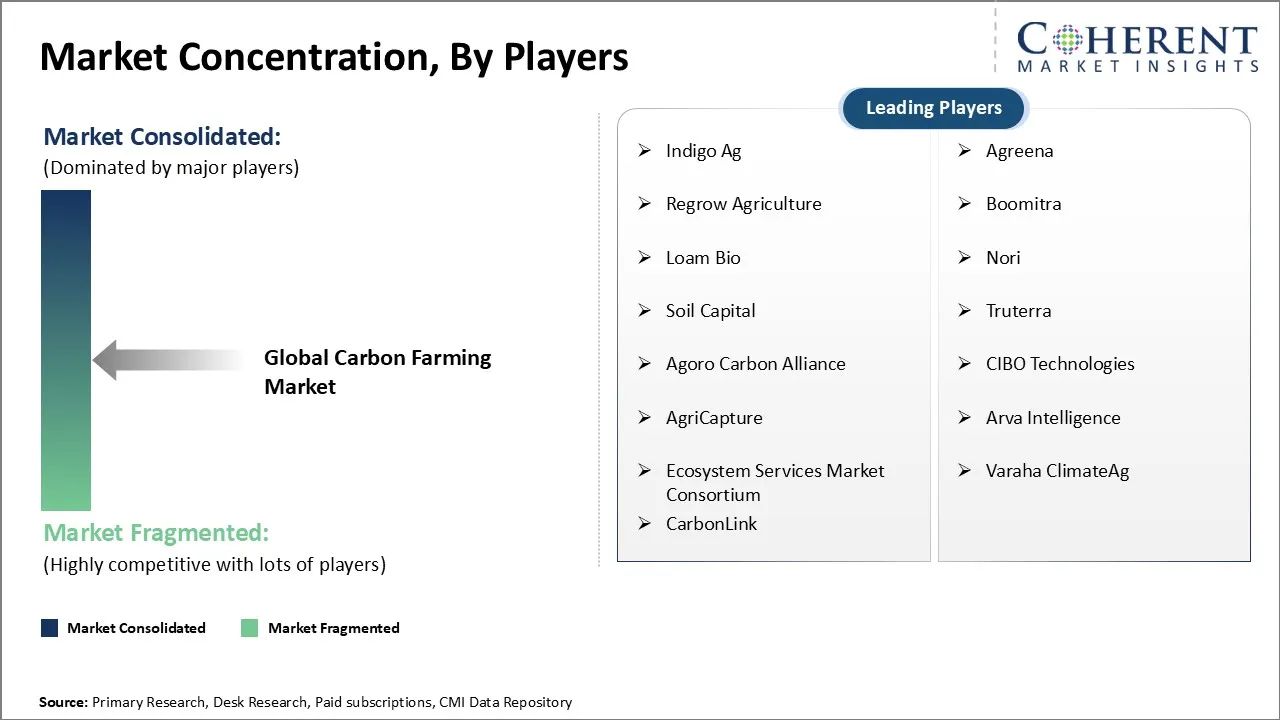
The global carbon farming market remains fragmented, with agricultural carbon project developers, digital monitoring providers, certification specialists, agribusinesses, and regional aggregators operating across different business models. Competition depends on project execution, carbon accounting credibility, farmer engagement, and access to reliable buyers. Specialist companies can differentiate through geographic expertise and technical capabilities, while established participants benefit from financing capacity, procurement relationships, and project management infrastructure.
Key competitive factors include
- Carbon Credit Quality: Demonstrating additionality, accurate carbon accounting, permanence safeguards, and independent verification.
- Project Development Efficiency: Controlling enrollment, implementation, monitoring, and certification expenses.
- Farmer Engagement: Maintaining long-term participation through practical support and competitive compensation arrangements.
- Technology Integration: Improving operational efficiency through field-data management and automated reporting workflows.
- Regulatory and Registry Compliance: Maintaining eligibility across applicable certification methodologies and regional requirements.
- Commercial Contracting: Managing payment timing, delivery obligations, credit ownership, and project performance risks.
- Regional Partnerships: Establishing local agricultural networks and technical support capabilities to improve project execution.
Market Report Scope
Global Carbon Farming Market Report Coverage | |||
Report Coverage | Details | ||
Base Year | 2025 | Market Size in 2026: | USD 1.88 Bn |
Historical Data For: | 2021 To 2024 | Forecast Period: | 2026 To 2033 |
Forecast Period 2026 To 2033 CAGR: | 14.40% | 2033 Value Projection: | USD 4.82 Bn |
Geographies covered: |
| ||
Segments covered: |
| ||
Companies covered: | Indigo Ag, Agreena, Regrow Agriculture, Boomitra, Loam Bio, Nori, Soil Capital, Truterra, Agoro Carbon Alliance, CIBO Technologies, AgriCapture, Arva Intelligence, Ecosystem Services Market Consortium, Varaha ClimateAg, CarbonLink | ||
Growth Drivers: |
| ||
Restraints & Challenges: |
| ||
Analyst Opinion (Expert Opinion)
- The Global Carbon Farming Market leadership is likely to shift toward companies that provide modular carbon farming infrastructure rather than relying exclusively on project ownership. Providers offering independently accessible measurement services, payment administration, and certification support could serve multiple developers simultaneously. This approach may create recurring service revenue while allowing customers to select specialized capabilities without depending on a single project operator.
- Climate-related variability could fundamentally reshape the pricing and contractual structure of agricultural carbon removals. Extreme weather, changing soil conditions, and uncertain carbon retention may encourage buyers to prioritize risk-adjusted purchasing arrangements over uniform credit pricing. Developers capable of managing reversal exposure through diversified project portfolios and credible financial safeguards could gain an advantage, while less resilient projects may face higher financing costs.
- Carbon farming participants should prioritize practical agronomic expertise, reliable carbon quantification, and flexible financing arrangements. Investment decisions should consider farmer retention, land-tenure uncertainty, verification expenses, and delayed credit revenue. Companies should strengthen relationships with agricultural intermediaries and independent technical specialists while avoiding excessive expenditure on proprietary infrastructure before establishing dependable project demand and commercially viable pricing arrangements.
Speak to the analyst
Want personalized insights?
Take the findings above to one of our principal consultants, or have the report rebuilt around the segments, geographies and competitors you actually track.
Market Segmentation
- Carbon Farming Practice Insights (Revenue, USD Bn, 2021 - 2033)
- Soil Carbon Management
- Conservation Tillage and No Till Farming
- Cover Cropping and Crop Rotation
- Agroforestry
- Managed Grazing and Silvopasture
- Biochar and Composting
- Integrated Crop Livestock Management
- Land System Insights (Revenue, USD Bn, 2021 - 2033)
- Cropland
- Pasture and Hayland
- Rangeland
- Mixed Crop Livestock Systems
- Other Agricultural Land
- Carbon Outcome Insights (Revenue, USD Bn, 2021 - 2033)
- Soil Organic Carbon Sequestration
- Biomass Carbon Sequestration
- Methane Emission Reduction
- Nitrous Oxide Emission Reduction
- Other Emission Reductions
- Market Offering Insights (Revenue, USD Bn, 2021 - 2033)
- Carbon Project Development and Management
- Carbon Monitoring Reporting and Verification
- Carbon Credit Generation and Certification
- Digital Carbon Measurement Platforms
- Advisory and Consulting Services
- Monetization Mechanism Insights (Revenue, USD Bn, 2021 - 2033)
- Tradable Carbon Credits
- Supply Chain Insetting
- Government Carbon Payments
- Corporate Sustainability Incentives
- End User Insights (Revenue, USD Bn, 2021 - 2033)
- Farmers and Agricultural Producers
- Food and Beverage Companies
- Carbon Credit Buyers
- Government Agencies
- Nonprofit and Conservation Organizations
- Distribution Model Insights (Revenue, USD Bn, 2021 - 2033)
- Direct Project Contracts
- Carbon Farming Platforms
- Agricultural Cooperatives and Aggregators
- Regional Insights (Revenue, USD Bn, 2021 - 2033)
- North America
- U.S.
- Canada
- Latin America
- Brazil
- Argentina
- Mexico
- Rest of Latin America
- Europe
- Germany
- U.K.
- Spain
- France
- Italy
- Russia
- Rest of Europe
- Asia Pacific
- China
- India
- Japan
- Australia
- South Korea
- ASEAN
- Rest of Asia Pacific
- Middle East
- GCC Countries
- Israel
- Rest of Middle East
- Africa
- South Africa
- North Africa
- Central Africa
- North America
Sources
Primary Research Interviews
- Carbon farming project developers and agricultural carbon credit providers
- Farmers cooperatives regenerative agriculture specialists and soil carbon experts
- Carbon credit buyers verification agencies and sustainability consultants
Stakeholders
- Carbon farming companies and project developers
- Farmers landowners and agricultural cooperatives
- Carbon credit registries traders and corporate buyers
- Soil testing MRV technology and certification providers
End-use Sectors
- Agriculture and agribusiness
- Food and beverage
- Forestry and land management
- Corporate sustainability and carbon offsetting
Regulatory and Industry Bodies
- United Nations Framework Convention on Climate Change UNFCCC
- Intergovernmental Panel on Climate Change IPCC
- Food and Agriculture Organization FAO
- U.S. Department of Agriculture USDA
- European Commission
- International Organization for Standardization ISO
Databases
- FAOSTAT agricultural emissions and land-use datasets
- Verra and Gold Standard carbon credit registries
- World Bank Carbon Pricing Dashboard
- USDA soil carbon and agricultural emissions databases
- Carbon credit issuance retirement and pricing databases
Magazines and Journals
- Agriculture Ecosystems & Environment
- Global Change Biology
- Geoderma
- Soil & Tillage Research
- Nature Climate Change
Associations
- International Emissions Trading Association IETA
- Integrity Council for the Voluntary Carbon Market ICVCM
- Ecosystem Services Market Consortium ESMC
- Carbon Markets Institute CMI
- Carbon Business Council
Public Domain Sources
- Agricultural carbon sequestration and soil carbon data
- Carbon credit project registration and issuance statistics
- Regenerative agriculture adoption and land-use data
- Corporate carbon credit purchases and climate commitments
- Carbon farming policy and incentive developments
Key Standards and Regulations
- EU Carbon Removals and Carbon Farming Certification Framework Regulation 2024/3012
- Verra VM0042 Improved Agricultural Land Management Methodology
- Gold Standard Soil Organic Carbon Framework Methodology
- GHG Protocol Land Sector and Removals Standard
- ISO 14064 greenhouse gas quantification and verification standards
- Paris Agreement Article 6 carbon market mechanisms
Proprietary Elements
- CMI Data Analytics Tool
- Proprietary CMI repository covering carbon farming projects agricultural carbon credits soil carbon sequestration regenerative agriculture carbon pricing policy developments and competitive intelligence.
Get access to 250+ pages report
Every segment, forecast, competitor profile and data table behind the analysis above — available for instant download.
- ESOMAR Member
- ISO 9001:2015 Certified
- D-U-N-S Registered
- GDPR & CCPA Compliant
Frequently Asked Questions
The CAGR of global carbon farming market is projected to be 14.40% from 2026 to 2033.
The global carbon farming market is estimated to be valued at USD 1.88 Bn in 2026 and is expected to reach USD 4.82 Bn by 2033.
Increasing adoption of regenerative agriculture and growing demand for verified carbon removal projects are creating opportunities in the global carbon farming market.
Large corporations, food and beverage companies, and organizations pursuing net-zero emission targets are major buyers of carbon farming credits.
Carbon credits are generated through verified practices that increase carbon sequestration in soil and vegetation or reduce agricultural greenhouse gas emissions.
Limited farmer awareness, complex carbon credit verification processes, and long-term monitoring requirements are major implementation challenges.
Rising demand for high quality agricultural carbon credits and Growing corporate Scope 3 emission reduction commitments are the major factor driving the growth of global carbon farming market.