

Global Carpooling Market Size and Forecast – 2026 To 2033
The global carpooling market is expected to grow from USD 11 Bn in 2026 to USD 30 Bn by 2033, registering a compound annual growth rate (CAGR) of 9.4% from 2026 to 2033. Growing smartphone penetration drives the market growth. On August 11, 2025, Rapido introduced Hopr as a dedicated carpooling and bikepooling application for working professionals. The Bengaluru pilot connects commuters with nearby people sharing similar workplace routes.
Key Takeaways of the Global Carpooling Market
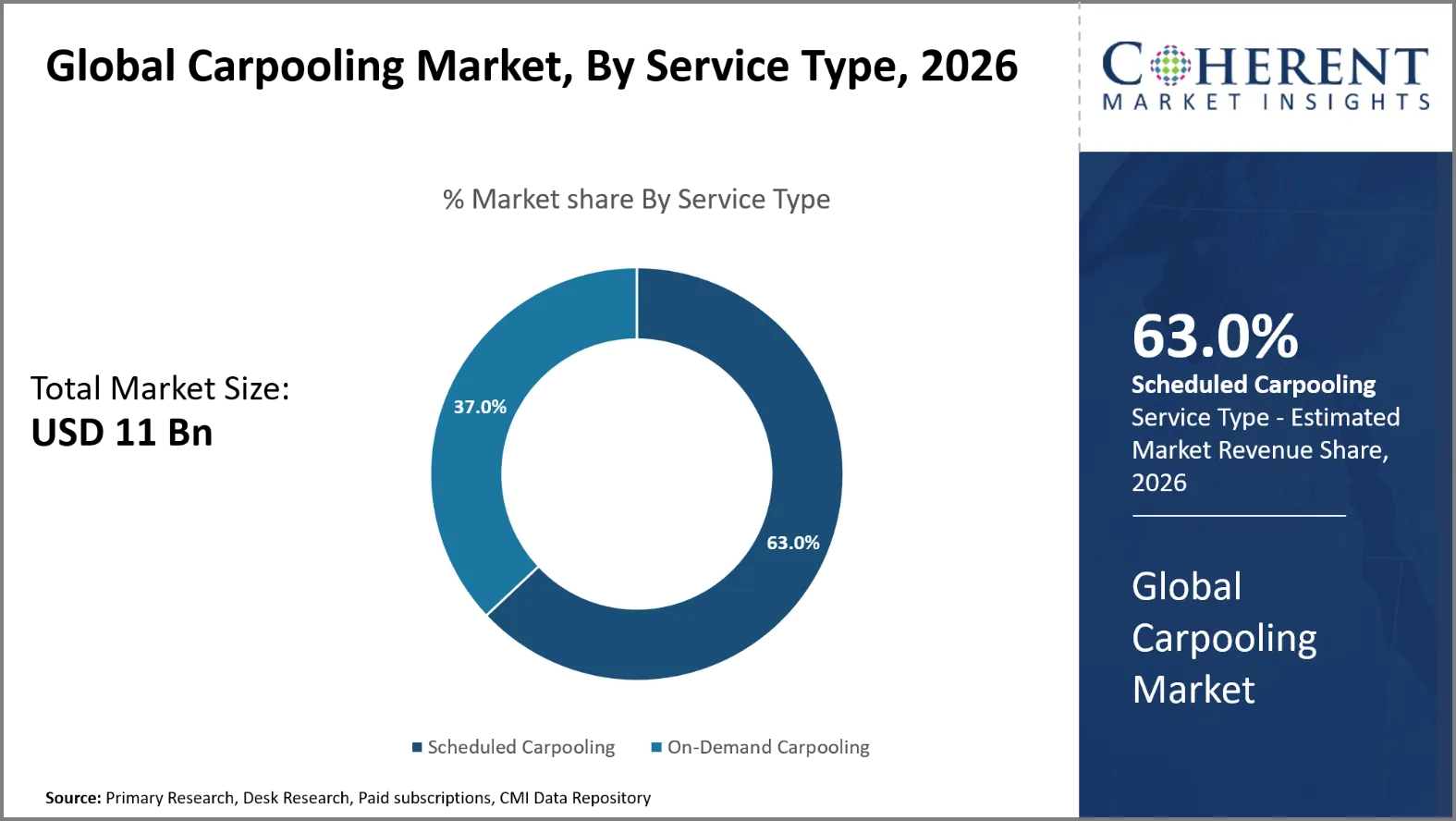
- The Scheduled Carpooling segment is expected to account for 63.0% of the global carpooling market share in 2026. Greater adoption of corporate commuting programs is driving the growth of the segment. For instance, L&T Finance employees used sRide for coordinated commuting across Pune, Bengaluru, and other locations in India. More than 654 employees participated, generating over 47,386 shared kilometers.
- The Online Platforms segment is estimated to capture 54.0% of the market share in 2026. Expansion of app-based mobility platforms is majorly driving the growth of the segment. In June 2026, BlaBlaCar entered 20 additional countries including Indonesia, Malaysia, Thailand, Vietnam, and the Philippines.
- The Passenger Cars segment is estimated to capture 58.0% of the market share in 2026. Increasing demand for affordable urban transportation is majorly driving the growth of the segment. On July 9, 2025, Uber introduced Wait & Save across more than ten Indian cities. Riders can accept longer waiting times for lower fares.
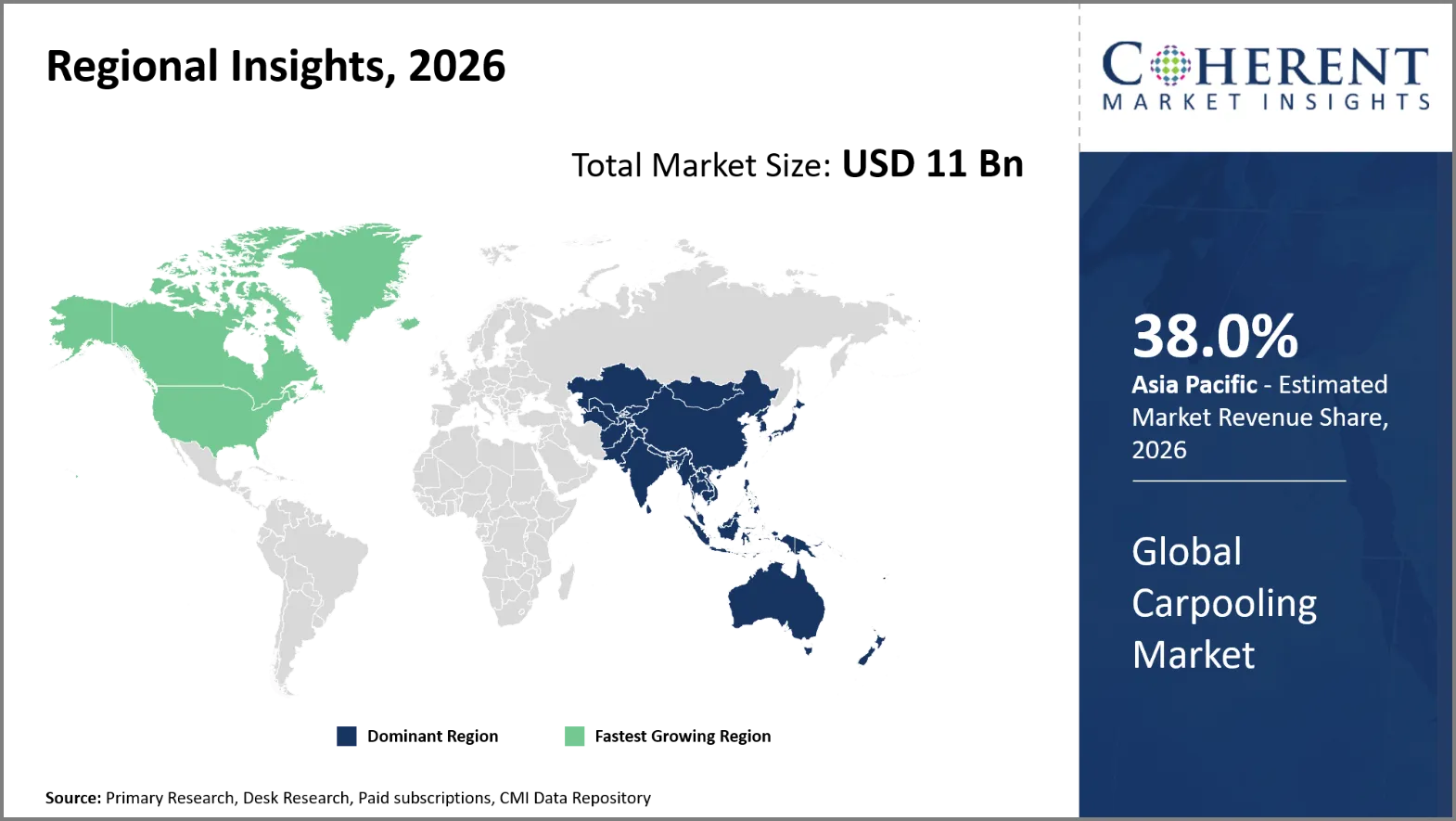
- Asia Pacific is expected to dominate the carpooling market in 2026 with a market share of 38.0%. Integration with public transportation networks in Asia Pacific is driving the growth of the regional market. In August 2025, Grab committed to a strategic equity investment in WeRide for autonomous shuttle deployment. The companies planned two Punggol routes connecting residents with public transport nodes in Singapore.
- North America is expected to account for 36.0% share in 2026 and is projected to record the fastest growth over the forecast period. Increasing environmental awareness in North America is driving the growth of the regional market. On October 22, 2025, Uber rebranded Uber Green as Uber Electric across the U.S. The company introduced Go Electric grants worth USD 4,000 for eligible drivers in California, Colorado, Massachusetts, and New York City in U.S.
Segmental Insights
Why Does Scheduled Carpooling Dominate the Global Carpooling Market?
The scheduled carpooling segment is expected to account for 63.0% of the global carpooling market share in 2026. Scheduled carpooling dominates because it provides predictable travel arrangements for recurring commuters. Users can book trips in advance and reduce the uncertainty as to when a driver will be available and when they will depart. Particularly appropriate for employees, students and regular city-to-city travelers. The advance scheduling also enables platforms to optimize routes and boost vehicle occupancy. This encourages more usage of scheduled carpooling services, due to regular travel patterns. On May 27, 2026, Herdy launched its carpooling app for Sydney’s Northern Beaches in Australia, targeting repetitive commuter trips. The portal had more than 660 pooled rides available for booking during the next 90 days. Routes included Sydney CBD, Chatswood, Macquarie Park, Norwest and Sydney Airport. Its pre-booking system lets commuters plan shared trips before departure. Especially relevant in locations where rail coverage is sparse and bus services are inconsistent.
- Current Industry Events of 2026
- Market Size Estimation
- Regional Breakdown
- Competitive Landscape
- Customer Intelligence
- Segmental Analysis
- Pricing Analysis
- Key Market Drivers, Challenges & Future Trends
- Customized Insights Section
Why is Online Platforms the Most Preferred Platform Type?
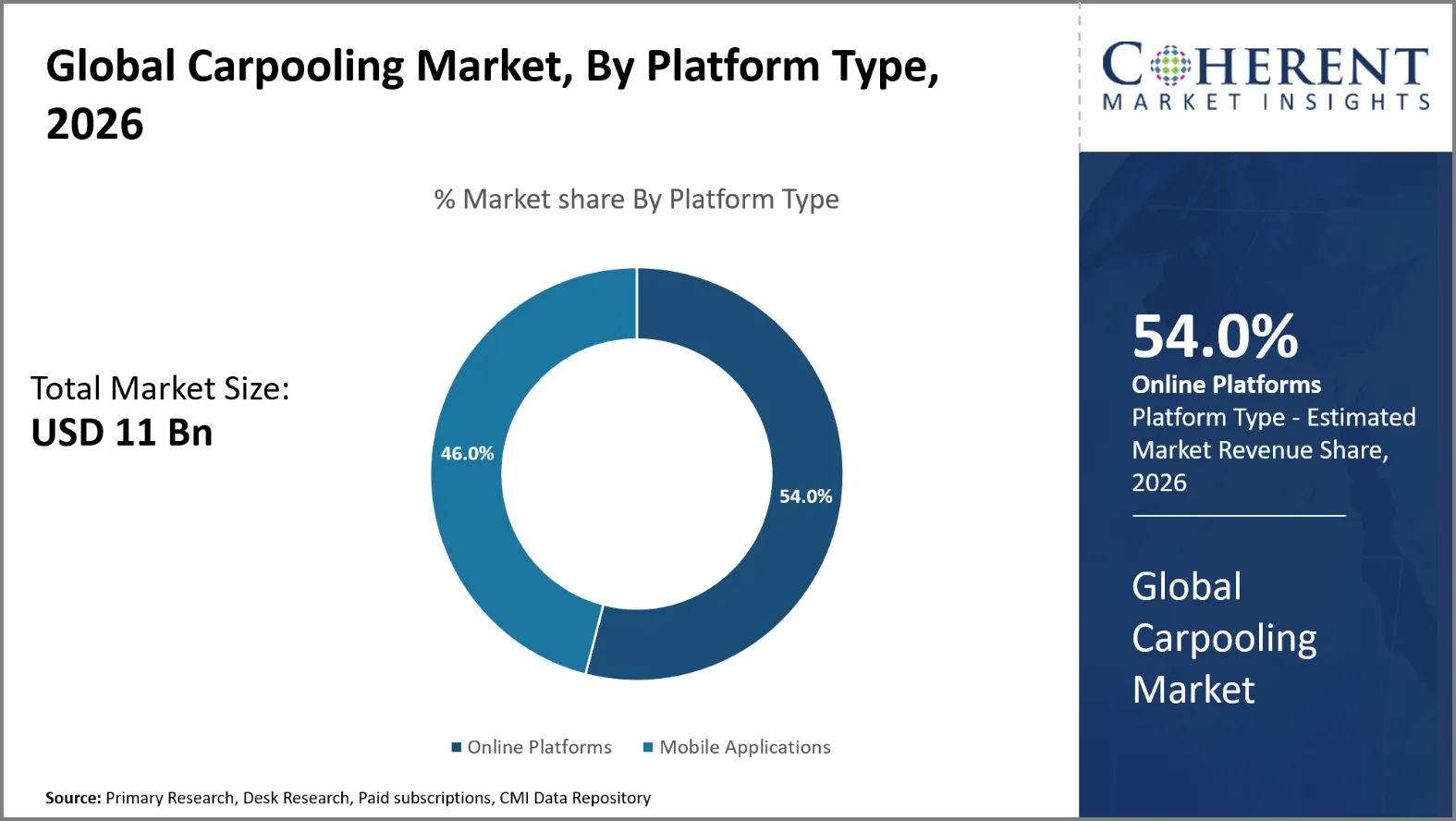
The online platforms segment is expected to account for 54.0% of the global carpooling market share in 2026. Carpooling services are readily available in many places over online platforms. Users can compare available rides, routes, timings and pricing in a single digital interface. These platforms also allow matching of drivers and passengers according to the requirements of the trip. Digital booking systems make it easier to coordinate, thus sharing rides is more convenient overall. Therefore, people are preferring to choose online platforms to provide flexible and easily available carpooling options. In March 2026, Rodshare debuted its carpooling application in India and introduced its service across the country. The platform moved from an initial intercity route to coverage across all 28 Indian states and eight union territories. Its Android application supports five languages, including English, Hindi, Urdu, Arabic, and Nepali.
Passenger Cars Dominates the Global Carpooling Market
The passenger cars segment is expected to account for 58.0% of the global carpooling market share in 2026. Passenger cars offer higher availability, flexibility and appropriateness for everyday shared mobility. They are owned by huge number of people. That means there is a vast potential pool of automobiles for carpooling services. They also serve the usual commuting groups without the need for specific infrastructure. Drivers and passengers are more likely to adapt because they are familiar with passenger cars. These features make passenger automobiles especially well-suited to enhance car-pooling in urban and suburban regions. In February 2026, Roycab launched chauffeur driven intercity carpooling with passenger cars across select Indian lines. It has vetted drivers on its platform and charges on a per-seat basis. The initial routes were Delhi-Jaipur, Delhi-Agra, Delhi-Chandigarh and Aligarh-Delhi.
Current Events and Their Impact
Current Events | Description and its Impact |
India - Motor Vehicle Aggregator Guidelines RT-16011/9/2019-T |
|
Singapore - Point-to-Point Transport Operator Licensing Framework |
|
Carpooling Market Dynamics
Market Drivers
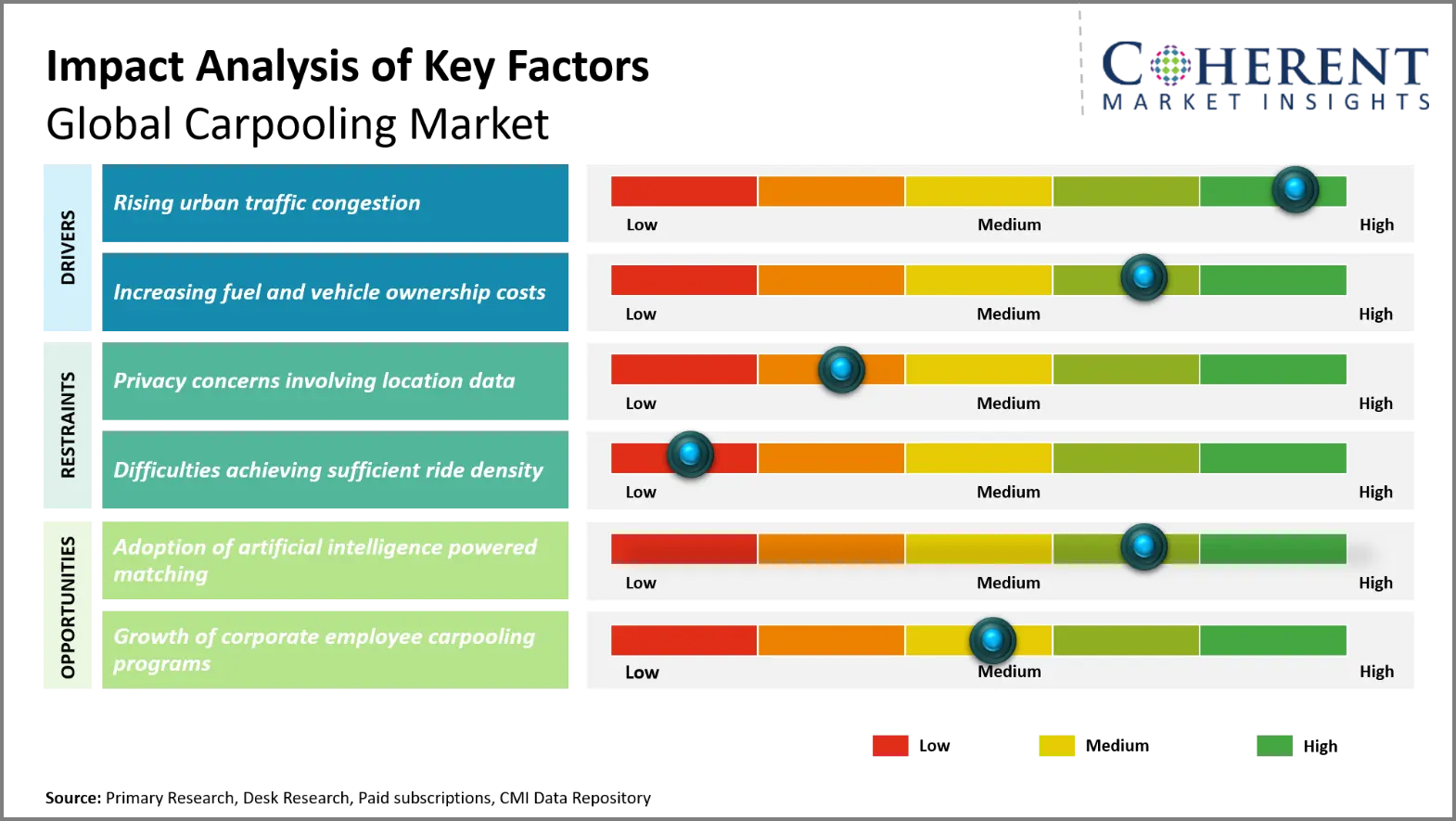
- Rising urban traffic congestion: Rapid urbanization has led to increased traffic congestion in major cities around the world. Longer journey times urge people to look for alternatives to using their own vehicle. Carpooling: Sharing a vehicle by several people traveling on similar routes. More people in each vehicle means fewer automobiles on the road during peak periods. So, carpooling is becoming more and more interesting for commuters who want to get to their destination faster and more efficiently. In August 2026, With Bengaluru’s roads becoming more congested and the cost of commuting rising, Quick Ride geared up to scale up carpooling. The corporation saw carpooling as a way to make better use of the automobiles it already had. The potential was enhanced after metro rates were increased by as much as 71% and bus fares were increased 15%.
- Increasing fuel and vehicle ownership costs: Increasing fuel prices raise the economic burden of regular personal commuting. There are other charges for maintenance, insurance, parking and depreciation when one owns a vehicle. Carpooling enables drivers and passengers to share travel cost among a large pool of users. Shared travel can thereby minimize individual travel expenditures without the need for further vehicle acquisition. This financial incentive encourages more people to use carpooling services. For instance, Higher gasoline prices place a lot of operating pressure on Uber and Lyft drivers in the U.S. Drivers claimed they were spending hundreds of dollars more a month on fuel. Some drivers are cutting back on long journeys or putting in more hours at work to make up for greater costs. The pressure highlights why sharing costs of a vehicle may become more attractive as costs of operating individual vehicles rise.
Emerging Trends
- AI-Based Ride Matching: Carpooling apps are increasingly leveraging artificial intelligence to connect riders with similar routes, timetables, and preferences. These solutions can enhance matching accuracy, empty vehicle capacity and enable dynamic route optimization for recurrent and real-time shared trips.
- Integration With Public Transportation: Carpooling platforms are rapidly linking their services with busses, trains and metro networks. The integration enhances the first mile and last mile connections, decreases reliance on private passenger and light commercial vehicles and provides more comfortable multimodal transit options for urban commuters.
- Growth Of Corporate Carpooling Programs: Employers are taking up organized carpooling programs to solve commuting issues and sustainability goals. Digital platforms enable firms to structure staff routes, increase vehicle occupancy, decrease parking strain and encourage more effective daily mobility practices.
- Expansion Of Electric Vehicle Carpooling: The proliferation of charging infrastructure is supporting a rising trend of electric vehicles in shared transportation systems. Shared mobility and electric mobility coupled with carpooling platforms can reduce transportation emissions and enable consumers to divide the costs of charging and operating among several riders.
Regional Insights
Why is Asia Pacific a Strong Market for Carpooling?
Asia Pacific is expected to account for a market share of 38.0% in 2026. Asia Pacific is expanding through dense urban corridors and digitally matched commuting networks. Indonesia, Malaysia, Thailand, Vietnam, and the Philippines entered BlaBlaCar’s network in 2026. India provides the region’s strongest example, with 19 million BlaBlaCar passengers in 2025. India also recorded 47% year-on-year platform growth during 2025. Southeast Asian expansion targets markets where smartphone usage supports app-based trip matching. China has also formalized private-car pooling rules in several cities. Wuhan permits non-commercial commuting pools when drivers publish trips beforehand and share costs. China’s transport ministry reported 392 licensed ride-hailing platforms by July 2025. These developments strengthen digital matching, regulated platforms, and intercity shared mobility across Asia Pacific.
Why Does North America Carpooling Market Exhibit High Growth?
North America is expected to register the fastest growth with a CAGR of 10.4% over the forecast period. The region is projected to account for 36.0% of the global carpooling market in 2026. North America has a distinctive opportunity in commuter-focused carpooling and employer-supported transportation. The U.S. Census Bureau continues tracking two-person, three-person, and larger carpools through its American Community Survey. In the 2024 dataset, carpooling is recognized as a separate commute transportation mode. Such precise classification aids developing workplace and regional mobility strategies. Employer commuting programs may focus on suburban corridors with less fixed-route public transit service. University campuses have concentrated demand as well through scheduled commuting patterns. The region’s established highway infrastructure supports longer recurring journeys between residential areas and employment centers. Digital matching can therefore focus on predictable commuter schedules rather than purely spontaneous rides.
Global Carpooling Market Outlook for Key Countries
Why is China Emerging as a Major Hub in the Carpooling Market?
China is developing carpooling through clearer distinctions between cost-sharing and commercial ride-hailing. Pingdingshan’s transport authority confirmed in 2025 that private-car pooling does not require ride-hailing operating permits. The arrangement must begin with the driver’s own travel needs and predetermined route. Passengers must share the same route and only divide part of the travel costs. Wuhan issued similar guidance for daily commuting trips. Its March 2025 response referenced a 25-kilometer daily commute example. The city confirmed that private-car pooling should remain non-profit and mutually beneficial. These rules create a distinct growth pathway based on legally defined cost-sharing. They also encourage platforms to separate genuine carpooling from commercial passenger services.
Is U.S. the Next Growth Engine for the Carpooling Market?
The carpooling landscape in the U.S. remains closely linked to commute patterns and the geography of work. The American Community Survey counts carpooled workers separately, distinguishing between two-person, three-person and greater carpools. This type of detailed data can be used to guide transportation design around job centers and residential corridors. Corporate commuting programs may utilize this information to identify locations with consistent single-occupancy traffic. Big metro areas concentrate opportunities near office districts, airports, universities and industrial campuses. Flexible work times also drive demand for platforms that match workers and jobs based on shifting commuting days. Digital platforms might give priority to the journeys that are taken regularly by employees, rather than those taken sometimes for pleasure. It provides a specific, employer-led growth route for U.S. carpooling.
Germany Carpooling Market Analysis and Trends
Germany benefits from established environmental mobility policies and strong digital adoption among commuters. BlaBlaCar reported that Germany achieved 30% usage of its Boost feature in an earlier impact assessment. The feature improves matching efficiency when standard searches produce limited ride options. Germany also has established long-distance travel corridors connecting major cities and regional centers. Carpooling can complement rail journeys when first-mile or last-mile connections remain inconvenient. BlaBlaCar’s European network increasingly combines carpooling with rail and bus options. Its 2025 sustainability report highlighted multimodal booking growth across Europe. Germany therefore offers a distinct opportunity around integrating shared cars with existing rail-oriented travel habits.
France Carpooling Market Analysis and Trends
France has one of Europe’s most developed carpooling ecosystems, supported by established platforms and public policy. BlaBlaCar originated in France and has built extensive domestic recognition around shared intercity travel. BlaBlaCar reported 20 million French members in earlier company data. Its 2025 sustainability report showed that 17% of French passengers used two or more travel solutions. The platform also integrated French train tickets across 350 national rail stations. France separately regulates income from cost-sharing carpool journeys. Drivers must report income when fares exceed eligible travel expenses. These mechanisms encourage legitimate cost-sharing while discouraging commercial passenger transport disguised as carpooling.
India Carpooling Market Analysis and Trends
India is currently one of the strongest examples of rapid carpooling adoption worldwide. BlaBlaCar reported 19 million Indian passengers during 2025. India became its largest global carpooling market during August 2025. Daily platform volumes exceeded 100,000 passengers during major periods such as Diwali and Raksha Bandhan. Around 70% of Indian BlaBlaCar users were aged 18-34. Mobile devices accounted for about 95% of the bookings. The platform said congested trains, limited busses and pricey journeys alone were largely to blame for the surge. India also created Bharat Taxi as a cooperative digital mobility platform in 2026. It was initially rolled out for Delhi-NCR and some cities in Gujarat.
Global Carpooling Market - Scheduled versus On-Demand Booking Preference by Region (2025)
Region | Scheduled Booking Preference | On-Demand Booking Preference |
Asia Pacific | 58% | 42% |
North America | 44% | 56% |
Europe | 61% | 39% |
Latin America | 47% | 53% |
Middle East and Africa | 45% | 55% |
How is Adoption of Artificial Intelligence Powered Matching Creating New Growth Opportunities in the Carpooling Market?
AI-based matching enables a more accurate and economic formulation of shared trips, thereby opening new business potential. Uber’s reinforcement learning engine matches riders and drivers based on future demand, not simply optimizing for the closest proximity at the moment. Its 2025 tests boosted driver earnings by 0.52% and cut rider cancelations by 2.2%. UberX Share also estimates the co-rider matching probability using signals such as trip duration, traffic, distance and pricing. The technology minimizes the extra time spent looking for another passenger to around 8 minutes. These capabilities help carpooling platforms match irregular routes, predict demand gaps, minimize unsuccessful matches, and increase vehicle utilization. This expands viable shared commuting corridors beyond heavily trafficked routes.
On February 6, 2025, Lyft and Anthropic announced they will work together to create new Lyft products that transform the rideshare experience for millions of riders and drivers. Together, the companies will collaborate on customer-first AI products to improve the rideshare experience for more than 40 million annual riders and over 1 million drivers in the Lyft community.
Market Players, Key Development, and Competitive Intelligence
Key Developments
- On February 11, 2026, BUSUP, a corporate mobility platform, acquired Spanish startup IOMOB and signed a strategic partnership with TRIBBU to expand its corporate mobility services. The deals enable BUSUP to act as a mobility hub, integrating various transport options under a single platform.
- On August 13, 2024, Ryde Group Ltd announced a strategic partnership with Singlife. This collaboration aims to redefine ride-sharing safety and provide unparalleled protection across different insurance services for both riders and driver-partners.
Competitive Landscape
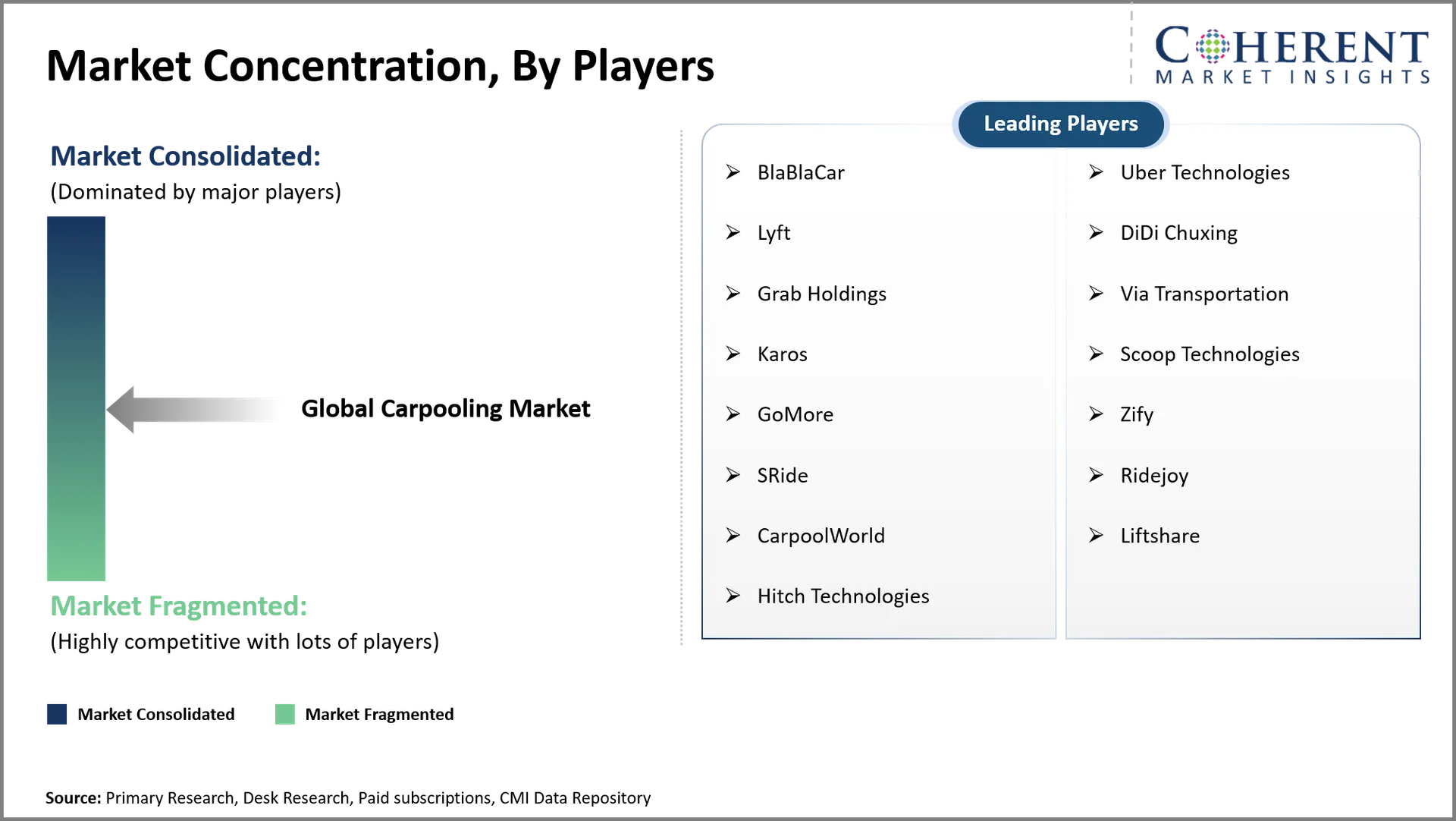
BlaBlaCar focuses on long distance carpooling, multimodal transport and worldwide expansion. The 2026 expansion included 20 countries to its network of platforms. Uber has focused on shared rides in cities, through UberX Share, and on algorithmic matching. Lyft is emphasizing shared rides, with its Lyft Shared service targeted at crowded city corridors. Grab focuses on Southeast Asian mobility ecosystems, integrating ride-hailing with a wider range of transportation services. Karos is designed around employer-based commuting, leveraging predictable employee routes to generate regular carpool demand. These players differ in geography, trip distance, and customer acquisition. Their strongest strategies combine intelligent matching, recurring travel patterns, multimodal integration, and localized mobility partnerships.
Global Carpooling Market Report Coverage | |||
Report Coverage | Details | ||
Base Year | 2025 | Market Size in 2026: | USD 11 Bn |
Historical Data For: | 2020 To 2024 | Forecast Period: | 2026 To 2033 |
Forecast Period 2026 To 2033 CAGR: | 9.40% | 2033 Value Projection: | USD 30 Bn |
Geographies covered: |
| ||
Segments covered: |
| ||
Companies covered: | BlaBlaCar, Uber Technologies, Lyft, DiDi Chuxing, Grab Holdings, Via Transportation, Karos, Scoop Technologies, GoMore, Zify, SRide, Ridejoy, CarpoolWorld, Liftshare, Hitch Technologies | ||
Growth Drivers: |
| ||
Restraints & Challenges: |
| ||
Analyst Opinion (Expert Opinion)
- The future of carpooling will center on highly adaptive matching rather than simple passenger-driver pairing. Artificial intelligence can evaluate route overlap, departure flexibility, traffic conditions, and cancellation probability simultaneously. Scheduled commuting should remain particularly attractive because recurring routes create stronger matching density. Platforms can also combine carpooling with rail and bus bookings to capture complete journeys.
- The largest opportunities should emerge in passenger-car commuting and business-to-business applications. India offers substantial potential because large employment centers create recurring travel corridors. Southeast Asia also provides attractive potential with mobile-first transportation platforms that have high user engagement. In Europe, the market should be more open to integrated carpooling options that connect private vehicles to existing public transport.
- Players looking for an edge should construct proprietary matching systems around repeating travel patterns. Platforms should look to build employer collaborations, not just individual consumer acquisition. They should also guarantee matching for high frequency routes and configurable fallback choices. Partnerships with rail operators, universities, airports, and large employers could create defensible demand clusters.
Speak to the analyst
Want personalized insights?
Take the findings above to one of our principal consultants, or have the report rebuilt around the segments, geographies and competitors you actually track.
Market Segmentation
- Service Type Insights (Revenue, USD Billion, 2021 - 2033)
- Scheduled Carpooling
- On-Demand Carpooling
- Platform Type Insights (Revenue, USD Billion, 2021 - 2033)
- Online Platforms
- Mobile Applications
- Vehicle Type Insights (Revenue, USD Billion, 2021 - 2033)
- Passenger Cars
- Light Commercial Vehicles
- Business Model Insights (Revenue, USD Billion, 2021 - 2033)
- Peer To Peer
- Business To Consumer
- Business To Business
- End User Insights (Revenue, USD Billion, 2021 - 2033)
- Individuals
- Corporates
- Schools
- Government Organizations
- Regional Insights (Revenue, USD Billion, 2021 – 2033)
- North America
- U.S.
- Canada
- Latin America
- Brazil
- Argentina
- Mexico
- Rest of Latin America
- Europe
- Germany
- U.K.
- Spain
- France
- Italy
- Russia
- Rest of Europe
- Asia Pacific
- China
- India
- Japan
- Australia
- South Korea
- ASEAN
- Rest of Asia Pacific
- Middle East
- GCC Countries
- Israel
- Rest of Middle East
- Africa
- South Africa
- North Africa
- Central Africa
- North America
Sources
Primary Research Interviews
- Carpooling Platform Executives & Product Managers
- Fleet Management & Mobility Solution Providers
- Urban Transportation Planners & Policy Advisors
- Corporate Mobility & Employee Transportation Managers
Magazines
- Automotive World Magazine
- Intelligent Transport Magazine
- Mobility Management Magazine
- Fleet Europe Magazine
Journals
- Journal of Transport Geography
- Transportation Research Part C: Emerging Technologies
- Journal of Cleaner Production (Sustainable Mobility Edition)
Associations
- International Transport Forum (ITF)
- Shared Mobility Principles for Livable Cities
- European Automobile Manufacturers Association (ACEA)
- International Association of Public Transport (UITP)
Public Domain Sources
- U.S. Department of Transportation (DOT) – Federal Highway Administration Reports
- European Commission – Directorate-General for Mobility and Transport
- World Health Organization (WHO) – Urban Mobility & Air Quality Reports
- United Nations Environment Program (UNEP) – Sustainable Transport Reports
Proprietary Elements
- CMI Data Analytics Tool
- Proprietary CMI Existing Repository of Information for Last 10 Years
Get access to 250+ pages report
Every segment, forecast, competitor profile and data table behind the analysis above — available for instant download.
- ESOMAR Member
- ISO 9001:2015 Certified
- D-U-N-S Registered
- GDPR & CCPA Compliant
Missing comfort of reading report in your local language? Find your preferred language:
Frequently Asked Questions
The global carpooling market is expected to stand at USD 11 Bn in 2026 and is expected to reach USD 30 Bn by 2033.
The CAGR of the global carpooling market is projected to be 9.4% from 2026 to 2033.
Rising urban traffic congestion and increasing fuel and vehicle ownership costs are the major factors driving the growth of the global carpooling market.
Privacy concerns involving location data and Difficulties achieving sufficient ride density are the major factors hampering the growth of the global carpooling market.
In terms of service type, scheduled carpooling segment is estimated to dominate the market revenue share in 2026.
Passengers can share eligible travel expenses instead of paying for an individual journey.
Mobile applications enable trip discovery, digital booking, communication, and location sharing.