

Global Clean Beauty Market Size and Forecast – 2026 To 2033
The Global Clean Beauty Market is estimated to be valued at USD 11.42 Bn in 2026 and is expected to reach USD 22.83 Bn by 2033, growing at a compound annual growth rate (CAGR) of 10.40% from 2026 to 2033. Market growth is supported by consumers paying closer attention to ingredient origin, formulation transparency, responsible sourcing, and the environmental impact of beauty products. This is encouraging brands and ingredient manufacturers to combine natural-origin materials with stronger scientific validation rather than relying only on conventional natural or botanical claims.
In April 2026, when dsm-firmenich introduced EXOVIVE LIFT, a skincare active based on plant-derived exosomes sourced from Alpine apple, Mediterranean tangerine, and Sicilian papaya. The company stated that these materials are selected from organic natural sources and isolated through a sustainable proprietary extraction process. The development shows how clean beauty is moving toward products that combine natural sourcing, advanced formulation science, measurable performance, and more sustainable processing methods.
Key takeaways of Global Clean Beauty Market
- Skincare is expected to post an estimated CAGR of 11.2% during 2026–2033 and account for 46.8% of the global clean beauty market in 2026, reflecting its role in recurring, routine-led consumption and strong scope for efficacy-focused clean formulations. In April 2026, Unilever reported mid-single-digit U.S. skincare growth, reinforcing the category’s commercial resilience.
- Plant Based Ingredients are expected to post an estimated CAGR of 11.6% through 2033 and represent 38.6% of the global clean beauty market in 2026, supported by ingredient transparency, renewable sourcing, and compatibility with natural positioning. In June 2025, L’Oréal highlighted vertical farming technology for AI-enabled cultivation of plant-based ingredients, strengthening scalable botanical sourcing.
- Online Retail is expected to register an estimated CAGR of 11.8% through 2033 and capture 36.8% of the global clean beauty market in 2026, as digital discovery makes ingredient-led comparison, niche-brand access, and education easier across geographies. In March 2025, Ulta Beauty’s Conscious Beauty brand list was updated to classify brands against clean ingredients, vegan, cruelty-free, and sustainable-packaging criteria.
- North America is expected to advance at an estimated CAGR of 10.0% during 2026–2033 and account for 32.8% of the global clean beauty market in 2026, supported by mature branded beauty retail, sophisticated ingredient scrutiny, and established clean-product merchandising. In December 2025, the U.S. FDA published its assessment of PFAS use in cosmetics, reinforcing regulatory attention to ingredient transparency.
- Europe is expected to grow at an estimated CAGR of 11.7% through 2033 and represent 31.7% of the global clean beauty market in 2026, with stringent product-safety expectations and sustainability-oriented formulation practices supporting premium clean positioning. In June 2026, the European Commission endorsed a provisional political agreement simplifying cosmetics rules while retaining strong consumer protection, improving regulatory predictability for beauty companies.
Segmental Insights
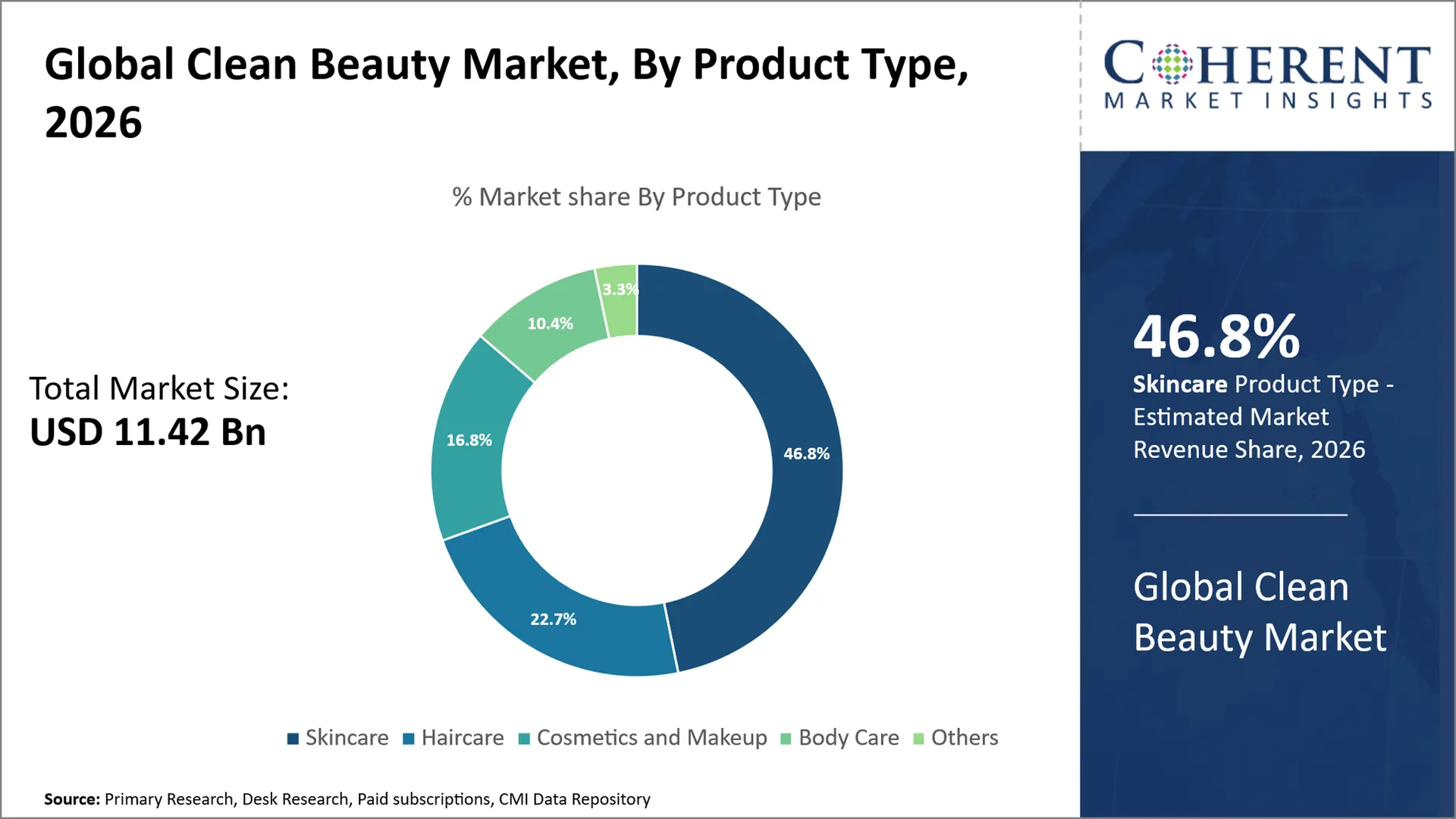
Why Does Skincare Dominate the Global Clean Beauty Market?
Skincare is expected to account for 46.8% of the global clean beauty market in 2026, making it the leading product segment. Its position is supported by the high frequency of facial and body-care routines, where consumers increasingly evaluate ingredient origin, formulation tolerability, and functional performance together. Unlike occasional-use beauty products, cleansers, serums, sunscreens, and treatments create recurring purchase requirements, strengthening category turnover. Formulators are also combining naturally derived ingredients with evidence-based actives, allowing clean skincare to address pigmentation, sensitivity, aging, hydration, and barrier care without relying solely on traditional natural positioning. Retailers benefit from broad assortment depth and repeat-purchase economics, while brands can build differentiated routines around specific skin concerns. In January 2025, L’Oréal unveiled Cell BioPrint, a five-minute skin-analysis technology using biomarkers to support more personalized skincare recommendations, demonstrating how diagnostic technology can increase product relevance and deepen skincare engagement.
- Current Industry Events of 2026
- Market Size Estimation
- Regional Breakdown
- Competitive Landscape
- Customer Intelligence
- Segmental Analysis
- Pricing Analysis
- Key Market Drivers, Challenges & Future Trends
- Customized Insights Section
Why Does Plant Based Ingredients Represent the Largest Ingredient Category in the Global Clean Beauty Market?
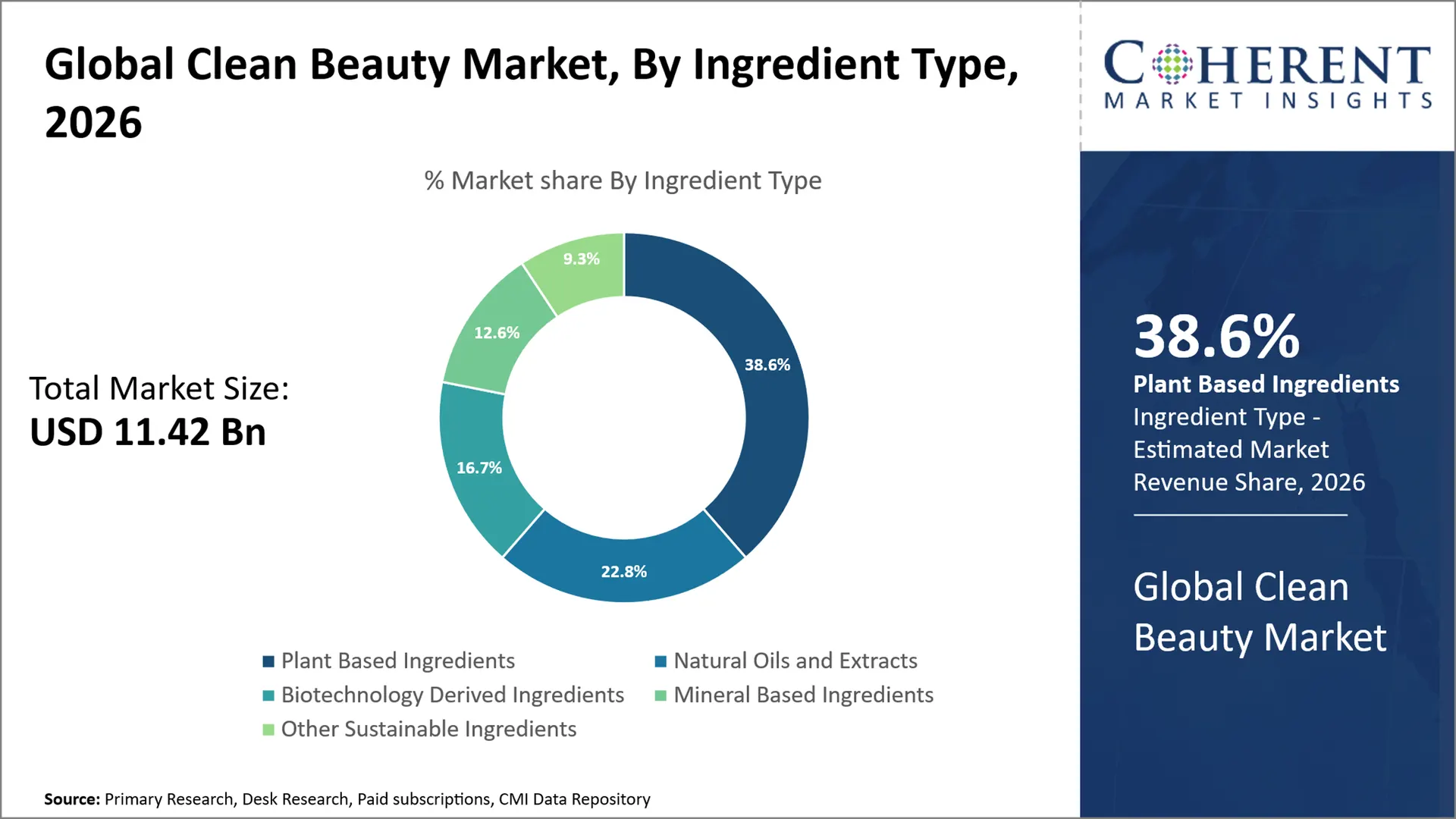
Plant Based Ingredients are expected to represent 38.6% of the global clean beauty market in 2026, reflecting their broad formulation compatibility and strong alignment with natural, vegan, biodegradable, and responsible-sourcing requirements. Their advantage extends beyond consumer perception: ingredient suppliers are improving functionality so botanical and renewable feedstocks can substitute conventional synthetic materials without materially compromising formulation performance. This expands their use across cleansing, conditioning, styling, moisturizing, and treatment products. Certified agricultural sourcing and traceability additionally help manufacturers substantiate environmental and ethical claims, while scalable ingredient platforms allow brands to incorporate plant-derived components across multiple product lines. The commercial opportunity therefore spans raw-material suppliers, formulators, contract manufacturers, and finished-product brands. In April 2025, BASF introduced three natural-based personal-care ingredients, including Verdessence Maize, a 100% renewable, biodegradable corn-starch polymer, demonstrating the increasing availability of functional plant-derived alternatives for cosmetic formulation.
Why Does Creams and Moisturizers Dominate the Skincare Category of the Global Clean Beauty Market?
Creams and Moisturizers are expected to hold 28.6% of the global clean beauty market in 2026, supported by their role as foundational products in daily skincare routines. Their broad applicability across dry, sensitive, mature, and combination skin creates a wider addressable consumer base than highly specialized treatments. Demand is also reinforced by the shift toward barrier-supportive formulations incorporating humectants, emollients, botanical extracts, and naturally derived lipids. From the supply side, advances in texture engineering allow manufacturers to deliver lighter, fast-absorbing formats while maintaining hydration performance, improving suitability for warm climates and layered routines. Pharmacies, specialty beauty retailers, dermatology-led channels, and e-commerce platforms provide multiple routes to market. In January 2025, Beiersdorf launched the NIVEA LUMINOUS EVEN GLOW facial-care range in India with locally adapted textures, packaging, and trial sizes, illustrating how moisturizer and facial-care formats can be tailored to purchasing behavior and local usage preferences.
Current Events and their Impact
Current Event | Description and Its Impact |
February 2026 – U.S. FDA updates Cosmetics Direct for MoCRA registration renewals |
|
February 2026 – UK Cosmetics Products Regulation amendments |
|
April 2026 – European Commission Regulation (EU) 2026/909 on cosmetic ingredients |
|
Global Clean Beauty Market Dynamics
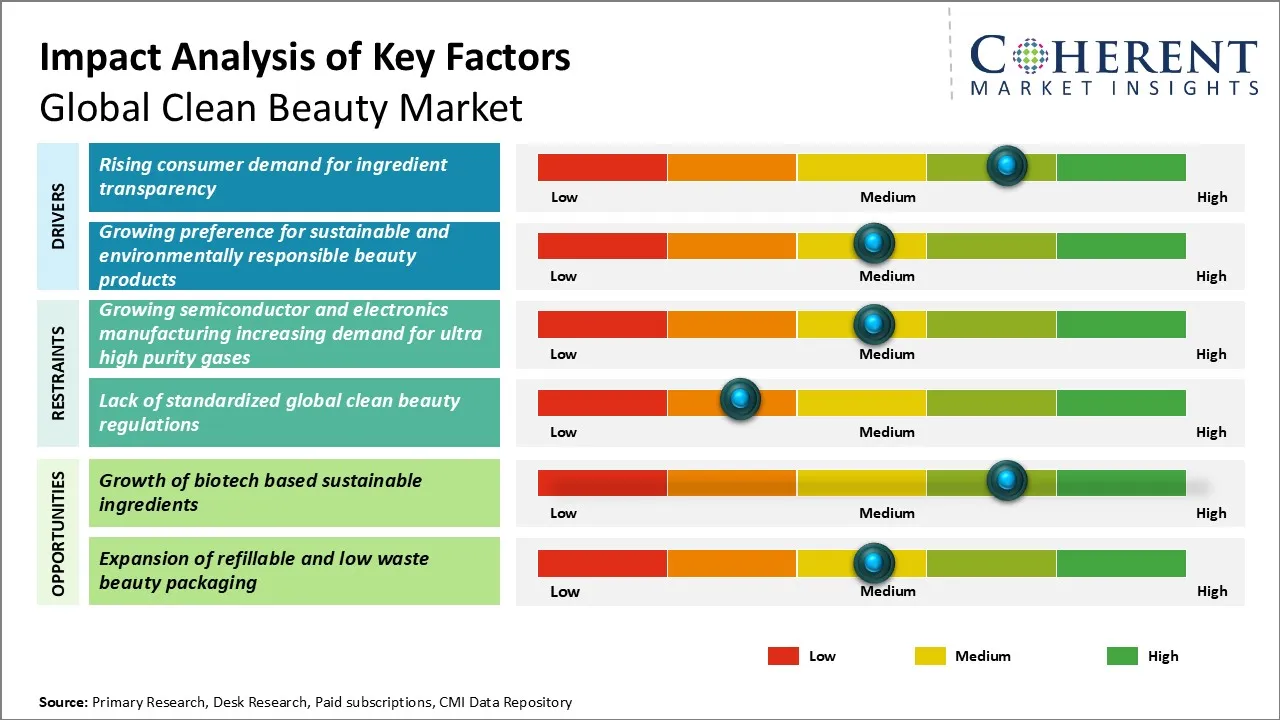
Key Market Drivers
- Rising consumer demand for ingredient transparency: Ingredient transparency is becoming a purchase-screening mechanism in the global clean beauty market, shifting value toward brands that explain ingredient purpose, sourcing, safety assessment, and formulation choices. Clear communication reduces perceived purchase risk and supports premium positioning, while retailers can use credible product information to strengthen assortment credibility. Suppliers also benefit when traceable inputs and documentation become commercial differentiators. In October 2024, the Estée Lauder Companies published its corporate ingredient glossary, covering more than 100 key ingredients and providing consumers with information on their purpose. This strengthens the commercial case for documented formulation claims and supplier-level traceability.
- Growing preference for sustainable and environmentally responsible beauty products: Growing preference for sustainable and environmentally responsible beauty products is reshaping formulation and packaging decisions across the global clean beauty market. Demand increasingly reaches beyond ingredient origin into resource use, recyclability, refillability, and lifecycle considerations. This favors brands and contract manufacturers able to redesign packs without compromising product protection or consumer experience, while packaging suppliers gain opportunities in lower-material and refill systems. In February 2026, Aveda announced global adoption of AeroFlexx refill packaging, designed to reduce plastic use while maintaining a premium refill experience. The move illustrates how packaging engineering is becoming a market-level differentiator for clean beauty brands.
Emerging Market Trends
- Clean beauty is shifting from “free-from” claims toward proof-based product communication: Clean beauty is moving from broad “free-from” positioning toward proof-based formulation communication. Brands are increasingly expected to connect ingredient choices with a specific consumer benefit, safety rationale, sourcing standard, or environmental attribute rather than relying on vague clean labels. This is changing product development toward better substantiation, clearer digital product information, and tighter coordination between formulators, regulatory teams, and marketing. Over the forecast period, brands that cannot substantiate claims may lose credibility, while companies with strong formulation documentation and consumer education capabilities should gain greater control over premium positioning and retailer acceptance.
- Modular formulation platforms are reshaping clean beauty product development: Beauty formulation is increasingly becoming a platform exercise rather than a single-product formulation task. Manufacturers are designing versatile ingredient systems that can support multiple textures, formats, skin concerns, and channels while preserving a consistent clean positioning. This favors suppliers with modular formulation technologies and contract manufacturers able to adapt base systems efficiently across markets. The direction should strengthen over the forecast period as brands seek faster portfolio expansion without multiplying development complexity. Specialists that combine formulation flexibility with regulatory knowledge and scalable production should gain an advantage over suppliers competing mainly on individual raw materials.
Regional Insights
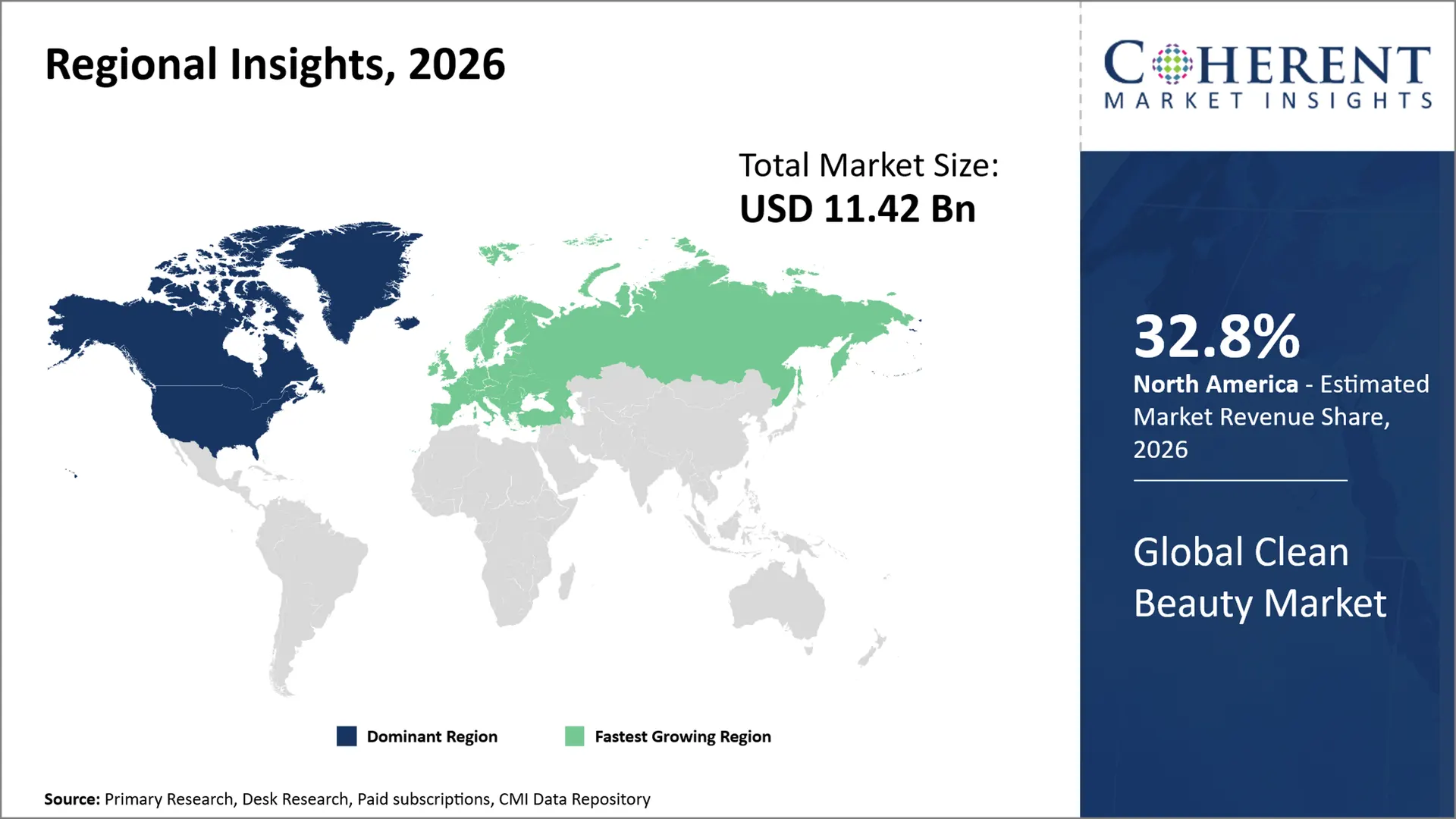
Why Does North America Dominate the Global Clean Beauty Market?
North America is expected to retain its leading position with 32.8% share in the global clean beauty market, supported by a mature premium-beauty retail structure, strong e-commerce penetration, sophisticated ingredient screening, and consumers accustomed to comparing formulation attributes before purchase. The region also benefits from established specialty retailers that can curate clean products, educate shoppers, and provide smaller brands with access to large consumer audiences. This creates a commercial pathway from niche formulation concepts to broader retail distribution. Packaging circularity is becoming an additional differentiator as retailers connect clean product positioning with waste reduction. In November 2025, Sephora reported that its Beauty (Re)Purposed program had collected more than 100,000 pounds of empty beauty packaging across its North American stores, strengthening the region's infrastructure for circular beauty consumption.
Why Is Europe Emerging as the Fastest-Growing Region in the Global Clean Beauty Market?
Europe is positioned for faster expansion with 31.7% market share in the global clean beauty market because sustainability expectations are increasingly embedded in product development, labeling, packaging, and retailer selection rather than treated as optional brand attributes. European consumers are also accustomed to ingredient scrutiny and detailed cosmetic information, creating favorable conditions for formulations supported by transparent ingredient policies and environmental positioning. The region's sophisticated premium beauty ecosystem further enables brands to monetize cleaner formulations through differentiated products and higher-value assortments. France provides an important commercial signal because clean beauty is being incorporated into mainstream specialty retail rather than remaining confined to independent brands. In 2024, Sephora France introduced its Clean at Sephora program, giving shoppers an identifiable framework for formulations excluding specified ingredient families and integrating the concept across stores, websites, and mobile shopping.
Global Clean Beauty Market Outlook for Key Countries
Why Is the U.S. a Key Market for the Global Clean Beauty Market?
The U.S. is a key market for the global clean beauty market because it combines sophisticated specialty-beauty retail, strong direct-to-consumer commerce, extensive brand innovation, and a large ecosystem of ingredient-conscious consumers. The country's importance also comes from the ability of retailers and brands to turn formulation attributes into searchable product filters, curated collections, and premium positioning. This creates strong visibility for clean skincare, makeup, haircare, and fragrance across digital and physical channels. U.S. beauty companies are also increasingly integrating sustainability into operating decisions rather than limiting it to product claims. In October 2025, Coty reported progress on ingredient transparency, supplier collaboration, and water-use reduction in its FY2025 Sustainability Report, illustrating how sustainability and formulation transparency are becoming embedded in the operating models of major U.S.-listed beauty companies.
Why Is China Important in the Global Clean Beauty Market?
China is an important market for the global clean beauty market because its large domestic cosmetics industry combines sophisticated manufacturing capabilities with rapidly evolving regulatory and digital-commerce infrastructure. Local manufacturers can respond quickly to changing formulation preferences, while brands can use China's extensive online ecosystem to introduce ingredient-focused products and communicate formulation attributes directly to consumers. Regulatory modernization is also encouraging more structured product documentation and innovation. In December 2025, China's National Medical Products Administration issued opinions supporting deeper cosmetics regulatory reform and higher-quality industry development, including measures intended to facilitate innovative efficacy claims, improve registration and filing efficiency, and strengthen whole-chain safety oversight. The direction favors manufacturers that can combine formulation R&D with strong regulatory documentation, while international brands entering China increasingly need localized compliance capabilities.
Why Is France a Strategic Country in the Global Clean Beauty Market?
France is a strategic country in the global clean beauty market because its cosmetics ecosystem combines premium product development, formulation expertise, sophisticated fragrance and skincare capabilities, and strong consumer familiarity with ingredient and environmental considerations. French beauty companies also have substantial influence over international product standards and premium positioning, making developments in the country relevant beyond domestic consumption. Sustainability is increasingly connected with packaging design, product development, and lifecycle management. In April 2026, LVMH's environmental reporting showed that 69% of evaluated Parfums & Cosmétiques products were enrolled in an eco-design approach, demonstrating how environmental assessment is being incorporated into the development architecture of a major French beauty group. This strengthens demand for formulation, packaging, and design capabilities that can satisfy both luxury expectations and environmental objectives.
Why Is South Korea a Key Market for the Global Clean Beauty Market?
South Korea is a key market for the global clean beauty market because its cosmetics industry is strongly oriented toward rapid formulation development, functional skincare, sophisticated textures, and export-ready product concepts. Korean manufacturers and brands frequently use formulation innovation as a competitive tool, allowing products to respond quickly to changing consumer preferences while maintaining strong performance expectations. The country's regulatory environment is also adapting to new product formats and efficacy-oriented development. In December 2025, South Korea's Ministry of Food and Drug Safety expanded its functional-cosmetics review framework to include solid formulations under specified conditions, reducing documentation requirements for qualifying products and supporting faster commercialization. This regulatory adjustment can benefit manufacturers developing solid skincare and other concentrated formats, while strengthening South Korea's role as a formulation and product-development hub for international beauty markets.
Why Is Brazil an Important Growth Market for the Global Clean Beauty Market?
Brazil is an important growth market for the global clean beauty market because its large domestic beauty culture, biodiversity, botanical-resource base, and established local cosmetics industry create favorable conditions for nature-oriented product development. Brazilian companies can differentiate through regional botanical ingredients and sustainability-linked formulation narratives while serving consumers across skincare, haircare, body care, and fragrance categories. The country's regulatory framework is also creating clearer pathways for smaller and artisanal producers. In September 2026, Anvisa approved a regulatory framework for artisanal personal-care products, cosmetics, and perfumes, establishing simplified procedures and specific requirements for qualifying products. This can lower formalization barriers for smaller producers while preserving defined safety requirements, potentially widening the supplier base for locally sourced clean beauty concepts and increasing opportunities for specialist brands to reach formal retail channels.
Consumer Preference and Product Evolution Landscape
Technology / Approach | Primary Market Application | Adoption Position | Commercial Impact on Clean Beauty |
AI-assisted formulation and ingredient screening | Formula optimization, ingredient compatibility, safety and sustainability assessment | Emerging-to-expanding | Can shorten formulation cycles and improve evidence-based ingredient selection |
Green chemistry assessment platforms | Raw-material selection and formulation redesign | Expanding | Helps balance performance, human safety, environmental impact, and ingredient substitution |
Biotechnology and precision fermentation | Actives, functional ingredients, bio-based alternatives | Expanding | Creates scalable alternatives to resource-intensive or inconsistent natural inputs |
Advanced botanical extraction technologies | Natural actives, fragrances, functional plant ingredients | Established-to-expanding | Improves consistency, concentration, traceability, and recovery of desirable compounds |
Waterless and concentrated formulation systems | Cleansers, solid formats, concentrated skincare and body care | Emerging | Reduces formulation water dependence and can support compact logistics and packaging formats |
Digital ingredient traceability and product-data systems | Ingredient provenance, compliance, claims substantiation and consumer information | Emerging | Converts supply-chain documentation into a commercial trust and market-access capability |
How Are Digital Traceability and Ingredient-Level Data Creating New Growth Opportunities in the Global Clean Beauty Market?
Digital traceability can create an underdeveloped opportunity by turning ingredient information into a customer-facing product attribute rather than a compliance record. Brands could connect batch-level sourcing, formulation rationale, certifications, allergen information, and disposal guidance through digital product pages or scannable product identities. This would be valuable for premium beauty buyers, specialty retailers, dermatology-oriented channels, and export-focused brands that need consistent evidence across markets. Suppliers could differentiate by providing standardized data packages alongside ingredients, while manufacturers could use connected records to support regulatory reviews and faster market entry. Capturing the opportunity requires interoperable ingredient databases, reliable supplier documentation, regulatory data management, and disciplined claims governance. Established companies with broad supplier networks may have scale advantages, but specialist software and traceability providers can capture value through integration partnerships. The strongest commercial models will combine transparency with useful purchasing guidance rather than simply displaying more data.
Market Players, Key Development, and Competitive Intelligence
Key Developments
- In June 2026, Kao announced Water Capturing Skin technology designed to increase stratum-corneum moisture by drawing in surrounding water. This is important for the global clean beauty market because differentiated hydration science can support new performance claims and help brands move beyond conventional moisturization architectures.
- In April 2026, Symrise introduced three cosmetic ingredients at in-cosmetics global, including plant-derived and barrier-care solutions. This is important for the global clean beauty market because specialty ingredient innovation expands the formulation toolkit available to brands seeking nature-linked positioning with reproducible cosmetic performance.
- In February 2026, Shiseido developed AI-based systems to assess cosmetic-ingredient biodegradability and identify safety information. This is important for the global clean beauty market because faster evidence screening can support environmentally preferable ingredient selection and strengthen safety documentation as formulation portfolios become more complex.
Competitive Landscape
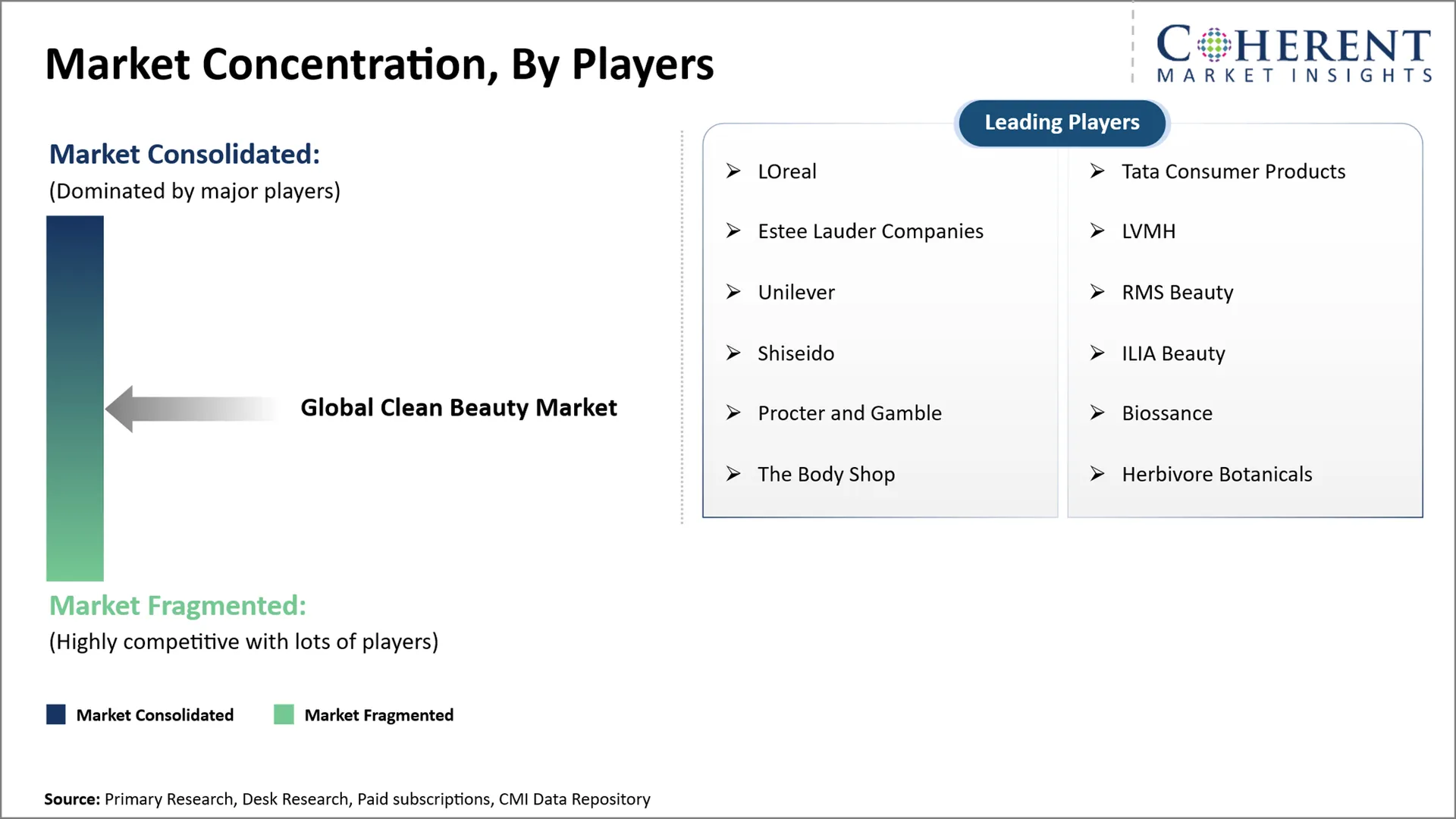
The global clean beauty market is moderately consolidated, with multinational beauty groups competing alongside specialist clean-beauty brands, digitally native labels, ingredient suppliers, and contract manufacturers. Competition increasingly depends on credible formulation claims, sensory performance, ingredient traceability, packaging design, regulatory readiness, and channel execution. Regional specialists can differentiate through local botanicals, cultural formulation expertise, agile launches, and retailer relationships, while larger players benefit from R&D scale and global compliance infrastructure.
Key focus areas include
- Formulation performance: Clean positioning must be supported by comparable sensory quality, stability, efficacy, and consumer experience.
- Ingredient specification: Traceability, purity, natural-origin content, certification, and consistent raw-material quality increasingly influence supplier selection.
- Regulatory compliance: Multi-market regulatory monitoring and formulation documentation can become a competitive barrier to international expansion.
- Packaging engineering: Refillable, recyclable, lightweight, and material-efficient formats provide differentiation beyond the formula itself.
- Contract manufacturing: Flexible private-label and small-batch capabilities benefit emerging brands seeking faster portfolio development.
- Distribution access: Specialty beauty, pharmacies, e-commerce, social commerce, and premium retail require different merchandising and education capabilities.
- Scientific substantiation: Clinical, dermatological, safety, and environmental evidence increasingly separates credible premium products from claim-led offerings.
- Regional localization: Local ingredient sourcing, climate-specific formulations, and culturally relevant product concepts can strengthen regional brands against global portfolios.
Market Report Scope
Global Clean Beauty Market Report Coverage | |||
Report Coverage | Details | ||
Base Year | 2025 | Market Size in 2026: | USD 11.42 Bn |
Historical Data For: | 2020 To 2024 | Forecast Period: | 2026 To 2033 |
Forecast Period 2026 To 2033 CAGR: | 10.40% | 2033 Value Projection: | USD 22.83 Bn |
Geographies covered: |
| ||
Segments covered: |
| ||
Companies covered: | LOreal, Estee Lauder Companies, Unilever, Shiseido, Procter and Gamble, The Body Shop, Tata Consumer Products, LVMH, RMS Beauty, ILIA Beauty, Biossance, Herbivore Botanicals | ||
Growth Drivers: |
| ||
Restraints & Challenges: |
| ||
Analyst Opinion (Expert Opinion)
- Competitive advantage in the global clean beauty market will gradually move toward portfolio architecture rather than isolated product launches. Brands that can build coherent product families around compatible formulations, complementary routines, and consistent quality standards should improve customer retention and reduce development duplication. This favors organizations capable of coordinating formulation science, procurement, regulatory teams, packaging, and channel strategy as one commercial system.
- The more consequential disruption will come from data-assisted formulation development, where computational screening, predictive modelling, automated experimentation, and digital formulation records increasingly influence R&D decisions. This could pressure traditional trial-and-error development models and raise the importance of proprietary formulation datasets. Ingredient suppliers and beauty manufacturers that can combine scientific expertise with usable data infrastructure should be better positioned than companies relying primarily on conventional formulation know-how.
- Companies should prioritize performance consistency, robust preservation systems, regulatory-ready documentation, and scalable sourcing rather than overinvesting in superficial “clean” positioning. Margin pressure can emerge when sustainable inputs, specialty packaging, or small production runs raise unit costs without sufficient willingness to pay. Management teams should therefore validate premium claims against measurable product performance and secure alternative suppliers for strategically important ingredients. Partnerships with specialist formulators, traceability providers, and packaging engineers can provide capability without requiring every technology to be developed internally.
Speak to the analyst
Want personalized insights?
Take the findings above to one of our principal consultants, or have the report rebuilt around the segments, geographies and competitors you actually track.
Market Segmentation
- Product Type Insights (Revenue, USD Bn, 2021 - 2033)
- Skincare
- Haircare
- Cosmetics and Makeup
- Body Care
- Others
- Ingredient Type Insights (Revenue, USD Bn, 2021 - 2033)
- Plant Based Ingredients
- Natural Oils and Extracts
- Biotechnology Derived Ingredients
- Mineral Based Ingredients
- Other Sustainable Ingredients
- Product Format Insights (Revenue, USD Bn, 2021 - 2033)
- Creams and Moisturizers
- Serums and Treatments
- Cleansers
- Masks and Exfoliators
- Oils and Balms
- Others
- Consumer Positioning Insights (Revenue, USD Bn, 2021 - 2033)
- Natural and Organic Beauty
- Vegan Beauty
- Sustainable Beauty
- Free From Formulations
- Ethical and Cruelty Free Beauty
- Distribution Channel Insights (Revenue, USD Bn, 2021 - 2033)
- Online Retail
- Specialty Beauty Stores
- Brand Owned Stores
- Supermarkets and Pharmacies
- Others
- Regional Insights (Revenue, USD Bn, 2021 - 2033)
- North America
- U.S.
- Canada
- Latin America
- Brazil
- Argentina
- Mexico
- Rest of Latin America
- Europe
- Germany
- U.K.
- Spain
- France
- Italy
- Russia
- Rest of Europe
- Asia Pacific
- China
- India
- Japan
- Australia
- South Korea
- ASEAN
- Rest of Asia Pacific
- Middle East
- GCC Countries
- Israel
- Rest of Middle East
- Africa
- South Africa
- North Africa
- Central Africa
- North America
Sources
Primary Research Interviews
- Clean beauty brands, natural ingredient suppliers, cosmetic manufacturers, contract manufacturers, formulation laboratories, and sustainable packaging suppliers
- Cosmetic scientists, formulation chemists, R&D managers, product development managers, sustainability managers, procurement professionals, and regulatory affairs specialists
- Beauty retailers, pharmacy buyers, e-commerce category managers, distributors, wholesalers, dermatologists, and professional skincare practitioners
Stakeholders
- Clean beauty, skincare, haircare, makeup, and personal care manufacturers
- Natural, botanical, bio-based, organic, and biotechnology-derived ingredient suppliers
- Contract manufacturers, formulation laboratories, testing laboratories, and packaging suppliers
- Specialty beauty retailers, pharmacies, online beauty platforms, distributors, and direct-to-consumer brands
- Consumers seeking transparent ingredients, sustainable products, ethical sourcing, and environmentally responsible packaging
End-use Sectors
- Skincare
- Haircare
- Makeup and color cosmetics
- Fragrance
- Personal care
- Premium and professional beauty
Regulatory and Industry Bodies
- U.S. Food and Drug Administration FDA
- European Commission
- Scientific Committee on Consumer Safety SCCS
- Health Canada
- Personal Care Products Council PCPC
- Cosmetics Europe
- International Federation of Societies of Cosmetic Chemists IFSCC
- International Organization for Standardization ISO
Databases
- PubMed
- ClinicalTrials.gov
- Company annual and sustainability reports
- Cosmetic ingredient and formulation databases
- Cosmetic product registration databases
- Beauty and personal care import-export datasets
- Ingredient specification and product portfolio databases
- Regulatory and restricted-substance databases
Magazines and Journals
- International Journal of Cosmetic Science
- Journal of Cosmetic Dermatology
- Cosmetics & Toiletries
- Personal Care Magazine
- CosmeticsDesign
- International Journal of Cosmetic Science
- International Journal of Molecular Sciences
Associations
- Personal Care Products Council PCPC
- Cosmetics Europe
- International Federation of Societies of Cosmetic Chemists IFSCC
- Society of Cosmetic Chemists SCC
- Natural Products Association NPA
- Regional cosmetics and personal care industry associations
Public Domain Sources
- Cosmetic ingredient safety assessments
- Natural and bio-based ingredient research
- Sustainable packaging and circularity developments
- Cosmetic labeling and ingredient-disclosure requirements
- Consumer preference and beauty purchasing studies
- Clean formulation, green chemistry, and biotechnology developments
- Beauty and personal care trade and industry statistics
Key Standards and Regulations
- Cosmetic product safety and ingredient compliance requirements
- Ingredient disclosure and cosmetic labeling regulations
- Cosmetic claims substantiation requirements
- Good Manufacturing Practice GMP requirements
- Restricted-substance and fragrance-allergen regulations
- Product registration and responsible-person requirements
- ISO 22716 Cosmetic Good Manufacturing Practices
- Environmental claims, packaging, recyclability, and sustainability-related requirements
Proprietary Elements
- CMI Data Analytics Tool
- Proprietary CMI repository containing 10+ years of beauty and personal care, skincare, cosmetic ingredients, natural and bio-based formulations, consumer behavior, sustainable packaging, regulatory developments, competitive intelligence, trade flows, and clean beauty market intelligence.
Get access to 250+ pages report
Every segment, forecast, competitor profile and data table behind the analysis above — available for instant download.
- ESOMAR Member
- ISO 9001:2015 Certified
- D-U-N-S Registered
- GDPR & CCPA Compliant
Frequently Asked Questions
The CAGR of global clean beauty market is projected to be 10.40% from 2026 to 2033.
The global clean beauty market is estimated to be valued at USD 11.42 Bn in 2026 and is expected to reach USD 22.83 Bn by 2033.
The major factors driving the global clean beauty market are rising consumer demand for ingredient transparency and a growing preference for sustainable and environmentally responsible beauty products.
Growing semiconductor and electronics manufacturing increasing demand for ultra-high purity gases and Lack of standardized global clean beauty regulations are the major factors hampering the growth of global clean beauty market.
In terms of product type, skincare is estimated to dominate the market revenue share in 2026.
LOreal, Estee Lauder Companies, Unilever, Shiseido, Procter and Gamble, The Body Shop, Tata Consumer Products, LVMH, RMS Beauty, ILIA Beauty, Biossance, Herbivore Botanicals are the major players.
North America is expected to lead the global clean beauty market in 2026.