

Global Cleaning Robot Market Size and Forecast – 2026 To 2033
The global cleaning robot market is expected to grow from USD 8.80 Bn in 2026 to USD 53.25 Bn by 2033, registering a compound annual growth rate (CAGR) of 18.0% from 2026 to 2033. The global cleaning robot market is driven by growing deployment of commercial cleaning robots. On May 11, 2026, Tennant Company announced the launch of the X2 ROVR SCRUB, its smallest and most nimble autonomous floor scrubber designed to deliver consistent, repeatable cleaning performance in tight, high‑traffic commercial environments.
Key Takeaways of the Global Cleaning Robot Market
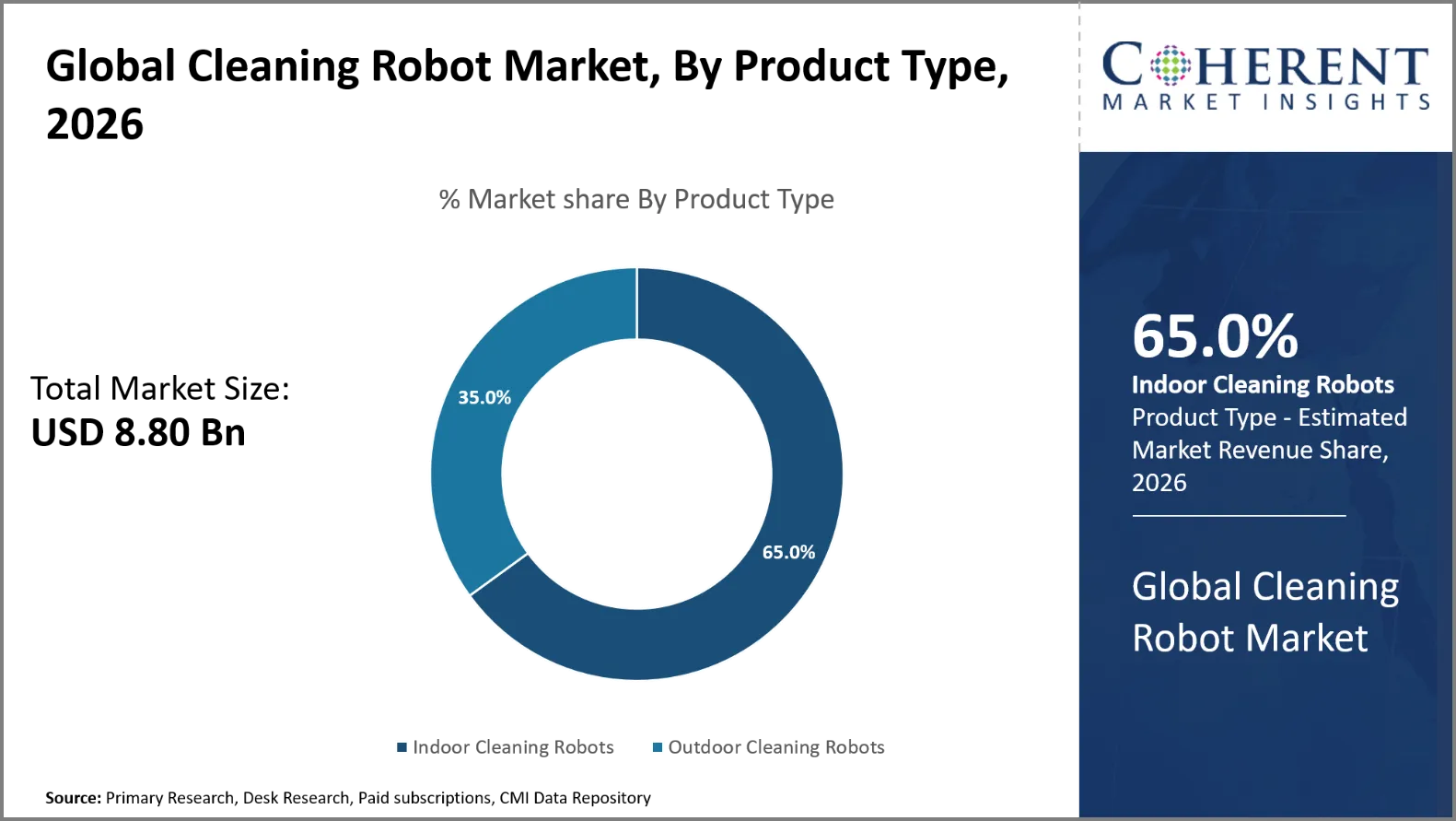
- The Indoor Cleaning Robots segment is expected to account for 65.0% of the global cleaning robot market share in 2026. Advancements in AI and autonomous navigation is driving the growth of the segment. On September 5, 2025, Dreame Technology unveiled their CyberX stair-climbing robotic vacuum prototype at IFA 2025 in Berlin, Germany. The system uses a dedicated climbing mechanism to transport a robotic vacuum between floors.
- The Autonomous segment is estimated to capture 46.0% of the market share in 2026. Increasing adoption of smart home technologies is majorly driving the growth of the segment. On September 4, 2025, ECOVACS and BSH Home Appliances Group announced a strategic partnership involving robotic vacuum cleaners. The partnership combines ECOVACS’ expertise in robotic cleaning with the household appliance skills of BSH.
- The Floor Cleaning Robots segment is estimated to capture 37.0% of the market share in 2026. Growing hygiene requirements across healthcare facilities is driving the growth of the segment. On September 4, 2025, ECOVACS introduced PowerBoost technology with the DEEBOT X11. The system restores six percentage points of battery power within three minutes during mop-cleaning pauses.
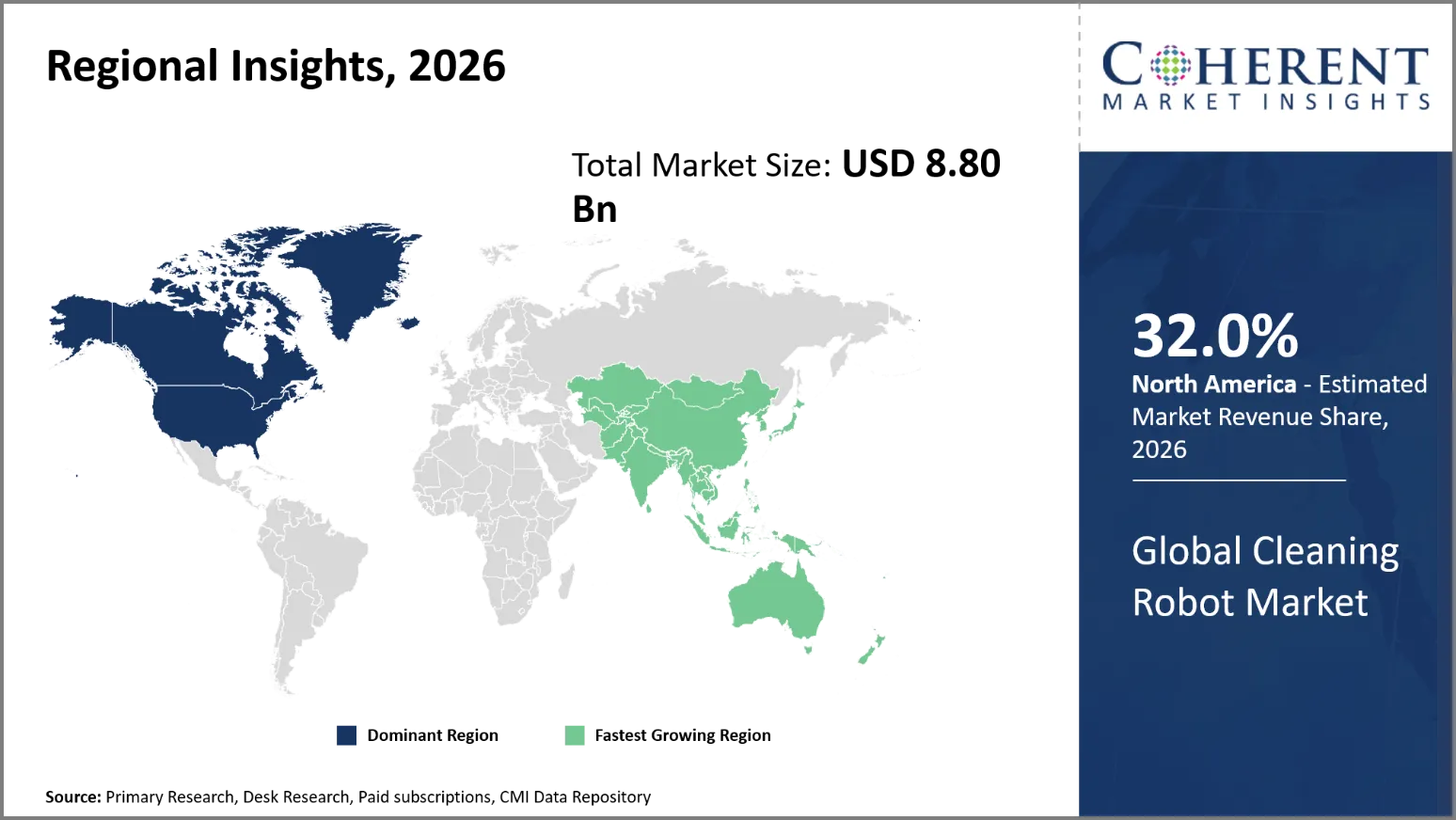
- North America is expected to dominate the cleaning robot market in 2026 with a market share of 32.0%. Expansion of robotic cleaning in hotels and retail facilities in North America is driving the growth of the regional market. On April 2, 2025, LG Electronics USA introduced a commercial-grade autonomous robotic vacuum cleaner developed in collaboration with Marriott Design Lab. The product became available to hospitality operators following implementation pilots at Marriott International properties.
- Asia Pacific is expected to account for 26.0% share in 2026. Rising demand for robotic pool and outdoor cleaning equipment in Asia Pacific is driving the growth of the regional market. On January 10, 2025, Aiper announced the Australian launch of its Scuba X1, Scuba X1 Pro, Scuba X1 Pro Max, and Surfer S2 robotic pool-cleaning products. The company scheduled Australian availability from March 2025.
Segmental Insights
Why Does Indoor Cleaning Robots Dominate the Global Cleaning Robot Market?
The indoor cleaning robots segment is expected to account for 65.0% of the global cleaning robot market share in 2026. Indoor cleaning robots are dominant because the residential and commercial buildings require regular and consistent cleaning. These robots automate normal floor maintenance in homes, offices, hotels, hospitals and retail stores. Their small sizes mean they can be used in tight locations and furniture arrangements. Cleaning is more convenient owing to smart navigation, obstacle recognition and customizable scheduling. The automated vacuuming and mopping reduce the physical workload and helps to maintain regular hygiene. Moreover, increasing adoption of smart home technology is also driving residential demand. Commercial facilities also benefit from scheduled cleaning schedules and reduced reliance on manpower. Indoor cleaning robots thus have great demand across residential and business applications.
On June 2, 2026, Pringle Robotics released a case study on more than 1,200 autonomous floor-cleaning robots. In 2024 and 2025 the fleet was deployed across a nationwide convenience store chain. This example demonstrates the suitability of cleaning robots for repetitive retail-floor maintenance.
- Current Industry Events of 2026
- Market Size Estimation
- Regional Breakdown
- Competitive Landscape
- Customer Intelligence
- Segmental Analysis
- Pricing Analysis
- Key Market Drivers, Challenges & Future Trends
- Customized Insights Section
Why is Autonomous the Most Preferred Operation Type?
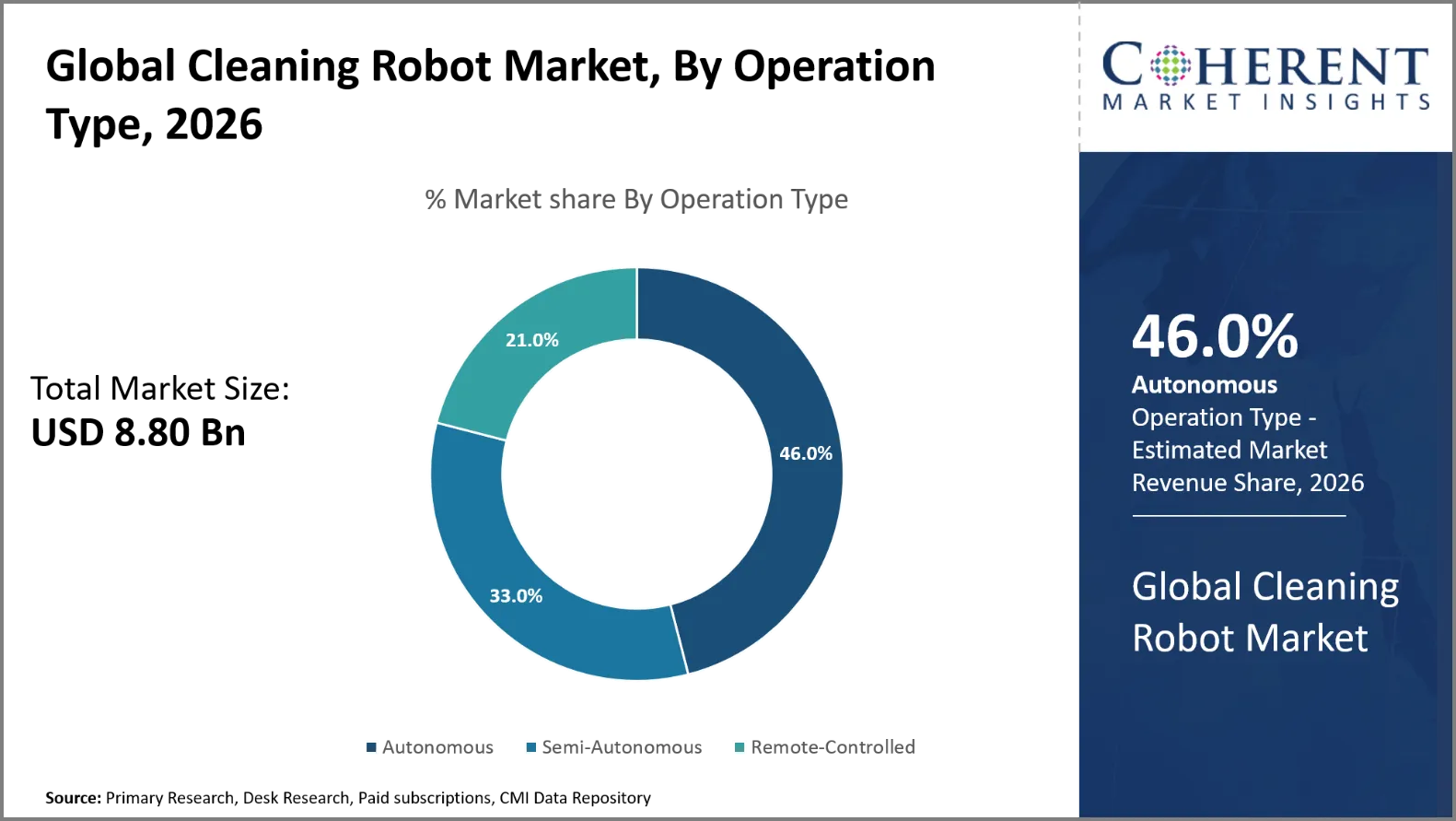
The autonomous segment is expected to account for 46.0% of the global cleaning robot market share in 2026. Autonomous cleaning robots are chosen as they can complete the cleaning jobs autonomously with less human interferences. The robots are equipped with the latest in navigation systems, sensors and artificial intelligence to identify barriers and to follow the best cleaning paths. Automation scheduling enables it to work during convenient hours without constant supervision. Improved coverage efficiency with mapping technologies and room-specific cleaning. The autonomous functioning also minimizes repetitive manual labor both in home and commercial settings. Self-charging means robots can get back to cleaning once the batteries are recharged. Such capabilities make autonomous robots intriguing for use in homes, offices, hotels and health-care facilities. The ease of use of such systems makes them more widely adopted.
On May 27, 2025, Pudu Robotics launched PUDU CC1 Pro, an autonomous commercial cleaning robot. The artificial intelligence detects liquid stains, identifies floor conditions and adapts the cleaning intensity. It also monitors cleaning components and validates cleaning results, reducing the need for routine supervision.
Floor Cleaning Robots Dominates the Global Cleaning Robot Market
The Floor Cleaning Robots segment is expected to account for 37.0% of the global cleaning robot market share in 2026. Floor cleaning robots are dominant because floors need frequent upkeep in homes, businesses and institutions. These robots do the vacuuming, sweeping and mopping automatically to take care of routine cleaning needs. Applications include houses, offices, hotels, commercial complexes, hospitals and educational organizations. Smart navigation provides better coverage for diverse floor plans. Most modern systems combine vacuuming and mopping into one cleaning unit. Automated docks make charging, garbage collection and maintenance even easier. Residential uptake is driven by growing customer demand for handy home appliances. Businesses like consistent cleaning schedules and less repetitious labor too. These characteristics increase the commercial domination of floor cleaning robots.
On January 1, 2025, ECOVACS announced it will unveil the DEEBOT X8 Family of robotic vacuum cleaners, incorporating the OZMO ROLLER Instant Self-Washing Technology. A wide range of modern service robotics will also be on display including the GOAT A&O Family robotic lawn mowers and WINBOT W2 PRO OMNI and WINBOT MINI robotic window cleaners.
Current Events and their Impact
Current Events | Description and its Impact |
European Union Machinery Regulation (EU) 2023/1230 |
|
European Union Artificial Intelligence Act Regulation (EU) 2024/1689 |
|
Cleaning Robot Market Dynamics
Market Drivers
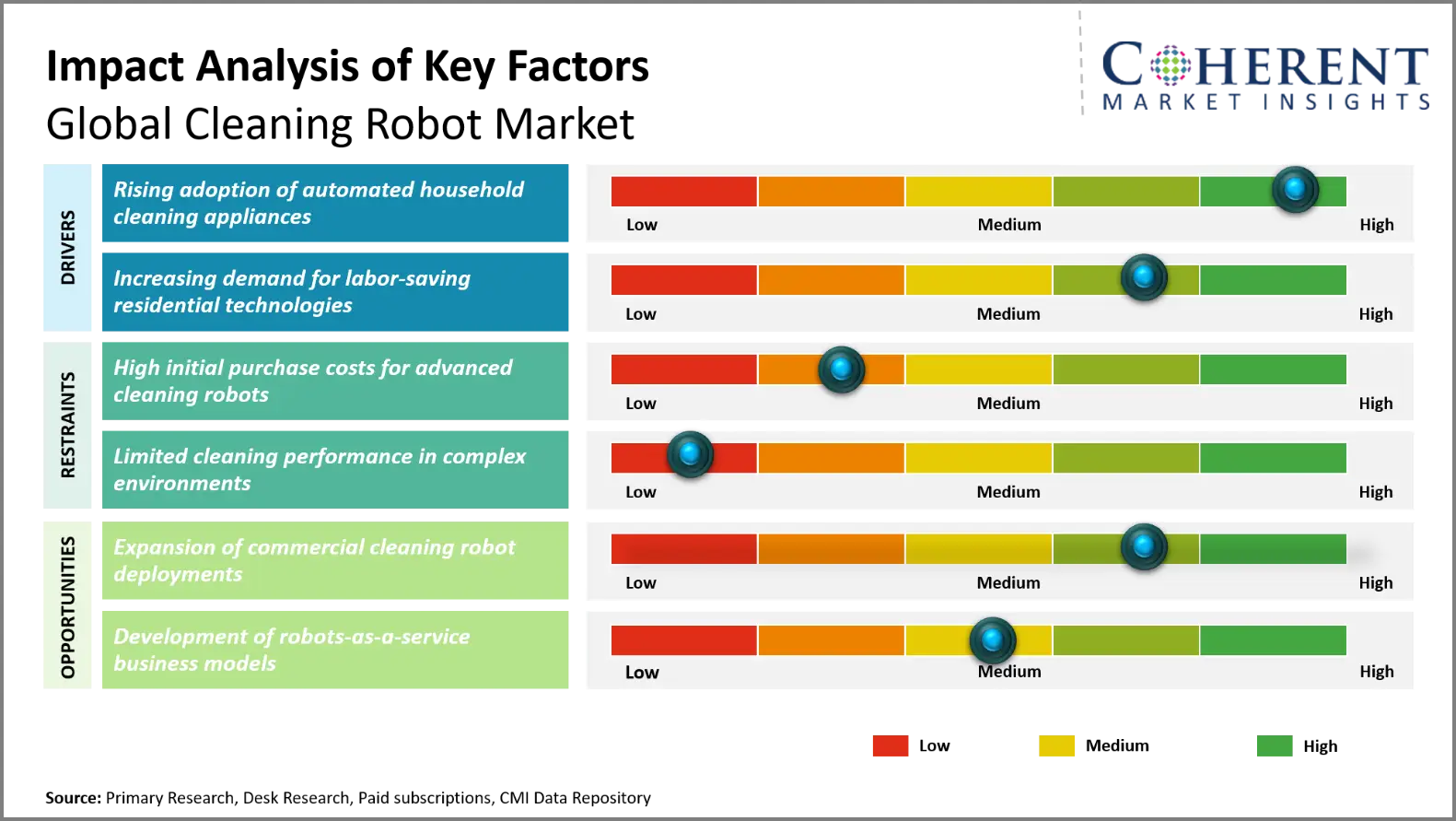
- Rising adoption of automated household cleaning appliances: Consumers are increasingly adopting automated household cleaning appliances in pursuit of convenience and effective home upkeep. Robotic vacuum cleaners, self-mopping robots and multi-function cleaning robots are increasingly popular for home use. Everyday usage is enhanced with smart navigation, automatic scheduling, obstacle detection and self-charging features. The ability to integrate with smartphone apps and smart home ecosystems also adds to the market appeal. As availability grows across price ranges, home adoption is on the rise as well. Such improvements are driving sustained demand for cleaning robots in the residential space.
- On September 3, 2025, Bosch Home Appliances announced the Spotless line of robotic vacuum cleaners. The range comprises four models, all of which enable automated vacuuming and mopping. Higher end models have structured light obstacle detection and camera-based navigation.
- Increasing demand for labor-saving residential technologies: The increasing demand for labor-saving residential technologies is driving households to adopt automated cleaning solutions. Due to busy work schedules, changing daily habits and limited time for domestic duties, interest in autonomous appliances is increasing. Cleaning robots automate vacuuming, sweeping and mopping operations, therefore reducing repeated manual jobs. Top-end models add scheduled cleaning, room mapping and automatic disposal of trash. This feature adds more convenience for working professionals, families and elderly household members. Growing knowledge of smart home technologies is further helping the uptake. As a result, the demand for autonomous cleaning robots is still rising in residential settings.
- On April 23, 2025, iRobot Corp. announced release of the Roomba Max 705 Vac Robot + AutoEmpty Dock in North America and select European markets. The new Roomba Max 705 Vac is built to keep busy, pet-loving households pristine with 180x more power-lifting suction for the maximum level of vacuuming and cleaning.
Market Restraints
- High initial purchase costs for advanced cleaning robots: Advanced cleaning robots are included with artificial intelligence, LiDAR navigation, advanced sensors and auto docking features. These technologies increase the expenses of manufacture and retail pricing, making them less affordable for the budget-conscious consumers and small commercial establishments.
- Limited cleaning performance in complex environments: Cleaning robots can have difficulty in congested areas, uneven floors, tiny corners, thick carpets and scattered obstructions. These constraints could lead to less cleaning coverage and necessitate manual operation, impacting operating efficiency and the overall user experience.
Emerging Trends
- Integration of AI and Advanced Navigation Technologies: Cleaning robots are gradually being equipped with artificial intelligence, LiDAR sensors, computer vision and intelligent mapping. These technologies improve the ability to recognize obstacles, plan routes, identify rooms and clean autonomously in complex home situations.
- Impact: Better navigation results in more precise cleaning, reduced repeated motions, and less human intervention. Artificial intelligence also offers customized cleaning schedules and increased flexibility to adjust to changing home arrangements.
- Relevance to the market: These advances increase product distinctiveness and premium robot acceptance. Manufacturers will be attractive to technology-aware families and commercial establishments looking for strong autonomous cleaning solutions.
- Development of Multifunctional Cleaning Robots: Manufacturers are progressively releasing multipurpose robots that vacuum, sweep, mop and automatically dispose of garbage. Integrated docking stations additionally provide water management, mop washing and automatic maintenance.
- Impact: Multifunctional features minimize cleaning effort in the household and avoid separate appliances. Better automation equals better convenience, operational efficiency and overall consumer pleasure.
- Relevance to the market: Multifunctional products offer potential for premium pricing and product innovation. Products are in increasing demand in private homes, hotels, workplaces and commercial buildings, helping spur market growth.
Regional Insights
Why is North America a Strong Market for Cleaning Robot?
North America is expected to account for a market share of 32.0% in 2026. North America has a foothold in existing smart home ecosystems and large-scale commercial cleaning automation. U.S. adoption is significant in airports, supermarket stores, educational facilities and major commercial structures. SoftBank Robotics America and Flagship Aviation Services increased their airport cleaning program in August 2026. They deployed over 200 autonomous robots across 25 airport areas. The fleet surpassed 100,000 operating hours and approached 500 million square feet cleaned. Tennant Company also supports autonomous floor cleaning across Canadian shopping centers. Domus Building Cleaning uses its autonomous scrubber at an 81,750-square-metre Ottawa shopping center. These deployments strengthen commercial demand.
Why Does Asia Pacific Cleaning Robot Market Exhibit High Growth?
Asia Pacific is expected to register the fastest growth with a CAGR of 18.3% over the forecast period. It is projected to account for 26.0% of the global cleaning robot market in 2026. The region benefits from domestic robotics manufacturing, expanding smart-home adoption, and increasing availability of advanced household appliances. Companies like Roborock, Ecovacs Robotics, Dreame Technology and Xiaomi have made China the center of regional production. Launches like Haier’s CIVIC X11 series are creating premium residential demand in India. Australia promotes commercial uptake through facility management automation and regional distribution networks. In 2025, SIMPPLE Australia installed autonomous cleaning robots in more than 80 retirement villages in New Zealand. The existing electronics businesses in Japan and South Korea as well as the advanced household automation technology in these countries boost the regional demand.
Global Cleaning Robot Market Outlook for Key Countries
Why is U.S. Emerging as a Major Hub in the Cleaning Robot Market?
The U.S. cleaning robot market is driven by commercial facility automation, increasing need for autonomous floor maintenance and growing use in retail settings. Airports are a significant use case as passenger flow results in constant cleaning requirements. SoftBank Robotics America and Flagship Aviation Services went to 25 airports in August 2026. Their fleet currently includes more than 200 autonomous cleaning robots. Brain Corporation also powers airport cleaning automation using its BrainOS platform. Its solutions assist custodial workers tackle repeated floor cleaning and focus on specialized sanitation duties. Consumer acceptance also boosts demand, with 13% of U.S. people saying they own an AI-enabled robot vacuum.
Is China the Next Growth Engine for the Cleaning Robot Market?
China has the benefits of scale of its domestic manufacturing, competitive electronics supply chains and constant product innovation. Roborock, Ecovacs Robotics, Dreame Technology, and Xiaomi are improving the country’s worldwide competitiveness. Chinese firms are pushing the limits of robotic vacuum technologies with artificial intelligence, intelligent navigation and versatile docking stations. Chinese mainland makers exported some 5.389 million robot vacuum cleaners in 2024. Ecovacs also stated that domestic product upgrading was strong and getting better. Its multifunctional docking devices accounted for 78.9% of domestic online sales revenue in 2024. These improvements further consolidate China’s advantages in manufacturing and product innovation.
Germany Cleaning Robot Market Analysis and Trends
Japan’s cleaning robot market is fueled by an aging population, small living spaces, and the need for household products that save time. Working households are increasingly appreciating the goods that decrease tedious household chores. In August 2024, iRobot Japan surveyed 800 Japanese citizens on their preferences while purchasing home appliances. Robot vacuum cleaners were the most popular of 24 appliance types shoppers wanted to buy. And, 77.3% of dual-income homes using robot vacuums stated they would be interested in other types of models that save time. Japanese consumers have high product demands as well. Survey respondents rated cleaning quality and usefulness lower than American respondents. Such choices stimulate better automation of maintenance and better accuracy of cleaning.
Japan Cleaning Robot Market Analysis and Trends
Japan's cleaning robot market benefits from aging demographics, compact residential layouts, and demand for time-saving household appliances. Working households increasingly value products that reduce repetitive domestic activities. In August 2024, iRobot Japan surveyed 800 Japanese adults about household appliance purchasing preferences. Robot vacuum cleaners ranked first among 24 appliance categories consumers wanted to purchase. Additionally, 77.3% of surveyed dual-income households owning robot vacuums expressed interest in more time-saving models. Japanese consumers also demonstrate demanding product expectations. Survey respondents reported lower satisfaction with cleaning quality and usability than American respondents. These preferences encourage improvements in maintenance automation and cleaning precision.
South Korea Cleaning Robot Market Analysis and Trends
South Korea benefits from advanced consumer electronics manufacturing, connected-home technologies, and strong competition among premium cleaning appliance brands. Roborock has established a particularly strong competitive position. Its corporate announcement, citing International Data Corporation tracking, identified South Korea among its leading national markets during 2025. Samsung Electronics and LG Electronics both add to domestic competitiveness with their established smart-home ecosystems and household appliance portfolios The trustworthiness of the product and the post-sale service are still the key factors affecting the buying decision. The Korea Consumer Agency reported that 74.5% of consumer compensation applications for robot vacuum cleaners from 2022 to June 2025 were caused by flaws in the products. This opens new potential for producers who focus on durability and reliable servicing.
Global Cleaning Robot Market - Cleaning Robot Price Comparison
Company | Product | Price (USD) |
MOVA | E10 Robot Vacuum Cleaner | 116 |
E20S Pro Robot Vacuum Cleaner | 210 | |
Dreame Technology | F10 Robot Vacuum and Mop | 211 |
Eureka Forbes | SmartClean Home Mapping Turbo | 163 |
SmartClean Auto Bin Turbo | 221 | |
ECOVACS | DEEBOT N30 White | 210 |
DEEBOT N30 Plus | 295 | |
DEEBOT T30e OMNI | 474 |
How is Expansion of Commercial Cleaning Robot Deployments Creating New Growth Opportunities in the Cleaning Robot Market?
Growth possibilities are being created as commercial cleaning robot deployments are expanding automation in airports, shopping centers, hospitals, warehouses, and retirement complexes. SoftBank Robotics America and Flagship Aviation Services grew their airport cleaning fleet to more than 200 autonomous robots at 25 airport locations in August 2026. Their deployments totaled more than 100,000 operating hours and approaching 500 million square feet cleaned. In a similar move SIMPPLE Australia used autonomous cleaning robots in more than 80 elderly homes around New Zealand in 2025. The examples above suggest the need for autonomous scrubber and vacuum systems in large plants. More installations also generate prospects for recurrent maintenance contracts, fleet management software and robot-as-a-service business models.
On August 20, 2025, Mitie deployed 32 autonomous cleaning cobots at Heathrow Airport terminals. The fleet includes equipment that mops and polishes floors all on their own. Each robot maps out its surroundings, avoids passengers and operates for about three hours. The robots assist 850 cleaning workers across the airport.
Market Players, Key Development, and Competitive Intelligence
Key Developments
- On September 3, 2026, Dyson announced the launch of two new robot vacuums, the Dyson R1 Nurovi Dry and the Dyson R2 Nurovi Wash+Dry, engineered to deliver powerful, efficient, and precise cleaning across all floor types. Combining advanced sensing and intelligent software, both machines are designed to adapt to the home environment and deliver a more complete clean, from fine dust to larger debris, and right up to edges and corners around a home.
- On March 3, 2026, SharkNinja, Inc., a global product design and technology company, announced the launch of Shark PowerDetect UV Reveal, the first robot vacuum and mop that combines UV light detection with a RGB color camera to seek out hidden messes.
- On January 6, 2026, Roborock, unveiled its new product line-up for the first half of the year at the Consumer Electronics Show 2026 (CES 2026) taking place in Las Vegas, U.S. Roborock unveiled the Saros Rover, the world's first robotic vacuum with AI-powered wheel-leg architecture that can both navigate stairs and slopes with human-like agility while cleaning them.
Competitive Landscape
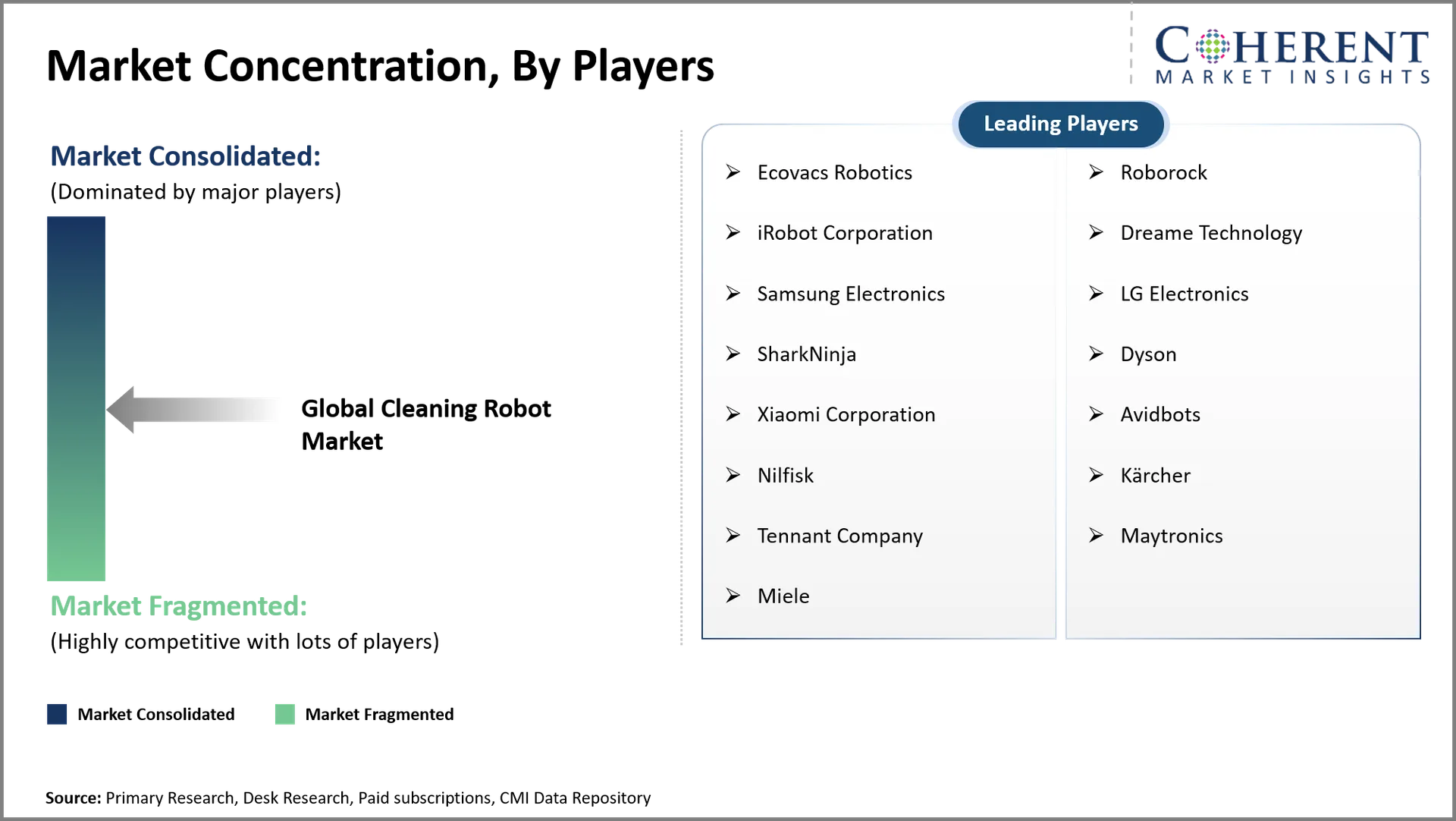
The global cleaning robot market features competition between established household appliance manufacturers and specialized commercial robotics companies. Roborock Maintains Leadership with AI, Advanced Navigation and Global Product Expansion It makes robotic vacuum cleaners and robotic lawn mowers. Ecovacs Robotics focuses on multifunctional household cleaning, automatic docking and linked home ecosystems. Pudu Robotics is focused on commercial facilities with autonomous scrubbers, sweepers and integrated cleaning systems. It’s August 2026 PUDU ET1 debut for smaller commercial locations. Tennant Company is strengthening its industrial and commercial robotics through its collaboration with Brain Corporation. The 2026 X16 SWEEP and P1 VAC releases introduce autonomous cleaning to warehouses and soft-floor environments. SoftBank Robotics emphasizes large-scale commercial deployments, particularly airports and facility management. Its partnership with Flagship Aviation Services demonstrates this strategy across 25 airport locations.
Top Manufacturers and Notable Products in the Cleaning Robot Market
Manufacturer | Notable Product | Key features |
Roborock | Saros 20 | 36000 Pa suction, StarSight Autonomous System 2.0, AdaptiLift Chassis 3.0, dual anti-tangle system |
ECOVACS Robotics | DEEBOT X12 | FocusJet stain cleaning, OZMO ROLLER 3.0 technology, AI-powered navigation, automated floor cleaning |
iRobot Corporation | Roomba Max 705 Combo | Vacuuming and mopping, automated docking, smart mapping, obstacle recognition |
Dreame Technology | X60 Pro Master | Advanced navigation, high-suction vacuuming, automated mopping, multifunctional docking |
Pudu Robotics | PUDU CC1 Pro | Four-in-one sweeping, scrubbing, vacuuming and dust mopping, AI spot cleaning, VSLAM and LiDAR navigation, obstacle detection, automatic charging |
Market Report Scope
Global Cleaning Robot Market Report Coverage | |||
Report Coverage | Details | ||
Base Year | 2025 | Market Size in 2026: | USD 8.80 Bn |
Historical Data For: | 2020 To 2024 | Forecast Period: | 2026 To 2033 |
Forecast Period 2026 To 2033 CAGR: | 18.00% | 2033 Value Projection: | USD 53.25 Bn |
Geographies covered: |
| ||
Segments covered: |
| ||
Companies covered: | Ecovacs Robotics, Roborock, iRobot Corporation, Dreame Technology, Samsung Electronics, LG Electronics, SharkNinja, Dyson, Xiaomi Corporation, Avidbots, Nilfisk, Kärcher, Tennant Company, Maytronics, Miele | ||
Growth Drivers: |
| ||
Restraints & Challenges: |
| ||
Analyst Opinion (Expert Opinion)
- The future of the cleaning robot industry will center on intelligent automation, multifunctional cleaning, and autonomous commercial operations. AI will improve stain detection, obstacle avoidance, and cleaning performance across different floor surfaces. Self-cleaning docking stations will become increasingly important for reducing manual maintenance. Commercial robots will expand beyond shopping centers into warehouses, airports, hospitals, and manufacturing facilities. Manufacturers will increasingly prioritize robots capable of operating continuously with limited supervision.
- The maximum opportunities will emerge in autonomous commercial floor cleaning and premium residential vacuum-mopping systems. Compact commercial cleaning robots offer attractive opportunities across China, Japan, Germany, and the U.S. Small-format retail stores, restaurants, hotels, and healthcare facilities require frequent cleaning. Manufacturers should prioritize compact scrubbers, intelligent docking stations, and robots supporting multiple cleaning functions. China offers manufacturing and product development advantages, while the U.S. provides opportunities for large-scale commercial deployments.
- Market participants should differentiate products through reliable navigation, stronger obstacle detection, and consistent cleaning performance. Carpet, hard floor, small aisle and industrial warehouse; manufacturers should design robots for each of the applications. Partnering with facilities management businesses as strategic partners, helps speed up commercial rollouts and recurring service income. Also focus should be on after sales assistance, replacement components and predictive maintenance services. Flexible subscription models may lower obstacles to initial purchase for smaller organizations. Integrating fleet management software will help customers monitor productivity and manage multiple robots efficiently.
Speak to the analyst
Want personalized insights?
Take the findings above to one of our principal consultants, or have the report rebuilt around the segments, geographies and competitors you actually track.
Market Segmentation
- Product Type Insights (Revenue, USD Billion, 2021 - 2033)
- Indoor Cleaning Robots
- Outdoor Cleaning Robots
- Operation Type Insights (Revenue, USD Billion, 2021 - 2033)
- Autonomous
- Semi-Autonomous
- Remote-Controlled
- Application Insights (Revenue, USD Billion, 2021 - 2033)
- Floor Cleaning Robots
- Pool Cleaning Robots
- Window Cleaning Robots
- Lawn Cleaning Robots
- Specialized Cleaning Robots
- End User Insights (Revenue, USD Billion, 2021 - 2033)
- Residential
- Commercial
- Industrial
- Regional Insights (Revenue, USD Billion, 2021 - 2033)
- North America
- U.S.
- Canada
- Latin America
- Brazil
- Argentina
- Mexico
- Rest of Latin America
- Europe
- Germany
- U.K.
- Spain
- France
- Italy
- Russia
- Rest of Europe
- Asia Pacific
- China
- India
- Japan
- Australia
- South Korea
- ASEAN
- Rest of Asia Pacific
- Middle East
- GCC Countries
- Israel
- Rest of Middle East
- Africa
- South Africa
- North Africa
- Central Africa
- North America
- Key Players Insights
- Ecovacs Robotics
- Roborock
- iRobot Corporation
- Dreame Technology
- Samsung Electronics
- LG Electronics
- SharkNinja
- Dyson
- Xiaomi Corporation
- Avidbots
- Nilfisk
- Karcher
- Tennant Company
- Maytronics
- Miele
Sources
Primary Research Interviews
- Cleaning Robot Manufacturers & OEMs
- Retail & E-commerce Distributors of Cleaning Robots
- End-Users (Residential & Commercial Facility Managers)
- Technology & AI Integration Specialists
Magazines
- IEEE Spectrum (Robotics & Automation)
- Robotics Business Review Magazine
- Consumer Electronics Magazine
- Appliance Design Magazine
Journals
- Journal of Field Robotics
- International Journal of Advanced Robotic Systems
- Robotics and Autonomous Systems (Elsevier)
Associations
- International Federation of Robotics (IFR)
- Association for Advancing Automation (A3)
- Consumer Technology Association (CTA)
- Robotic Industries Association (RIA)
Public Domain Sources
- U.S. Patent and Trademark Office (USPTO) - Robotics Patents Data
- European Commission - AI & Robotics Policy Reports
- World Trade Organization (WTO) - Trade Data on Electronics & Robotics
- U.S. Bureau of Labor Statistics (BLS) - Industry Employment Data
Proprietary Elements
- CMI Data Analytics Tool
- Proprietary CMI Existing Repository of Information for the last 10 years
Get access to 250+ pages report
Every segment, forecast, competitor profile and data table behind the analysis above — available for instant download.
- ESOMAR Member
- ISO 9001:2015 Certified
- D-U-N-S Registered
- GDPR & CCPA Compliant
Frequently Asked Questions
The global cleaning robot market is expected to stand at USD 8.80 Bn in 2026 and is expected to reach USD 53.25 Bn by 2033.
The CAGR of the global cleaning robot market is projected to be 18.0% from 2026 to 2033.
Rising adoption of automated household cleaning appliances and Increasing demand for labor-saving residential technologies are the major factors driving the growth of the global cleaning robot market.
High initial purchase costs for advanced cleaning robots and Limited cleaning performance in complex environments are the major factors hampering the growth of the global cleaning robot market.
In terms of product type, indoor cleaning robots segment is estimated to dominate the market revenue share in 2026.
The global cleaning robot market comprises autonomous machines designed to perform vacuuming, sweeping, mopping, scrubbing, and other cleaning activities.
LiDAR sensors create detailed environmental maps and help robots navigate rooms, identify obstacles, and optimize cleaning routes.