

Docking Station Market Size and Forecast — 2026 - 2033
The Global Docking Station Market size is estimated to be valued at USD 4.1 billion in 2026 and is expected to reach USD 7.8 billion by 2033, exhibiting a compound annual growth rate (CAGR) of 9.4% from 2026 to 2033.
Overview
The docking station market comprises a variety of products designed to enhance connectivity and expand the functionality of laptops, tablets, and smartphones. Key types include USB-C and Thunderbolt docking stations, which offer high-speed data transfer, video output, and power delivery. Traditional USB 3.0 and proprietary docking stations cater to legacy devices, while wireless and multi-device docking stations provide convenience and flexibility for modern workplaces. Some models integrate additional features such as Ethernet ports, SD card readers, and audio interfaces to support professional and multimedia applications. The market also includes compact travel docks and high-performance docking hubs tailored for corporate, gaming, and creative users.
Key Takeaways
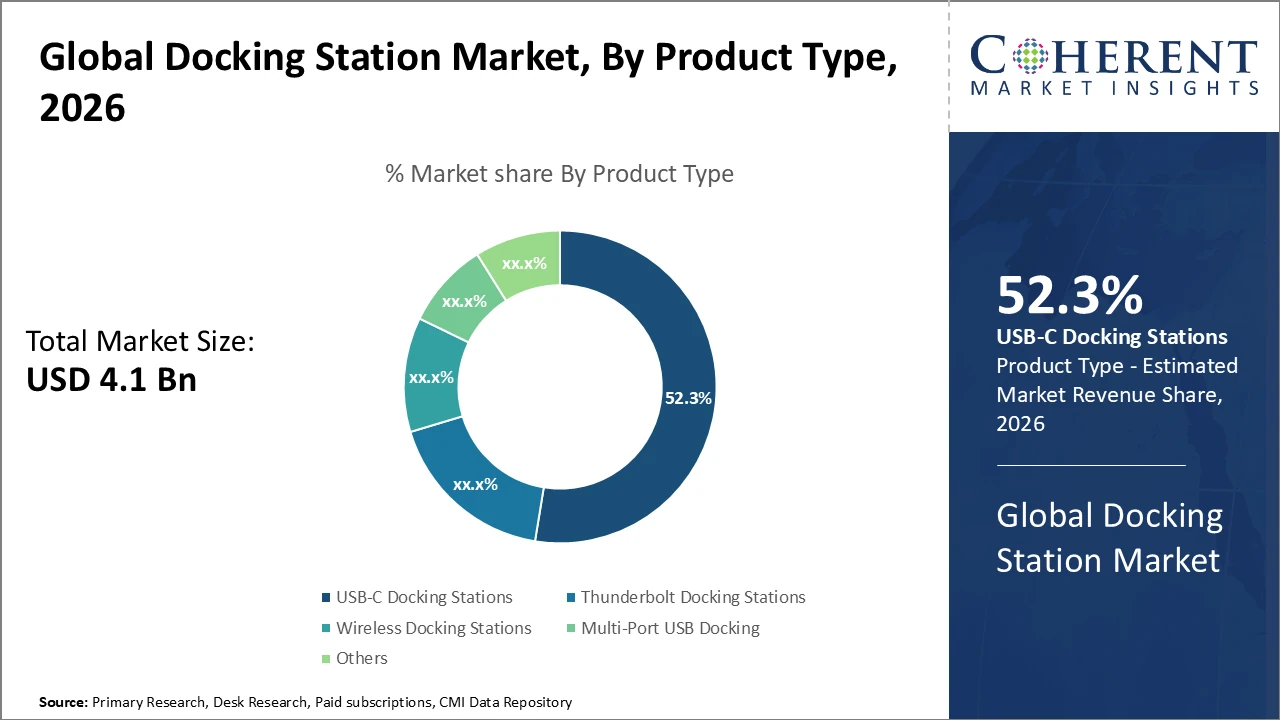
USB-C docking stations dominate the market with a 52.3% share, driven by universal compatibility and widespread adoption across various end-user industries.
The corporate sector is the largest contributor to market revenue, fueled by the expansion of remote workforce infrastructure and digital workspace solutions.
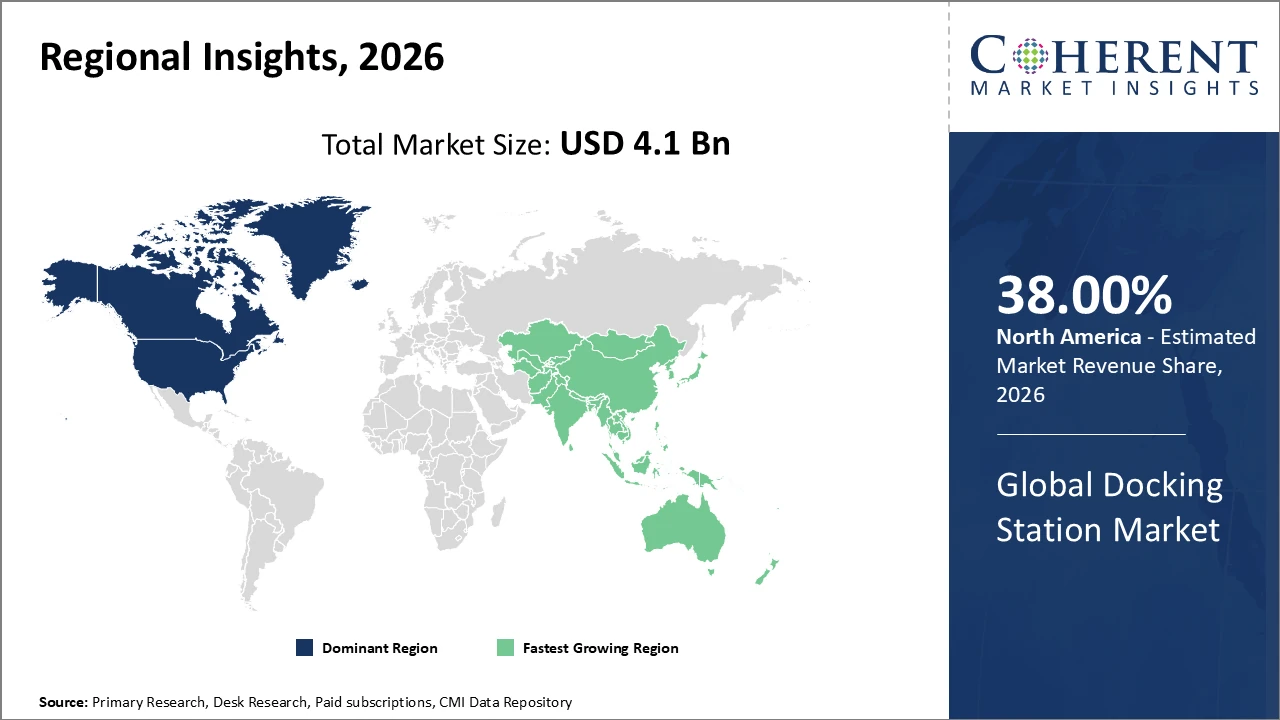
North America holds the largest market share, supported by strong enterprise adoption, advanced IT infrastructure, and progressive digital workspace initiatives.
Asia Pacific is the fastest-growing region, with a CAGR exceeding 11%, driven by government policies promoting digital transformation and increasing local manufacturing and technology capabilities.
Docking Station Market Segmentation Analysis
Docking Station Market Insights, By Product Type
USB-C docking stations lead the market with a 52.3% share, driven by universal compatibility and integration with modern laptops and mobile devices, providing seamless connectivity and power delivery. Wireless docking stations are the fastest-growing subsegment, valued for convenience and flexibility in hybrid and mobile work environments, recording over 30% growth in 2026. Thunderbolt docking stations serve high-performance needs, offering superior data transfer speeds and support for 4K and 8K displays, appealing to creative professionals. Multi-port USB docking stations maintain stable demand for legacy devices, while the ‘Others’ category includes specialized or hybrid docking solutions targeting niche applications and markets.
Docking Station Market Insights, By End User
The corporate sector leads the docking station market, accounting for around 37% of revenue in 2025, driven by the rapid adoption of remote and hybrid working models. The education segment is the fastest-growing, supported by increased deployment of digital classrooms and e-learning infrastructure, with school districts investing 22% more in docking devices in 2026 compared to 2024. Healthcare applications benefit from integrating medical devices and maintaining continuous communication, showing steady growth. Consumer electronics see rising demand for seamless device connectivity, while government institutions adopt secure and scalable docking solutions through digitization initiatives. The ‘Others’ category includes retailers and SMBs enhancing operational efficiency with docking technologies.
Docking Station Market Insights, By Distribution Channel
Online retail leads the docking station market, capturing over 45% of market share in 2026, driven by convenience, wider product selections, and competitive pricing. Direct sales are the fastest-growing channel, particularly in corporate procurement, where customized docking solutions and bulk purchasing drove a 28% growth rate in 2025. Offline retail remains relevant for consumers seeking immediate purchase and in-store product trials. OEM sales play a key role by bundling docking stations with laptops and other devices, supporting adoption in manufacturing supply chains. The ‘Others’ category includes specialized B2B distributors that enable regional penetration and support niche customer requirements.
Docking Station Market Trends
Rapid adoption of USB-C and Thunderbolt 4 technologies is driving demand for faster data transfer and higher power delivery, with 57% of docking stations shipped in 2026 supporting these standards.
Wireless docking solutions are gaining popularity, offering contactless connectivity, reflected by a 30% increase in wireless docking sales during 2026, highlighting a shift toward flexible and mobile work environments.
Sustainability is becoming a key focus, with manufacturers incorporating recyclable materials and energy-efficient designs in response to regulatory requirements and consumer preferences.
A leading docking station producer reduced its product carbon footprint by 25% in 2025 through material overhaul initiatives.
Docking Station Market Insights, By Geography
North America Docking Station Market Analysis and Trends
In North America, the docking station market is dominated by strong enterprise IT investment and the rapid adoption of flexible and hybrid work models. The region accounted for approximately 38% of the global market share in 2026, driven by widespread deployment of multi-device workstations across corporate offices and educational institutions. High adoption of advanced connectivity standards, including USB-C and Thunderbolt 4, supports seamless data transfer and power delivery, enhancing workplace efficiency. Additionally, progressive digital infrastructure, early technology adoption, and demand for high-performance docking solutions reinforce North America’s leadership position, making it a key hub for innovation, enterprise deployment, and market growth in docking stations.
Asia Pacific Docking Station Market Analysis and Trends
The Asia Pacific docking station market is experiencing the fastest growth, with a CAGR exceeding 11%, supported by strong government initiatives promoting digitalization and technology adoption. Expanding manufacturing ecosystems in key countries such as China and India are driving regional market development, enabling both production and consumption growth. Rising laptop penetration across corporate, educational, and consumer segments contributes to increasing demand for docking solutions. Small and medium-sized businesses are also adopting docking stations to enhance workplace efficiency and connectivity. Combined with growing awareness of hybrid and remote work setups, these factors are accelerating market expansion and establishing Asia Pacific as a high-growth region.
Docking Station Market Outlook for Key Countries
USA Docking Station Market Analysis and Trends
The U.S. continues to lead the docking station market, driven by advanced IT infrastructure and widespread remote and hybrid work policies. Between 2024 and 2026, the corporate sector increased docking station investments by nearly 32%, supported by government initiatives promoting technology adoption in federal agencies. Key market players, including Dell Technologies and Belkin, have strengthened their presence through product innovation, expanded distribution channels, and strategic enterprise partnerships, securing significant contracts with large organizations. High demand for multi-device connectivity, advanced standards like USB-C and Thunderbolt 4, and corporate digital transformation initiatives collectively reinforce the U.S. as a major hub in the global docking station market.
Germany Docking Station Market Analysis and Trends
The Germany docking station market is driven by strong enterprise IT investment, widespread adoption of hybrid work models, and a robust technology ecosystem. Corporate demand remains high as businesses upgrade workstations and integrate multi‑device connectivity solutions. The education sector also contributes, with schools and universities investing in digital infrastructure. Germany’s advanced manufacturing and automotive industries increasingly use docking stations for productivity and device integration. Retail and e‑commerce channels support broad product availability, while sustainability trends encourage eco‑friendly designs and recyclable materials. Continued emphasis on high‑speed connectivity standards such as USB‑C and Thunderbolt enhances market growth, positioning Germany as a key player in the European docking station landscape.
Analyst Opinion
Demand-side indicators show rising adoption of docking stations in IT enterprises, educational institutions, and healthcare sectors. In 2025, the corporate sector accounted for about 37% of total sales, driven by widespread remote work policies. Pricing strategies improved accessibility, with an average price decline of 6.2% in 2024, balancing cost and performance.
Supply-side dynamics highlight increased production capacity, particularly in East Asia, where output rose nearly 12% in 2026 compared to 2024 due to automation advancements. Export volumes from the region grew 15% in 2025, reflecting rising global demand.
USB-C compatible docking stations dominated with over 52% market share in 2026, supported by universal compatibility across laptops and mobile devices. Integration of 4K and 8K video output boosted premium offerings, driving a 20% revenue increase in the high-end segment in early 2026.
Aftermarket services and firmware updates are gaining traction, with over 18% of units sold in 2025 offering upgradable features, enhancing long-term utility and reducing total cost of ownership for enterprise consumers.
- Current Industry Events of 2026
- Market Size Estimation
- Regional Breakdown
- Competitive Landscape
- Customer Intelligence
- Segmental Analysis
- Pricing Analysis
- Key Market Drivers, Challenges & Future Trends
- Customized Insights Section
Market Scope
| Report Coverage | Details | ||
|---|---|---|---|
| Base Year: | 2025 | Market Size in 2026: | USD 4.1 billion |
| Historical Data for: | 2020 To 2024 | Forecast Period: | 2026 To 2033 |
| Forecast Period 2026 to 2033 CAGR: | 9.4% | 2033 Value Projection: | USD 7.8 billion |
| Geographies covered: |
| ||
| Segments covered: |
| ||
| Companies covered: | Anker Innovations, Belkin International, Dell Technologies, HP Inc., Lenovo Group, Targus, Kensington, CalDigit, Plugable Technologies, Avantree, Wavlink | ||
| Growth Drivers: |
| ||
Docking Station Market Growth Factors
The docking station market is primarily driven by the rapid adoption of hybrid and remote work models, increasing demand for versatile docking stations that support multiple device connections. In 2025, enterprises expanded remote work capabilities by 40%, boosting docking station requirements. Rising sales of ultrabooks and Chromebooks have fueled demand for compact, multi-port docking solutions that combine portability with full connectivity. Technological advancements in high-speed protocols like Thunderbolt 4 enable faster data transfer and enhanced video streaming, further supporting growth. Additionally, consumer preference for wireless docking solutions is rising, with wireless docking sales increasing 30% in 2026 amid smart workspace adoption.
Docking Station Market Development
In 2025, Dell Technologies launched an advanced USB-C and Thunderbolt 4 docking station series designed for hybrid work environments. These new models offered faster data transfer, multiple display support, and integrated power delivery, enabling seamless connectivity for corporate and educational users. The launch strengthened Dell’s position in the enterprise and education segments, contributing to a significant increase in regional market share.
Key Players
Leading Companies of the Market
Anker Innovations
Belkin International
Dell Technologies
HP Inc.
Lenovo Group
Targus
Kensington
CalDigit
Plugable Technologies
Wavlink
Competitive strategies in the docking station market have included acquisitions and strategic partnerships to strengthen technological capabilities and market presence. For example, Anker Innovations’ 2025 acquisition of a semiconductor chipmaker enhanced its proprietary USB-C chipsets, resulting in a 14% increase in market share within the first year after the deal. Similarly, Dell Technologies and HP Inc. focused on bundling docking stations with their premium laptop series, which boosted unit sales by 22% in 2024. These approaches highlight the emphasis on innovation, integrated solutions, and strategic alliances to capture market share and drive growth.
Docking Station Market Future Outlook
The docking station market is expected to grow steadily in the coming years, driven by the continued adoption of hybrid and remote work models across corporate, education, and healthcare sectors. Rising demand for USB-C, Thunderbolt 4, and wireless docking solutions will support market expansion, offering faster data transfer, multiple display support, and enhanced connectivity. Increasing laptop and ultrabook penetration, coupled with compact multi-port docking needs, will further fuel growth. Sustainability trends, including energy-efficient designs and recyclable materials, are gaining prominence. Technological advancements, regional market expansion, and integration with smart workspace solutions will collectively shape the future trajectory of the global docking station market.
Docking Station Market Historical Analysis
The docking station market has experienced significant growth over the past decade, driven by the rising adoption of laptops, ultrabooks, and mobile devices in corporate, educational, and consumer sectors. Early demand was focused on USB 2.0 and proprietary docking solutions, primarily for office workstations. As remote work and digital learning gained traction, USB-C and multi-port docking stations became increasingly popular, offering enhanced connectivity, power delivery, and video support. North America and Europe historically led the market due to advanced IT infrastructure and enterprise adoption, while Asia Pacific emerged as a growth hub with expanding manufacturing and SMB digitalization. Technological innovation and hybrid work trends have consistently fueled historical market expansion.
Sources
Primary Research Interviews:
IT hardware manufacturers and docking station product managers
Corporate IT procurement teams and educational IT administrators
Healthcare and hospital IT infrastructure managers
Consumer electronics distributors and resellers
Industry consultants and technology analysts
Magazines:
PCWorld – Computer Accessories and Connectivity Updates
TechRadar – Docking Stations and Peripheral Technology
CRN – Enterprise IT Hardware and Digital Workspace Trends
Laptop Mag – Docking Station Reviews and Innovations
Journals:
Journal of Computer Engineering – Peripheral Devices Research
International Journal of Information Technology – Workplace Technology Studies
IEEE Transactions on Consumer Electronics – Connectivity and Docking Solutions
Newspapers:
The Wall Street Journal – IT Hardware and Enterprise Technology
Financial Times – Technology Supply Chains and Market Trends
Reuters – Consumer Electronics and Peripheral Device News
Bloomberg – Enterprise IT and Technology Infrastructure
Associations:
Consumer Technology Association (CTA)
Institute of Electrical and Electronics Engineers (IEEE)
Association for Computing Machinery (ACM)
European IT & Digital Workspace Association (EITDWA)
Get access to 250+ pages report
Every segment, forecast, competitor profile and data table behind the analysis above — available for instant download.
- ESOMAR Member
- ISO 9001:2015 Certified
- D-U-N-S Registered
- GDPR & CCPA Compliant
Missing comfort of reading report in your local language? Find your preferred language:
Transform your Strategy with Exclusive Trending Reports
Frequently Asked Questions
Leading companies include Anker Innovations, Dell Technologies, HP Inc., Lenovo Group, and Belkin International, all of which have strategically expanded product portfolios and distribution channels to strengthen their market presence.
The market size is projected to grow from USD 4.1 billion in 2026 to USD 7.8 billion by 2033, with a CAGR of 9.4%, driven by evolving technology standards and rising demand for multi-device compatibility.
The corporate sector represents the largest growth opportunity due to the widespread adoption of remote and hybrid work models, which fuel consistent demand for docking stations.
Market trends will shift toward modular designs, wireless connectivity, and eco-friendly materials, supported by growing premium segment adoption and regulatory emphasis on sustainability.
The market is highly competitive, with top players focusing on innovation, partnerships, and aggressive pricing. Key challenges include component supply shortages and rapid technology obsolescence.
Common strategies include strategic acquisitions, bundling docking stations with laptops, leveraging direct-to-consumer channels, and expanding into emerging markets to reach diversified customer segments.