

Global Cloud Workload Protection Market Size and Forecast – 2026 To 2033
The global cloud workload protection market is expected to grow from USD 5.75 Bn in 2026 to USD 21.20 Bn by 2033, registering a compound annual growth rate (CAGR) of 11.6% from 2026 to 2033. The global cloud workload protection market is driven by growing adoption of containers and serverless applications. On May 12, 2026, Red Hat announced the general availability of Red Hat Hardened Images, offering more than 45 images across over 150 variants. The images include security hardening and faster vulnerability fixes, helping developers reduce container attack surfaces before deployment.
Key Takeaways of the Global Cloud Workload Protection Market
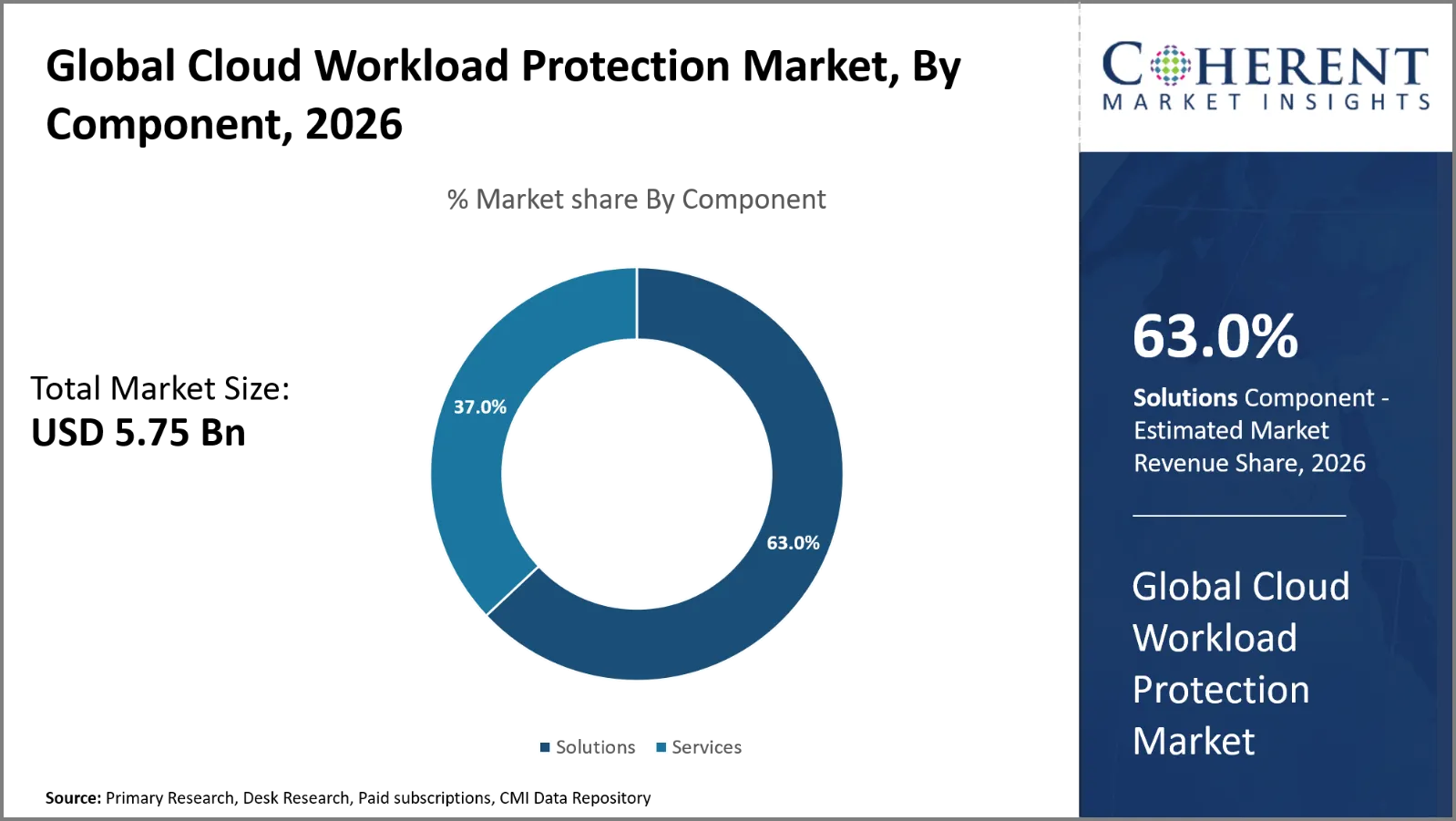
- The Solutions segment is expected to account for 63.0% of the global cloud workload protection market share in 2026. Increasing demand for runtime threat detection is driving the growth of the segment. On December 1, 2025, CrowdStrike announced a real-time detection engine, expanded cloud indicators of attack, and automated response actions for Falcon Cloud Security.
- The Agent-Based Protection segment is estimated to capture 54.0% of the market share in 2026. Stricter cybersecurity and data protection requirements is majorly driving the growth of the segment. On April 14, 2026, Netskope introduced its NewEdge management plane in Mumbai to support Indian organizations requiring data sovereignty and regulatory alignment.
- The Public Cloud segment is estimated to capture 51.0% of the market share in 2026. Integration of security into DevSecOps workflows is driving the growth of the segment. On January 14, 2026, Rapid7 partnered with ARMO to integrate cloud and application runtime security into the Rapid7 Command Platform.
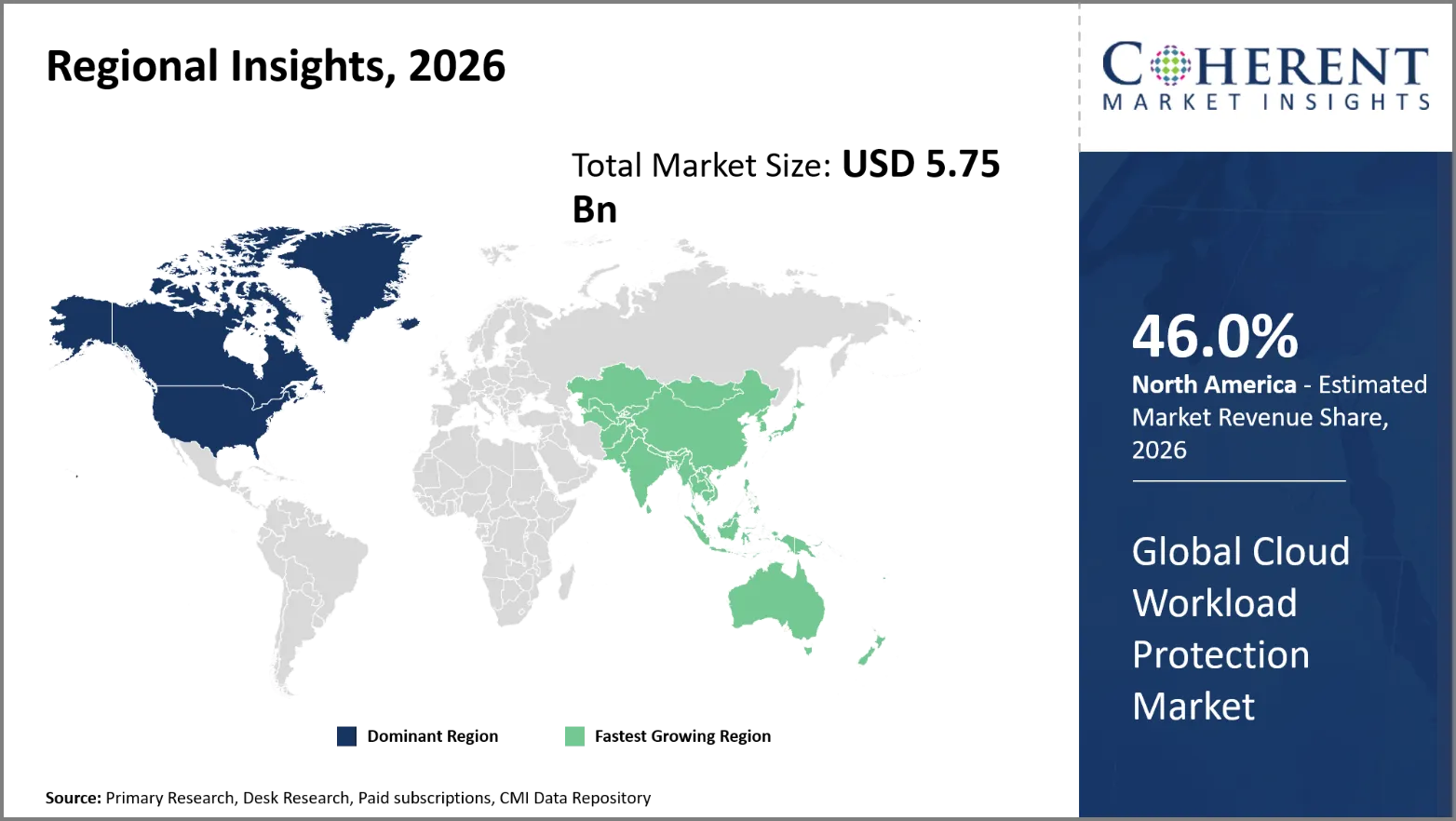
- North America is expected to dominate the cloud workload protection market in 2026 with a market share of 46.0%. Growth of managed cloud security services in North America is driving the growth of the regional market. On April 22, 2026, PwC launched a unified detection and response managed security service using Google Security Operations. The service combines continuous threat monitoring, vulnerability management, incident response, and penetration testing.
- Asia Pacific is expected to account for 25.0% share in 2026. Increasing integration of AI into threat detection in Asia Pacific is driving the growth of the regional market. On July 14, 2026, Google announced that Sec-Gemini v3, its specialized cybersecurity agent, would be available to trusted government and enterprise testers, including Flipkart. The initiative supports AI-assisted security analysis and helps defenders investigate vulnerabilities and emerging threats.
Segmental Insights
Why Does Solutions Dominate the Global Cloud Workload Protection Market?
The solutions segment is expected to account for 63.0% of the global cloud workload protection market share in 2026. Solutions are leading the cloud workload protection market as organizations need integrated security technologies to safeguard apps, virtual machines, containers and cloud-native workloads. Such technologies deliver vulnerability assessment, threat detection, configuration monitoring and runtime protection for complex cloud infrastructures. This centralizes security dashboards so enterprises can understand where there are concerns, prioritize the fixes and track their distributed infrastructure. It integrates with cloud platforms and security operations tools to further improve incident response and policy enforcement. With organizations deploying AI workloads and containerized apps, there is a growing need for scalable protection solutions.
On February 13, 2025, Palo Alto Networks announced Cortex Cloud, which combines cloud detection and response capabilities with its cloud-native application protection platform. The system features artificial intelligence-driven risk prioritization, automated remediation and real-time threat protection. It also ties cloud security information to security operations procedures.
- Current Industry Events of 2026
- Market Size Estimation
- Regional Breakdown
- Competitive Landscape
- Customer Intelligence
- Segmental Analysis
- Pricing Analysis
- Key Market Drivers, Challenges & Future Trends
- Customized Insights Section
Why is Agent-Based Protection the Most Preferred Security Architecture?
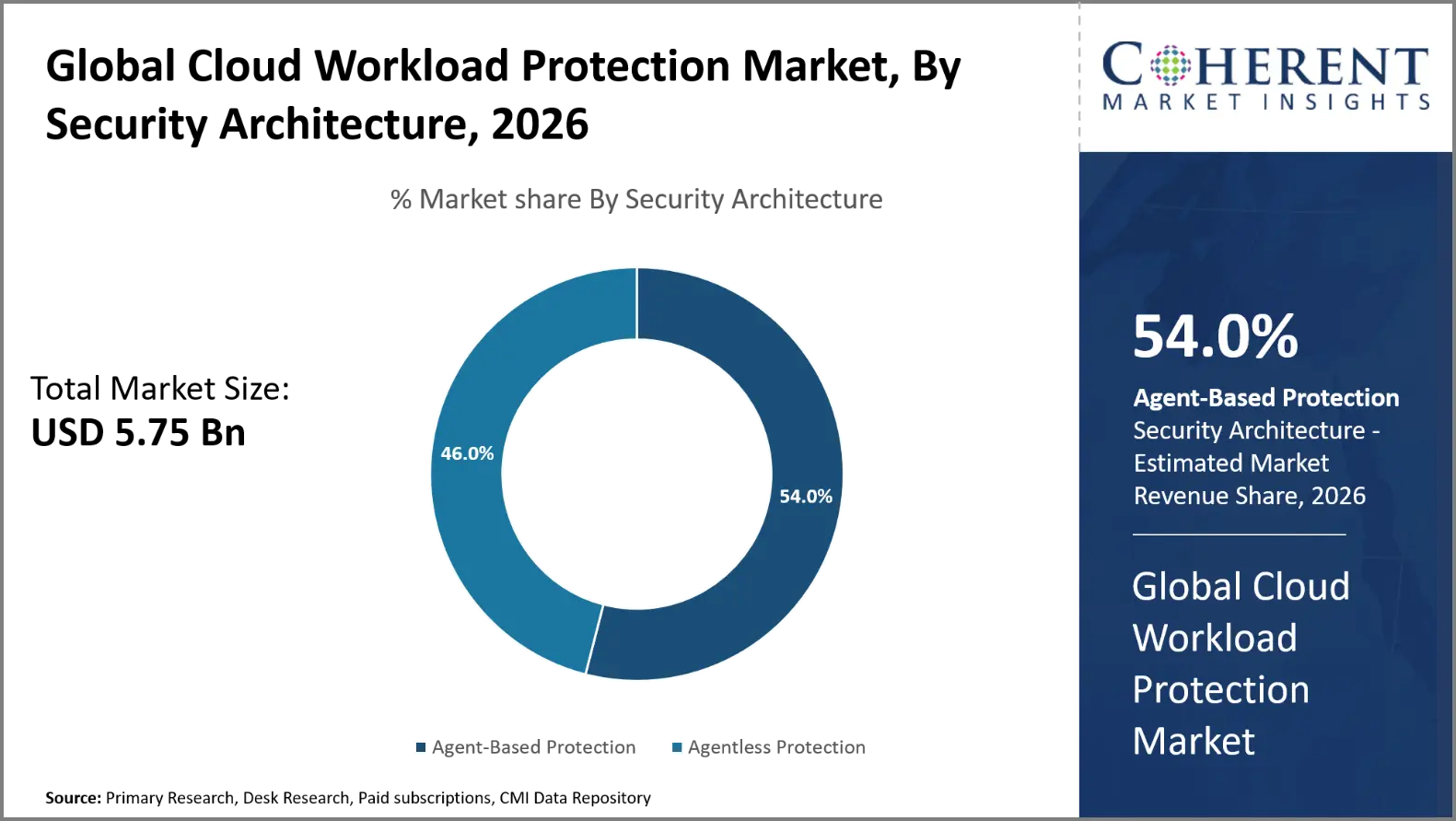
The agent-based protection segment is expected to account for 54.0% of the global cloud workload protection market share in 2026. Agent-based protection is still a common security architecture, because the lightweight software agents offer visibility at the workload level and thorough runtime monitoring. These agents can investigate the supported workloads and view processes, file activity, system behavior and unusual execution patterns. That visibility allows security teams find risks that would otherwise be unseen at the network level. When workloads run across distant cloud environments, agent-based technologies can also facilitate investigation and enforce security standards. This architecture is the architecture of choice for organizations requiring granular protection of virtual machines and traditional server applications.
On June 9, 2026, Tenable revealed AI-powered cloud detection and response capabilities through Tenable One Cloud Exposure. The platform correlates runtime telemetry with vulnerabilities, identities, and cloud exposure information. It also supports an optional extended Berkeley Packet Filter runtime sensor alongside agentless detection.
Public Cloud Dominates the Global Cloud Workload Protection Market
The public cloud segment is expected to account for 51.0% of the global cloud workload protection market share in 2026. Public cloud is a significant deployment scenario for cloud workload protection as more organizations deploy applications and store data on shared cloud infrastructure. Public cloud platforms deliver rapid resource provisioning, varying capacity and access to managed computing services. But workload variations and frequent configuration changes may introduce vulnerabilities that require constant monitoring. Cloud workload protection solutions help companies identify and defend virtual machines, containers and cloud-native apps against misconfigurations and attacks. As multi-cloud is rolled out, the need for consistent security standards and centralized visibility is even greater.
On July 14, 2026, Amazon Web Services added protection for artificial intelligence workloads and security monitoring for Microsoft Azure to Security Hub. The software discovers Azure VMs, container images, serverless apps and IDs. It scans these assets for vulnerabilities, misconfigurations, and internet exposure.
Current Events and their Impact
Current Events | Description and its Impact |
European Union Network and Information Security Directive (EU) 2022/2555 |
|
European Commission Implementing Regulation on Cybersecurity Risk Management |
|
Cloud Workload Protection Market Dynamics
Market Drivers
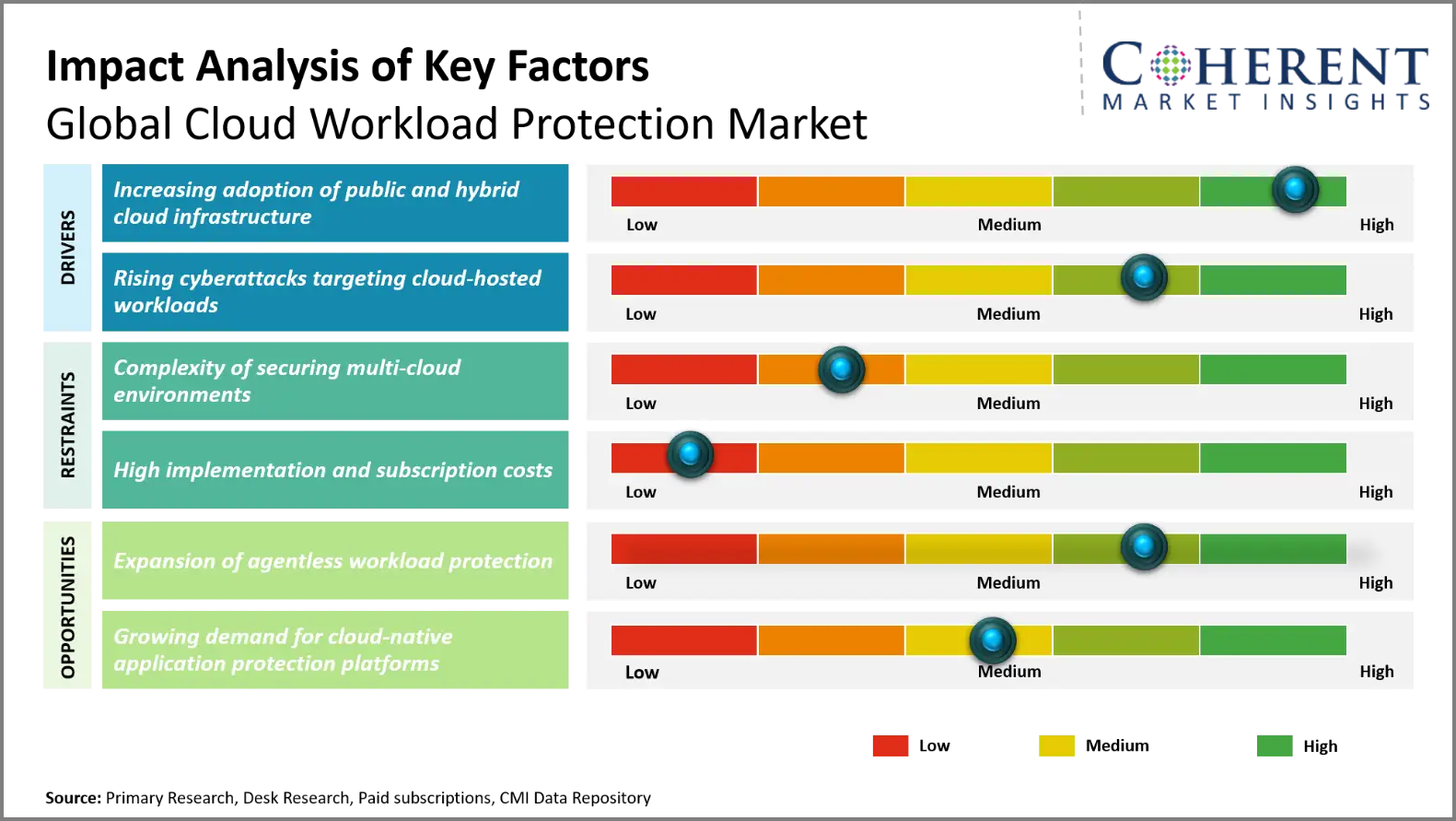
- Increasing adoption of public and hybrid cloud infrastructure: The growing adoption of public and hybrid cloud infrastructure fuels the growth of the global cloud workload protection market by increasing the number of workloads that need constant security monitoring. Organizations spread apps, databases and compute across public cloud platforms and private data centers. This distributed architecture increases the complexity of access control, configuration monitoring, and vulnerability assessment. Cloud workload protection solutions enable enterprises enforce consistent security standards across heterogeneous environments. They allow for workload visibility, threat detection and automated risk assessment as well. The increasing popularity of containers, microservices and artificial intelligence applications further accelerates the necessity for scalable protection methods.
- On June 25, 2026, Amazon announced plans to invest an additional USD 13 billion to build its AI and cloud infrastructure in India by June 25, 2026, bringing its total investment in the country to USD 48 billion between 2026 and 2030. Amazon announced a USD 35 billion investment into India business in 2025. This extra USD 13 billion would enhance AWS data center capacity in Mumbai and Hyderabad, allowing startups, companies and government organizations access to custom AI chips, managed AI services and reliable cloud technologies.
- Rising cyberattacks targeting cloud-hosted workloads: The increasing number of cyberattacks targeting cloud-hosted workloads is propelling the demand for improved cloud workload protection solutions. Attackers get access to cloud infrastructures by exploiting misconfigured resources, insecure software, compromising credentials, and excessive permissions. Such threats can lead to exposure of sensitive information, disruption of applications, and loss of corporate operations. More enterprises are putting in place workload protection solutions to detect malicious processes, monitor aberrant behavior and discover vulnerabilities before they are exploited. Automated threat warnings and runtime monitoring allow security teams to investigate unusual activity and respond quickly. The growing incentive for organizations to enhance workload security throughout their cloud infrastructure as ransomware, cryptojacking and cloud account attacks become more complex.
- On August 27, 2025, Microsoft Threat Intelligence reported that the Storm-0501 threat actor was increasingly targeting cloud systems for ransomware operations. The firm shifted from conventional on-premises attacks to cloud-based attacks utilizing compromised identities and cloud services. Such approaches might cause disruption of hosted apps, enterprise data and associated infrastructure.
Emerging Trends
- Artificial Intelligence-Powered Threat Detection: Cloud workload protection platforms are increasingly using artificial intelligence to identify suspicious processes, aberrant access patterns, and developing attack tactics. Those capabilities help security teams to prioritize actual dangers, cut down on manual research, and respond faster in complex cloud environments.
- Unified Protection Across Hybrid and Multi-Cloud Environments: Modern companies seek unified security systems that can protect workloads in public clouds, private infrastructure and hybrid environments. Centralized visibility helps security teams enforce consistent standards, detect configuration vulnerabilities and close monitoring gaps across distributed computing assets.
- Runtime Security for Containers and Cloud-Native Applications: The rise in container, microservices and Kubernetes systems increases the need for runtime workload protection. Security solutions monitor application behavior to detect illegal activities and suspect container activity, allowing companies to protect dynamic workloads over their entire operational lifecycle.
- Automated Compliance and Risk Management: Organizations are increasingly resorting to automated security assessments to identify misconfigurations, prioritize vulnerabilities and maintain audit evidence. Teams that are integrated with cloud infrastructure management and security operations technology may enforce security policies, accelerate remediation, and demonstrate compliance with relevant cybersecurity legislation.
Regional Insights
Why is North America a Strong Market for Cloud Workload Protection?
North America is expected to account for a market share of 46.0% in 2026. North America boasts a large hyperscale cloud infrastructure, superior cybersecurity procedures and enterprise requirements for centralized visibility of workloads. Amazon Web Services (AWS), Microsoft Azure and Google Cloud all have large regional infrastructures enabling enterprise applications and cloud-native services. The United States and Canada likewise have created managed security service providers that enable workload protection deployments. The unique development driver in the region is the incorporation of workload security into overall security operations, including cloud detection and response. Organizations are becoming more into connecting workload telemetry with identity monitoring, threat intelligence and incident response platforms. Financial organizations, healthcare networks and technology companies put a premium on runtime security from compromised credentials, illegitimate processes and ransomware.
Why Does Asia Pacific Cloud Workload Protection Market Exhibit High Growth?
Asia Pacific is expected to register the fastest growth with a CAGR of 12.3% over the forecast period. The region is projected to account for 25.0% of the global cloud workload protection market in 2026. Vendors of workload security have unique opportunities in China, Japan, India, Singapore and Australia. Japan’s Government Cloud program had 2,918 systems as of February 2025, up from 671 systems in August 2024. This development adds to the requirement for continuous security monitoring of government workloads. As digital public services and financial apps expand in India, the need to protect sensitive information on the cloud is growing more and more. Regional businesses also need solutions for differing legal constraints, local hosting configurations and multilingual security operations.
Global Cloud Workload Protection Market Outlook for Key Countries
Why is U.S. Emerging as a Major Hub in the Cloud Workload Protection Market?
The U.S. market has deep exposure to cloud-native software development and advanced security operations in financial services, healthcare and technology sectors. Amazon Web Services, Microsoft Azure, and Google Cloud enable enormous ecosystems of enterprise applications and managed services. Government contractors and technology vendors that sell to the public sector also base their purchase decisions on federal cybersecurity standards. The Federal Risk and Authorization Management Program (FedRAMP) creates a standardized approach to security assessment, authorization, and ongoing surveillance for cloud services utilized by federal agencies. Security suppliers thus gain from providing extensive audit logs, access monitoring, vulnerability assessment and incident response integration. It’s also being demanded by enterprises defending containerized apps, artificial intelligence infrastructure and sensitive workloads.
Is China the Next Growth Engine for the Cloud Workload Protection Market?
China’s cloud workload protection market is driven by increased local cloud infrastructure, digitalization of industry and desire for locally backed cybersecurity technology. Alibaba Cloud, Huawei Cloud and Tencent Cloud support organizations in manufacturing, financial services, retail, and digital platforms. China’s combined cloud computing and big data services revenue grew 13.6% in 2025, official government figures indicated. Information security goods and services revenue also rose 6.7%. These changes are driving need for workload vulnerability identification, runtime monitoring and security configuration management. Large digital systems need to be defended against illegal access, data leakage and attacks on containerized applications.
Germany Cloud Workload Protection Market Analysis and Trends
The market in Germany is driven by industrial digitalization, automation of production and the need of companies to protect integrated business systems. Automotive manufacturers, engineering firms and industrial suppliers are rapidly turning to cloud platforms for application development, analytics and production-related services. According to Germany’s Federal Statistical Office, 54% of firms with at least ten employees used paid cloud computing services in 2025. Adoption was 86% among firms with 250 or more employees. This proven enterprise usage provides chances to protect workloads in complicated IT settings. Security solutions must address vulnerabilities, privileged access and operational hazards that impact industrial applications and sensitive engineering information.
U.K. Cloud Workload Protection Market Analysis and Trends
The UK market gains from cloud usage in financial services, professional services, healthcare and digital companies. Banks and insurance businesses need robust controls on the applications that handle consumer data and financial activities. According to the government’s 2026 United Kingdom Business Data Survey, 31% of organizations surveyed that handled digitized data used public cloud providers. Adoption was higher among larger enterprises than smaller businesses. This usage of infrastructure enables the need for workload monitoring, security policy enforcement, and incident investigation. The National Cyber Security Center offers advice on cloud security and cyber resilience. To serve enterprises, providers can offer thorough audit trails and integration with existing security processes.
Japan Cloud Workload Protection Market Analysis and Trends
The rise in Japan’s market is due to government digital transformation, modernization of manufacturing, and growing focus on cybersecurity resilience. The Government Cloud program offers standardized cloud environments for national and local government information systems. Government Cloud usage grew from 671 systems in August 2024 to 2,918 systems as at February 2025. With this expansion will come an increased need for consistent workload configuration, access control and security monitoring. Automotive manufacturers, electronics businesses and financial institutions also need to protect their business applications and critical operational data. Cloud workload protection solutions can assist discover illegitimate processes, identify suspicious activities, and improve security across remote company systems.
Global Cloud Workload Protection Market - Post-Incident Workload Recovery
Recovery Metric | Critical Workloads | Important Workloads | Non-Critical Workloads |
Recovery Time Objective | 1 hour | 8 hours | 24 hours |
Recovery Point Objective | 5 minutes | 1 hour | 24 hours |
Target Recovery Success Rate | 99% | 98% | 95% |
Backup Verification Frequency | Daily | Weekly | Monthly |
Recovery Drill Frequency | Monthly | Quarterly | Semi-annually |
Clean Recovery Environment Availability | Immediate | Within 4 hours | Within 24 hours |
How is Expansion of Agentless Workload Protection Creating New Growth Opportunities in the Cloud Workload Protection Market?
As agentless workload protection grows, it creates growth opportunities for security teams to assess cloud assets without having to deploy software agents on each workload. This helps enterprises to identify unprotected virtual machines, misconfigured storage and excessive rights, as well as susceptible applications across larger cloud estates. For example, security systems can evaluate cloud provider application programming interfaces and workload snapshots to discover threats during deployment and routine reviews. Agentless scanning also reduces installation overhead in ephemeral containers and short-lived development environments. Cloud security vendors can therefore target organizations managing thousands of frequently changing assets. Combining agentless discovery with agent-based runtime monitoring creates additional opportunities for unified platforms covering configuration risks and active threats.
On November 4, 2025, Wiz introduced the Defend Agentless Workload Detection at its Wizdom 2025 conference. It can detect malware and suspicious activities without using typical security agents. It brings together local logs, runtime signals and cloud control plane data in the Wiz Security Graph. Security teams can examine threats across workloads, benefiting from contextual information.
Market Players, Key Development, and Competitive Intelligence
Key Developments
- On August 4, 2026, ESET launched ESET Cloud Workload Protection as part of a comprehensive update for its ESET PROTECT Platform. Announced at RSAC 2026, this new module helps customers to move beyond endpoints and servers to cover cloud workloads, significantly enriching telemetry for detection and response while consolidating security management across endpoint and cloud environments inside a single pane of glass.
- On March 3, 2026, Kaspersky announced an update to Kaspersky Cloud Workload Security (CWS) offering, introducing AI-powered workload analysis, enhanced integrations and performance optimizations designed to help organizations better secure complex cloud and hybrid environments.
- On January 15, 2025, Orca Security announced the launch of Orca Sensor, an advanced light-weight security solution that seamlessly integrates runtime visibility and protection with the Orca Cloud Security Platform. This enhancement significantly bolsters Orca’s Cloud Detection and Response (CDR) capabilities, offering real-time visibility, detection, investigation, and prevention optimized for cloud-native architectures and modern DevOps workloads.
Competitive Landscape
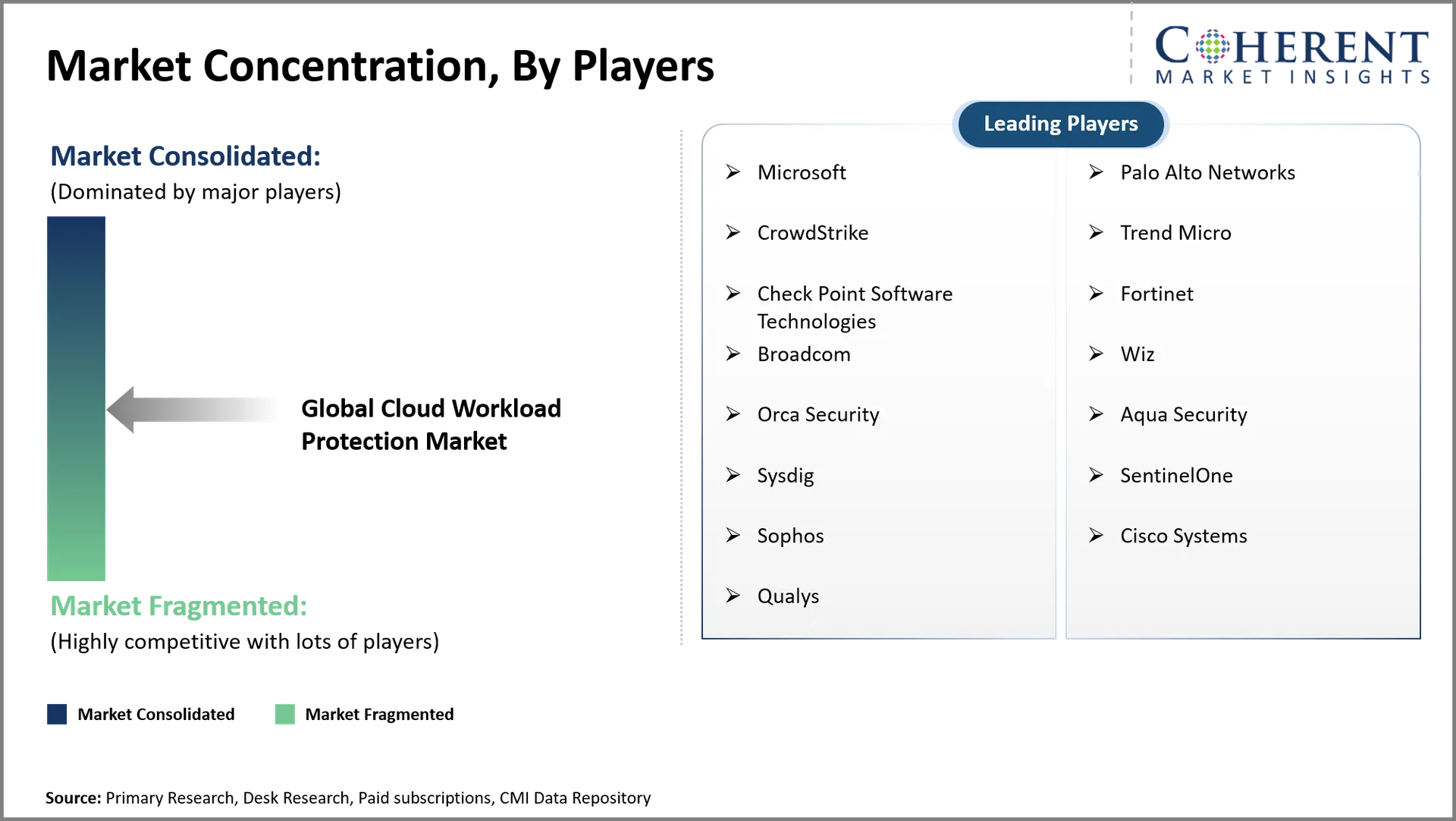
Vendors in the worldwide cloud workload protection market compete on runtime threat prevention, agentless assessment, and integrated cloud security systems. Microsoft’s Defender for Cloud offers workload protection, vulnerability assessment and multi-cloud security for Microsoft Azure, Amazon Web Services and Google Cloud. CrowdStrike is focused on agentless visibility and AI-powered runtime detection with Falcon Cloud Security. Palo Alto Networks integrates Prisma Cloud capabilities across application development, infrastructure security, and runtime protection. These vendors compete by connecting workload telemetry with security operations, automating risk prioritization, and protecting virtual machines, containers, and cloud-native applications.
Top Market Players and Notable Products/Offerings in the Cloud Workload Protection Market
Market Players | Notable Product/Offering | Key features |
Microsoft | Microsoft Defender for Cloud | Multi-cloud workload protection, agent-based and agentless scanning, vulnerability management, container security, threat detection, automated remediation |
CrowdStrike | Falcon Cloud Security | Real-time runtime protection, artificial intelligence-powered threat detection, agentless visibility, workload vulnerability management, container security |
Palo Alto Networks | Cortex Cloud | Cloud posture management, runtime threat detection, vulnerability prioritization, application security, automated remediation, unified cloud security |
Wiz | Wiz Cloud Security Platform | Agentless workload discovery, vulnerability assessment, attack-path analysis, cloud misconfiguration detection, identity risk correlation, runtime sensor support |
Orca Security | Orca Cloud Security Platform | Agentless Side Scanning technology, malware detection, vulnerability prioritization, misconfiguration assessment, attack-path analysis, container and serverless protection |
Market Report Scope
Global Cloud Workload Protection Market Report Coverage | |||
Report Coverage | Details | ||
Base Year | 2025 | Market Size in 2026: | USD 5.75 Bn |
Historical Data For: | 2020 To 2024 | Forecast Period: | 2026 To 2033 |
Forecast Period 2026 To 2033 CAGR: | 11.60% | 2033 Value Projection: | USD 21.20 Bn |
Geographies covered: |
| ||
Segments covered: |
| ||
Companies covered: | Microsoft, Palo Alto Networks, CrowdStrike, Trend Micro, Check Point Software Technologies, Fortinet, Broadcom, Wiz, Orca Security, Aqua Security, Sysdig, SentinelOne, Sophos, Cisco Systems, Qualys | ||
Growth Drivers: |
| ||
Restraints & Challenges: |
| ||
Analyst Opinion (Expert Opinion)
- The future of the global cloud workload protection market will depend on how effectively vendors protect rapidly changing cloud environments without slowing application deployment. Traditional server protection alone will become insufficient as organizations adopt containers, serverless computing, and artificial intelligence workloads. Vendors should combine vulnerability assessment, runtime monitoring, identity context, and automated incident response. Agentless discovery will help to uncover threats across big cloud estates but runtime sensors will still be vital to detect malicious execution. A platform that correlates these capabilities can better safeguard development and production environments.
- The biggest potential will be in agentless workload assessment, container security, and runtime protection for AI infrastructure. In the U.S., there are opportunities in financial institutions, healthcare providers and technology organizations that handle complicated cloud workloads. Germany offers chances in industrial applications and automotive software settings where good operational security is required. Opportunities are in government cloud modernization and enterprise digital transformation in Japan. Opportunities for locally compatible security solutions exist in China’s domestic cloud ecosystems. Vendors should modify products to meet each country’s regulatory needs, cloud platform and application architecture rather than taking a one-size-fits-all deployment philosophy.
- Market participants should differentiate based on measurable detection quality, rapid deployment and practical integration with existing security operations. Vendors need to show how their platforms detect sensitive workloads, trace attack vectors and decrease investigation time in real-world client situations. Support of Amazon Web Services, Microsoft Azure and Google Cloud should have explicit coverage limits and be compatible with policy management. Using managed security service providers can help expand deployment capabilities for enterprises that don’t have specialized cloud security teams. Competitive pricing without hidden fees, and adequate protection for ephemeral workloads will help suppliers win enterprise contracts.
Speak to the analyst
Want personalized insights?
Take the findings above to one of our principal consultants, or have the report rebuilt around the segments, geographies and competitors you actually track.
Market Segmentation
- Component Insights (Revenue, USD Billion, 2021 - 2033)
- Solutions
- Services
- Security Architecture Insights (Revenue, USD Billion, 2021 - 2033)
- Agent-Based Protection
- Agentless Protection
- Deployment Type Insights (Revenue, USD Billion, 2021 - 2033)
- Public Cloud
- Private Cloud
- Hybrid Cloud
- Workload Type Insights (Revenue, USD Billion, 2021 - 2033)
- Virtual Machines
- Containers
- Serverless Functions
- Cloud-Native Applications
- End User Insights (Revenue, USD Billion, 2021 - 2033)
- BFSI
- IT and Telecommunications
- Healthcare
- Government
- Manufacturing
- Energy and Utilities
- Retail
- Others
- Regional Insights (Revenue, USD Billion, 2021 - 2033)
- North America
- U.S.
- Canada
- Latin America
- Brazil
- Argentina
- Mexico
- Rest of Latin America
- Europe
- Germany
- U.K.
- Spain
- France
- Italy
- Russia
- Rest of Europe
- Asia Pacific
- China
- India
- Japan
- Australia
- South Korea
- ASEAN
- Rest of Asia Pacific
- Middle East
- GCC Countries
- Israel
- Rest of Middle East
- Africa
- South Africa
- North Africa
- Central Africa
- North America
Sources
Primary Research Interviews
- Cloud Security Architects
- IT Infrastructure Managers
- Cybersecurity Solution Providers
- Cloud Service Providers (CSPs)
Magazines
- Cloud Computing Magazine
- Cybersecurity Ventures Magazine
- Information Security Magazine
- Dark Reading Magazine
Journals
- Journal of Cloud Computing (Springer)
- IEEE Transactions on Cloud Computing
- Journal of Cybersecurity and Privacy
Associations
- Cloud Security Alliance (CSA)
- International Information System Security Certification Consortium (ISC²)
- Information Systems Security Association (ISSA)
- National Institute of Standards and Technology (NIST)
Public Domain Sources
- U.S. Cybersecurity and Infrastructure Security Agency (CISA) – Official Reports & Publications
- European Union Agency for Cybersecurity (ENISA) – Publications & Guidelines
- National Institute of Standards and Technology (NIST) – Cloud Computing Resources
- U.S. Department of Homeland Security (DHS) – Cybersecurity Reports
Proprietary Elements
- CMI Data Analytics Tool
- Proprietary CMI Existing Repository of Information for the Last 10 Years
Get access to 250+ pages report
Every segment, forecast, competitor profile and data table behind the analysis above — available for instant download.
- ESOMAR Member
- ISO 9001:2015 Certified
- D-U-N-S Registered
- GDPR & CCPA Compliant
Frequently Asked Questions
The global cloud workload protection market is expected to stand at USD 5.75 Bn in 2026 and is expected to reach USD 21.20 Bn by 2033.
The CAGR of the global cloud workload protection market is projected to be 11.6% from 2026 to 2033.
Increasing adoption of public and hybrid cloud infrastructure and Rising cyberattacks targeting cloud-hosted workloads are the major factors driving the growth of the global cloud workload protection market.
Complexity of securing multi-cloud environments and High implementation and subscription costs are the major factors hampering the growth of the global cloud workload protection market.
In terms of component, solutions segment is estimated to dominate the market revenue share in 2026.
Cloud workload protection involves monitoring, assessing, and securing applications and computing resources operating across public, private, and hybrid cloud environments.
Container adoption increases demand for image scanning, Kubernetes security, runtime monitoring, and protection against unauthorized container activity.