

Global Co-packaged Optics for AI Data Centers Market Size and Forecast – 2026 To 2033
The global co-packaged optics for AI data centers market is expected to grow from USD 0.57 Bn in 2026 to USD 18.34 Bn by 2033, at a compound annual growth rate (CAGR) of 64.2% over 2026–2033. Co-packaged optics (CPO) places the optical engine, the part that turns electrical signals into light, inside the same package as a switch chip or an AI accelerator, instead of in a pluggable transceiver at the front of the switch. This shortens the copper path between the chip and the fiber from several inches to a few millimeters, which lowers power per bit and lets far more bandwidth leave each chip. CPO technology is built on silicon photonics, a key segment of the broader silicon photonics market. In AI clusters, CPO is expected to gradually replace some of the pluggable transceivers that currently connect switches and servers, a segment covered by the optical transceiver market.
Suppliers are lining up the parts needed for volume shipments. On September 21, 2026, Lumentum announced it would demonstrate an eight-wavelength DWDM laser module in the ELSFP pluggable format at ECOC 2026, built to meet the OCI MSA optical interface for external laser sources in CPO and near-packaged optics. On May 4, 2026, GlobalFoundries introduced its SCALE optical module solution for CPO and reported that it is the first platform able to meet the OCI MSA specification for AI scale-up architectures. On the switch side, on October 8, 2025, Broadcom announced it was shipping Tomahawk 6 – Davisson, its third-generation CPO Ethernet switch with 102.4 Tbps of switching capacity.
Key Takeaways of the Global Co-packaged Optics for AI Data Centers Market
- The optical engines segment is expected to account for 58.4% of the global co-packaged optics for AI data centers market share in 2026. The optical engine holds the photonic and electronic chips that do the signal conversion, so it carries most of the value in each CPO package. On April 1, 2026, TSMC's COUPE silicon photonics platform, which stacks an electronic die directly on a photonic die, was reported to be on track to enter volume production in 2026.
- The scale-out networking segment is expected to hold 71.6% of the network architecture segment in 2026. Most CPO products shipping in 2026 are switches that link racks and clusters. On May 31, 2026, NVIDIA announced that Spectrum-X Ethernet Photonics, its CPO-based switch platform with 200 Gb/s SerDes, was in production, delivering 5x better power efficiency and 5x longer AI uptime than networks using traditional transceivers.
- The hyperscale cloud service providers segment is expected to account for 61.8% of the end user segment in 2026. Hyperscalers run the largest AI clusters and are the first to qualify new optics at scale. At the Optica Executive Forum in 2026, Meta reported more than 50 million device-hours of CPO testing, with early data showing better reliability than pluggable modules.
- North America is expected to dominate the co-packaged optics for AI data centers market in 2026, with a share of 46.3%. The region is home to the leading switch, GPU and optical I/O developers, and its hyperscalers place the earliest large orders. On March 3, 2026, Ayar Labs closed USD 500 million in Series E funding, led by Neuberger Berman, to accelerate volume production of its co-packaged optics.
- Asia Pacific is expected to account for 31.8% share in 2026 and to be the fastest-growing region. Most optical engine packaging, testing and switch assembly takes place in Taiwan, Japan, South Korea and China. On October 21, 2026, NVIDIA announced that SPIL is targeting a 15x increase in optical-engine manufacturing capacity in Taiwan for co-packaged optics by mid-2027, with a further doubling by the end of 2028.
Segmental Insights
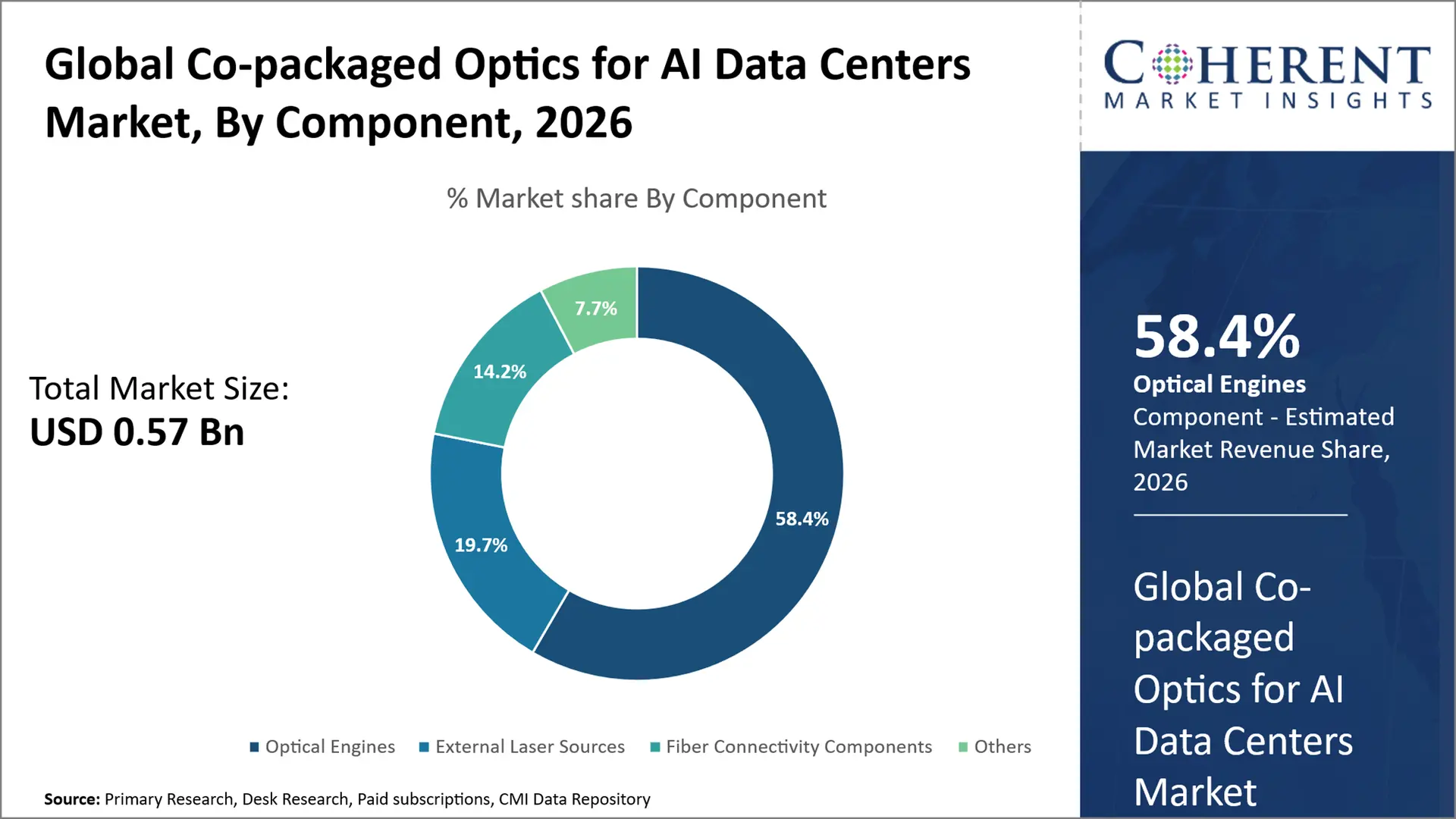
Why Do Optical Engines Dominate the Global Co-packaged Optics for AI Data Centers Market?
In terms of component, the optical engines segment is expected to account for 58.4% of the global co-packaged optics for AI data centers market share in 2026. An optical engine pairs a photonic integrated circuit, which carries the modulators, waveguides and photodetectors, with an electronic integrated circuit that drives and reads them. Building one takes silicon photonics wafers, 3D chip stacking, precise fiber coupling and wafer-level optical testing, which makes it the most complex and costly part of a CPO system. Each CPO switch or accelerator needs several engines placed around the main chip, so engine demand rises directly with bandwidth per package.
Engine makers are now moving to finer process nodes to cut power per bit further. On September 20, 2026, Marvell presented its first 2 nm optical interconnect demonstrations at ECOC 2026, which included a 102.4 Tbps co-packaged optics platform.
- Current Industry Events of 2026
- Market Size Estimation
- Regional Breakdown
- Competitive Landscape
- Customer Intelligence
- Segmental Analysis
- Pricing Analysis
- Key Market Drivers, Challenges & Future Trends
- Customized Insights Section
Why Does Scale-out Networking Lead the Network Architecture Segment?
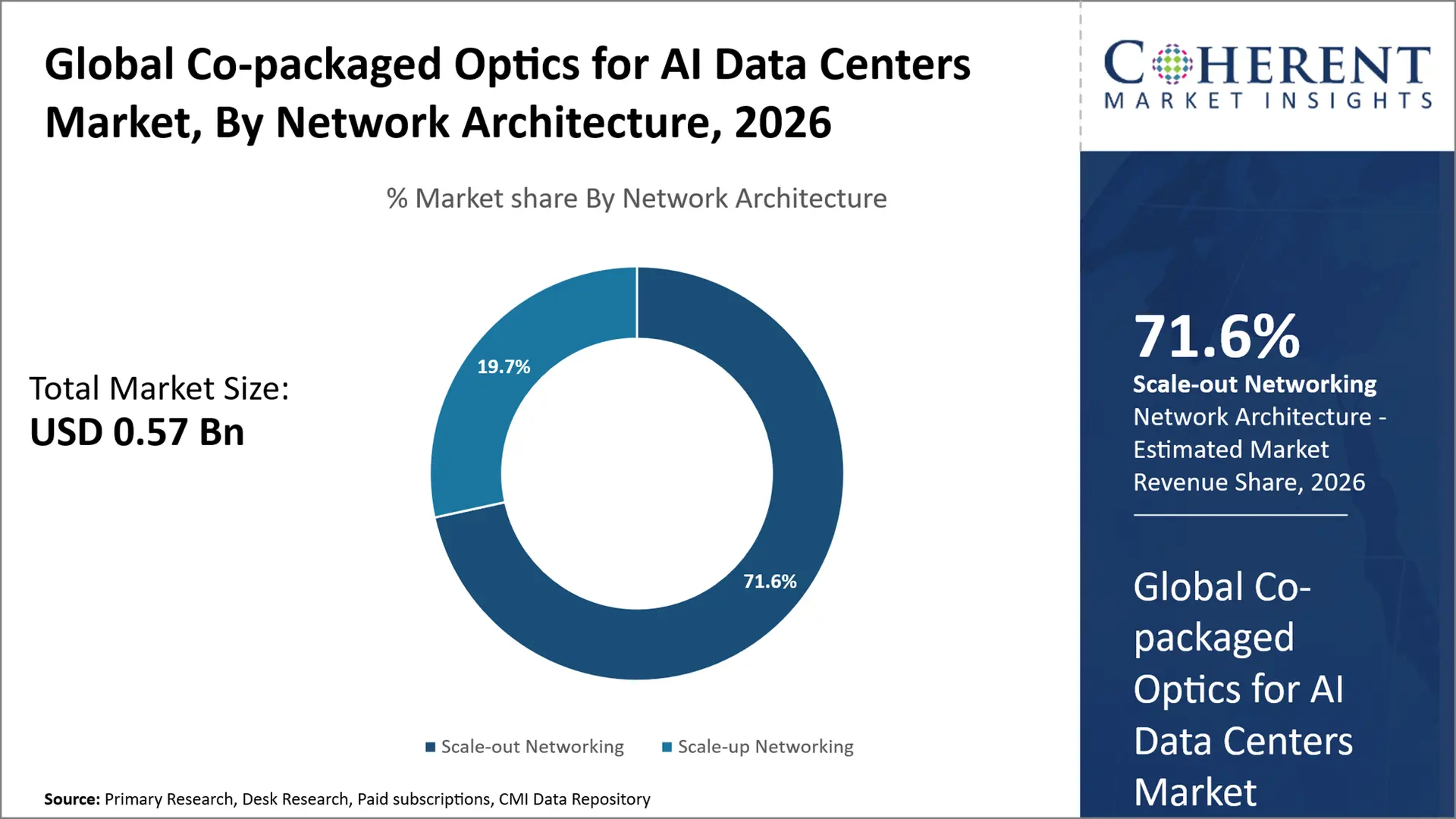
In terms of network architecture, the scale-out networking segment is expected to account for 71.6% of the global co-packaged optics for AI data centers market share in 2026. Scale-out networks connect thousands of servers through tiers of Ethernet and InfiniBand switches, and each switch port has long needed its own pluggable transceiver. Moving the optics into the switch package removes most of those modules, cutting both power and the number of parts that can fail. Switch vendors have refined their CPO designs over several product generations, so this is where commercial volumes started.
In March 2026, Cisco showcased a 51.2 Tbps silicon photonics CPO switch at OFC 2026, fitted with 64 optical engines of 800 Gbps each, a complete liquid cooling system and built-in monitoring, with a product lifespan designed to meet cloud service provider requirements.
Why Do Hyperscale Cloud Service Providers Lead the End User Segment?
In terms of end user, the hyperscale cloud service providers segment is expected to account for 61.8% of the global co-packaged optics for AI data centers market share in 2026. Hyperscale operators build the largest AI training clusters, often with tens of thousands of accelerators in a single fabric, so even small cuts in network power add up to megawatts. They also design their own racks and custom accelerators, which lets them adopt new packaging earlier than other buyers. Many co-develop CPO with chip vendors and run long reliability trials before committing to large orders.
On June 2, 2026, Ayar Labs joined the NVIDIA NVLink Fusion ecosystem, making its co-packaged optics optically and electrically compatible with NVIDIA's optical and SerDes technologies so that hyperscalers can build optically connected AI infrastructure around NVLink Fusion
Current Events and their Impact
Current Events | Description and its Impact |
U.S. Section 232 Proclamation 11002 on semiconductors (January 2026) |
|
China's suspension of its gallium, germanium and antimony export ban to the U.S. (November 9, 2025 – November 27, 2026) |
|
Co-packaged Optics for AI Data Centers Market Dynamics
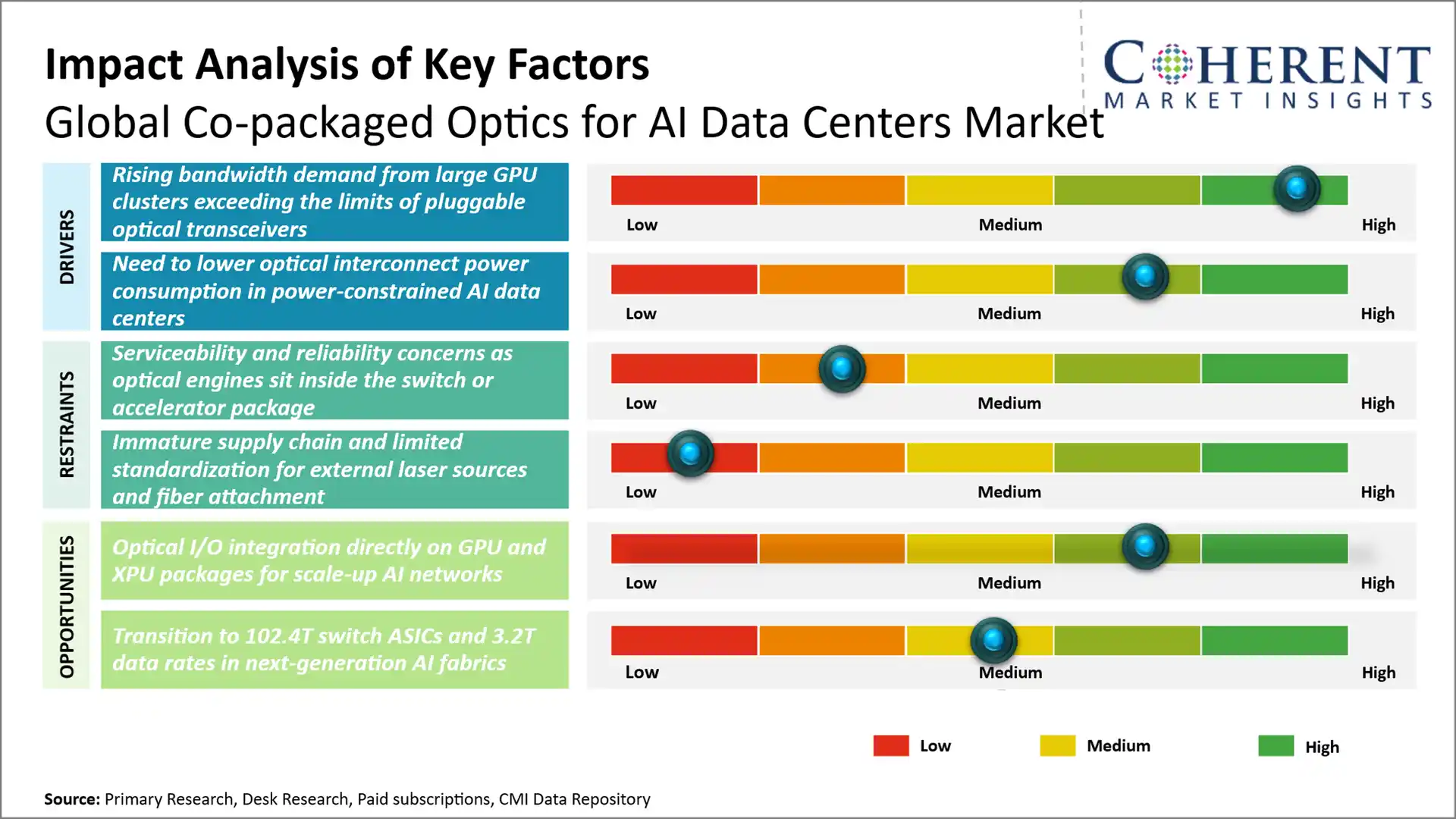
Market Drivers
- Rising bandwidth demand from large GPU clusters exceeding the limits of pluggable optical transceivers: AI training clusters now link tens of thousands of accelerators, and network bandwidth doubles every two to three years. At 200 Gbps per lane, copper traces lose too much signal over a few inches, so pluggable modules need power-hungry DSPs, and the switch front panel runs out of room for ports. Placing the optics next to the chip lets far more bandwidth leave each package.
- On September 26, 2025, Ayar Labs and Alchip Technologies announced a partnership in which Ayar Labs' TeraPHY optical engines are co-packaged with Alchip's ASIC solutions on a common substrate, bringing optical I/O directly to the AI accelerator interface.
- Need to lower optical interconnect power consumption in power-constrained AI data centers: Power, not floor space, now limits how many GPUs an AI data center can run. In large clusters, pluggable optics take a noticeable share of network power, and every watt saved there can go to compute. CPO removes retimers and shortens electrical paths, cutting optics power sharply.
- On October 6, 2025, NTT announced plans to bring its 102.4 Tbps photonics-electronics convergence switch to market in 2026 with Broadcom and Accton, and reported that the switch alone would cut power consumption by about 50%.
Emerging Trends
- Optics are moving from the package edge onto the silicon interposer: First-generation CPO places optical engines on the package substrate around the main chip. The next step brings them onto the silicon interposer itself, shortening the link between chip and optics even further. In October 22, 2026, NVIDIA presented an optics-on-interposer prototype at SEMICON West 2026, which moves optical engines from the organic package substrate onto the silicon interposer that carries the compute chips, alongside dense wavelength-division multiplexing work that carries more data over each fiber.
Impact: This shift is expected to further increase bandwidth density per package while reducing power consumption per bit.
Relevance to the market: Value is likely to shift toward foundries and advanced packaging providers that are capable of integrating photonics at the interposer level.
- Foundries are building end-to-end silicon photonics and CPO offerings: Chip buyers want one supplier that can handle photonic wafers, electronic dies and packaging together. In March 2026, Samsung Electronics' foundry division announced its entry into silicon photonics at OFC 2026, with a process design kit ready on a 300 mm wafer platform and a roadmap toward turnkey CPO services in 2029
Impact: The addition of foundry capacity is expected to reduce the risk of single-source supply constraints for optical engines.
Relevance to the market: Increased competition among foundries is anticipated to lower optical engine costs over the forecast period.
Regional Insights
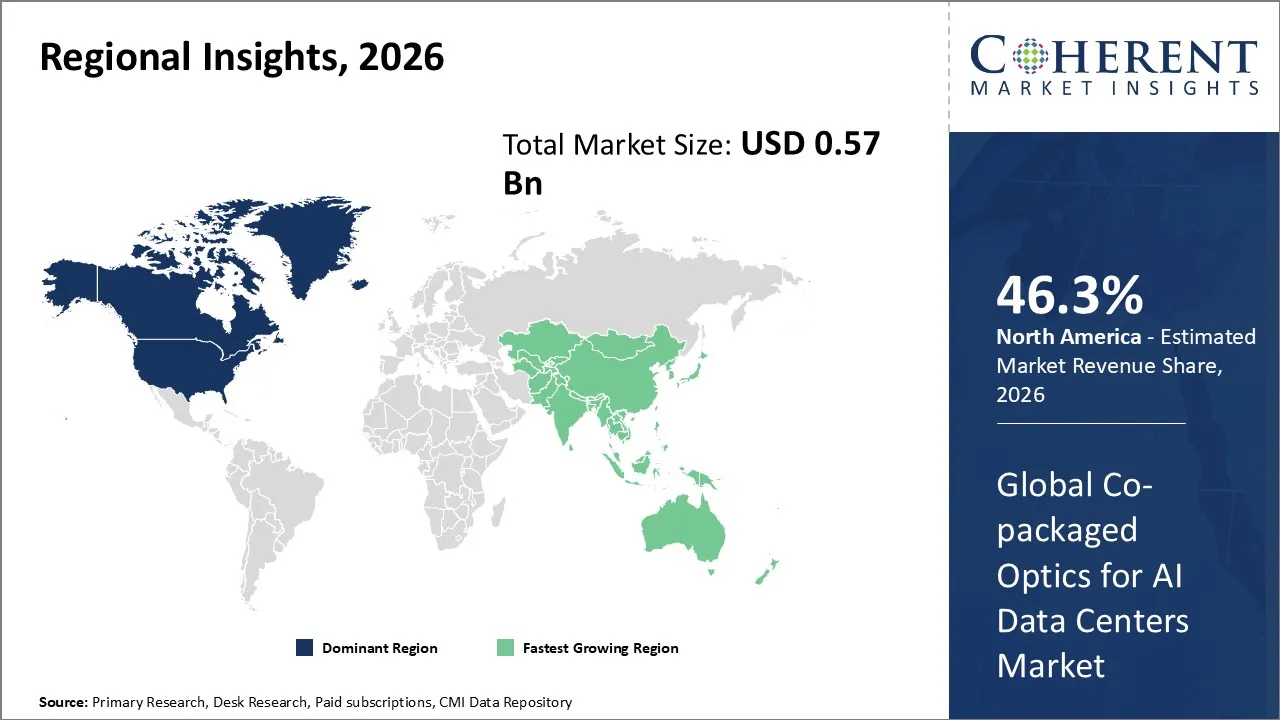
Why Does North America Lead the Global Co-packaged Optics for AI Data Centers Market?
North America is expected to account for a market share of 46.3% in 2026, worth about USD 0.26 Bn. The U.S. hosts the main CPO switch and GPU vendors, most optical I/O start-ups and the hyperscalers that run the world's largest AI clusters. These buyers are under the most pressure to cut network power per GPU, and they have the engineering teams needed to qualify a new optical architecture. Venture and strategic funding for optical interconnect start-ups is also concentrated in the region, which speeds up the move from prototypes to production.
Why Is Asia Pacific the Fastest-Growing Region in the Co-packaged Optics for AI Data Centers Market?
Asia Pacific is expected to account for 31.8% of the global market in 2026, worth about USD 0.18 Bn, and to register the fastest growth over the forecast period, at an estimated 68.9% CAGR (CMI estimate, based on announced optical engine, packaging and switch assembly capacity in Taiwan, Japan and South Korea relative to the region's current share). Taiwan leads in silicon photonics fabrication, chip packaging and switch assembly, while Japan and South Korea add laser, packaging and foundry capabilities. Chinese cloud providers are building large AI clusters with domestic suppliers, which adds a second source of regional demand.
Global Co-packaged Optics for AI Data Centers Market Outlook for Key Countries
Is the U.S. Driving Co-packaged Optics Adoption in North America?
The U.S. co-packaged optics for AI data centers market is projected to reach USD 0.24 Bn in 2026, the largest of any country. U.S. hyperscalers are running long field trials of CPO switches before buying at scale, and the results are building confidence in the technology. On October 1, 2025, Broadcom announced that its CPO had logged one million cumulative 400G-equivalent port device hours without a single link flap during high-temperature testing at Meta, while using 65% less optics power than pluggable modules.
Is China Following Its Own Path in Asia Pacific?
China's co-packaged optics for AI data centers market is projected to reach USD 0.07 Bn in 2026. Chinese cloud providers are favouring near-packaged optics as a step toward full CPO, because it keeps optics serviceable and lets domestic suppliers take part. On July 14, 2026, Huawei, Baidu and industry partners launched China's first multi-source agreement for near-packaged optics, aimed at an open technical standard for next-generation high-speed optical interconnects.
Taiwan Co-packaged Optics for AI Data Centers Market Analysis and Trends
Taiwan's co-packaged optics for AI data centers market is projected to reach USD 0.04 Bn in 2026. The country sits at the center of CPO manufacturing, with leading foundry, packaging, ASIC design and server makers based in Hsinchu and Taipei. On October 13, 2026, Wiwynn, Ayar Labs and GUC gave a live demonstration of an integrated optical compute system at the OCP Global Summit 2026, with optical I/O built directly into the chip design.
Japan Co-packaged Optics for AI Data Centers Market Analysis and Trends
Japan's co-packaged optics for AI data centers market is projected to reach USD 0.03 Bn in 2026. Japanese telecom and component makers bring decades of optical device experience and are using it to enter the data center switch market. In March 2026, NTT Innovative Devices showcased a 102.4 Tbps silicon photonics CPO built on Broadcom's Tomahawk 6 switch at OFC 2026, compatible with ELSFP external laser modules from four suppliers.
South Korea Co-packaged Optics for AI Data Centers Market Analysis and Trends
South Korea's co-packaged optics for AI data centers market is projected to reach USD 0.02 Bn in 2026. The country's memory and foundry strengths give it a path to combine high-bandwidth memory, logic and optics in one package. On September 8, 2026, Samsung was reported to be bringing silicon photonics PIC wafer testing in-house, using probe stations from FormFactor and MPI, with the goal of completing in-house validation by the end of 2026.
Global Co-packaged Optics for AI Data Centers Market – Key CPO Platforms Used in AI Data Centers
Platform | Producer | Main Features and Uses |
Spectrum-X Ethernet Photonics | NVIDIA | CPO Ethernet switch platform with 200 Gb/s SerDes for scale-out AI fabrics |
Tomahawk 6 – Davisson | Broadcom | 102.4 Tbps Ethernet switch with third-generation co-packaged optics |
TeraPHY | Ayar Labs | UCIe optical I/O chiplet for accelerator packages, used with the SuperNova light source |
COUPE | TSMC | Silicon photonics engine that stacks an electronic die on a photonic die using SoIC-X |
How Is Optical I/O integration directly on GPU and XPU packages for scale-up AI networks Creating New Growth Opportunities in the Co-packaged Optics for AI Data Centers Market?
Scale-up networks link GPUs and XPUs so they work as one large processor, and they mostly run on copper inside a single rack. As AI models grow, operators want scale-up domains that stretch across several racks, which copper cannot reach at the required speeds. Putting optical engines directly in the accelerator package solves this and opens a new product category: optical I/O chiplets sold to GPU makers and custom ASIC teams. Suppliers that can meet accelerator-level yield and reliability targets are best placed, because a failed optical attach can scrap a package that also carries expensive compute and memory.
In January 2025, Marvell announced a custom AI accelerator architecture that combines XPU compute silicon, HBM and its 3D SiPho engines on the same substrate, allowing hyperscalers to scale from tens of XPUs in a rack to hundreds across multiple racks
Market Players, Key Development, and Competitive Landscape
Key Developments
- On September 1, 2026, EV Group announced its work with customers and partners across the CPO ecosystem, supporting optical engine manufacturing with wafer bonding, nanoimprint lithography and thin-wafer processing technologies.
- On May 28, 2026, Wiwynn announced it would present its latest CPO interconnect technologies at Computex 2026, developed with partners including Ayar Labs and Molex for optical scale-up in hyperscale AI data centers.
- On March 17, 2026, Coherent announced CPO demonstrations at OFC 2026, including a 6.4T socketed CPO based on silicon photonics with an external laser source, a multimode socketed CPO using VCSELs and a 400G InP modulator on silicon.
Competitive Landscape
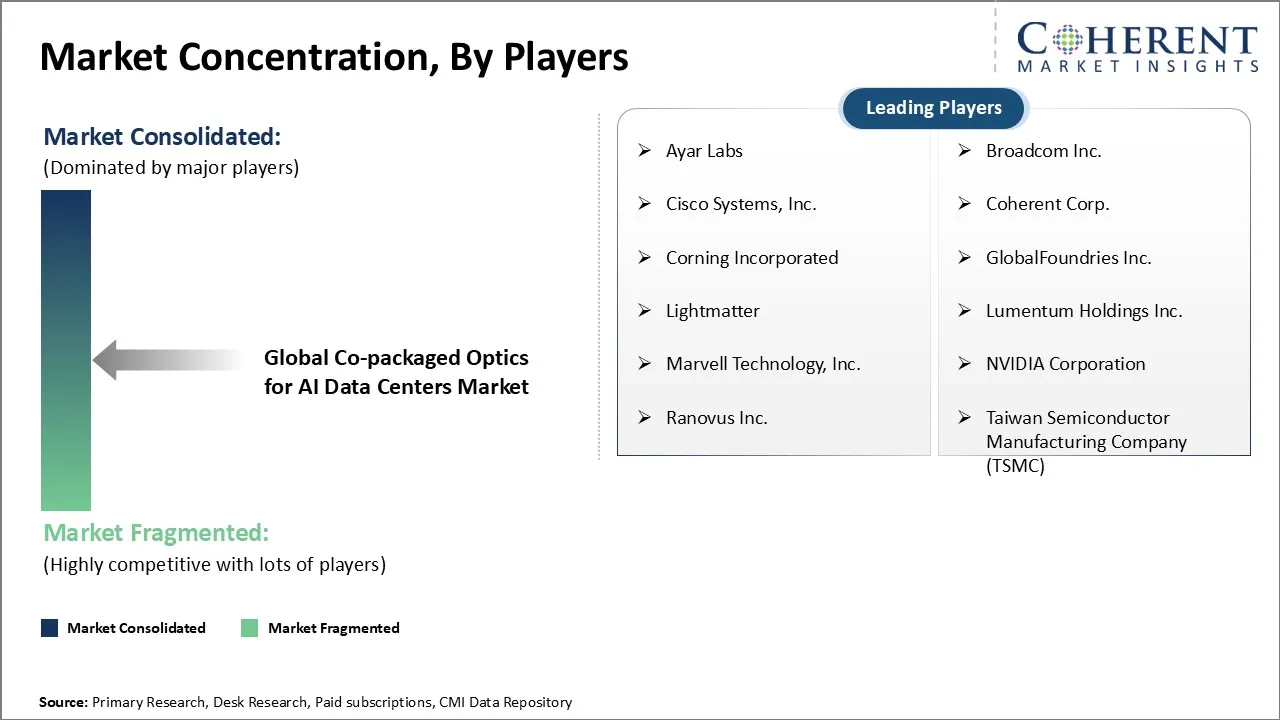
The market is concentrated at the top but has a growing supplier base below it. Switch and accelerator vendors such as Broadcom, NVIDIA, Cisco and Marvell define the CPO architecture and capture most of the system value. Foundries and packaging houses such as TSMC and GlobalFoundries build the optical engines, while laser and fiber specialists such as Coherent, Lumentum and Corning supply external light sources and connectivity. Optical I/O start-ups such as Ayar Labs, Lightmatter and Ranovus target accelerator-level integration, where the next wave of demand is expected. Competition centers on power per bit, field reliability, serviceability of lasers and fibers, and the ability to ship in volume. Partnerships and standards groups such as the OCI MSA are shaping which designs win, since hyperscalers want more than one source for each part.
Global Co-packaged Optics for AI Data Centers Market – Power Efficiency and Thermal Comparison of Optical Interconnect Options (per 1.6T Port)
Interconnect Option | Power per 1.6T Port | Energy per Bit | Thermal Management Requirements |
Fully retimed pluggable (with DSP) | 30 W | 18.5 pJ/bit | Highest heat load at the switch front panel; pluggable power is approaching air-cooling limits, and direct-to-plug liquid cooling is being introduced |
Linear pluggable optics (LPO) | 10 W | 6.5 pJ/bit | Lower front-panel heat because the DSP is removed, though optics still sit in front-panel cages |
Co-packaged optics (CPO) | 5 W | 3 pJ/bit | Heat moves from the front panel to the switch package, which is usually liquid-cooled; lasers are kept outside the package in pluggable external laser modules for cooling and replacement |
Market Report Scope
Global Co-packaged Optics for AI Data Centers Market Report Coverage | |||
Report Coverage | Details | ||
Base Year | 2025 | Market Size in 2026: | USD 0.57 Bn |
Historical Data For: | 2020 To 2024 | Forecast Period: | 2026 To 2033 |
Forecast Period 2026 To 2033 CAGR: | 64.20% | 2033 Value Projection: | USD 18.34 Bn |
Geographies covered: |
| ||
Segments covered: |
| ||
Companies covered: | Ayar Labs, Broadcom Inc., Cisco Systems, Inc., Coherent Corp., Corning Incorporated, GlobalFoundries Inc., Lightmatter, Lumentum Holdings Inc., Marvell Technology, Inc., NVIDIA Corporation, Ranovus Inc., Taiwan Semiconductor Manufacturing Company (TSMC) | ||
Growth Drivers: |
| ||
Restraints & Challenges: |
| ||
Analyst Opinion (Expert Opinion)
- Optical engines lead, but lasers are where growth is fastest. Optical engines make up 58.4% of spending in 2026, against 19.7% for external laser sources, 14.2% for fiber connectivity components and 7.7% for others. Laser sources should gain share as every new CPO switch and accelerator package needs pluggable, field-replaceable lasers. Scale-up networking holds 28.4% in 2026 but is the fastest-growing architecture, at an estimated 78.5% CAGR (CMI estimate, based on announced optical I/O roadmaps for GPUs and custom accelerators from 2027 onward). Suppliers that can serve both switch and accelerator packages will win the largest contracts.
- Adoption depends on serviceability and supply. North America holds 46.3% of the market in 2026, while Asia Pacific, at 31.8%, grows fastest as Taiwan, Japan and South Korea add engine and packaging capacity. The first risk is serviceability: a failed optical engine inside a package can mean replacing a full switch board or accelerator, so operators still demand long field trials. The second risk is supply: lasers, fiber attach and optical test remain thin parts of the chain, and export controls on key materials add uncertainty. Vendors that keep lasers pluggable, back designs with field reliability data and qualify multiple sources are the least exposed.
Speak to the analyst
Want personalized insights?
Take the findings above to one of our principal consultants, or have the report rebuilt around the segments, geographies and competitors you actually track.
Market Segmentation
- Component Insights (Revenue, USD Billion, 2021 - 2033)
- Optical Engines
- External Laser Sources
- Fiber Connectivity Components
- Others
- Data Rate (per Optical Engine) Insights (Revenue, USD Billion, 2021 - 2033)
- Up to 1.6 Tbps
- Above 1.6 Tbps to 3.2 Tbps
- Above 3.2 Tbps to 6.4 Tbps
- Above 6.4 Tbps
- Network Architecture Insights (Revenue, USD Billion, 2021 - 2033)
- Scale-out Networking
- Scale-up Networking
- End User Insights (Revenue, USD Billion, 2021 - 2033)
- Hyperscale Cloud Service Providers
- GPU Cloud (Neocloud) Providers
- Enterprises
- Government and Research Institutions
- Regional Insights (Revenue, USD Billion, 2021 - 2033)
- North America
- U.S.
- Canada
- Latin America
- Brazil
- Argentina
- Mexico
- Rest of Latin America
- Europe
- Germany
- U.K.
- Spain
- France
- Italy
- Russia
- Rest of Europe
- Asia Pacific
- China
- India
- Japan
- Australia
- South Korea
- ASEAN
- Rest of Asia Pacific
- Middle East
- GCC Countries
- Israel
- Rest of Middle East
- Africa
- South Africa
- North Africa
- Central Africa
- North America
- Key Players Insights
- Ayar Labs
- Broadcom Inc.
- Cisco Systems, Inc.
- Coherent Corp.
- Corning Incorporated
- GlobalFoundries Inc.
- Lightmatter
- Lumentum Holdings Inc.
- Marvell Technology, Inc.
- NVIDIA Corporation
- Ranovus Inc.
- Taiwan Semiconductor Manufacturing Company (TSMC)
Sources
Primary Research Interviews
- Data center network architects and infrastructure heads
- Hyperscale and GPU cloud procurement managers
- Optical engine and laser product managers
- Switch and accelerator hardware engineers
- Advanced packaging and test specialists
Magazines
- Lightwave
- Photonics Spectra
- IEEE Spectrum
- Optics & Photonics News
- EE Times
Journals
- Journal of Lightwave Technology
- IEEE Journal of Selected Topics in Quantum Electronics
- Optics Express
- IEEE Photonics Technology Letters
Associations
- Optica
- IEEE Photonics Society
- Optical Internetworking Forum (OIF)
- Open Compute Project (OCP)
- SEMI
Public Domain Sources
- U.S. Presidential Proclamation 11002: Adjusting Imports of Semiconductors, Semiconductor Manufacturing Equipment, and Their Derivative Products
- Ministry of Commerce of the People's Republic of China: Announcements on dual-use export controls
- U.S. Securities and Exchange Commission (SEC): Company annual filings
- Company press releases
Proprietary Elements
- CMI Data Analytics Tool
- Proprietary CMI Existing Repository of information for last 10 years
Get access to 250+ pages report
Every segment, forecast, competitor profile and data table behind the analysis above — available for instant download.
- ESOMAR Member
- ISO 9001:2015 Certified
- D-U-N-S Registered
- GDPR & CCPA Compliant
Frequently Asked Questions
The global co-packaged optics for AI data centers market is estimated to be valued at USD 0.57 Bn in 2026 and is expected to reach USD 18.34 Bn by 2033.
The CAGR of the global co-packaged optics for AI data centers market is projected to be 64.2% from 2026 to 2033.
Rising bandwidth demand from large GPU clusters exceeding the limits of pluggable optical transceivers, and need to lower optical interconnect power consumption in power-constrained AI data centers, are the major factors driving market growth.
Serviceability and reliability concerns as optical engines sit inside the switch or accelerator package, and immature supply chain and limited standardization for external laser sources and fiber attachment, are the major factors hampering market growth.
In terms of component, the optical engines segment is estimated to dominate the market, with a revenue share of 58.4% in 2026.
Co-packaged optics is a design in which the optical engine sits in the same package as a switch chip or an AI accelerator. Light leaves the package directly through fiber, instead of traveling as an electrical signal across the circuit board to a pluggable transceiver.
Pluggable optics sit in the switch front panel and often use a DSP to clean up the signal. Linear pluggable optics (LPO) remove the DSP but stay in the front panel. Near-packaged optics (NPO) place the optics on the same board, close to the chip. CPO goes furthest by placing the optics inside the chip package.