

Global Coin Cell Batteries Market Size and Forecast – 2026 To 2033
The global coin cell batteries market is expected to grow from USD 2.90 Bn in 2026 to USD 4.85 Bn by 2033, registering a compound annual growth rate (CAGR) of 4.4% from 2026 to 2033. The global coin cell batteries market is driven by growth in use of wireless earbuds and compact consumer electronics. On September 9, 2025, Apple announced AirPods Pro 3, which delivers unbelievable sound quality and the world’s best in-ear Active Noise Cancellation (ANC), removing up to two times more noise than the previous-generation AirPods Pro.
Key Takeaways of the Global Coin Cell Batteries Market
- The lithium coin cell batteries segment is expected to account for 36.0 % of the global coin cell batteries market share in 2026. Rising demand for automotive key fobs and TPMS systems is driving the growth of the segment. On March 5, 2026, Pacific Industrial began sales of its TPMS PMR-H101, a valve-mounted sensor that measures tire pressure and temperature and transmits information to an in-vehicle display or smartphone application, expanding its TPMS product offering for passenger vehicles.
- The consumer electronics segment is estimated to capture 34.0 % of the market share in 2026. Increasing miniaturization of electronic devices is majorly driving the growth of the segment. On June 23, 2025, Syntiant introduced its SPV digital microphone range with a space-efficient footprint designed for wearables, hearables and smart glasses.
- Asia Pacific is expected to dominate the coin cell batteries market in 2026 with a market share of 42.0 %. Growing demand for low-power energy-harvesting systems with battery backup in Asia Pacific is driving the growth of the regional market. On April 15, 2025, Asahi Kasei Microdevices (AKM) developed the AP4413, a new series of ultra-low current power management ICs (PMICs) ideal for battery charging systems used in energy harvesting applications.
- North America is expected to account for 26.0% share in 2026 and is projected to record the fastest growth over the forecast period. Expansion of electronic shelf labels and smart tags in North America is driving the growth of the regional market. On April 20, 2026, Pricer AB announced that its Canadian partner JRTech Solutions has signed a major agreement with Sobeys. The contract includes the deployment of Pricer’s latest electronic shelf label (ESL) technology and the cloud-based platform Pricer Plaza across an estimated 300-350 stores.
Segmental Insights
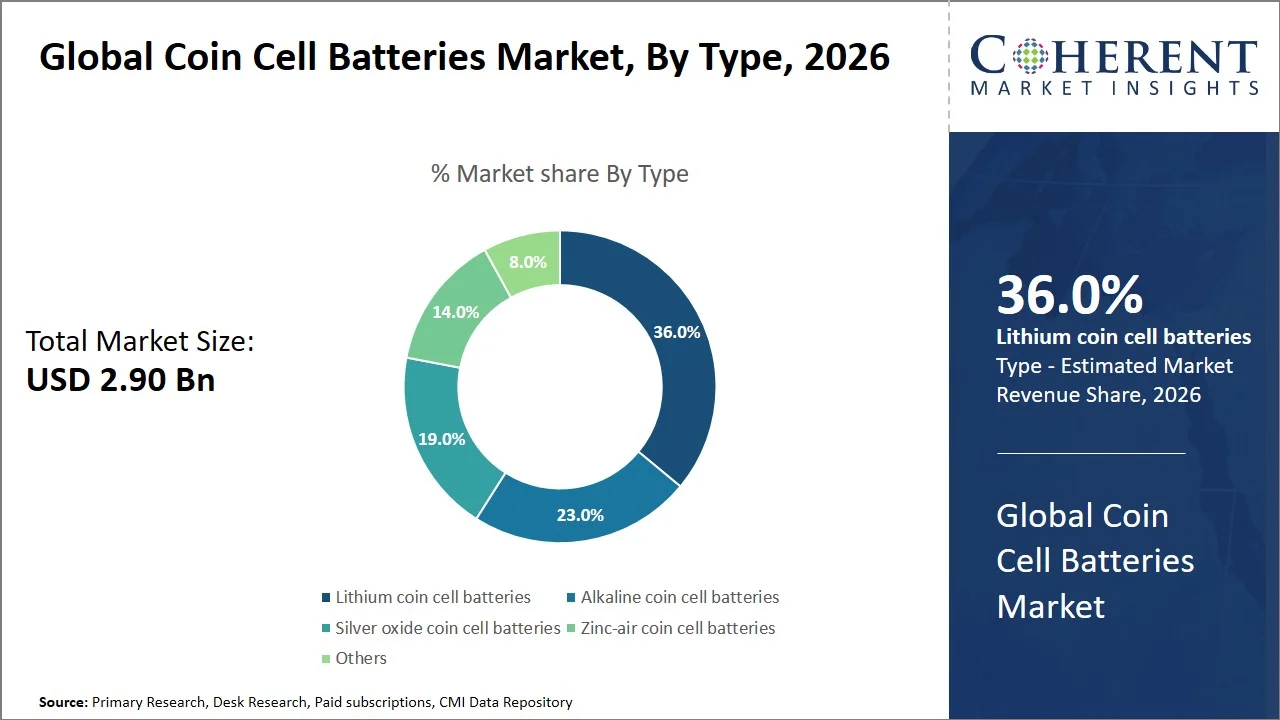
Why Does Lithium Coin Cell Batteries Dominate the Global Coin Cell Batteries Market?
The lithium coin cell batteries segment is expected to account for 36.0% of the global coin cell batteries market share in 2026. Lithium coin cell batteries dominate the global coin cell batteries market because they offer a strong combination of high energy density, long shelf life, low self-discharge and stable voltage output in a compact form factor. These qualities make lithium cells perfect for watches, key fobs, medical gadgets, fitness trackers, sensors, memory backup systems, and other miniature electronic items that need consistent power over long periods of time without regular replacement. On September 3, 2025, Panasonic Energy announced new CR2032E, CR2025E and CR2016E lithium coin cells featuring denatonium benzoate on the negative terminal to deter unintentional intake by minors. The new cells also extended the suggested storage period from five years to 10, reinforcing the value proposition of lithium chemistry for items requiring a long shelf life.
- Current Industry Events of 2026
- Market Size Estimation
- Regional Breakdown
- Competitive Landscape
- Customer Intelligence
- Segmental Analysis
- Pricing Analysis
- Key Market Drivers, Challenges & Future Trends
- Customized Insights Section
Why is Consumer Electronics the Most Crucial End User?
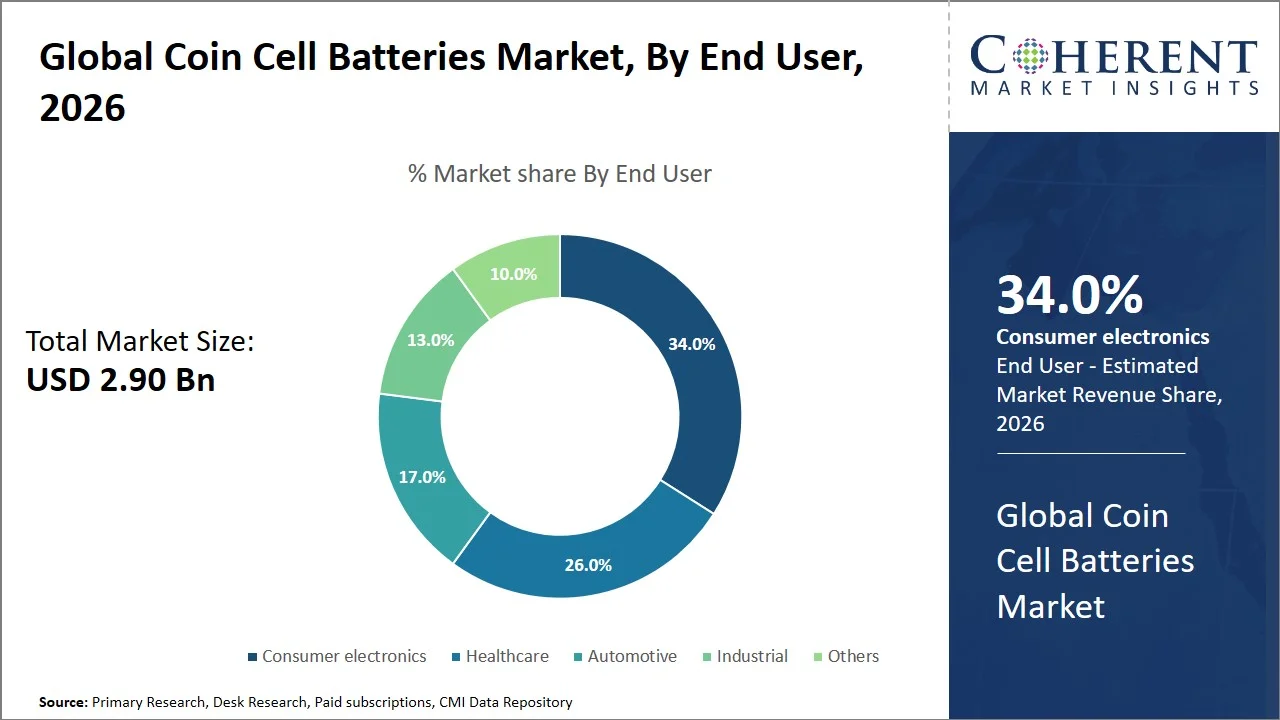
The consumer electronics segment is expected to account for 34.0% of the global coin cell batteries market share in 2026. The most important end user is consumer electronics where coin cell batteries are used in a wide range of high volume products such as watches, remote controls, calculators, Bluetooth accessories, trackers and compact electronic devices, resulting in a steady demand from both new product manufacturing and battery replacement cycles. The proliferation of connected consumer devices is also driving the number of products that need small, lightweight and long-lasting power sources. Consumer electronics devices have short product development cycles and provide coin cell battery manufacturers with the opportunity to gain additional volumes thru frequent launches and upgrades. On July 1, 2026, Garmin launched its first screen-free smart band, the CIRQA Smart Band. The CIRQA Smart Band records sophisticated fitness and wellness features, all without the need for a subscription. This smart band is designed to help users make progress toward a healthy lifestyle, without taking up all of their attention. It has a battery life of up to 10 days and delivers 24/7 health and fitness monitoring with data that can be easily accessible thru the Garmin Connect app.
Current Events and their Impact
Current Events | Description and its Impact |
European Union Battery Regulation (EU Regulation 2023/1542) |
|
India e-Waste Management Amendment Rules |
|
Coin Cell Batteries Market Dynamics
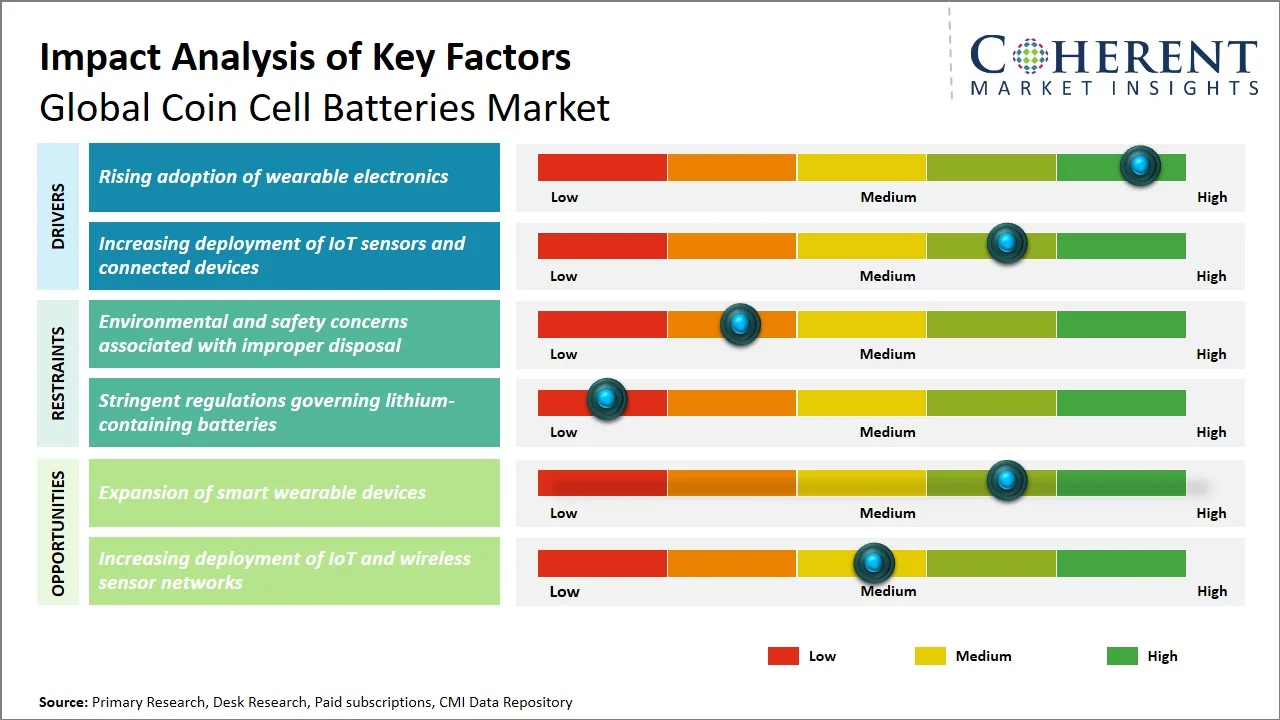
Market Drivers
- Rising adoption of wearable electronics: The increase in adoption of wearable electronics is driving the demand for coin cell batteries as smartwatches, fitness trackers, smart rings, wireless accessories and other small devices require lightweight power sources that can provide reliable energy within space-constrained designs. The continuing development of smaller, more feature-rich wearables is offering more prospects for coin cell makers, especially for lithium based cells, which deliver high energy density, long shelf life and consistent performance in small form factors. On September 9, 2025, Apple introduced the Apple Watch Series 11 with the most advanced collection of health features ever, greater battery life, an even more robust cover glass, and 5G cellular capabilities in its thinnest and most comfortable design.
- Increasing deployment of IoT sensors and connected devices: The increase in deployment of IoT sensors and connected devices is generating new demand for coin cell batteries as a number of wireless sensors, smart tags, asset trackers, security devices and building-monitoring equipment operate at low power and require compact batteries with prolonged operating life. The proliferation of linked infrastructure across smart homes, industrial facilities, logistics and retail environments is driving the growth of battery-powered endpoints and the wider acceptance of coin cells for devices where regular battery replacement is not viable. On January 27, 2026, ing announced a new range of smart home sensors in January 2026, including motion detectors, glass-break sensors, panic buttons, flood and freeze detectors, and temperature monitors that use Amazon Sidewalk rather than relying on Wi-Fi or a dedicated hub.
Emerging Trends
- Integration of coin cells with smart wearable devices: Coin cell batteries are increasingly being designed for compact wearable technology such as smart rings, fitness trackers, medical wearables and miniature wireless accessories, prompting manufacturers to enhance energy density, discharge stability and form-factor flexibility.
- Growth of battery-powered IoT endpoints: Demand for coin cells with long operational life, minimal self-discharge and reliable performance under intermittent power requirements is being driven by the growth of smart sensors, asset trackers, electronic shelf labels and linked monitoring devices.
- Development of rechargeable coin cell technologies: Rechargeable lithium-based coin cells are gaining interest for applications with repeated charging cycles, including compact electronics, wearables and specialized IoT products. They provide an alternative to traditional primary coin cells.
- Increasing focus on safer and more sustainable coin cells: In response to concerns about accidental ingestion, disposal of batteries and the growing number of miniature batteries entering the consumer market, battery manufacturers are focusing more on improving safety features, child-resistant packaging, recycling compatibility and reducing environmental impact.
Regional Insights
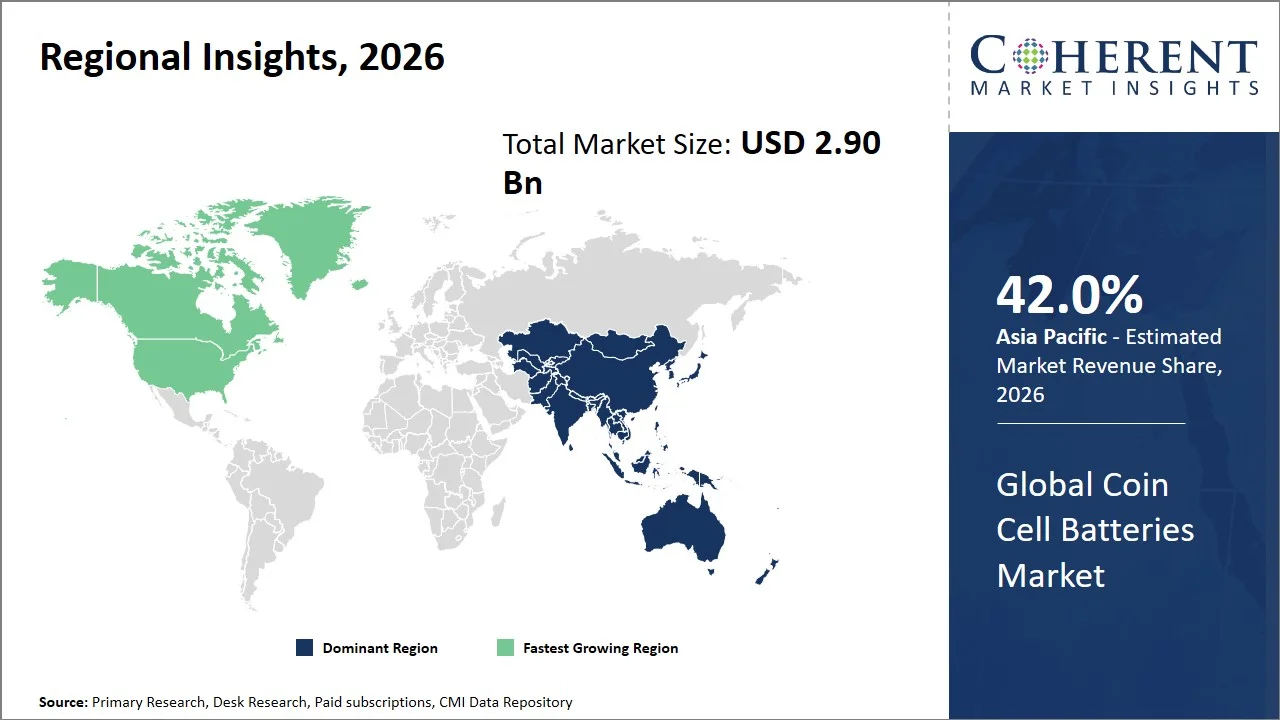
Why is Asia Pacific a Strong Market for Coin Cell Batteries?
Asia Pacific is expected to account for a market share of 42.0% in 2026. Asia pacific benefits from its concentration of electronics manufacturing, particularly in China, Japan, South Korea and Taiwan, where coin cells are incorporated into watches, wireless accessories, smart tags, remote controls, medical devices and compact sensors. Panasonic specifically identifies coin lithium batteries as suitable for household electronics and IoT devices because of their 3 V output, high energy density and long operating life, while Murata announced in 2025 that it would transfer its micro primary battery business, including coin manganese dioxide lithium batteries, to Maxell, demonstrating continued industrial activity around miniature primary cells in Japan. The region is also supported by rapid expansion of smart-device manufacturing and the growing deployment of low-power connected sensors, where compact CR-series cells remain useful because devices can operate for extended periods without wired power.
Why Does North America Coin Cell Batteries Market Exhibit High Growth?
North America is expected to register the fastest growth with a CAGR of 5.5% over the forecast period. It is projected to account for 26% of the global coin cell batteries market in 2026. North America is benefiting from the proliferation of connected household devices, automotive keyless-entry systems, tire-pressure monitoring systems, medical electronics and wireless security sensors that require small primary batteries with long shelf lives. Automotive applications are particularly important because coin cells are widely used in key fobs and other low-power vehicle accessories, while smart-home installations are expanding the installed base of wireless door, window, temperature and security sensors that can operate independently of mains power. Industry sources also identify automotive keyless entry, tire-pressure systems and medical devices as important demand applications in the region. The expansion of localized battery and component supply chains is additionally strengthening the broader battery ecosystem, with argonne national laboratory tracking more than 1,300 GWh per year of announced lithium-ion cell production capacity in north america by 2030, although this figure relates primarily to larger rechargeable batteries rather than coin cells.
Global Coin Cell Batteries Market Outlook for Key Countries
Why is China Emerging as a Major Hub in the Coin Cell Batteries Market?
China benefits from its exceptionally large electronics manufacturing ecosystem, which creates direct demand for coin cells across smart wearables, electronic toys, remote controls, computer accessories, sensors, automotive electronics and consumer devices. The country is also a major manufacturing base for the components and finished products that incorporate CR2032, CR2025 and related cells, allowing battery suppliers to serve electronics assemblers within relatively short supply chains. Asia pacific research specifically identifies the concentration of consumer-electronics and battery manufacturing in china as a major factor behind regional coin-cell demand. Another important growth factor is the expansion of connected-device production, particularly low-power trackers and smart-home sensors, where coin cells are attractive because their compact cylindrical form and stable output can support long maintenance intervals. Panasonic, for example, highlights IoT as a direct application for its coin lithium portfolio.
Is U.S. the Next Growth Engine for the Coin Cell Batteries Market?
The U.S. has particularly strong demand from automotive access systems, healthcare electronics, smart-home equipment and connected security products rather than being driven primarily by battery manufacturing. Coin cells are widely used in vehicle key fobs, tire-pressure monitoring systems, remote controls and wireless sensors, while the expansion of connected-home infrastructure is increasing the number of independently powered devices installed in residential buildings. One industry estimate indicates that approximately 90% of modern vehicle key fobs sold in the U.S. use lithium coin batteries, illustrating the importance of automotive access applications. Medical and healthcare electronics provide another distinctive demand source because miniature devices can require stable, long-duration power in compact housings, with north american market research specifically identifying medical devices alongside automotive systems as important applications.
Japan Coin Cell Batteries Market Analysis and Trends
Japan is supported by its specialized ecosystem of precision electronics, watches, cameras, medical equipment and miniature components, where reliability and long shelf life are especially important. Japanese battery companies have maintained significant expertise in micro primary cells, with murata announcing in june 2025 an agreement to transfer its micro primary battery business, including coin lithium and other miniature primary batteries, to maxell, with the transaction scheduled for completion during fiscal 2025. Japan also benefits from the continued use of miniature batteries in precision devices requiring stable voltage within very limited physical space, while Panasonic's coin lithium technology demonstrates how japanese manufacturers have targeted household electronics and IoT applications with high-energy-density 3 V cells.
South Korea Coin Cell Batteries Market Analysis and Trends
South korea is benefiting from its concentration of advanced consumer electronics, semiconductor-related equipment, wearables and connected devices, where compact battery formats are needed for products such as smart accessories, sensors, remote-control devices and miniature electronic systems. The country's strong position in smartphones, smartwatches, wireless accessories and other connected hardware creates a large downstream ecosystem for small batteries, while the increasing deployment of IoT devices adds applications requiring low-power operation and infrequent battery replacement. Asia pacific market analysis specifically identifies south korea alongside china and japan as one of the principal electronics and battery-manufacturing centers supporting regional coin-cell demand. The growth of miniature electronics also reinforces demand for lithium coin cells because their high energy density and stable 3 V output allow manufacturers to maintain compact device dimensions while providing relatively long operating periods.
India Coin Cell Batteries Market Analysis and Trends
India is developing a distinct growth pathway through the rapid expansion of domestic electronics assembly, connected devices, wearables and medical electronics rather than through mature coin-cell manufacturing. Meity reported that india became the world's second-largest manufacturer of mobile handsets by volume, with more than 300 units manufacturing cellular mobile phones and related components, while mobile-phone production reached USD 57 billion in FY2024-25 and exports reached approximately USD 21 billion. The electronics component manufacturing scheme approved in march 2025 is designed to attract domestic and global investment into component production and integrate Indian companies into global value chains, which can progressively expand the local ecosystem supporting miniature electronic components and batteries. There are certain medical-device applications of coin cells in India, where a government procurement specification for a portable blood related gadget in 2025 specifically calls for a single coin-cell battery of 3 V, showing direct application of this format in healthcare equipment deployed locally.
Global Coin Cell Batteries Market - Coin Cell Battery Production Volume By Country (2025)
Country | Coin Cell Battery Production Volume (Million Pieces) | Estimated Global Production Share |
China | 2,850 | 45.2% |
Japan | 1,420 | 22.5% |
South Korea | 620 | 9.8% |
United States | 480 | 7.6% |
Switzerland | 310 | 4.9% |
Germany | 260 | 4.1% |
Hong Kong | 170 | 2.7% |
India | 120 | 1.9% |
Taiwan | 55 | 0.9% |
Singapore | 20 | 0.3% |
Other countries | 5 | 0.1% |
How is Expansion of Smart Wearable Devices Creating New Growth Opportunities in the Coin Cell Batteries Market?
The expansion of smart wearable devices is creating new opportunities for coin cell batteries through the rapid emergence of ultra-compact form factors such as smart rings, screenless health bands, smart tags and specialized wearable accessories that have extremely limited space for energy storage. Smart rings are particularly relevant because devices such as the 2025 Pebble Index 01 use non-rechargeable silver oxide coin cells designed for approximately two years of operation, demonstrating a product category where replaceable miniature batteries can be preferable to bulky rechargeable packs.
Shipments of wearables worldwide hit 145.7 million units in the first quarter of 2026, with smart rings and smart glasses among the fastest-growing new form factors cited. Smartwatches are forecast to expand from 141.15 million shipped units in 2025 to 196.4 million in 2031, while intelligent and NFC-enabled rings are anticipated to reach 113.5 million shipped units by 2031. This shift is opening opportunities for manufacturers to develop thinner coin cells with higher energy density, stable voltage output and extended shelf life for wearable applications where frequent charging, added weight and larger rechargeable batteries can compromise product usability.
On July 22, 2026, Samsung Electronics announced the all-new Galaxy Watch Ultra2 and Galaxy Watch9, delivering a new era of effortless health, where users can unlock in-depth, meaningful health insights simply by wearing these devices. To support 24/7 wearability, Samsung delivers powerful innovations that maximize comfort while advancing performance with Galaxy Watch’s largest battery and brightest display ever, as well as the Snapdragon Wear Elite Platform.
Market Players, Key Development, and Competitive Landscape
Key Developments
- On December 16, 2025, Maxell announced the development of the PSB2032, a new coin-type all-solid-state battery designed to serve as a reliable main power source for IoT devices. With significantly higher capacity, compact size, and enhanced safety and durability, the PSB2032 addresses the growing demand for long-term, maintenance-free power in infrastructure and industrial monitoring applications.
- On June 17, 2024, TDK Corporation developed a material for CeraCharge, a next-generation solid-state battery with an energy density of 1,000 Wh/L, approximately 100 times greater than the energy density of TDK’s conventional solid-state battery.
Competitive Landscape
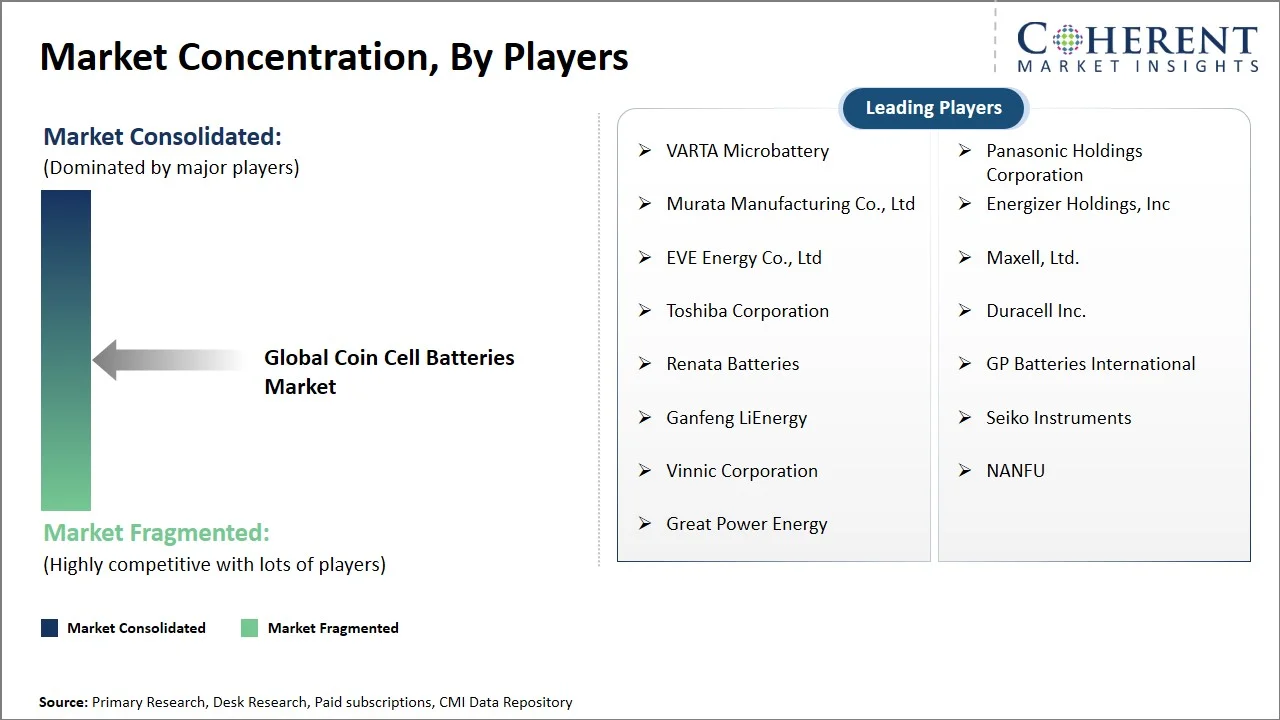
The competitive field is dominated by major manufacturers like Panasonic, VARTA and Murata. The competition is increasingly focused on application-specific performance and not just on the standard availability of CR2032. Panasonic expands its lithium coin line with enhanced material compositions for higher energy density, storage life and discharge performance, including suitable for keyless-entry devices and IoT equipment. VARTA is focusing on customized battery configurations for IoT applications, including its CR1216 primary lithium coin cell with pin tags for miniature wireless sensors, while also offering lithium-ion button cells for wearables and customized casing and connections. Murata is moving further toward ultra-low-power ecosystems, with its 2026 mass production of AMR sensors specifically designed to extend battery life in coin-cell-powered healthcare, wearable and IoT devices, demonstrating a strategy of combining miniature components with low-power system design rather than competing only on the battery itself.
Market Report Scope
Coin Cell Batteries Market Report Coverage
| Report Coverage | Details | ||
|---|---|---|---|
| Base Year: | 2025 | Market Size in 2026: | USD 2.90 Bn |
| Historical Data for: | 2020 To 2024 | Forecast Period: | 2026 To 2033 |
| Forecast Period 2026 to 2033 CAGR: | 4.4% | 2033 Value Projection: | USD 4.85 Bn |
| Geographies covered: |
| ||
| Segments covered: |
| ||
| Companies covered: | VARTA Microbattery, Panasonic Holdings Corporation, Murata Manufacturing Co., Ltd, Energizer Holdings, Inc, EVE Energy Co., Ltd, Maxell, Ltd., Toshiba Corporation, Duracell Inc., Renata Batteries, GP Batteries International, Ganfeng LiEnergy, Seiko Instruments, Vinnic Corporation, NANFU, Great Power Energy | ||
| Growth Drivers: |
| ||
| Restraints & Challenges: |
| ||
Analyst Opinion (Expert Opinion)
- The future of the industry is expected to shift toward application-specific miniature power solutions, particularly as connected products become smaller and require longer operating periods between battery replacements. The strongest opportunity is likely to emerge around lithium coin cells for IoT sensors, smart tags, wearables, security devices and automotive access systems, where Panasonic's high-energy-density approach and VARTA's customized IoT cells demonstrate the direction of product development.
- The Asia Pacific market should provide the strongest opportunity, particularly China, Japan and South Korea, because the region combines large-scale electronics manufacturing with dense supply chains for wearables, sensors and compact connected devices. Japan is particularly attractive for higher-value applications because companies such as Panasonic and Murata are developing technologies around energy density, miniaturization and ultra-low-power operation rather than relying solely on conventional commodity cells.
- Players seeking an edge should prioritize long-life lithium cells, customized form factors and extremely low self-discharge, while developing battery-plus-component solutions for specific device architectures. The Murata example is particularly relevant because reducing the power consumption of the electronics surrounding a coin cell can extend operating life without requiring a proportionally larger battery, suggesting that partnerships with sensor, semiconductor and IoT-device manufacturers could become an important competitive strategy.
Speak to the analyst
Want personalized insights?
Take the findings above to one of our principal consultants, or have the report rebuilt around the segments, geographies and competitors you actually track.
Market Segmentation
- Type Insights (Revenue, USD Billion, 2021 - 2033)
- Lithium coin cell batteries
- Alkaline coin cell batteries
- Silver oxide coin cell batteries
- Zinc-air coin cell batteries
- Others
- End User Insights (Revenue, USD Billion, 2021 - 2033)
- Consumer electronics
- Healthcare
- Automotive
- Industrial
- Others
- Regional Insights (Revenue, USD Billion, 2021 - 2033)
- North America
- U.S.
- Canada
- Latin America
- Brazil
- Argentina
- Mexico
- Rest of Latin America
- Europe
- Germany
- U.K.
- Spain
- France
- Italy
- Russia
- Rest of Europe
- Asia Pacific
- China
- India
- Japan
- Australia
- South Korea
- ASEAN
- Rest of Asia Pacific
- Middle East
- GCC Countries
- Israel
- Rest of Middle East
- Africa
- South Africa
- North Africa
- Central Africa
- North America
- Key Players Insights
- VARTA Microbattery
- Panasonic Holdings Corporation
- Murata Manufacturing Co., Ltd
- Energizer Holdings, Inc
- EVE Energy Co., Ltd
- Maxell, Ltd.
- Toshiba Corporation
- Duracell Inc.
- Renata Batteries
- GP Batteries International
- Ganfeng LiEnergy
- Seiko Instruments
- Vinnic Corporation
- NANFU
- Great Power Energy
Sources
Primary Research Interviews
- Coin Cell Battery Product and Engineering Teams
- Microbattery Product and Application Specialists
Magazines
- Electronics360
- Power Electronics News
- TechInsights
Journals
- Journal of Power Sources
- Batteries
- Electrochimica Acta
Associations
- Battery Council International
- The Electrochemical Society
Public Domain Sources
- U.S. International Trade Commission
- European Commission
- U.S. Consumer Product Safety Commission
Proprietary Elements
- CMI Data Analytics Tool
- Proprietary CMI Existing Repository of Information for the Last 10 Years
Get access to 250+ pages report
Every segment, forecast, competitor profile and data table behind the analysis above — available for instant download.
- ESOMAR Member
- ISO 9001:2015 Certified
- D-U-N-S Registered
- GDPR & CCPA Compliant
Missing comfort of reading report in your local language? Find your preferred language:
Transform your Strategy with Exclusive Trending Reports
Frequently Asked Questions
The global coin cell batteries market is expected to stand at USD 2.90 Bn in 2026 and is expected to reach USD 4.85 Bn by 2033.
The CAGR of the global coin cell batteries market is projected to be 4.4% from 2026 to 2033.
Rising adoption of wearable electronics and Increasing deployment of IoT sensors and connected devices are the major factors driving the growth of the global coin cell batteries market.
Environmental and safety concerns associated with improper disposal and Stringent regulations governing lithium-containing batteries are the major factors hampering the growth of the global coin cell batteries market.
In terms of type, lithium coin cell batteries segment is estimated to dominate the market revenue share in 2026.
The expansion of smartwatches, fitness trackers, smart rings and miniature wireless devices is increasing demand for compact and reliable battery solutions.
Low-power IoT sensors, smart tags, asset trackers and monitoring devices require compact batteries capable of operating for extended periods.