

Water Turbine Market Size and Forecast — 2026-2033
Overview
A turbine is an engine that captures energy from fluid flow. Turbines consist of a moving part also known as the rotor assembly, which is a drum or a shaft with blades attached to it. The rotors are powered by water coming in contact with the blades, thereby forming rotational energy. Water turbines help in the generation of hydroelectric power by converting the kinetic energy of flowing water into mechanical energy with the help of the attached blades.
The growing population and urbanization have compelled the governments to increase the power generation capacity. The augmenting demand for power across the globe, increased carbon footprint, and global warming has encouraged the focus towards renewable sources of power generation. The shift towards unconventional sources of power generation is one of the major factors driving the growth of water turbines market. Moreover, the artic regions experience harsh winters and to cope up with their power requirement the power producers are compelled to resort to expensive sources of power generation making it necessary for these regions to shift towards renewable sources. Stringent government regulations to control emissions has further boosted the global market for water turbines. However, high installation cost and design challenges of turbines are major factors hindering the growth of the water turbines market currently.
Water Turbine Market Size and Forecast – 2026 – 2033
The Water Turbine Market size is estimated to be valued at USD 3.76 billion in 2026 and is expected to reach USD 6.20 billion by 2033, exhibiting a compound annual growth rate (CAGR) of 7.4% from 2026 to 2033.
Key Takeaways
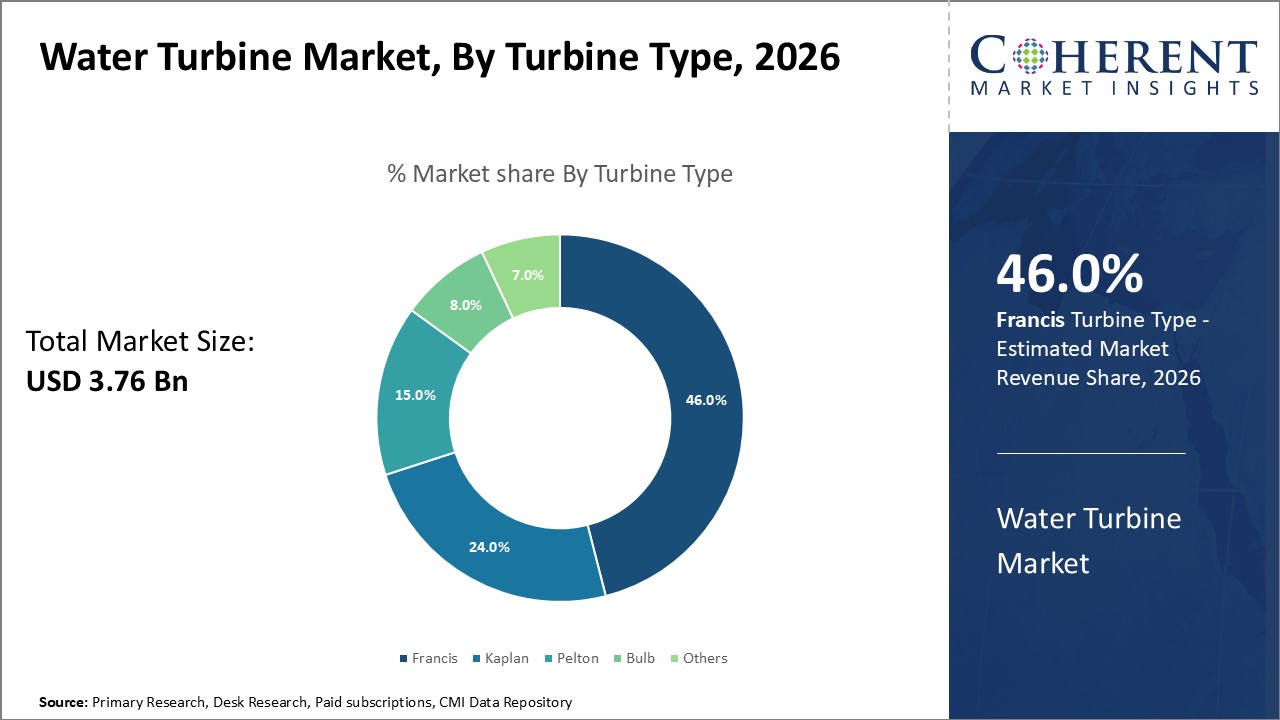
The Francis turbine sub segment holds a dominant position accounting for roughly 46% market share due to its versatility and high efficiency in medium to large hydropower plants.
Meanwhile, Kaplan turbines are gaining rapid traction in low-head hydropower Capacitys owing to their adjustable blade design enhancing energy capture. In terms of Capacity, hydroelectric power plants remain the predominant market segment driven by large-scale infrastructural expansion.
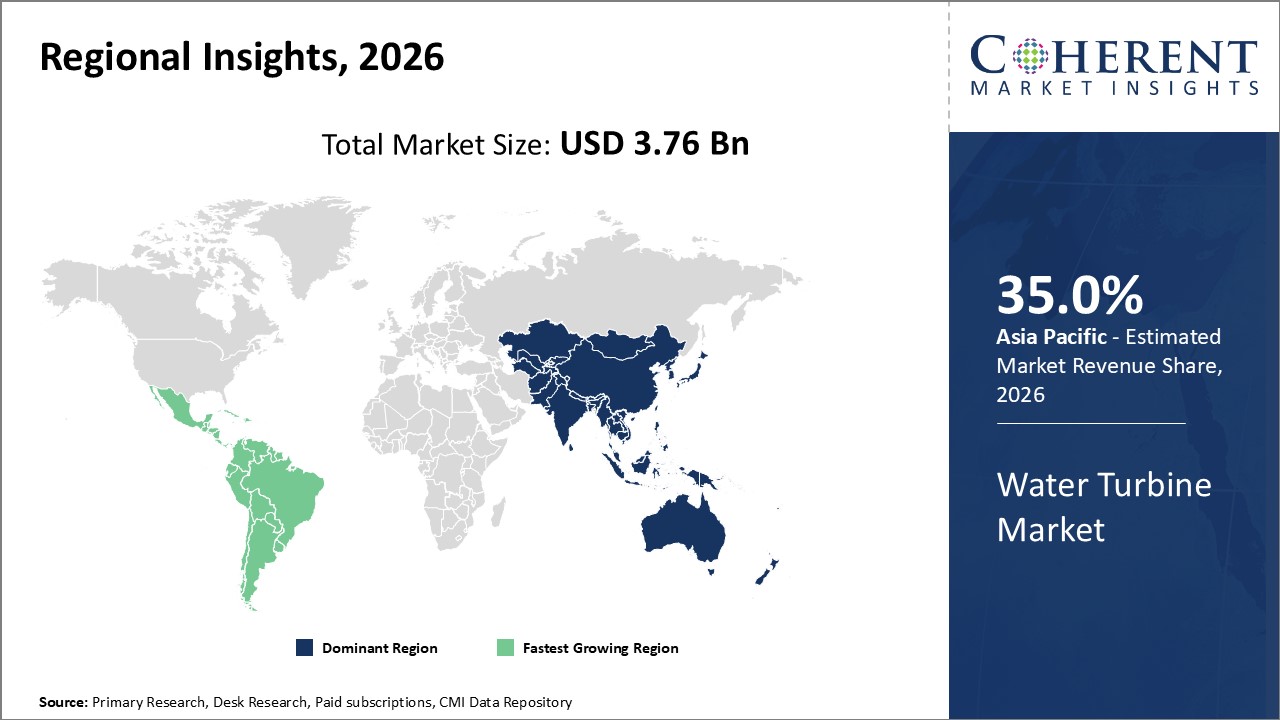
Regionally, Asia Pacific commands a significant industry share, driven by rising energy demand, abundant hydropower resources, and strong government support for renewable energy projects.
Latin America region is expected to be the fastest region driven by increasing investments in renewable energy infrastructure and the need for sustainable power generation. The region's abundant hydropower resources and government initiatives to expand clean energy capacity are key contributors to market expansion.
Water Turbine Market – Segmentation Analysis
Water Turbine Market Insights, By Turbine Type
The market is divided into several segments based on the kind of turbine: Francis, Kaplan, Pelton, Bulb, and Others. Of these, Francis holds a dominant market share of about 46%. Francis turbines' strong structural design and high efficiencies typically above 90% make them the preferred choice for medium- to high-head hydroelectric projects because of their versatility.
Water Turbine Market Insights, By Application
The application segment includes Hydroelectric Power Plants, Marine, Industrial Water Systems, and Others, with Hydroelectric Power Plants overwhelmingly dominating the market revenue. This segment’s dominance is attributed to the large-scale deployment of turbines in established and emerging hydropower projects.
Water Turbine Market Insights, By Capacity
Capacity segmentation divides the market into Small (<10 MW), Medium (10-100 MW), Large (>100 MW), and Others with Large capacity turbines being the dominant force in market revenue. Large turbines are primarily installed in major hydroelectric dams providing bulk power to grids, benefiting from technological optimization and economies of scale.
Water Turbine Market Insights, By Geography
Water Turbine Market in Asia Pacific Trends
Large-scale investments in renewable infrastructure, especially in China and India, are the foundation of the water turbine market's dominance in Asia Pacific. Thanks to government subsidies, rural electrification initiatives, and export-driven turbine manufacture, the region holds a dominant market share of more than 35%. To keep up with the increasing demand, leading enterprises like Dongfang Electric and Harbin Electric have greatly increased their production facilities in the region.
Water Turbine Market in Latin America Analysis and Trends
Latin America exhibits the fastest growth with a CAGR exceeding 9%, driven by large hydro projects in Brazil and Argentina and modernization initiatives targeting old dams. Government commitments to reducing fossil fuel dependency and attractive financing schemes have catalysed turbine market expansion.
Water Turbine Market Outlook for Key Countries
Market Analysis and Trends for Water Turbine in the United States
Federal initiatives supporting the transition to renewable energy sources and the expansion of hydroelectric capacity are driving the water turbine market in the United States. Hydropower accounted for more than 40% of the nation's renewable energy production in 2025, and investments in turbine retrofits rose by 12%.
Market Analysis and Trends for Water Turbine in the Brazil
Brazil’s market benefits from its abundant river systems and established hydroelectric infrastructure, contributing approximately 60% of national energy generation from hydropower. The country saw a 15% increase in turbine installations in 2025, supported by government incentives for expanding capacity in remote regions.
Analyst Opinion
The surge in global hydropower capacity additions is a critical demand-side indicator fueling the water turbine market size. In 2025, approximately 35 GW of new hydroelectric capacity became operational worldwide, primarily driven by significant projects in China and Brazil, reflecting an increase of 13% year-over-year. This expansion strongly correlates with elevated demand for advanced turbine technologies that improve efficiency and minimize environmental impact.
On the supply side, innovations in turbine manufacturing, notably the adoption of composite materials and modular designs, have cut production lead times by nearly 18% in recent years. For instance, a leading turbine manufacturer in Europe reported a 10% reduction in production costs in 2026 compared to 2023, directly enhancing market revenue by optimizing supply chain efficiencies and meeting market growth requirements.
Micro-hydropower projects are emerging as pivotal micro-indicators contributing to niche but fast-growing turbine segments. In India, micro-hydro installations expanded by over 26% in 2025, mainly in rural electrification schemes. Such projects are catalyzing market share growth for small-capacity turbines, spearheading decentralized business growth that complements large-scale expansion.
Export dynamics present a substantial market driver, with Asia Pacific countries like China and India increasing turbine exports by 20% in 2026. This export increment is supported by improved trade relations and reduced tariffs under regional agreements, aiding companies in expanding their footprint and revenue in emerging economies.
- Current Industry Events of 2026
- Market Size Estimation
- Regional Breakdown
- Competitive Landscape
- Customer Intelligence
- Segmental Analysis
- Pricing Analysis
- Key Market Drivers, Challenges & Future Trends
- Customized Insights Section
Market Scope
| Report Coverage | Details | ||
|---|---|---|---|
| Base Year: | 2025 | Market Size in 2026: | USD 3.76 billion |
| Historical Data for: | 2020 To 2024 | Forecast Period: | 2026 To 2033 |
| Forecast Period 2026 to 2033 CAGR: | 7.4% | 2033 Value Projection: | USD 6.20 billion |
| Geographies covered: |
| ||
| Segments covered: |
| ||
| Companies covered: | Voith Hydro, Andritz Hydro, GE Renewable Energy, Siemens Energy, Mitsubishi Power, Toshiba Energy Systems & Solutions, Bharat Heavy Electricals Limited (BHEL), Harbin Electric Corporation, Dongfang Electric Corporation | ||
| Growth Drivers: |
| ||
Growth factors
Stringent environmental regulations mandating increased reliance on renewable energy sources have propelled hydropower infrastructure investments globally, leading to increased demand for efficient turbines. For example, the U.S. government’s hydropower incentives in 2025 resulted in a 11% rise in turbine installations.
Technological advancements, such as variable speed turbines and digital twin technology for predictive maintenance, have significantly reduced operational downtime. In 2026, turbine providers reported up to 21% efficiency improvements compared to previous models.
Expanding government funding in developing regions, specifically Latin America and Asia Pacific, has accelerated hydropower plant constructions, accounting for approximately 30% of new turbine demand in 2025.
Rising electrification in rural and remote areas through small and micro-hydro projects is fueling demand for compact turbines, with India and Southeast Asia recording a 26% annual growth in small turbine installations.
Water Turbine Market Development
In May 2026, China announced to install one of the strongest impulse turbines ever constructed in the Tibet Autonomous Region's Datang Zala Hydropower Station. Using only Chinese technology, the turbine has a 500 megawatt single unit capacity, which is a record.
- In October 2025, The 42-month SHERPA project, which was sponsored by the European Commission under the Horizon Europe Program, has formally begun. Its goal is to improve the performance, environmental effect, and operating range of hydropower facilities. One of the main technological advances of the project is the use of adaptive rotational speed techniques, which modify turbine speed in response to water flow.
Market Trends
The Water Turbine Market is currently transitioning toward integration with digital technologies, such as IoT-enabled performance monitoring and AI-driven predictive analytics, propelling operational efficiencies and cost reductions. The emergence of eco-friendly turbine designs, emphasizing fish-friendly features and reduced ecological footprint, has gained momentum in 2025.
Simultaneously, there is a marked shift toward modular and scalable turbine solutions tailored for off-grid and micro-hydropower applications, addressing decentralized energy needs. For example, several projects in Scandinavia incorporated eco-design turbines in 2026, demonstrating reduced environmental disruption and achieving regulatory approvals faster, fueling business growth in these niche segments.
Key Players
Voith Hydro
Andritz Hydro
GE Renewable Energy
Siemens Energy
Mitsubishi Power
Alstom Hydro (a GE company)
Bharat Heavy Electricals Limited (BHEL)
Harbin Electric Corporation
Dongfang Electric Corporation
A number of prominent businesses have implemented technology licensing agreements and strategic partnerships to increase their market share and earnings. As an example, Siemens Energy's 2025 collaboration with up-and-coming Asian producers increased knowledge transfer effectiveness by 16%, increasing their market share in Asia Pacific. In a similar vein, Voith Hydro's investment in research and development for large-capacity turbines improved their competitive advantage by lowering output losses by as much as 7%, which resulted in higher returns in international competitive tendering for hydropower projects.
Outlook for the Water Turbine Market in the Future
The demand for water turbines has a bright future thanks to growing investments in renewable energy and international initiatives to cut carbon emissions. The market is anticipated to shift towards smart hydro systems that include grid-responsive technologies, IoT sensors, and sophisticated flow modeling. Off-grid electricity, environmentally beneficial turbine designs including fish-friendly and low-head systems, and government regulations encouraging small-scale hydro projects will all contribute to the market's rapid growth.
Technological advancements in turbine blade efficiency and digital monitoring are enhancing power generation capabilities while addressing environmental concerns. The integration of water turbines into decentralized and hybrid renewable energy systems is poised to redefine their role in future energy landscapes, focusing on sustainability and energy reliability. Overall, the market is evolving with an increase in modular and digitally optimized water turbine solutions targeting both urban and rural electrification, particularly in developing regions.
Historical Analysis
In June 2017, General Renewable Energy (General Electric) partnered with Cube Hydro to provide three aerating turbines to Cube Hydro Partners for their High Rock plant in North Carolina. This was expected to be operational from spring 2019. This partnership was signed to increase the company’s presence in the U.S.
In August 2018, Gilbert Gilkes & Gordon Ltd’s four Francis turbines were installed in the Ghuilbinn Hydro Power Station, located in the Corrour Estate (East Lochaber with the Scottish Highlands). Each of these turbines had a capacity of 666kW and produced more electrical output than all other three schemes combined. This installation helped the company in gaining a prominent position in the European water turbine market.
In February 2018, Innergex acquired Alterra Power for US$ 1.1 billion. This was one of Innergex’s largest acquisitions which increased the company’s total capacity to 1,609 MW, and further helped the company in accelerating its growth.
Sources
Primary Research interviews:
Government energy departments and regulators
Environmental consultants specializing in hydropower
Hydropower plant engineers and operators
Databases:
United Nations Comtrade Database
US Energy Information Administration (EIA)
International Renewable Energy Agency (IRENA) Statistics
Magazines:
Renewable Energy World
Power Engineering International
Water & Wastewater International
Journals:
Journal of Hydraulic Engineering
International Journal on Hydropower & Dams
Energy Policy
Newspapers:
The Hindu Business Line (Power & Energy)
Financial Times (Energy)
The Wall Street Journal (Energy section)
Associations:
International Water Association (IWA)
American Society of Civil Engineers (ASCE) – Hydropower Division
International Energy Agency – Hydro TCP
Get access to 250+ pages report
Every segment, forecast, competitor profile and data table behind the analysis above — available for instant download.
- ESOMAR Member
- ISO 9001:2015 Certified
- D-U-N-S Registered
- GDPR & CCPA Compliant
Missing comfort of reading report in your local language? Find your preferred language:
Transform your Strategy with Exclusive Trending Reports
Frequently Asked Questions
Dominance lies with companies like Voith Hydro, Andritz Hydro, GE Renewable Energy, and Siemens Energy, which lead through continuous innovation, strategic partnerships, and extensive project portfolios globally.
The Water Turbine market size is projected to reach USD 6.20 billion by 2033, propelled by increasing hydropower capacity installations and technological advancements enhancing market revenue.
Hydroelectric power plants represent the largest growth opportunity, driven by ongoing renewable energy mandates and modernization of existing infrastructure.
Market trends will increasingly focus on digital integration, eco-friendly turbine designs, and a pivot towards distributed micro-hydropower systems, enhancing operational performance and environmental sustainability.
Competition is intense with emphasis on innovation, cost efficiency, and strategic alliances. Challenges include regulatory compliance complexities and sensitivity to environmental impact assessments.
Strategies include technology licensing, joint ventures, expanding aftersales service networks, and focusing on emerging markets with tailored solutions for small and micro-hydro applications.