

Global Coking Coal Market Size and Forecast – 2026 To 2033
The global Coking Coal Market is estimated to be valued at USD 114.82 Bn in 2026 and is expected to reach USD 141.79 Bn by 2033, growing at a compound annual growth rate (CAGR) of 3.1% from 2026 to 2033. Market growth is driven by continued investment in mining productivity, coal processing and transportation infrastructure, and the ongoing metallurgical coal requirements of integrated steel manufacturers, particularly in emerging economies. Moreover, improvements in cross-border logistics are enabling long-term procurement contracts and better access to international coal supplies.
In June 2025, Mongolia's Railway Authority announced the commencement of construction of the Gashuunsukhait – Gantsmod cross-border railroad between Mongolia and China. The project involves large additional coal shipments and is intended to improve export connectivity and provide a more efficient supply of raw materials for Chinese steelmakers. The move highlights the strategic importance of logistics infrastructure in enhancing the global coking coal supply chain.
Key takeaways of the Global Coking Coal Market
- Hard Coking Coal is projected to expand at a CAGR of 3.2% between 2026-2033 and represented a market share of 57.8% in the global coking coal market in 2026. The good caking properties are conducive to the production of good durability blast-furnace coke and the uniform quality of such coke is of considerable commercial value to steelmakers. In March 2025, Whitehaven completed the Blackwater mine joint venture with Nippon Steel and JFE Steel, securing long-term access to metallurgical coal.
- Underground Mining segment is anticipated to expand at a CAGR of 3.4% till 2033, and it accounted for 60.5% of the global coking coal market in 2026. It has a niche where surface mining is not practical. Access to deeper seams of coal and selective mining. Warrior Met Coal said its Blue Creek underground longwall operation had ramped up after an early start in February 2026, increasing production scale and cost efficiency.
- Steelmaking is expected to grow at a CAGR of 3.1% during the forecast period and constitute 92.7% of the coking coal consumption in 2026. Metallurgical coke supplies the chemical reduction capacity and physical support required in traditional blast furnaces. The ongoing demand for coke-making feedstock in integrated steel production was highlighted by Tata Steel's commissioning of its Kalinganagar blast furnace in September 2024.
- Asia Pacific is forecast to grow at a CAGR of 2.9% through 2033 and will hold 75.5% of the global coking coal market revenue in 2026. The region is the focus of demand for metallurgical coal because China, India and other industrial economies have extensive blast furnace operations. In August 2025, India’s Ministry of Coal announced progress in Mission Coking Coal including domestic production improvements and washery initiatives to improve supply security for the steel sector.
- Europe is assigned the fastest indicative CAGR of 4.2% through 2033, from a 9.2% share of the global coking coal market in 2026. A possible revival in domestic steel production could underpin coal buying at operating blast furnaces, although conversion to electric-arc furnace still limits the extent of the change. In March 2025 the European Commission announced new safeguards on steel imports to assist domestic producers rebuild their production.
Segmental Insights
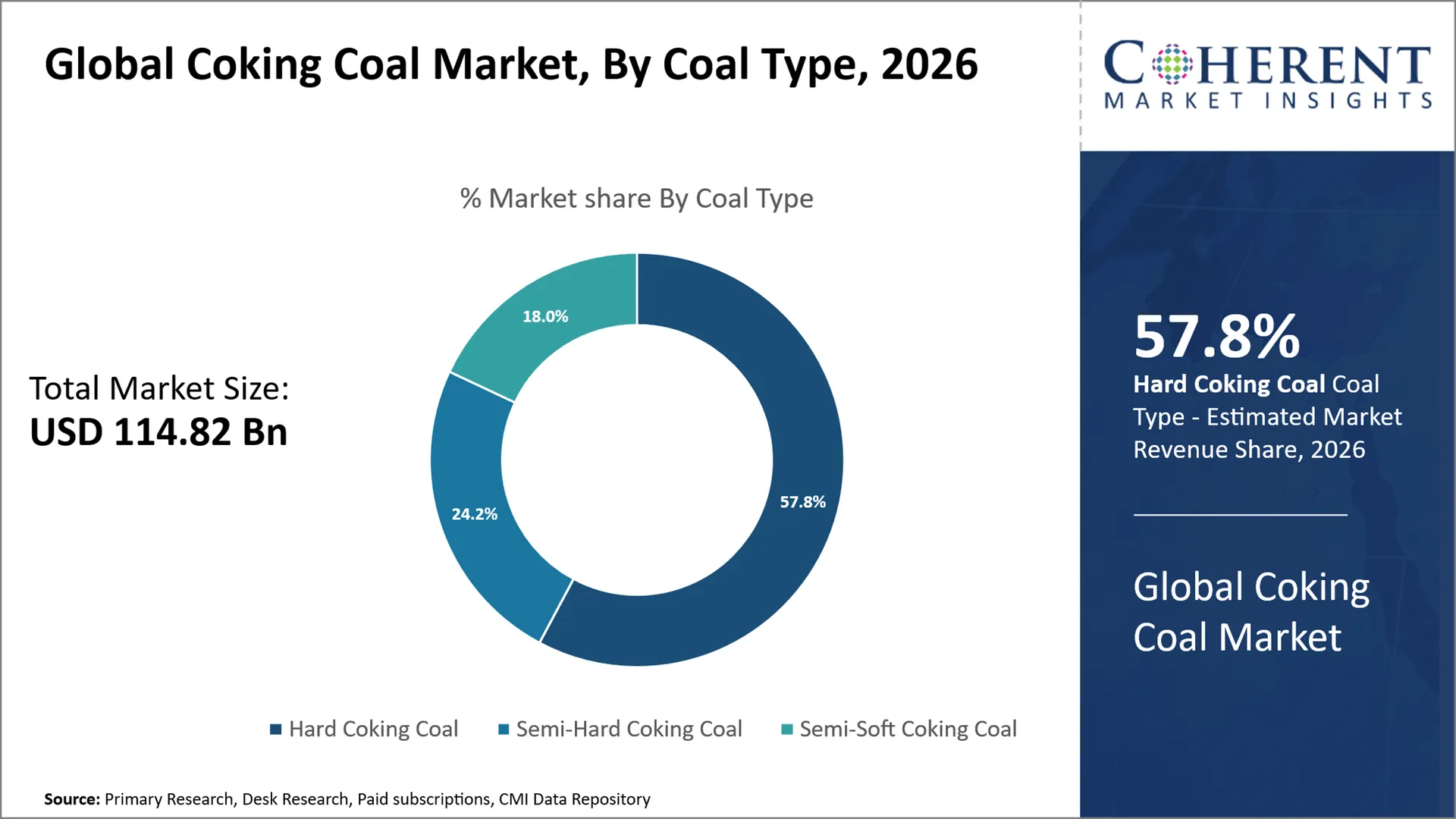
Why Does Hard Coking Coal Dominate the Global Coking Coal Market?
Hard Coking Coal is expected to make up 57.8% of the global coking coal market in 2026, emphasizing its critical role in the economics of metallurgical coal blending. Cokemakers produce blends from premium grades to meet the coke requirements of a given furnace, but which also contain less expensive coal components. This flexibility is important for integrated steelmakers who want to control their raw material costs without constantly changing their coke-oven charge. The commercial importance of coal preparation, assay accuracy and benchmark-linked contracts is even more acute due to the paucity of deposits that consistently produce high-grade coal on the supply side. In August 2025, BHP disclosed that approximately 90% of BMA's products were priced against premium low-volatility hard coking coal indices. The disclosure highlights the impact of grade-based pricing on supplier margins and buyer negotiations, cementing the category’s leadership position.
- Current Industry Events of 2026
- Market Size Estimation
- Regional Breakdown
- Competitive Landscape
- Customer Intelligence
- Segmental Analysis
- Pricing Analysis
- Key Market Drivers, Challenges & Future Trends
- Customized Insights Section
Why Does Underground Mining Represent the Largest Mining Method in the Global Coking Coal Market?
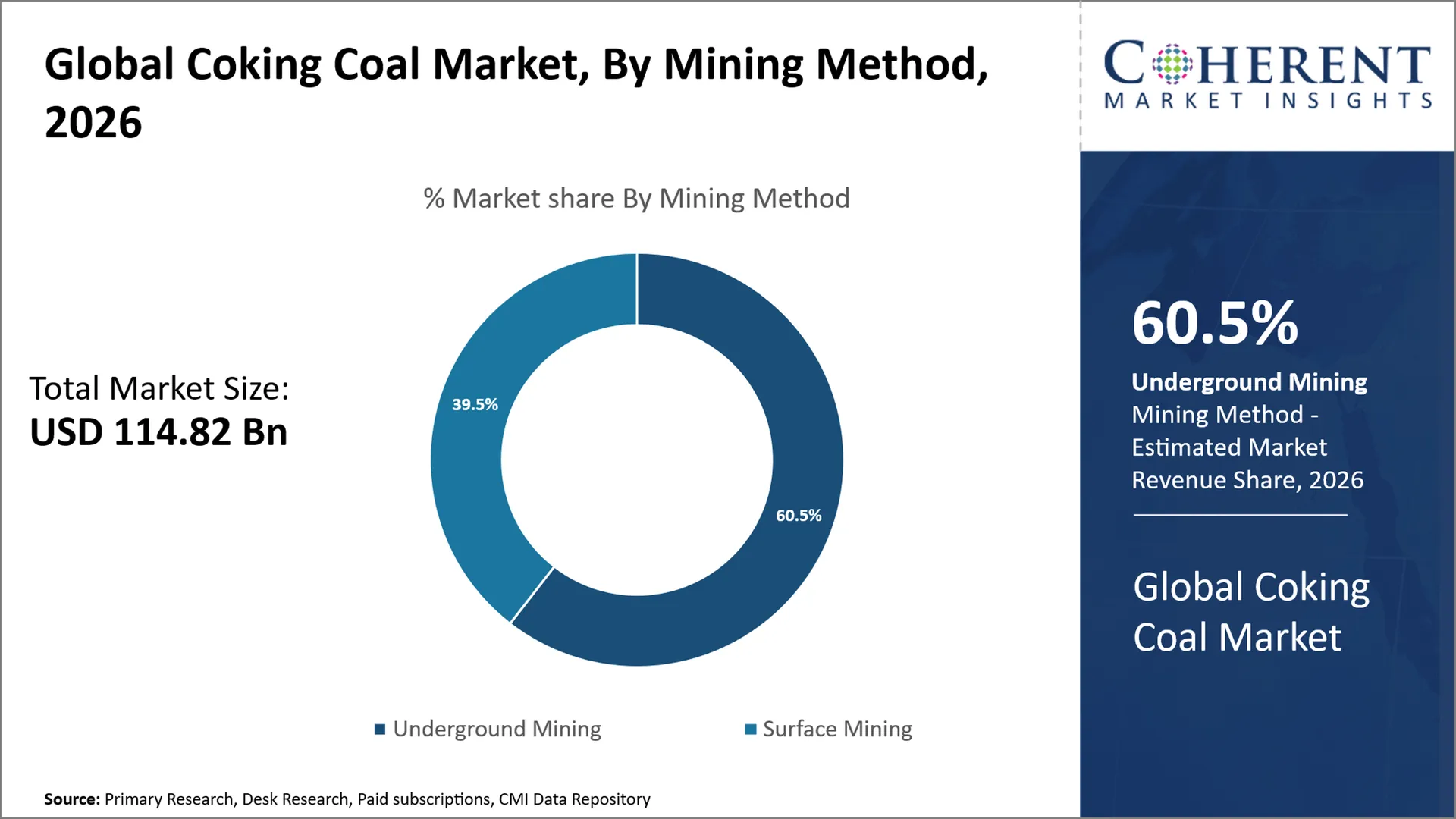
Underground Mining is likely to account for 60.5% of the global coking coal market share in 2026 owing to its ability to recover large seam panels without the need to extend open-cut pits. Modern longwall systems allow continuous extraction once ventilation, roof support and conveying infrastructure are in place. There are large upfront capital requirements and geotechnical risks, however Mining contractors, equipment suppliers and metallurgical coal producers benefit from the ability to develop production underneath existing land uses. Underground operators also require reliable gas management and panel sequencing to avoid interruptions that could impact contracted deliveries. In April 2026, Malabar Resources completed the first full coal shears from its longwall machine at the Maxwell Underground Mine in New South Wales. The achievement of this milestone is a reflection of the investment in mechanized extraction to optimize metallurgical coal production from existing resource areas.
Why Does Steelmaking Dominate the Application Segment of the Global Coking Coal Market?
Steelmaking is expected to account for 92.7% of the global coking coal market in 2026. Integrated steelworks are constructed for continuous ironmaking and have dedicated coke ovens, blast furnaces, and material-handling systems. The demand for industrial fuels on a spot basis is not their basis for coal needs. Their basis for coal needs is their operating schedules, coke inventories and planned furnace maintenance. The infrastructure makes coking coal procurement a production-continuity decision, as supply disruptions can affect multiple interdependent processing steps. As a consequence, steelmakers focus on planning inventories and securing stable delivery windows in the coke-to-hot-metal production chain. In December 2025, ArcelorMittal resumed steelmaking and blast furnace No. 2 at its Fos-sur-Mer, France, site after a fire earlier in the plant. The coking plant kept running during the outage. The restart reflects the interdependent operating needs supporting steelmaking's dominant share of coking coal consumption.
Current Events and their Impact
Current Event | Description and Its Impact |
November 2025 – United States Designates Metallurgical Coal as a Critical Mineral |
|
July 2024 – Australia Revises Coal Mine Methane Emissions Reporting Requirements |
|
Global Coking Coal Market Dynamics
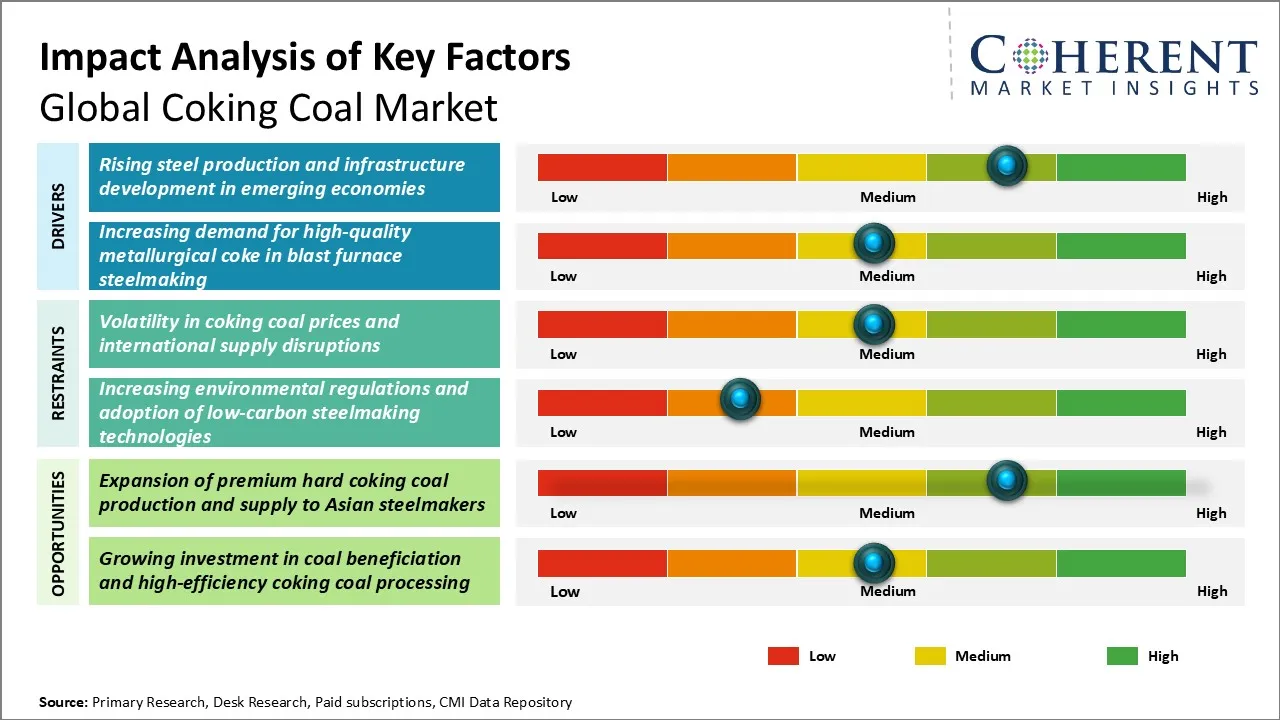
Key Market Drivers
- Rising steel production and infrastructure development in emerging economies: New rail, housing and industrial capacity in developing economies increases requirements for structural and flat steel, but its effect on coking coal depends on the production route. Where steelmakers add blast furnace–basic oxygen furnace capacity, each incremental hot-metal tonne requires coke-making coal within a carefully managed burden. This supports mine operators, washeries and bulk logistics providers, especially those offering dependable cargo schedules. In October 2024, JSW Steel confirmed the commissioning of the blast furnace at its 5 MTPA JVML-Vijayanagar expansion, illustrating how new ironmaking assets establish continuing metallurgical-coal procurement needs.
- Increasing demand for high-quality metallurgical coke in blast furnace steelmaking: Coke performance is gaining more importance in the commercial differentiation of coking coal grades than simply coal tonnage. Steelmakers want coke that is more durable, lower in ash and controlled in sulfur content to maintain furnace permeability, limit slag formation and reduce corrective burden additions. This means that coal suppliers who can identify reliable caking qualities and market optimum blending can build more sustainable customer relationships. ACRE announced the first coke production from Guizhou Meijin’s new coke oven battery in China in May 2024, the project was designed for the production of high-quality metallurgical coke. This creates a direct link between investment and the choice of coke specifications and feedstock.
Emerging Market Trends
- Expansion of Rail-Connected Supply Corridors Is Reshaping Coking Coal Trade Economics: Rail-connected coking coal trade is starting to challenge the assumption that seaborne cargoes define every importer's practical supply set. Border terminals, inland rail capacity and customs processing can determine whether a mine reaches a steelwork competitively. Buyers may increasingly compare landed coal costs across both shipping routes and overland corridors, including handling losses and transit reliability. This change could reward inland producers and logistics investors while exposing ports and seaborne-only suppliers to route-specific competition. During the forecast period, infrastructure access may become a stronger commercial differentiator than distance alone.
- Adaptive Coal-Blending Strategies Are Changing Metallurgical Coal Procurement: Coke making procurement is moving toward more adaptive coal-blend design, with feedstock selection tied to coke strength, ash chemistry and coal plasticity. Instead of specifying a single preferred grade, sophisticated buyers can qualify compatible combinations and adjust their purchases as prices and supplies change. Digital modelling and laboratory testing can expand the usable supplier pool, but inconsistent assay data may exclude smaller miners. Over time, value should migrate toward suppliers that provide dependable quality certificates, sampling protocols and predictable washing outcomes, rather than those competing solely on nominal calorific value.
Regional Insights
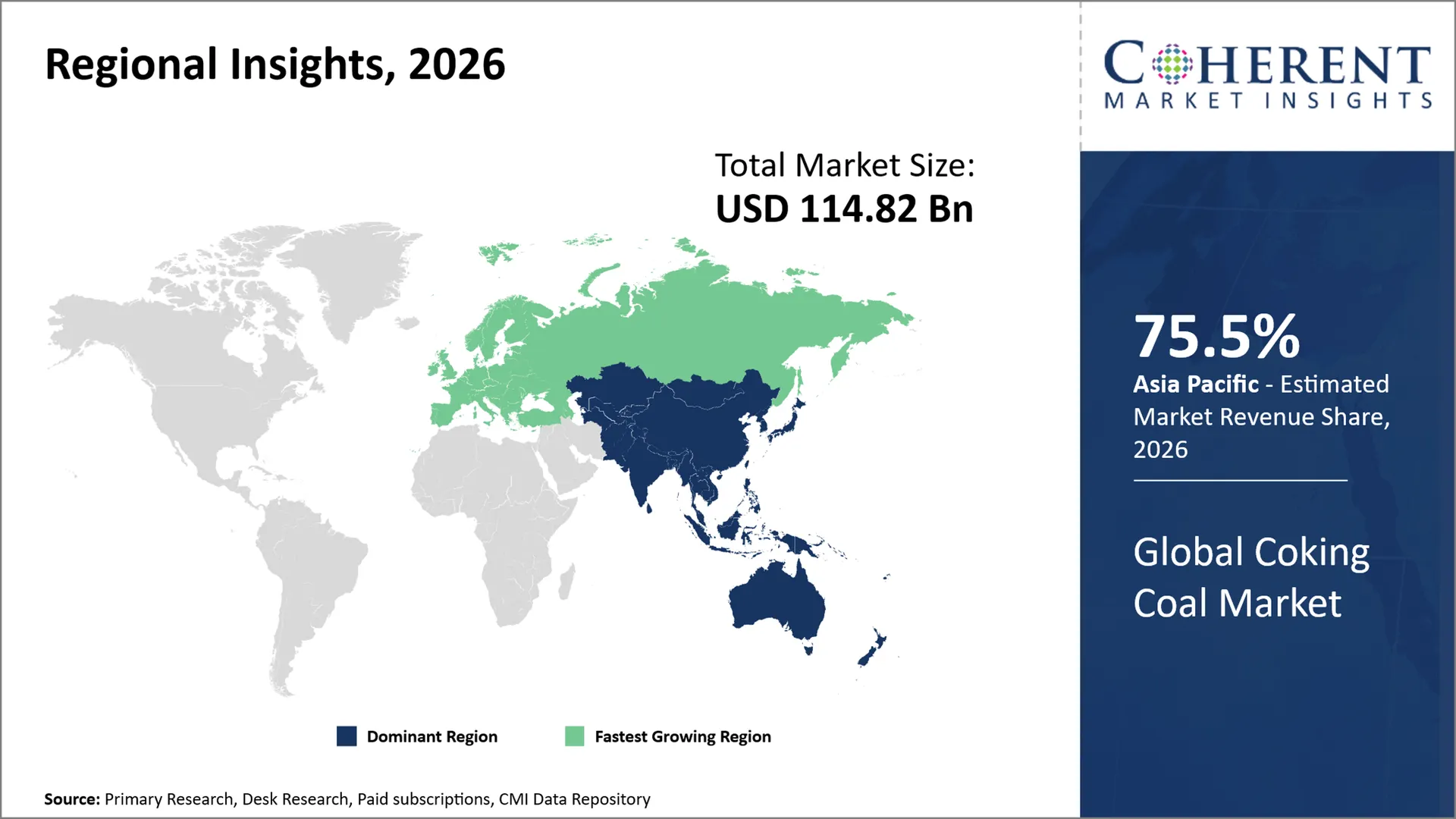
Why Does Asia Pacific Dominate the Global Coking Coal Market?
Asia Pacific is expected to command 75.5% of the global coking coal market in 2026 because the region combines extensive blast-furnace ironmaking with established cross-border metallurgical-coal trade. China, India, Japan and South Korea have developed a large and technologically diverse customer base as steelworks require different blends of coal rather than one uniform market. These buyers have links to premium and complementary grades via Australian export terminals and regional shipping routes. Suppliers are offered recurring industrial contracts by the concentration but import volumes can vary quickly with steel output and stock changes. In January 2026, the World Steel Association reported that Asia and Oceania produced 1,324.5 million tonnes of crude steel in 2025, illustrating the size of the region's downstream industrial base. The production figure measures steel, not coking coal consumption.
Why Is Europe Emerging as the Fastest-Growing Region in the Global Coking Coal Market?
Europe is the fastest growing regional market and is projected to account for a share of 9.2% by 2026. Its growth prospects depend on the maintenance or restoration of conventional ironmaking capacity, not on the implementation of many new coal-intensive steel projects. Steelworks still equipped with blast furnaces have to face emission costs, volatile energy prices and competition from electric-arc-furnace production and securing coal and coke through reliable import channels. This benefits suppliers who are capable of accommodating customers who are experiencing emergency feedstock shortages without assuming a permanent increase in coke consumption. In April 2025, the United Kingdom's Department for Business and Trade said it had settled a dispute over an incoming cargo of Australian coking-coal and secured raw materials for the blast furnaces at Scunthorpe. Instead, the intervention is evidence of the importance of supply continuity, not of consumption growth in Europe.
Global Coking Coal Market Outlook for Key Countries
Why Is China a Key Market for the Global Coking Coal Market?
China is a key market for coking coal because of its large coke-making infrastructure that helps move the country’s supply of domestic coal, imported blending materials, and blast-furnace steel production. The relationship between coke margins, furnace utilization and delivered coal quality is of particular importance in determining purchasing decisions. While steelmakers still use a lot of coal, domestic mine production and inventories can help cut import needs. Therefore, China has strong sales potential for international suppliers; but they are also very vulnerable to domestic supply and procurement cycles. In March 2026, China's National Bureau of Statistics reported coke production of 82.55 million tonnes during January and February, an increase of 1.1% from the corresponding period in 2025. The data indicates that the coke sector remains active, despite lower pig iron production, which highlights the significance of tracking actual furnace demand.
Why Is India Important in the Global Coking Coal Market?
India’s steel sector is ramping up output from large integrated plants, providing a structurally important source of incremental demand for coking coal. Imported coals are commercially important in conjunction with beneficiation efforts because domestic metallurgical coal reserves do not consistently provide the low-ash material needed for all coke blends. Hence, steel producers consider inland freight, port handling and coal chemistry costs when negotiating supply contracts. Suppliers who can provide predictable arrival schedules and flexible grades can relieve working capital pressure from excessive inventories and promote capacity utilization. In July 2026, India’s Ministry of Steel said that hot-metal production and finished-steel consumption rose 1.4% and 8.3% respectively during April-June 2026 compared with the year-ago period. These developments are indicative of downstream buy-side momentum and activity in ironmaking.
Why Is Australia a Strategic Country in the Global Coking Coal Market?
Australian export-oriented mines are a significant supply-side factor in the international coking coal market, supplying coking coal to steelworks that are unable to source suitable metallurgical grades locally. The ability of producers to capitalize on favorable pricing windows is dependent on the reliability of shipments, and Queensland’s coalfields, well-established rail systems and bulk export ports facilitate large cargo movements. Cost management and mine planning are also crucial because of the revenue exposure to international steel cycles. The Australian Bureau of Statistics said in August 2026 export volumes of hard coking coal in June were up 6.9% on a year earlier, but semi-soft coal volumes were down. This divergence highlights the commercial importance of grade-specific export performance. Australian producers able to maintain consistent specifications and logistics access remain well placed to supply high-value steelmaking blends.
Why Is Colombia an Important Supplier in the Global Coking Coal Market?
Colombia is relevant to the global coking coal market as a specialist source of metallurgical coal and coke, distinct from its much larger thermal-coal business. Producers in established coal districts can target overseas coke makers and industrial buyers that value compatible blending properties and shorter Atlantic trade routes. However, smaller mine sizes, fragmented processing capacity, and inland transport expenses can restrict participation in long-term contracts. In April 2025, Colombia's National Mining Agency convened a metallurgical coal and coke value-chain initiative to examine production requirements, steel-sector demand, and opportunities to strengthen domestic industrial linkages. That initiative highlights an opportunity for producers to coordinate coal preparation, customer qualification, and infrastructure access. Future competitiveness will rest on dependable product quality and efficient export logistics.
Mining and Coking Coal Processing Technology Landscape
The global coking coal market increasingly depends on technologies that improve recoverable coal quality, operational safety, mining productivity and environmental performance. Technology adoption varies according to seam conditions, coal characteristics, mine economics and the availability of processing infrastructure.
Technology | Application in Coking Coal Market | Adoption Landscape | Commercial Impact |
Automated Longwall Mining Systems | Remote-controlled shearers, powered roof supports and automated face alignment for underground extraction | Established at advanced underground operations; adoption depends on geological suitability | Enhances extraction consistency, decreases worker exposure at the mine face and facilitates the productive exploitation of deep coal reserves |
Dense-Medium Cyclones for Coal Beneficiation | Density-based circuits for separation of mineral impurities in the washing of raw coking coal | Established technology in commercial coal preparation plants for the metallurgical industry | Controls ash content and improves concentrate quality, but recovery yields are dependent on feedstock characteristics and separation efficiency |
Online Coal Quality Analysis System | Conveyor-mounted analyzers, such as prompt gamma neutron activation analysis, are used to monitor feedstock consistency and elemental composition. | Large mining and preparation facilities have selectively adopted it. | enables faster quality adjustments, reduces shipment variation and improves compliance with steelmaker purchasing specs |
Sensor Based Coal Sorting Methods | X-ray transmission and optical sensor systems separate coal-bearing material from unwanted rock before processing. | Commercial acceptance on a targeted basis, performance based on feedstock characteristics | Potential reductions in downstream processing loads and unnecessary material handling and washing costs |
Coal Mine Methane Drainage and Utilization | Pre-drainage, gas capture and beneficial use of methane associated with underground coal seams | Applied in suitable high gas mines, depending upon technical feasibility and project economics | Improves gas management, makes mining operations safer and can cut down fugitive emissions or provide usable energy |
AI for Predictive Maintenance and Equipment Monitoring | Conveyor, crusher, ventilation systems and mobile equipment develop failures that are detected by equipment sensors and analytical models | Expanding selectively across digitally equipped mining operations | Aids in reducing unplanned downtime, improves maintenance scheduling and supports more predictable operating costs |
How Can Fine-Coal Recovery and Tailings Reprocessing Create New Growth Opportunities in the Global Coking Coal Market?
Recovery of usable coking coal from legacy fine-coal streams offers a commercial route that does not depend on opening another large mine. Fine particles lost during washing or held in tailings facilities can sometimes be upgraded through selective flotation, dewatering and controlled blending.
The opportunity is especially relevant to established coal preparation complexes and merchant coke producers seeking additional feedstock flexibility. However, recovered material must undergo caking, ash, sulfur and oxidation tests before it can qualify for steelmaking blends; technical recovery does not automatically imply saleable metallurgical quality.
Suppliers could capture value by establishing fine-coal circuits, certified sampling procedures and predictable concentrate specifications. Participation requires site-specific mineral characterization, water management, tailings permissions and offtake trials with coke makers. Preparation-plant operators and specialist mineral processors are likely to have an advantage because they combine existing feedstock access with processing experience. New entrants may participate through technology services rather than mine ownership.
Market Players, Key Development, and Competitive Landscape
Key Developments
- In April 2025, Metinvest confirmed the arrival of a shipment of United States coking coal in Ukraine from its United Coal subsidiary. The commercial significance of alternative supply arrangements during severe mining disruptions was underscored by the cargo, which supported the procurement of substitute feedstock after operations at Pokrovske Coal ceased.
- In December 2024, Coronado Global Resources announced the official opening of its Mammoth Underground Mine at the Curragh complex in Queensland. The project adds access to metallurgical coal reserves through a different mining configuration, helping diversify the complex's production options and reduce exposure to weather-related interruptions.
Competitive Landscape
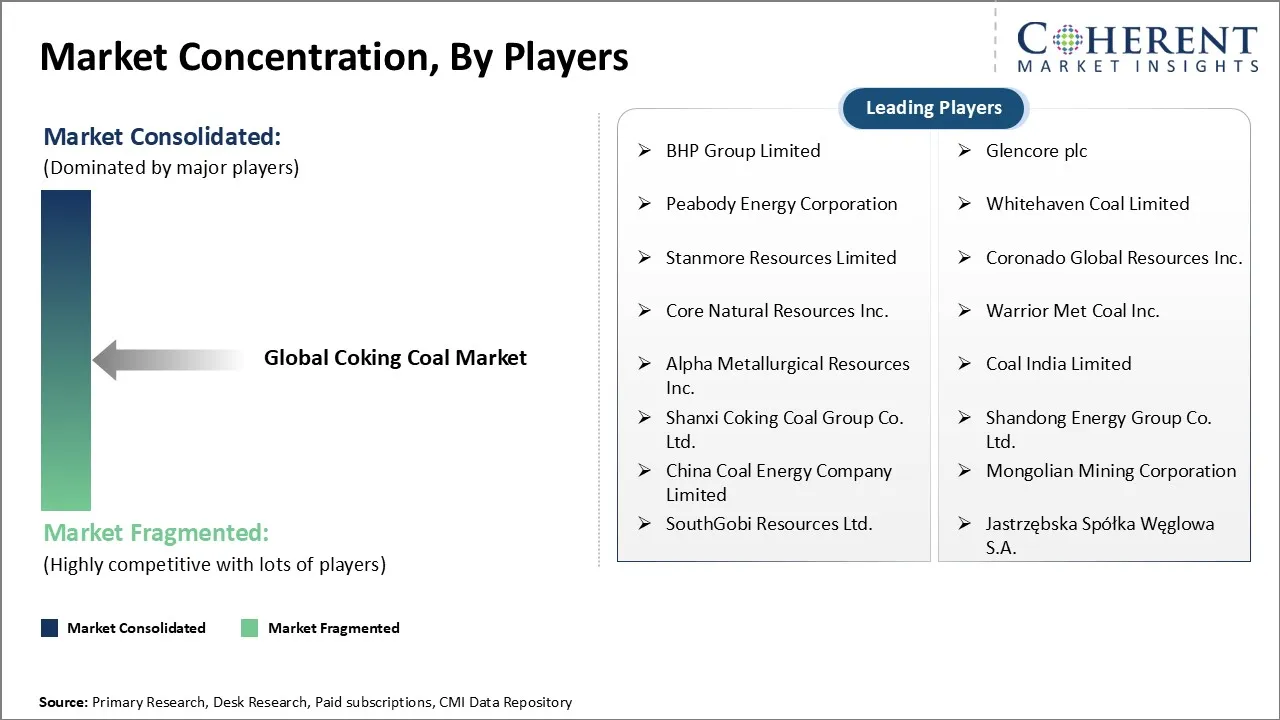
The global coking coal market is moderately consolidated in the internationally traded premium grades, while domestic mining and merchant supply remain more diverse. Major integrated miners compete with regional producers, specialist underground operators and trading houses. Contract awards depend on coal chemistry, washability, delivered cost and dependable shipment execution. Port access, mine productivity, safety compliance and relationships with coke makers shape competitive positions more than production capacity alone.
Key Competitive Focus Areas
- Resource's Coal Quality: Competitors vary in consistency of grades of recoverable product, ash, sulfur, caking characteristics and volatile matter.
- Reserve Economics: In low price environments, producers with good geology, predictable costs and manageable strip ratios are better positioned.
- Processing Infrastructure: The ownership or access to efficient coal preparation facilities impacts concentrate recovery, salable quality and operational flexibility.
- Mining Productivity: The economics of sustainable production are a function of maintenance discipline, workforce capability, geotechnical management and equipment utilization.
- Export Infrastructure Access: Rail agreements, terminal capacity and vessel-loading efficiency affect delivered competitiveness and exposure to freight-related costs.
- Environmental and Safety Compliance: Investment requirements and operational continuity are shaped by permit management, mine rehabilitation provisions, worker safety and emissions reporting.
- Customer Qualification: Successful product testing, transparent quality documentation and established steelmaker relationships strengthen supplier credibility in technically demanding markets.
Market Report Scope
Coking Coal Market Report Coverage | |||
Report Coverage | Details | ||
Base Year | 2025 | Market Size in 2026: | USD 114.82 Bn |
Historical Data For: | 2020 To 2024 | Forecast Period: | 2026 To 2033 |
Forecast Period 2026 To 2033 CAGR: | 3.1% | 2033 Value Projection: | USD 141.79 Bn |
Geographies covered: |
| ||
Segments covered: |
| ||
Companies covered: | BHP Group Limited, Glencore plc, Peabody Energy Corporation, Whitehaven Coal Limited, Stanmore Resources Limited, Coronado Global Resources Inc., Core Natural Resources Inc., Warrior Met Coal Inc., Alpha Metallurgical Resources Inc., Coal India Limited, Shanxi Coking Coal Group Co. Ltd., Shandong Energy Group Co. Ltd., China Coal Energy Company Limited, Mongolian Mining Corporation, SouthGobi Resources Ltd., Jastrzębska Spółka Węglowa S.A. | ||
Growth Drivers: |
| ||
Restraints & Challenges: |
| ||
Analyst Opinion (Expert Opinion)
- Coking coal leadership is likely to be decided increasingly by capital discipline rather than headline reserve ownership. Producers capable of pacing investment, preserving option value in undeveloped seams and meeting rehabilitation liabilities should withstand steel-cycle downturns better than volume-maximizing rivals. Asset portfolios with flexible sequencing may ultimately command a financing advantage, even where their short-term output is less aggressive.
- Partial substitution of fossil coke through biocarbon, injected gases and alternative reductants could gradually weaken the historic link between blast-furnace throughput and coking-coal consumption. Established sellers that price future offtake solely from steel capacity may be caught by lower coke rates. Suppliers with coke-performance testing and close operational feedback from furnaces will be best placed to defend their place in evolving burdens.
- Producers should stress-test new projects against weaker prices, higher freight costs and slower coke demand before committing to fixed infrastructure. Direct investment toward reliable seam mapping, load-out flexibility and verifiable shipment quality; pilot lower-cost beneficiation options only where coke tests show value. Joint contingency plans with buyers can limit outages and disputes. Avoid expensive greenfield expansions dependent on persistent premium pricing or uncertain permits.
Speak to the analyst
Want personalized insights?
Take the findings above to one of our principal consultants, or have the report rebuilt around the segments, geographies and competitors you actually track.
Market Segmentation
- Coal Type Insights (Revenue, USD Bn, 2021 - 2033)
- Hard Coking Coal
- Semi-Hard Coking Coal
- Semi-Soft Coking Coal
- Mining Method Insights (Revenue, USD Bn, 2021 - 2033)
- Underground Mining
- Surface Mining
- Application Insights (Revenue, USD Bn, 2021 - 2033)
- Steelmaking
- Foundry and Ferroalloy Production
- Other Industrial Applications
- End User Insights (Revenue, USD Bn, 2021 - 2033)
- Integrated Steel Manufacturers
- Merchant Coke Producers
- Foundries and Other Industrial Users
- Sales Channel Insights (Revenue, USD Bn, 2021 - 2033)
- Direct Sales
- Coal Traders and Distributors
- Regional Insights (Revenue, USD Bn, 2021 - 2033)
- North America
- U.S.
- Canada
- Latin America
- Brazil
- Argentina
- Mexico
- Rest of Latin America
- Europe
- Germany
- U.K.
- Spain
- France
- Italy
- Russia
- Rest of Europe
- Asia Pacific
- China
- India
- Japan
- Australia
- South Korea
- ASEAN
- Rest of Asia Pacific
- Middle East
- GCC Countries
- Israel
- Rest of Middle East
- Africa
- South Africa
- North Africa
- Central Africa
- North America
- Key Players Insights
- BHP Group Limited
- Glencore plc
- Peabody Energy Corporation
- Whitehaven Coal Limited
- Stanmore Resources Limited
- Coronado Global Resources Inc.
- Core Natural Resources Inc.
- Warrior Met Coal Inc.
- Alpha Metallurgical Resources Inc.
- Coal India Limited
- Shanxi Coking Coal Group Co. Ltd.
- Shandong Energy Group Co. Ltd.
- China Coal Energy Company Limited
- Mongolian Mining Corporation
- SouthGobi Resources Ltd.
- Jastrzębska Spółka Węglowa S.A.
Sources
Primary Research Interviews
- Coking coal mining companies, coal producers, and mine operators
- Metallurgical coal suppliers, coal traders, and distributors
- Integrated steel manufacturers, coke producers, and mining industry experts
Stakeholders
- Hard, semi-hard, and semi-soft coking coal producers
- Underground and surface mining equipment suppliers
- Coal beneficiation companies, logistics providers, and exporters
- Steel manufacturers, merchant coke producers, and industrial end users
End-use Sectors
- Integrated steel manufacturing
- Merchant metallurgical coke production
- Foundry and ferroalloy manufacturing
- Other metallurgical and industrial applications
Regulatory and Industry Bodies
- International Energy Agency (IEA)
- U.S. Mine Safety and Health Administration (MSHA)
- Australian Department of Industry, Science and Resources
- Ministry of Coal, Government of India
- China National Bureau of Statistics
- International Organization for Standardization (ISO)
- ASTM International
Databases
- Company annual reports and investor presentations
- UN Comtrade coal import and export statistics
- International Energy Agency coal production and consumption databases
- U.S. Energy Information Administration (EIA)
- Australian Resources and Energy Quarterly
- Metallurgical coal pricing, production capacity, and trade databases
Magazines and Journals
- International Journal of Coal Geology
- Fuel
- Fuel Processing Technology
- International Journal of Mining Science and Technology
- Ironmaking & Steelmaking
- International Mining
Associations
- World Steel Association (worldsteel)
- FutureCoal – The Global Alliance for Sustainable Coal
- Minerals Council of Australia (MCA)
- National Mining Association (NMA)
- Coal Association of Canada
- Queensland Resources Council (QRC)
Public Domain Sources
- Coking coal production, consumption, and international trade statistics
- Steel production, metallurgical coke demand, and coal pricing data
- Underground and surface mining technology developments
- Coal beneficiation, transportation, and export infrastructure investments
- Mining regulations, emissions policies, and company developments
Key Standards and Regulations
- ISO 18283:2022 – Coal and coke manual sampling
- ISO 13909 Series – Coal and coke mechanical sampling
- ASTM D2639/D2639M – Coal plasticity testing using the Gieseler plastometer
- ASTM D720/D720M – Free-swelling index of coal
- U.S. 30 CFR Part 75 – Underground coal mine safety standards
- Mines and Minerals (Development and Regulation) Act, 1957 – India
- National Greenhouse and Energy Reporting Act, 2007 – Australia
Proprietary Elements
- CMI Data Analytics Tool and proprietary CMI repository covering coking coal production, metallurgical coal pricing, mine capacity, steelmaking demand, global trade flows, mining technologies, regulatory developments, and competitive intelligence.
Get access to 250+ pages report
Every segment, forecast, competitor profile and data table behind the analysis above — available for instant download.
- ESOMAR Member
- ISO 9001:2015 Certified
- D-U-N-S Registered
- GDPR & CCPA Compliant
Frequently Asked Questions
The CAGR of global coking coal market is projected to be 3.1% from 2026 to 2033.
The global coking coal market is estimated to be valued at USD 114.82 billion in 2026 and is expected to reach USD 141.79 billion by 2033.
Expansion of coal beneficiation facilities, recovery of fine coking coal, and development of efficient export infrastructure are creating growth opportunities in the global coking coal market.
Increasing adoption of advanced coal-blending technologies, automated mining systems, and sustainable mining practices are among the key trends shaping the global coking coal market.
Underground mining is expected to dominate the global coking coal market, supported by access to deep coal reserves and established mechanized extraction operations.
Steelmaking represents the largest application segment, as coking coal is essential for producing metallurgical coke used in conventional blast furnace steel production.
The global coking coal market is primarily driven by expanding steel production and infrastructure development in emerging economies, along with growing demand for high-quality metallurgical coke used in blast furnace steelmaking.