

Global Cold Storage Warehouse Market Size and Forecast – 2026 To 2033
The global cold storage warehouse market is expected to grow from USD 135.00 Bn in 2026 to USD 268.00 Bn by 2033, registering a compound annual growth rate (CAGR) of 11.8% from 2026 to 2033. The global cold storage warehouse market is driven by growing demand for frozen and processed food products. On February 4, 2025, Nortera unveiled the USD 25 million expansion of its Wright Street frozen warehouse in Strathroy, Ontario, Canada. This investment directly supports the local economy by sustaining over 270 jobs and strengthening Nortera’s partnerships with Ontario vegetable farmers.
Key Takeaways of the Global Cold Storage Warehouse Market
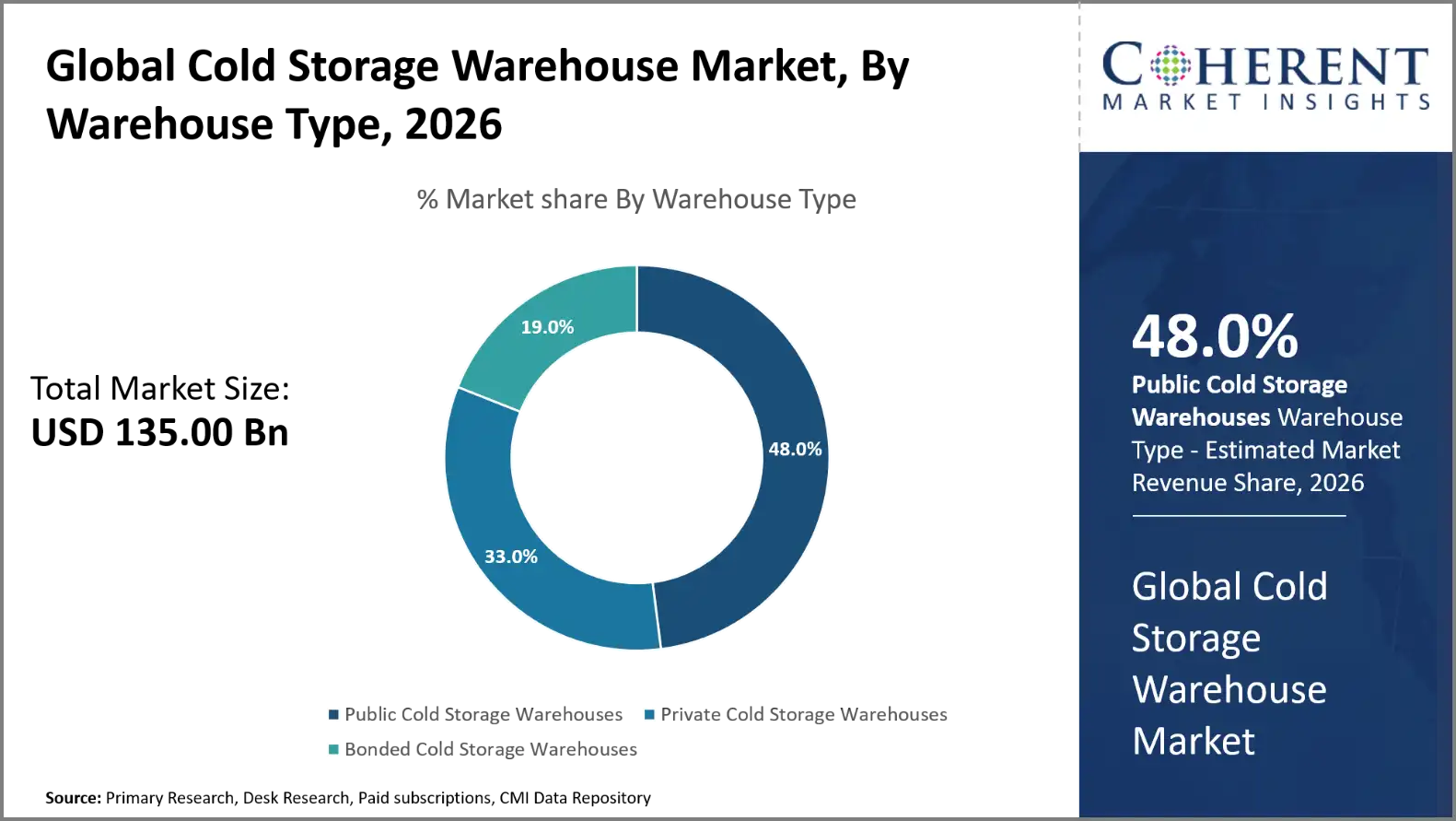
- The Public Cold Storage Warehouses segment is expected to account for 48.0% of the global cold storage warehouse market share in 2026. Increasing adoption of automated cold storage warehouses is driving the growth of the segment. On December 18, 2025, NewCold announced its Wakefield III expansion in the U.K. The development adds 19,380 automated frozen pallet positions.
- The Chilled Storage segment is estimated to capture 52.0% of the market share in 2026. Expansion of organized retail and grocery distribution networks is majorly driving the growth of the segment. On February 16, 2026, Ahold Delhaize USA broke ground on its USD 860 million Burlington distribution center. The facility will exceed one million square feet and expand fresh and frozen distribution capacity.
- The Storage Services segment is estimated to capture 43.0% of the market share in 2026. Increasing adoption of warehouse robotics and automated storage systems is driving the growth of the segment. On February 9, 2026, Corvus Robotics introduced Corvus One for Cold Chain. The autonomous inventory drones operate in freezer environments reaching minus 20°F.
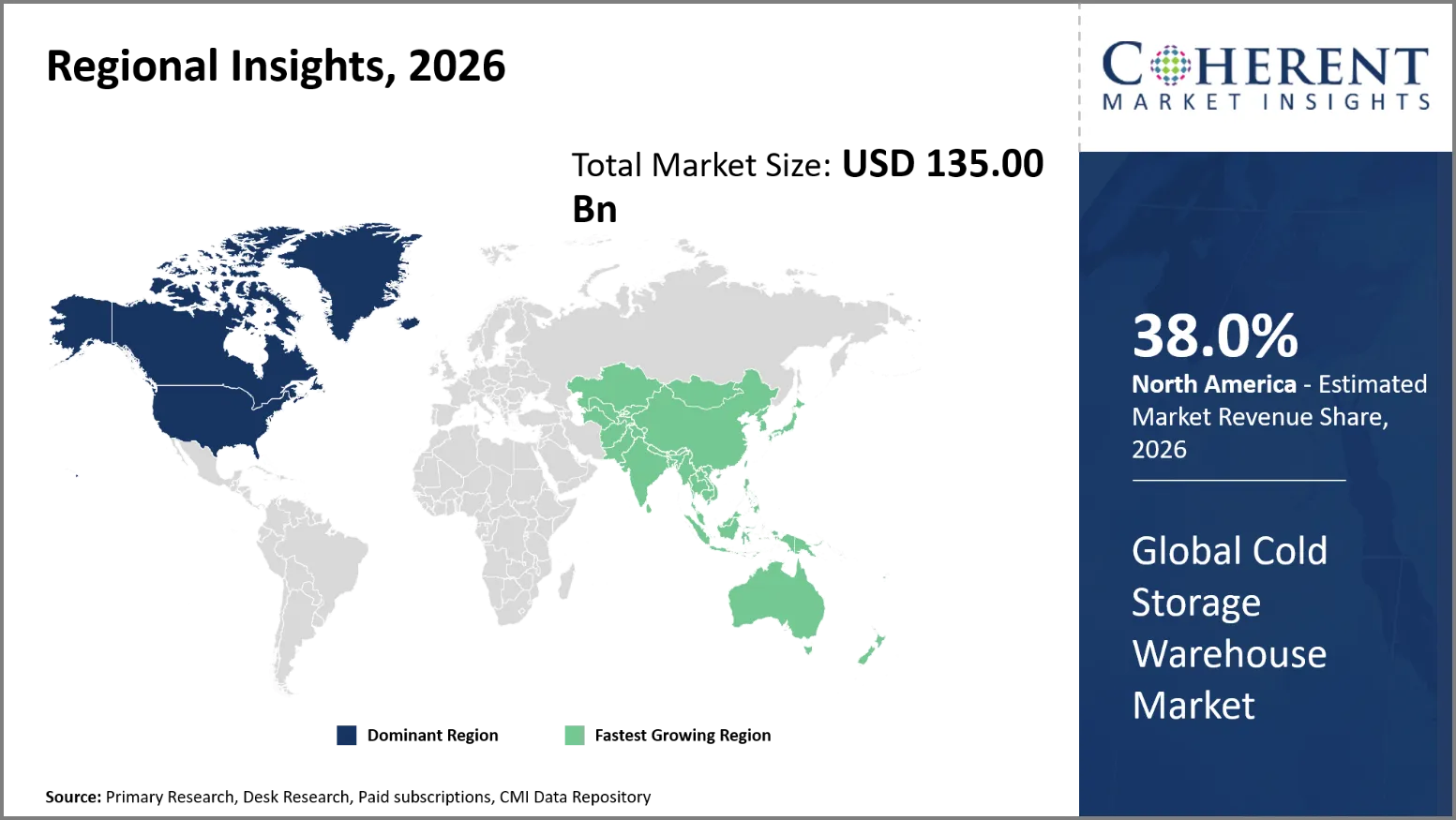
- North America is expected to dominate the cold storage warehouse market in 2026 with a market share of 38.0%. Integration of renewable energy and energy-efficient refrigeration in North America is driving the growth of the regional market. On February 5, 2026, Arctic Cold partnered with REC Solar to install a 3.3-megawatt rooftop solar system at its Santa Maria, California, U.S. facility.
- Asia Pacific is expected to account for 26.0% share in 2026. Expansion of cold chain infrastructure in Asia Pacific is driving the growth of the regional market. On March 20, 2025, Lotte Global Logistics Vietnam began constructing a USD 34 million cold chain center. The project covers 5.5 hectares within Nhon Trach 6 Industrial Park.
Segmental Insights
Why Does Public Cold Storage Warehouses Dominate the Global Cold Storage Warehouse Market?
The public cold storage warehouses segment is expected to account for 48.0% of the global cold storage warehouse market share in 2026. Public cold storage warehouses dominate because they provide flexible storage services to multiple customers. Food processors, food retailers, pharmaceutical firms and distributors all profit from integrated infrastructure. The facilities help in seasonal inventory management and eliminate the need for individual investment. Specialized refrigeration, inventory handling and transportation coordination are provided by third party providers. Public warehouses also handle shifting volumes of storage without dedicated infrastructure. They are adaptable enough to cater to enterprises with varying products and demands. The growing outsourcing of food manufacturers and merchants makes them more important.
On March 24, 2025, Americold announced construction on its USD 34 million Halwyn factory expansion in Hornby, Christchurch. This ambitious project will more than double the site’s capacity and considerably improve its ability to service the increasing demand for temperature-controlled storage solutions throughout the South Island of New Zealand.
- Current Industry Events of 2026
- Market Size Estimation
- Regional Breakdown
- Competitive Landscape
- Customer Intelligence
- Segmental Analysis
- Pricing Analysis
- Key Market Drivers, Challenges & Future Trends
- Customized Insights Section
Why is Chilled Storage the Most Preferred Temperature Type?
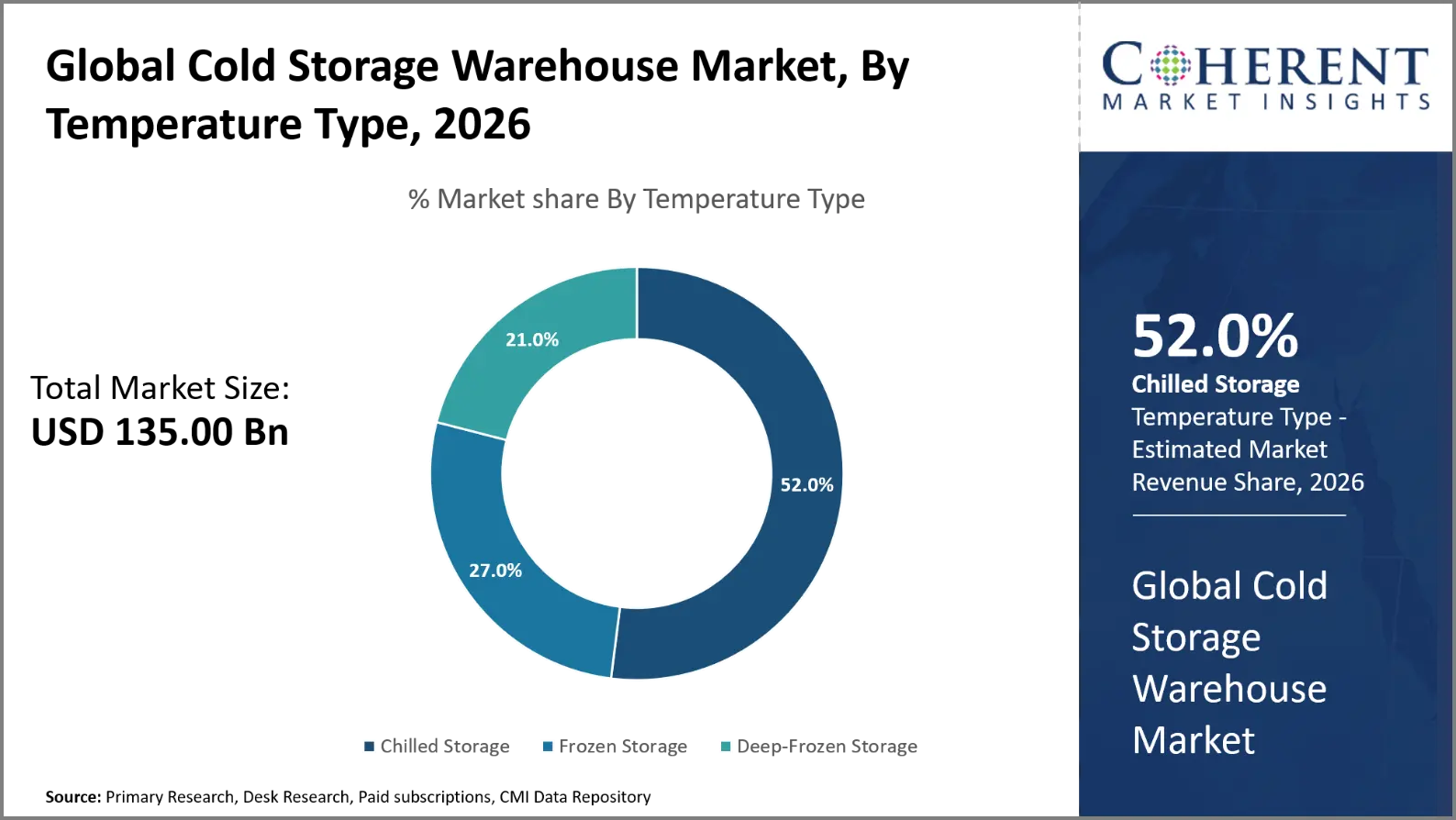
The chilled storage segment is expected to account for 52.0% of the global cold storage warehouse market share in 2026. Chilled storage is still preferable for storage since many perishable products need this. Fresh fruits, vegetables, dairy products, drinks and specified pharmaceutical goods must be kept at regular temperatures. Cold temperature maintains the quality of the goods and also avoids spoiling and increases shelf life. They also enable quick movement of inventories through food production, retail and distribution systems. It is not frozen, but is used for things that need to stay fresh but not be frozen. Rising consumption of fresh foods and growth of organized retail support demand. Chilled storage is utilized throughout a wide array of industries, ensuring effective product delivery and upholding quality within chilled supply chains.
On June 6, 2025, Woolworths Group appointed BESIX Watpac to construct its main chilled distribution center in Eastern Creek, Sydney, Australia. The project covers more than 93,000 square meters across multiple levels. It will handle over 6,000 tons of fruit, vegetables, and chilled products daily.
Storage Services Dominates the Global Cold Storage Warehouse Market
The storage services segment is expected to account for 43.0% of the global cold storage warehouse market share in 2026. Storage services dominate because businesses require reliable inventory preservation throughout refrigerated supply chains. Warehouses maintain a certain temperature for storing food products, medications and other perishable items. Customers want the storage provider to keep goods secure, monitor temperature and handle product. Storage services also respond to seasonal production cycles and to the needs of variable distribution. Sustained demand is positive for steady warehouse utilization and long-term customer relationships. An increasing number of food retailers and producers are outsourcing their storage work to specialist companies. Less investment in infrastructure, and greater operational flexibility, is the strategy.
On March 17, 2026, Lineage announced the completion of its Louisville-Winstead warehouse expansion in Kentucky, U.S. The project added over 84,000 square feet of temperature-controlled warehouse space. It provides approximately 10,400 additional pallet positions across convertible freezer and cooler rooms.
Current Events and their Impact
Current Events | Description and its Impact |
U.S. American Innovation and Manufacturing Act Public Law 116-260, Division S, Title II |
|
U.S. Environmental Protection Agency Technology Transitions Rule 40 Code of Federal Regulations, Part 84, Subpart B |
|
Cold Storage Warehouse Market Dynamics
Market Drivers
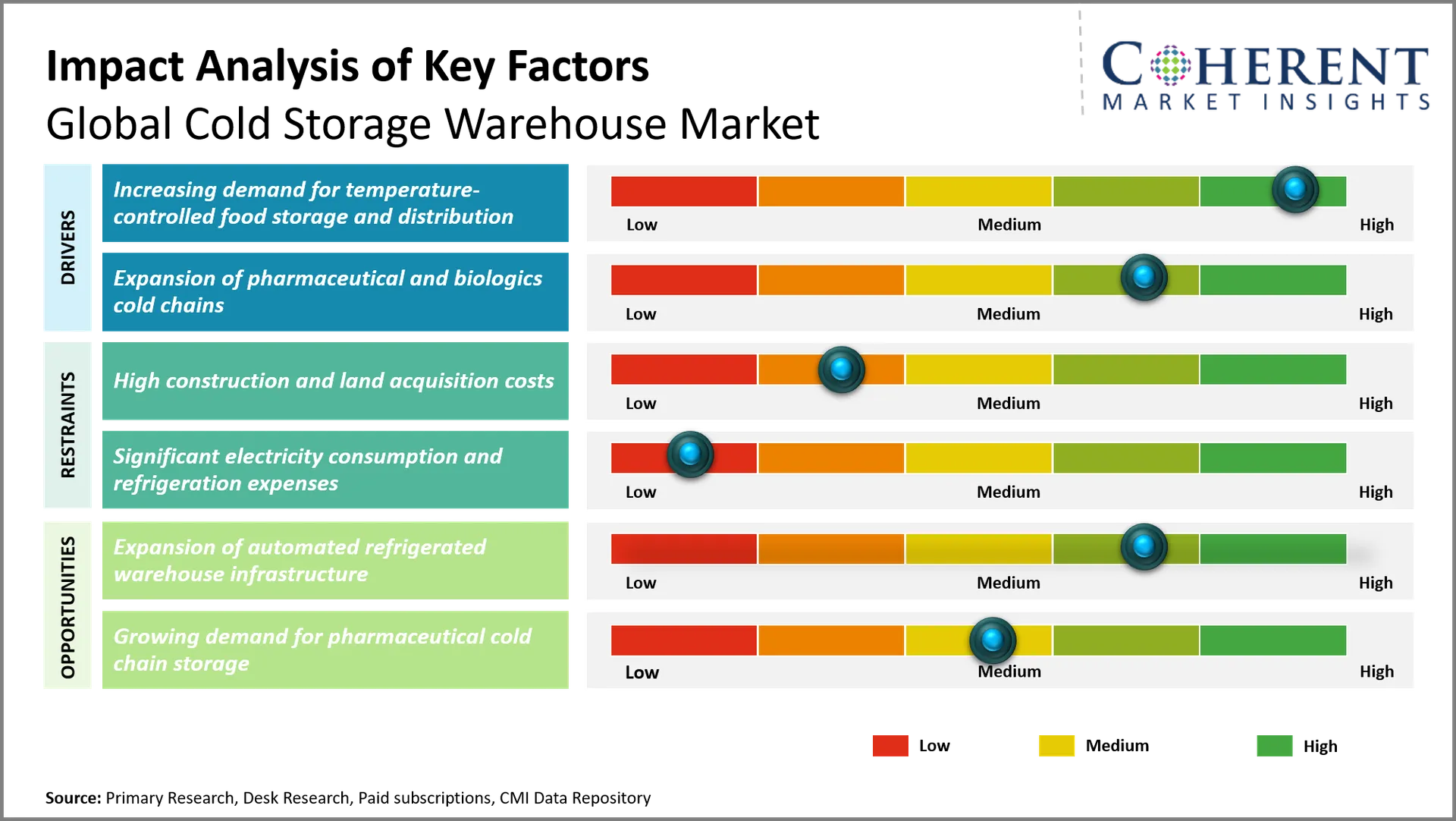
- Increasing demand for temperature-controlled food storage and distribution: Increased consumption of fresh food, frozen products, dairy, meat and seafood increases the demand for temperature-controlled storage infrastructure. Organized retail, online grocery delivery and quick-commerce businesses all depend on efficient cold-chain distribution networks to grow. More and more food industries are depending on cold storage facilities to maintain product quality and minimize spoilage. India’s rapidly expanding quick-commerce industry is fueling need for urban logistics facilities and replenishment centers. Cold storage facilities assist in inventory management, storage of seasonal products in agriculture, and proper distribution of products. Increasing need for food safety and shelf life is driving investments in refrigerated warehouses. These facilities assist firms to maintain product quality while facilitating growing regional and global food supply chains.
- On June 1, 2026, Target opened its largest food distribution center in Thornton, Colorado, U.S. The temperature-controlled facility will employ more than 380 team members and service 129 stores across 11 states, helping resupply those locations up to two days faster than previously.
- Expansion of pharmaceutical and biologics cold chains: The rising manufacturing of pharmaceuticals, vaccine distribution, the development of biologics and temperature-sensitive healthcare items are all driving demand for specialist cold storage facilities. Many biological drugs need to be kept at specified temperatures throughout storage and transit. For pharmaceutical organizations, approved refrigeration equipment, constant temperature monitoring and dependable inventory management are critical. Reliable refrigeration infrastructure throughout health care networks is also needed for vaccine distribution. The animal health sector in India is growing, and the need for a reliable vaccination cold chain and veterinarian delivery infrastructure is paramount. Pharmaceutical cold storage facilities help ensure product integrity, regulatory compliance and supply continuity. The growing popularity of biologics is driving investments in specialized refrigeration, monitoring technologies and temperature-controlled logistics.
- On June 27, 2025, Aenova announced a new cold chain warehouse at its sterile manufacturing facility. The facility has around 1,300 pallet locations in 6,500 cubic meters. Storage is maintained at 2°C - 8°C in dedicated storage.
Emerging Trends
Adoption of Automated and Smart Cold Storage Warehouses: Cold storage operators are progressively adapting automation storage systems, robotics, Internet of Things sensors, and warehouse management software. These solutions improve inventory visibility, optimize the use of space and enable precise temperature monitoring.
- Impact: Automation decreases manual handling, increases operational accuracy and limits product exposure during warehouse moves. Smart monitoring also allows quicker response to temperature variations and equipment breakdowns.
- Relevance to the market: This trend stimulates investments in sophisticated warehouse infrastructure and integrated monitoring systems. Facilities enabled by technology boost operational efficiency, storage capacity and competitiveness.
Transition Toward Energy-Efficient and Sustainable Refrigeration: Increasingly, cold storage developers are embracing natural refrigerants, energy-efficient compressors, solar-powered cooling and thermal energy storage. These solutions cut energy use, promoting ecologically responsible warehouse operations.
- Impact: Sustainable refrigeration can cut operating costs and emissions and improve energy reliability. Also, renewable integration helps facilities to manage electricity cost and reduce dependence on conventional power sources.
- Relevance to the market: This trend generates demand for contemporary refrigeration technology and eco-friendly warehouse infrastructure. Operators have chances to improve efficiency, meet environmental regulations and increase long-term facility competitiveness.
Regional Insights
Why is North America a Strong Market for Cold Storage Warehouse?
North America is expected to account for a market share of 38.0% in 2026. North America is benefiting from increased investment in automated refrigerated warehouses and cross-border food distribution infrastructure. The U.S. and Canada are building temperature-controlled logistics networks along significant shipping routes. Americold opened a 335,000-square-foot import-export hub in Kansas City during August 2025. Canadian operator Conestoga Cold Storage developed a major facility in Halton Hills. NewCold is also constructing an automated cold storage facility in Alberta. These developments support efficient handling of imported food, frozen products, and agricultural commodities. Expanding refrigerated transportation connections with ports and railways further strengthen regional warehouse development.
Why Does Asia Pacific Cold Storage Warehouse Market Exhibit High Growth?
Asia Pacific is expected to register the fastest growth with a CAGR of 12.0% over the forecast period. It is projected to account for 26.0% of the global cold storage warehouse market in 2026. In the Asia Pacific region, agricultural supply chains are being modernized and post-harvest infrastructure is being developed with government backing. The Ministry of Food Processing Industries, India is supporting integrated cold chain projects which connect the farm to the processing unit and then to the customer. In October 2025, India approved 395 projects, of which 291 were operating. In June 2025, the National Development and Reform Commission of China announced 19 more national cold-chain logistics bases. These changes strengthen farm preservation, local distribution and food processing networks. Southeast Asian economies also require specialized storage for seafood, tropical fruits, beef and processed commodities. Growing export-oriented food production creates additional demand for refrigerated warehouses near ports and processing clusters.
Global Cold Storage Warehouse Market Outlook for Key Countries
Why is U.S. Emerging as a Major Hub in the Cold Storage Warehouse Market?
Pharmaceutical distribution needs and growing demand for specialized storage of biologics supports U.S. industry. Pharmaceutical items, vaccines and temperature sensitive injectable medicines need refrigerated settings to be validated. Growing distribution of biologics and weight-loss drugs also fuels demand for controlled pharmaceutical logistics. State-of-the-art warehouses are more and more equipped with specialized temperature zones, monitoring systems and regulatory documents. Another key application is still food distribution, especially for meat, fish, frozen foods and supermarket shops. In May 2026, the U.S. Department of Agriculture announced plans to bolster cold chain infrastructure for emergency food relief. Such advances spur investment in specialized warehousing and temperature-controlled distribution capacities.
Is China the Next Growth Engine for the Cold Storage Warehouse Market?
Government-led logistics infrastructure development and regional agriculture distribution integration are the factors benefitting China's cold storage warehouse sector. In June 2025, China’s National Development and Reform Commission chose 19 more national cold chain logistics bases. The additions have brought the national network to 105 recognized bases in all 31 provincial-level areas. The places chosen were Guangzhou, Hangzhou and Yantian. The government is strengthening the chilled logistics corridors that link agricultural producing centers with coastal ports and consumption centers. Yunnan and Ruili facilities also assist in agricultural distribution and cross-border trade with South Asia and Southeast Asia.
Japan Cold Storage Warehouse Market Analysis and Trends
Warehouse automation, manpower shortages and the increased need for efficient frozen food distribution are benefitting the Japanese market. Mitsubishi Corporation Urban Development finished its first automated cold storage facility in Kawasaki in June 2026. The site has automated frozen storage with a capacity of 10,000 pallet placements. DAIBIRU CORPORATION also finished LOGI FLAG TECH Nagoya Minato in May 2026. Its building holds 9,752 pallets and has automated freezer racks. It features natural refrigerants and rooftop solar panels. The expenditures are aimed at minimizing manual work in warehouses, improving energy efficiency and solving shortages of logistics workers in Japan.
U.K. Cold Storage Warehouse Market Analysis and Trends
The U.K. market benefits from pharmaceutical logistics specialization and modernization of aging refrigerated warehouse infrastructure. Third-party logistics services are building facilities to serve pharmaceutical producers and healthcare distributors. In May 2026 GEODIS announced the development of a temperature-controlled, Good Distribution Practice-compliant warehouse close to Manchester Airport. The facility has 2,000 pallet locations, including controlled room temperature and cold storage areas. Aging refrigeration infrastructure, meanwhile, presents warehouse developers with prospects for renovation. Regulations on refrigerants and the increasing need for refurbishment are driving investment in contemporary facilities. The demand from food retailers, pharmaceutical distributors and makers of temperature-sensitive products is fueling the development of specialist warehouses.
India Cold Storage Warehouse Market Analysis and Trends
India’s cold storage warehouse sector is supported by horticultural produce, potato processing, dairy distribution and government-backed post-harvest infrastructure. Important storage clusters are Uttar Pradesh, West Bengal, Gujarat, Punjab and Maharashtra. The Ministry of Food Processing Industries says that as many as 302 cold chain projects were operating by January 2026 with government backing. These developments led to creation of about 9.108 lakh metric tons of cold storage capacity. Maharashtra had 58 completed projects of which there were 81 cold storage facilities. The Central Warehousing Corporation also invited proposals for public-private cold storage developments in Kalamboli, Chikalthana, Sangli, Vashi, and Ratnagiri.
Global Cold Storage Warehouse Market - Refrigerated Warehouse Capacity by Country (2025)
Country | Capacity (million m³) |
U.S. | 156.210 |
India | 150.000 |
China | 130.950 |
Japan | 39.257 |
U.K. | 35.926 |
Canada | 27.516 |
South Korea | 21.500 |
Brazil | 19.447 |
Germany | 14.180 |
Mexico | 14.000 |
How is Expansion of Automated Refrigerated Warehouse Infrastructure Creating New Growth Opportunities in the Cold Storage Warehouse Market?
Higher pallet density, lower manpower dependency and higher inventory throughput give expansion prospects through building out automated cold storage infrastructure. Japan has one example: Mitsubishi Corporation Urban Development’s automated Kawasaki facility, finished in June 2026. The facility has roughly 10,000 automated frozen storage pallet slots. DAIBIRU CORPORATION's LOGI FLAG TECH Nagoya Minato I stores 9,752 pallets using automated freezer shelves. The projects illustrate demand for high density automated storage systems in land-constrained logistics industries. These automated facilities also help operators to handle complex inventory transfers and provide constant storage conditions. Automation thus opens significant potential for warehouse developers, refrigeration equipment makers, robotics suppliers and providers of warehouse management technologies.
On August 12, 2025, Celcius Logistics introduced Celcius+. It focuses on Good Distribution Practice-compliant operations and real-time visibility of shipments. Its main areas include transport of temperature sensitive products such as vaccines, biologics, insulin and specialized medications.
Market Players, Key Development, and Competitive Intelligence
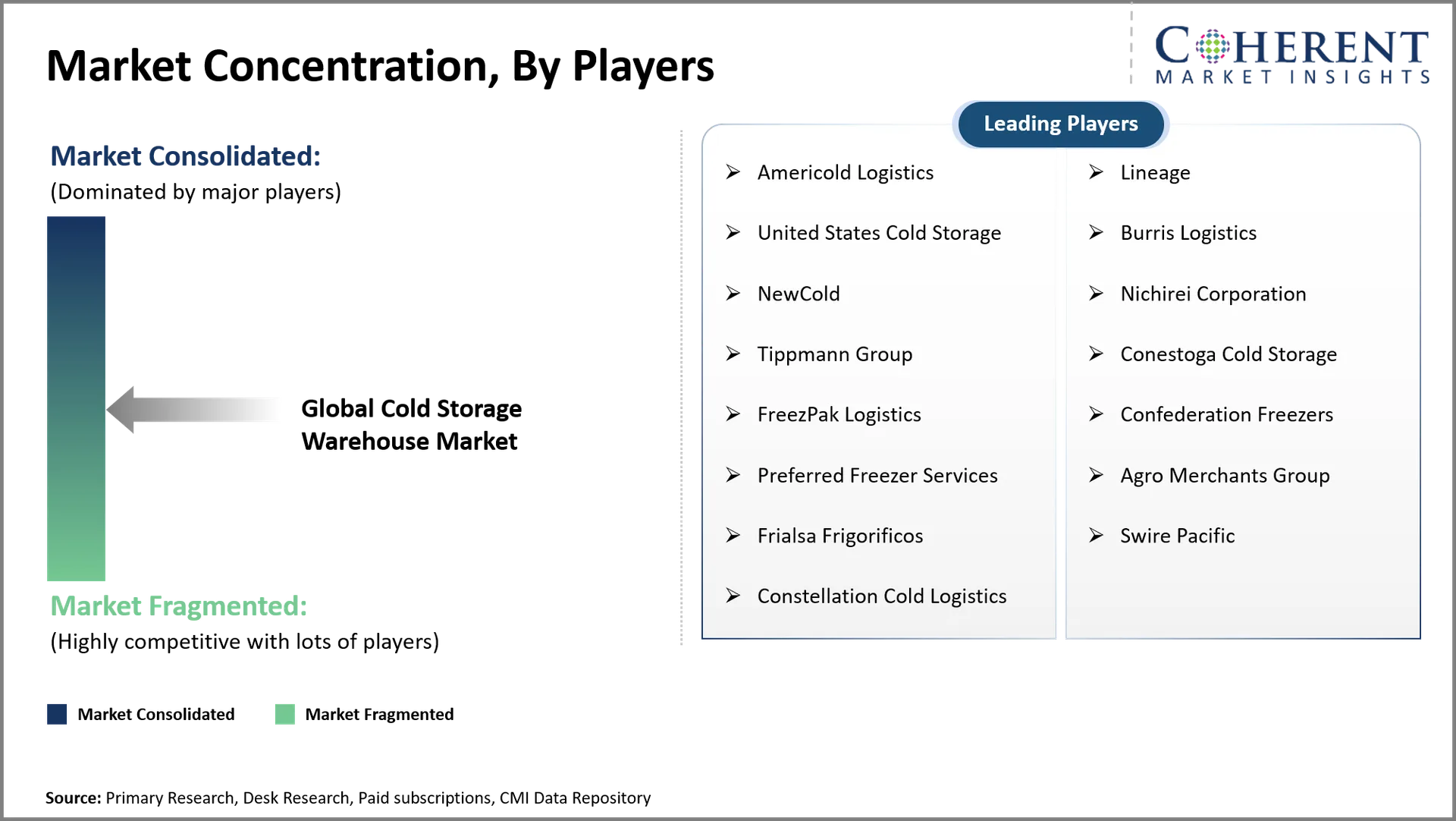
Key Developments
- On September 16, 2026, NewCold, a global leader in advanced food logistics, officially opened its latest warehouse extension in Victoria, further cementing its position as one of the largest and most advanced cold chain logistics hubs in Australia. The extension adds 80,000 pallet positions to NewCold’s current Melbourne operations, bringing the capacity of the facility to 180,000 pallet positions.
- On May 13, 2025, DP World opened a state-of-the-art and sustainable cold chain warehouse at Taloja, Navi Mumbai, India. The new facility further reinforces DP World’s commitment to alter India’s logistics landscape and satisfy the evolving needs of the pharmaceuticals, FMCG and quick-service restaurant (QSR) sectors.
Competitive Landscape
Network growth, warehouse automation, strategic acquisitions, and integrated logistics alliances are the hallmarks of the worldwide cold storage warehouse sector. Lineage, Inc. is focused on automated infrastructure, unique warehouse execution software and strategic customer relationships. Lineage said in April 2025 that would spend around USD 1 billion to support its acquisitions and automated warehouse expansions with Tyson Foods. Americold Realty Trust is focused on import-export hubs, rail access and automation. Its Kansas City facility opened in August 2025 with 335,000 square feet. NewCold emphasizes high-density automated frozen storage. Its McDonough facility announced in February 2026 provides 125,000 pallet positions. Mitsubishi Corporation is looking at automated frozen storage and distribution infrastructure in Japan. Nichirei Corporation and United States Cold Storage are other rivals in the area of specialized warehousing, distribution networks and customer-specific services.
Top Manufacturers and Notable Products/Services in the Cold Storage Warehouse Market
Manufacturer | Notable Product/Service | Key features |
Lineage, Inc. | Precision Cold Storage Warehousing | Multi-temperature storage, automated warehouses, blast freezing, inventory management, repacking, and integrated transportation |
Americold Realty Trust | Integrated Cold Chain Solutions | Refrigerated and frozen storage, temperature-controlled distribution, blast freezing, import-export handling, and value-added services |
NewCold Coöperatief U.A. | Automated Frozen Warehousing | High-density automated storage, automated truck loading, warehouse management systems, material flow control, and oxygen-reduction fire protection |
United States Cold Storage, Inc. | Public Refrigerated Warehousing | Temperature-controlled storage, blast freezing, food handling, distribution, inventory management, and transportation coordination |
Nichirei Logistics Group Inc. | Temperature-Controlled Logistics Services | Automated temperature management, refrigerated storage, transportation, distribution processing, and nationwide logistics coverage |
Market Report Scope
Global Cold Storage Warehouse Market Report Coverage | |||
Report Coverage | Details | ||
Base Year | 2025 | Market Size in 2026: | USD 135.00 Bn |
Historical Data For: | 2020 To 2024 | Forecast Period: | 2026 To 2033 |
Forecast Period 2026 To 2033 CAGR: | 11.80% | 2033 Value Projection: | USD 268.00 Bn |
Geographies covered: |
| ||
Segments covered: |
| ||
Companies covered: | Americold Logistics, Lineage, United States Cold Storage, Burris Logistics, NewCold, Nichirei Corporation, Tippmann Group, Conestoga Cold Storage, FreezPak Logistics, Confederation Freezers, Preferred Freezer Services, Agro Merchants Group, Frialsa Frigorificos, Swire Pacific, Constellation Cold Logistics | ||
Growth Drivers: |
| ||
Restraints & Challenges: |
| ||
Analyst Opinion (Expert Opinion)
- The future of the cold storage warehouse industry will increasingly depend on automation, energy efficiency, and specialized temperature management. Conventional warehouses will gradually incorporate automated retrieval systems, robotics, and intelligent inventory monitoring. Operators will prioritize facilities offering multiple temperature zones and integrated distribution capabilities. Refrigerant transitions will also influence equipment selection and warehouse modernization. Companies combining storage infrastructure with transportation services will gain stronger customer relationships. It is expected for technology-enabled public warehouses to remain particularly attractive for third-party logistics providers and food manufacturers.
- The maximum growth opportunity will emerge from automated public cold storage warehouses serving frozen foods and pharmaceutical products. India and China offer significant opportunities because agricultural distribution requires better post-harvest preservation infrastructure. The U.S. presents attractive opportunities for automated frozen food distribution and specialized pharmaceutical storage. Japan offers opportunities for high-density automated facilities addressing labor shortages and land constraints. Chilled storage will remain important for fresh produce, dairy products, and temperature-sensitive pharmaceutical products. Investors should prioritize strategically located facilities near food processing clusters, pharmaceutical manufacturing centers, and major distribution corridors.
- Market players should focus on investments in automation, energy efficient refrigeration and strategically-located warehouse expansion. Operators should link up with food processors, pharmaceutical producers, supermarket chains and agricultural cooperatives. Developers will have to integrate modular temperature zones to respond to changing client demands. Companies should also add real-time temperature monitoring and predictive equipment maintenance. The use of natural refrigerants and renewable electricity can increase the environmental performance and operational resilience. For regional expansion, priority should be given to neglected agricultural corridors and pharmaceutical distribution clusters. These tactics help boost client retention, improve warehouse usage and generate unique service offerings.
Speak to the analyst
Want personalized insights?
Take the findings above to one of our principal consultants, or have the report rebuilt around the segments, geographies and competitors you actually track.
Market Segmentation
- Warehouse Type Insights (Revenue, USD Billion, 2021 - 2033)
- Public Cold Storage Warehouses
- Private Cold Storage Warehouses
- Bonded Cold Storage Warehouses
- Temperature Type Insights (Revenue, USD Billion, 2021 - 2033)
- Chilled Storage
- Frozen Storage
- Deep-Frozen Storage
- Service Type Insights (Revenue, USD Billion, 2021 - 2033)
- Storage Services
- Blast Freezing Services
- Refrigerated Transportation
- Inventory Management Services
- Value-Added Logistics Services
- Construction Type Insights (Revenue, USD Billion, 2021 - 2033)
- Production Stores
- Bulk Stores
- Distribution Centers
- Automated Cold Storage Warehouses
- Application Insights (Revenue, USD Billion, 2021 - 2033)
- Fruits and Vegetables
- Meat and Poultry
- Fish and Seafood
- Dairy Products
- Frozen Food
- Pharmaceuticals and Healthcare
- Chemicals
- Others
- Regional Insights (Revenue, USD Billion, 2021 - 2033)
- North America
- U.S.
- Canada
- Latin America
- Brazil
- Argentina
- Mexico
- Rest of Latin America
- Europe
- Germany
- U.K.
- Spain
- France
- Italy
- Russia
- Rest of Europe
- Asia Pacific
- China
- India
- Japan
- Australia
- South Korea
- ASEAN
- Rest of Asia Pacific
- Middle East
- GCC Countries
- Israel
- Rest of Middle East
- Africa
- South Africa
- North Africa
- Central Africa
- North America
- Key Players Insights
- Americold Logistics
- Lineage
- United States Cold Storage
- Burris Logistics
- NewCold
- Nichirei Corporation
- Tippmann Group
- Conestoga Cold Storage
- FreezPak Logistics
- Confederation Freezers
- Preferred Freezer Services
- Agro Merchants Group
- Frialsa Frigorificos
- Swire Pacific
- Constellation Cold Logistics
Sources
Primary Research Interviews
- Cold Storage Facility Operators & Managers
- Refrigeration Technology Providers & Equipment Manufacturers
- Food & Beverage Supply Chain Executives
- Pharmaceutical & Healthcare Logistics Specialists
Magazines
- Cold Chain Today Magazine
- Refrigerated & Frozen Foods Magazine
- Supply Chain Management Review
- Logistics Management Magazine
Journals
- Journal of Food Engineering
- International Journal of Refrigeration
- Journal of Supply Chain Management
Associations
- Global Cold Chain Alliance (GCCA)
- International Association of Refrigerated Warehouses (IARW)
- International Refrigerated Transportation Association (IRTA)
- American Frozen Food Institute (AFFI)
Public Domain Sources
- U.S. Department of Agriculture (USDA) - Cold Storage Reports
- Food and Agriculture Organization of the United Nations (FAO)
- U.S. Department of Energy (DOE) - Energy Efficiency in Cold Storage
- World Bank – Logistics Performance Index Reports
Proprietary Elements
- CMI Data Analytics Tool
- Proprietary CMI Existing Repository of Information for Last 10 Years
Get access to 250+ pages report
Every segment, forecast, competitor profile and data table behind the analysis above — available for instant download.
- ESOMAR Member
- ISO 9001:2015 Certified
- D-U-N-S Registered
- GDPR & CCPA Compliant
Frequently Asked Questions
The global cold storage warehouse market is expected to stand at USD 135.00 Bn in 2026 and is expected to reach USD 268.00 Bn by 2033.
The CAGR of the global cold storage warehouse market is projected to be 11.8% from 2026 to 2033.
Increasing demand for temperature-controlled food storage and distribution and Expansion of pharmaceutical and biologics cold chains are the major factors driving the growth of the global cold storage warehouse market.
High construction and land acquisition costs and Significant electricity consumption and refrigeration expenses are the major factors hampering the growth of the global cold storage warehouse market.
In terms of warehouse type, public cold storage warehouses segment is estimated to dominate the market revenue share in 2026.
A cold storage warehouse is a temperature-controlled facility designed to preserve perishable products and temperature-sensitive materials.
They maintain appropriate storage temperatures and humidity levels, slowing deterioration and preserving product quality.