

Global Collaborative Combat Aircraft Mission Autonomy Software Market Size and Forecast – 2026 To 2033
The global collaborative combat aircraft mission autonomy software market is expected to grow from USD 0.26 Bn in 2026 to USD 0.95 Bn by 2033, at a compound annual growth rate (CAGR) of 20.4% over 2026–2033. A collaborative combat aircraft (CCA) is an uncrewed jet built to fly alongside a crewed fighter, carrying extra sensors or weapons and taking risks that a pilot should not have to take. Mission autonomy software is what lets it do that job. The pilot gives a short instruction, such as defend this area or search that sector, and the software works out the route, keeps formation, fuses sensor data and positions the aircraft. It sits above the flight controls supplied by the airframe maker, so air forces can now buy it, upgrade it and swap it on its own. The market draws on the same demand that is lifting the unmanned combat aerial vehicle and military drone markets, but it moves with software licences, open architectures and flight testing rather than airframe volumes.
Spending and testing are both picking up. On 10 June 2026, Boeing announced software upgrades for the MQ-28 Ghost Bat that comply with the Government Reference Architecture, so operators can tailor weapons, payloads, command and control and mission autonomy to their own needs. On 18 August 2026, Kratos announced that a missionized US Marine Corps Valkyrie had demonstrated electronic warfare capability and a beyond-line-of-sight command and control datalink at a US Navy test range in southern California. Private money is flowing in as well. On 14 September 2026, Lockheed Martin announced that its Skunk Works division would build four more Vectis aircraft, bringing its company-funded fleet to five.
Key Takeaways of the Global Collaborative Combat Aircraft Mission Autonomy Software Market
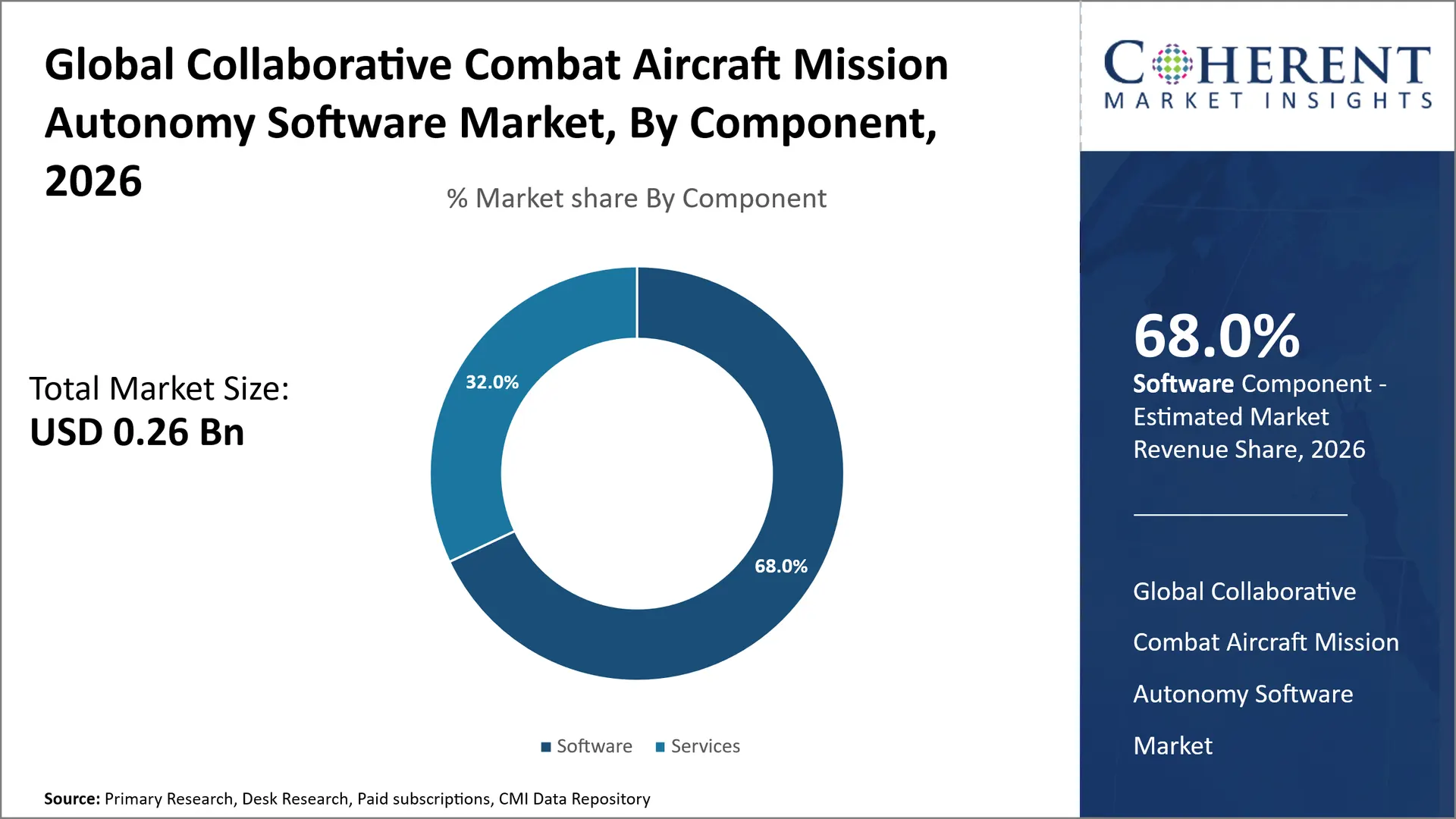
- The software segment is expected to account for 68.0% of the market share in 2026. Air forces pay mainly for the autonomy stack itself, and it is the part that keeps being upgraded after the aircraft is delivered. On 1 June 2026, Helsing announced Area 9, an advanced research division whose first project, the Centaur AI pilot, has already flown on the Saab Gripen and now underpins the company’s CA-1 Europa autonomous fighter.
- The air to air combat segment is projected to hold 38.7% of the application segment in 2026. Counter-air is the first mission most air forces have set for their CCAs. On 19 February 2026, Shield AI announced that its Hivemind software had flown two BQM-177A aircraft at the Point Mugu Sea Range, defending combat air patrol positions against constructive adversary aircraft.
- The air force segment is expected to account for 81.5% of the market share in 2026. Air forces own the fighter fleets that CCAs support and run nearly every funded programme. On 23 April 2026, the US Air Force announced a partnership with the Netherlands Ministry of Defence to acquire prototype CCAs, with Dutch personnel training alongside US crews at the Experimental Operations Unit at Nellis Air Force Base.
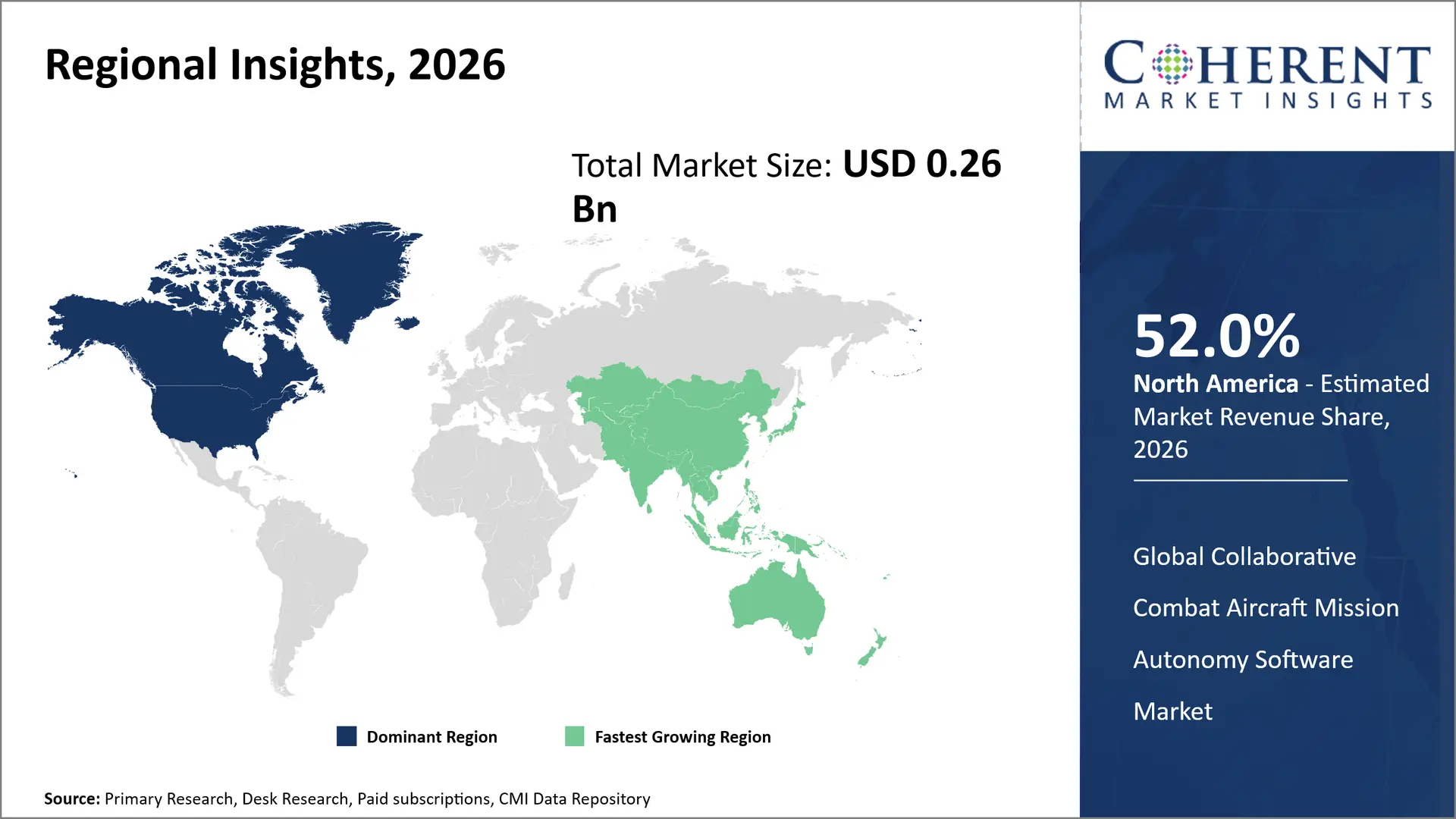
- North America is expected to dominate the market in 2026, with a share of 52.0%. The region has the largest funded CCA programme and most of the companies that have flown mission autonomy on CCA prototypes. On 23 February 2026, General Atomics Aeronautical Systems announced a joint autonomy exercise with the US Air Force in which an F-22 fitted with government reference autonomy software sent commands to an MQ-20 Avenger to fly tactical manoeuvres and adjust waypoints.
- Asia Pacific is expected to account for 18.1% share in 2026 and to be the fastest-growing region. Australia already has a CCA programme of record. On 9 December 2025, Boeing announced a Ghost Bat program of record for more MQ-28 aircraft, valued at about USD 0.50 Bn.
Segmental Insights
Why Does Software Dominate the Global Collaborative Combat Aircraft Mission Autonomy Software Market?
In terms of component, software is expected to account for 68.0% of the global collaborative combat aircraft mission autonomy software market share in 2026. The value of a CCA as a wingman comes almost entirely from code: the AI pilot, the mission planner, the sensor fusion and the logic that lets several aircraft work as a team. Air forces license this software separately from the airframe and can update it far more often than they can change the aircraft, so spending keeps flowing over the whole life of the fleet. A mature autonomy stack can also move from one airframe to another, which makes it the most reusable and most valuable part of the system.
On 13 February 2026, Shield AI announced its selection as a mission autonomy provider for the US Air Force CCA program and reported that its Hivemind software is A-GRA compliant and platform agnostic.
- Current Industry Events of 2026
- Market Size Estimation
- Regional Breakdown
- Competitive Landscape
- Customer Intelligence
- Segmental Analysis
- Pricing Analysis
- Key Market Drivers, Challenges & Future Trends
- Customized Insights Section
Why Does Air to Air Combat Lead the Application Segment?
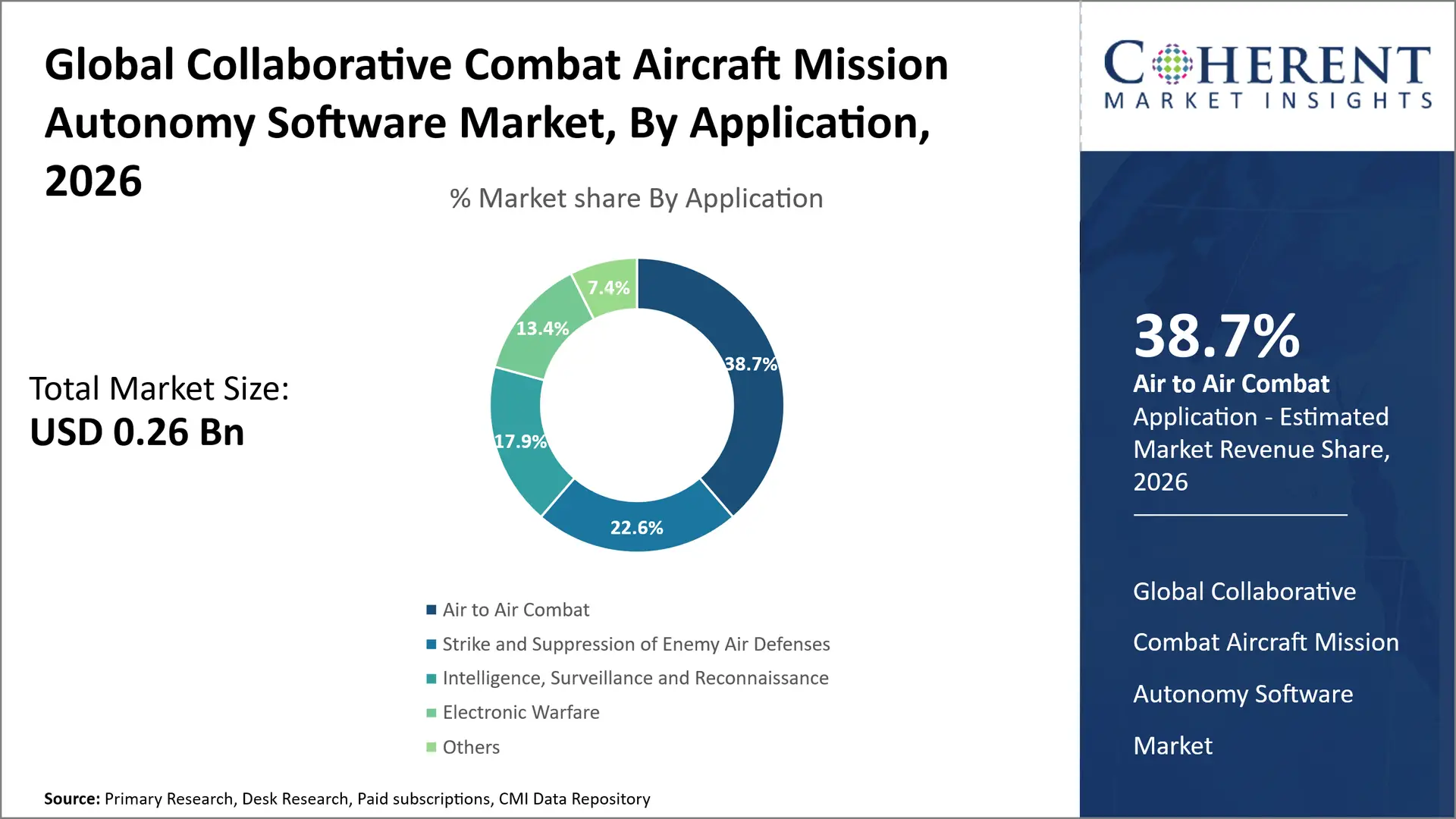
In terms of application, air to air combat is expected to account for 38.7% of the market share in 2026. An autonomous wingman adds value fastest in counter-air: it can push forward to find and engage enemy aircraft, hold a patrol area and carry extra missiles while the crewed fighter stays further back. These tasks also need the most demanding autonomy, including formation tactics and fast reactions to manoeuvring threats, which raises the software content in each aircraft.
In a test conducted on 27 December 2025, Baykar reported that two Bayraktar KIZILELMA prototypes flew in coordinated close formation using autonomous fleet algorithms and an autonomous combat pilot, the first time two uncrewed fighter aircraft had done so.
Why Do Air Forces Lead the End User Segment?
In terms of end user, air forces are expected to account for 81.5% of the market share in 2026. Air forces own the fighter fleets that CCAs are designed to support, set the software standards that vendors build to and run the programmes that have moved from prototypes to production. Early licence revenue therefore flows mainly through air force contracts, with naval services following a few years behind.
On 9 December 2025, Boeing announced that the Royal Australian Air Force had completed an air-to-air autonomous weapon engagement with an MQ-28, which received authorisation from an E-7A Wedgetail operator and destroyed a fighter-class target drone with an AIM-120 missile after an F/A-18F identified the target.
Current Events and their Impact
Current Events | Description and its Impact |
NATO Defence Spending Pledge at the Hague Summit (June 2025) |
|
Heavy Use of Drones and Electronic Warfare in the Russia-Ukraine War (Ongoing) |
|
Collaborative Combat Aircraft Mission Autonomy Software Market Dynamics
Market Drivers
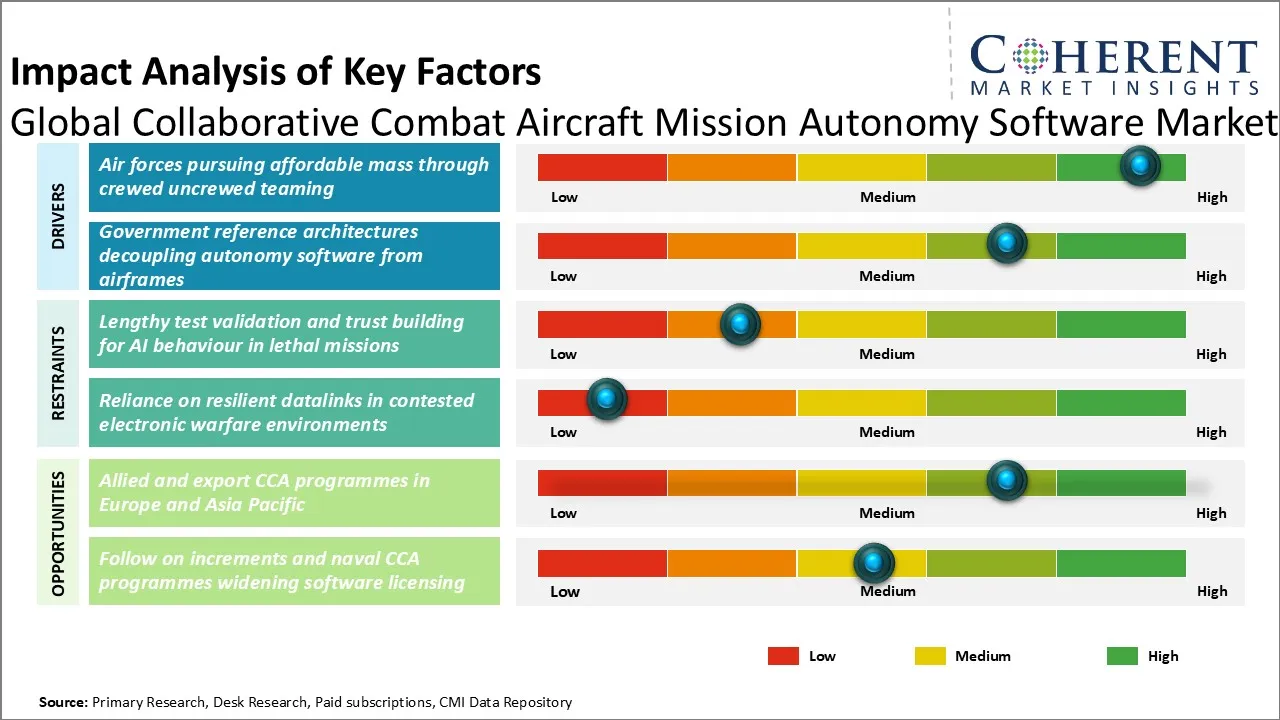
- Air forces pursuing affordable mass through crewed uncrewed teaming: Modern fighters are expensive and slow to build, and pilots take years to train. Pairing each crewed jet with cheaper autonomous wingmen lets an air force put more sensors and weapons in the air without a matching rise in pilot numbers. This only works if the uncrewed aircraft can act on simple instructions, which makes mission autonomy software the enabling technology.
- On 25 September 2025, Helsing unveiled the CA-1 Europa, an autonomous combat aircraft that the company reported is designed for intelligent mass and is controlled natively by its Centaur AI pilot.
- Government reference architectures decoupling autonomy software from airframes: Government-owned reference architectures define a common interface between autonomy software and the aircraft. An air force can then swap or upgrade the software without going back to the airframe maker, and software-focused companies can compete on equal terms with large primes. This turns autonomy into a separate, recurring purchase.
- On 16 April 2026, Applied Intuition announced that its Acuity Air Combat Autonomy software had been embedded within Northrop Grumman’s Prism Mission Autonomy framework and commanded the Talon IQ test aircraft in flight, using standard government reference architectures.
Emerging Trends
- European buyers are pairing proven airframes with sovereign mission systems: Rather than wait for a new aircraft, European primes are fitting their own mission systems to airframes that already fly. On 13 March 2026, Airbus announced that it was preparing two Kratos-built uncrewed combat aircraft for first flight with a European mission system, aiming to offer the German Air Force an operational system by 2029.
- Impact: Development timelines shrink from a decade to a few years, and European air forces keep control of the software and data.
- Relevance to the market: This opens room for regional autonomy and mission system suppliers alongside US vendors.
- Software changes are becoming the main fix during flight testing: When problems appear, programmes increasingly correct them through software releases rather than hardware redesign. On 21 May 2026, General Atomics Aeronautical Systems announced that the YFQ-42A had returned to flight testing after a joint review with the US Air Force, in which technical authorities endorsed the software changes made after a mishap.
- Impact: Test campaigns recover faster, but every change needs a clear review and approval path.
- Relevance to the market: This raises demand for simulation, verification and secure software release tools, and favours vendors with mature test pipelines.
Regional Insights
Why Does North America Lead the Global Collaborative Combat Aircraft Mission Autonomy Software Market?
North America is expected to account for a market share of 52.0% in 2026, or about USD 0.14 Bn. The US runs the most mature CCA programme and buys mission autonomy as a separate product from the airframe. Most of the companies that have flown mission autonomy on CCA prototypes, including Shield AI, Anduril, Collins Aerospace, General Atomics, Lockheed Martin, Northrop Grumman and Applied Intuition, are based in the US. Funding is also moving from development to procurement, which turns test contracts into licence revenue.
Why Is Asia Pacific the Fastest-Growing Region in the Market?
Asia Pacific is expected to account for 18.1% of the global market in 2026, or about USD 0.05 Bn, and to register the fastest growth over the forecast period, at an estimated 26.1% CAGR. Australia has an MQ-28 program of record, and Japan is funding AI-enabled collaborative aircraft to fly with its next-generation fighter. Japan’s Ministry of Defense requested about USD 55.6 Bn for fiscal year 2027, a record, with priority on AI and unmanned systems. Rising air threats across the Indo-Pacific are pushing other air forces to study crewed uncrewed teaming as well.
Global Collaborative Combat Aircraft Mission Autonomy Software Market Outlook for Key Countries:
Is the U.S. the Largest Market for CCA Mission Autonomy Software?
The U.S. market is projected to reach about USD 0.13 Bn in 2026, the largest of any country and about 95% of the North American total. The Department of the Air Force’s fiscal year 2027 budget request included about USD 996.5 million in procurement funding to begin production of Increment 1 CCAs, plus about USD 150 million in advance procurement for fiscal year 2028. This is the first time the service has asked for CCA procurement money rather than development funding alone.
Why Is Germany a Key Market in Europe?
Germany’s market is projected to reach USD 0.02 Bn in 2026, the largest in Europe. The German Air Force plans to field collaborative combat aircraft from 2029, and several industry teams are competing for the role. On 31 March 2026, Rheinmetall announced a strategic partnership with Boeing under which it would act as system manager for the MQ-28 Ghost Bat in Germany, handling integration into Bundeswehr command and weapon systems.
U.K. Market Analysis and Trends
The U.K. market is projected to reach USD 0.01 Bn in 2026. The UK wants a sovereign CCA to work with its Typhoon fleet and, later, its next-generation fighter. On 22 July 2026, BAE Systems unveiled Brontanax at the Farnborough International Airshow, describing it as the UK’s first uncrewed autonomous CCA, with ground testing at Warton planned before flight testing in UK airspace.
Australia Market Analysis and Trends
Australia’s market is projected to reach USD 0.02 Bn in 2026, the largest in Asia Pacific. The MQ-28 Ghost Bat was designed and built in Australia, and the Royal Australian Air Force is moving it from trials into service. That program of record, worth about USD 500.7 million after conversion, gives local software and integration work a steady base over the forecast period.
Japan Market Analysis and Trends
Japan’s market is projected to reach USD 0.01 Bn in 2026. Japan’s Ministry of Defense planned conceptual design work in fiscal year 2026 for a collaborative unmanned aircraft that uses AI to make autonomous flight and behaviour decisions alongside its next-generation fighter. This creates early demand for AI pilot development, simulation and integration services.
Global Collaborative Combat Aircraft Mission Autonomy Software Market – Key CCA Platforms Hosting Mission Autonomy
Platform | Producer | Main Features and Role for Autonomy Software |
FQ-42A Dark Merlin | General Atomics Aeronautical Systems, Inc. | US Air Force Increment 1 aircraft; modular design built for rapid integration of mission systems and third-party mission autonomy software |
FQ-44A Fury | Anduril Industries, Inc. | US Air Force Increment 1 aircraft; two external weapon stations; built to fly with mission autonomy from more than one vendor |
MQ-28 Ghost Bat | The Boeing Company | Australian-developed CCA with an open, modular system architecture; more than 150 flights completed |
YFQ-48A Talon Blue | Northrop Grumman Corporation | Company-funded CCA linked to the Talon IQ autonomy testbed, where third-party autonomy software is integrated and tested |
Brontanax | BAE Systems plc | UK sovereign CCA designed to add combat mass alongside crewed aircraft at lower cost |
How Are Naval and Follow On CCA Programmes Creating New Software Licensing Opportunities?
Each new increment of a CCA programme reopens the software competition and adds new mission sets, from strike to electronic warfare. Naval services are now starting their own efforts, and they bring different needs, such as operating from ships, far from land bases and over open water. These needs call for new autonomy behaviours and new rounds of integration work, which gives software vendors fresh chances to win licences even if they missed the first air force awards. Vendors whose software already follows government reference architectures can move into these programmes at lower cost.
The US Department of Defense fiscal year 2027 budget request overview includes funding for a Marine Corps Collaborative Combat Aircraft, adding a second US service to the buyer base for mission autonomy.
Market Players, Key Development, and Competitive Intelligence
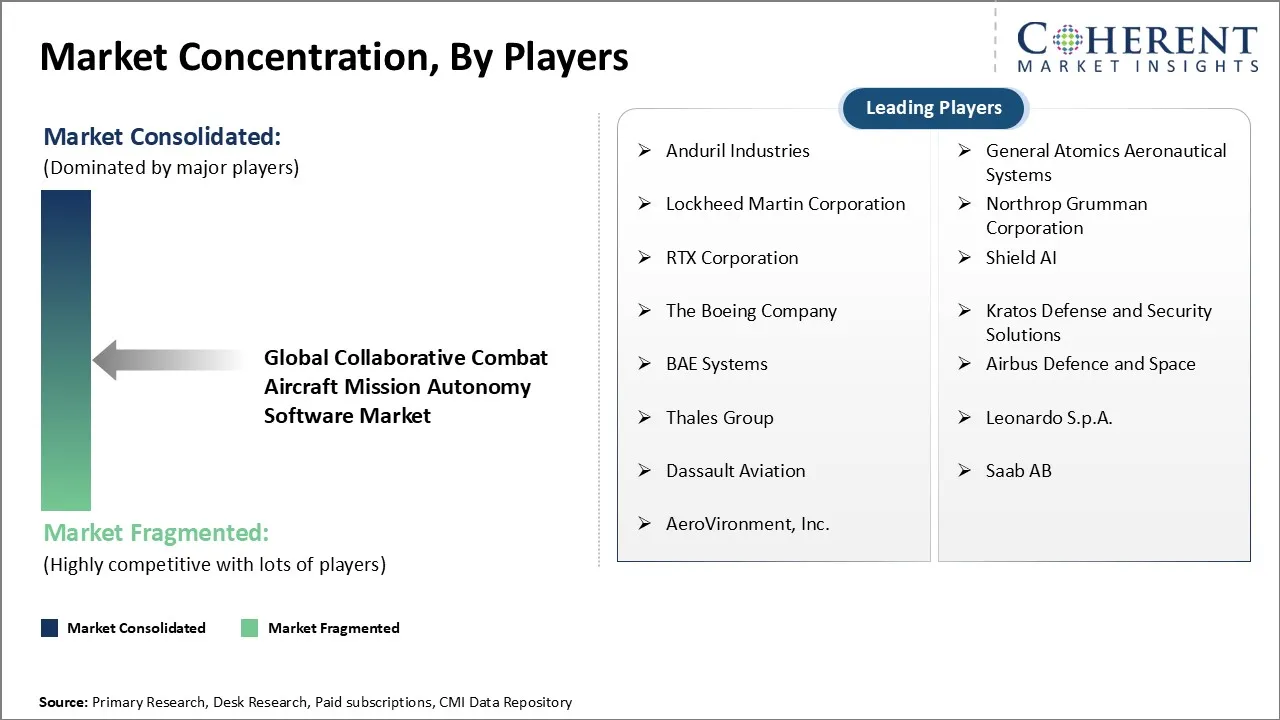
Key Developments
- On 9 November 2026, Shield announced that its Hivemind mission autonomy software had flown multiple US Air Force CCAs as a coordinated team for the first time, including multi-ship formation and beyond-visual-range air combat manoeuvres.
- On 12 October 2026, Airbus announced the first European flight of the U740 Valkyrie, developed with Kratos, opening the way for flight tests with its MARS mission system.
- On 17 June 2026, Anduril announced that the US Air Force had selected its Lattice for Mission Autonomy software stack for the next phase of the CCA program.
- On 20 February 2026, RTX announced that its Collins Aerospace business had flown its Sidekick mission autonomy software on the YFQ-42A, with autonomy mode engaged for a four-hour flight managed by a ground operator.
- On 12 February 2026, Helsing announced a strategic partnership with HENSOLDT to equip the CA-1 Europa with HENSOLDT radar, optronics and electromagnetic warfare systems alongside the Centaur AI agent.
Competitive Landscape
The market is moderately concentrated and is shared between three groups that often work together. Software-first companies such as Shield AI, Anduril, Applied Intuition and Helsing build AI pilots and autonomy stacks that run on aircraft from different makers. Defence primes such as Lockheed Martin, Northrop Grumman, Collins Aerospace, BAE Systems and Saab combine autonomy with mission systems and decades of combat aircraft integration. Airframe makers such as General Atomics, Boeing, Kratos, Airbus and Baykar pair their aircraft with in-house or partner software. Competition centres on proven flight hours, compliance with government reference architectures, the speed of software releases and the ability to run on more than one airframe. Long test and approval cycles for weapon-carrying autonomy make it hard for new entrants to win production licences quickly.
Top Companies and Notable Products in the Market
Company | Notable Product | Key Features |
Shield AI, Inc. | Hivemind | Platform-agnostic AI pilot that is A-GRA compliant; flown on several uncrewed aircraft types |
Anduril Industries, Inc. | Lattice for Mission Autonomy | Autonomy and command software built to the US Air Force A-GRA standard |
Collins Aerospace | Sidekick | Collaborative mission autonomy software designed for open-systems integration with third-party aircraft |
Northrop Grumman Corporation | Prism Mission Autonomy | Mission autonomy framework that can host autonomy software from partner companies |
Applied Intuition, Inc. | Acuity | Onboard autonomy for air and other domains, drawing on EpiSci tactical AI technology |
Market Report Scope
Global Collaborative Combat Aircraft Mission Autonomy Software Market Report Coverage | |||
Report Coverage | Details | ||
Base Year | 2025 | Market Size in 2026: | USD 0.26 Bn |
Historical Data For: | 2020 To 2024 | Forecast Period: | 2026 To 2033 |
Forecast Period 2026 To 2033 CAGR: | 20.40% | 2033 Value Projection: | USD 0.95 Bn |
Geographies covered: |
| ||
Segments covered: |
| ||
Companies covered: | Airbus SE, Anduril Industries, Inc., Applied Intuition, Inc., BAE Systems plc, Baykar Technologies, Collins Aerospace, General Atomics Aeronautical Systems, Inc., Helsing GmbH, Kratos Defense and Security Solutions, Inc., Lockheed Martin Corporation, Northrop Grumman Corporation, Saab AB, Shield AI, Inc., The Boeing Company | ||
Growth Drivers: |
| ||
Restraints & Challenges: |
| ||
Analyst Opinion (Expert Opinion)
- Software holds most of the value, but services are set to grow faster. Software is expected to make up 68.0% of spending in 2026, against 32.0% for services. That split fits a market where air forces are buying their first autonomy licences. As more aircraft types, allied buyers and mission sets are added, the work of integrating, testing, certifying and sustaining the software will grow quickly, and services are expected to rise at an estimated 22.1% CAGR. Vendors that can pair a proven autonomy stack with strong integration and test support tend to win the larger awards.
- North America leads, Asia Pacific catches up fastest, and two risks stand out. North America holds 52.0% of the market in 2026, while Asia Pacific, at 18.1%, is growing fastest on the back of Australian and Japanese programmes. The first risk is approval time: weapon-carrying autonomy needs long test campaigns and formal reviews, and delays there push licence revenue later. The second is connectivity: crewed uncrewed teams depend on datalinks that can be jammed, so software must keep missions going with little contact. Suppliers that can show reliable behaviour under jamming and run on more than one airframe are the least exposed.
Speak to the analyst
Want personalized insights?
Take the findings above to one of our principal consultants, or have the report rebuilt around the segments, geographies and competitors you actually track.
Market Segmentation
- Component Insights (Revenue, USD Billion, 2021 - 2033)
- Software
- Services
- Autonomy Function Insights (Revenue, USD Billion, 2021 - 2033)
- Mission Planning and Tasking
- Navigation and Flight Management
- Sensor Fusion and Target Recognition
- Multi Aircraft Teaming and Swarm Coordination
- Weapons and Effects Management
- Aircraft Type Insights (Revenue, USD Billion, 2021 - 2033)
- Expendable
- Attritable
- Reusable
- Application Insights (Revenue, USD Billion, 2021 - 2033)
- Air to Air Combat
- Strike and Suppression of Enemy Air Defenses
- Intelligence, Surveillance and Reconnaissance
- Electronic Warfare
- Others
- End User Insights (Revenue, USD Billion, 2021 - 2033)
- Air Force
- Navy and Marine Corps
- Regional Insights (Revenue, USD Billion, 2021 - 2033)
- North America
- U.S.
- Canada
- Latin America
- Brazil
- Argentina
- Mexico
- Rest of Latin America
- Europe
- Germany
- U.K.
- Spain
- France
- Italy
- Russia
- Rest of Europe
- Asia Pacific
- China
- India
- Japan
- Australia
- South Korea
- ASEAN
- Rest of Asia Pacific
- Middle East
- GCC Countries
- Israel
- Rest of Middle East
- Africa
- South Africa
- North Africa
- Central Africa
- North America
- Key Players Insights
- Airbus SE
- Anduril Industries, Inc.
- Applied Intuition, Inc.
- BAE Systems plc
- Baykar Technologies
- Collins Aerospace
- General Atomics Aeronautical Systems, Inc.
- Helsing GmbH
- Kratos Defense and Security Solutions, Inc.
- Lockheed Martin Corporation
- Northrop Grumman Corporation
- Saab AB
- Shield AI, Inc.
- The Boeing Company
Sources
Primary Research Interviews
- Air Force and Naval Aviation Programme Offices
- Autonomy Software Developers
- Uncrewed Combat Aircraft Manufacturers
- Mission Systems and Avionics Suppliers
- Defence System Integrators and Test Organisations
Magazines
- Air & Space Forces Magazine
- Aviation Week & Space Technology
- Breaking Defense
- Defense News
- Janes Defence Weekly
- Flight International
Journals
- Journal of Aerospace Information Systems (AIAA)
- IEEE Transactions on Aerospace and Electronic Systems
- Aerospace Science and Technology
- Journal of Guidance, Control, and Dynamics
Associations
- American Institute of Aeronautics and Astronautics (AIAA)
- Air & Space Forces Association
- Association for Uncrewed Vehicle Systems International (AUVSI)
- Royal Aeronautical Society
- AeroSpace and Defence Industries Association of Europe (ASD)
Public Domain Sources
- US Department of Defense: FY2027 Budget Request Overview Book
- US Department of the Air Force: FY2027 aircraft procurement request for CCA Increment 1
- US Air Force: press release on the Netherlands CCA partnership, 23 April 2026
- US Department of Defense: Directive 3000.09, Autonomy in Weapon Systems
- Japan Ministry of Defense: FY2026 and FY2027 budget requests
- NATO: Hague Summit Declaration, June 2025
- Company press releases and annual reports
Proprietary Elements
- CMI Data Analytics Tool
- Proprietary CMI Existing Repository of information for last 10 years
Get access to 250+ pages report
Every segment, forecast, competitor profile and data table behind the analysis above — available for instant download.
- ESOMAR Member
- ISO 9001:2015 Certified
- D-U-N-S Registered
- GDPR & CCPA Compliant
Frequently Asked Questions
The global collaborative combat aircraft mission autonomy software market is estimated to be valued at USD 0.26 Bn in 2026 and is expected to reach USD 0.95 Bn by 2033.
The CAGR of the global collaborative combat aircraft mission autonomy software market is projected to be 20.4% from 2026 to 2033.
Air forces pursuing affordable mass through crewed uncrewed teaming, and government reference architectures decoupling autonomy software from airframes, are the major factors driving market growth.
Lengthy test validation and trust building for AI behaviour in lethal missions, and reliance on resilient datalinks in contested electronic warfare environments, are the major factors hampering market growth.
In terms of component, software is estimated to dominate the market, with a revenue share of 68.0% in 2026.
It is the software that lets an uncrewed collaborative combat aircraft carry out tasks given by a pilot or operator, such as route planning, formation keeping, sensor fusion and target engagement, while the airframe’s own systems handle basic flight control.
The vehicle management system keeps the aircraft flying safely, handling control surfaces, engine and basic navigation, and is supplied with the airframe. Mission autonomy sits above it and decides what the aircraft should do to complete its task.