

Global Condensed Milk Market Size and Forecast – 2026 To 2033
The Condensed Milk Market is estimated to be valued at USD 11,823.7 Mn in 2026 and is expected to reach USD 16,870.4 Mn by 2033, exhibiting a compound annual growth rate (CAGR) of 5.2% from 2026 to 2033. This steady growth is supported by expanding use in bakery, desserts, beverages, confectionery, and household cooking, where condensed milk offers sweetness, dairy richness, texture, and shelf stability in a single ingredient. Demand is also strengthening in emerging markets as brands introduce more convenient, functional, and differentiated formats for modern retail and foodservice users.
In May 2026, Mali, Thailand’s leading condensed milk brand produced by The Thai Dairy Industry Co., Ltd., launched a protein-fortified sweetened condensed milk in a 180 g tube, offering 20 g protein, low sugar per serving, lactose-free positioning, and 33% less fat than the standard formula. This highlights how condensed milk brands are using nutrition-led innovation and convenience packaging to widen consumer appeal beyond traditional dessert use. (Source: Mini Me)
Key Takeaways of the Condensed Milk Market
- Conventional condensed milk is expected to dominate with 81.4 % of the market share in 2026, supported by large-scale foodservice and household use where affordability, consistency, and longer shelf-life matter. In June 2026, Nestlé Professional India’s live MILKMAID catalogue listed 2 kg and 5 kg foodservice packs with milk solids and sugar as key ingredients, reinforcing conventional format demand. (Source: Nestlé)
- Sweetened condensed milk is expected to account for 58.6 % of the market share in 2026, reflecting its strong use in desserts, beverages, bakery fillings, and confectionery preparations. In June 2026, Eagle Brand’s official product page listed its sweetened condensed milk in a resealable, easy-pour pouch for coffee, tea, fruit, oatmeal, muffins, and everyday recipes, showing continued relevance of core sweetened formats through convenience-led packaging. (Source: Eagle Family Foods LLC)
- Cans are expected to hold 53.8 % of the market share in 2026, as they support shelf stability, export movement, and pantry storage for condensed and evaporated milk. In December 2024, Sonoco completed the acquisition of Eviosys, strengthening its position in food cans, ends, and closures, which supports broader metal-packaging capacity for shelf-stable food products. (Source: Sonoco)
- Asia Pacific is expected to lead the condensed milk market with 48.1 % share in 2026, supported by strong use of condensed milk in tea, desserts, bakery, and traditional sweet preparations. In September 2024, Fraser & Neave (F&N’s) annual report stated that its portfolio includes leading condensed and evaporated milk products under F&N, TEAPOT, GOLD COIN, and CARNATION. (Source: Fraser & Neave)
- Europe is expected to hold 23.4 % of the condensed milk market in 2026 and emerge as the fastest-growing region, supported by advanced dairy processing and high-value dessert applications. In November 2025, Eurostat reported that EU farms produced 161.8 million tons of raw milk in 2024, strengthening the regional supply base for processed dairy products. (Source: Eurostat)
- Convenience packaging gains strategic importance in condensed milk market: Brands are improving pack usability through resealable, easy-pour, portion-friendly, and foodservice-oriented formats, helping reduce wastage and improve handling. In May 2026, Siam Original Food launched Khwan Khao dairy-free condensed milk in Original and Sugar-Free variants, highlighting how pack and formulation innovation is expanding condensed milk usage beyond traditional dairy formats.
- B2B demand for ingredients continues to strengthen : B2B distribution is expected to remain important as manufacturers use condensed milk to improve sweetness, texture, body, and blending performance in bakery, confectionery, dairy, and beverage formulations. In June 2026, Dairy Farmers of America’s ingredient platform listed sweetened condensed milk for food manufacturing with format options and application recommendations, supporting industrial-scale adoption. (Source: Dairy Farmers of America, Inc)
Segmental Insights
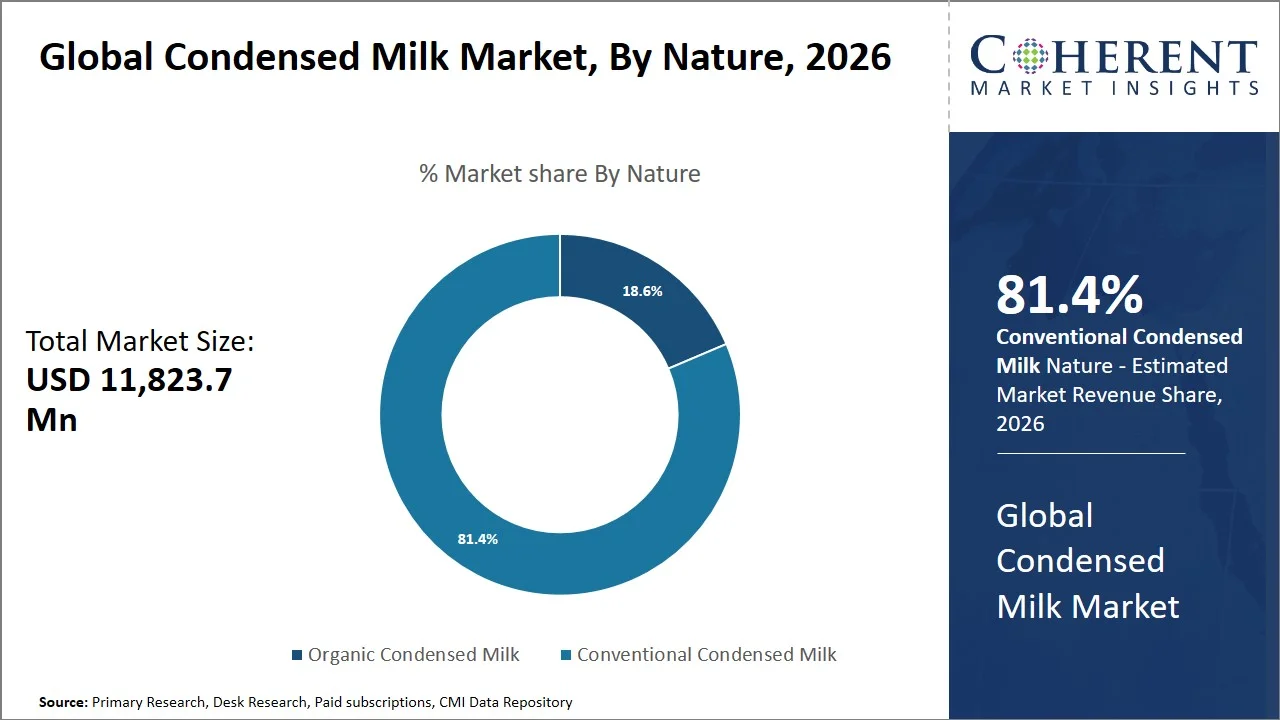
Why Does Conventional Condensed Milk Dominate the Global Condensed Milk Market?
Conventional condensed milk is expected to hold 81.4% share in 2026 due to its stronger price accessibility, wider distribution base, and established use across retail and industrial food manufacturing. Compared to organic variants, conventional products benefit from large-scale dairy procurement, standardized processing, and broader availability in cans, pouches, and foodservice packs. Demand is supported by households, bakeries, dessert makers, beverage operators, and confectionery manufacturers that prioritize consistent sweetness, texture, and shelf stability over premium certification claims. On the supply side, conventional condensed milk is easier to manufacture at scale through existing dairy evaporation and sugar blending infrastructure. In March 2025, Vinamilk’s 2024 Annual Report highlighted condensed milk, yogurt, and nut milk as key drivers of the company’s performance in 2024, reinforcing the continued commercial importance of mainstream condensed milk portfolios.
- Current Industry Events of 2026
- Market Size Estimation
- Regional Breakdown
- Competitive Landscape
- Customer Intelligence
- Segmental Analysis
- Pricing Analysis
- Key Market Drivers, Challenges & Future Trends
- Customized Insights Section
Why Does Sweetened Condensed Milk Represent the Largest Product Type Segment in the Market?
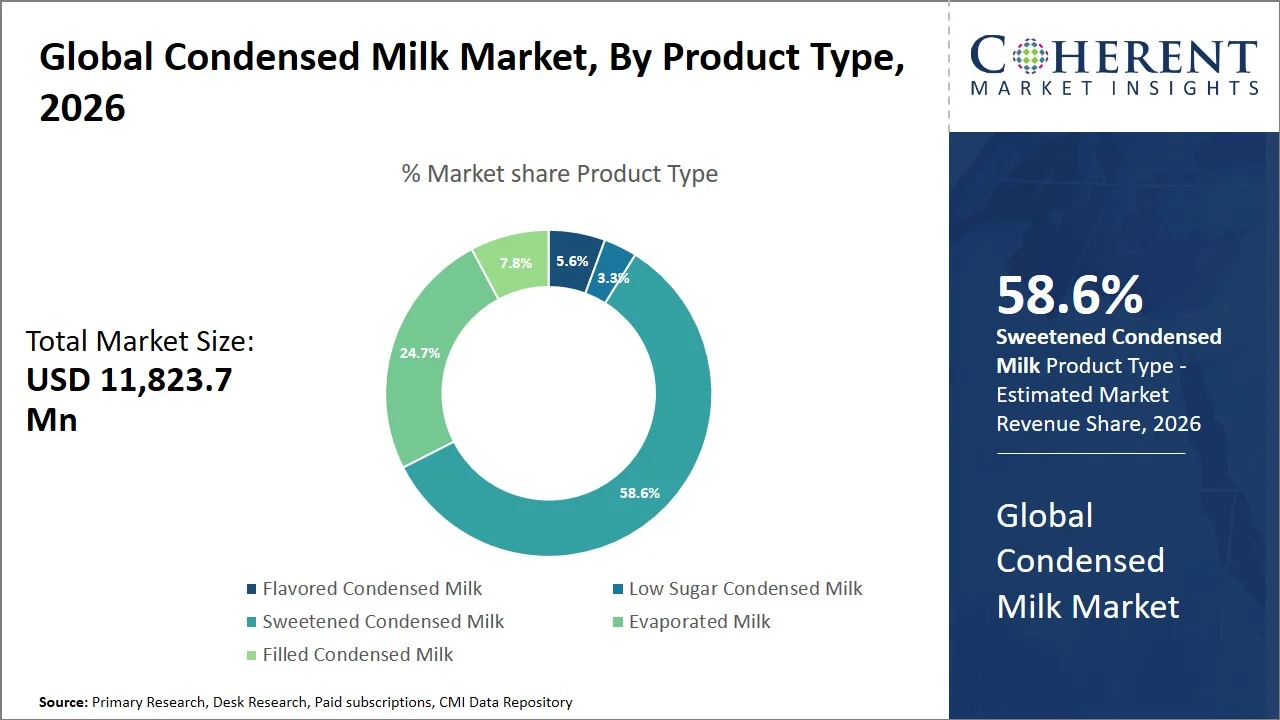
Sweetened condensed milk is expected to account for 58.6% share in 2026 in condensed milk market because it functions as both a dairy ingredient and a sweetening system, reducing the need for separate sugar, milk solids, and texture enhancers in several recipes. It dominates product type demand as it is widely used in Indian sweets, cakes, cheesecakes, fudges, ice creams, puddings, beverages, and café-style drinks. Foodservice operators prefer it because it improves mouthfeel, caramelized flavor, viscosity, and batch consistency, while retail consumers use it as a convenient dessert shortcut. Supply-side strength comes from brand familiarity, long shelf life, and flexible packaging formats. In June 2025, Nestlé India’s Annual Report referenced MILKMAID Mini in a resealable soy format, which facilitated growth for the milk products and nutrition portfolio, supporting convenience-led sweetened condensed milk adoption.
Why Does the Cans Segment Dominate the Condensed Milk Packaging Market?
Cans are expected to dominate with 53.8% share in 2026 because condensed milk requires packaging that can protect product quality, withstand heat processing, support long shelf life, and enable long-distance trade without cold-chain dependency. Cans are particularly important for sweetened condensed milk and evaporated milk because they provide strong barrier protection against light, oxygen, moisture, and physical damage. For distributors and retailers, canned formats also offer stack ability, transport durability, and familiarity among household and foodservice buyers. Supply-side adoption is supported by mature metal packaging capacity and compatibility with automated filling and sterilization lines. In April 2025, Trivium Packaging released its 2024 Sustainability Report, while its food packaging portfolio states that it supplies metal packaging for edible products including dairy, supporting the continued role of cans in shelf-stable dairy packaging (Source: Trivium Packaging)
Currents Events and their Impact
Current Events | Description and its Impact |
Brazil Updates Technical Requirements for Condensed Milk and Milk Powder (October 2025 onward) |
|
India Strengthens Packaged Food Nutrition Labelling Rules (July 2024 and February 2025 onward) |
|
European Union Packaging and Packaging Waste Regulation Tightens Packaging Rules (February 2025 onward) |
|
Global Condensed Milk Market Dynamics
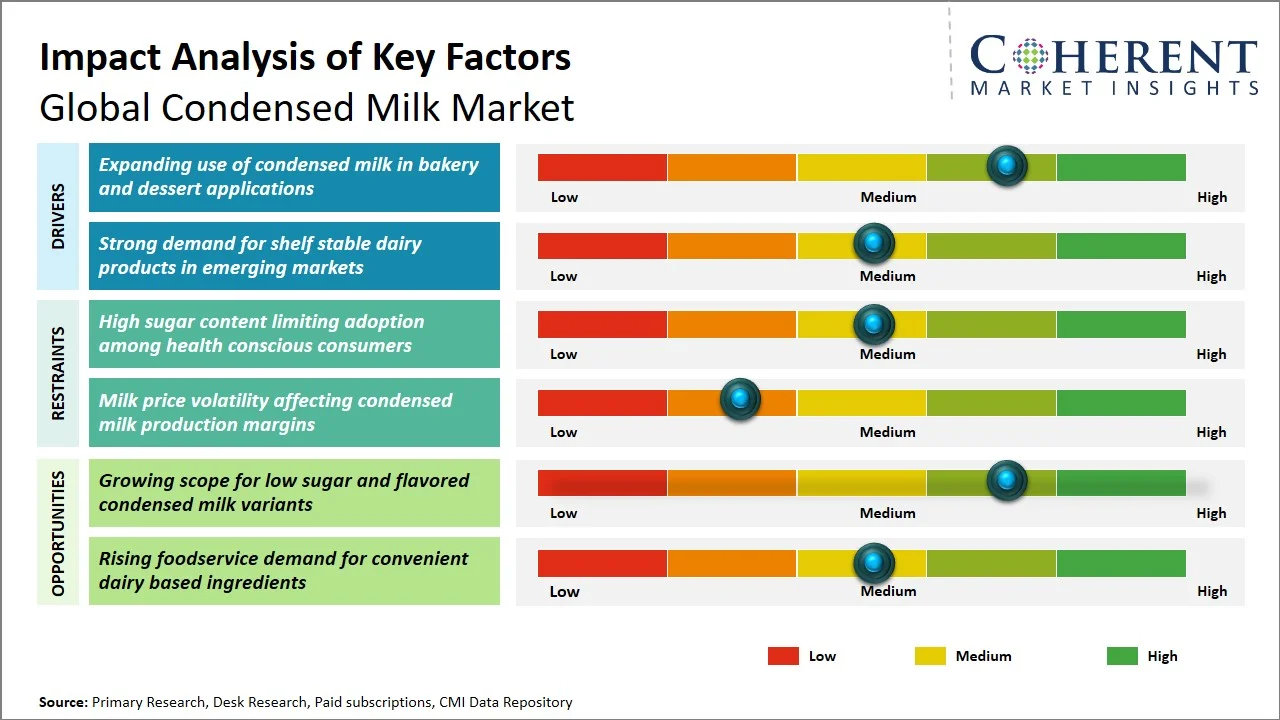
Market Drivers
- Expanding bakery and dessert applications: The condensed milk market is gaining stronger relevance as a multi-functional ingredient in bakery, confectionery, frozen desserts, café beverages, and traditional sweets because it combines dairy solids, sweetness, viscosity, and caramelized flavor in one input. For food manufacturers, this reduces formulation complexity and supports consistent texture in cakes, flans, ice creams, fudges, fillings, and milk-based drinks. The driver is especially important for B2B users because condensed milk offers recipe stability, long shelf life, and ease of handling compared with fresh milk and separate sweeteners. In April 2026, Bon Appétit tested 13 sweetened condensed milk brands for desserts, drinks, hot tea, and no-churn ice cream, highlighting its practical use across recipe formats and consumer-facing food applications.
- Strong demand for shelf-stable dairy in emerging markets: Shelf-stable dairy formats are supporting condensed milk adoption in emerging markets where cold-chain limitations, rural distribution gaps, affordability, and hot climates influence product choice. Condensed milk fits these conditions because it can be transported and stored more efficiently than refrigerated dairy, while still serving household, foodservice, retail, and industrial ingredient needs. This strengthens adoption in markets such as Indonesia, India, Brazil, Mexico, and Southeast Asia, where both modern retail chains and small food businesses require durable dairy inputs. In April 2025, USDA FAS Jakarta reported that fresh, shelf-stable UHT, flavored, and condensed milk together accounted for 60% of Indonesia’s dairy consumption, highlighting the commercial relevance of shelf-stable dairy formats.
Emerging Trends
- Shift toward flexible and aseptic packaging formats: Condensed milk packaging is gradually moving beyond traditional cans as manufacturers explore aseptic cartons, spouted pouches, tubes, and portion-control packs to improve convenience, dispensing control, and channel suitability. While cans remain the dominant format, alternative packaging is creating new value in retail, foodservice, e-commerce, and on-the-go consumption. These formats help reduce wastage, improve handling, and support smaller pack sizes for price-sensitive consumers. For brands, packaging diversification also enables premium positioning, better shelf differentiation, and wider suitability for modern trade and convenience retail. This trend is particularly relevant for sweetened condensed milk because its thick texture benefits from resealable and easy-pour formats.
- Rising focus on sugar reduction and cleaner labeling: Condensed milk manufacturers are increasingly operating in a market where sugar content, nutrition labeling, and health-positioning influence purchasing decisions. Since sweetened condensed milk is traditionally high in sugar, brands are likely to expand low-sugar, portion-controlled, and alternative sweetener-based formats to retain dessert functionality while addressing health-conscious consumers. This trend is expected to influence both retail and foodservice demand, as bakeries, cafés, and packaged dessert producers seek ingredients that balance indulgence with clearer nutrition claims. Reformulation can also help manufacturers protect category relevance among younger consumers, urban households, and institutional buyers that are increasingly attentive to sugar intake, label transparency, and balanced product positioning.
Regional Insights
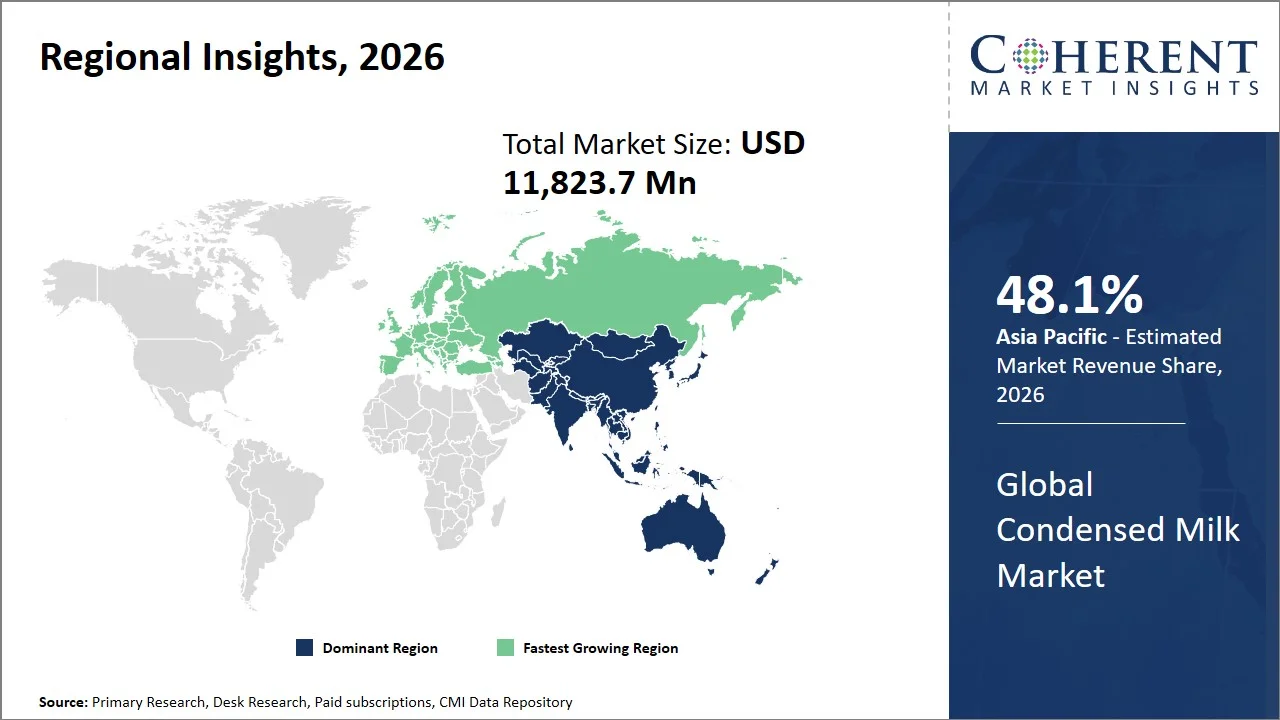
Why Does Asia Pacific Dominate the Global Condensed Milk Market?
Asia Pacific is expected to dominate the global condensed milk market with 48.1% share in 2026, supported by strong consumption of condensed milk in household desserts, tea and coffee preparations, bakery fillings, sweet snacks, and foodservice recipes. The region benefits from large dairy-consuming populations, expanding modern retail, and established processing networks across India, China, Indonesia, Vietnam, and Malaysia. Shelf-stable dairy formats remain important in tropical markets, as they reduce cold-chain dependency and support wide rural and urban distribution. In July 2024, FrieslandCampina opened a new Frisian Flag Indonesia dairy plant in West Java, Indonesia , producing products including sweetened condensed milk, strengthening Southeast Asia’s local dairy processing and distribution capacity. (Source: FrieslandCampina)
Why is Europe Emerging as the Fastest-Growing Region in the Global Condensed Milk Market?
Europe is expected to emerge as the fastest-growing region with 23.4% share in 2026, supported by premium bakery culture, café consumption, processed dessert manufacturing, and growing demand for convenient shelf-stable dairy ingredients. The region’s mature dairy-processing base enables manufacturers to supply condensed and evaporated milk for retail, foodservice, confectionery, and bakery applications with consistent quality standards. Growth is also supported by product reformulation and alternative dairy innovation, as brands respond to changing consumer preferences around vegan, lactose-free, and specialty dessert ingredients. In January 2021, Nestlé UK highlighted Carnation Vegan Condensed Milk Alternative, made from oat and rice flour and certified by the Vegan Society, showing Europe’s role in product innovation within condensed milk alternatives. (Source: Nestlé UK)
Global Condensed Milk Market Outlook for Key Countries
Why is Mexico a Key Foodservice Market for Condensed Milk?
Mexico is important in the condensed milk market due to its strong dessert culture and high use of sweetened dairy ingredients in flan, tres leches cake, gelatins, pastries, cold desserts, and bakery fillings. The country’s foodservice sector supports demand through cafés, bakeries, hotels, restaurants, and small dessert businesses that require consistent dairy sweetness and easy preparation. Condensed milk also fits Mexico’s retail cooking culture, where canned dairy ingredients are commonly used for homemade desserts. In June 2024, Alpura published a recipe for Carlota de Limón (Mexican lemon icebox dessert) that uses sweetened condensed milk as a key ingredient, demonstrating the product’s widespread application in traditional Mexican dessert preparation.
Why is India a High-Consumption Market for Condensed Milk-Based Desserts?
India is a key condensed milk market because of its large dairy-consuming population and strong demand for convenient dessert ingredients across households, sweet shops, bakeries, cloud kitchens, and cafés. Condensed milk is widely used in kheer, halwa, laddoo, rasmalai, cakes, ice cream, chocolate, and baked products, as it delivers sweetness, dairy solids, and texture in one format. Domestic availability is supported by a large cooperative dairy base and strong retail distribution. In June 2026, Amul’s official shop listed Amul Mithai Mate as sweetened condensed milk made with pure milk fat, positioned for enhancing desserts and supplied with an easy-open-end lid.
Why is China Important for Processed Dairy and Condensed Milk Supply Chains?
China is important for the condensed milk market because of its large dairy processing base, expanding modern retail channels, and growing industrial use of dairy ingredients in bakery, beverages, confectionery, and packaged desserts. Although condensed milk is a smaller category than liquid milk, China’s broader dairy infrastructure supports production scalability, ingredient availability, and product innovation in shelf-stable formats. Domestic processors are also strengthening upstream integration to reduce import dependence and stabilize raw milk supply. In November 2025, USDA FAS reported that large farms with over 1,000 head accounted for more than 68% of China’s dairy production in 2025, highlighting increasing scale and supply-chain consolidation.
Why is Indonesia a Major Southeast Asian Market for Sweetened Condensed Milk?
Indonesia is a major market due to the widespread use of sweetened condensed milk in beverages, bread toppings, desserts, street food, and household recipes. The product fits local demand for affordable dairy-based sweetness, long shelf life, and easy storage in tropical conditions. Foodservice adoption is also strong across coffee stalls, bakeries, quick-service outlets, and small food businesses. Supply-side growth is supported by investments in local production and distribution, helping companies serve both Indonesia and wider Southeast Asia. In July 2024, FrieslandCampina opened a new Frisian Flag Indonesia dairy plant in Cikarang, with products including fluid milk and sweetened condensed milk, strengthening regional production capacity. (Source: FrieslandCampina)
Why is Brazil the Strong Dessert-Led Condensed Milk Market?
Brazil is significant in the condensed milk market because the product is deeply linked with dessert preparation, including brigadeiro, puddings, cakes, fillings, sweet sauces, and festive recipes. The market benefits from strong supermarket availability, high household usage, and a large bakery and confectionery base. Local dairy processors support category depth through broad portfolios and national distribution. In June 2026, Piracanjuba’s official product platform featured condensed milk as “the right choice for your recipe,” while the company states its portfolio spans more than 140 items and includes dairy products from cream to condensed milk.
Technology Adoption Landscape in the Global Condensed Milk Market
Technology | Key Features | Clinical Advantage | Market Relevance |
Vacuum evaporation / falling-film evaporation | Removes water from milk under vacuum at controlled temperatures; improves concentration of milk solids while limiting excessive heat damage. | Helps retain dairy flavor, texture, and nutritional quality while reducing microbial risk through controlled processing. | Core technology for producing sweetened condensed milk and evaporated milk at industrial scale; supports consistent viscosity, solids content, and batch quality. |
UHT and in-container sterilization | Uses high-temperature treatment or sterilization after filling to extend shelf life and reduce microbial load. | Improves product safety and enables ambient storage before opening, reducing dependence on refrigeration. | Highly relevant for emerging markets and export trade where long shelf life, retail durability, and cold-chain reduction are major adoption factors. |
Aseptic filling and shelf-stable packaging | Combines sterile processing, sterile packaging, and sealed containers such as cartons, pouches, or aseptic packs. | Protects product from post-processing contamination and helps maintain quality during storage and transport. | Supports growth of convenient, lightweight, and non-can formats, especially for modern retail, foodservice, e-commerce, and single-use applications. |
Membrane filtration and pre-concentration | Uses ultrafiltration, nanofiltration, or reverse osmosis to separate and concentrate milk components before evaporation. | Can improve product consistency, reduce thermal load, and support cleaner concentration of milk solids. | Helps manufacturers reduce energy consumption, improve process efficiency, and develop customized dairy ingredient bases for condensed milk applications. |
Energy-efficient MVR evaporation | Mechanical vapor recompression reuses vapor energy during evaporation, reducing steam and utility requirements. | Supports more controlled processing conditions and reduces environmental impact associated with dairy concentration. | Important for large dairy processors aiming to reduce operating costs, energy intensity, and carbon footprint in condensed milk production. |
Automated mixing, dosing, and quality control systems | Uses automated sugar dosing, inline blending, viscosity monitoring, temperature control, and digital process supervision. | Improves food safety, reduces formulation errors, and ensures consistent sweetness, texture, and product quality. | Strengthens industrial-scale production for B2B bakery, confectionery, beverage, and dessert manufacturers requiring standardized condensed milk inputs. |
Vacuum evaporation / falling-film evaporation | Removes water from milk under vacuum at controlled temperatures; improves concentration of milk solids while limiting excessive heat damage. | Helps retain dairy flavor, texture, and nutritional quality while reducing microbial risk through controlled processing. | Core technology for producing sweetened condensed milk and evaporated milk at industrial scale; supports consistent viscosity, solids content, and batch quality. |
How are premium dairy processing and dessert innovation creating new growth opportunities in the condensed milk market?
Premium dairy processing and dessert-led innovation are creating new growth opportunities in the condensed milk market by positioning condensed milk as a value-added ingredient for indulgent, high-quality, and differentiated food applications. Manufacturers and food brands are increasingly using condensed milk not only as a sweetener, but also as a texture-building ingredient that improves creaminess, milk richness, and flavor depth in desserts, frozen products, bakery fillings, and confectionery. This creates opportunities for dairy processors to supply customized condensed milk bases to premium dessert brands, foodservice operators, and packaged food manufacturers. For instance, in November 2025, Meiji launched a winter-exclusive Dear Milk ice cream using its proprietary Tokachi condensed milk, produced through freezing-point concentration to intensify milk sweetness, aroma, and richness without relying on non-dairy additives. This highlights how advanced processing and premium dairy positioning can expand condensed milk usage in high-value frozen dessert applications.
Market Players, Key Development, and Competitive Intelligence
Key Developments
- In October 2025, Eagle Foods highlighted continued growth across its portfolio, including Eagle Brand Sweetened Condensed Milk, Magnolia Sweetened Condensed Milk, PET Milk, and Milnot Evaporated Milk. This supported stronger visibility for condensed and evaporated milk as pantry-stable dairy products used in baking, dessert preparation, and retail household cooking.
- In June 2025, Carnation relaunched Kickin’ Jalapeño Flavored Evaporated Milk through Walmart.com, with an exclusive nationwide Walmart store rollout planned from September 2025. This development strengthened shelf-stable dairy innovation by moving evaporated milk beyond traditional baking and beverage uses into savory cooking applications such as queso, jalapeño mac and cheese, casseroles, and creamy sauces.
- In April 2025, Soprole launched Leche Condensada Azucarada in Chile, adding condensed milk to its wider dairy portfolio. This launch helped the company enter a high-frequency dessert ingredient category and strengthen its presence in value-added dairy beyond milk, yogurt, cheese, and desserts.
Competitive Landscape
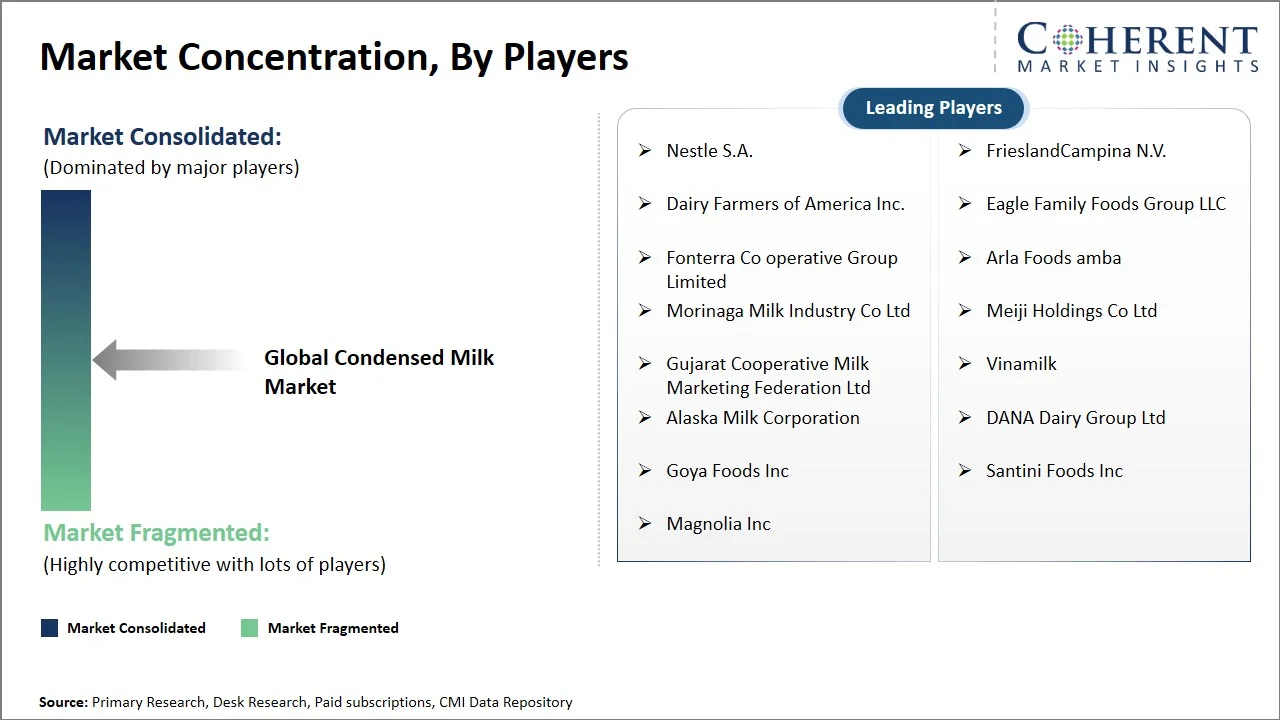
The global condensed milk market is moderately consolidated with top dairy companies focusing on brand strength, product quality, pricing, packaging types, distribution network and application-driven innovations. Foodservice, bakery, confectionery, beverage, dessert and household cooking applications are hot markets for established players that seek to augment their retail presence, foodservice products and their B2B ingredient sales. The competition also is growing with low sugar varieties, flavored condensed milk, resealable packages, tubes, pouches, and shelf stable dairy products for emerging markets.
Key focus areas include
- Development of low-sugar, flavored, protein-enriched, and lactose-free condensed milk formats
- Expansion of cans, tubes, pouches, and aseptic packs to improve convenience and shelf life
- Strengthening B2B supply for bakery, confectionery, beverages, ice cream, and dessert manufacturers
- Wider retail and e-commerce distribution to improve household penetration
- Investment in dairy processing efficiency, quality control, and shelf-stable product innovation
- Regional expansion in Asia Pacific, Latin America, and other high-consumption emerging markets
Market Report Scope
Condensed Milk Market Report Coverage
| Report Coverage | Details | ||
|---|---|---|---|
| Base Year: | 2025 | Market Size in 2026: | USD 11,823.7 Mn |
| Historical Data for: | 2020 To 2024 | Forecast Period: | 2026 To 2033 |
| Forecast Period 2026 to 2033 CAGR: | 5.2% | 2033 Value Projection: | USD 16,870.4 Mn |
| Geographies covered: |
| ||
| Segments covered: |
| ||
| Companies covered: | Nestle S.A., FrieslandCampina N.V., Dairy Farmers of America Inc., Eagle Family Foods Group LLC, Fonterra Cooperative Group Limited, Arla Foods amba, Morinaga Milk Industry Co Ltd, Meiji Holdings Co Ltd, Gujarat Cooperative Milk Marketing Federation Ltd, Vinamilk, Alaska Milk Corporation, DANA Dairy Group Ltd, Goya Foods Inc, Santini Foods Inc, and Magnolia Inc | ||
| Growth Drivers: |
| ||
| Restraints & Challenges: |
| ||
Analyst Opinion (Expert Opinion)
- The global condensed milk market is expected to witness steady long-term growth due to its strong role as a shelf-stable dairy ingredient across bakery, desserts, beverages, confectionery, and household cooking. Its ability to provide sweetness, milk solids, texture, and longer shelf life in one product is expected to support continued adoption among both retail consumers and food manufacturers.
- The strongest opportunities are likely to emerge in Asia Pacific and Latin America, where condensed milk is widely used in traditional sweets, tea and coffee, bakery products, and dessert preparation. Europe is expected to grow faster due to premium bakery culture, foodservice innovation, and rising demand for convenient value-added dairy ingredients.
- To gain a competitive advantage, market players should focus on sugar reduction, convenient packaging, product differentiation, and stronger B2B ingredient positioning. Companies that can offer consistent quality, affordable pricing, long shelf life, and application-specific formats for bakery, dessert, beverage, and foodservice users will be better positioned to capture market growth.
Speak to the analyst
Want personalized insights?
Take the findings above to one of our principal consultants, or have the report rebuilt around the segments, geographies and competitors you actually track.
Market Segmentation
- Nature Insights (Revenue, USD Mn, 2021 - 2033)
- Organic Condensed Milk
- Conventional Condensed Milk
- Product Type Insights (Revenue, USD Mn, 2021 - 2033)
- Flavored Condensed Milk
- Low Sugar Condensed Milk
- Sweetened Condensed Milk
- Evaporated Milk
- Filled Condensed Milk
- Packaging Type Insights (Revenue, USD Mn, 2021 - 2033)
- Aseptic Packs and Cartons
- Pouches
- Tubes
- Bottles and Jars
- Cans
- Others
- Application Insights (Revenue, USD Mn, 2021 - 2033)
- Beverages
- Bakery and Confectionery
- Desserts and Ice Cream
- Dairy Products
- Retail Household Use
- Others
- Distribution Channel Insights (Revenue, USD Mn, 2021 - 2033)
- B2C
- B2B
- Regional Insights (Revenue, USD Mn, 2021 - 2033)
- North America
- U.S.
- Canada
- Latin America
- Brazil
- Argentina
- Mexico
- Rest of Latin America
- Europe
- Germany
- U.K.
- Spain
- France
- Italy
- Russia
- Rest of Europe
- Asia Pacific
- China
- India
- Japan
- Australia
- South Korea
- ASEAN
- Rest of Asia Pacific
- Middle East
- GCC Countries
- Israel
- Rest of Middle East
- Africa
- South Africa
- North Africa
- Central Africa
- North America
- Key Players Insights
- Nestle S.A.
- FrieslandCampina N.V.
- Dairy Farmers of America Inc.
- Eagle Family Foods Group LLC
- Fonterra Co operative Group Limited
- Arla Foods amba
- Morinaga Milk Industry Co Ltd
- Meiji Holdings Co Ltd
- Gujarat Cooperative Milk Marketing Federation Ltd
- Vinamilk
- Alaska Milk Corporation
- DANA Dairy Group Ltd
- Goya Foods Inc
- Santini Foods Inc
- Magnolia Inc
Sources
Primary Research Interviews
- Packaging procurement heads from condensed milk and dairy processing companies
- Product managers handling canned, pouch, carton, and bottle-based dairy packaging formats
- Metal can manufacturers supplying food-grade tinplate and aluminum cans
- Aseptic carton, flexible pouch, and laminated packaging suppliers serving dairy brands
- Quality assurance and food safety professionals involved in dairy packaging compliance
- Packaging machinery providers offering filling, sealing, sterilization, and retort packaging systems
Stakeholders
- Condensed milk manufacturers
- Dairy processing companies
- Metal can producers
- Aseptic carton manufacturers
- Flexible packaging converters
- Glass and plastic packaging suppliers
- Packaging machinery and filling equipment manufacturers
- Retailers, wholesalers, supermarkets, and e-commerce grocery platforms
End-use Sectors
- Dairy processing companies
- Food and beverage manufacturers
- Bakery and confectionery producers
- Retail packaged food brands
- HoReCa sector
- Private-label food manufacturers
- Export-oriented dairy product manufacturers
Regulatory & Food Safety Bodies
- U.S. Food and Drug Administration (FDA)
- European Food Safety Authority (EFSA)
- Food Safety and Standards Authority of India (FSSAI)
- Codex Alimentarius Commission
- Health Canada
- U.K. Food Standards Agency (FSA)
- China National Health Commission
- Brazilian Health Regulatory Agency (ANVISA)
- Ministry of Health, Labour and Welfare, Japan
Databases
- UN Comtrade Database
- ITC Trade Map
- FAOSTAT
- U.S. Department of Agriculture (USDA) Dairy Data
- Eurostat Dairy Statistics
- FDA Food Contact Substances Database
- EFSA Food Contact Materials Database
- World Bank Trade and Manufacturing Data
- OECD Food and Agriculture Statistics
Magazines / Trade Publications
- Dairy Reporter
- Dairy Foods
- FoodBev Media
- Packaging World
- Packaging Digest
- Food Engineering
- Food Processing
- Beverage Daily
- FoodNavigator
- Packaging Europe
Journals
- Journal of Dairy Science
- Food Packaging and Shelf Life
- Packaging Technology and Science
- Journal of Food Engineering
- Food Control
- LWT – Food Science and Technology
- International Dairy Journal
- Foods
- Trends in Food Science & Technology
Newspapers
- The Wall Street Journal
- Financial Times
- The Economic Times
- Business Standard
Associations
- International Dairy Federation (IDF)
- Can Manufacturers Institute (CMI)
- Metal Packaging Europe
- Flexible Packaging Association (FPA)
- Sustainable Packaging Coalition
- Carton Council
- International Organization for Standardization (ISO)
- European Dairy Association
- U.S. Dairy Export Council
- Dairy Processors Association
Public Domain Sources
- FDA – Food Contact Materials and Packaging Regulations
- EFSA – Food Contact Materials Guidelines
- FSSAI – Packaging and Labelling Regulations
- Codex Alimentarius – Milk and Milk Products Standards
- USDA – Dairy Market and Production Data
- Eurostat – Dairy Production and Trade Statistics
- UN Comtrade – Dairy Packaging and Trade Flow Data
- ITC Trade Map – Import and Export Data for Dairy Products and Packaging Materials
- Company Annual Reports and Sustainability Reports of Dairy and Packaging Companies
Proprietary Elements
- CMI Data Analytics Tool, Proprietary CMI Existing Repository of information for last 10 years.
Get access to 250+ pages report
Every segment, forecast, competitor profile and data table behind the analysis above — available for instant download.
- ESOMAR Member
- ISO 9001:2015 Certified
- D-U-N-S Registered
- GDPR & CCPA Compliant
Missing comfort of reading report in your local language? Find your preferred language:
Transform your Strategy with Exclusive Trending Reports
Frequently Asked Questions
The CAGR of the condensed milk market is projected to be 5.2% from 2026 to 2033.
The condensed milk market is estimated to be valued at USD 11,823.7 million in 2026 and is expected to reach USD 16,870.4 million by 2033.
The cans segment dominates the condensed milk market and is expected to account for a 53.8% share in 2026.
Expanding use of condensed milk in bakery and dessert applications and strong demand for shelf stable dairy products in emerging markets are the major factors driving the growth of the global condensed milk market.
High sugar content limiting adoption among health-conscious consumers and milk price volatility affecting condensed milk production margins are the major factors hampering the growth of the global condensed milk market.
In terms of nature, conventional condensed milk is estimated to dominate the market revenue share in 2026.
Nestle S.A., FrieslandCampina N.V., Dairy Farmers of America Inc., Eagle Family Foods Group LLC, Fonterra Cooperative Group Limited, Arla Foods amba, Morinaga Milk Industry Co Ltd, Meiji Holdings Co Ltd, Gujarat Cooperative Milk Marketing Federation Ltd, Vinamilk, Alaska Milk Corporation, DANA Dairy Group Ltd, Goya Foods Inc, Santini Foods Inc, and Magnolia Inc are the major players.