

Global Convergent Billing Market Size and Forecast – 2026 To 2033
The global convergent billing market is expected to grow from USD 18.30 Bn in 2026 to USD 73.75 Bn by 2033, registering a compound annual growth rate (CAGR) of 16.3% from 2026 to 2033. The global convergent billing market is driven by increasing migration from legacy billing infrastructure toward cloud native platforms. On March 13, 2025, TIM Brasil announced a strategic partnership with Ericsson to modernize its billing systems, consolidating multiple platforms and unifying systems across its consumer, corporate, and fixed customers segments with the cloud-native Ericsson Billing solution.
Key Takeaways of the Global Convergent Billing Market
- The Software segment is expected to account for 61.0 % of the global convergent billing market share in 2026. Expansion of bundled telecommunications and digital services is driving the growth of the segment. On May 27, 2025, Airtel launched its all-in-one OTT entertainment packs for prepaid customers, combining mobile connectivity with access to more than 25 OTT platforms, including Netflix, JioHotstar, ZEE5 and SonyLIV.
- The Cloud segment is estimated to capture 54.0 % of the market share in 2026. Growing requirement for real time charging and personalized pricing is majorly driving the growth of the segment. On May 15, 2026, Nokia announced it has integrated GenAI into its Converged Charging solution to support real-time personalized offers, dynamic monetization and automated creation of tariffs and bundles.
- The Prepaid Billing segment is estimated to capture 46.0 % of the market share in 2026. Increasing adoption of subscription based business models is driving the growth of the segment. On September 4, 2025, Tata Elxsi and Evergent announced the launch of Subscription Hub, a unified platform that redefines how media and telecom operators offer, manage and monetize subscription offerings to their customers.
- North America is expected to dominate the convergent billing market in 2026 with a market share of 32.0 %. Increasing monetization of IoT connectivity and machine to machine services in North America is driving the growth of the regional market. On October 20, 2025, T-Mobile unveiled Edge Control and T-Platform for enterprise clients, bringing together 5G Advanced connectivity, IoT deployments, network performance monitoring and centralized management in one platform.
- Asia Pacific is expected to account for 27.0 % share in 2026. Rising demand for AI enabled billing analytics and revenue assurance across Asia Pacific is driving the growth of the regional market. On January 23, 2025, Grameenphone renewed its partnership with Ericsson with a six-year agreement that includes AI in its BSS environment, including intelligent usage analysis for charging and AI-based charging anomaly detection to identify possible revenue leakage and avoid billing-related losses.
Segmental Insights
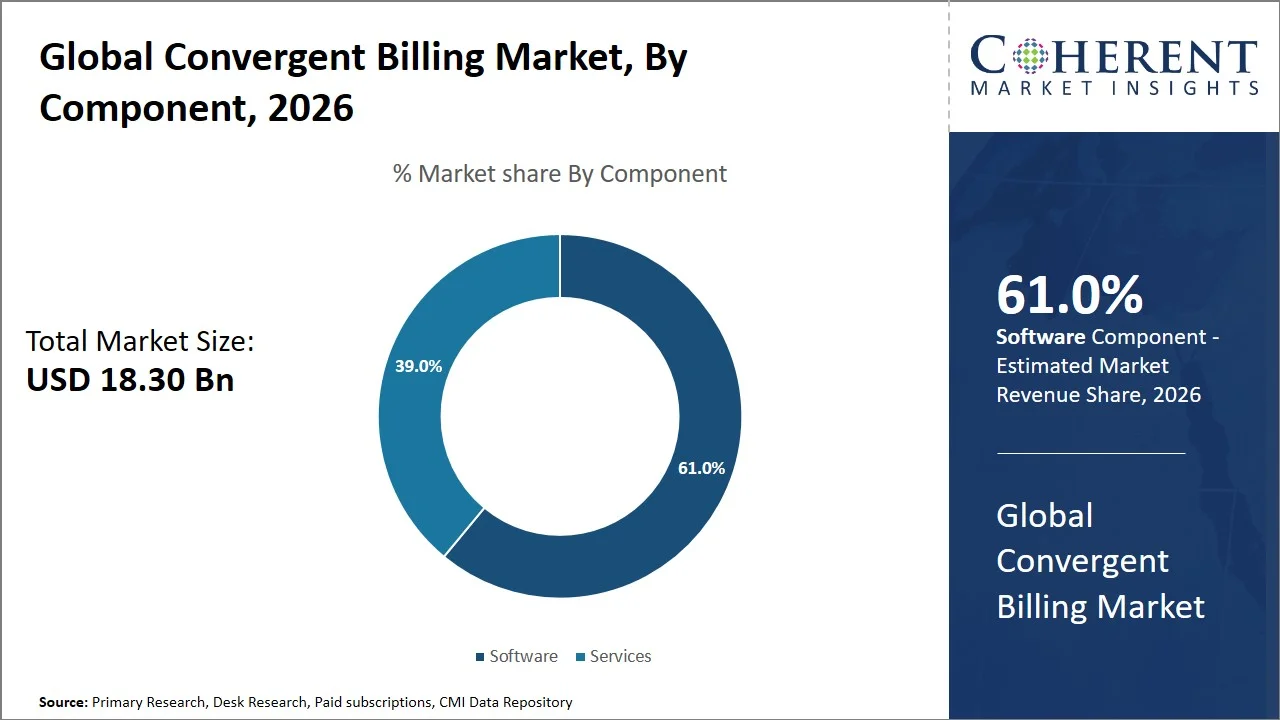
Why Does Software Dominate the Global Convergent Billing Market?
The software segment is expected to account for 61.0% of the global convergent billing market share in 2026. Software holds the largest share of the global convergent billing market as telecom operators seek flexible platforms to combine charging, billing, customer accounts, usage data and revenue management across multiple services including mobile, broadband, 5G, IoT and digital subscriptions. Modern software-based billing platforms allow operators to implement sophisticated pricing models, real-time charging, bundles and tailored rates without major changes to underlying infrastructure. The change to cloud-native architectures is also facilitating faster deployment, easier scalability and integration with current BSS and OSS environments, making software a more flexible alternative as operators migrate away from fragmented legacy billing systems. On June 17, 2025, Ericsson announced it is evolving its Business and Operations Support Systems (OSS/BSS) portfolio at pace to ensure Communication Service Providers (CSPs) globally are fully supported for innovation as they introduce new services and revenue streams relying on AI, intents and Autonomous Networks.
- Current Industry Events of 2026
- Market Size Estimation
- Regional Breakdown
- Competitive Landscape
- Customer Intelligence
- Segmental Analysis
- Pricing Analysis
- Key Market Drivers, Challenges & Future Trends
- Customized Insights Section
Why is Cloud the Most Preferred Deployment Type?
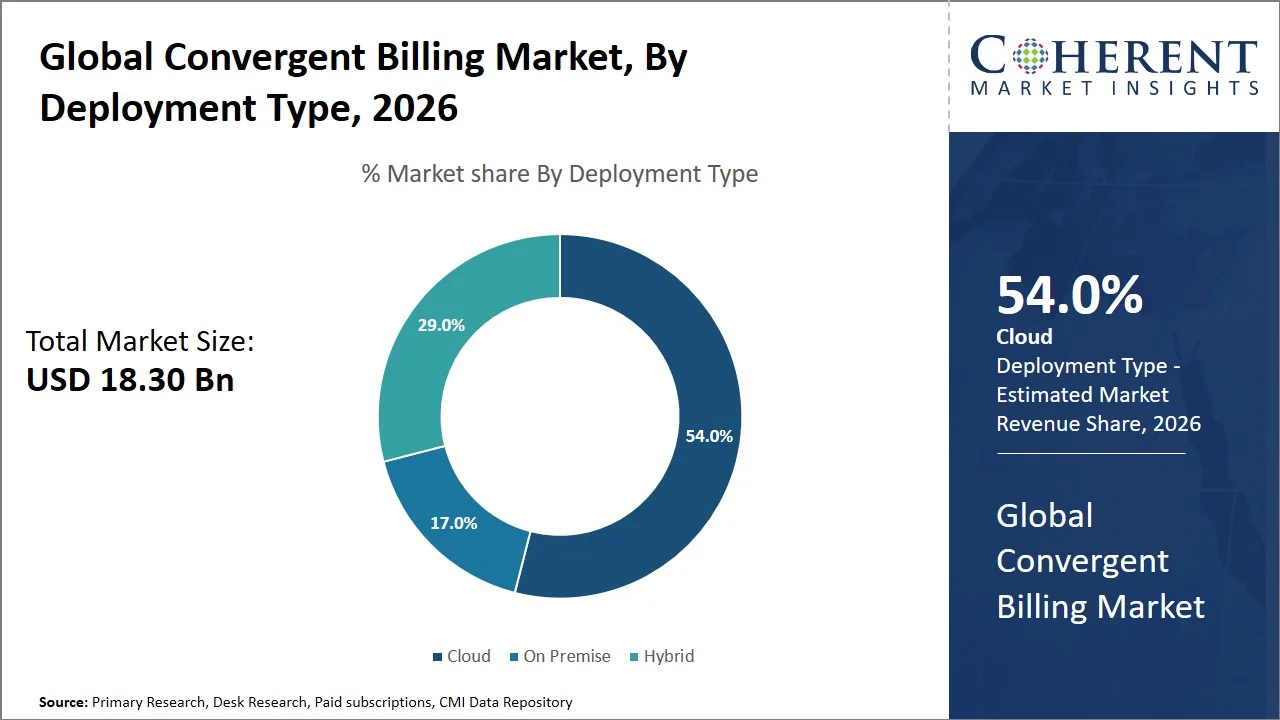
The cloud segment is expected to account for 54.0% of the global convergent billing market share in 2026. The cloud is the preferable option since it enables convergent billing platforms to scale rapidly in response to changing subscriber volumes, service portfolios and transaction loads without operators having to constantly build physical infrastructure. Cloud-based systems also provide speedier integration with 5G, IoT, digital services and real-time charging settings, while lowering the operational load of supporting on-premise hardware. This flexibility enables telecom operators to deploy new billing models and packaged services more rapidly, while enhancing system availability and enabling geographically dispersed operations. On October 22, 2024, Odido successfully migrated its billing environment to a single cloud-native Ericsson Billing platform hosted on AWS, consolidating the billing for its main brand and MVNO Ben across consumer and enterprise services, with more than 5.7 million subscribers eventually being migrated to the platform.
Prepaid Billing Dominates the Global Convergent Billing Market
The prepaid billing segment is expected to account for 46.0% of the global convergent billing market share in 2026. Prepaid billing is widely accepted as it allows telecoms operators greater control over revenue collection, and less exposure to payment defaults and credit-related concerns. The approach allows users to prepay mobile voice, data, broadband and digital services and is well suited to markets where there are substantial mobile subscriber bases and a strong need for flexibility in spending. Real-time balance tracking and rapid service activation or suspension also assist operators to manage usage efficiently while giving customers more control over their communication spending. On June 18, 2025, T-Mobile launched three new prepaid plans with unlimited talk and text, high-speed 5G data, international perks and bundled entertainment features, as it continues to invest in flexible prepaid propositions and upfront customer payment models.
Current Events and their Impact
Current Events | Description and its Impact |
India - Telecommunications (Authorisation for Provision of Principal Telecommunication Services) Rules, 2026 |
|
European Union - Digital Services Act |
|
Convergent Billing Market Dynamics
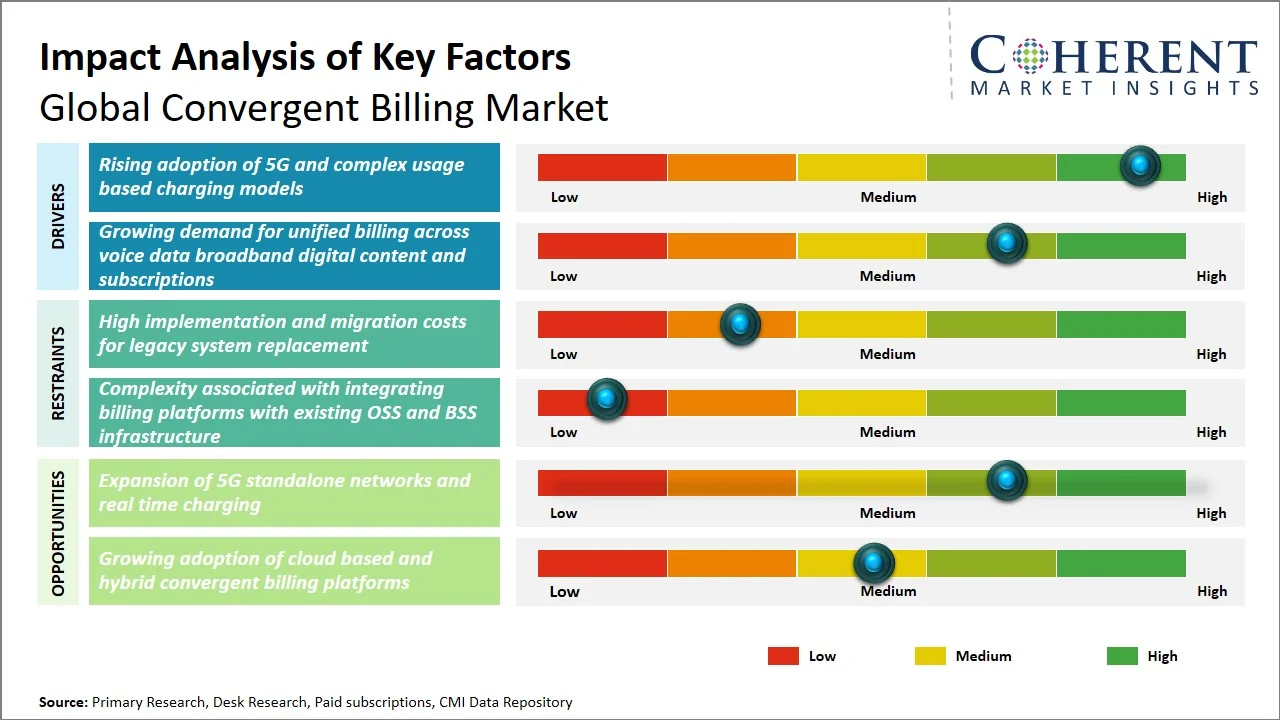
Market Drivers
- Rising adoption of 5G and complex usage based charging models: Telecom service monetization is becoming more complex with the rapid rollout of 5G networks with differentiated data plans, network slicing, ultra low latency services, enterprise connectivity and IoT applications by operators. These services generally demand real time charging depending on data consumption, bandwidth, quality of service, location, device type and duration, which make conventional billing systems inappropriate. Convergent billing technologies allow operators to bundle these characteristics into flexible charging rules and support dynamic pricing, letting them monetize a variety of 5G use cases while providing accurate and timely invoicing. On April 29, 2025, Ooredoo Qatar and Ericsson collaborated to enhance Ooredoo’s charging infrastructure, leveraging their long-standing charging collaboration and strengthening Ooredoo Qatar’s capabilities in the 5G era.
- Growing demand for unified billing across voice data broadband digital content and subscriptions: Telecom operators are increasingly bundling mobile voice, data, broadband, streaming, gaming, cloud services and other digital subscriptions into integrated offerings, creating a need for a single billing environment that can handle different services and payment structures. Unified billing enables operators to aggregate numerous charges into a single customer account and invoice, while offering a consistent view of consumption, payments, discounts and subscription entitlements. This enables operators to deploy cross service bundles and personalized offers more efficiently, while simplifying client management. On November 11, 2025, Amdocs announced an extended partnership with Telefónica Germany, one of Germany’s leading quad-play service providers, to deploy new GenAI use cases and extend its billing platform for both consumer and enterprise services for a further three years.
Emerging Trends
- AI driven billing and revenue management: Artificial intelligence is increasingly being integrated into convergent billing platforms to identify abnormal usage patterns, predict customer payment behaviors, spot revenue leakage and automate complex charging decisions, enabling operators to improve revenue assurance and tailor service offerings.
- Real time charging for 5G and IoT services: The growth of 5G infrastructure, private networks and IoT is generating demand for real time charging capabilities that can calculate usage based on data volume, network quality, device type, application and service duration, allowing operators to monetize highly differentiated connectivity services.
- Cloud native and API driven billing architectures: Operators are adopting cloud-native billing environments with modular architectures and open APIs to enable faster integration with digital platforms, payment systems, customer experience applications and emerging communication services, and reduce dependence on rigid legacy infrastructure.
- Convergence of telecom and digital service billing: Billing platforms are evolving from handling traditional voice and data services to encompassing streaming, gaming, content subscriptions, broadband, cloud services and connected devices in unified customer accounts, enabling bundled offerings and more personalized pricing models.
Regional Insights
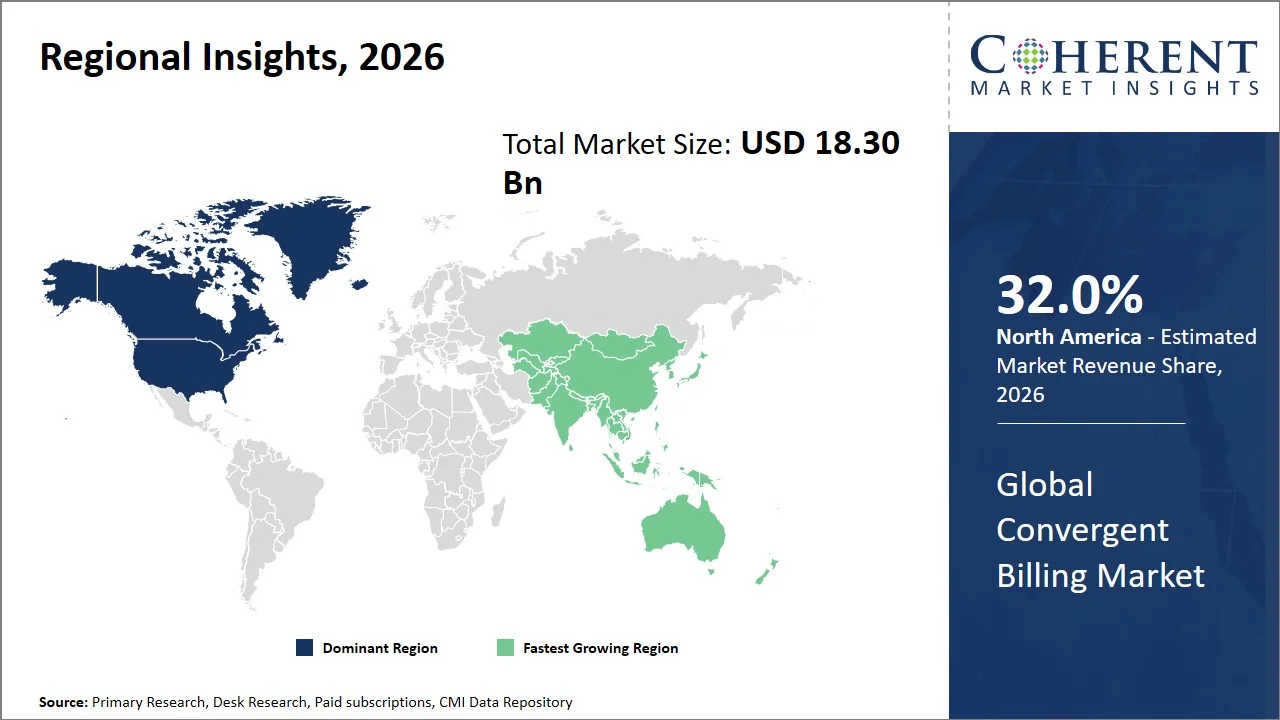
Why is North America a Strong Market for Convergent Billing?
North America is expected to account for a market share of 32.0% in 2026. The fast convergence of mobile, fiber, fixed wireless access and digital entertainment services is driving the need for billing systems that can combine various subscriptions and promotional rights into a single customer account in North America. Verizon added more than 300,000 mobility and internet connections in the second quarter of 2025 and had more than 4.8 million fixed wireless access members by the first quarter. Its 2026 Verizon One offering expressly mixes mobile and home services under one plan and one bill. In 2025, 42% of AT&T’s fiber households were also clients of its wireless service, illustrating the growing relevance of bundled billing for convergent customers.
Why Does Asia Pacific Convergent Billing Market Exhibit High Growth?
Asia Pacific is expected to register the fastest growth with a CAGR of 17.3% over the forecast period. Asia Pacific accounted for 27% of the global convergent billing market in 2026. Asia Pacific is experiencing strong demand for convergent billing because operators are simultaneously managing enormous mobile subscriber bases, 5G services, broadband, IoT, digital content, and enterprise connectivity. By the third quarter of 2025, China Mobile had more than 622 million 5G network subscribers and nearly 329 million wireline broadband subscribers. In 2024, the company's IoT card subscriber base reached 1.416 billion, creating a huge demand for differentiated charging for consumer, household, enterprise and machine connections. India is adding another layer of complexity through rapidly expanding 5G and fixed wireless access, while operators such as Jio are integrating connectivity with entertainment and digital services.
Global Convergent Billing Market Outlook for Key Countries
Why is U.S. Emerging as a Major Hub in the Convergent Billing Market?
Fixed-mobile convergence is especially impacting the U.S. convergent billing market, with operators leveraging fiber and 5G infrastructure to develop multi-service contracts rather than selling cellular connectivity as a standalone product. AT&T had more than 10 million fiber consumer subscribers at the end of 2025, and four in ten fiber houses also had wireless service. In July 2026, AT&T Internet Air had 2 million members, and more than half of those customers also utilized AT&T cellular. Verizon has also expanded its convergence strategy with fiber, 5G home internet, fixed wireless access, streaming perks and combined mobile-home agreements. This has necessitated billing infrastructure to manage discounts, entitlements, device payments and numerous connectivity offerings.
Is China the Next Growth Engine for the Convergent Billing Market?
The breadth and complexity of China Mobile's connection ecosystem is driving China, where traditional mobile billing increasingly has to live side by side with 5G, broadband, enterprise services, IoT, smart vehicles, cloud services and digital content. By the end of 2024, China Mobile had 552 million 5G users and 315 million wireline broadband customers, while its IoT card client base had grown to 1.416 billion. By the first half of 2025, China Mobile had more than 69 million linked vehicles. The operator said 5G dedicated-network revenue was up 57.8% YoY and there are more than 36.95 million commercial client packages, increasing demand for granular billing across enterprise connectivity, IoT, automotive services and packaged commercial products.
Germany Convergent Billing Market Analysis and Trends
Demand for billing is converging in Germany as mobile, fiber, television and fixed-line services are becoming more integrated, with Deutsche Telekom’s fixed-mobile convergence strategy driving this. At the end of 2025, Deutsche Telekom had 74.49 million mobile customers, 15.10 million retail broadband lines, 13.37 million fiber lines and 4.75 million TV customers in Germany. Its Germany and Europe operations had 14.7 million customers with fixed-mobile convergence or comparable offers. Converging fiber, 5G, IPTV and mobile subscriptions requires billing environments that handle household level discounts, pooled services, equipment charges and multi-product invoicing.
Japan Convergent Billing Market Analysis and Trends
Japan is being shaped by the move to more flexible 5G service structures and the convergence of telecoms with financial and domestic services. In June 2025, NTT DOCOMO announced a pair of selectable docomo MAX and docomo Poikatsu MAX plans, with more than 3 million memberships as of March 2026. Its billing ecosystem integrates mobile charges and d CARD, family discounts, home 5G, and power discounts. DOCOMO also launched 5G standalone services and is developing network slicing capabilities. It is seeing a growing requirement for billing solutions that can handle optional network features, usage-based services, bundled discounts and numerous payment relationships.
India Convergent Billing Market Analysis and Trends
India is propelled by very large mobile and broadband subscriber bases, ambitious 5G expansion, fixed wireless access and the convergence of connectivity with digital ecosystems. By December 2025, India had over 947 million mobile wireless broadband customers and 1.007 billion broadband subscribers in total. Reliance Jio had 514.35 million broadband subscribers, while Bharti Airtel had 314.26 million. Jio also has a cloud-native online charging system that supports real-time charging for voice, data and multimedia services across fixed and mobile networks. Jio’s larger digital ecosystem combines connectivity with commerce, entertainment and other services, thus increasing the need for unified customer accounts and real-time charging.
Global Convergent Billing Market - Adoption of API-Based Charging and Monetization (2025)
Region | Operators With API-Based Charging & Monetization Adoption | Operators Still Primarily Using Non-API Charging Models |
North America | 52% | 48% |
Europe | 49% | 51% |
Asia Pacific | 41% | 59% |
Middle East | 38% | 62% |
Latin America | 27% | 73% |
Africa | 22% | 78% |
How is Expansion of 5G Standalone Networks and Real Time Charging Creating New Growth Opportunities in the Convergent Billing Market?
The expansion of 5G standalone networks is creating a direct need for convergent billing platforms that can translate network-level capabilities such as slicing, latency guarantees, throughput, device identity, application category, and location into real-time charging rules. This is particularly significant as commercial differentiated-connectivity offerings based on 5G SA network slicing increased to 84 globally by 2026, up from 65 only six months earlier, while GSMA reports that 5G SA operators can achieve 5% to 15% uplift in average revenue per user through premium connectivity offerings. In India, Bharti Airtel is deploying Ericsson’s 5G SA-enabled charging and policy solution specifically to support network-slicing monetization and new business models, while Reliance Jio is using 5G SA network slicing for fixed wireless access. These developments create opportunities for billing vendors to provide charging engines capable of processing service events instantly and pricing connectivity according to the actual performance or network resources consumed rather than relying only on conventional data-volume tariffs.
On June 12, 2025, O2 Czech Republic deployed Nokia 5G Standalone (SA) Core software in a move that will enable the country’s biggest operator to offer advanced 5G services, like slicing, that deliver a better customer experience. O2 Czech Republic is the first operator in the country to deploy 5G SA. The rollout strengthens O2 Czech Republic’s network with greater reliability, security, energy efficiency for better mobile battery life, and near zero-touch automation for managing workloads.
Market Players, Key Development, and Competitive Landscape
Key Developments
- On October 7, 2025, Ericsson announced that T-Mobile selected Ericsson Charging Evolved for its next-generation charging program, bringing session-aware charging, on-demand charging and real-time monetization across B2C, B2B and B2B2X services.
- On February 4, 2025, Amdocs announced that Tusass, Greenland’s largest telecom provider, selected Amdocs to modernize its convergent charging and billing platform. This strategic upgrade marks a milestone in Tusass’ digital transformation journey, paving the way for improved scalability, flexibility, and operational efficiency.
Competitive Landscape
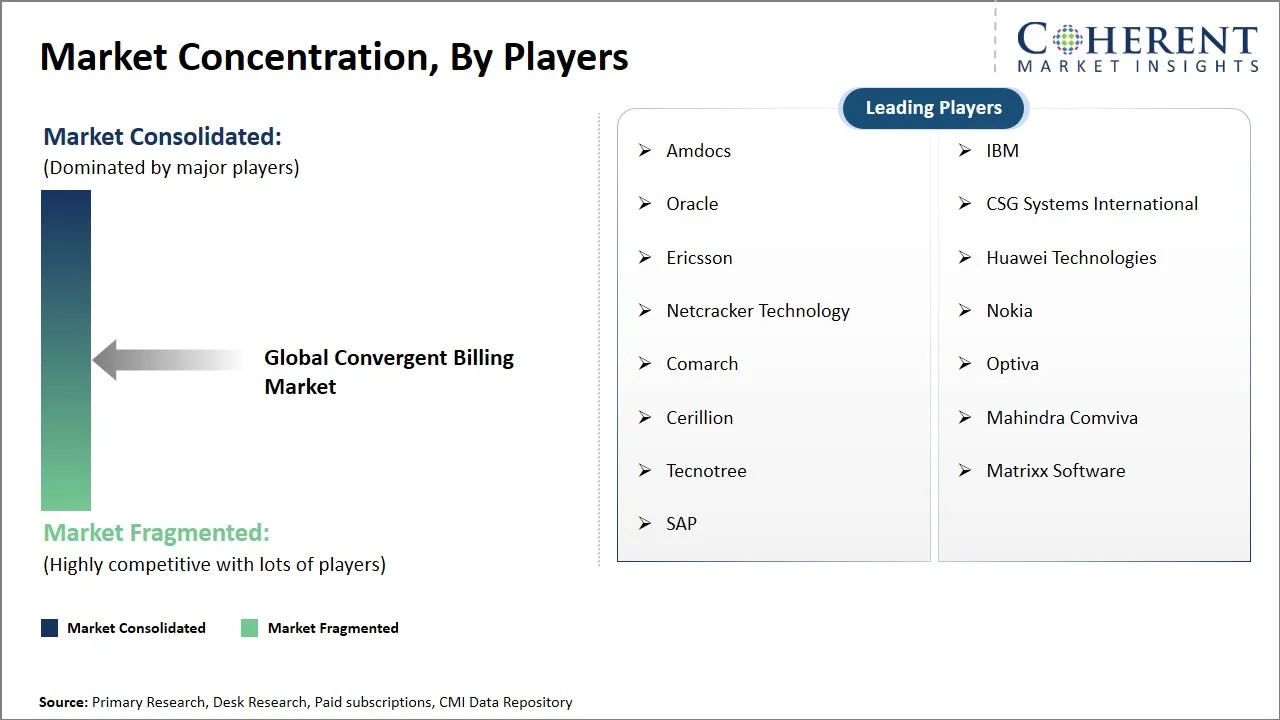
Amdocs is the leader and is consolidating its position with cloud-native convergent charging and wider 5G monetization, rather than simply traditional billing replacement. Its RevenueONE platform provides convergent charging, a single product catalog, partner management and real-time billing and its 5G Value Plane connects charging with policy control, network analytics, APIs and service catalogs to monetize attributes such as latency, speed, coverage, capacity and network slices. Amdocs has also increased deployments with operators such as Bell Canada and Odido, where billing modernization is being combined with fixed-mobile convergence and cloud-based pricing. CSG is pursuing a similar modernization strategy but is emphasizing rapid launch of complex B2B2X bundles, 5G slicing, billing, payments, and customer engagement through an AI-powered platform. Meanwhile, Oracle is strengthening revenue assurance through analytics, Ericsson is positioning its charging system around open APIs and third-party applications, and Huawei maintains a particularly strong position among Chinese operators.
Market Report Scope
Convergent Billing Market Report Coverage
| Report Coverage | Details | ||
|---|---|---|---|
| Base Year: | 2025 | Market Size in 2026: | USD 18.30 Bn |
| Historical Data for: | 2020 To 2024 | Forecast Period: | 2026 To 2033 |
| Forecast Period 2026 to 2033 CAGR: | 16.3% | 2033 Value Projection: | USD 73.75 Bn |
| Geographies covered: |
| ||
| Segments covered: |
| ||
| Companies covered: | Amdocs, IBM, Oracle, CSG Systems International, Ericsson, Huawei Technologies, Netcracker Technology, Nokia, Comarch, Optiva, Cerillion, Mahindra Comviva, Tecnotree, Matrixx Software, SAP | ||
| Growth Drivers: |
| ||
| Restraints & Challenges: |
| ||
Analyst Opinion (Expert Opinion)
- The future of the industry is expected to move from conventional subscriber billing toward real-time monetization of network capabilities and digital services. The strongest shift will occur as 5G standalone enables operators to charge for characteristics such as latency, throughput, coverage, capacity, network slices, and application-level performance rather than relying predominantly on data volume. Amdocs' charging architecture already reflects this transition by connecting policy control and charging with service catalogues and 5G network functions.
- The largest opportunity is expected to be concentrated in cloud-native convergent charging for 5G enterprise services, IoT, private networks, fixed-mobile convergence, and B2B2X models. Geographically, the U.S., China, India, Japan, and other advanced 5G markets should remain important because operators are moving beyond connectivity into network slicing, connected vehicles, enterprise connectivity, and bundled digital services; China is particularly attractive for high-volume IoT and connected-device monetization, while India offers substantial opportunity around 5G, broadband, and multi-service consumer ecosystems.
- To gain an edge, vendors should prioritize modular cloud-native architectures that allow operators to introduce charging rules without lengthy software development cycles, while integrating AI-based revenue assurance, open APIs, policy control, network analytics, and partner settlement into the same monetization environment. The ability to support rapid experimentation with pricing, service-level agreements, network slices, and industry-specific offers will become more valuable than simply processing conventional invoices, particularly as operators seek to monetize 5G investments through enterprise and ecosystem partnerships.
Speak to the analyst
Want personalized insights?
Take the findings above to one of our principal consultants, or have the report rebuilt around the segments, geographies and competitors you actually track.
Market Segmentation
- Component Insights (Revenue, USD Billion, 2021 - 2033)
- Software
- Services
- Deployment Type Insights (Revenue, USD Billion, 2021 - 2033)
- Cloud
- On Premise
- Hybrid
- Billing Type Insights (Revenue, USD Billion, 2021 - 2033)
- Prepaid Billing
- Postpaid Billing
- Hybrid Billing
- Operator Type Insights (Revenue, USD Billion, 2021 - 2033)
- Mobile
- Fixed Line
- Broadband
- Television and Digital Services
- End User Insights (Revenue, USD Billion, 2021 - 2033)
- Telecommunications Service Providers
- Enterprises
- Government Organizations
- Other Service Providers
- Regional Insights (Revenue, USD Billion, 2021 - 2033)
- North America
- U.S.
- Canada
- Latin America
- Brazil
- Argentina
- Mexico
- Rest of Latin America
- Europe
- Germany
- U.K.
- Spain
- France
- Italy
- Russia
- Rest of Europe
- Asia Pacific
- China
- India
- Japan
- Australia
- South Korea
- ASEAN
- Rest of Asia Pacific
- Middle East
- GCC Countries
- Israel
- Rest of Middle East
- Africa
- South Africa
- North Africa
- Central Africa
- North America
- Key Players Insights
- Amdocs
- IBM
- Oracle
- CSG Systems International
- Ericsson
- Huawei Technologies
- Netcracker Technology
- Nokia
- Comarch
- Optiva
- Cerillion
- Mahindra Comviva
- Tecnotree
- Matrixx Software
- SAP
Sources
Primary Research Interviews
- Chief Information Officers at Telecommunications Operators
- Chief Technology Officers at Mobile Network Operators
Journals
- IEEE Transactions on Network and Service Management
- Journal of Network and Systems Management
Associations
- Open Mobile Alliance
- Telecom Infra Project
- Broadband Forum
Public Domain Sources
- U.S. Federal Communications Commission
- European Commission
Proprietary Elements
- CMI Data Analytics Tool
- Proprietary CMI Existing Repository of Information for the Last 10 Years
Get access to 250+ pages report
Every segment, forecast, competitor profile and data table behind the analysis above — available for instant download.
- ESOMAR Member
- ISO 9001:2015 Certified
- D-U-N-S Registered
- GDPR & CCPA Compliant
Missing comfort of reading report in your local language? Find your preferred language:
Transform your Strategy with Exclusive Trending Reports
Frequently Asked Questions
The global convergent billing market is expected to stand at USD 18.30 Bn in 2026 and is expected to reach USD 73.75 Bn by 2033.
The CAGR of the global convergent billing market is projected to be 16.3% from 2026 to 2033.
Convergent billing is a unified billing approach that combines multiple services, usage types, subscriptions, and payment models into a single billing and charging environment.
It enables telecom operators to manage voice, data, broadband, digital content, IoT, and other services through an integrated monetization platform.
It provides customers with consolidated bills, simplified account management, flexible payment options, and greater visibility across multiple subscribed services.
IoT increases demand for automated and high-volume charging capabilities because connected devices can generate large numbers of usage events across different service categories.
Rising adoption of 5G and complex usage based charging models and Growing demand for unified billing across voice data broadband digital content and subscriptions are the major factors driving the growth of the global convergent billing market.