

Global Copper Sulphate Market Size and Forecast – 2026 To 2033
The Global Copper Sulphate Market is estimated to be valued at USD 1,478.4 Mn in 2026 and is expected to reach USD 2,052.7 Mn by 2033, growing at a compound annual growth rate (CAGR) of 4.8% from 2026 to 2033. Market expansion is supported by copper sulphate consumption in agricultural crop protection, mineral processing, animal nutrition, chemical manufacturing, and water-management applications. Its Fungicides and algaecides properties continue to support recurring requirements across agricultural and municipal treatment systems.
In September 2025, the City of Worcester, Massachusetts, announced a preventive algae treatment at Indian Lake using copper sulfate to control harmful, toxin-producing algae, illustrating its continued practical relevance in water-resource management.
Key Takeaways of the Global Copper Sulphate Market
- Copper sulphate pentahydrate is expected to hold 82.6 % of the global copper sulphate market in 2026 because it is the industry’s most practical commercial hydrate, combining stable handling, ready dissolution, and broad suitability across crop protection, water treatment, feed, and industrial formulations. In August 2024, the U.S. EPA registered Rotam Copper Sulfate Pentahydrate 20.5% SC for multiple agricultural and aquatic uses.
- Crystals are expected to account for 46.8 % of the market in 2026 because they offer convenient bulk handling, controlled dissolution, lower dust generation than fine powders, and flexibility for customers preparing solutions at the point of use. In March 2026, Manuchar’s plant-nutrition portfolio listed copper sulphate in crystalline form within its soluble sulphates range, reinforcing continued commercial preference for crystal-based supply.
- Agricultural fungicides and algaecides are expected to lead with 37.4 % in 2026, reflecting copper sulphate’s established role in preventive disease management and algae control where dependable contact activity and familiar application practices remain important. In October 2025, Australia’s APVMA published registration details for a copper sulfate pentahydrate soluble concentrate intended to control fungal diseases in vegetables and ornamentals.
- Asia Pacific is expected to command 45.7 % of the global market in 2026 because major agricultural economies, mineral-processing activity, expanding water-management needs, and an established copper-processing base create demand across several end-use channels simultaneously. In August 2026, Hindustan Copper’s production reporting continued to track copper sulphate in tonnes as a dedicated output category, illustrating an active regional supply base serving downstream users.
- Europe is expected to represent 18.9 % of the market in 2026 while recording the fastest growth, supported by intensive crop protection in specialty agriculture, technically specified industrial uses, and stronger integration of circular metal-processing streams into chemical supply. In July 2026, Aurubis reported that its Lunen, Germany multimetal recycling operation produces copper sulfate among its by-products, strengthening localized circular feedstock availability.
Segmental Insights
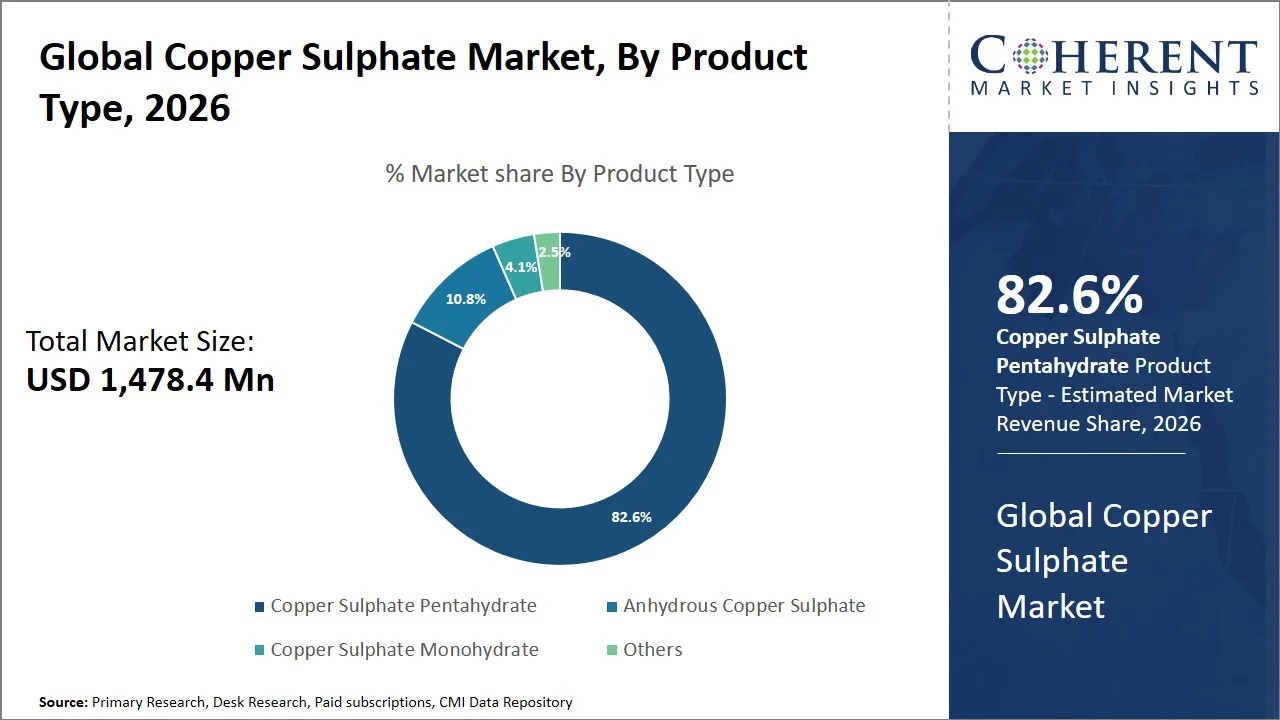
Why Does Copper Sulphate Pentahydrate Dominate the Global Copper Sulphate Market?
Copper sulphate pentahydrate is expected to lead the product-type category with 82.6% in 2026 because aqueous copper-sulphate production naturally lends itself to crystallizing the five-water hydrate, allowing manufacturers to standardize commercial output without additional dehydration steps required for anhydrous grades. This supports efficient conversion, predictable assay control, and broad availability across industrial supply chains. Demand is reinforced by buyers requiring a well-defined copper-bearing salt for biocidal formulations, electrochemical systems, feed premixes, mining reagents, and specialty chemical preparation. For producers, the segment supports high-volume manufacturing while permitting grade differentiation through impurity control and certification. In May 2026, Great Britain’s Health and Safety Executive extended the expiry date for copper sulphate pentahydrate as a PT02 biocidal active substance to July 2031, confirming continued regulatory relevance for this specific hydrate in a controlled end-use market.
- Current Industry Events of 2026
- Market Size Estimation
- Regional Breakdown
- Competitive Landscape
- Customer Intelligence
- Segmental Analysis
- Pricing Analysis
- Key Market Drivers, Challenges & Future Trends
- Customized Insights Section
Why Do Crystals Represent the Largest Form Segment in the Global Copper Sulphate Market?
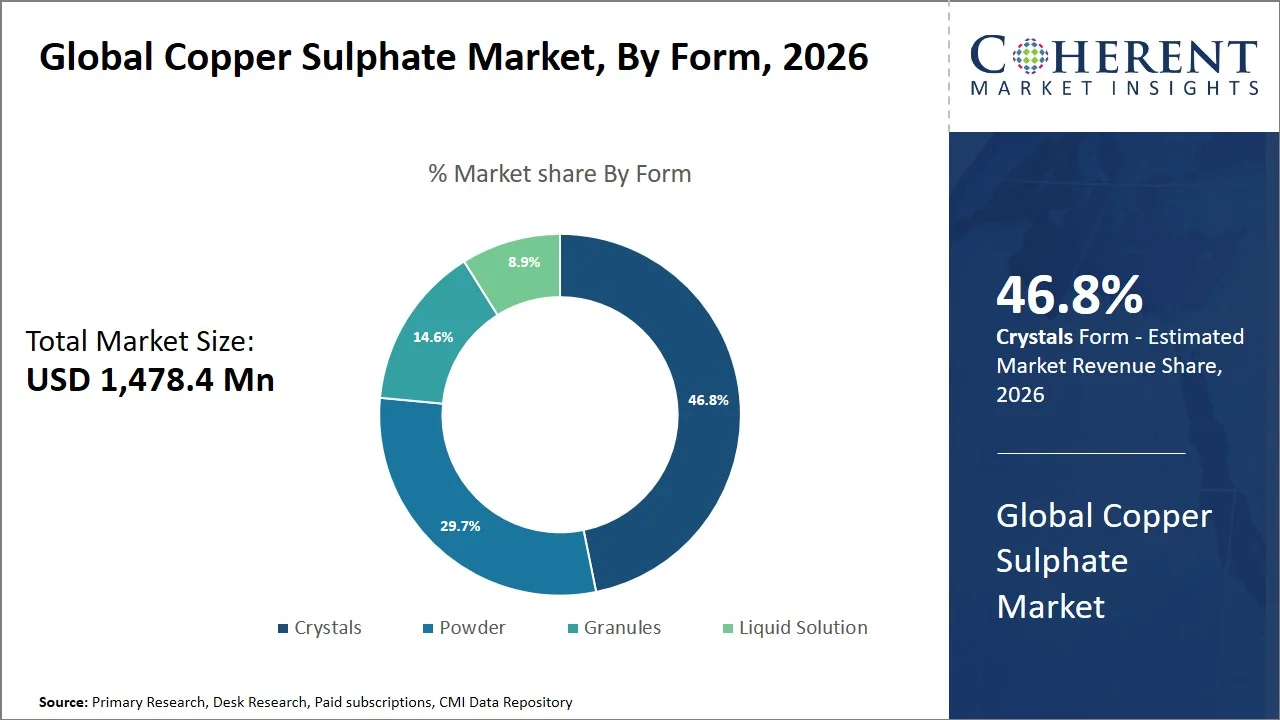
Crystals are expected to remain the largest form segment with expected market share 46.8% in 2026 because crystallization is the direct finishing route for much of commercial copper sulphate production, reducing the need for downstream milling, granulation, or transportation of water-rich solutions. This gives suppliers a comparatively straightforward manufacturing and storage model while allowing industrial users to prepare electrolyte or process solutions at their own facilities. Crystal form is particularly relevant where users value chemical integrity, controlled replenishment, and the ability to maintain solution concentration over repeated operating cycles. These characteristics support demand from cathodic-protection systems, laboratories, mining operations, and industrial chemical users. In October 2025, Hindustan Petroleum Corporation Limited issued a government e-Marketplace tender for Cu/CuSO₄ reference half-cells that explicitly required separate copper sulphate crystals to be supplied, demonstrating direct institutional procurement of the crystal form for field electrochemical infrastructure.
Why Do Agricultural Fungicides and Algaecides Dominate the Application Segment of the Global Copper Sulphate Market?
Agricultural fungicides and algaecides are expected to lead the application category because copper sulphate provides a copper-ion-based control mechanism that can be incorporated into crop disease management and aquatic algae-control programs. Its commercial relevance is strongest where growers, irrigation managers, and agricultural service providers need a familiar inorganic active that can address fungal pressure or algal interference without relying on a single biochemical target. The segment also benefits from established agricultural distribution, seasonal repeat purchasing, and compatibility with regulated organic-production practices when application conditions are observed. Manufacturers serving this application therefore compete on formulation suitability, label support, purity, and stewardship rather than commodity price alone. In July 2024, the U.S. Department of Agriculture’s Agricultural Marketing Service maintained copper sulfate within its organic-crop review framework for plant disease control and for algicide and insecticide uses, supporting its continuing role in regulated agricultural production.
Current Events and their Impact
Current Event | Description and Its Impact |
July 2026 – Canada recalls contaminated feed-grade copper sulphate pentahydrate |
|
April 2026 – European Union amends maximum residue levels for copper compounds |
|
Global Copper Sulphate Market Dynamics
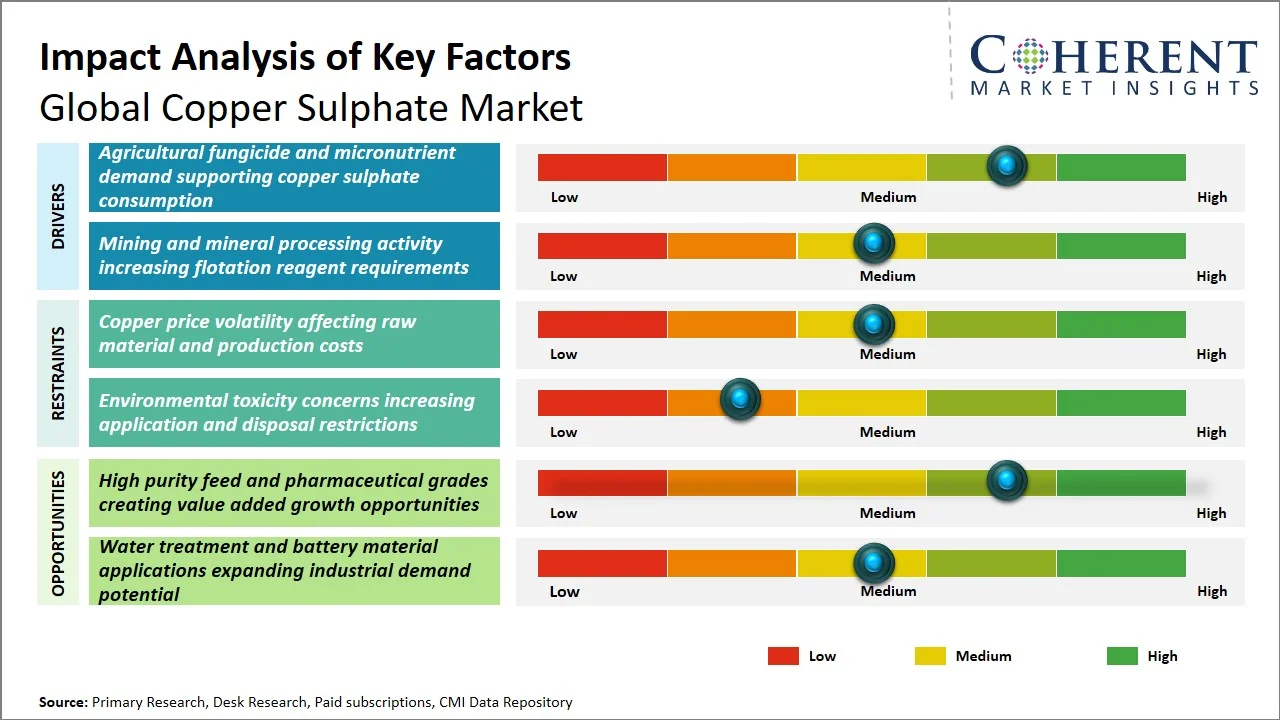
Key Market Drivers
- Agricultural fungicide and micronutrient demand supporting copper sulphate consumption: Agricultural use is a structurally important consumption base because copper sulphate serves both as a copper source and as an active component in established crop-protection formulations. Its fungicidal utility is particularly relevant in horticulture, vineyards, orchards, and other disease-sensitive crops, while micronutrient use supports corrective treatment where soil or plant copper availability is inadequate. This dual functionality broadens demand across agrochemical formulators, fertilizer blenders, agricultural distributors, and technical-grade suppliers. Commercially, suppliers that can provide consistent solubility, controlled impurities, and formulation-compatible particle characteristics are better positioned to qualify with crop-input manufacturers and maintain repeat seasonal orders. In May 2024, Nufarm reported that Cuproxat, a fungicide containing copper sulfate, was registered in South Africa, illustrating continued regulatory market access for copper-sulphate-based crop protection.
- Mining and mineral processing activity increasing flotation reagent requirements: Copper sulphate remains a functional process reagent in polymetallic mineral beneficiation, where it is commonly used as an activator in flotation circuits, particularly for sulphide minerals. Consumption therefore tracks ore throughput, mineral complexity, recovery targets, and the intensity of concentrator operations rather than simply headline copper production. Mining companies seek predictable reagent performance because variations in purity or dissolution can affect flotation chemistry, concentrate quality, and operating stability. This supports demand for industrial-grade producers, bulk chemical distributors, mine-site logistics providers, and suppliers capable of dependable delivery to remote processing locations. In February 2024, Southern Copper Corporation report recorded consumption of 319,300 kg of copper sulfate at the plant between January and October 2023, providing direct evidence of material reagent requirements within an operating polymetallic mining complex.
Emerging Market Trends
- Regionalization of Formulation and Customer-Facing Supply: Suppliers are increasingly positioning formulation, repacking, and inventory closer to major agricultural and industrial customers to reduce lead times and improve supply reliability. This model strengthens the role of regional distributors and supports flexible packaging, local stockholding, and faster fulfillment. Over the forecast period, suppliers with efficient regional networks and specification-ready delivery capabilities are likely to gain an advantage over companies dependent on long-distance imports.
- Application-Ready Liquid and Suspension Formats: Liquid and suspension copper sulphate formats are gaining relevance where users seek easier dosing, lower dust exposure, and more consistent application. These products reduce preparation steps while enabling suppliers to differentiate through formulation stability, packaging, and technical support. Although adoption is expected to remain application-specific, such formats can create higher-value opportunities and encourage investment in wet-formulation, dosing, and customer-support capabilities.
Regional Insights
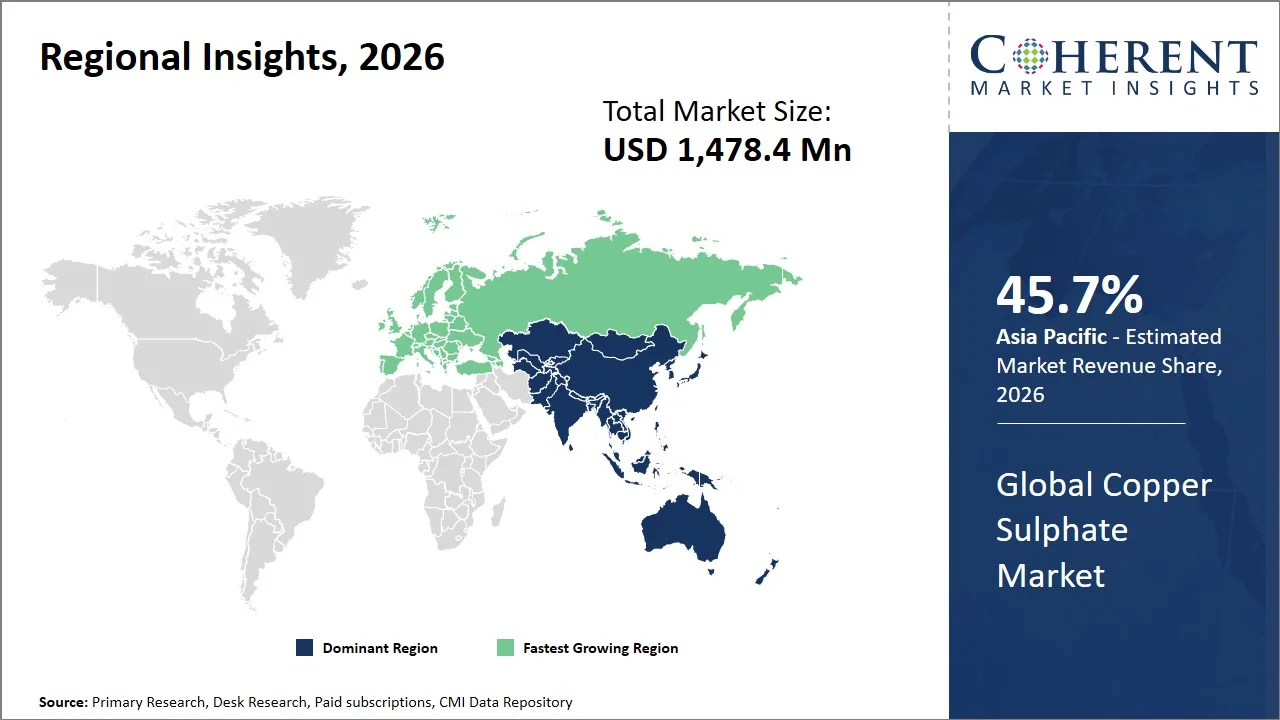
Why Does Asia Pacific Dominate the Global Copper Sulphate Market?
Asia Pacific is expected to account for 45.7% of the global copper sulphate market in 2026 because the region combines high-volume agricultural chemical consumption with mineral beneficiation, aquaculture, electroplating, and a large copper-processing base. China and India provide substantial downstream demand, while regional chemical manufacturing and distributor networks improve availability of technical, agricultural, and industrial grades. The region also benefits from proximity between copper-bearing feedstocks, conversion facilities, and end users, reducing logistics friction for a comparatively bulk chemical. Suppliers can therefore compete across both commodity crystals and more application-specific formulations. In December 2025, India’s Press Information Bureau reported the development and transfer of a stable water-based Copper Sulphate Pentahydrate 23.99% suspension-concentrate formulation, illustrating continued regional investment in higher-value copper-sulphate crop-protection technology.
Why Is Europe Emerging as the Fastest-Growing Region in the Global Copper Sulphate Market?
Europe is expected to hold 18.9% of the global copper sulphate market in 2026 and emerge as the fastest-growing region as suppliers respond to tightly specified agricultural, industrial, and environmental-use requirements. Specialty horticulture and vineyards sustain demand for copper-based crop protection, while electroplating, chemical processing, and water-related applications favor consistent purity and documented quality. Europe’s regulatory framework also encourages suppliers to compete through stewardship, traceability, impurity control, and optimized formulations rather than volume alone, supporting value growth within established applications. Localized distribution and technically qualified formulators can benefit as customers seek compliant products with reliable documentation. In July 2025, the European Commission adopted Implementing Regulation (EU) 2025/1489 extending the approval period for copper compounds used as pesticide active substances, preserving regulatory continuity while their renewal assessment proceeds.
Global Copper Sulphate Market Outlook for Key Countries
Why Is the U.S. a Key Market for the Global Copper Sulphate Market?
The U.S. is a key copper sulphate market because demand is spread across municipal water management, crop protection, animal nutrition, industrial processing, and selected mining applications, giving suppliers multiple customer channels rather than dependence on one end use. Buyers generally place strong emphasis on registered uses, documented composition, safe handling, and dependable domestic distribution, which favors established chemical suppliers and technically capable distributors. Water utilities are particularly relevant because copper sulphate remains an operational option for algae management where treatment protocols permit its use. Industrial customers also value predictable assay and dissolution performance for repeat dosing. In June 2026, the City of Peekskill, New York stated that its Water & Sewer Department currently applies copper sulfate treatment to the pre-treated Camp Field Reservoir, directly demonstrating continued municipal use within U.S. water-management operations.
Why Does China Support Growth in the Global Copper Sulphate Market?
China supports growth in the global copper sulphate market through an unusually broad combination of aquaculture, crop production, nonferrous mining, electroplating, chemical manufacturing, and industrial distribution. This diversified end-use structure enables copper sulphate suppliers to sell across agricultural, veterinary-aquaculture, flotation, and technical-grade channels, helping stabilize demand across seasonal and industrial cycles. Domestic manufacturing clusters also make rapid product conversion, packaging, and regional delivery commercially practical, while large numbers of downstream users support specialized grades rather than a single commodity specification. Aquaculture is a distinct demand pocket because copper sulphate can be used under defined treatment conditions for certain parasitic problems. In June 2025, Guangzhou’s agriculture authority recommended copper sulphate treatments in its aquaculture disease forecast, including specified pond-treatment concentrations, confirming active use within a major Chinese aquaculture market.
Why Is India Important in the Global Copper Sulphate Market?
India is important to the global copper sulphate market because expanding copper-processing infrastructure is improving the upstream platform from which sulphate salts and other copper chemicals can be supplied, while agriculture, fertilizer micronutrients, mining, electroplating, and chemical manufacturing provide diverse downstream demand. The country’s large agricultural distribution system creates recurring requirements for copper-containing crop and nutrient inputs, whereas industrial customers support technical-grade consumption. Greater domestic smelting and refining capability can also improve feedstock security for local chemical conversion and reduce exposure to imported processed copper. In February 2026, NITI Aayog reported that India’s installed copper smelting capacity had reached around 1.03 million tonnes per annum and highlighted additional processing capacity emerging in Kutch. This expansion strengthens the broader domestic copper value chain from which copper sulphate producers can source material and build localized supply.
Why Is Chile a Strategic Country in the Global Copper Sulphate Market?
Chile is a strategic country for the global copper sulphate market because it combines a globally important copper industry with concentrated agricultural uses that require copper-based formulations. Its mining and metallurgical infrastructure provides technical expertise, copper-bearing material streams, and established chemical logistics, while vineyards and other high-value crops create demand for fungicidal and bactericidal products. This combination allows suppliers to participate in both industrial and agricultural value chains and gives local formulators an advantage in tailoring products to crop-specific requirements. For market participants, Chile is therefore relevant not only as a copper-resource economy but also as a specialized downstream consumption base. In July 2025, Chile’s Agricultural and Livestock Service published the authorized AGROCOPPER SP label, identifying copper sulphate pentahydrate at 98% by weight as the active ingredient in a contact fungicide-bactericide.
Why Is Brazil an Important Growth Market for the Global Copper Sulphate Market?
Brazil is an important growth market for copper sulphate because its large and geographically diverse agricultural economy creates recurring need for crop-protection formulations, copper micronutrient inputs, and farm-level disease-management products. Tropical and subtropical production conditions increase the commercial importance of preventive disease control, while a broad agricultural-input distribution network enables copper-containing formulations to reach professional growers across multiple states. Beyond crop protection, animal nutrition and industrial chemical uses provide additional demand channels. Suppliers that can combine regulatory documentation, formulation support, and regional inventory are better positioned than purely spot-market sellers. In May 2025, Brazil’s Ministry of Agriculture recorded completion of phytosanitary-product processes covering a copper sulphate solution combined with calcium hydroxide, alongside related mixed formulations, demonstrating continued regulatory processing of copper-based agricultural inputs within the country.
Technology Adoption Landscape in the Global Copper Sulphate Market
Technology | Adoption Level | Key Application Area | Business Impact |
Reaction-Controlled Copper Dissolution and Leaching Systems | High | Copper sulphate manufacturing | Improves reaction control, copper conversion efficiency, feedstock utilization, and consistency of the solution entering downstream processing. |
Centrifugal Crystal Separation and Low-Temperature Drying | High | Copper sulphate pentahydrate finishing | Improves moisture control, crystal handling, free-flow characteristics, packaging stability, and consistency between production batches. |
Automated Reagent Dissolution and Metering Skids | High | Mineral flotation and industrial water treatment | Provides repeatable solution concentration and dosing while reducing manual handling, process variability, and avoidable reagent consumption. |
ICP-OES / ICP-MS Trace-Impurity Analysis | High | Feed, agricultural, electroplating, and specialty grades | Strengthens contaminant detection, batch-release control, customer qualification, and compliance with increasingly specific impurity requirements. |
Laser-Diffraction Particle-Size Analysis | Medium | Powder and crystal quality control | Enables tighter particle-size distribution, supporting predictable dissolution, formulation compatibility, flowability, and customer-specific specifications. |
Fluid-Bed Granulation and Anti-Caking Conditioning | Medium | Granular copper sulphate production | Improves flow characteristics, reduces dust and agglomeration, supports mechanized dosing, and increases storage and handling reliability. |
How Are Controlled-Dosing Water and Aquaculture Applications Creating New Growth Opportunities in the Global Copper Sulphate Market?
Water bodies that require algae management, reservoir maintenance, irrigation-system control, and selected aquaculture treatments create an underdeveloped opportunity for copper sulphate suppliers that can move beyond selling undifferentiated crystals. The commercial opening lies in controlled-dosing solutions built around application guidance, rapid-dissolution formats, water-chemistry assessment, residue management, and packaging suited to smaller or recurring treatment volumes. Potential customers include aquaculture operators, irrigation districts, industrial ponds, water-management contractors, and institutional facility operators. Suppliers can capture higher-value business by pairing material supply with dosing protocols, documentation, local inventory, and technical support that reduces misuse and improves treatment consistency. Participation requires application expertise, disciplined labeling, environmental compliance capability, and distribution partners able to reach decentralized users. This opportunity is likely to favor specialist chemical suppliers and technically capable regional distributors rather than commodity-only producers, because purchasing decisions in these applications depend heavily on treatment reliability, responsible use, and responsive field support. It also creates room for differentiated service contracts.
Market Players, Key Development, and Competitive Landscape
Key Developments
- In March 2026, Tartana Minerals Limited commenced process and plant upgrades at its copper sulphate pentahydrate facility in Queensland, including replacement of the chiller circuit used within the solvent-extraction– crystallization process. The investment was explicitly aimed at improving production capacity and plant reliability. This is important for the global copper sulphate market because it demonstrates targeted capital deployment toward removing crystallization bottlenecks and improving the operating consistency of a regional producer; the announcement describes intended improvements rather than proof that the targeted throughput was subsequently achieved.
- In July 2025, KGHM Polska Miedź S.A. implemented and maintained an integrated management system at its Legnica Copper Smelter and Refinery covering copper sulphate production, documented through an IQNET-recognized certificate incorporating quality, environmental, and occupational-health-and-safety standards. This is important for the global copper sulphate market because auditable manufacturing systems strengthen supplier qualification and provide additional assurance to industrial customers that evaluate operating discipline alongside chemical specifications and price.
- In March 2025, Jinchuan Copper Precious Metal Company expanded its electronics-materials market outreach by introducing high-purity copper sulfate alongside other copper products at the International Electronic Circuit Exhibition in Shanghai. Jinchuan identified printed circuit boards, semiconductor applications, chemical plating, and high-end electroplating among the relevant uses. This is important for the global copper sulphate market because it illustrates supplier movement toward purity-sensitive applications where technical qualification and impurity control can support differentiation beyond bulk industrial grades.
Competitive Landscape
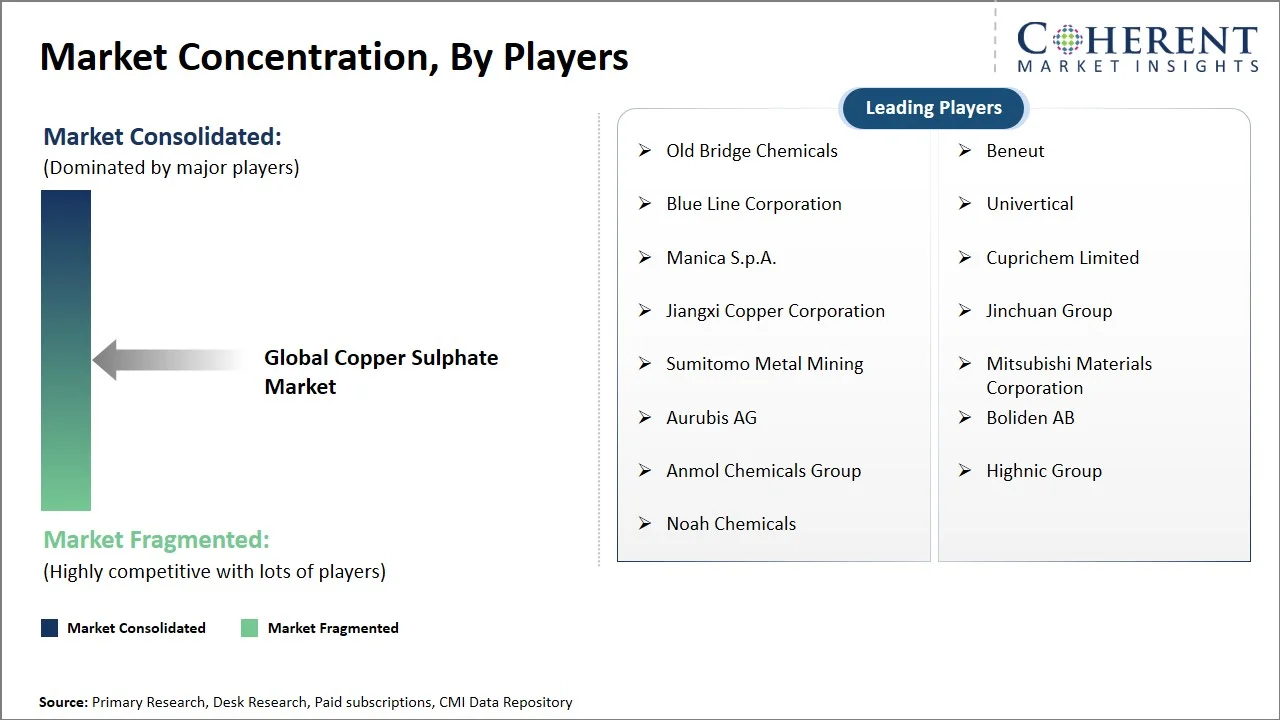
The global copper sulphate market is moderately fragmented, combining vertically integrated copper smelters and refiners, dedicated inorganic chemical manufacturers, specialty formulation companies, agricultural-input suppliers, and regional distributors. Competition is shaped less by branding than by feedstock economics, usable copper content, process consistency, impurity control, delivered cost, supply reliability, and customer qualification. Regional suppliers retain an important role because logistics, inventory availability, pack configuration, and technical response times can materially affect purchasing decisions, while specialist producers can defend higher-value positions where customers require tighter specifications or documented quality systems. Key focus areas include:
- Raw-material economics: Secure copper-bearing feedstocks and efficient conversion processes are central to sustainable margin performance.
- Batch consistency: Moisture, soluble copper content, acidity, insoluble, and contaminant profiles influence repeat purchasing and supplier qualification.
- Supply reliability: Seasonal agricultural requirements and continuous industrial operations reward manufacturers capable of maintaining contracted availability.
- Compliance readiness: Documentation, analytical testing, labeling discipline, and auditable quality systems increasingly influence access to regulated customers.
- Logistics configuration: Flexible bags, drums, bulk formats, moisture protection, and regional warehousing can materially improve customer service economics.
- Operational performance: Products that dissolve, flow, meter, and store predictably can reduce customers’ preparation costs and process interruptions.
- Commercial flexibility: Long-term supply contracts, formula-based pricing, safety stocks, and tailored delivery schedules can strengthen customer retention beyond spot-price competition.
Market Report Scope
Copper Sulphate Market Report Coverage
| Report Coverage | Details | ||
|---|---|---|---|
| Base Year: | 2025 | Market Size in 2026: | USD 1,478.4 Mn |
| Historical Data for: | 2020 To 2024 | Forecast Period: | 2026 To 2033 |
| Forecast Period 2026 to 2033 CAGR: | 4.8% | 2033 Value Projection: | USD 2,052.7 Mn |
| Geographies covered: |
| ||
| Segments covered: |
| ||
| Companies covered: | Old Bridge Chemicals, Beneut, Blue Line Corporation, Univertical, Manica S.p.A., Cuprichem Limited, Jiangxi Copper Corporation, Jinchuan Group, Sumitomo Metal Mining, Mitsubishi Materials Corporation, Aurubis AG, Boliden AB, Anmol Chemicals Group, Highnic Group, Noah Chemicals | ||
| Growth Drivers: |
| ||
| Restraints & Challenges: |
| ||
Analyst Opinion (Expert Opinion)
- The global copper sulphate market is likely to separate more clearly into two competitive models: scale-oriented commodity supply and specification-led specialty supply. Producers occupying the middle ground without either structural cost advantages or strong customer qualification capabilities may face the greatest margin pressure. Future leadership should therefore depend increasingly on whether a supplier can become the lowest-risk procurement option for a defined customer group rather than simply offering copper sulphate at an attractive headline price.
- Changes in upstream copper-processing economics could alter the competitive map more materially than incremental downstream demand growth. Copper sulphate availability can be influenced by how integrated metal producers manage copper-bearing process streams, electrolyte purification, and intermediate recovery. If integrated producers become more aggressive in monetizing these streams, standalone manufacturers may face stronger feedstock and pricing pressure. Conversely, disruptions within integrated refining networks could increase the strategic value of dedicated production capacity and geographically diversified supply.
- Market participants should prioritize flexible manufacturing, analytical quality control, dependable raw-material access, application expertise, and regional inventory rather than committing heavily to undifferentiated capacity. Contract structures should incorporate mechanisms for managing copper-input volatility while protecting customer continuity. Suppliers should concentrate investment where technical service or compliance creates meaningful switching barriers, strengthen alternative sourcing routes, and avoid overexpansion in commodity grades unless new capacity is supported by secured feedstock, disciplined operating economics, and credible long-term offtake.
Speak to the analyst
Want personalized insights?
Take the findings above to one of our principal consultants, or have the report rebuilt around the segments, geographies and competitors you actually track.
Market Segmentation
- Product Type Insights (Revenue, USD Mn, 2021 - 2033)
- Copper Sulphate Pentahydrate
- Anhydrous Copper Sulphate
- Copper Sulphate Monohydrate
- Others
- Form Insights (Revenue, USD Mn, 2021 - 2033)
- Crystals
- Powder
- Granules
- Liquid Solution
- Application Insights (Revenue, USD Mn, 2021 - 2033)
- Agricultural Fungicides and Algaecides
- Animal Feed Additives
- Mineral Flotation and Mining
- Electroplating and Metal Treatment
- Water Treatment
- Chemical Synthesis and Pigments
- Others
- Distribution Channel Insights (Revenue, USD Mn, 2021 - 2033)
- Direct B2B Sales
- Distributors and Wholesalers
- Agricultural Input Retailers
- Online B2B Platforms
- Others
- Regional Insights (Revenue, USD Mn, 2021 - 2033)
- North America
- U.S.
- Canada
- Latin America
- Brazil
- Argentina
- Mexico
- Rest of Latin America
- Europe
- Germany
- U.K.
- Spain
- France
- Italy
- Russia
- Rest of Europe
- Asia Pacific
- China
- India
- Japan
- Australia
- South Korea
- ASEAN
- Rest of Asia Pacific
- Middle East
- GCC Countries
- Israel
- Rest of Middle East
- Africa
- South Africa
- North Africa
- Central Africa
- North America
- Key Players Insights
- Old Bridge Chemicals
- Beneut
- Blue Line Corporation
- Univertical
- Manica S.p.A.
- Cuprichem Limited
- Jiangxi Copper Corporation
- Jinchuan Group
- Sumitomo Metal Mining
- Mitsubishi Materials Corporation
- Aurubis AG
- Boliden AB
- Anmol Chemicals Group
- Highnic Group
- Noah Chemicals
Sources
Primary Research Interviews
- Copper sulphate manufacturers, refiners, chemical processors, and specialty chemical producers
- Copper sulphate pentahydrate, anhydrous, crystal, powder, granule, and solution suppliers
- Agricultural, animal feed, mining, electroplating, and water-treatment users
- Distributors, wholesalers, formulators, agricultural-input suppliers, and industry experts
Stakeholders
- Copper sulphate and inorganic chemical manufacturers
- Copper miners, smelters, refiners, and raw-material suppliers
- Agrochemical, fertilizer, feed-additive, mining, and water-treatment companies
- Distributors, importers, exporters, and industrial end users
End-use Sectors
- Agriculture and crop protection
- Animal feed and livestock nutrition
- Mining and mineral flotation
- Electroplating and metal treatment
- Water and wastewater treatment
- Chemical synthesis, pigments, and industrial processing
Regulatory and Government Bodies
- U.S. EPA, USDA, FDA, and USGS
- European Commission, ECHA, EFSA, and Eurostat
- China Ministry of Agriculture, Ministry of Ecology and Environment, and China Customs
- India CIBRC, Ministry of Agriculture, CPCB, and Ministry of Mines
- Brazil MAPA, IBAMA, and ANVISA
- Chile SAG, Ministry of Mining, and National Customs Service
Databases
- UN Comtrade, ITC Trade Map, WTO, Eurostat, USITC, World Bank, and OECD
- FAOSTAT and national agricultural databases
- USGS and national mining and copper-production databases
- WIPO PATENTSCOPE, Espacenet, company filings, catalogues, and pricing records
Magazines and Journals
- Hydrometallurgy, Minerals Engineering, and Mining Engineering
- Crop Protection, Pest Management Science, and Journal of Agricultural and Food Chemistry
- Water Research, Environmental Science & Technology, and Journal of Environmental Management
- Chemical Engineering, ICIS Chemical Business, and Chemical Week
Associations
- International Copper Association
- International Fertilizer Association
- CropLife International
- International Council on Mining and Metals
- National chemical, mining, fertilizer, and crop-protection associations
Public Domain Sources
- Product catalogues, technical specifications, SDS, and certificates of analysis
- Purity, copper content, particle size, solubility, and impurity data
- Agricultural, mining, copper-production, trade, and industrial-consumption statistics
- Annual reports, patents, product registrations, capacity expansions, and investments
Key Standards and Regulations
- EU REACH and CLP requirements
- EU Plant Protection Products Regulation and copper residue requirements
- U.S. FIFRA and EPA pesticide-registration requirements
- Feed-grade and contaminant requirements for copper sulphate
- GHS, SDS, ISO quality, chemical-handling, transport, and environmental requirements
Proprietary Elements
- CMI Data Analytics Tool, Proprietary CMI Existing Repository of information for the last 10 years
Get access to 250+ pages report
Every segment, forecast, competitor profile and data table behind the analysis above — available for instant download.
- ESOMAR Member
- ISO 9001:2015 Certified
- D-U-N-S Registered
- GDPR & CCPA Compliant
Missing comfort of reading report in your local language? Find your preferred language:
Transform your Strategy with Exclusive Trending Reports
Frequently Asked Questions
The CAGR of global copper sulphate market is projected to be 4.8% from 2026 to 2033.
The global copper sulphate market is estimated to be valued at USD 1478.4 million in 2026 and is expected to reach USD 2052.7 million by 2033.
Agricultural fungicide and micronutrient demand supporting copper sulphate consumption and Mining and mineral processing activity increasing flotation reagent requirements are the major factor driving the growth of global copper sulphate market.
Copper sulphate is widely used in agricultural fungicides and algaecides, animal feed additives, mineral flotation, electroplating, water treatment, and chemical synthesis.
Direct B2B sales are important as large agricultural, mining, chemical, and industrial customers typically procure copper sulphate directly from manufacturers and bulk suppliers.
Asia Pacific is important due to its strong agricultural base, extensive mining and mineral processing activities, large chemical manufacturing sector, and established copper-processing infrastructure.
Copper price volatility affecting raw material and production costs and Environmental toxicity concerns increasing application and disposal restrictions are the major factor hampering the growth of Global Copper Sulphate Market.