

Global Dairy Phytase Market Size and Forecast – 2026 To 2033
The global dairy phytase market is estimated to be valued at USD 24.4 Mn in 2026 and is expected to reach USD 49.7 Mn by 2033, growing at a compound annual growth rate (CAGR) of 10.70% from 2026 to 2033. This growth reflects the increasing importance of feed additives that improve phosphorus availability, protein digestibility, and overall nutrient utilization in dairy cattle. Phytase is an enzyme that unlocks the phytate-bound phosphorus in plant-based feed ingredients, helping to reduce phosphorus losses in manure and allowing better use of minerals.
In January 2023, a peer-reviewed study published in the Journal of Animal Science involving 30 mid-lactating Holstein-Friesian cows demonstrated that bacterial 6-phytase supplementation improved the digestibility of phosphorus, phytate phosphorus, and crude protein while reducing fecal phosphorus excretion. The results also highlight the commercial importance of phytase for improving dairy feed efficiency and environmentally sustainable livestock nutrition.
Key Takeaways of the Global Dairy Phytase Market
- Bacterial Phytase is projected to account for 66.8% of the global dairy phytase market in 2026 and register a compound annual growth rate (CAGR) of 11.1% by 2033. Its suitability for enzyme engineering allows for improved phytate breakdown in dairy cattle feed. In April 2025, a study published in the Journal of Dairy Science demonstrated that bacterial 6-phytase supplementation enhanced phosphorus digestibility and decreased nutrient excretion in lactating cows.
- Powder Phytase is projected to grow at an estimated CAGR of 10.2% through 2033, holding 47.2% of the global dairy phytase market in 2026. Its convenient storage, accurate dosing, and compatibility with dry feed blending support commercial adoption. In April 2024, the European Commission authorized Nutrex's powder phytase preparation for poultry feed, demonstrating formulation maturity, although dairy-specific authorization was not established.
- Lactating Dairy Cows are anticipated to achieve an estimated CAGR of 10.9% through 2033, capturing 57.5% of the global dairy phytase market in 2026. Their nutrient-intensive feeding requirements create opportunities for phytase solutions that improve feed utilization. In September 2026, IFF launched Omni-Bos PHY specifically for dairy cattle, reporting improved phosphorus and phytate digestibility during product-development studies.
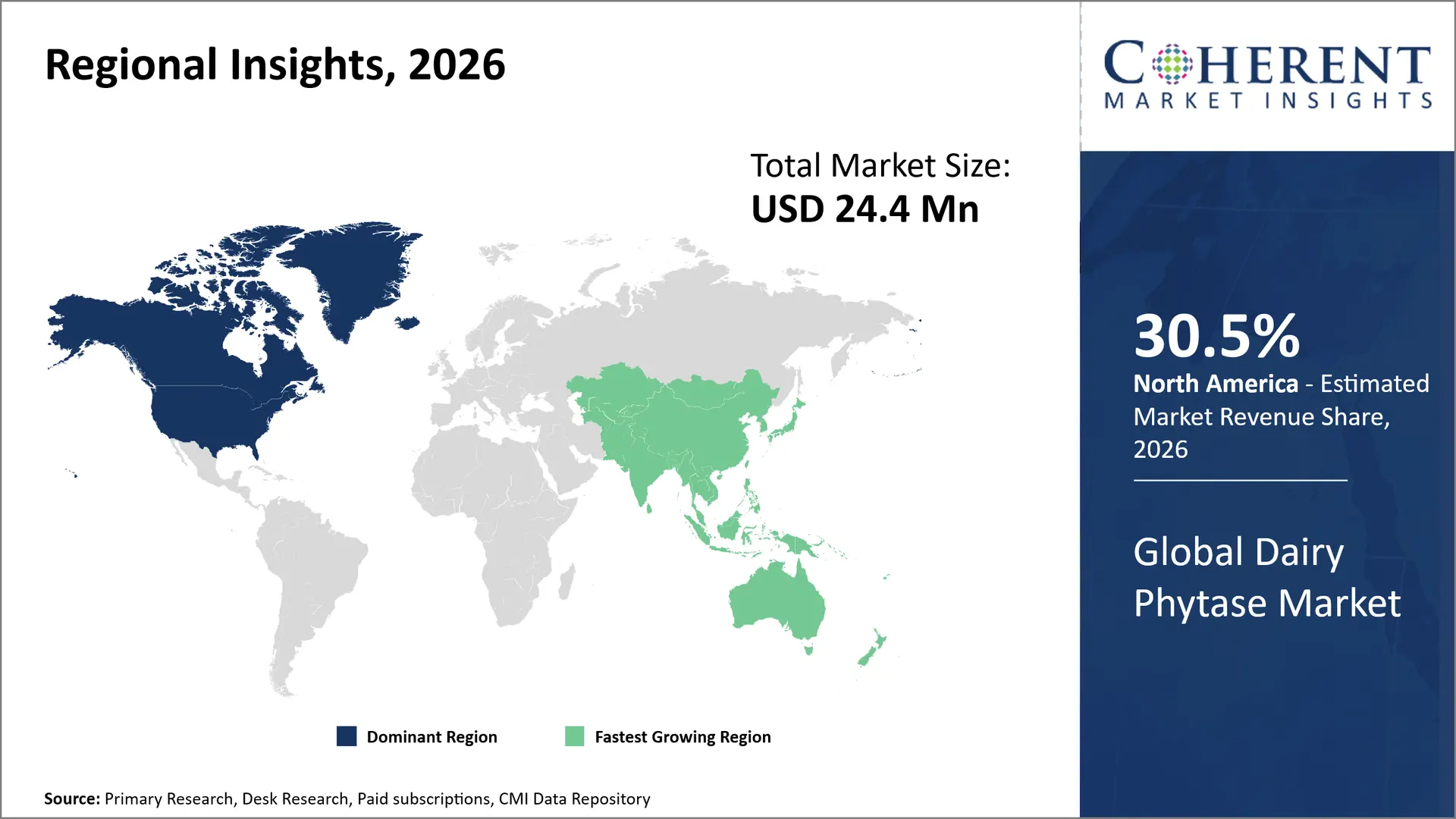
- North America is expected to record an estimated CAGR of 9.6% through 2033, maintaining its leading 30.5% share of the global dairy phytase market in 2026. Commercial dairy nutrition practices and an increased emphasis on phosphorus management make specialized feed-enzyme evaluation easier. In September 2025, research was initiated at the University of Kentucky to study the effect of supplemental phytase on intestinal disappearance of phosphorus in cattle.
- Asia Pacific is projected to expand at an estimated CAGR of 13.2% through 2033, representing 28.6% of the global dairy phytase market in 2026. Dairy operations can potentially achieve cost efficiencies by improving the recovery of nutrients from feed ingredients. In July 2026, the Chinese patent for a biological formulation with phytase for improving the utilization of phosphorus in dairy cows was issued to Zhejiang University.
Segmental Insights
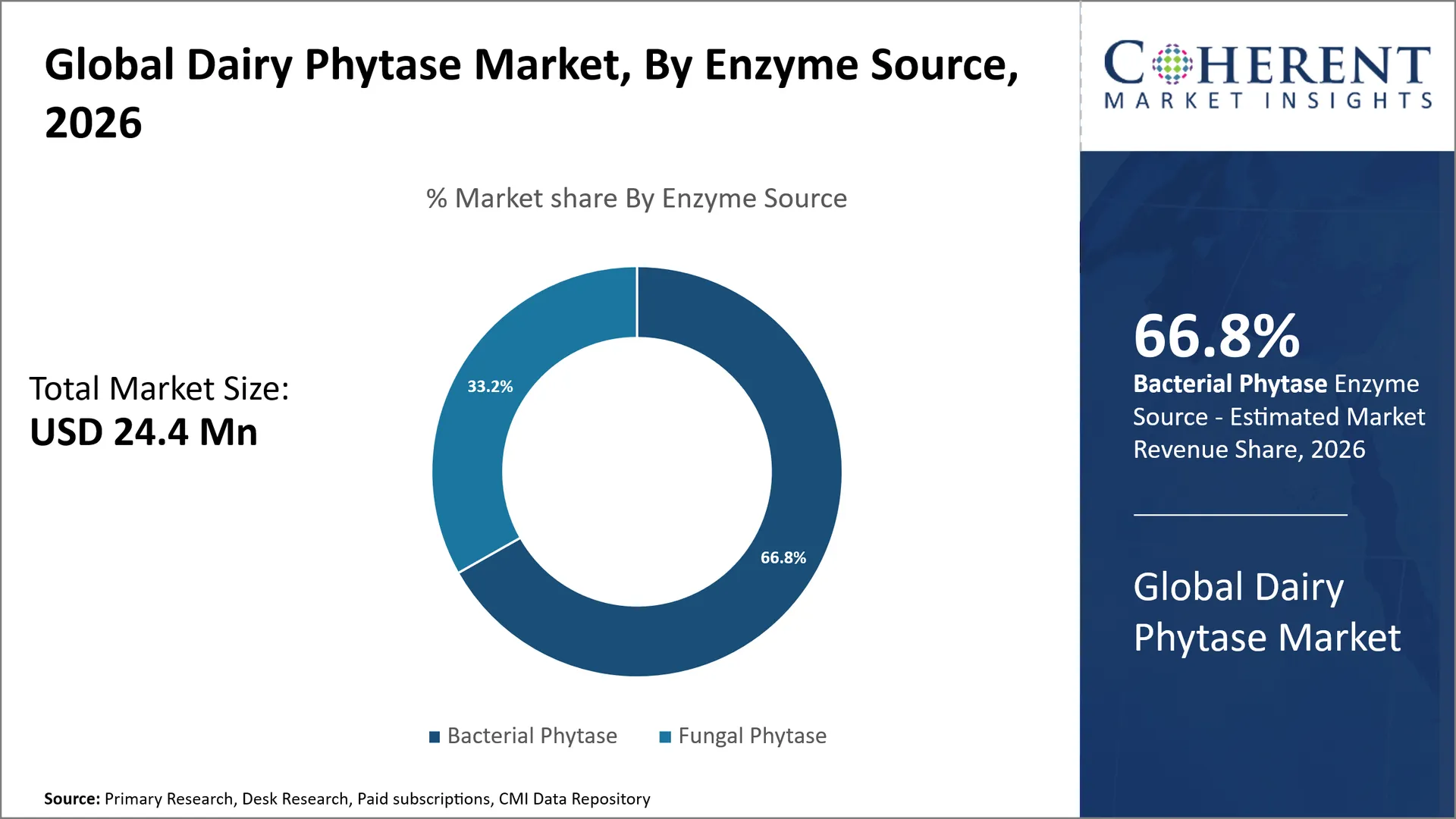
Why Does Bacterial Phytase Dominate the Enzyme Source Category in the Global Dairy Phytase Market?
Bacterial Phytase is expected to hold 66.8% of the global dairy phytase market by 2026. This is attributed to established microbial fermentation platforms for the production of high-activity enzyme preparations with consistent batch specifications. Feed manufacturers can formulate against the measured phytate levels in cereal and oilseed ingredients and suppliers can scale production and standardize enzyme activity. The commercial advantage is therefore linked to predictable potency, secure supply and cost per unit of activity. In January 2024, Adisseo published a peer-reviewed evaluation of a new biosynthetic bacterial 6-phytase in broiler diets, evaluating the digestibility and excretion of phosphorus. Although the trial was not conducted on dairy cattle, it does demonstrate the continued evolution of bacterial phytase platforms for feed applications. Further validation of dairy-specific performance is required.
- Current Industry Events of 2026
- Market Size Estimation
- Regional Breakdown
- Competitive Landscape
- Customer Intelligence
- Segmental Analysis
- Pricing Analysis
- Key Market Drivers, Challenges & Future Trends
- Customized Insights Section
Why Does Powder Phytase Represent the Largest Product Form Segment in the Global Dairy Phytase Market?
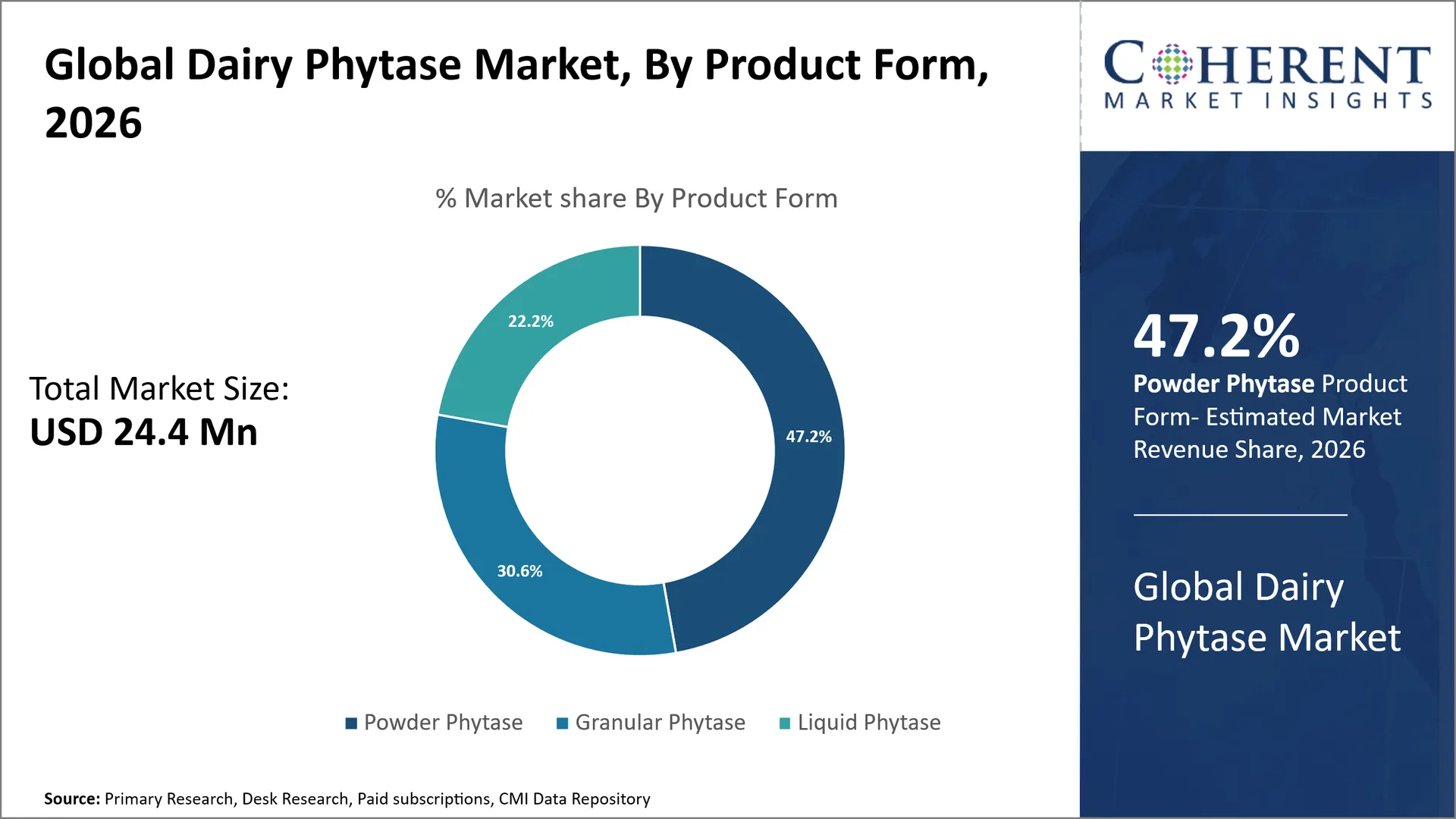
Powder Phytase is expected to account for 47.2% of the global dairy phytase market share by 2026, supported by its suitability for centralized premix manufacturing and batch-level quality control. Feed-enzyme suppliers can test activity and adjust potency and can homogenize the ingredient with mineral or vitamin carriers before it gets to the feed mills, ensuring premix producers maintain consistent specifications across production runs. This is particularly relevant where cooperatives and commercial nutrition companies supply standardized dairy rations to multiple farms. The format also allows suppliers to offer different activity grades while retaining a common downstream feed-mill handling process. In October 2024, Japan’s Food Safety Commission assessed QPT2 phytase and documented powder, granular and liquid formulations for animal-feed use. The assessment covered non-dairy species, confirming formulation availability rather than dairy-cattle authorization.
Why Do Lactating Dairy Cows Dominate the Dairy Animal Type Category in the Global Dairy Phytase Market?
Lactating Dairy Cows are expected to account for 57.5% of the global dairy phytase market in 2026 because this group receives the largest share of production-oriented feed management and is routinely fed formulated rations at scale. Dairy operators typically separate milking cows by production level and adjust concentrate, protein and mineral supply to support milk output, creating a recurring channel for targeted enzyme inclusion. The segment therefore offers feed additive suppliers a larger addressable ration base than calves, heifers or dry cows. In March 2026, researchers from the University of Hohenheim and the University of Bonn published a meta-analysis of 399 observations from 77 dairy-cow studies, identifying phosphorus secretion through milk as a key component of lactating-cow phosphorus requirements. The study informs nutrient formulation rather than phytase efficacy specifically.
Why Does Compound Dairy Feed Lead the Feed Application Category in the Global Dairy Phytase Market?
Compound Dairy Feed is projected to capture 35.2% of the global dairy phytase market in 2026 because centralized feed manufacturing enables phytase to be incorporated during standardized formulation, blending and quality-control stages. Compared with on-farm supplementation, factory-made compound feed can provide consistent nutrient specifications and reduce the burden on individual farmers to measure and mix enzyme additives. This channel is commercially relevant to cooperatives, commercial feed mills and dairy nutrition suppliers serving farms with limited in-house formulation capacity, especially in high-volume dairy regions. In February 2026, Cargill opened a dairy feed plant in Wazirabad, Punjab, with annual production capacity of 400,000 tonnes. The investment expands organized dairy-feed manufacturing capacity; Cargill did not state that phytase was included in the plant's products.
Current Events and their Impact
Current Event | Description and Its Impact |
December 2024 – EFSA implements updated feed additive efficacy guidance |
|
October 2026 – Canada updates its livestock feed ingredient classification for phytase |
|
Global Dairy Phytase Market Dynamics
Key Market Drivers
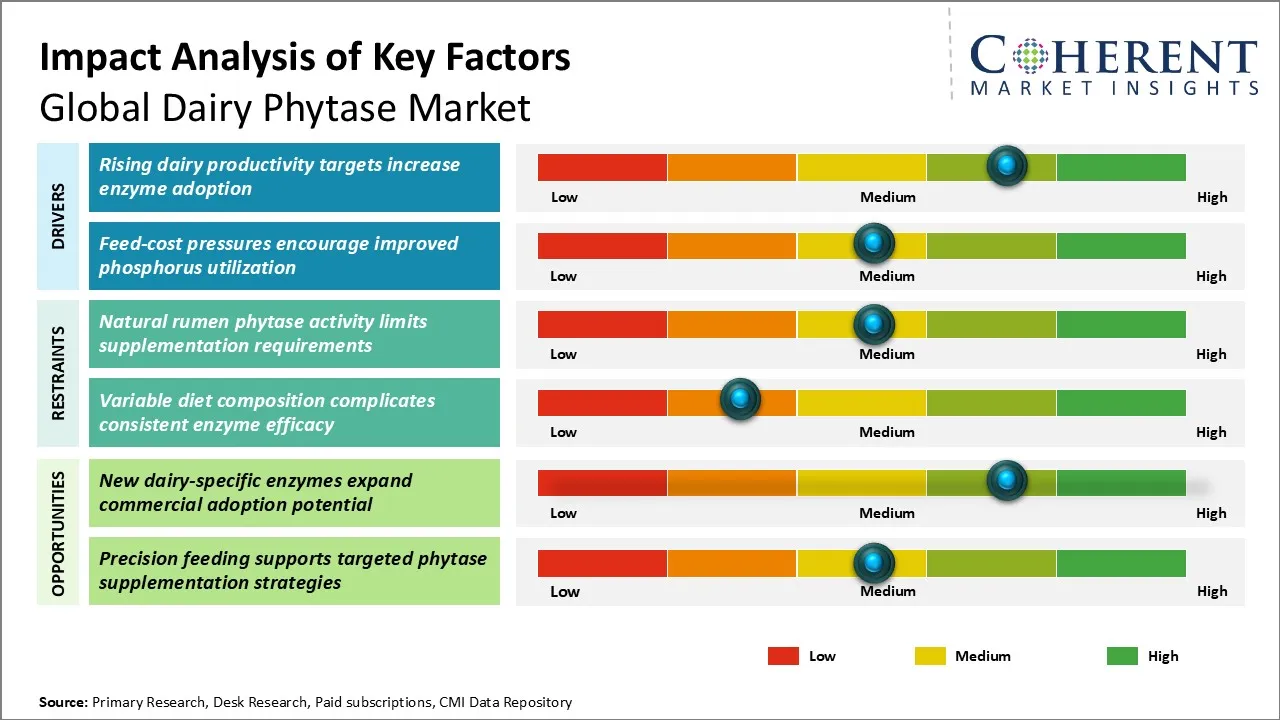
- Rising dairy productivity targets increase enzyme adoption: Higher milk output per cow requires rations to deliver consistent energy, protein and mineral availability without simply increasing concentrate inclusion. Phytase suppliers can benefit where plant-based ingredients contain phytate-bound phosphorus and dairy nutritionists seek to improve nutrient release within fixed ration limits. Feed manufacturers, premix companies and larger dairy operators are the main commercial adopters because they can validate enzyme response at scale. In February 2026, USDA ERS documented continued productivity gains alongside wider use of computerized feeding and milking systems on U.S. dairy farms.
- Feed-cost pressures encourage improved phosphorus utilization: Purchased feed and mineral supplementation directly affect dairy farm operating margins, making nutrient release from existing ingredients commercially relevant. Phytase can liberate phytate-bound phosphorus in cereal and oilseed meals, potentially allowing formulators to refine inorganic phosphate inclusion where dairy-specific trials confirm the response. Feed mills, premix suppliers and larger herd operators benefit from cost-in-use evidence rather than enzyme price alone. In October 2026, AHDB reported that the GB milk-to-feed ratio remained below its five-year average, underlining pressure on purchased-feed economics.
Emerging Market Trends
- Increasing Use of Diversified Feed Ingredients Requires Substrate-Specific Enzyme Formulations: Requires Diverse Enzyme Formulations: Dairy rations are using a range of oilseed meals, cereal by-products and alternative plant ingredients, each with different nutrient matrices and phytate level. This is because of the variation in enzyme activity and it is not as suitable for use across different feed formulations, and it promotes the ingredient level formulation.
- Impact: As the composition of the ingredients changes, feed manufacturers might shift to using combinations of enzymes specific to the feed and to more frequent feed reformulations.
- Relevance to the Global Dairy Phytase Market: Phytase suppliers with flexible activity profiles and formulation support can gain preference, while suppliers relying on one standard blend may face pricing pressure.
- Growing Focus on Phosphorus Stewardship and Nutrient Traceability: Dairy processors and larger farms increasingly want traceability from feed input to animal output, including mineral balance and manure nutrient management. This creates an incentive to document phosphorus intake, digestibility and excretion as part of broader nutrient stewardship.
- Impact: Feed mills and nutrition advisors may be asked to provide clearer nutrient records and evidence behind enzyme claims.
- Relevance to the Global Dairy Phytase Market: Phytase suppliers that connect activity data with credible nutrient-balance outcomes may become part of longer-term feed-management programs rather than occasional additive purchases.
Regional Insights
Why Does North America Dominate the Global Dairy Phytase Market?
North America is expected to maintain its leading position with 30.5% share in the global dairy phytase market, supported by established commercial dairy systems, high-output herds and well-developed feed manufacturing and nutrition advisory networks. Large farms in the U.S. and Canada use formulated concentrates, premixes and total mixed rations, providing practical opportunities for incorporating enzyme additives and monitoring ration performance. Integrated cooperatives, feed mills and specialist nutrition companies also support repeat purchasing and technical evaluation. In February 2026, the U.S. Dairy Export Council reported that U.S. dairy exports reached 2.32 million metric tonnes in milk-solids-equivalent terms in 2025, with overseas shipments accounting for more than 17% of milk production. This production and trade scale supports demand for specialized dairy feed inputs.
Why Is Asia Pacific Emerging as the Fastest-Growing Region in the Global Dairy Phytase Market?
Asia Pacific is expected to be the fastest-growing region and is expected to account for 28.6% of the global dairy phytase market in 2026, reflecting the coexistence of very large dairy populations and a gradual shift from individually mixed feed toward standardized compound feed, concentrates and premixes. This transition creates an expanding route for phytase suppliers to reach farms through feed mills and cooperative procurement systems, particularly as commercial dairies seek consistent nutrient specifications across larger herds. The region’s diverse feed ingredients also create demand for formulation support suited to local cereal and oilseed materials. In June 2025, India's National Dairy Development Board and Uttar Pradesh's dairy federation transferred several dairy plants and a cattle-feed plant to NDDB under a ten-year operating arrangement, strengthening organized feed supply infrastructure.
Global Dairy Phytase Market Outlook for Key Countries
Why Is the U.S. a Key Market for the Global Dairy Phytase Market?
The U.S. is a key national market for dairy phytase because its dairy sector combines large-scale milk production with sophisticated ration formulation, extension support and a mature animal-feed industry. Commercial dairies often manage cows by production stage and rely on nutritionists to adjust forage, concentrates and mineral supply, creating a channel for targeted feed additives. However, phytase adoption requires dairy-specific proof rather than assumptions drawn from poultry or swine applications. In August 2025, Penn State Extension reviewed the National Academies' dairy-cattle nutrient guidance and described enzyme-based feed additives as part of the dairy nutrition toolkit, while noting that responses vary with lactation stage, ration composition and enzyme selection. This reinforces the importance of local trials and technical support.
Why Is Germany Important in the Global Dairy Phytase Market?
Germany is an important European market because it combines a substantial dairy herd with high average milk output per cow and a concentrated commercial farm structure. These characteristics favor professionally formulated rations, routine feed analysis and purchasing through established feed mills, creating a suitable route for specialty enzymes when cost-in-use is demonstrated. At the same time, feed and energy costs put pressure on producers to scrutinize additive returns, so suppliers must substantiate phosphorus release and ration economics rather than rely on broad performance claims. In September 2026, Germany's Federal Centre for Agriculture and Food reported that the country produced nearly 34 million tonnes of cow's milk in 2025 and maintained approximately 3.6 million dairy cows.
Why Does China Support Growth in the Global Dairy Phytase Market?
China has a significant supply of dairy products, a large feed-manufacturing industry and a process of consolidation towards more standard commercial dairy operations, which helps support the global dairy phytase market. The size of the market is not the growth of the herd but in making rations more efficient, better quality control and better nutrient utilization in existing production units. Feed enzyme suppliers could work with large feed producers or integrated dairy groups, but need to adjust to the domestic feed ingredients and test the efficacy in the local feeding situations. In February 2026, the National Bureau of Statistics of China reported milk production of 40.91 million tonnes in 2025, which is slightly up 0.3% from previous year. This output scale holds promise for a differentiated market for specialised dairy nutrition inputs.
Why Is India Important in the Global Dairy Phytase Market?
India is a major opportunity within Asia Pacific because its dairy economy combines the world's largest milk output with a broad base of cooperative procurement and a growing need to improve feed quality across diverse farm sizes. The addressable market is not limited to industrial dairies: cooperative feed plants and organized suppliers can distribute premixes and balanced rations to small and medium producers. This makes affordability, simple dosing and reliable technical guidance important for phytase suppliers. In April 2026, the Department of Animal Husbandry and Dairying reported that India produced 247.87 million tonnes of milk in 2024–25, up 3.58% from the previous year. The scale and continued expansion of milk output underpin long-term feed-additive potential.
Enzyme Formulation and Feed-Integration Landscape of the Global Dairy Phytase Market
Technology | Technical Description | Commercial Relevance | Adoption Status and Considerations |
Ruminant-Adapted Phytase Engineering | Enzyme variants that are developed to be active in different ruminant digestive conditions. | Uses dairy formulation of enzymes instead of transferring traditional monogastric enzyme specifications. | Emerging; requires dairy-specific efficacy validation. |
Thermostable Phytase Variants | This is achieved by the protein engineering of enzymes and/or selection of microbial strains for higher processing temperature resistance. | Helps maintain enzyme activity during compound feed manufacturing and thermal processing. | Suitable for wider use in feeds – needs validation for dairy use. |
Coated Granules and Encapsulated Carriers | Enzyme stability is enhanced against moisture, heat and handling conditions with the use of protective coatings and/or carrier materials. | Can be incorporated into dairy feed premixes and granular formulations on a consistent basis. | Selective adoption; formulation costs and release characteristics require assessment. |
Post-Pellet Liquid Application | Cooled feed pellets are sprayed with liquid phytase after the high-temperature pelleting. | Reduces the losses from enzyme activity during processing and enhances liquid product applications. | Applicable commercially when spraying and dosing equipment is available in the feed mill. |
Multi-Enzyme Co-Formulations | Has phytase in combination with other enzymes like xylanase, cellulase and protease to attack several components of the feed. | Provides flexibility for differentiated formulations for the complicated dairy feed ingredients. | Emerging; enzyme compatibility and separate activity and regulatory requirements remain important. |
Enzyme Activity Analytics and Batch Quality Control | Standardized enzyme activity assays, stability testing and batch-level quality monitoring. | Supports consistent phytase activity, accurate inclusion rates and dependable feed formulation. | Essential manufacturing capability; integration with routine feed-mill testing varies. |
How Can Pre-Ruminant Calf Starter Formulations Create a New Growth Opportunity in the Global Dairy Phytase Market?
Pre-ruminant calf starter feeds offer a focused opportunity because young calves have an incompletely developed rumen and rely more heavily on enzymatic digestion in the abomasum and small intestine. Plant-based starter ingredients can contain phytate-bound phosphorus, so a phytase selected for calf digestive conditions may improve phosphorus release before mature rumen fermentation is established.
This application is commercially distinct from broad adult-cow ration use and could support dedicated calf pre-starters and early-weaning formulations. Suppliers can capture it by developing age-specific enzyme doses, validating performance against mineral intake and bone-development endpoints, and working with calf-feed manufacturers and veterinary nutritionists.
Commercial entry requires controlled trials across pre-weaning and post-weaning stages, reliable activity during storage and mixing, clear label claims, and species-specific regulatory acceptance. Specialist enzyme developers and vertically integrated premix suppliers are likely to have an advantage because they can combine formulation, testing and technical support. The opportunity should be pursued through targeted pilots rather than broad capacity expansion until repeatable responses are established.
Market Players, Key Developments, and Competitive Landscape
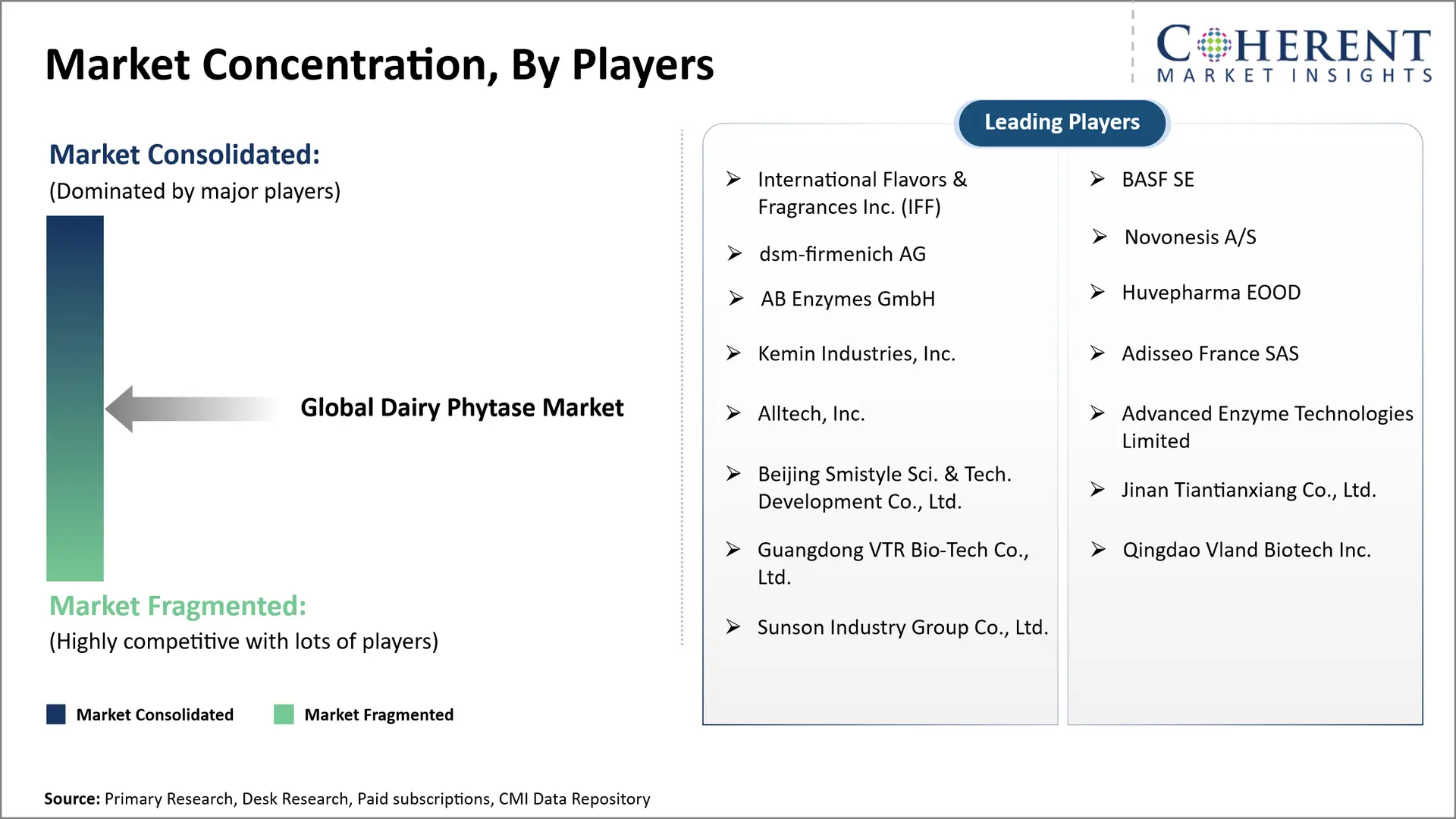
Key Developments
- In October 2025, BASF began evaluating strategic options for its feed enzymes business, which includes the Natuphos phytase portfolio. The review could alter ownership, investment priorities and long-term supply arrangements, although BASF stated that customer and partner continuity remained a priority.
- In June 2025, Novonesis completed its acquisition of dsm-firmenich’s stake in the Feed Enzymes Alliance, bringing sales and distribution under its control alongside existing enzyme development and production. The integration strengthens its ability to coordinate phytase commercialization and technical support across feed markets.
Competitive Landscape
The global dairy phytase market is moderately consolidated at the enzyme-development level, where multinational biotechnology and feed-additive suppliers hold formulation IP, regulatory dossiers and application expertise. Regional fermentation producers and premix formulators add competition through cost, localization and customer access. Differentiation rests on ruminant-specific efficacy, activity retention, quality consistency, technical validation and reliable supply to dairy feed manufacturers.
Key Competitive Focus Areas
- Proprietary microbial strains and enzyme sequence IP.
- Ruminant-specific efficacy and digestibility evidence.
- Activity guarantees and independent assay comparability.
- Formulation compatibility across TMR, concentrates and premixes.
- Heat and moisture stability during storage and processing.
- Species-specific approvals, labeling and regulatory documentation.
- Cost per unit of phosphorus made nutritionally available.
- Technical support and reliable regional distribution networks.
Market Report Scope
Dairy Phytase Market | |||
Report Coverage | Details | ||
Base Year | 2025 | Market Size in 2026: | USD 24.4 Mn |
Historical Data For: | 2020 to 2024 | Forecast Period: | 2026 to 2033 |
Forecast Period 2026 To 2033 CAGR: | 10.70% | 2033 Value Projection: | USD 49.7 Mn |
Geographies covered: |
| ||
Segments covered: |
| ||
Companies covered: | International Flavors & Fragrances Inc. (IFF), BASF SE, dsm-firmenich AG, Novonesis A/S, AB Enzymes GmbH, Huvepharma EOOD, Kemin Industries, Inc., Adisseo France SAS, Alltech, Inc., Advanced Enzyme Technologies Limited, Beijing Smistyle Sci. & Tech. Development Co., Ltd., Jinan Tiantianxiang Co., Ltd., Guangdong VTR Bio-Tech Co., Ltd., Qingdao Vland Biotech Inc., Sunson Industry Group Co., Ltd. | ||
Growth Drivers: |
| ||
Restraints & Challenges: |
| ||
Analyst Opinion (Expert Opinion)
- Future Market Direction: Competitive leadership in the global dairy phytase market is likely to shift from selling enzyme activity units to selling validated feeding programs that combine product selection, ration compatibility, dose setting and post-sale performance review. Suppliers able to document repeatable value across different dairy systems may secure longer-term feed-mill relationships, while undifferentiated products risk competing mainly on price.
- Transformative Trend or Disruption: A material disruption could emerge if phytase suppliers begin offering performance-linked contracts tied to measured nutrient release and ration outcomes. This would challenge procurement models based on enzyme price per tonne and favor companies with field data, independent assay capability and technical teams able to work directly with feed formulators.
- Strategic Priorities, Risks and Recommendations: Suppliers should prioritize controlled dairy trials, validated nutrient-matrix values, stability under actual feed-processing conditions and clear target-species dossiers. Margin discipline is essential: avoid discounting without demonstrating cost per unit of available phosphorus, and avoid dedicated capacity expansion before repeatable farm-level responses are established. Local premix partnerships can reduce adoption barriers.
Speak to the analyst
Want personalized insights?
Take the findings above to one of our principal consultants, or have the report rebuilt around the segments, geographies and competitors you actually track.
Market Segmentation
- Enzyme Source Insights (Revenue, USD Mn, 2021 - 2033)
- Bacterial Phytase
- Fungal Phytase
- Product Form Insights (Revenue, USD Mn, 2021 - 2033)
- Powder Phytase
- Granular Phytase
- Liquid Phytase
- Dairy Animal Type Insights (Revenue, USD Mn, 2021 - 2033)
- Lactating Dairy Cows
- Dry & Transition Cows
- Dairy Heifers
- Dairy Calves
- Feed Application Insights (Revenue, USD Mn, 2021 - 2033)
- Compound Dairy Feed
- Dairy Feed Concentrates
- Total Mixed Rations (TMR)
- Dairy Feed Premixes & Supplements
- Functional Benefit Insights (Revenue, USD Mn, 2021 - 2033)
- Improved Phosphorus Digestibility
- Enhanced Protein & Mineral Utilization
- Reduced Phosphorus Excretion
- Improved Feed Efficiency
- Regional Insights (Revenue, USD Mn, 2021 - 2033)
- North America
- U.S.
- Canada
- Latin America
- Brazil
- Argentina
- Mexico
- Rest of Latin America
- Europe
- Germany
- U.K.
- Spain
- France
- Italy
- Russia
- Rest of Europe
- Asia Pacific
- China
- India
- Japan
- Australia
- South Korea
- ASEAN
- Rest of Asia Pacific
- Middle East
- GCC Countries
- Israel
- Rest of Middle East
- Africa
- South Africa
- North Africa
- Central Africa
- North America
- Key Players Insights
- International Flavors & Fragrances Inc. (IFF)
- BASF SE
- dsm-firmenich AG
- Novonesis A/S
- AB Enzymes GmbH
- Huvepharma EOOD
- Kemin Industries, Inc.
- Adisseo France SAS
- Alltech, Inc.
- Advanced Enzyme Technologies Limited
- Beijing Smistyle Sci. & Tech. Development Co., Ltd.
- Jinan Tiantianxiang Co., Ltd.
- Guangdong VTR Bio-Tech Co., Ltd.
- Qingdao Vland Biotech Inc.
- Sunson Industry Group Co., Ltd.
Sources
Primary Research Interviews
- Phytase manufacturers, feed enzyme developers, and animal nutrition companies
- Dairy feed manufacturers, compound feed producers, and premix suppliers
- Dairy nutritionists, veterinarians, and livestock feed consultants
- Dairy farm operators, cooperatives, and procurement managers
- Feed additive distributors, fermentation specialists, and regulatory experts
Stakeholders
- Bacterial and fungal phytase manufacturers
- Microbial fermentation and enzyme production companies
- Feed additive and specialty enzyme suppliers
- Compound dairy feed and feed concentrate manufacturers
- Dairy feed premix and TMR producers
- Enzyme testing laboratories and quality assurance providers
- Dairy cooperatives, commercial farms, and feed distributors
End-use Sectors
- Lactating Dairy Cows: Milk-production rations, phosphorus utilization, and nutrient digestibility
- Dry & Transition Cows: Mineral management and pre-calving nutritional formulations
- Dairy Heifers: Growth-oriented feed formulations and mineral utilization
- Dairy Calves: Starter feeds, phosphorus availability, and early-stage nutrition
Feed Applications
- Compound dairy feed
- Dairy feed concentrates
- Total mixed rations (TMR)
- Dairy feed premixes and supplements
Regulatory and Industry Bodies
- European Food Safety Authority (EFSA)
- European Commission – DG SANTE
- U.S. Food and Drug Administration (FDA), Center for Veterinary Medicine
- U.S. Association of American Feed Control Officials (AAFCO)
- Canadian Food Inspection Agency (CFIA)
- Ministry of Agriculture and Farmers Welfare, India
- Bureau of Indian Standards (BIS)
- Ministry of Agriculture and Rural Affairs (MARA), China
- Ministry of Agriculture and Livestock (MAPA), Brazil
- Codex Alimentarius Commission
Databases
- FAOSTAT – Food and Agriculture Organization
- USDA National Agricultural Statistics Service (NASS)
- USDA Economic Research Service (ERS)
- Eurostat – Agricultural and Livestock Statistics
- UN Comtrade and ITC Trade Map
- India Department of Animal Husbandry and Dairying (DAHD)
- Basic Animal Husbandry Statistics (BAHS), India
- China National Bureau of Statistics
- Brazil Brazilian Institute of Geography and Statistics (IBGE)
- World Bank Open Data
Magazines and Journals
- Journal of Dairy Science
- Journal of Animal Science
- Animal Feed Science and Technology
- Animal Nutrition
- Livestock Science
- Animal
- Frontiers in Animal Science
- Journal of Applied Animal Nutrition
- Feed Strategy
- Feed & Grain
- All About Feed
Associations
- International Feed Industry Federation (IFIF)
- European Feed Manufacturers' Federation (FEFAC)
- American Feed Industry Association (AFIA)
- International Dairy Federation (IDF)
- Association of American Feed Control Officials (AAFCO)
- Compound Livestock Feed Manufacturers Association of India (CLFMA)
- China Feed Industry Association
- Brazilian Feed Industry Association (Sindirações)
Public Domain Sources
- Phytase product catalogues, technical datasheets, and enzyme activity specifications
- Bacterial and fungal enzyme production processes, microbial strains, and fermentation technologies
- Phytase activity, thermal stability, pH tolerance, dosage, and shelf-life specifications
- Dairy cattle nutrition studies, feeding trials, and phosphorus digestibility research
- Dairy feed production, livestock population, milk production, and feed consumption statistics
- Company annual reports, product launches, patents, manufacturing investments, and capacity expansions
- Feed additive pricing, distribution agreements, import-export statistics, and supplier disclosures
- Research publications covering phytate degradation, phosphorus utilization, and feed conversion efficiency
Key Standards and Regulations
- EU Regulation (EC) No. 1831/2003 – Feed Additives for Animal Nutrition
- EU Regulation (EC) No. 767/2009 – Marketing and Use of Animal Feed
- EU Regulation (EC) No. 183/2005 – Feed Hygiene Requirements
- U.S. Food Safety Modernization Act (FSMA) – Preventive Controls for Animal Food, 21 CFR Part 507
- U.S. FDA – Applicable Animal Food Ingredient and Feed Additive Requirements
- Canada Feeds Act and Feeds Regulations
- Canadian Feed Ingredients Table (CFIT)
- China – Feed and Feed Additive Regulations and Applicable Safety Use Requirements
- India – Applicable BIS Standards for Compounded Cattle Feed
- Brazil – MAPA Regulations for Animal Feed Products
- Codex Alimentarius – CAC/RCP 54-2004, Code of Practice on Good Animal Feeding
- ISO 22000 – Food Safety Management Systems
- ISO/IEC 17025 – Testing and Calibration Laboratory Competence
- FAMI-QS – Quality and Feed Safety Management System for Specialty Feed Ingredients
- GMP+ Feed Safety Assurance (FSA)
Proprietary Elements
- CMI Data Analytics Tool and proprietary research repository, supported by primary interviews, phytase enzyme activity and pricing analysis, bacterial and fungal enzyme benchmarking, manufacturing capacity assessment, dairy feed consumption analysis, segment-wise market sizing, average selling price (ASP) evaluation, country-level dairy production assessment, trade analysis, distribution-channel evaluation, and competitive intelligence.
Get access to 250+ pages report
Every segment, forecast, competitor profile and data table behind the analysis above — available for instant download.
- ESOMAR Member
- ISO 9001:2015 Certified
- D-U-N-S Registered
- GDPR & CCPA Compliant
Frequently Asked Questions
The CAGR of global dairy phytase market is projected to be 10.70% from 2026 to 2033.
The global dairy phytase market is estimated to be valued at USD 24.4 million in 2026 and is expected to reach USD 49.7 million by 2033.
In plant-based feed ingredients, phytase will decompose phytate and release bound phosphorus, thereby increasing its bioavailability for dairy cows.
Enzymes should be considered with regard to enzyme activity, thermal stability, shelf life, feed compatibility, product quality, compliance with regulations, and technical support from the supplier.
Yes. Phytase may be added to compound feeds, concentrates, premixes and TMRs, provided that the formulation is compatible and that the enzyme is stable under the intended conditions of use.
Important parameters include guaranteed enzyme activity, purity, batch consistency, storage stability, shelf life, safety documentation, and a certificate of analysis.
Rising dairy productivity targets increase enzyme adoption and Feed-cost pressures encourage improved phosphorus utilization are the major factor driving the growth of global dairy phytase market.