

Global Data Center Generator Market Size and Forecast – 2026 To 2033
The Global Data Center Generator Market is estimated to be valued at USD 9.68 Bn in 2026 and is expected to reach USD 14.85 Bn by 2033, growing at a compound annual growth rate (CAGR) of 6.3% from 2026 to 2033. Market expansion is supported by increasing investments in hyperscale data centers, AI computing infrastructure, and cloud services, which require dependable emergency power systems to maintain operational continuity.
The need for high performance generators that are fuel efficient, have a quick load acceptance and emit less is also a priority for data center operators. In January 2026, Volvo Penta announced the arrival of its G17 natural gas engine for powering data centers and other mission-critical applications, with an output of around 450 kWe. The ability to run on conventional and renewable natural gas shows the evolution of backup power solutions to meet reliability and sustainability needs.
Key Takeaways of the Global Data Center Generator Market
- Diesel generators are projected to grow at an estimated 5.8% CAGR through 2033 while retaining a 74.8% global data center generator market share in 2026. Critical functions are maintained during grid failures by using onsite fuel supplies and prompt start-up assistance. In June 2025, Rolls-Royce said it would expand manufacturing capacity in Minnesota for mtu Series 4000 backup generator systems for data centers.
- Below 1 MW generators could register an estimated 5.4% CAGR during 2026–2033 and represent 44.5% of global data center generator market revenue in 2026. Smaller units are more suitable for distributed enterprise facilities since they can be tailored to specific electrical loads and to reduce initial capital costs. In September 2025, Enchanted Rock unveiled their newest natural gas generator, the ERT500, which has a capacity of 500kW.
- Hyperscale data centers are projected to deliver an estimated 8.1% CAGR in generator expenditure through 2033, accounting for 34.5% of global data center generator market revenue in 2026. They require high computing demands and coordinated generator fleets with high load acceptance and centralized controls. In January 2025, Cummins announced it has deployed 18 QSK95 generator sets at the Gak Sejong campus in South Korea to support Naver’s hyperscale data center.
- North America is expected to record an estimated 5.5% CAGR through 2033 and maintain 37.8% of global data center generator market in 2026. A large installed base of computers and HTS requirements support expenditures for replacements and upgrades of systems. During Winter Storm Fern, the U.S. Department of Energy approved the use of backup generation at data centers and other facilities, including PJM and Duke Energy, in January 2026.
- Asia Pacific could achieve an estimated 8.0% CAGR during 2026–2033, representing 32.0% of global data center generator market revenue in 2026. Resilient electrical architectures are emerging in the form of new cloud campuses in India and regional digital infrastructure hubs. In September 2026, Amazon announced that the planned Thane data center would have a separate HV substation and emergency generator to ensure uninterrupted service.
Segmental Insights
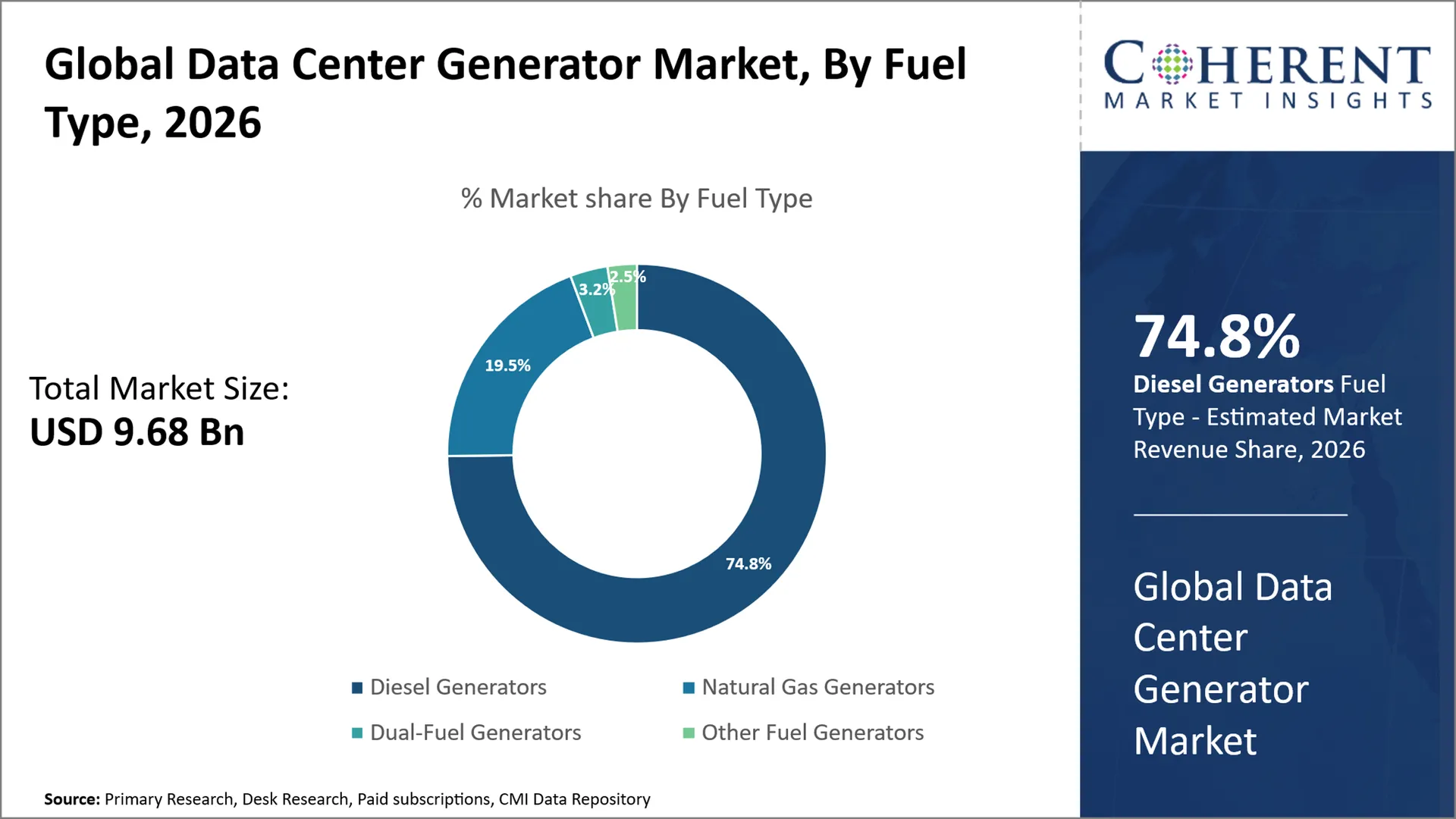
Why Do Diesel Generators Dominate the Global Data Center Generator Market?
Diesel generators are expected to account for 74.8% of the global data center generator market in 2026, due to operators' preference for equipment with well-defined electrical performance when facing sudden changes in IT equipment load. In addition to the reliability of the engine, buyers consider frequency recovery, voltage stability, emissions compliance and compatibility with existing protection systems. This gives a competitive edge to manufacturers who can provide evidence of generator performance and assistance with site specific commissioning. The segment is significant to colocation facilities and enterprise operators that are upgrading existing electrical systems without considering the redesign of their entire backup system. In October 2026, Perkins confirmed that its 5016 diesel engines had entered production for critical-power applications, including data centers, featuring engineered load acceptance and electronically controlled fuel injection. The step marks the ongoing investment in diesel-powered systems, which continues to grow with the development's success.
- Current Industry Events of 2026
- Market Size Estimation
- Regional Breakdown
- Competitive Landscape
- Customer Intelligence
- Segmental Analysis
- Pricing Analysis
- Key Market Drivers, Challenges & Future Trends
- Customized Insights Section
Why Does Below 1 MW Represent the Largest Power Capacity Segment in the Global Data Center Generator Market?
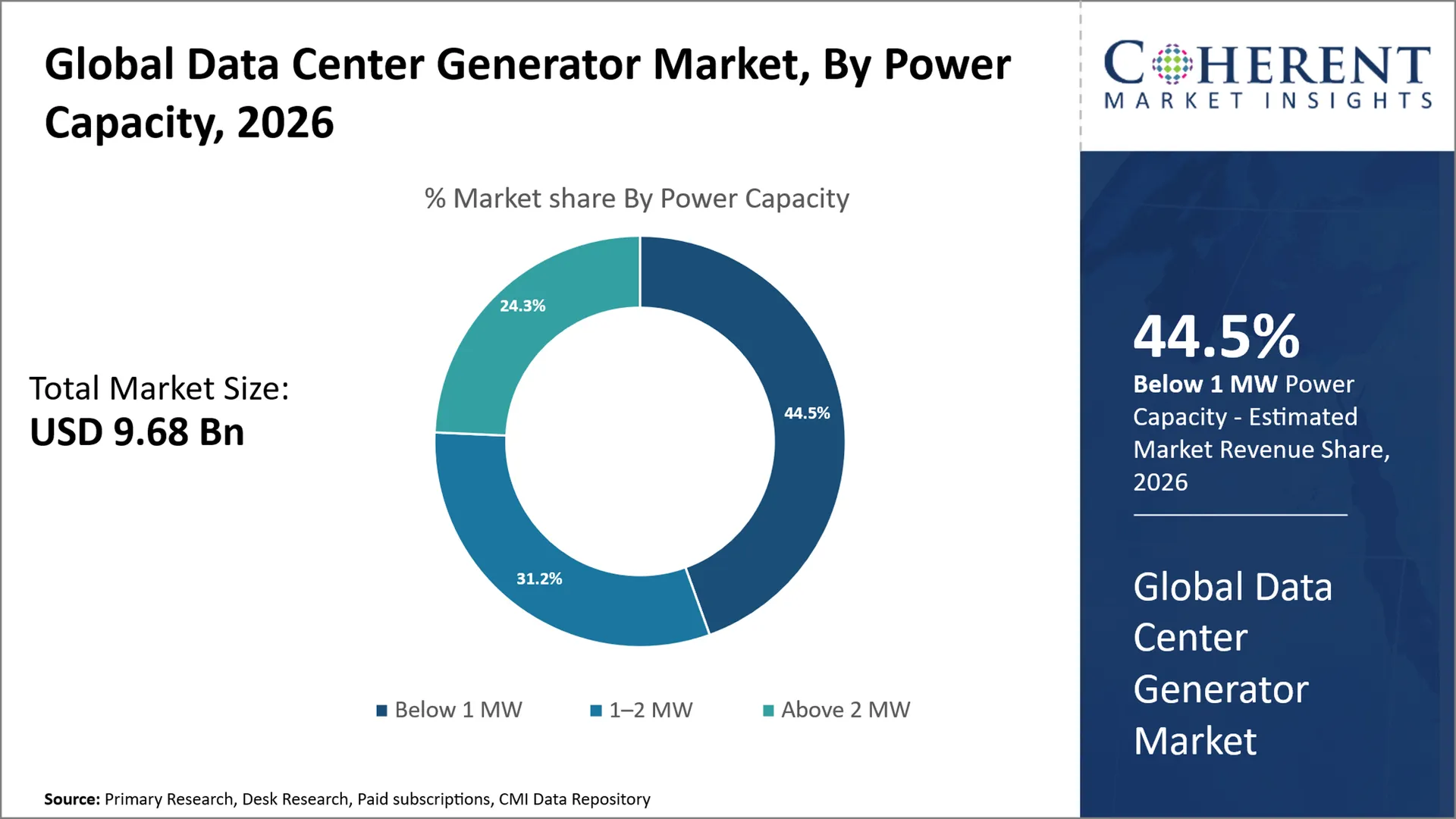
Below 1 MW generators are expected to hold 44.5% of the global data center generator market in 2026, because they are used for providing backup power to individual server rooms, network equipment, and critical building services instead of at large multimegawatt data centers. Smaller ratings allow the buyer to coordinate the equipment selection to critical electrical loads and the installation space and acoustic requirements. Rental agreements may also be a useful tool to help support a refurbishment project at an existing enterprise facility without the need to own equipment. In addition to generator specifications, enclosure design and equipment availability and maintenance are areas for competition for manufacturers and rental providers. In May 2025, Life Insurance Corporation of India issued a tender to hire and operate a 750 kVA sound-attenuated generator at its Vile Parle data center in Mumbai. This procurement demonstrates institutional requirements for sub-megawatt backup power equipment.
Why Do Hyperscale Data Centers Dominate the Data Center Type Category of the Global Data Center Generator Market?
Hyperscale data centers are projected to lead the data center type category with a 34.5% share of the global data center generator market in 2026. They make their purchase decisions based on the campus-wide electrical architecture that requires a back-up generation system to provide power to individual power blocks, while allowing for the facilities to be commissioned at different stages and requiring connections at appropriate distribution voltages. These projects are likely to go to generators that can provide repeatable high voltage packages, work closely with electrical contractors, and ensure that the specifications are uniform across various buildings. Commercial opportunities are not limited to initial equipment supply, but continue with factory testing, engineering support and additional capacity additions. In May 2026, HIMOINSA reported deploying 18 high-voltage generator sets totaling 41 MW for a phase of GDS Holdings' Kempas Tech Park hyperscale campus in Malaysia. The installation demonstrates the importance of campus-scale electrical engineering in hyperscale generator procurement.
Current Events and their Impact
Current Event | Description and Its Impact |
May 2025 – U.S. EPA Clarification on Emergency Engine Operation |
|
July 2025 – U.S. Executive Order on Data Center Infrastructure Permitting |
|
Global Data Center Generator Market Dynamics
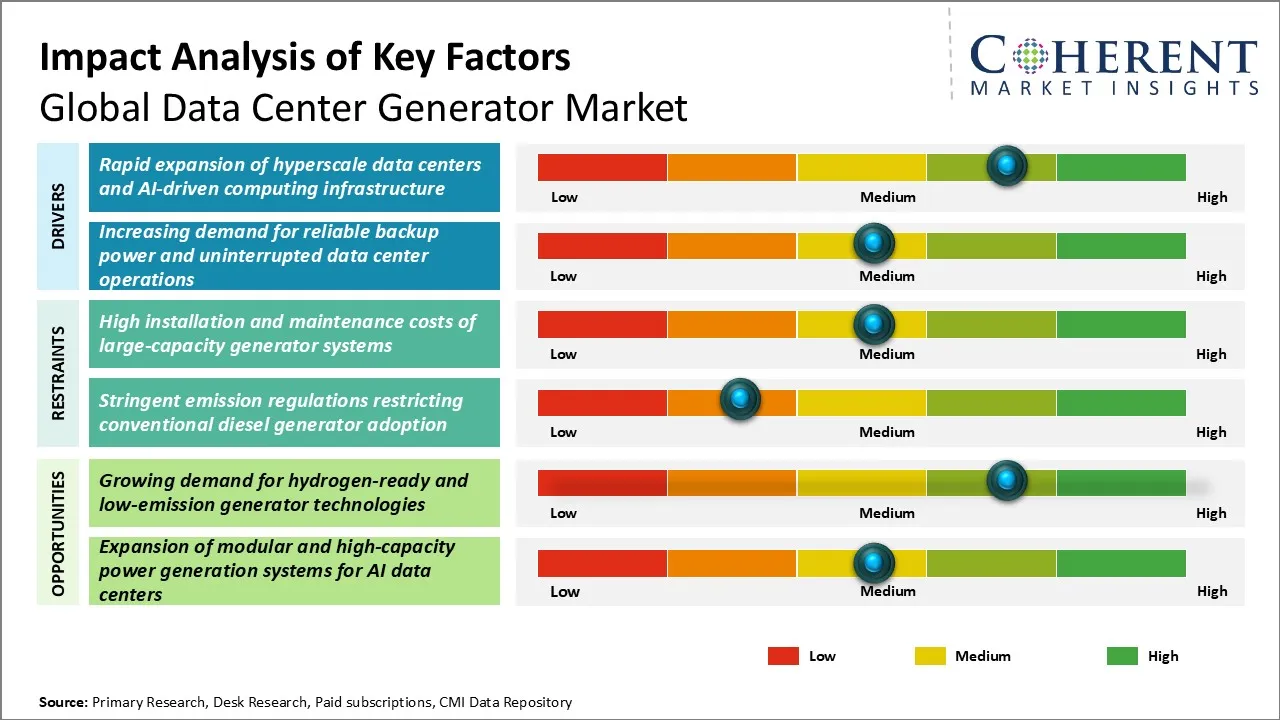
Key Market Drivers
- Rapid expansion of hyperscale data centers and AI-driven computing infrastructure: New AI training campuses are being designed around much larger blocks of electrical load than conventional enterprise facilities. Generator requirements therefore shift from individual standby units to engineered fleets, with coordinated protection, fuel autonomy, high-voltage integration, and phased expansion. This benefits engine OEMs, switchgear suppliers, enclosure fabricators, and electrical contractors capable of delivering synchronized packages rather than standalone equipment. In July 2026, Meta announced expansion of its Richland Parish, Louisiana, AI data center to 5 GW of compute capacity. The project illustrates potential procurement scale, although Meta did not disclose generator orders.
- Increasing demand for reliable backup power and uninterrupted data center operations: For operators that sell computing availability under contractual service commitments, backup power is a risk-control investment rather than a discretionary equipment purchase. A generator fleet must survive utility failures while coordinating with battery-backed UPS, transfer controls, fuel supply, and recovery procedures. Purchasers consequently scrutinize commissioning evidence, fault tolerance, and maintenance coverage alongside capital price, supporting suppliers with proven mission-critical service capabilities. In December 2025, Equinix described its use of generators capable of powering entire facilities during utility outages, alongside N+1 or greater power redundancy across its data center portfolio.
Emerging Market Trends
- Growing Preference for Fuel-Flexible and Lower-Emission Generator Systems: Procurement specifications are shifting from a simple diesel-versus-gas choice toward evidence of how a generator behaves under multiple fuel scenarios. Buyers increasingly need documented compatibility, fuel-quality assurance, exhaust-treatment integration, and warranty conditions before accepting lower-carbon alternatives. This changes competition for engine builders and fuel-system suppliers because advertised fuel flexibility is less valuable than tested performance at site conditions. Through the forecast period, vendors with transparent fuel qualification and service procedures should command stronger attention from operators balancing emissions commitments with strict startup requirements.
- Increasing Adoption of Factory-Integrated and Modular Generator Packages: Data center builders are shifting more of the generator package’s complexity to the factory setting, rather than leaving it for on-site construction. “Validated wiring interfaces, coordinated ventilation, preassembled enclosures and integrated fuel handling can reduce risk of installation and improve documentation consistency. The move benefits vendors that can build enclosures and conduct factory acceptance tests. Those that only sell unintegrated engines are feeling the squeeze. During the forecast period, standardized package interfaces should enable more predictable procurement comparisons, although customization will remain necessary for local noise, fire-safety, and environmental conditions.
Regional Insights
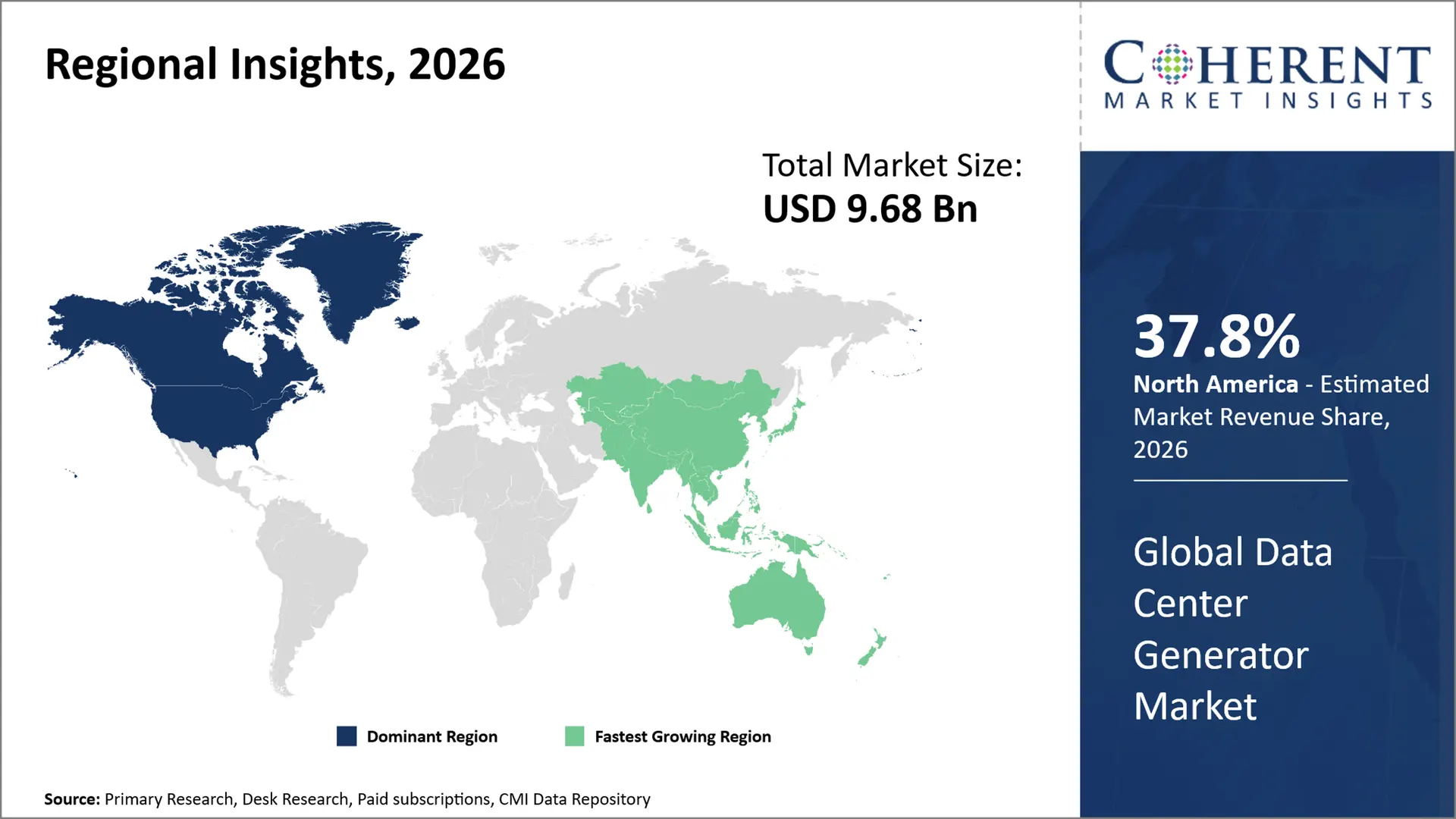
Why Does North America Dominate the Global Data Center Generator Market?
North America is projected to account for 37.8% of the global data center generator market in 2026, supported by a mature network of hyperscale campuses, colocation operators and specialized critical-power contractors. Purchasers are now considering generator equipment availability along with electrical interconnection schedules, since delays can affect the acceptance of computing workloads by completed facilities. In addition, region also provides well-established service networks for emergency repairs, routine testing, and commissioning. It gives suppliers the opportunity to offer modular systems with agreed delivery schedules and local technical support. In May 2026, 2G Energy received a North American order for containerized power plants in the low triple-digit megawatt range for data center applications. Delivery is planned to start in the later part of the year. The order illustrates commercial interest in deployable onsite generation where utility connection timing remains a project constraint.
Why Is Asia Pacific Emerging as the Fastest-Growing Region in the Global Data Center Generator Market?
The Asia Pacific region is expected to account for 32.0% share of the global data center generator market in 2026 and is projected to be the fastest growing region through 2033. The rush to build in both established and emerging digital hubs is pushing operators to create backup-power specifications that correspond to different environmental requirements and fuel supply situations. Increasingly, there is a procurement priority to reduce the lifecycle carbon footprint of emergency generation, while maintaining transfer performance during an outage. This enables engine manufacturers and fuel suppliers to test compatible renewable fuels in the real operating conditions. In May 2026, Bridge Data Centres and EcoCeres completed an HVO backup-fuel pilot at data center campuses in Asia Pacific, testing generator startup, load transfer, and sustained operation. The outcome highlights how fuel qualification may influence future equipment procurement across regional data center portfolios.
Global Data Center Generator Market Outlook for Key Countries
Why Is the U.S. a Key Market for the Global Data Center Generator Market?
The U.S. remains a significant market for data center generators globally, with a high demand for engineered emergency-power systems that is fueled by the country’s high concentration of cloud platforms and colocation facilities. Buyers are increasingly coordinating purchases across multiple campuses and prefer long-term service contracts, domestic engineering access and repeatable technical specifications. The country’s network of critical-power experts and equipment resellers can help upgrade older electrical setups and reduce fault response times. Mitsubishi Heavy Industries opened a dedicated data center business base in Dallas, Texas in May 2025 to enhance U.S. collaboration on integrated power, cooling and digital infrastructure solutions. The Concentric expansion of critical-power engineering and service capabilities underscores the commercial value of accessible technical support. In the United States, the competitiveness of generator suppliers is increasingly based on project completion success rather than individual equipment performance.
Why Does China Support Growth in the Global Data Center Generator Market?
China’s existing manufacturing base for diesel engines, alternators, enclosures and power-control equipment and large domestic need for computing infrastructure make it strategically important to the global data center generator market. The development of inland computing clusters at geographically distributed locations introduces site specific considerations like ambient conditions, electrical integration and equipment maintenance. Domestic producers can also coordinate the manufacturing of engine and power-system components, which can reduce the procurement complexity for operators and engineering contractors. In January 2026, Shandong Heavy Industry established a Power & Energy business segment. Weichai is focused on data center generator sets, acoustic enclosures, switchgear and integrated power stations. The expansion is proof of China’s move into providing fully engineered power packages. Local manufacturing depth can give buyers more control over delivery schedules and configuration flexibility.
Why Is India Important in the Global Data Center Generator Market?
India is becoming an important procurement global data center generator market as cloud platforms, financial institutions, and AI infrastructure developers expand high-density facilities. Reliable standby power that can be accommodated with complex electrical designs and changing server loads is required in Mumbai, Chennai and other digital infrastructure locations. The combination of high output equipment, engineering customization, local production and service capacity will enable domestic generator manufacturers to remain competitive. This also provides opportunities for Indian vendors to replace imported packages in some projects if they meet performance criteria. In June 2026, Kirloskar Oil Engines announced that HyperNext has ordered 96 Opti prime dual-core power systems for data center infrastructure with a total capacity of 192 MW. The deal highlights the increasing role of locally engineered power systems in large Indian computing facilities, instead of depending completely on international OEMs..
Why Is Japan an Important Growth Market for the Global Data Center Generator Market?
Japan is a large global market for data center generator producers due to the large importance placed on resilience to extended utility outages, typhoons and earthquakes in business continuity planning. When selecting a generator, considerations are coordination with battery backed power systems, seismic protection, fuel availability, and limited urban installation space. These requirements benefit manufacturers who can offer reliable domestic maintenance support along with a compact mechanical design. Japan also has a robust engine manufacturing base which can satisfy both domestic installations and international projects. Yanmar announced in April 2026 that it will build a new factory for emergency power systems in Kitakyushu, Fukuoka, to primarily serve data centers and expects it to be operational in 2028. The investment shows that manufacturers are building new production capacity for higher-output emergency systems and are still keeping close to existing component and service networks.
Generator Technology Deployment and Infrastructure Landscape
Technology | Adoption Landscape | Key Applications | Commercial Implications |
High-Power Diesel Generator Systems | Established | Hyperscale, colocation, and enterprise standby power | Provides high load acceptance and established fuel-storage options; buyers emphasize power density and lifecycle maintenance. |
Fast-Response Natural Gas Generators | Selective adoption | Gas-connected facilities and suitable critical-power applications | Offers fuel diversification, subject to validated startup performance and reliable gas delivery. |
Dual-Fuel Generator Technology | Developing | Facilities evaluating flexible fuel strategies | Supports alternative fuel configurations while requiring additional controls, fuel-system engineering, and operational validation. |
HVO-Compatible Generator Engines | Increasing specification interest | Backup power systems using qualified renewable diesel fuels | Offers a potential route to lower lifecycle emissions without replacing compatible generator engines, subject to fuel availability and approvals. |
IoT-Based Generator Condition Monitoring | Expanding | Remote maintenance, fleet monitoring, and critical-power asset management | Provides operating-condition visibility and diagnostic information, supporting maintenance planning and service agreements. |
How Are Phased Grid Connections Creating New Growth Opportunities in the Global Data Center Generator Market?
Grid-connection delays create an opportunity for generator packages engineered around staged commissioning rather than a fixed operating role. Developers often need electricity for construction, systems testing, and limited IT deployment before the permanent utility connection is fully available.
Capturing this opportunity requires genuine engine duty-cycle qualification, fuel logistics, emissions permits, protection engineering, and clear responsibility for each operating mode; an emergency-only generator cannot automatically serve as unrestricted prime power.
Manufacturers with flexible engineering platforms may win equipment sales, while specialist integrators can earn design, commissioning, and repackaging fees. Vendors should prioritize demonstrable role conversion and lifetime economics over marketing a universally interchangeable product. A clearly specified changeover strategy can reduce stranded capacity and protect customer capital.
Market Players, Key Development, and Competitive Landscape
Key Developments
- In June 2026, Rehlko announced plans for a new assembly facility in Kenosha, Wisconsin, supporting integrated eFRAME enclosures for backup generators rated up to 4 MW. The investment is intended to strengthen production capacity and local project delivery for hyperscale data center customers.
- In April 2025, Generac introduced five diesel generator models rated from 2.25 MW to 3.25 MW for data center standby applications. The launch broadened its high-output portfolio and gave large facility buyers an additional supplier option for packaged generators with specialized controllers, alternators, and redundancy features.
Competitive Landscape
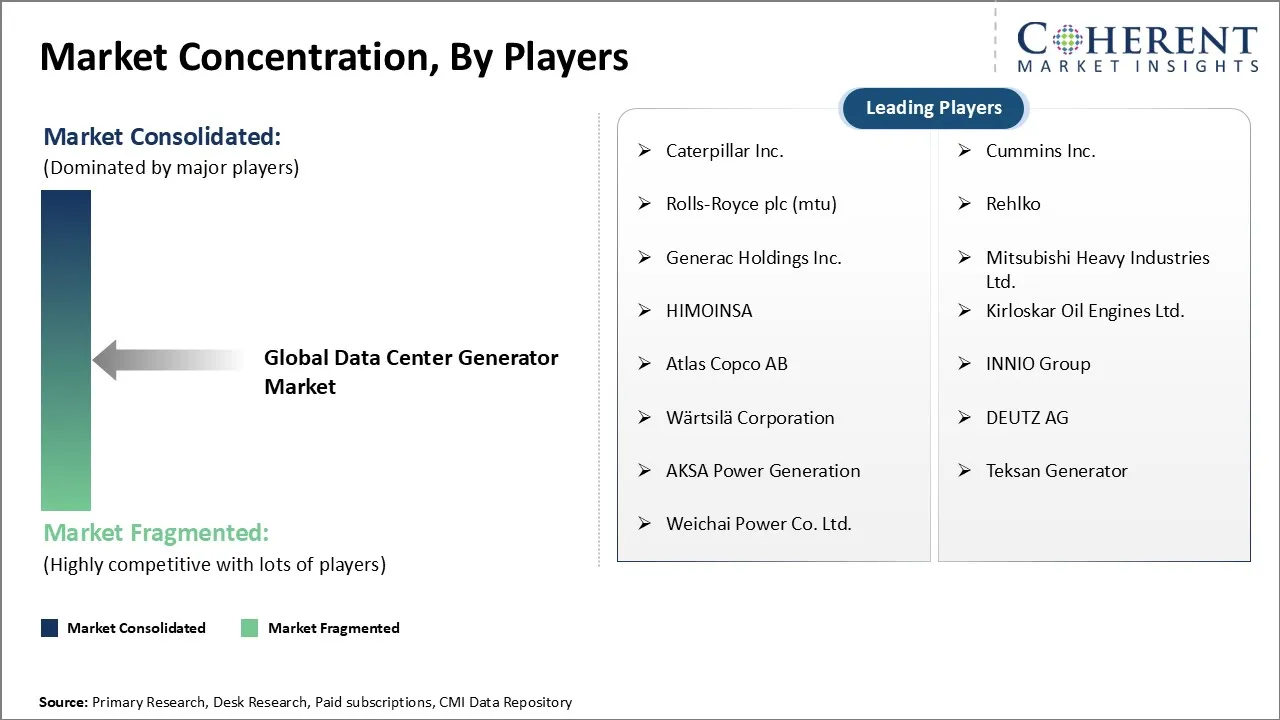
The global data center generator market at the large-project level is moderately consolidated with established engine and generator manufacturers competing with regional packagers, electrical integrators and specialist service providers. Contracts are awarded on the basis of proven performance, ability to execute the project, approved specifications, local support and not just the price of the equipment. Smaller suppliers still have a place where regional regulatory knowledge, tailoring and installation accessibility matter more than global manufacturing scale..
Key focus areas include:
- Cost Competitiveness: Buyers consider acquisition costs as well as maintenance expenditure, fuel consumption, installation requirements and replacement intervals.
- Consistency in Delivery: Production planning, sourcing of components, factory testing etc. are all important factors for major procurement decisions.
- Manufacturing Reliability: Production planning, component sourcing, factory testing, and on-time delivery all influence key procurement decisions.
- Environmental Compliance: Suppliers differentiate themselves with documentation for jurisdiction-specific approvals, acoustic engineering, and emissions control configurations.
- Distribution Capabilities: Certified regional installers install equipment and provide market access through authorized dealer networks.
- Technical Customization: The equipment for a given project is selected based on the enclosure requirements, voltage configurations, cooling configurations and electrical interfaces.
- After Sales Service: When purchasing it is important to assess availability of spare parts, training of service personnel, warranty administration and ability to perform emergency repairs.
Market Report Scope
Data Center Generator Market Report Coverage | |||
Report Coverage | Details | ||
Base Year | 2025 | Market Size in 2026: | USD 9.68 Bn |
Historical Data For: | 2020 To 2024 | Forecast Period: | 2026 To 2033 |
Forecast Period 2026 To 2033 CAGR: | 6.3% | 2033 Value Projection: | USD 14.85 Bn |
Geographies covered: |
| ||
Segments covered: |
| ||
Companies covered: | Caterpillar Inc., Cummins Inc., Rolls-Royce plc (mtu), Rehlko, Generac Holdings Inc., Mitsubishi Heavy Industries Ltd., HIMOINSA, Kirloskar Oil Engines Ltd., Atlas Copco AB, INNIO Group, Wärtsilä Corporation, DEUTZ AG, AKSA Power Generation, Teksan Generator, Weichai Power Co. Ltd. | ||
Growth Drivers: |
| ||
Restraints & Challenges: |
| ||
Analyst Opinion (Expert Opinion)
- The global data center generator market is expected to become increasingly integrated with infrastructure financing and risk allocation in contractual terms. Producers who can offer clear operating guaranties, performance data on their equipment and service commitments compatible with financing, may improve their competitive position in projects requiring large capital investments. Indeed, being a market leader may be an indicator of the ability to reduce ownership uncertainty rather than increase generator output.
- More customer control of electrical-system architecture could disrupt proprietary generator-control ecosystems. Major data center buyers might want standardized communication interfaces and interoperable equipment allowing them to independently select their engines, controls and maintenance providers. Suppliers using closed integration models might face pricing pressure, whereas those focusing on secure interoperability could gain access to more complex projects.
- Manufacturers need to focus on regional availability of spare parts, securing the supply of critical components, validating the performance of the equipment in harsh operating conditions and developing specialized engineering talent. The decision to invest should be based on confirmed project specifications and customer pipelines, not on speculative capacity commitments. Flexibility across product configurations will be key to protect margins from procurement delays, regulatory changes and fluctuating manufacturing costs.
Speak to the analyst
Want personalized insights?
Take the findings above to one of our principal consultants, or have the report rebuilt around the segments, geographies and competitors you actually track.
Market Segmentation
- Fuel Type Insights (Revenue, USD Bn, 2021 - 2033)
- Diesel Generators
- Natural Gas Generators
- Dual-Fuel Generators
- Other Fuel Generators
- Power Capacity Insights (Revenue, USD Bn, 2021 - 2033)
- Below 1 MW
- 1–2 MW
- Above 2 MW
- Data Center Type Insights (Revenue, USD Bn, 2021 - 2033)
- Hyperscale Data Centers
- Colocation Data Centers
- Enterprise Data Centers
- Edge Data Centers
- Tier Standard Insights (Revenue, USD Bn, 2021 - 2033)
- Tier I and II
- Tier III
- Tier IV
- Sales Channel Insights (Revenue, USD Bn, 2021 - 2033)
- Direct Manufacturer Sales
- EPC Contractors and System Integrators
- Dealers and Distributors
- Regional Insights (Revenue, USD Bn, 2021 - 2033)
- North America
- U.S.
- Canada
- Latin America
- Brazil
- Argentina
- Mexico
- Rest of Latin America
- Europe
- Germany
- U.K.
- Spain
- France
- Italy
- Russia
- Rest of Europe
- Asia Pacific
- China
- India
- Japan
- Australia
- South Korea
- ASEAN
- Rest of Asia Pacific
- Middle East
- GCC Countries
- Israel
- Rest of Middle East
- Africa
- South Africa
- North Africa
- Central Africa
- North America
- Key Players Insights
- Caterpillar Inc.
- Cummins Inc.
- Rolls-Royce plc (mtu)
- Rehlko
- Generac Holdings Inc.
- Mitsubishi Heavy Industries Ltd.
- HIMOINSA
- Kirloskar Oil Engines Ltd.
- Atlas Copco AB
- INNIO Group
- Wärtsilä Corporation
- DEUTZ AG
- AKSA Power Generation
- Teksan Generator
- Weichai Power Co. Ltd.
Sources
Primary Research Interviews
- Generator manufacturers, engine OEMs, alternator and power system suppliers
- Hyperscale, colocation, enterprise, and edge data center operators
- EPC contractors, system integrators, distributors, and industry experts
Stakeholders
- Diesel, natural gas, and dual-fuel generator manufacturers
- Engine, alternator, switchgear, and control system suppliers
- Data center developers, operators, and infrastructure investors
- EPC contractors, distributors, and maintenance service providers
End-use Sectors
- Hyperscale data centers
- Colocation data centers
- Enterprise data centers
- Edge data centers
Regulatory and Industry Bodies
- U.S. Environmental Protection Agency (EPA)
- European Commission
- International Organization for Standardization (ISO)
- National Fire Protection Association (NFPA)
- International Electrotechnical Commission (IEC)
- Central Pollution Control Board (CPCB), India
- Uptime Institute
Databases
- Company annual reports and investor presentations
- UN Comtrade and international generator trade statistics
- IEA, U.S. EIA, and Eurostat energy databases
- Generator production, pricing, capacity, and import-export databases
- Data center infrastructure, installed capacity, and power reliability databases
Magazines and Journals
- Data Center Dynamics
- Data Center Frontier
- Power Engineering
- Mission Critical
- Diesel Progress
- IEEE Transactions on Industry Applications
Associations
- Electrical Generating Systems Association (EGSA)
- 7x24 Exchange International
- Association for Computer Operations Management (AFCOM)
- Infrastructure Masons (iMasons)
- European Data Centre Association (EUDCA)
Public Domain Sources
- Generator production, installation, consumption, and trade statistics
- Data center construction, investment, and power capacity developments
- Diesel, natural gas, and alternative-fuel generator technologies
- Backup power reliability, emissions, and fuel efficiency data
- Product launches, manufacturing investments, and regulatory updates
Key Standards and Regulations
- ISO 8528 – Reciprocating engine-driven generator set performance and testing
- NFPA 110 – Emergency and standby power systems
- NFPA 70 – National Electrical Code (NEC)
- IEC 60034 – Rotating electrical machines
- U.S. EPA 40 CFR Part 60, Subparts IIII and JJJJ – Stationary engine emission standards
- EU Directive 2015/2193 – Medium Combustion Plant Directive, where applicable
Proprietary Elements
- CMI Data Analytics Tool and proprietary CMI repository covering power generation, data center infrastructure, generator demand, equipment pricing, manufacturing capacity, fuel technologies, regulatory developments, and competitive intelligence.
Get access to 250+ pages report
Every segment, forecast, competitor profile and data table behind the analysis above — available for instant download.
- ESOMAR Member
- ISO 9001:2015 Certified
- D-U-N-S Registered
- GDPR & CCPA Compliant
Frequently Asked Questions
The CAGR of global data center generator market is projected to be 6.3% from 2026 to 2033.
The global data center generator market is estimated to be valued at USD 9.68 billion in 2026 and is expected to reach USD 14.85 billion by 2033.
The report covers market dynamics, regional opportunities, technological developments, regulatory requirements, competitive positioning, and future industry outlook.
The report highlights emerging investment opportunities, infrastructure expansion, customer requirements, and potential growth areas for manufacturers, suppliers, and investors.
Power reliability, fuel efficiency, emissions compliance, equipment availability, installation costs, maintenance support, and total cost of ownership influence procurement decisions.
Yes, the report examines key manufacturers, product portfolios, technological capabilities, strategic developments, competitive positioning, and market expansion strategies.
The rapid expansion of hyperscale data centers and AI-driven computing infrastructure, along with the growing need for reliable backup power and uninterrupted operations, are the major factors driving the growth of the global data center generator market.