

What is the Global Decorative Laminates Market?
The global decorative laminates market includes high pressure laminates, low pressure laminates, compact laminates, and other surface materials used in furniture, cabinets, wall panels, flooring, countertops, doors, and partitions.
Key Statistics at a Glance
Metric | Value |
Global Market Size (2026) | USD 10.63 Billion |
Forecast Market Size (2033) | USD 16.96 Billion |
Growth Rate (CAGR 2026–2033) | 6.9% |
Leading Product Segment | High Pressure Laminates (43.6% share in 2026) |
Leading Surface Finish | Matte Finish (32.4% share in 2026) |
Leading Application | Furniture and Cabinets (34.8% share in 2026) |
Dominant Region | Asia Pacific (40.7% share in 2026) |
Fastest Growing Region | Europe (25.6% share in 2026) |
Base Year | 2025 |
Forecast Period | 2026–2033 |
Key Players | Greenlam Industries, Merino Laminates, Wilsonart, Formica Group, AICA Kogyo |
Global Decorative Laminates Market Size and Forecast – 2026 To 2033
The Global Decorative Laminates Market is estimated to be valued at USD 10.63 Bn in 2026 and is expected to reach USD 16.96 Bn by 2033, exhibiting a compound annual growth rate (CAGR) of 6.9% from 2026 to 2033. This steady growth is driven by increasing demand for decorative laminates from the residential and commercial construction sectors, along with rising consumer preference for aesthetically appealing, durable, and low-maintenance interior surfaces.
The market outlook is backed by the expansion in emerging markets, rising popularity of modular furniture, and increasing usage of high-end finishes in the kitchens, wardrobes, cabinets, wall panels, and commercial fit-outs. In March 2026, Arpa Industriale launched the Naturalia collection, a new HPL range inspired by nature and designed for interior design applications, highlighting the market’s shift toward premium, design-led decorative surfaces and differentiated material aesthetics.
Key Takeaways of the Global Decorative Laminates Market
- High Pressure Laminates are expected to dominate the product type segment with 43.6 % of the market share in 2026, supported by their durability, abrasion resistance, and suitability across furniture, wall panels, countertops, and high-traffic interiors. In May 2025, ICDLI launched its digital HPL Compendium at interzum Cologne, strengthening technical awareness and specification confidence for HPL among architects, designers, and processors.
- Matte Finish is expected to lead the surface finish segment with 32.4 % of the market share in 2026, as buyers increasingly prefer premium, low-glare, fingerprint-friendly surfaces for modern residential and commercial interiors. In February 2026, EGGER’s Decorative Collection 26+ expanded its PerfectSense portfolio, giving designers more room for comprehensive matte design concepts across high-performance interior surfaces.
- Furniture and Cabinets are expected to remain the leading application segment with 34.8 % of the market in 2026, as decorative laminates offer cost-efficient design flexibility for wardrobes, casegoods, shelving, modular kitchens, and office furniture. In August 2025, Wilsonart introduced four new woodgrain designs under its LUJO Collection, targeting cabinets, casegoods, furniture, open shelving, and accent wall panels.
- Asia Pacific is expected to dominate the global decorative laminates market with 40.7 % share in 2026, supported by expanding manufacturing capacity, organized furniture production, and higher spending on interior surfacing. In July 2025, Greenlam Industries announced a USD 12.09 Mn high-pressure laminate and particle board facility in Andhra Pradesh, India, strengthening regional supply capability for engineered wood and laminate products.
- Europe is expected to be the fastest-growing region while holding 25.6 % of the market share in 2026, as renovation demand, premium interior specifications, and stricter material compliance accelerate product upgrades. From August 2026, EU REACH formaldehyde rules will apply tighter emission limits for furniture and wood-based articles, pushing laminate manufacturers toward safer, low-emission surfacing systems.
- Current Industry Events of 2026
- Market Size Estimation
- Regional Breakdown
- Competitive Landscape
- Customer Intelligence
- Segmental Analysis
- Pricing Analysis
- Key Market Drivers, Challenges & Future Trends
- Customized Insights Section
Segmental Insights
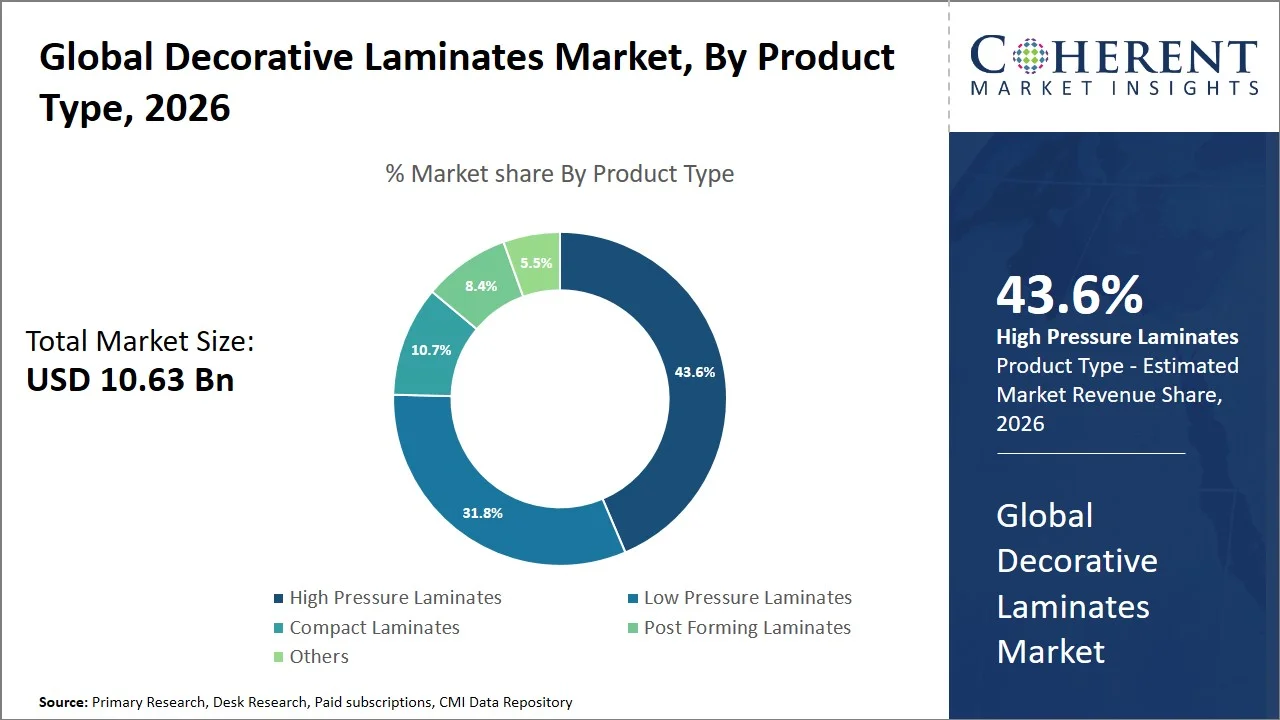
Why Do High Pressure Laminates Dominate the Global Decorative Laminates Market?
High pressure laminates are expected to dominate the global decorative laminates market with 43.6% share in 2026 because they offer a strong combination of surface durability, design flexibility, and broad application compatibility. Demand is supported by high-use interiors where resistance to scratches, abrasion, heat, moisture, and routine cleaning is commercially important. On the supply side, established press technology, paper-resin layering, larger sheet formats, and scalable production lines make HPL suitable for both standard and premium projects. HPL is strongly adopted in countertops, cabinets, furniture, wall panels, doors, retail fixtures, and institutional interiors. In June 2025, Rushil Décor announced that Phase 2 of its jumbo laminate plant in Gujarat, India, would add 2.8 million sheets per annum, strengthening supply for export-oriented HPL demand.
Why Does Matte Finish Represent the Largest Surface Finish Segment in the Global Decorative Laminates Market?
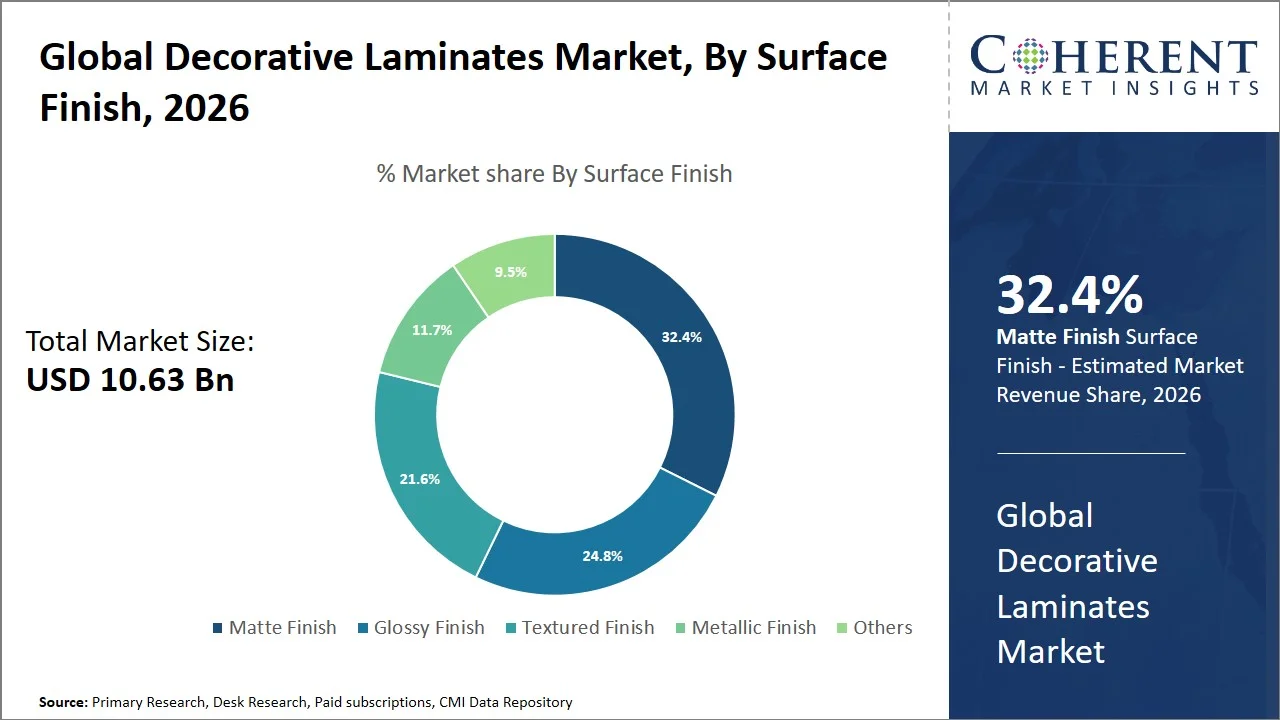
Matte finish is expected to lead the surface finish segment with 32.4% of the market share in 2026 because it aligns with modern interior preferences for soft, low-glare, premium-looking surfaces. Demand is particularly strong in kitchens, wardrobes, office furniture, feature walls, and retail interiors where surfaces must look refined while remaining easy to maintain. Supply-side innovation is strengthening the segment through anti-fingerprint coating, scratch-resistant top layers, smooth tactile finishes, and wider texture libraries. Matte laminates also help designers replace difficult-to-maintain painted or textured surfaces with engineered, consistent, and cleanable alternatives. In May 2025, Formica India introduced its Dual Matt Finish, highlighting anti-fingerprint functionality, reduced glare, scratch resistance, 1 mm thickness, and use across furniture, cabinetry, offices, kitchens, and partitions.
Why Do Furniture and Cabinets Dominate the Global Decorative Laminates Market?
Furniture and cabinets are expected to dominate the application segment with 34.8% of the market share in 2026 because laminates are highly compatible with MDF, particleboard, plywood, and other engineered substrates used in mass and modular furniture production. Demand is supported by wardrobes, kitchen cabinets, office desks, shelving, storage units, casegoods, and retail fixtures that require attractive, durable, and cost-controlled surfaces. From the supply side, laminates support fast fabrication, edge-banding compatibility, coordinated décor systems, and repeatable finishes across large furniture batches. This makes them important for residential renovation, commercial fit-outs, hospitality furniture, and institutional interiors. In January 2025, Pfleiderer launched its 2025–2028 EXPRESS collection for furniture and interior design, with quickly available decors across DecoBoard P2, Duropal HPL laminate, and HPL composite elements.
Global Decorative Laminates Market Dynamics
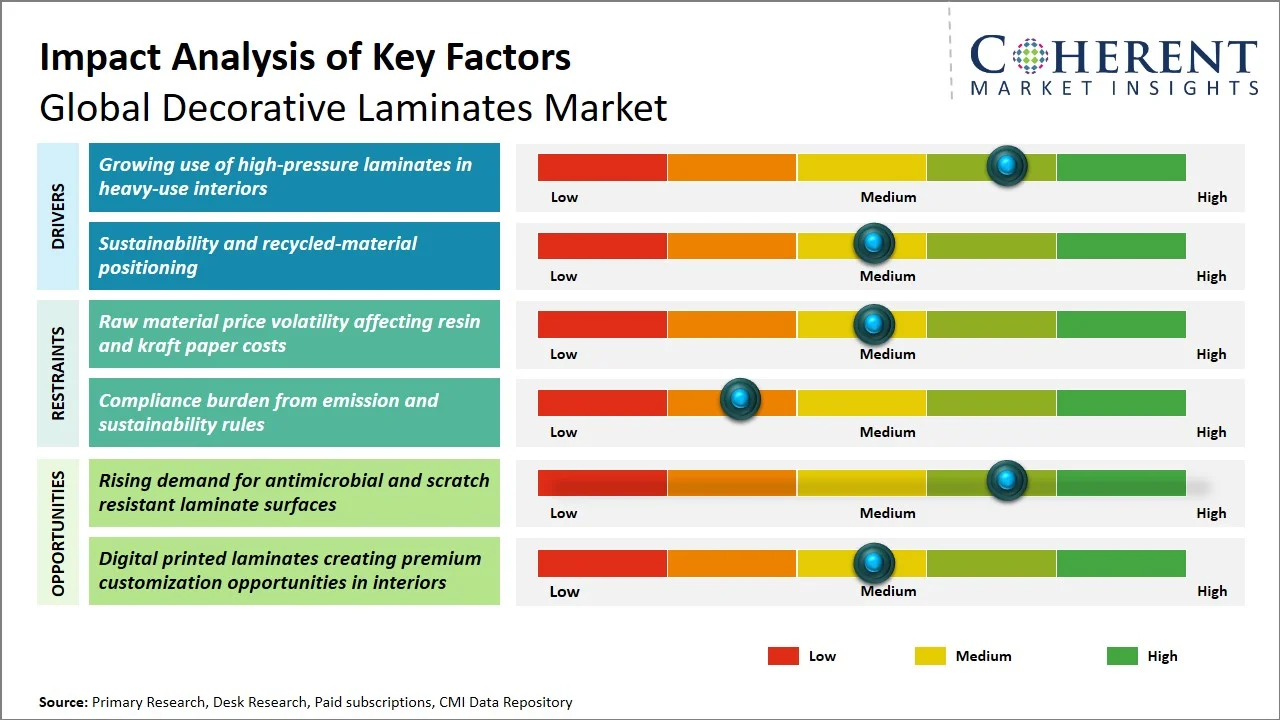
Key Market Drivers
- Growing Use of High-Pressure Laminates in Heavy-Use Interiors: High-pressure laminates are gaining preference because they offer better resistance to scratches, abrasion, impact, moisture, and routine cleaning compared to many conventional surfacing materials. This makes them suitable for kitchens, office furniture, retail counters, healthcare furniture, education furniture, and hospitality interiors where surfaces face frequent use. Large-format and jumbo laminate sheets are also helping contractors reduce joints and improve visual continuity in premium interior projects.
- Sustainability and Recycled-Material Positioning: Sustainability is becoming an important selection factor in commercial interiors, public buildings, and export-oriented furniture production. Decorative laminate suppliers are responding by improving responsible sourcing, recycled wood use, low-emission panels, and environmental certification alignment. These requirements are especially important in Europe and North America, where architects and procurement teams increasingly ask for sustainability documentation. In January 2025, Kronospan highlighted recycled-wood-based panels at BAU 2025, reinforcing how circular material positioning is becoming commercially relevant for wood-based panels and decorative surface systems.
- Expansion of Modular Furniture and Cabinet Applications: Furniture and cabinets are the largest application area because laminates give furniture manufacturers a practical balance of appearance, durability, and affordability. Modular kitchens, wardrobes, storage units, office desks, shelving, and casegoods require surfaces that are easy to fabricate, available in many designs, and compatible with MDF, particleboard, plywood, and other substrates. Laminates also help furniture makers standardize finishes across mass and premium product ranges. This supports higher adoption among organized furniture manufacturers, interior contractors, and residential renovation service providers.
- Premiumization of Matte, Textured, and Natural-Look Surfaces: Buyers are shifting from plain glossy laminates toward matte, anti-fingerprint, woodgrain, stone-look, fabric-look, and synchronized texture finishes. This is improving product realization for manufacturers because premium surfaces allow brands to move beyond commodity pricing. Interior designers and homeowners are also using laminates as cost-effective substitutes for veneer, stone, metal, and solid surfaces. As a result, design depth, tactile feel, and finish consistency are becoming key purchase criteria in both residential and commercial projects.
- Stronger Role of Distributors, Dealers, and Project Specification Channels: Distributors and dealers remain important because decorative laminates are specification-led products where customers need access to samples, catalogues, shade matching, fabrication guidance, and local delivery. Contractors and furniture workshops also prefer channels that can supply multiple thicknesses, finishes, and matching edge bands with shorter lead times. This supports steady demand from residential renovation, commercial fit-out, and small-scale furniture manufacturing. At the same time, digital catalogues and online sampling are improving product discovery, especially for designers and urban consumers.
Top 5 Trends in the Global Decorative Laminates Market
- Adoption of Coordinated Surface Solutions: Decorative laminate buyers are increasingly choosing matched laminates, compact panels, worktops, wall panels, edgebands, and boards from the same design family. This trend helps furniture makers and contractors maintain visual consistency across kitchens, wardrobes, office furniture, retail fixtures, and commercial interiors while reducing shade mismatch and project execution delays.
- Rise of Realistic Wood, Stone, and Metal Reproductions: Decorative laminates are increasingly designed to replicate natural materials with improved print depth and texture alignment. This trend allows furniture makers and contractors to deliver premium aesthetics at lower cost and with easier maintenance than natural veneer, stone, or metal.
- Demand for Larger Sheet Formats: Jumbo and large-format laminates are gaining relevance in countertops, wall panels, wardrobes, doors, and commercial fixtures. Larger sheets reduce visible seams, improve installation speed, and support premium interior designs with continuous surface appearance.
- Growing Focus on Low-Emission and Compliance-Ready Products: Manufacturers are investing in resin optimization, safer substrates, and emission-controlled laminates to meet stricter indoor air quality requirements. Compliance readiness is becoming a competitive advantage for suppliers targeting Europe, North America, institutional projects, and export-led furniture manufacturers.
- Digital Specification and Sample-Based Selling: Designers, contractors, and consumers increasingly use digital catalogues, room visualizers, and online sample ordering before final purchase. This is strengthening brand visibility and shortening the decision cycle, especially in urban residential and commercial renovation projects.
Market Challenges
- Raw material price volatility affecting resin and kraft paper costs : Decorative laminate production depends on kraft paper, decorative paper, phenolic resins, melamine resins, overlays, substrates, and energy-intensive pressing operations. Price movement in paper, petrochemical-derived resins, and energy can directly affect production costs. Smaller manufacturers often face margin pressure because they have limited ability to pass sudden cost increases to distributors or project buyers. This can widen the gap between organized and unorganized players.
- Compliance Burden from Emission and Sustainability Rules: Stricter formaldehyde emission rules, wood traceability requirements, and construction product documentation are increasing testing and certification requirements. Exporters must invest in laboratory testing, supplier traceability, technical files, and quality-control systems. While these rules improve product quality and market trust, they raise compliance costs for small and medium suppliers. Non-compliant suppliers may lose access to regulated markets or premium commercial projects.
- Competition from Substitute Surfacing Materials: Decorative laminates compete with veneers, acrylic sheets, PVC films, solid surfaces, quartz, ceramic panels, painted MDF, and engineered wood finishes. In premium projects, architects may select alternatives based on tactile quality, fire performance, water resistance, or luxury positioning. This limits laminate adoption in certain high-end counters, wet-area applications, and luxury wall cladding projects. Manufacturers must therefore differentiate through finish quality, durability, certifications, and coordinated design systems.
Current Events and their Impact
Current Events | Description and its Impact |
EU REACH Formaldehyde Restriction, August 2026 onward |
|
EU Deforestation Regulation Amendment, December 2025 |
|
EU Construction Products Regulation 2024, applicable from January 2026 |
|
Technology Adoption Landscape in the Global Decorative Laminates Market
Technology | Adoption Level | Key Application Area | Business Impact |
Digital décor printing | Medium | Custom woodgrain, stone, abstract, and branded surface designs | Enables shorter design cycles, smaller batches, and faster response to interior trends. |
Anti-fingerprint matte coating | High | Kitchen cabinets, wardrobes, office furniture, retail fixtures | Improves product premiumization and supports higher-value residential and commercial specifications. |
Electron beam curing / advanced surface curing | Medium | High-durability HPL overlays and specialty surfaces | Improves scratch resistance, cleanability, and surface performance for high-traffic applications. |
Embossed-in-register texture pressing | Medium | Realistic wood, stone, and fabric-look laminates | Enhances tactile realism and helps laminates compete with veneer, stone, and premium panels. |
Low-emission resin systems | High | Furniture-grade laminates, panels, and export-oriented products | Supports compliance with indoor air quality rules and improves acceptance in regulated markets. |
Digital sampling and visualization tools | Medium | Architect, dealer, contractor, and consumer specification | Reduces decision time, improves design confidence, and strengthens brand-led selling. |
How are Low-Emission Premium Surfaces Creating New Growth Opportunities in the Global Decorative Laminates Market?
Low-emission premium surfaces are creating strong commercial opportunities because decorative laminates are no longer selected only for price and basic aesthetics. Residential buyers, commercial developers, architects, and institutional procurement teams increasingly expect surfaces that combine attractive design, durability, easy maintenance, and safer indoor air performance. This creates room for manufacturers to differentiate through low-formaldehyde resin systems, certified substrates, anti-fingerprint matte finishes, realistic textures, and coordinated décor systems for furniture, doors, wall panels, and cabinets. The opportunity is commercially important because premium and compliance-ready laminates can improve margins while helping suppliers access regulated export markets and specification-led commercial projects. Manufacturers that invest in testing, quality control, digital design libraries, and sustainable sourcing can move beyond commodity sheet sales and become preferred partners for furniture makers, contractors, and interior designers. Growth will be strongest where buyers need durable, design-rich, and regulation-ready surfacing at a cost lower than natural veneer, stone, or metal.
Regional Insights
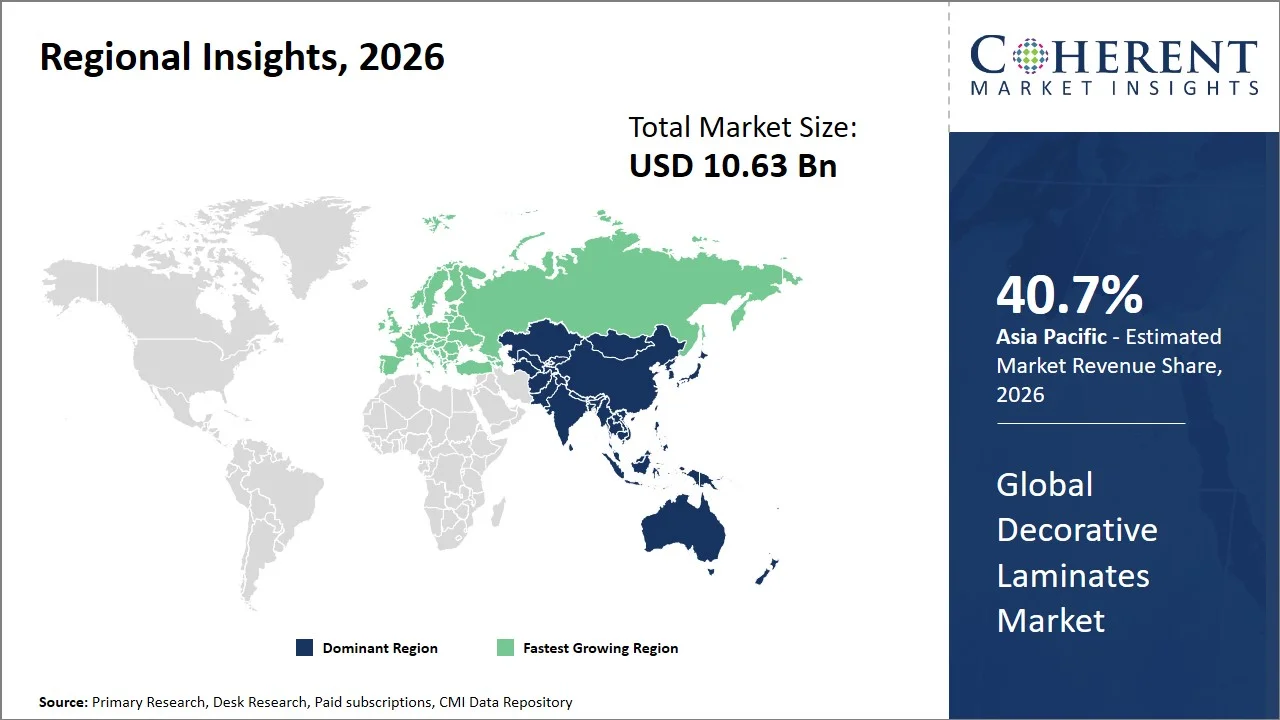
Why Does Asia Pacific Dominate the Global Decorative Laminates Market?
Asia Pacific is expected to dominate the global decorative laminates market with 40.7% share in 2026, supported by large-scale furniture production, expanding urban housing, strong distributor-led sales, and cost-competitive laminate manufacturing clusters in China, India, Japan, and Southeast Asia. The region has a strong demand base across modular furniture, cabinets, retail fixtures, wall panels, and residential renovation. Local manufacturers also benefit from substrate availability, export-oriented production, and rising adoption of HPL, compact laminates, and fire-retardant decorative panels. In May 2026, AICA Kogyo’s FY2025 results presentation forecast 55.0% YoY growth in high-pressure laminate sales for FY2026, supported by Stylam consolidation and higher-value product growth, showing how Asia-based players are strengthening global laminate supply.
Why is Europe Emerging as the Fastest-Growing Region in the Global Decorative Laminates Market?
Europe is expected to be the fastest-growing region with 25.6% share in 2026, supported by premium interior renovation, demand for compliant low-emission surfaces, and strong adoption of HPL in furniture, hospitality, education, healthcare, and commercial fit-out projects. European buyers place high importance on durability, fire performance, surface hygiene, sustainability documentation, and design authenticity, which supports higher-value laminate specifications. The region also benefits from established laminate producers, design-led trade fairs, and a mature architect/specifier ecosystem. In October 2025, Abet Laminati presented new products at SICAM 2025, including additions to the Rocks collection, Capsule collection, Velwood and Polaris finishes, highlighting Europe’s focus on premium décor innovation and material-led surface differentiation.
Global Decorative Laminates Market Outlook for Key Countries:
Why is the U.S. a Key Market for the Global Decorative Laminates Market?
The U.S. is expected to account for 18.6% of the global decorative laminates market share in 2026, making it one of the most important markets for decorative laminates. Demand is supported by remodeling, cabinet replacement, office furniture, healthcare interiors, education facilities, retail fixtures, and hospitality refurbishment. The country has a mature specification culture where laminates are selected for durability, cleanability, code compliance, and design consistency across large projects. Demand in the U.S. is also supported by strong distributor networks and availability of HPL, TFL, compact laminate, and specialty surfaces. In May 2026, the U.S. Census Bureau reported construction spending at a seasonally adjusted annual rate of USD 2,210.2 billion, with residential construction at USD 930.2 billion, indicating a large downstream base for interior surfacing materials.
Why Does China Support Growth in the Global Decorative Laminates Market?
China is expected to hold 18.3% share in 2026, supported by its large furniture manufacturing base, extensive wood-based panel production, strong domestic consumption, and export-oriented interior product supply chains. Decorative laminates are prevalent in ready-to-assemble furniture, cabinets, doors, fit-outs for retail, and mass housing. China's strength is that it can achieve scale production, comprehensive raw material supply, rapid design of decoration and mass sales to home and overseas customers. Policies also help meet demand in the country, focusing on upgrading consumers and spending on their homes. The National Bureau of Statistics of China announced in 2025 that the total value of furniture retail sales by enterprises above the national designated size rose 14.6%. Retail sales of furniture by enterprises above the national designated size jumped 14.6% in 2025 as reported by National Bureau of Statistics of China.
Why is India Important in the Global Decorative Laminates Market?
India is expected to account for 9.2% share of the global decorative laminates market in 2026. supported by rapid urban housing formation, modular kitchen adoption, branded laminate penetration, and a strong domestic manufacturing base for decorative laminates. Demand is concentrated in wardrobes, kitchen cabinets, office furniture, retail interiors, wall panels, and residential renovation. India also benefits from a wide dealer network, price-tiered product availability, and rising acceptance of premium matte, textured, anti-fingerprint, and large-sheet formats. Export ambitions are improving as manufacturers scale HPL and decorative panel production. In September 2025, Euro Pratik Sales, a decorative wall panels and laminates company, listed at nearly an 11% premium over its IPO price, reflecting investor interest in organized decorative surfacing and branded interior material businesses.
Why is Germany a Strategic Country in the Global Decorative Laminates Market?
Germany is expected to hold 5.6% share in 2026, supported by advanced furniture manufacturing, premium interior design standards, strong building renovation activity, and strict material quality expectations. The country is important for high-performance laminates used in office furniture, kitchen systems, worktops, wall panels, education furniture, healthcare interiors, and commercial fit-outs. German buyers typically prioritize certified surfaces, durable finishes, emission compliance, and coordinated décor systems, which supports higher-value laminate adoption. Germany also acts as a design and specification hub for wider European demand. In April 2026, Destatis reported 20,172 dwellings in building permits and estimated building costs of USD 0.093 billion, showing the continuing project pipeline for residential and non-residential interior surfacing demand.
Why is the UAE an Important Growth Market for the Global Decorative Laminates Market?
The UAE is expected to account for 1.1% share in 2026, supported by high-value real estate, luxury residential projects, hospitality interiors, retail fit-outs, office refurbishments, and imported premium surfacing materials. Decorative laminates are used in hotel furniture, wardrobes, cabinets, wall panels, doors, counters, commercial partitions, and high-traffic public interiors. The market is relatively smaller in volume than China, India, or the U.S., but it is strategically important because project specifications often favor premium finishes, fire-rated materials, and fast installation solutions. In April 2026, Dubai Land Department reported that Dubai real estate transactions reached USD 68.62 billion in Q1 2026, up 31% YoY, supporting continued fit-out and decorative surface demand.
Market Players, Key Development, and Competitive Intelligence
Key Developments
- In November 2025, Dekodur introduced its Genuine Metals HPL Collection 2026, including 17 premium decors that combine authentic metal aesthetics with HPL processing convenience. This is important for the decorative laminates market because it expands specialty HPL positioning in high-value architectural interiors where designers seek premium metallic appearance with laminate workability.
- In May 2025 , Merino Laminates showcased its new design collection and surface solutions at Interzum 2025, including Harmony Coordinated Surfaces, Luvih anti-fingerprint laminates, and Impreza Worktops. The launch strengthens Merino’s position in premium coordinated surfacing by offering architects, interior designers, furniture makers, and commercial fit-out customers more design-led and functional laminate options.
- In February 2025 , Fundermax highlighted the opening of an 800 m² showroom in Hangzhou, China, dedicated exclusively to Fundermax products and designs. The showroom enhances specification support and product visibility in Asia Pacific by allowing architects, designers, and project buyers to evaluate laminate applications in a real interior-surfacing environment.
Competitive Intelligence
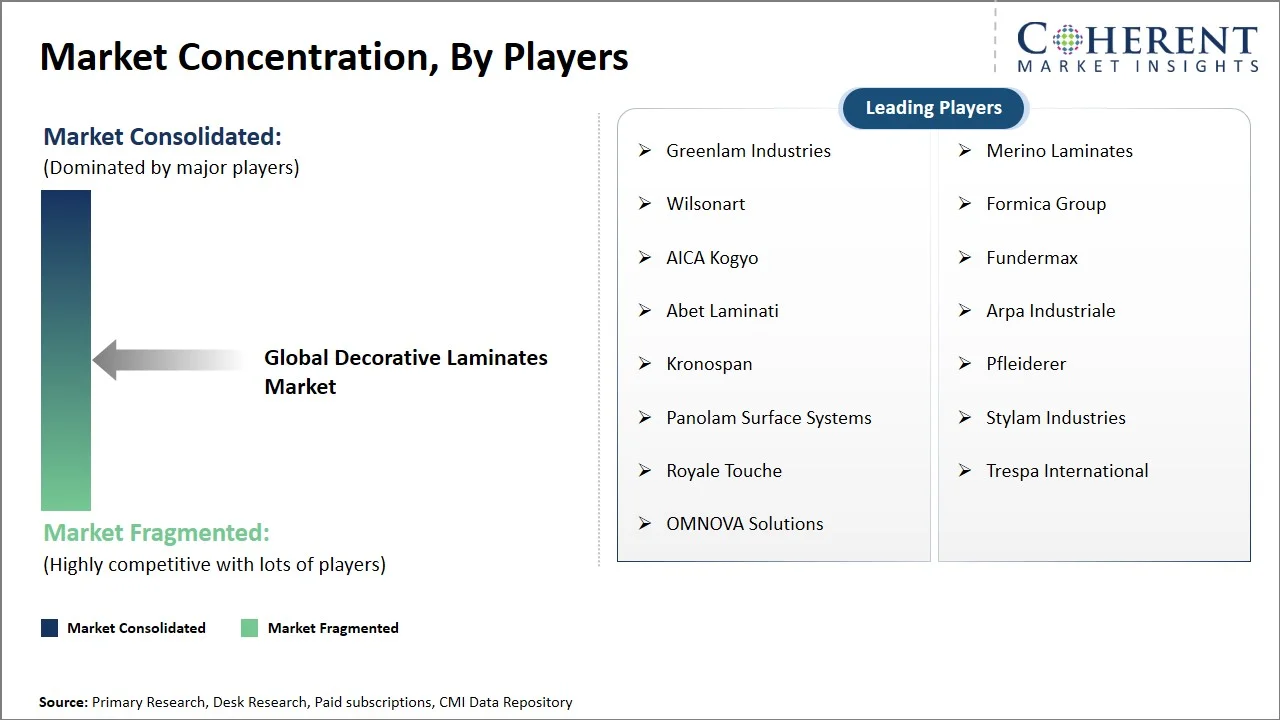
The global decorative laminates market is moderately fragmented, with competition between large multinational surface-material companies, regional laminate manufacturers, wood-panel producers, organized distributors, and private-label suppliers. Companies compete based on décor depth, surface finish, technical performance, cost efficiency, compliance readiness, dealer reach, and ability to supply consistent quality across residential, commercial, and furniture manufacturing channels.
Key focus areas include
- Product quality and differentiation: Companies focus on scratch resistance, moisture resistance, heat resistance, cleanability, and design authenticity.
- Technology adoption and process efficiency: Advanced presses, coating systems, digital printing, and automated finishing help improve consistency and reduce defects.
- Pricing and cost competitiveness: Scale, raw material sourcing, and production efficiency remain critical in price-sensitive residential and dealer-led markets.
- Capacity expansion and supply reliability: Reliable sheet availability, faster delivery, and broader stock programs are important for contractors and furniture makers.
- Certifications, compliance, and quality control: Low-emission certifications, fire ratings, sustainability documentation, and technical data sheets support premium specification.
- Distribution network and customer reach: Strong dealer networks, sample availability, and architect engagement improve brand conversion at the project level.
- Specification differentiation: Thickness, sheet size, finish, grade, post-forming capability, compact laminate strength, and coordinated edgebands help suppliers target specific applications.
- B2B and digital channel expansion: Online catalogues, visualizers, digital sampling, and direct project support are improving sales efficiency and customer engagement.
Competitive Landscape Table
Company | Headquarters | Key Decorative Laminates Brands | Primary Market Segment |
Greenlam Industries | New Delhi, India | Greenlam Laminates, Greenlam Clads, Mikasa Laminates | HPL, compact laminates, interior cladding, furniture and commercial surfacing solutions |
Merino Laminates | New Delhi, India; registered office in Kolkata, India | Merino Lam, Luvih, Acrolam, Feather Touch | Decorative laminates, compact panels, interior panels, residential and commercial surface solutions |
Wilsonart | Texas, U.S. | Wilsonart HPL, Wilsonart TFL, Arborite, Laminart, Polyrey, Resopal | HPL, TFL, compact laminates, engineered surfaces for residential, retail, hospitality, healthcare, office and education |
Formica Group | Ohio, U.S. | Formica Laminate, Formica ColorCore, 180fx, DecoMetal, FENIX | HPL and specialty surfacing for countertops, cabinets, worktops, wall panels, residential and commercial interiors |
AICA Kogyo | Nagoya, Japan | AICA HPL, CERARL, AICA POLY, Altyno, ARDICA, LUNALITE | HPL, fire-retardant decorative panels, wall panels, counters, furniture and public/commercial interior materials |
Fundermax | St. Veit an der Glan, Austria | Max HPL, Max Compact Interior, Max Compact Exterior, Aptico, Star Favorit | Compact laminates, HPL panels, interior wall cladding, exterior façades, office furniture and high-use architectural applications |
Abet Laminati | Bra, Italy | Print HPL, Stratificato HPL, Polaris, Full-Colour, Metalli, Diafos, Labgrade, Lamishield | Decorative HPL for interiors, exteriors, furniture, hospitality, marine, retail, contract and architectural surfaces |
Arpa Industriale | Bra, Italy | Arpa HPL, FENIX, Bloom-based HPL surfaces | High-quality HPL surfaces for interior design, furniture, product design and architectural applications |
Kronospan | Mosta, Malta | Kronodesign, Kronoart, KronoOriginal, Rocko, MyStyle, Kronostep | Wood-based decorative panels, melamine-faced boards, laminate flooring, wall panels, worktops and furniture/interior design surfaces |
Pfleiderer | Neumarkt in der Oberpfalz, Germany | Duropal HPL, Duropal Compact, Duropal XTreme, SolidColor, DecoBoard, DST-System | HPL, compact laminates, decorative panels, melamine-faced boards, worktops and furniture/interior fitting solutions |
Panolam Surface Systems | Shelton, U.S. | Nevamar, Pionite, Panolam TFL, Pluswood, FRL, FRP, Conolite | HPL, TFL and specialty surface systems for contract, commercial, healthcare, residential, wall, fixture and architectural applications |
Stylam Industries | Chandigarh, India | Stylam Laminates, Stylam HPL, exterior cladding panels, solid surface solutions | Decorative and high-pressure laminates for homes, offices, commercial interiors, furniture and exterior applications |
Royale Touche | Gujarat, India | Royale Touche Laminates, Crystal, Crystal Matty+, HD Laminates, Digital Laminates, Super Matt, Fluted Laminates | Luxury decorative laminates and compact laminates for residential, office, hotel, restaurant, education, retail and commercial interiors |
Trespa International | Weert, Netherlands | Trespa Meteon, Pura NFC, Trespa TopLab | HPL panels for exterior cladding, decorative façades, sidings, interior panels and scientific surface solutions |
OMNOVA Solutions | Ohio, U.S. | OMNOVA decorative laminates, surf(x) 3D Laminates, 2D Laminates, decor papers | Decorative films, laminates, 2D/3D laminates and performance surfaces for cabinetry, furniture, retail fixtures, RVs and manufactured housing interiors |
Market Report Scope
Decorative Laminates Market Report Coverage
| Report Coverage | Details | ||
|---|---|---|---|
| Base Year: | 2025 | Market Size in 2026: | USD 10.63 Bn |
| Historical Data for: | 2020 To 2024 | Forecast Period: | 2026 To 2033 |
| Forecast Period 2026 to 2033 CAGR: | 6.9% | 2033 Value Projection: | USD 16.96 Bn |
| Geographies covered: |
| ||
| Segments covered: |
| ||
| Companies covered: | Greenlam Industries, Merino Laminates, Wilsonart, Formica Group, AICA Kogyo, Fundermax, Abet Laminati, Arpa Industriale, Kronospan, Pfleiderer, Panolam Surface Systems, Stylam Industries, Royale Touche, Trespa International, and OMNOVA Solutions | ||
| Growth Drivers: |
| ||
| Restraints & Challenges: |
| ||
Analyst Opinion (Expert Opinion)
- The global decorative laminates market is expected to maintain a positive outlook as furniture, cabinets, wall panels, flooring, and commercial interiors continue to shift toward engineered, cost-efficient, and design-flexible surfaces. High-pressure laminates, matte finishes, and furniture/cabinet applications are expected to remain the strongest demand pockets because they combine durability, décor flexibility, and broad end-use relevance.
- Asia Pacific will remain the main volume engine due to manufacturing scale, furniture production, residential renovation, and dealer-led consumption, while Europe offers stronger value growth through compliance-led product upgrades, premium interior specifications, and low-emission material requirements. Commercial interiors, modular kitchens, wardrobes, retail fixtures, office furniture, and hospitality fit-outs will remain important demand areas.
- Key risks include raw material price volatility, stricter emission and sourcing compliance, and competition from substitute surfacing materials. Market players should focus on premium matte and textured designs, low-emission formulations, larger sheet formats, sustainability documentation, and stronger dealer/specifier engagement. Companies that combine design innovation with compliance readiness and reliable delivery will be better positioned to gain market share.
Speak to the analyst
Want personalized insights?
Take the findings above to one of our principal consultants, or have the report rebuilt around the segments, geographies and competitors you actually track.
Market Segmentation
- Product Type Insights (Revenue, USD Bn, 2021 - 2033)
- High Pressure Laminates
- Low Pressure Laminates
- Compact Laminates
- Post Forming Laminates
- Others
- Surface Finish Insights (Revenue, USD Bn, 2021 - 2033)
- Matte Finish
- Glossy Finish
- Textured Finish
- Metallic Finish
- Others
- Application Insights (Revenue, USD Bn, 2021 - 2033)
- Furniture and Cabinets
- Flooring
- Wall Panels
- Countertops
- Doors and Partitions
- Others
- End User Insights (Revenue, USD Bn, 2021 - 2033)
- Residential
- Commercial
- Industrial
- Distribution Channel Insights (Revenue, USD Bn, 2021 - 2033)
- Distributors and Dealers
- Direct Sales
- Online and Others
- Regional Insights (Revenue, USD Bn, 2021 - 2033)
- North America
- U.S.
- Canada
- Latin America
- Brazil
- Argentina
- Mexico
- Rest of Latin America
- Europe
- Germany
- U.K.
- Spain
- France
- Italy
- Russia
- Rest of Europe
- Asia Pacific
- China
- India
- Japan
- Australia
- South Korea
- ASEAN
- Rest of Asia Pacific
- Middle East
- GCC Countries
- Israel
- Rest of Middle East
- Africa
- South Africa
- North Africa
- Central Africa
- North America
- Key Players Insights
- Greenlam Industries
- Merino Laminates
- Wilsonart
- Formica Group
- AICA Kogyo
- Fundermax
- Abet Laminati
- Arpa Industriale
- Kronospan
- Pfleiderer
- Panolam Surface Systems
- Stylam Industries
- Royale Touche
- Trespa International
- OMNOVA Solutions
Source
Primary Research Interviews
- Decorative laminate manufacturers producing HPL, LPL, compact, post-forming, matte, textured, metallic, and anti-fingerprint laminates
- Furniture and cabinet manufacturers using laminates for wardrobes, modular kitchens, office furniture, shelving, and storage systems
- Distributors, dealers, building material retailers, architects, interior designers, contractors, and commercial fit-out companies
- Raw material and substrate suppliers covering kraft paper, décor paper, phenolic resins, melamine resins, MDF, particleboard, plywood, and decorative panels
- Testing labs and compliance consultants involved in formaldehyde emission, fire safety, abrasion, scratch, and indoor air quality testing
Company and Industry Sources Used
- Company websites, press releases, investor presentations, and product pages of Greenlam Industries, Merino Laminates, Wilsonart, Formica Group, AICA Kogyo, Fundermax, Abet Laminati, Arpa Industriale, Kronospan, Pfleiderer, Panolam Surface Systems, Stylam Industries, Royale Touche, Trespa International, OMNOVA Solutions/SURTECO, Rushil Décor, and Formica India
- Official company developments used for product launches, collections, capacity expansion, showroom expansion, product positioning, and competitive landscape validation
Government / Regulatory Sources Used
- European Commission, EUR-Lex, and ECHA for REACH formaldehyde restrictions, EU Deforestation Regulation, and EU Construction Products Regulation
- S. Census Bureau for construction spending and housing indicators
- China National Bureau of Statistics for furniture retail and manufacturing-related indicators
- Destatis Germany for building permits and construction indicators
- Dubai Land Department for UAE real estate and construction activity indicators
- Trade / Market Data Sources Used:
- UN Comtrade and ITC Trade Map for laminate, wood-based panel, and surfacing material trade checks
- Eurostat and PRODCOM for Europe production, trade, construction, furniture, and wood panel indicators
- USITC DataWeb for U.S. import/export validation
Proprietary Elements
- CMI Data Analytics Tool, Proprietary CMI Existing Repository of information for last 10 years.
Get access to 250+ pages report
Every segment, forecast, competitor profile and data table behind the analysis above — available for instant download.
- ESOMAR Member
- ISO 9001:2015 Certified
- D-U-N-S Registered
- GDPR & CCPA Compliant
Missing comfort of reading report in your local language? Find your preferred language:
Transform your Strategy with Exclusive Trending Reports
Frequently Asked Questions
The CAGR of the global decorative laminates market is projected to be 6.9% from 2026 to 2033.
The global decorative laminates market is estimated to be valued at USD 10.63 billion in 2026 and is expected to reach USD 16.96 billion by 2033.
Matte finish is expected to be the leading surface finish segment, owing to its premium look, low-glare appearance, and growing use in modern interiors.
Furniture and cabinets are expected to dominate the application segment, supported by strong usage in wardrobes, kitchens, office furniture, shelving, and modular storage systems.
The residential segment is expected to dominate the market, driven by home renovation, modular kitchens, wardrobes, and rising spending on interior upgrades.
Distributors and dealers are expected to lead the distribution channel segment, as buyers prefer physical samples, local availability, shade matching, and project-based supply support.
High pressure laminates are widely used due to their durability, scratch resistance, heat resistance, moisture tolerance, and suitability for furniture, countertops, cabinets, wall panels, and commercial interiors.