

Aerospace Materials Market Size and Forecast — 2026 - 2033
The global aerospace materials market is estimated to be valued at USD 34.7 billion in 2026 and is projected to reach USD 56.3 billion by 2033, registering a compound annual growth rate (CAGR) of 7.2% between 2026 and 2033.
Overview
The aerospace materials market is driven by rising global air travel and increasing aircraft production by companies like Boeing and Airbus. Demand for lightweight, high-strength materials such as composites and advanced alloys is growing to improve fuel efficiency and reduce emissions. Expanding defense budgets and modernization programs further boost material demand. Additionally, the shift toward sustainable aviation and the development of next-generation aircraft increase the need for innovative, heat-resistant, and recyclable materials. Maintenance, repair, and overhaul (MRO) activities, along with the rise of space exploration initiatives, also contribute to steady market growth.
Key Takeaways
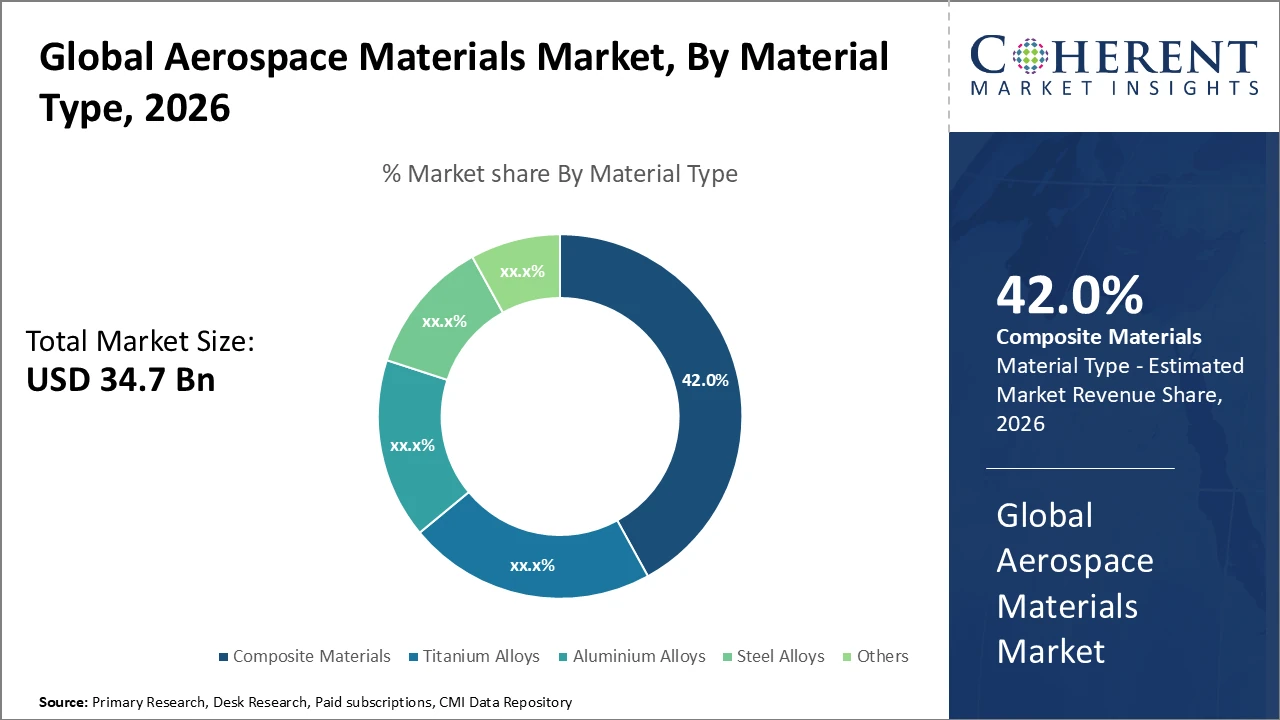
Composite materials dominate the aerospace materials market segment, accounting for 42% of the market share, driven by their lightweight and corrosion-resistant properties essential for commercial aerospace applications. Advanced manufacturing processes such as additive manufacturing are the fastest-growing subsegments, reducing fabrication complexity.
In application segmentation, commercial aircraft continue to lead market revenue growth due to rising global air travel, while the military aircraft segment shows the fastest growth, supported by modernization programs funded through defense budgets.
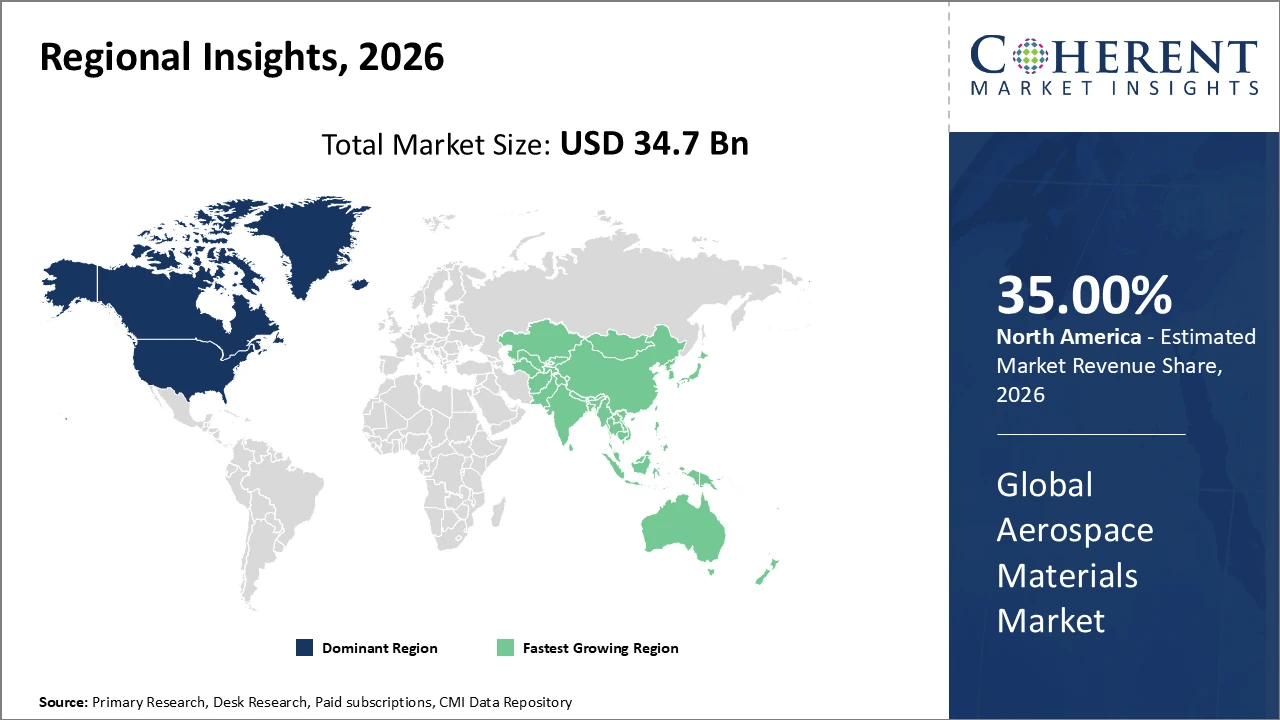
North America holds the largest share of the aerospace materials market, supported by significant R&D investments and the presence of major market players. Asia Pacific exhibits the fastest CAGR, with expanding aerospace manufacturing infrastructure in India and China fueling demand. Strong government initiatives and growing export capabilities contribute to the region’s promising market outlook.
Aerospace Materials Market Segmentation Analysis
Aerospace Materials Market Insights, By Material Type
Composite materials dominate the aerospace materials market with a 42% share, valued for their high strength-to-weight ratio and corrosion resistance, making them essential for fuselage and wing structures. Titanium alloys are the fastest-growing subsegment, increasingly used in engines and structural frameworks due to superior strength and temperature tolerance. Aluminum alloys remain widely used in airframes for their lightweight and cost-effective properties. Steel alloys, while heavier, are critical for landing gear and other load-bearing components. Emerging materials, such as magnesium alloys, are applied in niche areas where ultra-lightweight performance is required, supporting ongoing innovation in aerospace design.
Aerospace Materials Market Insights, By Application
Commercial aircraft dominate the aerospace materials segment, driven by expanding global air travel and fleet modernization, with composites and advanced alloys widely used to enhance fuel efficiency and performance. Military aircraft represent the fastest-growing subsegment, supported by rising defense budgets and the need for stealth, durability, and high-performance materials. Spacecraft materials, while niche, are gaining importance due to increasing investments from private and public sectors in space exploration. Unmanned aerial vehicles (UAVs) benefit from miniaturization trends, requiring specialized lightweight materials for efficiency and endurance. Other applications include rotorcraft and general aviation, contributing to overall market diversity and innovation.
Aerospace Materials Market Insights, By Manufacturing Process
Conventional manufacturing dominates the aerospace materials market, driven by established fabrication and machining methods for aluminum and titanium alloys. Additive manufacturing is the fastest-growing subsegment, enabling complex geometries, material savings, and design flexibility, particularly for composites and metallic aerospace components. Hybrid processes, which combine traditional and additive techniques, are gaining traction in prototyping and small-batch production, optimizing performance and efficiency.
Aerospace Materials Market Trends
The aerospace materials market is increasingly shaped by sustainability and circular economy principles.
Adoption of recyclable composites and green manufacturing techniques has accelerated due to stricter environmental regulations introduced from 2024 onward.
Advances in additive manufacturing have reduced production costs, enabled customization for specific aerospace applications, and minimized lead time and inventory requirements.
Smart materials embedded with sensors for real-time structural health monitoring are emerging, enhancing safety and reliability.
Rising operator and regulatory demands are driving the adoption of innovative materials and technologies focused on performance, efficiency, and environmental compliance.
Aerospace Materials Market Insights, By Geography
North America Aerospace Materials Market Analysis and Trends
In North America, the aerospace materials market is driven by a strong presence of aircraft OEMs and leading material manufacturers, representing over 35% of the global market share. The United States, in particular, benefits from a well-established R&D ecosystem and government support, fostering innovations in advanced composites, titanium, and aluminum alloys. Collaborative efforts between research institutions, suppliers, and manufacturers enable efficient technology transfer and supply chain resilience. Continuous investment in high-performance materials, additive manufacturing, and sustainable solutions further strengthens the region’s competitive advantage, ensuring North America remains a dominant player in the global aerospace materials market for the foreseeable future.
Asia Pacific Aerospace Materials Market Analysis and Trends
Asia Pacific is the fastest-growing region in the aerospace materials market, with a CAGR exceeding 9%, driven by rapidly expanding aerospace manufacturing hubs in China and India. Favorable government initiatives, including India’s “Make in India” program and China’s industrial subsidies, have stimulated domestic production capacity and technological advancement. The region benefits from growing commercial aircraft orders and supportive regional trade agreements, which enhance market stability and revenue growth. Additionally, local manufacturers are increasingly investing in research, advanced materials, and modern production technologies to meet global standards. These factors collectively position Asia Pacific as a key driver of future aerospace materials demand.
Aerospace Materials Market Outlook for Key Countries
USA Aerospace Materials Market Analysis and Trends
The United States continues to be a key market in aerospace materials, supported by major aerospace hubs such as Seattle and Wichita, where companies like Boeing and Hexcel lead innovation. Substantial defense budgets drive demand for high-performance materials that meet strict military standards. Advances in additive manufacturing at U.S. research institutions have improved material efficiency and shortened production cycles. Furthermore, government regulations promoting sustainable manufacturing have encouraged investments in recyclable composites and efficient alloy production. Combined, these factors reinforce the U.S.’s leadership in aerospace materials, ensuring continued innovation, supply chain strength, and global competitiveness in both commercial and defense aerospace sectors.
Germany Aerospace Materials Market Analysis and Trends
Germany’s aerospace materials market is driven by its strong engineering heritage and well-established aerospace manufacturing sector, including major players like Airbus and MTU Aero Engines. Advanced composites and high-performance alloys dominate, supporting fuel-efficient and lightweight aircraft designs. The country emphasizes research and innovation, with collaborations between universities, research institutes, and industry fostering developments in additive manufacturing, titanium alloys, and sustainable materials. Growing focus on green aviation and stricter EU environmental regulations have accelerated the adoption of recyclable composites and eco-friendly production techniques. Germany also benefits from robust supply chains and skilled labor, ensuring consistent quality, technological leadership, and steady market growth.
Analyst Opinion
The increasing production capacity of carbon fiber reinforced polymers (CFRP) has significantly boosted the aerospace materials market, with polymer composite shipments growing over 15% in 2025. Supply-chain improvements and a 7% price reduction over two years have increased demand for lightweight aircraft components.
Advanced alloys, particularly titanium and aluminum-lithium alloys, dominate the market with a combined share exceeding 60%, as OEMs focus on weight reduction without sacrificing strength. In 2024, titanium alloy imports to aerospace hubs rose by 12%, aided by global trade agreements improving raw material access.
Adoption of additive manufacturing in aerospace component fabrication has reduced material wastage by 25% in 2025, supporting sustainability and cost-efficiency initiatives and influencing procurement patterns.
Nano-scale composites with embedded nanomaterials have improved fatigue resistance by 18%, according to 2026 aerospace testing, driving growth in this niche segment and expanding applications in military and space sectors.
- Current Industry Events of 2026
- Market Size Estimation
- Regional Breakdown
- Competitive Landscape
- Customer Intelligence
- Segmental Analysis
- Pricing Analysis
- Key Market Drivers, Challenges & Future Trends
- Customized Insights Section
Market Scope
| Report Coverage | Details | ||
|---|---|---|---|
| Base Year: | 2025 | Market Size in 2026: | USD 34.7 billion |
| Historical Data for: | 2020 To 2024 | Forecast Period: | 2026 To 2033 |
| Forecast Period 2026 to 2033 CAGR: | 7.2% | 2033 Value Projection: | USD 56.3 billion |
| Geographies covered: |
| ||
| Segments covered: |
| ||
| Companies covered: | Hexcel Corporation, Toray Industries Inc., Solva S.A., Owens Corning, Airbus SE, Boeing Company, Evonik Industries AG, 3M Company, Teijin Limited, BAE Systems | ||
| Growth Drivers: |
| ||
Aerospace Materials Market Growth Factors
The demand for lightweight, fuel-efficient aircraft is the primary driver of aerospace materials market growth, reinforced by regulatory targets aiming for a 25% reduction in carbon emissions by 2030. Advances in additive manufacturing have accelerated the use of complex materials, cutting production lead times by up to 30%. Rising defense budgets, particularly in Asia-Pacific, are boosting demand for materials capable of withstanding extreme operational conditions. Additionally, the commercialization of space exploration, driven by NASA and private companies like SpaceX, has increased investments in ultra-high-performance materials. These factors collectively enhance market revenue and support long-term industry expansion.
Aerospace Materials Market Development
In April 2026, Syensqo signed a long-term supply agreement with Avio to provide advanced materials for its launch vehicle programs, including the Vega-C.
Key Players
Leading Companies of the Market
Hexcel Corporation
Toray Industries Inc.
Solvay SA
Owens Corning
Airbus SE
Boeing Company
Evonik Industries AG
3M Company
Teijin Limited
BAE Systems
Several leading aerospace materials companies have adopted vertical integration as a key competitive strategy, allowing tighter control over raw material sourcing and processing, resulting in cost savings of up to 8% annually for some market leaders. For instance, Hexcel Corporation’s acquisition of smaller specialty composite manufacturers expanded production capabilities, enabling Boeing to incorporate more lightweight materials into its 737 MAX series. Another strategic focus is investment in R&D for next-generation alloys, with Toray Industries leading advancements in thermoplastic composites, achieving 20% improvements in manufacturing cycle times while enhancing material recyclability, supporting both efficiency and sustainability goals.
Aerospace Materials Market Future Outlook
The aerospace materials market is expected to grow steadily, driven by rising demand for fuel-efficient, lightweight, and high-performance aircraft. Advanced composites, titanium alloys, and high-strength aluminum will remain key materials, while innovations in additive manufacturing, nanomaterials, and sustainable alternatives will shape future developments. Electrification of aircraft, hybrid propulsion systems, and next-generation supersonic travel will create opportunities for specialized materials with superior thermal and mechanical properties. Asia-Pacific is likely to emerge as a major growth region due to expanding aerospace manufacturing. Overall, the market will focus on innovation, cost optimization, environmental sustainability, and compliance with increasingly stringent safety and regulatory standards.
Aerospace Materials Market Historical Analysis
The aerospace materials market has evolved significantly over the past decades, driven by the need for lighter, stronger, and more durable materials. Historically, aluminum alloys dominated aircraft structures due to their strength-to-weight ratio and corrosion resistance. In the 1980s and 1990s, titanium and high-strength steels gained prominence in engines and critical components. The 2000s saw the rise of advanced composites, such as carbon-fiber-reinforced polymers, enabling fuel efficiency and extended aircraft lifespan. Continuous innovations in processing techniques, including additive manufacturing and alloy optimization, have supported performance improvements. Market growth has been closely linked to commercial aviation expansion, defense spending, and technological advancements.
Sources
Primary Research Interviews:
Engineers, R&D managers, and project leaders from companies manufacturing aerospace components and advanced materials.
Technical specialists from firms providing testing, certification, and materials performance analysis for aviation and space applications.
Industry experts from companies supplying additive manufacturing, nanomaterials, and lightweight alloy technologies for aerospace structures and propulsion systems.
Magazines:
Aerospace Manufacturing and Design – Innovations in aerospace materials, manufacturing techniques, and market trends.
Aviation Week & Space Technology – Updates on aircraft development, material applications, and aerospace industry insights.
CompositesWorld – Developments in composite materials, lightweight structures, and next-generation aerospace applications.
Journals:
Materials & Design – Research on advanced alloys, composites, and performance optimization for aerospace use.
Journal of Aerospace Engineering – Studies on material selection, structural performance, and fatigue resistance.
Journal of Materials Science – Insights into novel materials, coatings, and thermal management for aerospace components.
Newspapers:
The Wall Street Journal – Corporate strategies, investments, and mergers in aerospace materials companies.
Financial Times – Market developments, regulatory updates, and global aerospace demand analysis.
Reuters – News on technological advancements, materials innovation, and aerospace standards.
Bloomberg – Financial performance and market insights for aerospace materials manufacturers.
Associations:
Society for the Advancement of Material and Process Engineering (SAMPE) – Standards, research, and innovation in aerospace materials.
American Institute of Aeronautics and Astronautics (AIAA) – Research, guidelines, and data for aerospace engineering and materials.
European Aerospace and Defence Industries Association (ASD) – Market insights, safety standards, and innovation in aerospace materials.
Get access to 250+ pages report
Every segment, forecast, competitor profile and data table behind the analysis above — available for instant download.
- ESOMAR Member
- ISO 9001:2015 Certified
- D-U-N-S Registered
- GDPR & CCPA Compliant
Missing comfort of reading report in your local language? Find your preferred language:
Transform your Strategy with Exclusive Trending Reports
Frequently Asked Questions
Dominant players include Hexcel Corporation, Toray Industries, and Solvay SA, with strategic investments in R&D and acquisitions enhancing their industry share.
The Aerospace Materials market is expected to grow from USD 34.7 billion in 2026 to USD 56.3 billion by 2033, with a CAGR of 7.2%.
Commercial aircraft manufacturing presents the largest growth opportunity due to ongoing fleet expansions and replacement cycles, while military aircraft materials demand is growing rapidly.
Trends will focus on sustainable materials, hybrid composites, and integration of additive manufacturing, supported by AI-driven design technologies enhancing market dynamics.
The competitive landscape is characterized by technological innovation, vertical integration, and strategic partnerships, with challenges including raw material price volatility and supply chain disruptions.
Key strategies include product diversification, strategic acquisitions for capacity expansion, and collaborations focusing on sustainable materials and manufacturing efficiency.