

OEM Insulation Materials Market Size and Share Analysis- 2026 To 2033
The OEM Insulation Materials Market size is anticipated to grow at a CAGR of 5.9%, with USD 40.15 Bn in 2026 and is expected to reach approximately USD 59.97 Bn in 2033. The primary drivers are largely defined by the growing demand for energy-efficient equipment, increasing adoption of thermal and acoustic insulation across automotive and transportation applications, rising insulation requirements in HVAC and refrigeration systems, and wider use of high-performance insulation materials in household appliances and industrial equipment. According to Knauf Insulation, mineral wool-based OEM insulation solutions support the increasing need for advanced thermal and acoustic management in OEM products and offer energy efficiency, fire safety, acoustic performance and mechanical performance for such applications as domestic appliances.
Key Takeaways
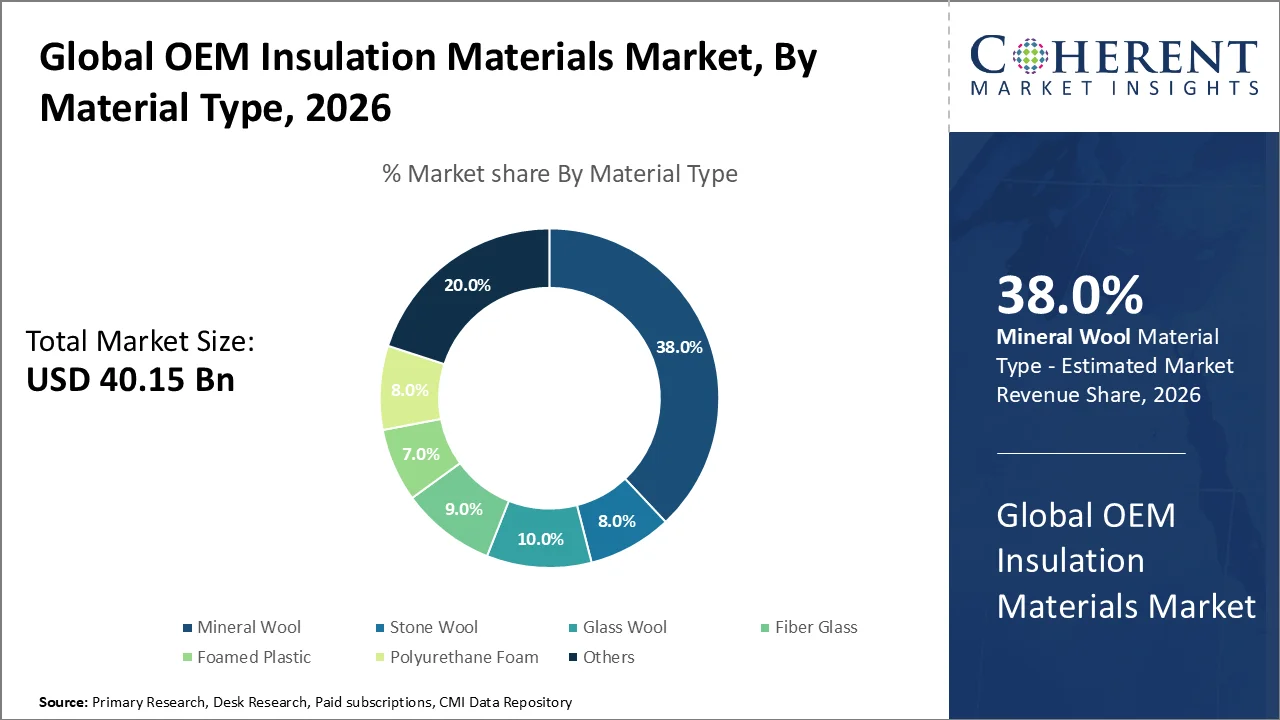
- The mineral wool material type category is projected to be the largest in 2026, with approximately 38.0%. The segment is expected to witness growth due to its superior thermal performance, fire resistance, acoustic insulation properties, dimensional stability, and widespread usage in industrial equipment, HVAC systems, appliances, transportation, and other OEM applications. In 2025, ROCKWOOL’s insulation segment delivered revenues of EUR 3.206 Bn, up 1.5% in local currencies versus 2024, supported by continued commercial demand for mineral wool-based insulation solutions.
- The industrial segment is set to lead the end-use industry category with approximately 38.0% in 2026. The segment’s growth is owing to the increasing requirement for thermal management, process-energy efficiency, equipment protection, acoustic control, and reduction of heat losses across industrial machinery and manufacturing facilities.
- The blanket insulation segment is likely to lead the insulation type category with approximately 39.0% in 2026. The segment’s growth is owing to its lightweight and flexible configuration, ease of installation around complex equipment geometries, strong thermal and acoustical performance, and widespread suitability for transportation, appliances, HVAC equipment, and other OEM systems. Johns Manville’s SG Series Spin-Glas OEM insulation blanket is designed for transportation, appliance, HVAC, and specialty applications and has a temperature limit of 350°F, while incorporating approximately 56% recycled content, illustrating the performance and sustainability characteristics supporting blanket insulation adoption.
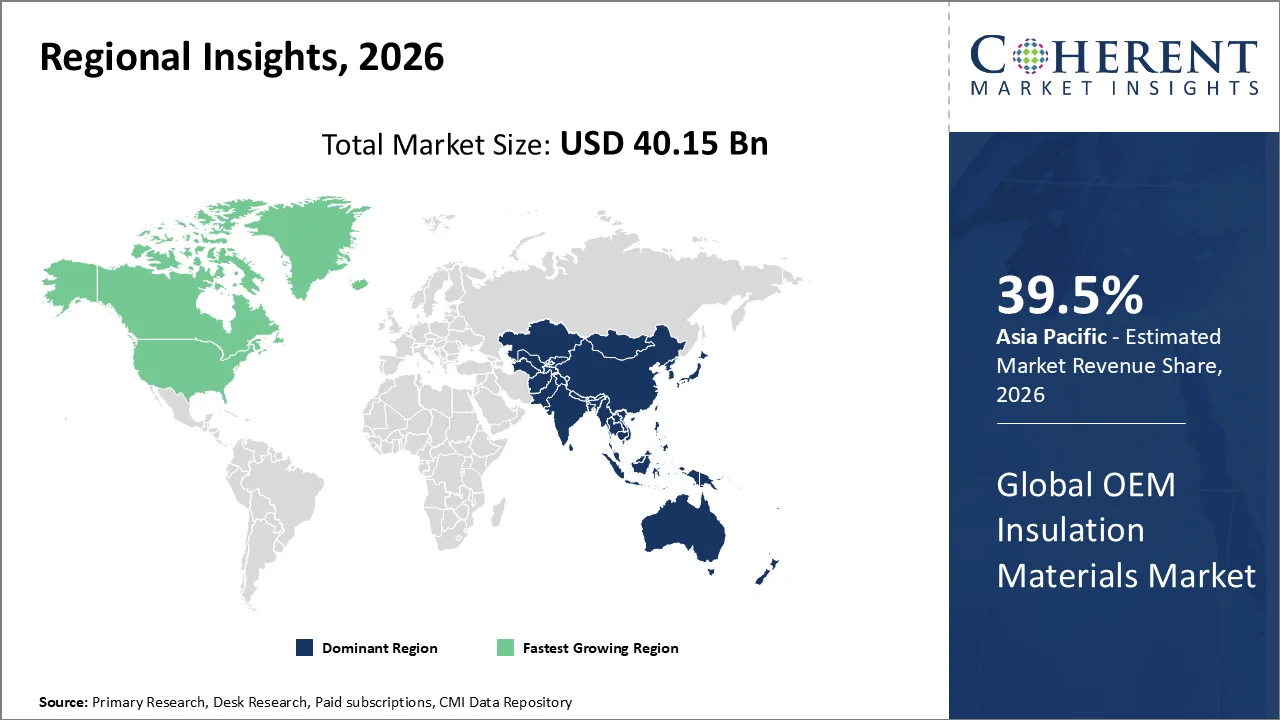
- Asia Pacific is expected to acquire the prominent regional share of approximately 39.5% in 2026. The region’s growth is owing to its extensive automotive and industrial manufacturing base, rising production of appliances and HVAC equipment, infrastructure expansion, and increasing requirements for thermal and acoustic insulation across OEM applications. According to the International Organization of Motor Vehicle Manufacturers (OICA), Asia-Pacific produced approximately 59.2 million vehicles in 2025, up 7.6% year-on-year and accounting for more than 61% of global vehicle production.
Market Drivers
Increasing Industrial Energy-Efficiency Requirements are Accelerating the Adoption of OEM Insulation Materials
OEM Insulation Materials Market is gaining momentum as industrial manufacturers are concentrating more on reducing thermal losses, improving equipment efficiency, maintaining process temperatures and reducing energy consumption. Insulation materials are being used in industrial machinery and process equipment, boilers, storage systems, HVAC equipment and other OEM-manufactured systems to reduce unwanted heat transfer and improve operating efficiency.
According to the IEA’s Global Energy Review 2025 said that industrial electricity consumption rose by almost 4% in 2024 and accounted for almost 40% of the total increase in global electricity demand in the year. As industrial processes are being increasingly electrified and equipment is subjected to higher thermal loads, OEMs will likely require more mineral wool, fiberglass, elastomeric foam, polyurethane foam and other insulation materials for thermal protection and energy conservation.
Expansion of HVAC, Appliance, and Transportation Manufacturing is Increasing OEM Insulation Consumption
Increased production and use of HVAC equipment, household appliances, automobiles, rail systems, and other transportation equipment is driving demand for thermal and acoustic insulation materials. OEM insulation is increasingly being used in air-conditioning systems, refrigerators, ovens, water heaters, automobiles, railcars and specialty equipment to reduce heat transfer, control noise and vibration, improve passenger comfort and enhance equipment energy efficiency.
According to the International Organization of Motor Vehicle Manufacturers (OICA) reported that, in 2025, Asia-Pacific produced around 59.2 million vehicles, up 7.6% from the previous year, accounting for more than 61% of global vehicle production. In 2025, China alone produced about 34.53 million vehicles, with new-energy vehicle production hitting 16.63 million units, up 29%.
Current Events and Their Impact on the OEM Insulation Materials Market
Current Event | Description and its Impact |
U.S. Department of Energy Proposes Major Revision of Appliance Energy-Efficiency Rulemaking Framework (2026) |
|
European Union Advances Ecodesign for Sustainable Products Regulation and 2025–2030 Working Plan |
|
- Current Industry Events of 2026
- Market Size Estimation
- Regional Breakdown
- Competitive Landscape
- Customer Intelligence
- Segmental Analysis
- Pricing Analysis
- Key Market Drivers, Challenges & Future Trends
- Customized Insights Section
Segmental Insights
Why is Mineral Wool Acquiring the Largest Share?
On the basis of material type, the mineral wool segment is projected to account for the largest OEM Insulation Materials Market share of approximately 38.0% in 2026. The segment’s growth is owing to its high-temperature resistance, non-combustibility, acoustic performance, dimensional stability, and suitability for industrial machinery, HVAC systems, transportation equipment, data centers, and other OEM applications.
Mineral wool also provides a significant technical advantage in high-temperature and fire-sensitive OEM environments. ROCKWOOL states that stone wool insulation can resist temperatures above 1,000°C and maintain its performance for at least 65 years, which enhances its appropriateness for use in situations where the need for thermal stability, fire safety and long operating life is high.
In May 2026, ROCKWOOL announced an agreement to acquire Ravago’s stone wool plant in Hungary, strengthening its mineral wool production footprint across Central and Eastern Europe. The facility can produce around 40,000 tons of stone wool annually and employs more than 100 people.
Why does the Industrial Segment Hold the Largest Market Share?
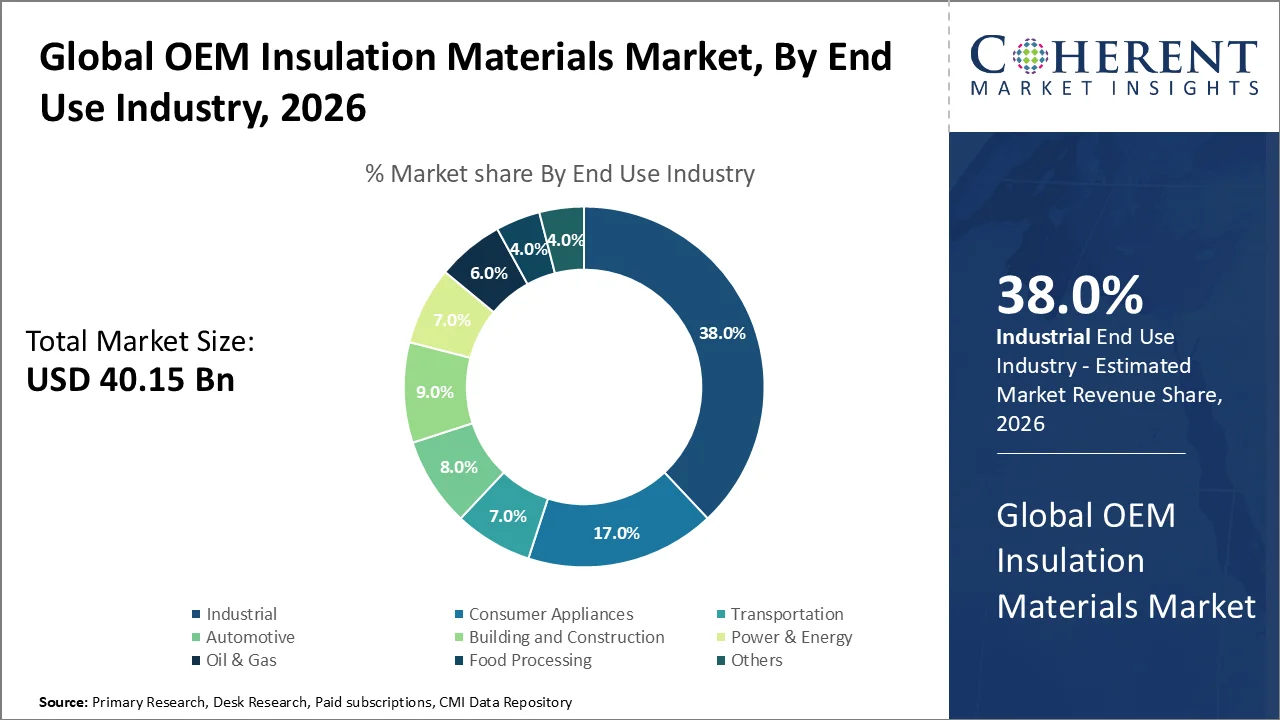
On the basis of end-use industry, the industrial segment is expected to lead with approximately 38.0% share in 2026. The segment’s growth is owing to the extensive use of insulation across process equipment, boilers, piping systems, storage vessels, industrial HVAC units, machinery, power-generation equipment, and other systems were reducing heat loss and maintaining operating temperatures directly improve energy efficiency and process performance.
The IEA reported that energy-intensive industries represent approximately three-quarters of total industrial energy demand, with many industrial processes requiring heat at temperatures above 500°C. Such high operating temperatures are supporting demand for mineral wool, fiberglass, cellular insulation and other high-performance materials that can reduce thermal losses and protect surrounding equipment.
In June 2025, Armacell launched a new aerogel insulation manufacturing plant in Pune, India, to manufacture its ArmaGel XGH and ArmaGel XGC insulation blankets for the global market. The new ArmaGel XG range is designed for demanding industrial and energy applications, covering operating temperatures from around -196°C (-321°F) to +650°C (+1,200°F).
Why is Blanket Insulation Acquiring the Largest Share?
On the basis of insulation type, the blanket insulation segment is projected to account for the largest share of approximately 39.0% in 2026. The segment’s growth is owing to its flexibility, relatively low weight, ease of cutting and fabrication, adaptability to curved and irregular equipment surfaces, and ability to provide both thermal and acoustic insulation across appliances, HVAC equipment, automotive systems, rail equipment, and other OEM applications.
Current OEM product specifications illustrate these advantages. Johns Manville’s SG Series Spin-Glas insulation is specifically designed as a lightweight blanket for transportation, appliance, HVAC, and specialty OEM applications. The product is available in thicknesses from 0.5 to 4.0 inches and densities from 0.55 to 2.2 pounds per cubic foot, allowing OEMs to select insulation configurations based on the space available for equipment and the thermal performance required.
OEM Insulation Materials Market Trends
- The accelerating shift to electric vehicles is increasing demand for lightweight thermal and acoustic insulation around battery packs, vehicle cabins, HVAC systems and other temperature-sensitive components. The IEA said global electric-car sales reached 17 million units in 2024, up more than 25%, and sales were forecast to exceed 20 million units in 2025.
- The increased need for insulation capable of functioning under extreme industrial temperature environments is propelling the adoption of advanced ceramic fibers, microporous insulation, and engineered high-temperature materials. Morgan Advanced Materials’ 2025 technical portfolio includes rigid carbon insulation engineered for demanding vacuum and inert-atmosphere applications at temperatures up to approximately 3,000°C, supporting OEM applications in furnaces, energy systems and specialized industrial equipment.
- The rising focus on lighter and quieter vehicle interiors is increasing the integration of multifunctional acoustic and thermal insulation by automotive OEMs. 3M currently lists 63 insulation products for automotive applications, including 37 acoustic, 15 thermal, and 11 electrical insulation and foam products. Its Thinsulate automotive insulation systems are designed to reduce cabin noise while helping OEMs meet vehicle mass-reduction requirements.
Regional Insights
Asia Pacific Dominates Owing to its Large Appliance, Automotive, and Equipment Manufacturing Base
The Asia Pacific region accounts for approximately 39.5% of the OEM Insulation Materials Market share in 2026. The region’s dominance is owing to its extensive manufacturing base for HVAC equipment, household appliances, automobiles, industrial machinery, and electrical equipment, coupled with continued industrialization across China, India, Japan, South Korea, and Southeast Asia.
China’s manufacturing scale provides a large demand base for OEM thermal and acoustic insulation. China made some 267.0 million room air-conditioners and 109.2 million household refrigerators in 2025, according to the National Bureau of Statistics. These equipment categories extensively utilize polyurethane foam, fiberglass, mineral wool, elastomeric foam, and other insulation materials to reduce heat transfer, improve energy efficiency, and control operating noise.
North America is Expected to Emerge as the Fastest-Growing Region
North America is expected to witness the fastest growth in the OEM Insulation Materials Market over the 2026–2033 forecast period. The region’s growth is owing to rapid investment in data centers, advanced manufacturing, high-efficiency HVAC and cooling equipment, electrification, and increasing adoption of sophisticated thermal-management systems across the U.S. and Canada. These applications are creating opportunities for mineral wool, fiberglass, elastomeric foam, aerogel blankets, and other high-performance OEM insulation materials.
The rapid growth of AI and hyperscale data centers is becoming more and more relevant for OEM insulation demand. In June 2026 U.S. Data Center Energy Usage Report update, Lawrence Berkeley National Laboratory estimated data centers could account for 11.8% of total U.S. electricity consumption by 2030, with scenarios ranging from 9.5% to 15.3%. The reference case in the report projects data-center electricity use to reach about 649 TWh in 2030.
In March 2026, W. L. Gore & Associates launched its next generation GORE Thermal Insulation in North America, designed for use in semiconductor manufacturing equipment and on heating jackets for cleanroom gas lines.
Expanding HVAC and Thermal Equipment Base is Supporting the OEM Insulation Materials Market in the United States
The U.S. OEM Insulation Materials Market is witnessing steady demand owing to the large domestic HVAC and thermal-equipment industry, replacement of aging heating and cooling systems, increasing emphasis on equipment energy efficiency, and rising requirements for thermal and acoustic management. Fiberglass, mineral wool, polyurethane foam, elastomeric foam, and blanket insulation are widely incorporated into air conditioners, heat pumps, water heaters, furnaces, refrigeration equipment, and industrial systems.
According to the Air-Conditioning, Heating, and Refrigeration Institute (AHRI), U.S. shipments of central air conditioners and air-source heat pumps reached 837,098 units in April 2026, increasing 5.1% from 796,279 units in April 2025. Air-conditioner shipments alone rose 8.0% to 456,210 units, while air-source heat-pump shipments increased 1.8% to 380,888 units.
In September 2025, Knauf Insulation announced a major investment in its Shelbyville, Indiana manufacturing operations to expand fiberglass insulation production. The investment includes upgrades to existing pipe-insulation manufacturing, a new state-of-the-art dedicated pipe-insulation production line, and additional glass capacity.
China OEM Insulation Materials Market Trends
China is expected to remain a major growth center for the OEM Insulation Materials Market owing to its extensive industrial-equipment manufacturing ecosystem, expansion of power-generation machinery, factory automation, transportation equipment, and increasing production of technologically advanced systems requiring thermal, acoustic, and fire-protection materials.
According to the National Bureau of Statistics of China, production of power-generation equipment reached approximately 370.87 million kW in 2025, increasing 37.6% year-on-year. The growth in turbines, generators, auxilary equipment, piping systems and related machinery provides a significant application base for mineral wool, fiberglass blankets, aerogel and other high-temperature insulation materials.
In May 2025, Zhengzhou Tuopu New Materials Technology Co., Ltd. (Zhengzhou Exceed) announced the launch of its Phase II thermal-insulation manufacturing facility in Zhengzhou, China. The new facility covers more than 4,000 square meters and incorporates intelligent production lines for aerogel blankets, aerogel slurry, aerogel coatings, and aerogel powder.
Who are the Major Companies in OEM Insulation Materials Industry
Some of the major key players in OEM Insulation Materials Market are Knauf Insulation, Johns Manville, Fomo Products Inc., Paroc Group, Owens Corning Insulating Systems LLC., Roxul Inc., Shanon enterprises, Saint Gobin, ACH Foam Technologies, Armacell International, Rockwool International.
Key News
- In February 2025, Johns Manville announced a new Climate Pro fiberglass blowing-wool production line at its Winder, Georgia facility. The production line is expected to become operational in mid-2027 and is intended to increase insulation manufacturing capacity to serve growing demand across East Coast and Central U.S. markets.
- In December 2025, Atlas Molded Products introduced ReGenX Technology for insulation and cold-chain applications. ReGenX converts recovered materials into new high-performance resin and enables products containing 30% recycled content, while Atlas stated that certain products can incorporate up to 50% recycled content.
Market Report Scope
OEM Insulation Materials Market Report Coverage
| Report Coverage | Details | ||
|---|---|---|---|
| Base Year: | 2025 | Market Size in 2026: | USD 40.15 Bn |
| Historical Data for: | 2020 To 2024 | Forecast Period: | 2026 To 2033 |
| Forecast Period 2026 to 2033 CAGR: | 5.9% | 2033 Value Projection: | USD 59.97 Bn |
| Geographies covered: |
| ||
| Segments covered: |
| ||
| Companies covered: | Knauf Insulation, Johns Manville, Fomo Products Inc., Paroc Group, Owens Corning Insulating Systems LLC., Roxul Inc., Shanon enterprises, Saint Gobin, ACH Foam Technologies, Armacell International, Rockwool International. | ||
| Growth Drivers: |
| ||
| Restraints & Challenges: |
| ||
Analyst Opinion
- The OEM Insulation Materials Market is gradually shifting from conventional commodity insulation toward engineered, application-specific thermal-management solutions, particularly in electric vehicles, energy equipment, and other space-constrained OEM systems. Aspen Aerogels reported USD 168.9 million in thermal-barrier revenue in 2025 and has multi-year production contracts with OEMs including General Motors, Toyota, Scania, ACC, Volvo, and Volvo Truck for its PyroThin aerogel thermal barriers.
- Sustainability credentials are becoming an increasingly important purchasing criterion alongside thermal and acoustic performance. Owens Corning reported in its 2025 Sustainability Report that its Thermafiber mineral wool insulation contains a weighted average of 70% recycled content, while its commercial and industrial fiberglass insulation averages 53% recycled content. Its North American FOAMULAR NGX extruded-polystyrene insulation also contains an average of 20% recycled content.
- Regulatory changes are likely to accelerate reformulation of foam-based OEM insulation and favor suppliers with low-global-warming-potential technologies. Under the U.S. EPA's Technology Transitions Program, beginning January 1, 2025, polyurethane foams, extruded-polystyrene foam, phenolic insulation foam, polyisocyanurate foam, and several other foam categories became subject to a GWP limit of 150 for specified blowing agents. The broader AIM Act framework targets an 85% phase-down in U.S. HFC production and consumption by 2036.
Speak to the analyst
Want personalized insights?
Take the findings above to one of our principal consultants, or have the report rebuilt around the segments, geographies and competitors you actually track.
Market Segmentation
- By Material Type (Revenue, USD Bn, 2021-2033)
- Mineral Wool
- Stone Wool
- Glass Wool
- Fiber Glass
- Foamed Plastic
- Polyurethane Foam
- Others
- By End Use Industry (Revenue, USD Bn, 2021-2033)
- Consumer Appliances
- Baking Ovens
- Heaters
- Washers & Dryers
- Air-Conditioners
- Others
- Transportation
- Automotive
- Industrial
- Building and Construction
- Power & Energy
- Oil & Gas
- Food Processing
- Others
- Consumer Appliances
- By Insulation Type (Revenue, USD Bn, 2021-2033)
- Blanket
- Rolls and Batts
- Loose Fill
- By Region (Revenue, USD Bn, 2021-2033)
- North America
- U.S.
- Canada
- Latin America
- Brazil
- Mexico
- Argentina
- Rest of Latin America
- Europe
- Germany
- U.K.
- France
- Italy
- Spain
- Russia
- Rest of Europe
- Asia Pacific
- China
- India
- Japan
- Australia
- South Korea
- ASEAN
- Rest of Asia Pacific
- Middle East
- GCC
- Israel
- Rest of Middle East
- Africa
- South Africa
- Central Africa
- North Africa
- North America
Sources
Primary Research Interviews
- OEM insulation material manufacturers
- Thermal and acoustic insulation product developers
- Materials scientists and insulation engineers
- R&D and product development heads from HVAC, appliance, automotive, and industrial equipment manufacturers
- Industrial energy-efficiency and thermal management experts
- Procurement managers from automotive, aerospace, HVAC, appliance, power, and industrial equipment companies
- Distributors and converters of mineral wool, fiberglass, polymeric foams, and specialty insulation materials
- Key opinion leaders (KOLs) in thermal insulation, acoustic management, and advanced materials
Databases
- World Bank
- Organisation for Economic Co-operation and Development (OECD)
- International Energy Agency (IEA)
- U.S. Department of Energy (DOE)
- U.S. Environmental Protection Agency (EPA)
- Eurostat
- National Bureau of Statistics of China
- United Nations Industrial Development Organization (UNIDO)
Magazines
- Insulation Outlook
- ACHR News
- HPAC Engineering
- Processing Magazine
- Manufacturing Today
- Automotive Manufacturing Solutions
Journals
- Energy and Buildings
- Applied Thermal Engineering
- International Journal of Thermal Sciences
- Construction and Building Materials
- Journal of Cleaner Production
- Materials Today
- Thermal Science and Engineering Progress
Newspapers
- The Wall Street Journal
- Financial Times
- Reuters
- The Economic Times
- Nikkei Asia
Associations
- National Insulation Association (NIA)
- European Industrial Insulation Foundation (EiiF)
- North American Insulation Manufacturers Association (NAIMA)
- Air-Conditioning, Heating, and Refrigeration Institute (AHRI)
- ASHRAE
- International Organization of Motor Vehicle Manufacturers (OICA)
- ASTM International
- European Insulation Manufacturers Association (EURIMA)
Public Domain Sources
- Company Annual Reports and Investor Presentations
- Government Energy-Efficiency and Industrial Policy Publications
- Company Product Catalogues and Technical Data Sheets
- Environmental Product Declarations and Sustainability Reports
- Regulatory Publications Related to HFCs, Blowing Agents, Fire Safety, and Energy Efficiency
- Patent Databases such as WIPO, USPTO, and Google Patents
- Publicly Available Industrial Production and Equipment Shipment Data
- Government and Industry Association Publications on HVAC, Automotive, Appliances, and Industrial Equipment
Proprietary Elements
- CMI Data Analytics Tool
- Proprietary CMI Existing Repository of Information for the Last 10 Years
Get access to 250+ pages report
Every segment, forecast, competitor profile and data table behind the analysis above — available for instant download.
- ESOMAR Member
- ISO 9001:2015 Certified
- D-U-N-S Registered
- GDPR & CCPA Compliant
Missing comfort of reading report in your local language? Find your preferred language:
Transform your Strategy with Exclusive Trending Reports
Frequently Asked Questions
The OEM Insulation Materials Market is expected to reach approximately USD 59.97 Bn in 2033, compared with USD 40.15 Bn in 2026.
Major players operating in the OEM Insulation Materials Market include Knauf Insulation, Johns Manville, Fomo Products Inc., Paroc Group, Owens Corning Insulating Systems LLC., Roxul Inc., Shanon Enterprises, Saint Gobin, ACH Foam Technologies, Armacell International, and Rockwool International.
The high raw material and production costs and volatility in insulation material prices are the key factors hampering growth of the market.
The increasing demand for energy-efficient industrial equipment and rising adoption of thermal and acoustic insulation in HVAC systems are key factors driving market growth. Growing requirements across transportation, appliances, refrigeration systems, and industrial equipment are also supporting demand.
The OEM Insulation Materials Market is anticipated to grow at a CAGR of 5.9% between 2026 and 2033.
Asia Pacific is expected to dominate the OEM Insulation Materials Market with approximately 39.5% market share in 2026. The region benefits from its large automotive, appliance, HVAC, and industrial equipment manufacturing base.
North America is expected to witness the fastest growth over the forecast period. Growth is supported by investments in data centers, advanced manufacturing, high-efficiency HVAC and cooling equipment, electrification, and sophisticated thermal-management systems.