

Viscosity Reducing Agents Market Size and Forecast — 2026 - 2033
The Global Viscosity Reducing Agents Market size is estimated to be valued at USD 1.25 billion in 2026 and is expected to reach USD 2.20 billion by 2033, exhibiting a compound annual growth rate (CAGR) of 8.1% from 2026 to 2033.
Overview
Viscosity reducing agents are specialized chemical additives designed to lower the viscosity of liquids, enhancing flow, processability, and performance in various applications. These products are widely used in industries such as paints and coatings, adhesives, lubricants, food processing, and pharmaceuticals. Key types include polymer-based, surfactant-based, and enzyme-based agents, each tailored for specific rheological requirements. They improve mixing, pumping, and spraying efficiency, while maintaining product stability and quality. Advanced formulations also enable compatibility with water- or solvent-based systems, high-temperature environments, and environmentally friendly processes. Overall, viscosity reducing agents optimize industrial operations and enhance product performance across multiple sectors.
Key Takeaways
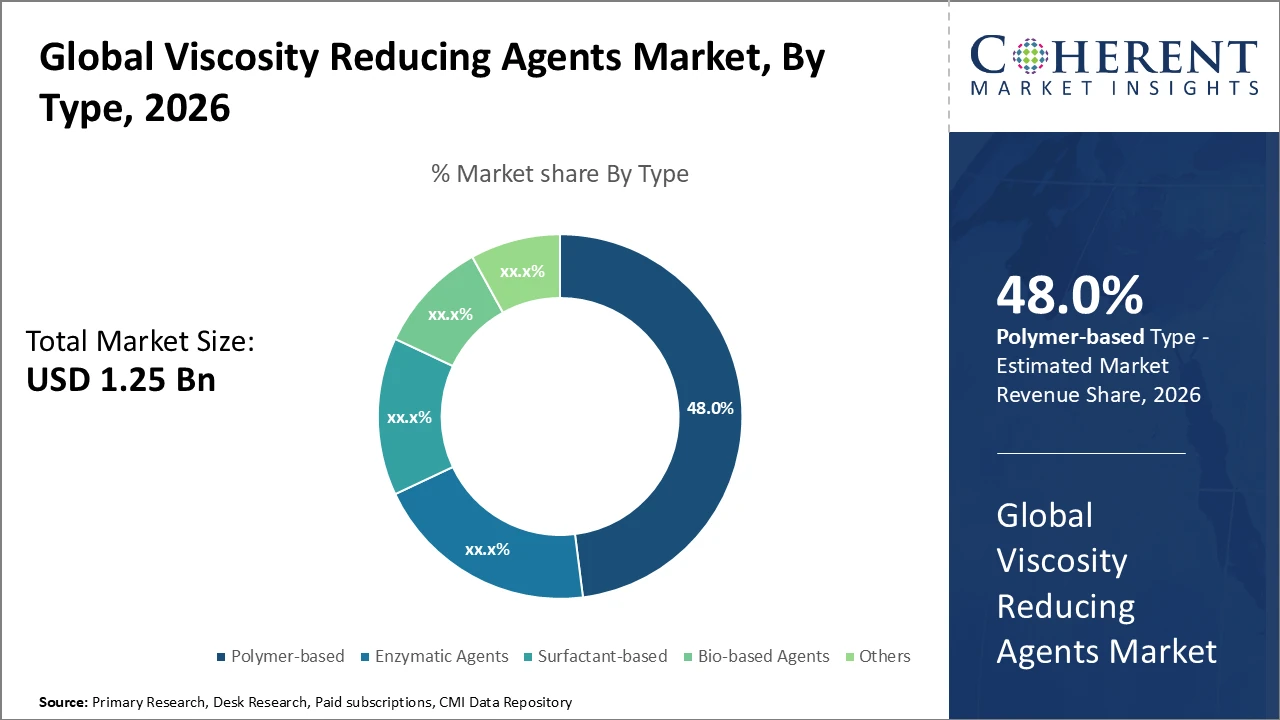
Polymer-based viscosity reducing agents dominate the market with a 48% share, driven by versatility and efficiency in applications such as paints & coatings and polymer processing.
The oil & gas application segment is expected to see substantial growth due to high demand for flow optimization in challenging conditions.
Industrial manufacturing represents the largest end-use industry by revenue, benefiting from rising automation and process efficiency trends.
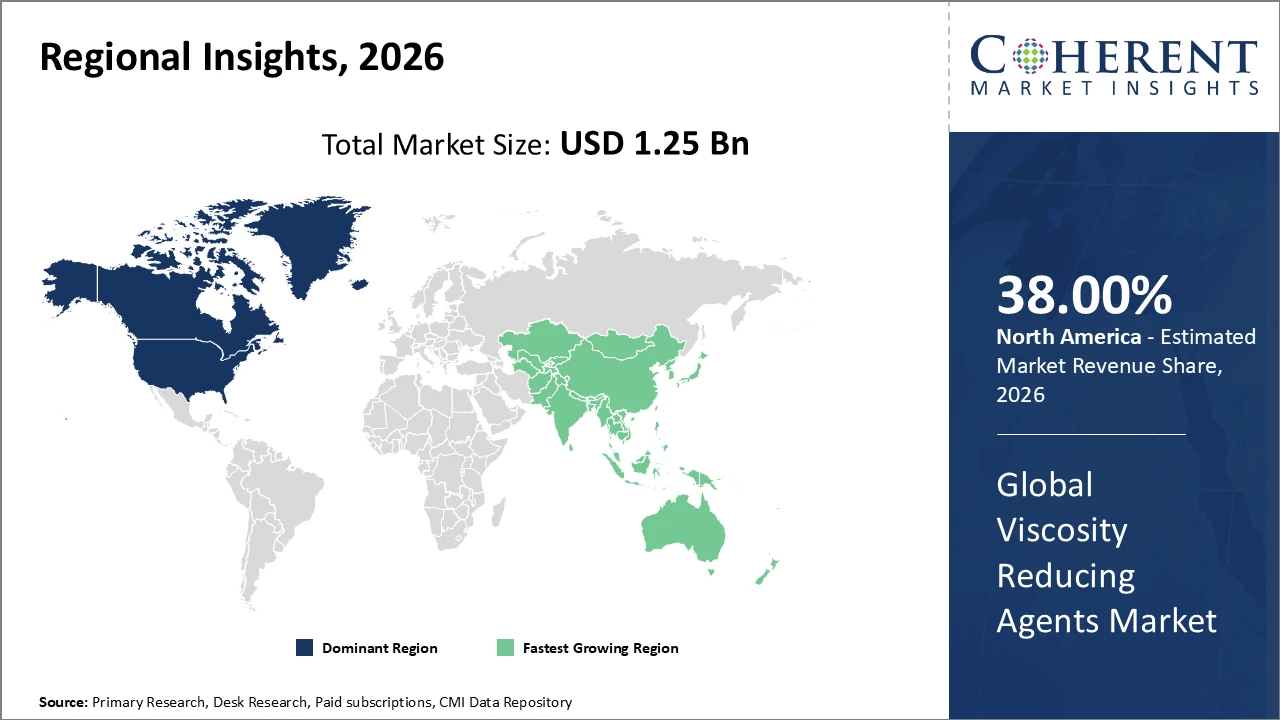
North America leads the market regionally with a 38% share, supported by mature oilfield chemical markets and regulatory frameworks that encourage innovation.
Asia Pacific shows the highest CAGR, around 9.5%, fueled by strong industrial growth, government incentives, and localized manufacturing hubs in India and China.
Viscosity Reducing Agents Market Segmentation Analysis
Viscosity Reducing Agents Market Insights, By Type
Polymer-based viscosity reducing agents dominate the market with a 48% share, valued for their high efficiency across diverse applications, especially in paints & coatings and polymer processing, where consistent performance under varying temperatures is critical. The fastest-growing subsegment is bio-based agents, driven by sustainability initiatives and stricter environmental regulations, offering eco-friendly alternatives to conventional chemical additives. Enzymatic agents serve niche pharmaceutical applications, providing precise control over viscosity for specialized formulations. Surfactant-based and other types address unique industrial needs, including lubricants and adhesives, though they maintain moderate market penetration. Overall, product innovation and sustainability are shaping market trends.
Viscosity Reducing Agents Market Insights, By Application
The oil & gas segment leads the viscosity reducing agents market, driven by widespread use in drilling fluids and pipeline management, where precise viscosity control enhances operational efficiency and reduces energy consumption. Paints & coatings represent the fastest-growing application, fueled by regulatory mandates for low-VOC formulations and the need for improved flow and leveling on various surfaces. In polymer processing, viscosity reducers ensure consistent product flow and manufacturing precision, supporting quality and productivity. Pharmaceuticals and other niche applications utilize these agents for specialized formulation stability, although their contribution to overall market revenue remains relatively smaller compared to industrial and energy sectors.
Viscosity Reducing Agents Market Insights, By End User Industry
Industrial manufacturing dominates the end-use segment of viscosity reducing agents, utilizing them for process optimization in chemical production, adhesives, and composite materials. The automotive sector is rapidly growing, applying these agents in lubrication systems and advanced paint formulations to improve performance and efficiency. Construction applications benefit from enhanced flow and spreadability of cementitious and polymer-based materials. In agriculture, viscosity reducers optimize fluid formulations for better dispersion and application effectiveness. Other niche sectors, including textiles and electronics, also employ these additives, contributing incrementally to market growth. Overall, diverse industrial applications drive demand and support continuous market expansion.
Viscosity Reducing Agents Market Trends
The Viscosity Reducing Agents market is increasingly shaped by demand for sustainable and technologically advanced chemical solutions.
Nanotechnology-based viscosity reducers are growing rapidly, reducing dosage requirements and improving efficacy; 2025 product launches achieved up to 30% viscosity reduction with less material.
Bio-based agents are gaining market traction, driven by stricter environmental regulations and consumer preference for eco-friendly products, resulting in a 25% market penetration increase between 2024 and 2026.
AI-driven customization of viscosity modifiers optimizes performance for specialized applications, creating new revenue opportunities and further stimulating market growth.
Viscosity Reducing Agents Market Insights, By Geography
North America Viscosity Reducing Agents Market Analysis and Trends
In North America, the Viscosity Reducing Agents market is dominated by strong oil & gas and industrial chemical sectors, accounting for roughly 38% of the global market share. The U.S. leads the region through innovation in high-performance additives and regulatory frameworks that promote efficient and environmentally compliant viscosity modifiers. Key players, including Dow Inc. and Lubrizol, capitalize on advanced regional manufacturing capabilities and substantial R&D investments to maintain competitive advantages. The combination of technological expertise, regulatory support, and mature industrial infrastructure drives consistent demand, market growth, and continued leadership in the North American viscosity reducing agents landscape.
Asia Pacific Viscosity Reducing Agents Market Analysis and Trends
Asia Pacific shows the fastest growth in the Viscosity Reducing Agents market, with a CAGR of approximately 9.5%, driven by rapid industrialization and expansion in construction and automotive sectors. Government initiatives supporting local manufacturing, technology adoption, and import facilitation have further accelerated market revenue. China and India lead the region, benefiting from increasing chemical production facilities, infrastructure development, and rising industrial demand. Key players such as Clariant AG and BASF SE are actively investing in regional partnerships, process innovation, and localized production strategies. These combined factors position Asia Pacific as a high-growth market with strong long-term potential.
Viscosity Reducing Agents Market Outlook for Key Countries
USA Viscosity Reducing Agents Market Analysis and Trends
The U.S. Viscosity Reducing Agents market benefits from a mature chemical manufacturing ecosystem, making it one of the largest consumption hubs worldwide. Investments in the Gulf Coast petrochemical corridor increased production capacity by 10% in 2025, enhancing supply stability. Leading companies such as Evonik Industries AG and Ashland Global Holdings introduced specialized polymer-based viscosity reducers designed to meet strict environmental regulations, significantly boosting revenue in applications like oilfield chemicals and waterborne coatings. Additionally, the rising focus on next-generation additives incorporating nanotechnology supports improved efficiency and performance, providing a strong foundation for sustained market growth and continued expansion of market share.
Germany Viscosity Reducing Agents Market Analysis and Trends
Germany’s Viscosity Reducing Agents market is driven by a mature industrial base, advanced chemical manufacturing infrastructure, and strict environmental regulations. The country emphasizes high-performance additives in applications such as paints & coatings, automotive fluids, and polymer processing, where precise viscosity control is critical. Key players leverage local R&D capabilities to develop innovative polymer-based, bio-based, and nanotechnology-enabled solutions, aligning with sustainability goals. Industrial manufacturing, automotive, and construction sectors remain the largest consumers, while emerging trends focus on eco-friendly formulations and energy-efficient production processes. Overall, Germany represents a stable and technologically advanced market with steady growth and strong regulatory support.
Analyst Opinion
The rising demand in the oil & gas sector to optimize drilling and pipeline efficiency is a key supply-side driver, with oilfield chemical consumption accounting for nearly 35% of total viscosity reducing agents revenue in 2025, a 12% increase from 2024.
On the demand side, global use in water-based paints and coatings has surged, particularly in Asia Pacific, which saw a 15% year-over-year increase in import volumes in 2024 due to stricter VOC regulations and a shift toward eco-friendly solvents.
Nano-scale additive technologies are transforming the market, enabling more effective viscosity reduction at lower dosages; in 2026, nano-based polymeric viscosity reducers captured around 18% market share in specialty chemical segments.
Pricing trends remain stable despite raw material fluctuations, supported by production capacity expansions in chemical hubs like the U.S. Gulf Coast and South Korea, with a 10% increase in 2025 ensuring supply stability and healthy margins.
- Current Industry Events of 2026
- Market Size Estimation
- Regional Breakdown
- Competitive Landscape
- Customer Intelligence
- Segmental Analysis
- Pricing Analysis
- Key Market Drivers, Challenges & Future Trends
- Customized Insights Section
Market Scope
| Report Coverage | Details | ||
|---|---|---|---|
| Base Year: | 2025 | Market Size in 2026: | USD 1.25 billion |
| Historical Data for: | 2020 To 2024 | Forecast Period: | 2026 To 2033 |
| Forecast Period 2026 to 2033 CAGR: | 8.1% | 2033 Value Projection: | USD 2.20 billion |
| Geographies covered: |
| ||
| Segments covered: |
| ||
| Companies covered: | Evonik Industries AG, BASF SE, Clariant AG, Dow Inc., Arkema S.A., Solvay S.A., Lanxess AG, Nouryon, Lubrizol Corporation, SNF Floerger | ||
| Growth Drivers: |
| ||
Viscosity Reducing Agents Market Growth Factors
The oil & gas industry remains a key growth driver for viscosity reducing agents, as advanced drilling techniques require efficient fluid flow, with these agents enhancing pumpability and transport, directly boosting revenue. Demand is further supported by the shift toward sustainable, bio-based chemicals, with renewable polymers achieving 14% market penetration by 2026. Stricter environmental regulations push industrial sectors like automotive and paints & coatings to adopt low-viscosity, low-VOC formulations, accelerating market expansion. Rapid industrialization in Asia Pacific, especially China and India, also drives growth, with industrial manufacturing increasingly using viscosity reducers to optimize processes and improve operational efficiency.
Viscosity Reducing Agents Market Development
In October 2025, BRB Lube Oil Additives & Chemicals introduced the Viscotech Upcycled series, a low-carbon viscosity modifier made with high-quality re-refined base oils (RRBO) as a sustainable alternative to virgin base oils.
Key Players
Leading Companies of the Market
Evonik Industries AG
BASF SE
Clariant AG
Dow Inc.
Arkema S.A.
Solvay S.A.
Nouryon
Lubrizol Corporation
SNF Floerger
Lanxess AG
Leading companies in the viscosity reducing agents market are strengthening their positions through strategic partnerships and capacity expansions. In 2025, Evonik Industries increased polymer additive production by 18% with the commissioning of a new facility, improving supply for high-demand applications such as paints. Similarly, BASF expanded its regional footprint in Asia Pacific through the acquisition of several specialty additive producers in 2024, broadening its product portfolio and boosting market presence. These initiatives contributed to a 22% revenue increase in viscosity reducing agents, demonstrating how targeted investments and strategic growth activities are enhancing competitive positioning and supporting market expansion.
Viscosity Reducing Agents Market Future Outlook
The viscosity reducing agents market is expected to experience robust growth driven by technological innovation, sustainability trends, and expanding industrial applications. Demand for bio-based and eco-friendly additives is increasing, propelled by stricter environmental regulations and consumer preference for greener chemicals. Advanced polymeric and nanotechnology-based agents will continue to enhance efficiency, reduce material usage, and optimize fluid performance across sectors such as oil & gas, paints & coatings, automotive, and industrial manufacturing. Rapid industrialization in Asia Pacific and ongoing capacity expansions in North America and Europe will support supply stability. Overall, market growth will be fueled by innovation, regulatory compliance, and rising global industrial demand.
Viscosity Reducing Agents Market Historical Analysis
The viscosity reducing agents market has evolved significantly over the past decade, driven by industrial growth, technological advancements, and increasing demand for process efficiency. Early market development focused on polymer-based additives for paints, coatings, and chemical processing, ensuring stable viscosity under varying conditions. Growing oil & gas exploration and infrastructure projects expanded demand for high-performance agents in drilling fluids and pipeline management. Over time, bio-based and environmentally friendly agents emerged, responding to stricter regulations and sustainability initiatives. Advancements in nanotechnology and specialty formulations enhanced product effectiveness, reduced dosage requirements, and diversified applications. Historical growth has been shaped by industrialization, regulatory frameworks, and innovation in chemical additives.
Sources
Primary Research Interviews:
Executives and operations managers at chemical and specialty additive manufacturing companies
R&D and product development managers in paints, coatings, adhesives, and polymer processing firms
Procurement and category managers at industrial distributors and oilfield chemical suppliers
Magazines:
Chemical & Engineering News – Innovations in Industrial Additives
Coatings World – Viscosity Reducers in Paints and Coatings
Oil & Gas Journal – Specialty Chemicals in Drilling and Pipeline Applications
Paint & Coatings Industry – Market Developments and Product Trends
Journals:
Journal of Industrial and Engineering Chemistry – Viscosity Modifier Applications and Efficiency Studies
International Journal of Polymer Science – Polymer-Based Additives Research
Chemical Engineering Research and Design – Process Optimization Using Viscosity Reducers
Journal of Applied Materials Science – Nanotechnology and Bio-Based Additive Studies
Newspapers:
The Wall Street Journal – Specialty Chemicals Market Updates
Financial Times – Global Chemical Industry and Additives Market Trends
Chemical Week – Viscosity Reducers and Industrial Chemicals Developments
Bloomberg – Industrial Additives and Supply Chain Insights
Associations:
American Chemical Society (ACS) – Research, Standards, and Best Practices for Chemical Additives
Society of Chemical Industry (SCI) – Industrial Chemical Innovation and Market Insights
International Association of Oil & Gas Producers (IOGP) – Standards and Guidelines for Oilfield Chemicals
Get access to 250+ pages report
Every segment, forecast, competitor profile and data table behind the analysis above — available for instant download.
- ESOMAR Member
- ISO 9001:2015 Certified
- D-U-N-S Registered
- GDPR & CCPA Compliant
Missing comfort of reading report in your local language? Find your preferred language:
Transform your Strategy with Exclusive Trending Reports
Frequently Asked Questions
The market is principally led by established chemical entities such as Evonik Industries AG, BASF SE, and Dow Inc., which hold significant market share through extensive product portfolios and strategic expansions.
The market size is expected to grow from USD 1.25 billion in 2026 to USD 2.20 billion by 2033, reflecting a CAGR of 8.1%.
Industrial manufacturing and oil & gas industries present the largest growth opportunities due to their increasing demand for optimized fluid dynamics and sustainable chemical solutions.
Emerging trends include increased adoption of nano-technological additives and bio-based agents, supported by AI-driven formulation innovations to enhance market revenues.
Competition revolves around technological advancements, capacity expansions, and regulatory compliance, with challenges linked to raw material price fluctuations and evolving environmental norms.
Key strategies include mergers and acquisitions to broaden product portfolios, regional manufacturing expansions, and partnerships aimed at co-developing advanced additive technologies.