

Global Wood Products Market Size and Forecast 2026-2033
The Global Wood Products Market is estimated to be valued at USD 874.0 Mn in 2026 and is expected to reach USD 1,714.0 Mn by 2033, exhibiting a compound annual growth rate (CAGR) of 10.1% from 2026 to 2033.
Key Takeaways of the Wood Products Market
- The softwood segment is expected to account for 76.1% of the global wood products market in 2026, driven by its widespread availability and favorable physical properties that make it suitable for a wide range of applications.
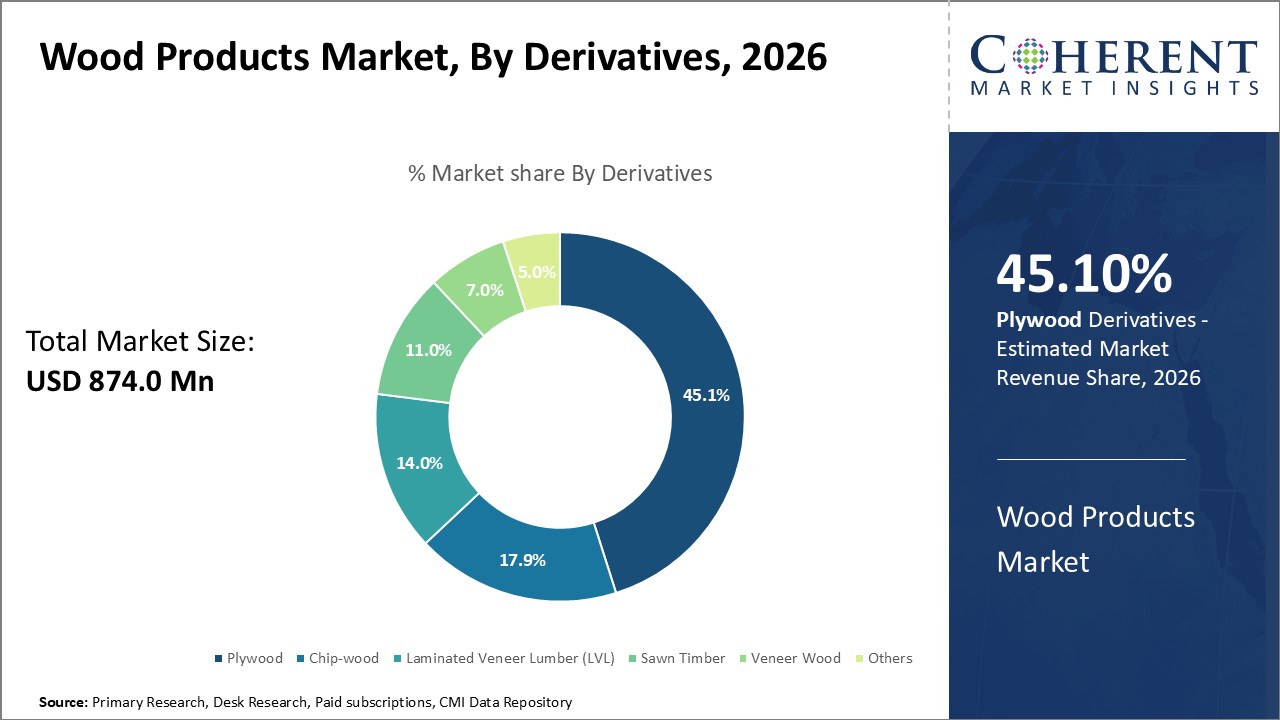
- The plywood segment is projected to hold 45.1% of the market share in 2026, driven by its superior strength, dimensional stability, and versatility, making it crucial for a wide range of industrial and construction applications.
- The residential segment is anticipated to represent 64.7% of the market share in 2026, driven by the growing demand for housing and the increasing use of wood materials in home construction and renovation.
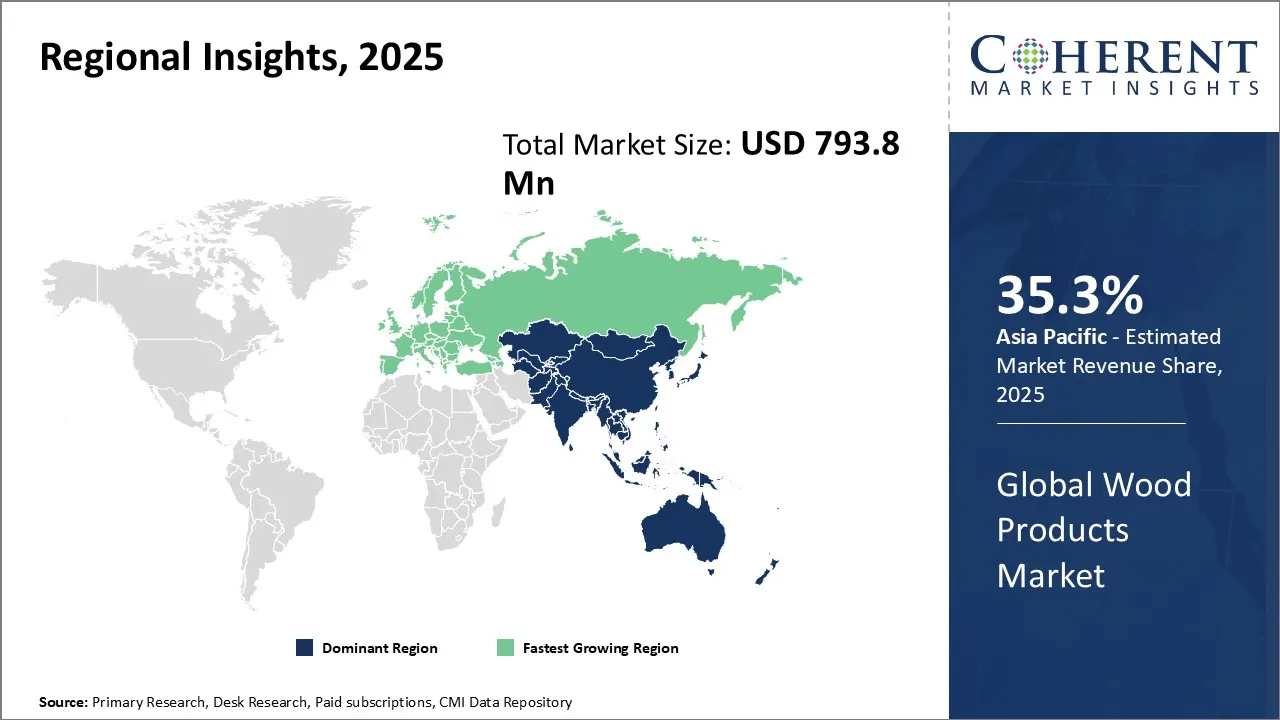
- Asia Pacific is expected to lead the global wood products market in 2026 with a 35. 3% share, driven by rapid urbanization, infrastructure development, and the rising demand for residential and commercial construction. Europe, with a 24.7% share in 2026, will be the fastest-growing region, fueled by increasing adoption of eco-friendly materials, government policies promoting sustainable forestry, and a growing focus on green building certifications.
Market Overview
A significant trend in the wood products market is the rising shift towards environmentally sustainable wood sourcing and manufacturing practices. Innovations in engineered wood products, along with growing awareness about reducing carbon footprints, are driving market evolution. Additionally, government regulations promoting green construction building practices and the preference for renewable materials in urban development projects are further boosting adoption, placing wood products at the forefront of sustainable construction solutions globally.
Currents Events and their Impact
Current Events | Description and its impact |
Surge in Demand for Sustainable Construction Materials |
|
Technology and Innovation in Wood Processing |
|
Segmental Insights

- Current Industry Events of 2026
- Market Size Estimation
- Regional Breakdown
- Competitive Landscape
- Customer Intelligence
- Segmental Analysis
- Pricing Analysis
- Key Market Drivers, Challenges & Future Trends
- Customized Insights Section
Wood Products Market Insights, By Wood Type – Softwood Segment Dominates the Market due to its Versatility and Sustainability Advantages
Softwood segment is expected to hold 76.1% share of the global wood products market in 2026, exhibiting 10% of CAGR, due to its widespread availability and favorable physical properties that suit a broad range of applications. One of the key factors driving the prominence of softwood is its faster growth cycle compared to hardwood. This rapid renewability makes softwood a more sustainable option, appealing to industries and consumers increasingly focused on environmental responsibility. The relatively quick maturation of softwood species such as pine, fir, and spruce allows producers to meet large-scale demand more efficiently without placing undue pressure on forest ecosystems.
Additionally, softwood is lighter and easier to process than hardwood, which translates to cost efficiencies in manufacturing and transportation. These characteristics make softwood ideal for construction and building materials where strength combined with workability is crucial. Its ability to absorb treatments and finishes well enhances durability, further supporting its use in outdoor structures such as framing, decking, and roofing.
Wood Products Market Insights, By Derivatives - Plywood’s Segment Dominates the Market due to its Structural Flexibility and Superior Performance Attributes
The plywood segment is expected to capture 45.1% of the market share in 2026, growing at 10.1% CAGR. Its superior strength, dimensional stability, and versatility make it essential for various industrial and construction applications. The engineered process of layering multiple veneers with adhesive bonds enhances its resistance to warping, cracking, and splitting, outperforming solid wood of comparable thickness. This unique feature allows plywood to be widely used in load-bearing structures, flooring systems, wall sheathing, and furniture manufacturing.
A major factor fueling plywood’s growth is the increasing demand for materials that can fulfill both structural and aesthetic roles without exorbitant costs. Plywood balances affordability with performance, providing a reliable material solution that outperforms many alternatives. Furthermore, its ability to be produced in large sheet formats minimizes on-site jointing, speeding up construction times and reducing labor expenses.
Wood Products Market Insights, By Application – Residential Segment Leads the Market due to Expanding Housing Needs and Preference for Wood-Based Aesthetics
The residential segment is expected to account for 64.7% of the market share in 2026, growing at a 9.3% CAGR. This growth is driven by the increasing demand for housing and the rising use of wood materials in home construction and renovation. Urbanization in emerging markets and ongoing remodeling activities in developed regions are fueling consistent residential construction, supporting steady volume consumption of wood products.
Wood’s natural insulating properties make it an attractive material for energy-efficient residential designs. With rising consumer awareness around energy conservation, builders and homeowners prefer wood products not only for their structural benefits but also for their ability to enhance thermal retention. This translates to lower energy consumption for heating and cooling, aligning with growing environmental and cost-saving priorities.
Regional Insights
Asia Pacific Wood Products Market Analysis and Trends
The Asia Pacific region is projected to lead the market with a 35.3% share in 2026, growing at a 10.7% CAGR, driven by rapid urbanization, infrastructure development, and rising demand for residential and commercial construction across emerging economies like China, India, and Southeast Asia. Governments in the region are increasingly promoting the use of wood products as eco-friendly alternatives to concrete and steel, supported by policies encouraging sustainable forestry and green building certifications.
The relatively large workforce and growing manufacturing capabilities have attracted investments from global companies like Canfor Corporation, Stora Enso, and local leaders such as Sumitomo Forestry and Aditya Birla Group. Additionally, the region benefits from abundant forest resources in countries like Indonesia and Malaysia, which serve as critical raw material suppliers, further catalyzing industrial growth. Trade expansion within ASEAN and between Asia Pacific and global markets continues to enhance the region’s prominence in the global wood products supply chain.
Europe Wood Products Market Analysis and Trends
The Europe region is expected to exhibit the fastest growth in the market contributing 24.7% share in 2026, growing at a 9.7% CAGR, driven by increasing demand for sustainable construction materials, particularly in the residential and commercial sectors. Countries such as Germany, France, and the Nordic nations are at the forefront, prioritizing eco-friendly solutions due to strong environmental regulations and building standards. The European Union's commitment to green building certifications and its emphasis on renewable resources have bolstered the market for wood products.
Moreover, Europe's well-established forestry practices and advanced wood processing technologies contribute to the region's competitive edge. Companies like Stora Enso, UPM-Kymmene, and local players such as Metsä Group and Södra are leading the charge. The region also benefits from strong manufacturing capabilities and a skilled workforce, which have attracted investment in wood-based product innovations. Trade within the EU and its growing export activities to global markets, especially in the construction and furniture sectors, further solidify Europe's position as a key player in the global wood products supply chain.
Global Wood Products Market Outlook for Key Countries
U.K. Wood Products Market Trends
The U.K. wood products market is projected to grow at a 10.4% CAGR, supported by a well-established wood products industry with access to abundant forest resources and advanced production facilities. Leading companies like BSW Timber and James Jones & Sons are driving innovations in engineered wood products and sustainable practices. Government incentives for green infrastructure and renewable materials further boost demand, while a skilled workforce and strong R&D capabilities provide a competitive edge. The U.K. also benefits from favorable trade policies and established export channels, particularly to Europe and North America.
China Wood Products Market Trends
China continues to lead as a massive consumer and manufacturer within the wood products market, growing at an 11.1% CAGR, driven by an expansive construction sector that demands both raw and engineered wood materials. Key domestic companies like China National Forest Products Co. have scaled production to meet urban housing needs and infrastructure projects, supported by government initiatives targeting sustainable forestry and afforestation. Despite high import volumes to compensate for resource limitations, China is investing heavily in developing its wood processing technologies and circular economy approaches.
Japan Wood Products Market Trends
Japan’s wood products market is projected to grow at a 10.8% CAGR, supported by its advanced manufacturing capabilities and a focus on sustainable construction materials. Key players like Sumitomo Forestry and Matsumoto Shikkui lead in producing high-quality engineered wood products for both domestic and international markets. Japanese forestry policies prioritize sustainability, certification, and forest regeneration, boosting the market’s global reputation. Innovations in cross-laminated timber (CLT) and wood-based construction materials position Japan as a key player in the green building sector.
India Wood Products Market Trends
India’s wood products market is expanding rapidly at a 10.6% CAGR amidst urban growth and infrastructure modernization. Domestic players such as Aditya Birla Group and Greenply Industries stimulate the sector by focusing on plywood, veneers, and engineered wood products tailored for local consumer preferences and export. Government support for affordable housing and initiatives promoting renewable building materials drive increased wood demand, while sustainable forest management remains an area of ongoing development.
ASEAN Wood Products Market Trends
The ASEAN wood products market is growing at a 10.7% CAGR, driven by urbanization, infrastructure development, and rising demand for sustainable materials. Key players focus on engineered wood products, supported by government policies promoting sustainable forestry and energy-efficient construction. ASEAN’s strong export networks, particularly to China, Japan, and the Middle East, enhance its role in global wood product trade.
End User Feedback and Unmet Needs: Wood Products Market
- A common point of satisfaction among industrial users in the construction sector is the durability and versatility of engineered wood products, especially those used in structural applications such as beams, panels, and flooring. For instance, large-scale contractors have praised the consistent quality and strength of cross-laminated timber (CLT), a wood product that has gained momentum for sustainable construction. End users highlighted its ease of integration into designs, reduced reliance on concrete, and rapid installation times.
- Customization and Personalization: Many end users, especially those in construction and high-end furniture manufacturing, have expressed a desire for more customization in wood products. Tailored wood solutions, such as unique dimensions, finishes, and treatments, are crucial for meeting the specific needs of these industries. A lack of customization in some product lines has led to the search for alternative materials, which are often less sustainable. Offering customizable solutions could enhance user satisfaction and ensure that manufacturers remain competitive in niche markets.
Market Players, Key Development, and Competitive Intelligence
Key Developments
- In July 2024, Georgia-Pacific began operations at its state-of-the-art Dixie plant, dedicated to producing premium paper plates. The advanced facility is designed to boost production efficiency and sustainability, as the Dixie brand seeks to meet the increasing demand for high-quality disposable tableware while adopting innovative methods to minimize waste and reduce energy usage.
- In September 2023, Lintec Europe unveiled a new label stock solution at Labelexpo Europe 2023. This innovation improves the recyclability of PET bottles and advocates for the use of direct thermal paper as an eco-friendly alternative to synthetic paper products.
Top Strategies Followed by Global Wood Products Market Players
- Established industry leaders, often multinational corporations, invest heavily in research and development (R&D) to innovate high-performance wood products that meet evolving consumer demands and regulatory standards. By prioritizing innovation, these players enhance product durability, sustainability, and design, which helps differentiate them in a crowded marketplace.
- For example, Weyerhaeuser, one of the largest producers of timber products in North America, emphasizes innovation in engineered wood products like cross-laminated timber (CLT) that are used in multi-story buildings, capitalizing on sustainability trends in the construction sector.
- Mid-level wood product companies typically position themselves as providers of cost-effective solutions that strike a balance between quality and affordability. These players cater primarily to price-sensitive consumers who demand reliable wood products without premium pricing. To sustain competitive advantage, mid-level firms focus on optimizing production processes and supply chain efficiencies to reduce costs.
- For instance, Georgia-Pacific, a prominent mid-level player, focuses on affordable yet reliable wood-based products such as plywood and engineered wood products for the construction sector. To sustain competitive advantage, mid-level companies often optimize production processes, leveraging advanced technologies to reduce operational costs.
- Small-scale players in the global wood products market face the challenge of competing with larger firms that benefit from economies of scale and extensive global networks. To carve out their niche, these smaller companies typically focus on specialized product features or innovative offerings that cater to specific customer needs or emerging trends, such as eco-friendly materials, custom designs, or unique finishes.
- For instance, Katerra, a technology-driven construction firm, partnered with leading wood suppliers to create modular wood building products that streamline construction timelines and reduce costs, helping smaller wood product companies scale up their offerings.
Market Report Scope
Wood Products Market Report Coverage
| Report Coverage | Details | ||
|---|---|---|---|
| Base Year: | 2025 | Market Size in 2026: | USD 874.0 Mn |
| Historical Data for: | 2020 To 2024 | Forecast Period: | 2026 To 2033 |
| Forecast Period 2026 to 2033 CAGR: | 10.1% | 2033 Value Projection: | USD 1,714.0 Mn |
| Geographies covered: |
| ||
| Segments covered: |
| ||
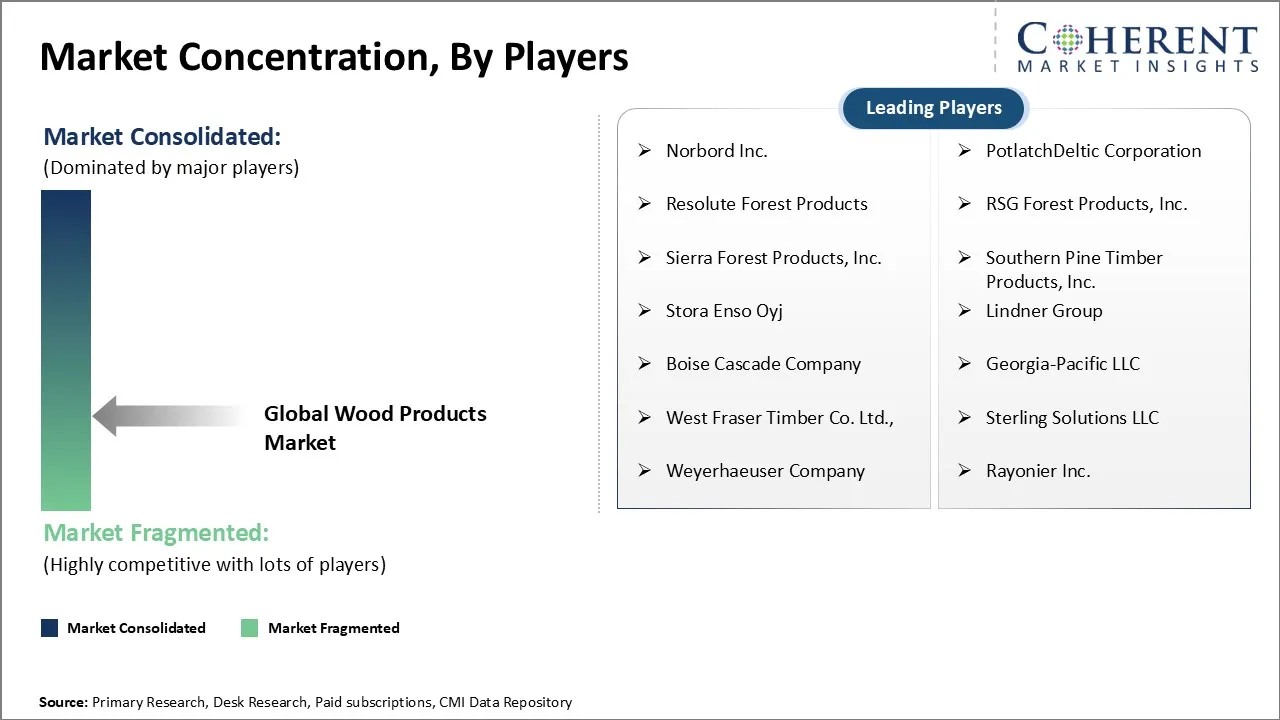
| Companies covered: | Norbord Inc., PotlatchDeltic Corporation, Resolute Forest Products, RSG Forest Products, Inc., Sierra Forest Products, Inc., Southern Pine Timber Products, Inc., Stora Enso Oyj, Lindner Group, Boise Cascade Company, Georgia-Pacific LLC, West Fraser Timber Co. Ltd.,, Sterling Solutions LLC, Weyerhaeuser Company, and Rayonier Inc. | ||
| Growth Drivers: |
| ||
| Restraints & Challenges: |
| ||
Wood Products Market Dynamics
Wood Products Market Driver - Growing Demand for Sustainable and Eco-Friendly Building Materials
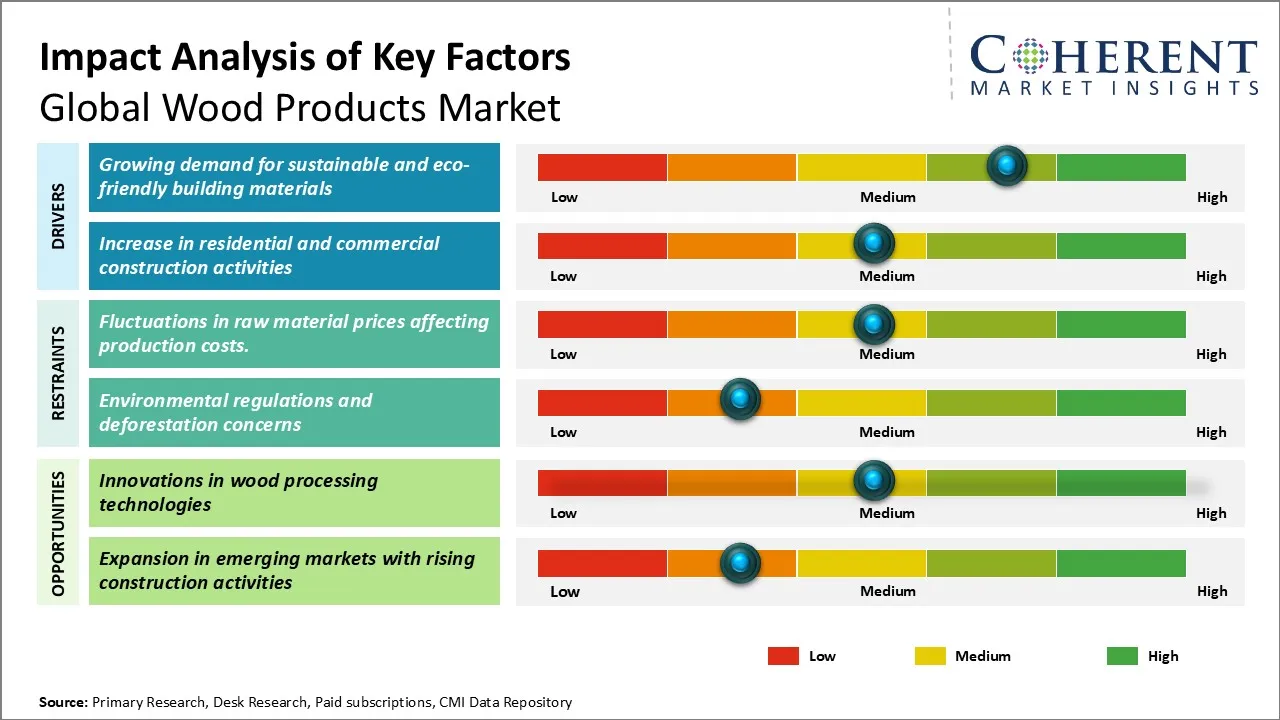
The increasing global emphasis on environmental preservation and sustainable development is significantly influencing the demand for wood products in the construction and manufacturing sectors. As architects, builders, and consumers become more conscious of the environmental impact of traditional materials like concrete and steel, wood emerges as a preferred alternative due to its renewable nature and lower carbon footprint. Wood’s ability to sequester carbon, ease of recyclability, and biodegradability enhance its appeal as a green building material.
In Sweden, the government has launched initiatives to promote the use of wood in construction to reduce carbon emissions in the building sector. Swedish company, Skanska has been involved in numerous projects using cross-laminated timber (CLT), a wood product with a much lower carbon footprint than traditional concrete or steel.
Wood Products Market Opportunity - Innovations in Wood Processing Technologies
The global wood products market stands to benefit significantly from ongoing innovations in wood processing technologies, which present substantial opportunities for enhanced efficiency, quality, and sustainability. Advanced technologies such as automated sawmilling, laser-guided cutting, and computer numerical control (CNC) machinery are revolutionizing traditional wood processing methods by enabling greater precision and reducing wastage. Additionally, developments in engineered wood products, including cross-laminated timber (CLT) and laminated veneer lumber (LVL), are expanding the application scope of wood in construction, especially in multi-story buildings where sustainability and strength are pivotal.
The use of automated sawmilling technology has significantly improved the efficiency of wood processing. Swedish company, Södra implemented a fully automated sawmilling process, increasing production capacity by 30% while reducing waste. This automation ensures more precise cutting and optimized use of raw materials, leading to cost savings and lower environmental impact.
Analyst Opinion (Expert Opinion)
- The global wood products market is poised for robust growth, driven by increasing consumer demand for sustainable building materials and eco-friendly furniture. Insights from the International Wood Products Conference (2023) and the Forest Products Society Annual Meeting (2022) emphasized the shift towards certified sustainable sourcing and innovative wood processing technologies.
- Companies like West Fraser Timber are capitalizing on this trend, with their recent investment in advanced milling techniques that enhance yield and reduce waste, demonstrating a commitment to sustainability while meeting market needs. Additionally, discussions at these conferences highlighted the growing popularity of engineered wood products, such as cross-laminated timber, which are gaining traction in construction due to their strength and lower carbon footprint.
- As urbanization continues to drive demand for residential and commercial properties, the integration of wood products in green building certifications will further bolster market growth. Firms that prioritize sustainability, invest in innovative production methods, and foster transparency in their supply chains will likely emerge as leaders in this evolving landscape, positioning themselves to capitalize on the increasing consumer preference for eco-conscious choices in the wood products sector.
Speak to the analyst
Want personalized insights?
Take the findings above to one of our principal consultants, or have the report rebuilt around the segments, geographies and competitors you actually track.
Market Segmentation
- Wood Type Insights (Revenue, USD Mn, 2021 - 2033)
- Softwood
- Hardwood
- Derivatives Insights (Revenue, USD Mn, 2021 - 2033)
- Plywood
- Chip-wood
- Laminated Veneer Lumber (LVL)
- Sawn Timber
- Veneer Wood
- Others (OSB, Roundwood, I-beam, etc.)
- Application Insights (Revenue, USD Mn, 2021 - 2033)
- Residential
- Commercial
- Distribution Channel Insights (Revenue, USD Mn, 2021 - 2033)
- Offline
- Online
- Regional Insights (Revenue, USD Mn, 2021 - 2033)
- North America
- U.S.
- Canada
- Latin America
- Brazil
- Argentina
- Mexico
- Rest of Latin America
- Europe
- Germany
- U.K.
- Spain
- France
- Italy
- Russia
- Rest of Europe
- Asia Pacific
- China
- India
- Japan
- Australia
- South Korea
- ASEAN
- Rest of Asia Pacific
- Middle East
- GCC Countries
- Israel
- Rest of Middle East
- Africa
- South Africa
- North Africa
- Central Africa
- North America
- Key Players Insights
- Norbord Inc.
- PotlatchDeltic Corporation
- Resolute Forest Products
- RSG Forest Products, Inc.
- Sierra Forest Products, Inc.
- Southern Pine Timber Products, Inc.
- Stora Enso Oyj
- Lindner Group
- Boise Cascade Company
- Georgia-Pacific LLC
- West Fraser Timber Co. Ltd.
- Sterling Solutions LLC
- Weyerhaeuser Company
- Rayonier Inc.
Sources
Primary Research Interviews
- Operations Manager – Leading Wood Panel Manufacturer
- Procurement Head – Major Furniture Producer
- Product Development Director – Global Engineered Wood Brand
- Sustainability & Certification Head – Forest Stewardship Organization
Stakeholders
- Manufacturers (Sawn Timber, Plywood, Particleboard, Engineered Wood)
- End-use Sectors
- Construction (Residential & Commercial Building, Modular Homes)
- Furniture & Interior Solutions Brands
- Packaging & Pallet Producers
- Regulatory & Certification Bodies
- Timber Exporters and Importers
- Digital Platforms/Marketplaces (for wood products trading)
- Technology Providers (for wood processing, grading, digital supply chain)
Databases
- FAOSTAT (UN Food and Agriculture Organization)
- UN Comtrade Database (Global Timber & Wood Product Flows)
- India Import Export (EXIM) Database
- Eurostat – International Wood Trade Data
Magazines
- Woodworking Network – Industry News & Developments
- Timber Trades Journal – Global Timber Market Trends
- Furniture Today – Raw Material Sourcing and Wood Product Innovations
- Panel World – Plywood and Engineered Wood Industry Updates
Journals
- Journal of Wood Science – Properties and Applications of Wood Products
- Forest Products Journal – Wood Processing and New Materials
- European Journal of Wood and Wood Products – Market and Engineering Trends
Newspapers
- The Financial Times – Wood Industry Investments & Trade Policies
- The Guardian – Forest Management and Environmental Policies
- Asia Forest Journal – Wood Products Growth in Asia-Pacific
- European Timber News – Regulation and Trade in the EU
Associations
- American Hardwood Export Council (AHEC)
- European Panel Federation (EPF)
- Canadian Wood Council (CWC)
- Forest Stewardship Council (FSC)
- Programme for the Endorsement of Forest Certification (PEFC)
Public Domain Sources
- Food and Agriculture Organization (FAO) – Global Forest Resources Assessments
- International Tropical Timber Organization (ITTO) – Market Reports and Policy Briefs
- US Department of Agriculture (USDA) – Forestry and Wood Products Data
- European Commission – Timber Regulation and Import Policies
Proprietary Elements
- CMI Data Analytics Tool, Proprietary CMI Existing Repository of information for last 8 years.
Get access to 250+ pages report
Every segment, forecast, competitor profile and data table behind the analysis above — available for instant download.
- ESOMAR Member
- ISO 9001:2015 Certified
- D-U-N-S Registered
- GDPR & CCPA Compliant
Missing comfort of reading report in your local language? Find your preferred language:
Transform your Strategy with Exclusive Trending Reports
Frequently Asked Questions
The global wood products market is estimated to be valued at USD 874.0 Mn in 2026 and is expected to reach USD 1,714.0 Mn by 2033.
The CAGR of global wood products market is projected to be 10.1% from 2026 to 2033.
Growing demand for sustainable and eco-friendly building materials and increase in residential and commercial construction activities are the major factors driving the growth of the global wood products market.
Fluctuations in raw material prices affecting production costs and environmental regulations and deforestation concerns are the major factors hampering the growth of the global wood products market.
In terms of wood type, softwood is estimated to dominate the market revenue share in 2026.
Norbord Inc., PotlatchDeltic Corporation, Resolute Forest Products, RSG Forest Products, Inc., Sierra Forest Products, Inc., Southern Pine Timber Products, Inc., Stora Enso Oyj, Lindner Group, Boise Cascade Company, Georgia-Pacific LLC, West Fraser Timber Co. Ltd., Sterling Solutions LLC, Weyerhaeuser Company, and Rayonier Inc. are the major players.
Asia Pacific is expected to lead the global wood products market in 2026.