

Global Differential Scanning Calorimetry Market Size and Forecast – 2026 - 2033
The Global Differential Scanning Calorimetry Market is estimated to be valued at USD 727.0 Mn in 2026 and is expected to reach USD 1,465.1 Mn by 2033, exhibiting a compound annual growth rate (CAGR) of 10.5% from 2026 to 2033.
Key Takeaways of the Differential Scanning Calorimetry Market
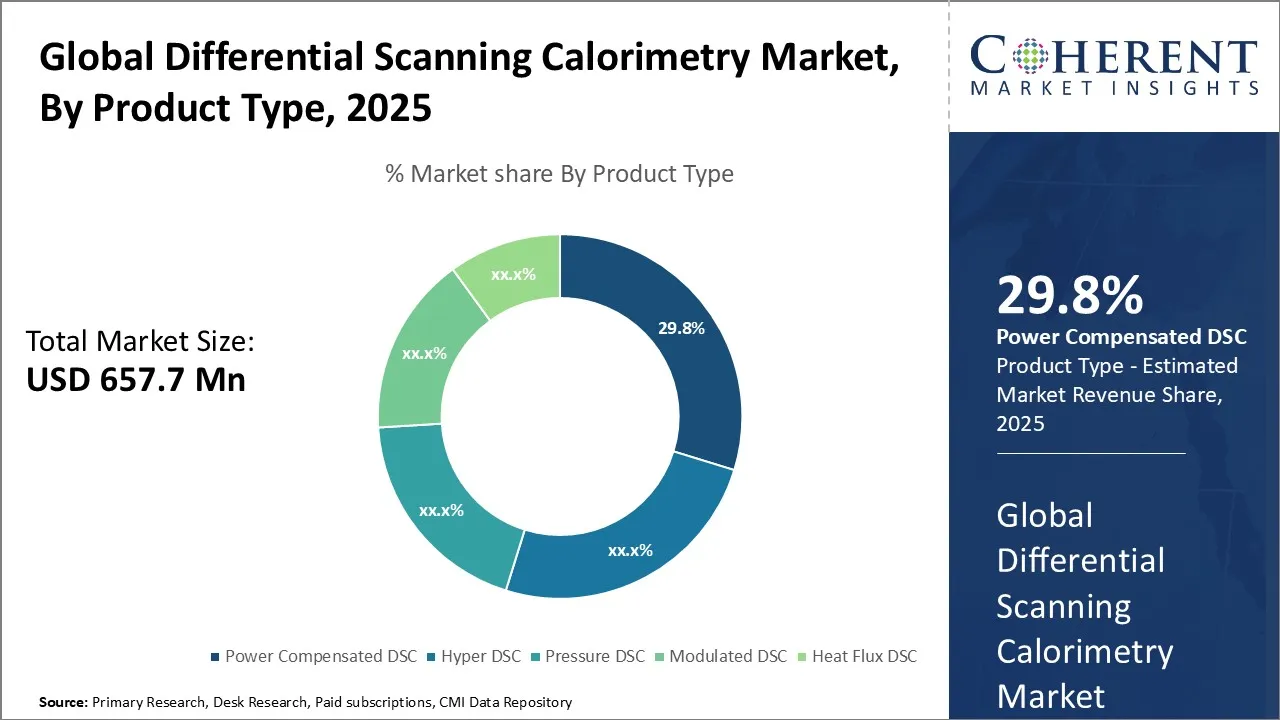
- The Power Compensated DSC segment is expected to account for 30.8% of the market share in 2026, driven by its advanced technical features and wide-ranging applications across various industries.
- The Food Science segment is projected to hold a 33.3 % share of the global differential scanning calorimetry market in 2026, driven by growing consumer awareness and regulatory demands aimed at maintaining food quality, safety, and nutritional value.
- North America is expected to lead the global differential scanning calorimetry market in 2026 with a 33.4 % share, driven by significant advancements in technology, high demand across industries, and strong research and development investments.
- Europe, with a 26.01 % share in 2026, will be the fastest-growing region, propelled by increasing industrial applications, advancements in material science, and growing adoption of DSC in pharmaceuticals and research institutions.
Market Overview
The market trend reveals a rising emphasis on advanced materials research and the development of innovative DSC instruments with enhanced sensitivity and automation capabilities. Additionally, growing investments in research and development (R&D) activities, particularly in emerging economies, and increasing government initiatives to improve quality standards are fueling market expansion. Integration of DSC with complementary technologies for comprehensive material characterization, including protein stability analysis, is also shaping industry growth dynamics.
Current Events and Its Impact
Current Events | Description and its impact |
Technological Advancements in DSC Instruments |
|
Growing Pharmaceutical and Polymer Industries Demand |
|
Segmental Insights
- Current Industry Events of 2026
- Market Size Estimation
- Regional Breakdown
- Competitive Landscape
- Customer Intelligence
- Segmental Analysis
- Pricing Analysis
- Key Market Drivers, Challenges & Future Trends
- Customized Insights Section
Differential Scanning Calorimetry Market Insights, By Product Type - Power Compensated DSC Segment Dominates the Market, due to its Superior Sensitivity and Versatility
Power Compensated DSC segment is expected to contribute 30.8% share of the market in 2026, primarily driven by its technical superiority and broad applicability across numerous industries. The segment is expected to grow at a CAGR of 9.97%. One of the main factors fueling the growth of power compensated DSC is its exceptional sensitivity and precise temperature control.
This system maintains a constant temperature difference between the sample and reference by modulating the power supplied individually to each, enabling highly accurate detection of thermal transitions such as melting points, crystallization, and glass transitions. This makes it especially suitable for materials that require fine thermal resolution, including polymers, pharmaceuticals, and specialty chemicals.
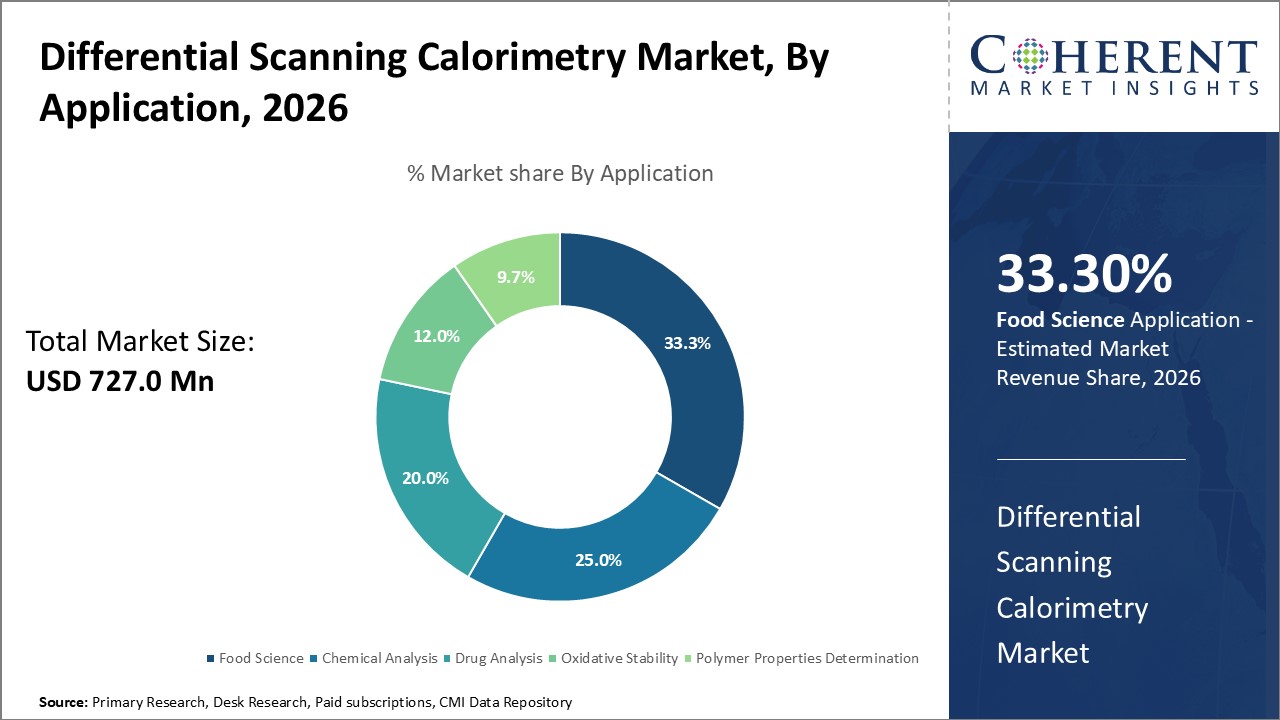
Differential Scanning Calorimetry Market Insights, By Application - Food Science Segment Leads the Market, driven by the Rising Emphasis on Food Safety, Quality, and Nutritional Analysis
Food Science segment is expected to hold 33.3% share of the global differential scanning calorimetry market in 2026, propelled by increasing consumer awareness and regulatory requirements focused on ensuring food quality, safety, and nutritional value. The segment is projected to grow at a CAGR of 10.71%. DSC is extensively employed in the food industry to analyze thermal properties that directly affect texture, shelf life, and processing conditions of food products.
The growing demand for minimally processed and clean-label foods challenges manufacturers to understand the thermal behavior of ingredients and finished products without compromising quality. DSC provides critical insights into fat crystallization, protein denaturation, and moisture interactions. Its ability to precisely measure melting points, crystallization kinetics, and oxidative stability helps food scientists optimize formulations to improve texture, mouthfeel, and storage stability.
Regional Insights
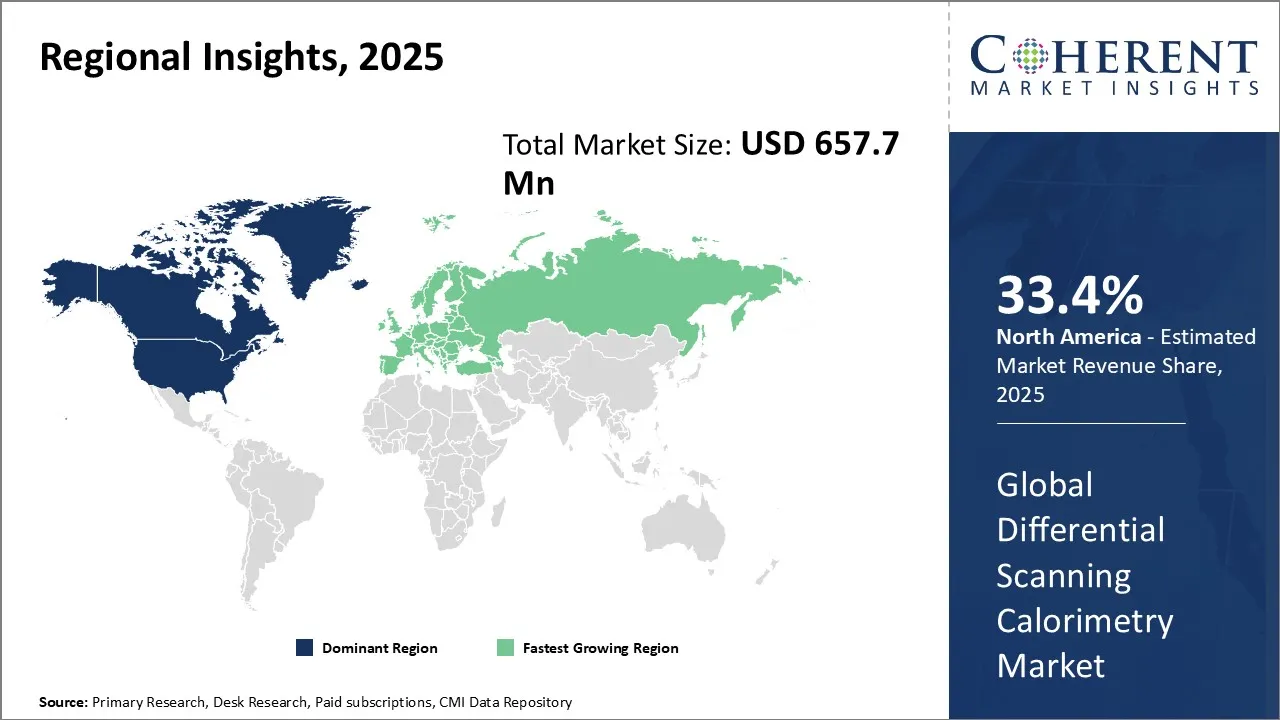
North America Differential Scanning Calorimetry Market Analysis and Trends
The North America region is projected to lead the market with a 33.4% share in 2026, primarily driven by a well-established industrial ecosystem, advanced research infrastructure, and favorable government policies that support scientific innovation. The region is expected to grow at a CAGR of 11.55%. The region hosts numerous pharmaceutical, polymer, and chemical companies that rely heavily on DSC technology for product development and quality control.
Robust investments in R&D, the presence of key universities and research institutions, and stringent regulatory frameworks increase demand for precise thermal analysis instruments. Major players like TA Instruments (Waters Corporation), Mettler-Toledo, and PerkinElmer have a strong footprint here, continuously pushing product innovation and customer support services. The integrated supply chains and strong trade networks further consolidate North America’s leadership, enabling seamless import/export operations and rapid dissemination of new technologies.
Europe Differential Scanning Calorimetry Market Analysis and Trends
Europe region is expected to exhibit the fastest growth in the market, contributing 26.01% share in 2026, driven by robust industrialization, a strong pharmaceutical and chemical sector, and increasing government initiatives to support scientific research and advanced manufacturing. This region is projected to grow at a CAGR of 10.45%.
The presence of leading global players in thermal analysis, such as NETZSCH and Malvern Panalytical, is boosting market dynamics. Additionally, increasing investments in scientific research and rising demand for high-precision instruments for applications in the pharmaceutical, polymer, and food industries contribute significantly to the market's expansion. The European Union's stringent regulatory environment, focused on quality control standards and product safety, is further fueling the need for advanced thermal analysis instruments. The growth of domestic instrument manufacturers and favorable R&D policies in key European countries are also supporting market progress in this region.
Global Differential Scanning Calorimetry Market Outlook for Key Countries
Italy Differential Scanning Calorimetry Market Trends
Italy's differential scanning calorimetry market is fueled by advanced technology adoption and significant R&D investment. The country boasts a strong pharmaceutical, materials science, and academic research presence, driving demand for high-precision DSC instruments. Leading market players are developing products tailored to Italy's stringent quality standards. The pharmaceutical, food, and chemical sectors heavily rely on DSC for product development and quality control. The market is projected to grow at a CAGR of 12.67%. Increasing emphasis on quality control is further accelerating the adoption of DSC technology.
Canada Differential Scanning Calorimetry Market Trends
Canada’s differential scanning calorimetry market thrives on its robust pharmaceutical, chemical, and material science industries, which require extensive material characterization and testing. The country benefits from an established manufacturing ecosystem and government support for innovation and advanced manufacturing, encouraging the integration of sophisticated analytical instruments in various sectors. The market is projected to grow at a CAGR of 11.95%. This growth is driven by increasing demand for high-precision DSC instruments in research and product development.
China Differential Scanning Calorimetry Market Trends
China continues to lead as a crucial growth engine within the Asia Pacific region, fueled by government priorities on scientific advancement and innovation-driven economic policies. The expanding pharmaceutical, polymer, and electronics industries demand DSC instruments for quality control and R&D. The market is projected to grow at a CAGR of 11.95%. Domestic players are emerging strongly alongside international brands, with companies like PerkinElmer and Shimadzu collaborating with local distributors to tailor offerings for the Chinese market. Regulatory emphasis on product safety and efficacy also pushes investments in thermal analysis technologies.
India Differential Scanning Calorimetry Market Trends
India’s market is witnessing rapid expansion supported by growth in pharmaceuticals, biotech, and chemical manufacturing. Government initiatives aimed at fostering innovation and building infrastructure for scientific research are enhancing the adoption of DSC instruments. The market is projected to grow at a CAGR of 11.41%. International companies such as TA Instruments and Mettler-Toledo have strengthened their regional presence through partnerships and local support centers, enabling better access to advanced DSC solutions. The rising quality standards within Indian industries currently accelerate the instrumentation demand.
Russia Differential Scanning Calorimetry Market Trends
Russia’s differential scanning calorimetry market is gaining traction, due to its growing chemical and materials science industries, which require advanced thermal analysis tools for product development and quality control. The country is increasingly investing in research and development, with a focus on improving manufacturing processes across various sectors. Russian companies, along with international players, are playing a pivotal role in providing high-quality DSC instruments.
The market is projected to grow at a CAGR of 11.53%. Government support for scientific research and the emphasis on sustainable manufacturing further contribute to the market’s expansion. The rising demand for high-precision instruments is accelerating the adoption of DSC technology.
Role of AI in the Differential Scanning Calorimetry (DSC) Market
- Automated Data Interpretation: AI-driven algorithms interpret DSC thermal curves and complex data patterns, reducing the need for manual analysis and lowering the risk of errors. Machine learning models can detect subtle phase transitions and material events that traditional analysis might miss, ensuring more reliable results.
- Process Optimization: AI optimizes instrument parameters such as temperature ramp rates and sampling protocols, resulting in higher experiment throughput and standardized testing conditions. This maximizes efficiency, especially in pharmaceutical and materials research labs.
- Predictive Analytics: Using historical experiment data, AI can forecast material behaviors under varying conditions, supporting faster innovation and more informed decision-making in product development and quality control.
- Integration with Automation: AI works in tandem with robotic sample handling and smart instrument networks, streamlining high-volume DSC analysis. This is vital for applications such as drug formulation screening, polymer development, and food safety testing.
Market Players, Key Development, and Competitive Intelligence
Key Developments
- In January 2025, a new Reference Material (RM) for Temperature and Enthalpy Calibration of Differential Scanning Calorimeters was introduced. This new RM expands the scope of NIST’s DSC-related calibration standards to include sub-ambient temperatures, providing a significant advancement in the field. It offers a viable alternative to the previously used Standard Reference Material (SRM) 2225 Mercury, which was discontinued in 2017 due to safety concerns. This development enhances calibration accuracy and broadens the applications of DSCs in various scientific and industrial settings.
- In July 2023, METTLER TOLEDO introduced the DSC 5+, setting a new standard for differential scanning calorimetry. The DSC 5+ comes with groundbreaking performance enhancements and automation upgrades, offering superior functionality and increased productivity. This new model significantly improves the performance of METTLER TOLEDO’s DSC instrumentation, providing laboratories with a more efficient and reliable tool for advanced thermal analysis.
Top Strategies Followed by Global Differential Scanning Calorimetry Market Players
- Established players in the market, often multinational corporations with extensive resources, invest substantially in research and development (R&D) to drive innovation and develop high-performance DSC instruments that address evolving customer needs. Their R&D efforts focus on enhancing sensitivity, accuracy, and user-friendly features to maintain technological leadership. In addition, these market leaders actively pursue strategic partnerships and collaborations with major industry players, original equipment manufacturers (OEMs), and research institutions.
- For example, Mettler-Toledo, has developed high-performance DSC models like the DSC 3+ with cutting-edge automation features, ensuring its dominance in industries such as pharmaceuticals, material science, and food testing.
- Mid-level players in the DSC market adopt a distinct approach centered on balancing quality with affordability, targeting price-sensitive consumer segments such as small research laboratories, academic institutions, and mid-sized enterprises. Recognizing that these customers demand reliable yet cost-effective DSC solutions, mid-tier companies focus on streamlining their product design and manufacturing processes to offer competitively priced instruments without significantly compromising performance. To enhance their production capabilities and technological competencies, many mid-level players actively engage in collaborations or joint ventures that enable technology transfer and shared expertise.
- For instance, TA Instruments Discovery DSC series focuses on delivering excellent performance at a lower price point, making it an attractive option for cost-conscious customers. These mid-level players often streamline their product designs and manufacturing processes to offer competitively priced instruments without sacrificing reliability.
- Small-scale players operate with a different set of strategies, often carving out specialized niches within the broader DSC market. These companies typically concentrate on developing innovative products equipped with unique or advanced features tailored to specific applications or customer requirements. Leveraging cutting-edge technologies such as miniaturization, automation, or integration with complementary analysis techniques allows these smaller firms to remain competitive despite limited resources.
Market Report Scope
Differential Scanning Calorimetry Market Report Coverage
| Report Coverage | Details | ||
|---|---|---|---|
| Base Year: | 2025 | Market Size in 2026: | USD 727.0 Mn |
| Historical Data for: | 2020 To 2024 | Forecast Period: | 2026 To 2033 |
| Forecast Period 2026 to 2033 CAGR: | 10.5% | 2033 Value Projection: | USD 1,465.1 Mn |
| Geographies covered: |
| ||
| Segments covered: |
| ||
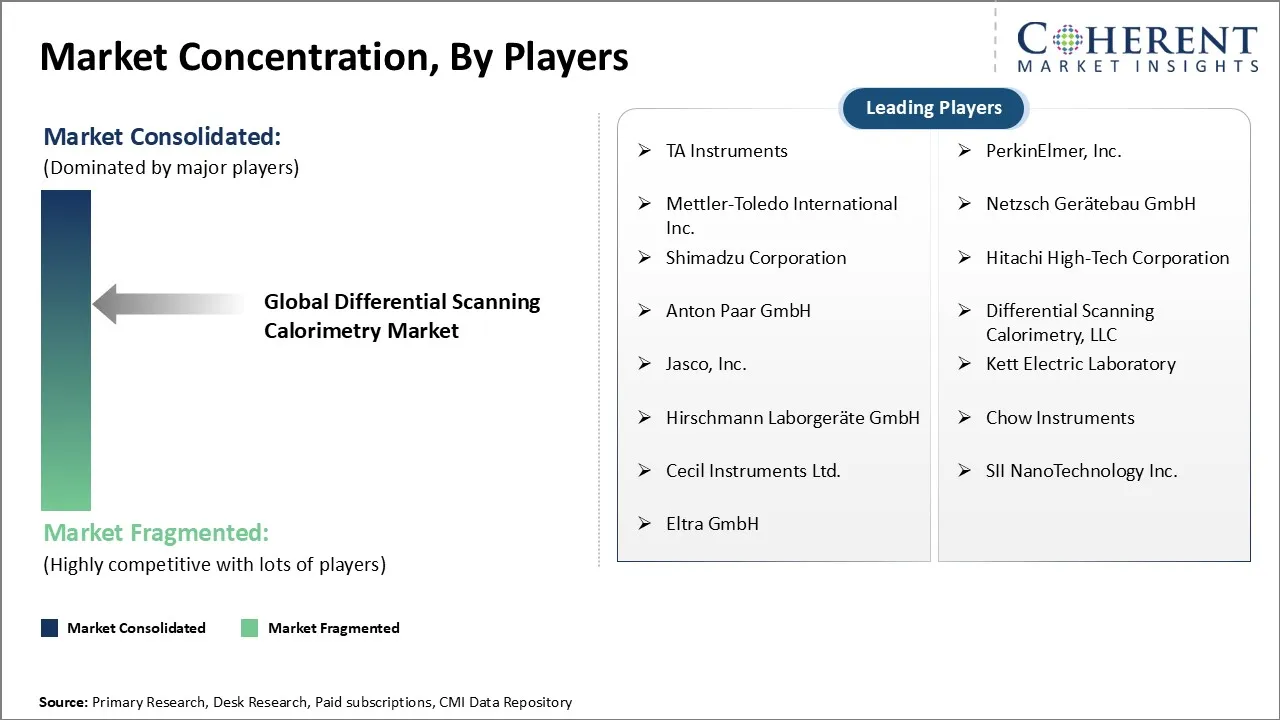
| Companies covered: | TA Instruments, PerkinElmer, Inc., Mettler-Toledo International Inc., Netzsch Gerätebau GmbH, Shimadzu Corporation, Hitachi High-Tech Corporation, Anton Paar GmbH, Differential Scanning Calorimetry, LLC, Jasco, Inc., Kett Electric Laboratory, Hirschmann Laborgeräte GmbH, Chow Instruments, Cecil Instruments Ltd., SII NanoTechnology Inc., and Eltra GmbH | ||
| Growth Drivers: |
| ||
| Restraints & Challenges: |
| ||
Differential Scanning Calorimetry Market Dynamics
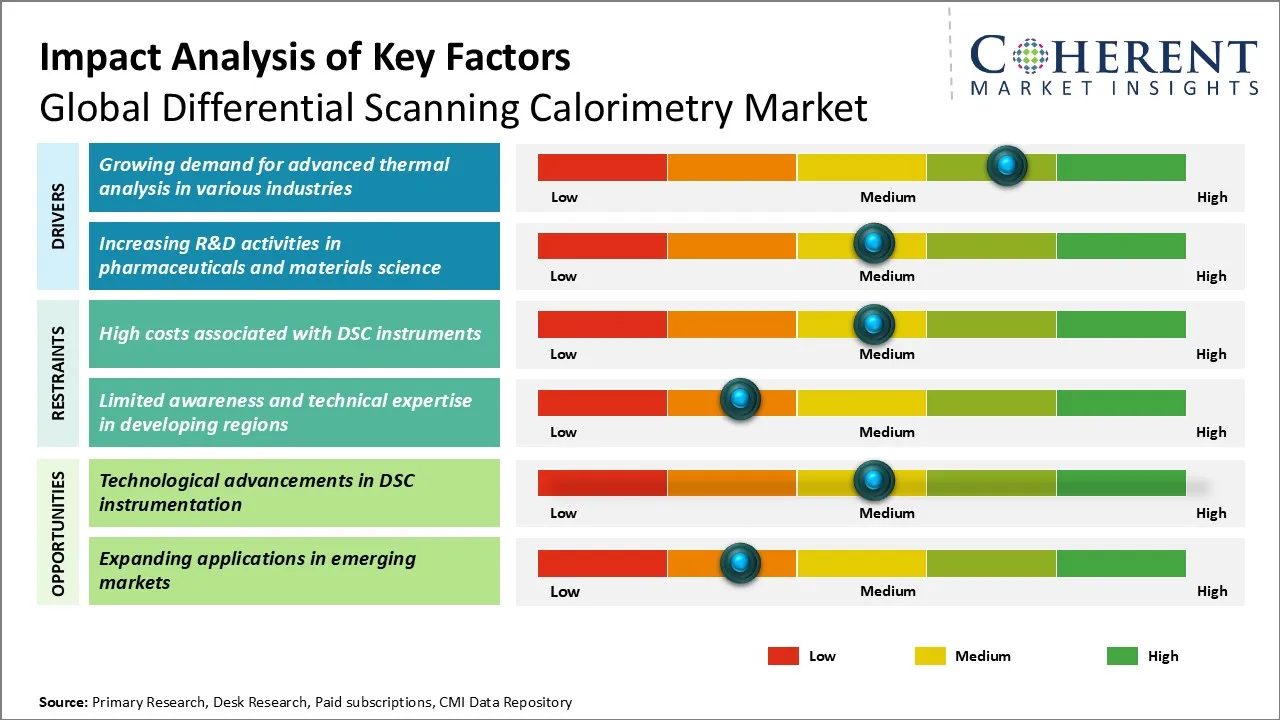
Differential Scanning Calorimetry Market Driver - Growing Demand for Advanced Thermal Analysis in Various Industries
The increasing complexity of materials and products in sectors such as pharmaceuticals, polymers, chemicals, and automotive has significantly driven the demand for sophisticated thermal analysis techniques like Differential Scanning Calorimetry (DSC). Industries are progressively prioritizing the accurate characterization of thermal properties, including phase transitions, melting points, and crystallization behavior, to ensure product quality, performance, and safety.
For instance, according to the U.S. Food and Drug Administration's 2022 report on pharmaceutical manufacturing quality, thermal analysis techniques including DSC have become essential tools for ensuring drug safety and efficacy, with over 85% of new drug applications incorporating thermal characterization data. Similarly, the electronics industry's evolution toward miniaturization and advanced materials has necessitated sophisticated thermal analysis capabilities, where DSC enables engineers to understand glass transition temperatures, crystallization behavior, and thermal stability of electronic components and packaging materials.
Differential Scanning Calorimetry Market Opportunity - Technological Advancements in Differential Scanning Calorimetry (DSC) Instrumentation
The global differential scanning calorimetry market stands to benefit significantly from ongoing technological advancements in DSC instrumentation, which present a substantial opportunity for market growth and diversification. Recent innovations focus on enhancing the sensitivity, accuracy, and versatility of DSC devices, enabling more precise thermal analysis across diverse applications such as pharmaceuticals, polymers, food science, and materials research. Modern DSC instruments are increasingly incorporating features like faster heating and cooling rates, improved temperature control, and automation capabilities, which streamline workflow and increase throughput in laboratories.
For example, TA Instruments' Q2000 DSC model integrates automation features, which significantly reduce human error and labor costs. Automation allows researchers to run multiple samples simultaneously, increasing laboratory throughput and efficiency. This is especially valuable in industries such as materials research and biotechnology, where large sample sizes need to be analyzed under identical conditions.
Analyst Opinion (Expert Opinion)
- The global differential scanning calorimetry market is poised for significant growth, driven by advancements in materials science and increased demand for precise thermal analysis across various industries. Companies like TA Instruments and Mettler Toledo are at the forefront, showcasing innovative DSC technologies that enhance accuracy and efficiency.
- Recent conferences such as the Thermal Analysis and Calorimetry Conference (2023) and the International Symposium on Thermal Analysis (2022) highlighted how these advancements are crucial in sectors like pharmaceuticals and polymers. Presentations detailed case studies where enhanced DSC techniques enabled researchers to better understand phase transitions and material stability, thus accelerating product development cycles.
- Discussions underscored the growing trend of integrating DSC with other analytical techniques to provide comprehensive insights, a move that is gaining traction among R&D teams. Furthermore, the push for sustainable materials is driving demand for advanced DSC applications in bioplastics and composite materials. As industries increasingly recognize the importance of thermal analysis in innovation, differential scanning calorimetry market is set for robust expansion, with companies that embrace technological advancements and interdisciplinary approaches likely to gain a competitive edge.
Speak to the analyst
Want personalized insights?
Take the findings above to one of our principal consultants, or have the report rebuilt around the segments, geographies and competitors you actually track.
Market Segmentation
- Product Type Insights (Revenue, USD Mn, 2021 - 2033)
- Power Compensated DSC
- Hyper DSC
- Pressure DSC
- Modulated DSC
- Heat Flux DSC
- Application Insights (Revenue, USD Mn, 2021 - 2033)
- Food Science
- Chemical Analysis
- Drug Analysis
- Oxidative Stability
- Polymer Properties Determination
- Regional Insights (Revenue, USD Mn, 2021 - 2033)
- North America
- U.S.
- Canada
- Latin America
- Brazil
- Argentina
- Mexico
- Rest of Latin America
- Europe
- Germany
- U.K.
- Spain
- France
- Italy
- Russia
- Rest of Europe
- Asia Pacific
- China
- India
- Japan
- Australia
- South Korea
- ASEAN
- Rest of Asia Pacific
- Middle East
- GCC Countries
- Israel
- Rest of Middle East
- Africa
- South Africa
- North Africa
- Central Africa
- North America
- Key Players Insights
- TA Instruments
- PerkinElmer, Inc.
- Mettler-Toledo International Inc.
- Netzsch Gerätebau GmbH
- Shimadzu Corporation
- Hitachi High-Tech Corporation
- Anton Paar GmbH
- Differential Scanning Calorimetry, LLC
- Jasco, Inc.
- Kett Electric Laboratory
- Hirschmann Laborgeräte GmbH
- Chow Instruments
- Cecil Instruments Ltd.
- SII NanoTechnology Inc.
- Eltra GmbH
Sources
Primary Research Interviews
- R&D Director – Leading DSC Manufacturer
- Product Development Manager – Global Thermal Analysis Company
- Applications Scientist – Research and Development in Calorimetry
- Marketing Manager – Industrial Equipment Supplier for DSC Systems
- Technical Support Head – Thermal Analysis Device Provider
Stakeholders
- Manufacturers
- End-use Sectors:
- Research Laboratories (universities, public/private research organizations)
- Pharmaceutical & Biopharmaceutical Companies (drug formulation, stability testing)
- Food & Beverage Industry (product development, quality control)
- Electronics Industry (material characterization)
- Chemical Manufacturers (polymers, adhesives)
- Regulatory & Certification Bodies
- Equipment Distributors & Retailers
- Technology Integration Players: Companies offering advanced software for DSC data analysis and automation
Databases
- UN Comtrade Database
- India Import Export (EXIM) Database
Magazines
- Thermal Analysis Magazine – Applications and innovations in DSC technology
- Journal of Analytical Chemistry – Developments in calorimetry instruments and techniques
- Lab Manager Magazine – Industry insights for thermal analysis applications
- Material Science and Engineering Magazine – DSC applications in material properties testing
- Food Engineering Magazine – DSC for food stability and safety testing
Journals
- Journal of Thermal Analysis and Calorimetry – Advances in thermal analysis techniques, including DSC
- Thermochimica Acta – Studies on calorimetric measurements and applications
- Journal of Chemical Thermodynamics – Thermodynamic properties and phase behavior using DSC
- Materials Science and Engineering Journal – DSC in material characterization
- Journal of Applied Polymer Science – DSC applications in polymer science and processing
Newspapers
- The Wall Street Journal – Emerging markets for thermal analysis in industrial applications
- The Guardian – Environmental applications of DSC in material sustainability
- Business Standard – Growth in demand for DSC equipment in the Asia-Pacific region
- Financial Times – Market trends and growth opportunities in DSC equipment manufacturing
Associations
- International Confederation for Thermal Analysis and Calorimetry (ICTAC)
- Society of Analytical Chemists of India (SACI)
- American Society for Testing and Materials (ASTM) – Standards for thermal analysis and calorimetry
- European Society for Thermal Analysis (ESTA)
- International Union of Pure and Applied Chemistry (IUPAC) – Guidelines for calorimetric analysis methods
Public Domain Sources
- U.S. FDA – Guidelines for Calibration of Analytical Instruments
- ISO 11357 – Standards for DSC equipment and calibration procedures
- European Commission – Thermal analysis regulations and testing methods
- World Health Organization (WHO) – Health and safety assessments in pharmaceutical formulations
Proprietary Elements
- CMI Data Analytics Tool, Proprietary CMI Existing Repository of information for the last 8 years.
Get access to 250+ pages report
Every segment, forecast, competitor profile and data table behind the analysis above — available for instant download.
- ESOMAR Member
- ISO 9001:2015 Certified
- D-U-N-S Registered
- GDPR & CCPA Compliant
Missing comfort of reading report in your local language? Find your preferred language:
Transform your Strategy with Exclusive Trending Reports
Frequently Asked Questions
The global differential scanning calorimetry market is estimated to be valued at USD 727.0 Mn in 2026 and is expected to reach USD 1,465.1 Mn by 2033.
The CAGR of the global differential scanning calorimetry market is projected to be 10.5% from 2026 to 2033.
Growing demand for advanced thermal analysis in various industries and increasing R&D activities in pharmaceuticals and materials science are the major factors driving the growth of global differential scanning calorimetry market.
High costs associated with DSC instruments and limited awareness and technical expertise in developing regions are the major factors hampering the growth of global differential scanning calorimetry market.
In terms of Product Type, Power Compensated DSC is estimated to dominate the market revenue share in 2026.
TA Instruments, PerkinElmer, Inc., Mettler-Toledo International Inc., Netzsch Gerätebau GmbH, Shimadzu Corporation, Hitachi High-Tech Corporation, Anton Paar GmbH, Differential Scanning Calorimetry, LLC, Jasco, Inc., Kett Electric Laboratory, Hirschmann Laborgeräte GmbH, Chow Instruments, Cecil Instruments Ltd., SII NanoTechnology Inc., and Eltra GmbH are the major players in the global differential scanning calorimetry market.
North America is expected to lead the global differential scanning calorimetry market in 2026.