

3D Scanning Market Analysis & Forecast: 2026 to 2033
3D Scanning Market is estimated to be valued at USD 4,246.7 Mn in 2026 and is expected to reach USD 14,692.0 Mn in 2033, exhibiting a compound annual growth rate (CAGR) of 19.4% from 2026 to 2033.
Key Takeaways
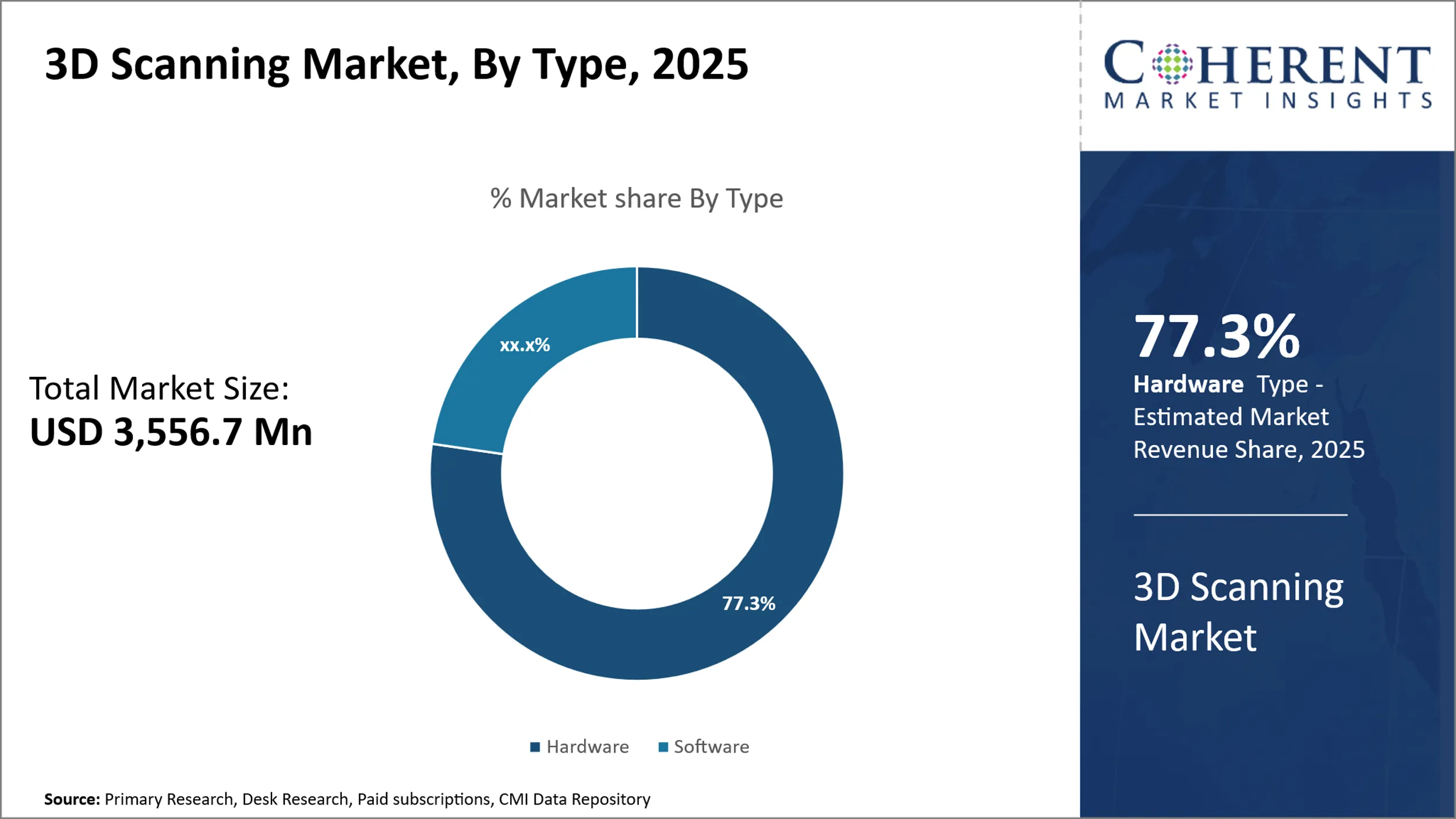
- By Type, the Hardware segment is projected to hold the largest share of the global 3D scanning market in 2026, accounting for 78.3% of the total market, driven by the widespread deployment of scanners across industrial and healthcare applications.
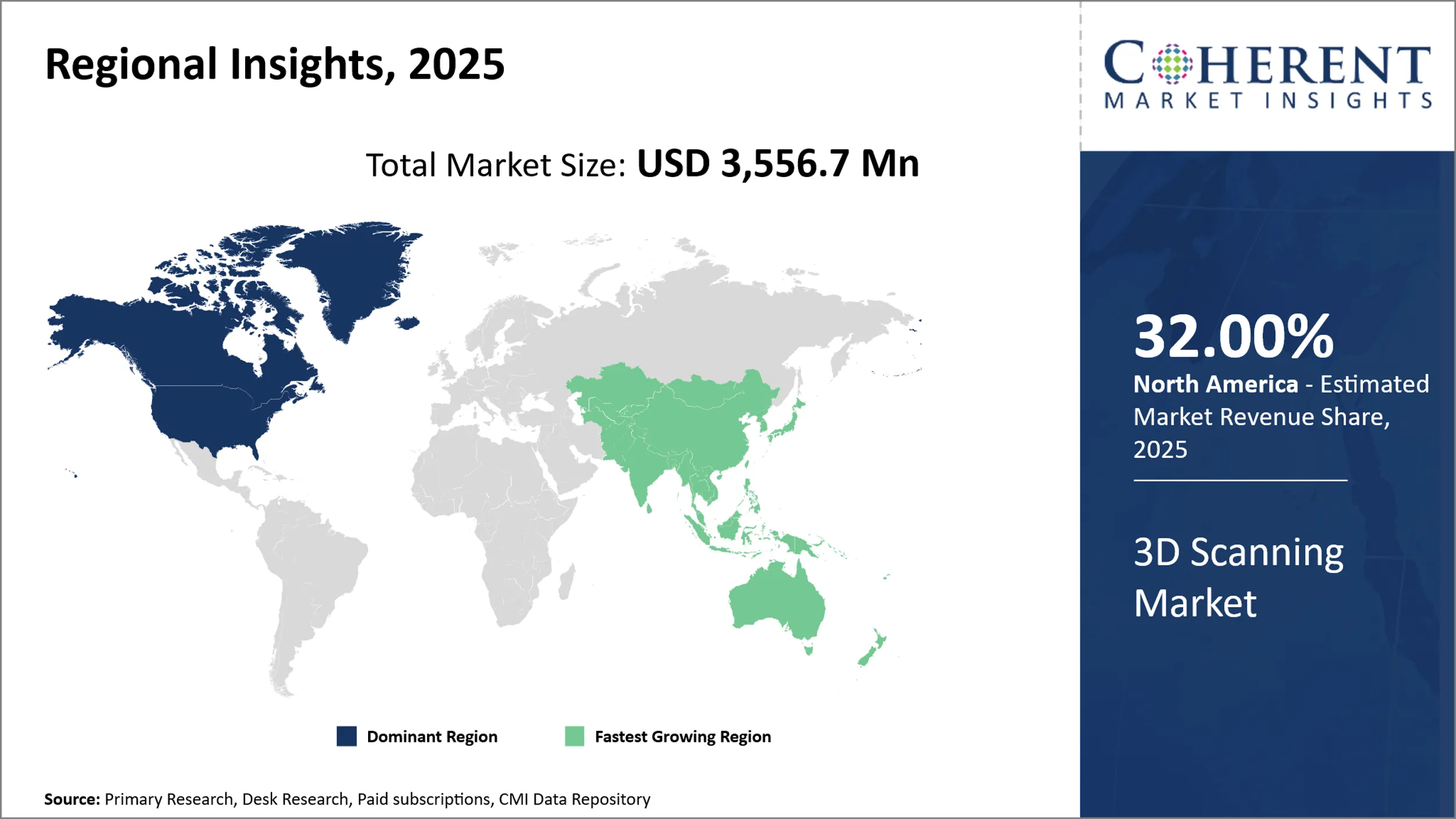
- By Region, North America is anticipated to maintain a leading position in the global 3D scanning market, holding 32% of the market share in 2026, supported by strong adoption in the aerospace, automotive, and healthcare industries.
Market Overview
The global market for 3D scanning is expected to rise significantly in the future. Increasing investment in R&D is one of the factors responsible for driving the growth of the industry. Moreover, rapid technological advancements are also boosting the demand for the products in the global market. Besides the growing demand for the smarter production, a strong growth in the gaming industry is also likely to drive the market growth. Moreover, the growth in the media and entertainment industry is slated to fuel the growth of the 3D scanning market.
For instance, in 2023, NVIDIA partnered with companies across sectors—including automotive, manufacturing, and gaming—to enable real-time collaboration using 3D scanned environments. This reflects a strong investment in R&D and technological advancement.
Current Events and Its Impact on the 3D Scanning Market
Event | Description and Impact |
AI and Machine Learning Integration in 3D Technology |
|
U.S.-China Technology Trade Tensions and Export Controls |
|
Automotive Industry's Digital Transformation and EV Transition |
|
Role of Emerging Technologies
Emerging technologies are fundamentally transforming the global 3D scanning market, reshaping how data is captured, processed, and utilized across industries. Innovations in 3D scanning hardware, such as the miniaturization of laser scanning systems and integration of LiDAR, are enhancing portability without compromising the precision of 3D scanning. This has enabled broader deployment in mobile devices, drones, and field applications.
Artificial intelligence is revolutionizing 3D scanning software by automating point cloud processing, reducing manual input and accelerating workflow efficiency. Real-time scanning and AI-powered noise filtering now allow for on-the-spot decision-making, streamlining use in manufacturing, healthcare, and construction.
Cloud-based services are democratizing access to high-end scanning by enabling large dataset processing without high-performance local systems. Meanwhile, structured light and photogrammetry technologies are evolving to improve accuracy on complex surfaces, expanding use cases from forensic analysis to cultural preservation.
As these technologies converge, new markets are opening, particularly for small businesses and education. This shift is reinforcing dominance in the 3D scanning market for players who innovate rapidly. Ultimately, emerging technologies are not only improving performance but also transforming 3D scanning by broadening the reach and accessibility of laser scanning and 3D scanning solutions across sectors.
- Current Industry Events of 2026
- Market Size Estimation
- Regional Breakdown
- Competitive Landscape
- Customer Intelligence
- Segmental Analysis
- Pricing Analysis
- Key Market Drivers, Challenges & Future Trends
- Customized Insights Section
Segmental Insights
Global 3D Scanning Market Insights, By Type
In terms of type, the hardware segment is projected to hold 78.3% of the global 3D scanning market share by 2026. This dominance is driven by the significant benefits offered by optical and laser scanning technologies. Optical scanners provide greater flexibility, enhanced accuracy, and dynamic referencing capabilities, making them ideal for high-precision tasks. Meanwhile, laser scanners continue to evolve rapidly due to innovations in sensor technology and scanning algorithms, further strengthening the segment’s market position.
Global 3D Scanning Market Insights, By Range
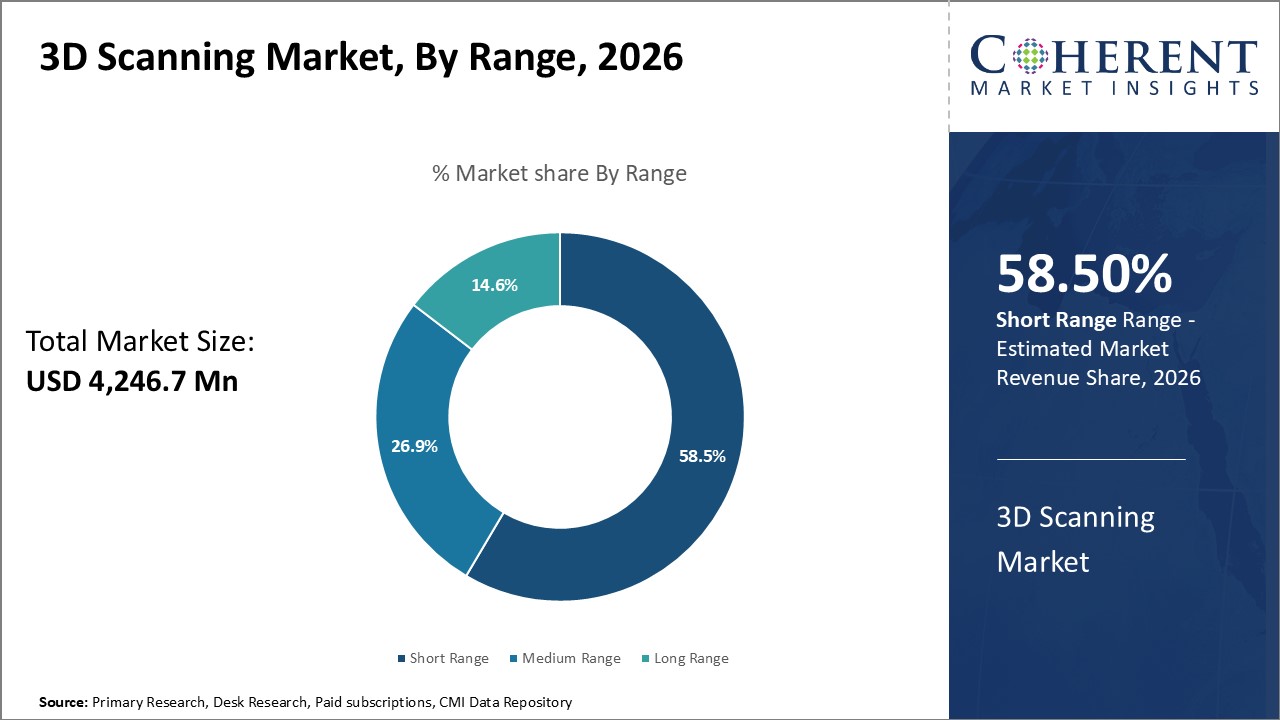
Based on range, short range 3D scanners are anticipated to lead the market throughout the forecast period. This growth is fueled by increasing demand for highly accurate as-built 3D models and measurements. Short-range scanners typically use structured light or laser triangulation technology and are optimized for ranges under 20 feet. Their ability to deliver high-precision outputs makes them ideal for applications in product design, manufacturing inspection, and cultural heritage documentation.
Global 3D Scanning Market Insights, By Application
From application perspective, reverse engineering is expected to dominate the global 3D scanning market. The technique provides numerous advantages, such as reduced manual labor, fast turnaround times, and accurate replication of complex components. 3D scanning allows manufacturers to generate detailed digital models of existing parts, facilitating design modifications and innovation with ease. These attributes are driving widespread adoption in industries ranging from aerospace to consumer electronics.
Global 3D Scanning Market Insights, By End User Vertical
In terms of end user vertical, the aerospace and defense segment is set to command a major share of the market by 2026. This is attributed to the strategic benefits that 3D scanning brings to the sector, including high reliability in quality assurance, lightweight design development, enhanced manufacturing productivity, and fast design validation. Furthermore, the ability to recover 3D data quickly and cost-effectively supports maintenance, repair, and overhaul (MRO) operations, fueling consistent demand from this vertical.
Regional Insights
North America 3D Scanning Market Analysis and Trends
North America is expected to maintain its position as a leading region in the global 3D scanning market in 2026, accounting for an estimated 32.00% of total market share. This stronghold is supported by well-established industrial infrastructure, increasing adoption of advanced technologies, and high demand across sectors such as aerospace and defense, healthcare, architecture, and media.
The U.S. and Canada are experiencing rapid advancements in healthcare applications for 3D scanning, driven by rising healthcare expenditures and a growing aging population. In Canada specifically, the increasing incidence of osteoarthritis and rheumatoid conditions is fueling the adoption of 3D scanning technologies in orthopedics, surgical planning, and prosthetics. Meanwhile, the U.S. continues to see growth in its aerospace, research, and entertainment industries, where 3D scanning plays a crucial role in design validation, reverse engineering, and digital content creation.
The region’s focus on technological innovation, combined with demand for precision and efficiency, is reinforcing North America’s leadership in the global 3D scanning landscape.
Asia Pacific 3D Scanning Market Analysis and Trends
Asia Pacific is emerging as the fastest-growing region in the global 3D scanning market, supported by a surge in infrastructure projects, preservation of cultural heritage, and rapid digitalization across industries. Countries including China, Japan, India, and South Korea are investing heavily in technologies that support digital modeling, entertainment, and industrial automation, sectors where 3D scanning is increasingly essential.
The demand for historical building reconstruction, especially in countries with rich architectural legacies, is expanding the application of 3D scanning for cultural preservation. Additionally, the animation and media industries in China are accelerating growth, with increasing investments in television, theatrical productions, streaming, and international co-productions. This is driving the need for advanced scanning tools to create high-quality digital content.
The region’s focus on tourism and infrastructure restoration is also contributing to the demand for accurate and non-invasive scanning methods. As digital transformation and cultural preservation efforts converge, Asia Pacific is poised to become a major driver of global 3D scanning market growth.
3D Scanning Market Outlook Country-Wise
China 3D Scanning Market Analysis and Trends
China leads the Asia Pacific 3D scanning market with its rapidly expanding animation, architectural reconstruction, and industrial design sectors. The country's entertainment industry is evolving through multi-platform content production and increased licensing partnerships. Government support for cultural preservation and smart manufacturing is further accelerating adoption of 3D scanning technologies.
India 3D Scanning Market Analysis and Trends
India is experiencing growing demand for 3D scanning in manufacturing, heritage conservation, and healthcare. The country’s emphasis on smart cities, digital infrastructure, and medical advancements is creating a favorable environment for market expansion. Government projects to digitize historical monuments and rising adoption of precision technologies in orthopedics and prosthetics are boosting the market.
Japan 3D Scanning Market Analysis and Trends
Japan continues to be a hub for technological innovation, with strong integration of 3D scanning in robotics, automotive design, and electronics. The country’s focus on automation and digital twins is supporting widespread application of 3D scanning in quality control and prototyping, while its cultural heritage initiatives are utilizing scanning for digital archiving and museum-grade restoration.
South Korea 3D Scanning Market Analysis and Trends
South Korea’s booming entertainment and gaming industries are driving the demand for advanced 3D scanning technologies. The country is also integrating scanning solutions in consumer electronics manufacturing and cosmetic surgery planning. A high level of tech adoption and government investment in digital content infrastructure are fostering rapid growth in the 3D scanning market.
Market Report Scope
3D Scanning Market Report Coverage
| Report Coverage | Details | ||
|---|---|---|---|
| Base Year: | 2025 | Market Size in 2026: | USD 4,246.7 Mn |
| Historical Data for: | 2020 To 2024 | Forecast Period: | 2026 To 2033 |
| Forecast Period 2026 to 2033 CAGR: | 19.4% | 2033 Value Projection: | USD 14,692.0 Mn |
| Geographies covered: |
| ||
| Segments covered: |
| ||
| Companies covered: | Trimble Inc., 3D Systems Inc., ShapeGrabber Inc., Creaform, Hexagon AB, GOM, 3D Digital Corp, Faro Technologies Inc., Autodesk, Inc., Topcon Corporation, and Maptek Pty Ltd. | ||
| Growth Drivers: |
| ||
| Restraints & Challenges: |
| ||
Global 3D Scanning Market Drivers
- Rise in demand for 3D metrology in different industries to boost growth of the market
The need for higher accuracy inspection of 3D data is rapidly increasing for modeling and analysis is boosting the investment in 3D metrology. Due to these investments the advancement and innovations in 3D scanning technologies is increasing all over the world. 3D solutions in metrology cover long range of materials, which is why they are highly adopted in various industries.
For instance, Creaform Inc., a Canada-based company offers MetraSCAN 3D, which is a 3D scanning solution designed for metrology-grade measurements on all type of materials. Thus, these factors are expected to drive growth of the global 3D scanning market over the forecast period.
- Increasing technological innovations to augment the market pace
The market is witnessing various technological innovations, which is turning the market from contact-based scanning towards light-based scanning or Photogrammetry. The most commonly used light-based scanning technique in 3D scanning is laser scanning. The innovation of such laser pulse scanning in 3D printing has expanded the scope for 3D printing technologies.
Moreover, the market is also witnessing innovations in terms of size, cost, and user-friendly applications. For instance, adoption of handheld and portable scanners is growing rapidly in the market. Thus, such novel innovations in 3D scanning are expected to fuel growth of the market in the near future.
Global 3D Scanning Market Opportunities
Rise in advancement in software and sensor technology to create multiple business opportunities in the global 3D scanning market over the forecast period. 3D scanning is likely to become more affordable, more useful, and more powerful with rise in advancements in software and sensor technology. This in turn is influencing various industries all over the world.
Moreover, 3D scanning will become more advantageous in product development workflows. The investments in 3D scanning technologies are expected to increase due to rise in pressure to work with multidisciplinary remote teams, innovate more quickly, and to grow product innovation at faster rate. These factors are thus anticipated to offer lucrative opportunities in the market.
Growing applications of 3D scanning is anticipated to create lucrative environment for growth opportunities in the global 3D scanning market over the forecast period. The use of 3D scanning enables quality 3D models, eliminates errors, facilitates the design iteration process, and boosts the reverse engineering speed.
Thus, the technology will be massively adopted in the specific market sectors of manufacturers in the coming future. Moreover, 3D scanning is expected to find various applications in the quality control field. Thus, the market is likely to witness several growth opportunities in the near future.
Global 3D Scanning Market Trends
- Emerging use of AI and machine learning with 3D scanning is a major trend
In the near future, the use of artificial intelligence (AI), machine learning, and 3D scanning will be applied for teaching computers make decisions based on particular criteria. Moreover, this combination will be useful to measure impressions and inspect dent in bigger aeroplanes and automotive that go unnoticed by humans. With this technology, manufacturers can decide how and when to treat the dent in the aircraft. Thus, this trend is growing in the global 3D scanning market, which is anticipated to boost growth of the market over the forecast period.
- Introduction of more affordable products and innovations to the market is a growing trend
Several manufacturers, especially from Asian region, are bringing in innovations and products that more affordable into the market. This in turn is likely to help them gain a competitive edge in the global 3D scanning market.
Global 3D Scanning Market Drivers
- Rise in demand for 3D metrology in different industries to boost growth of the market
The need for higher accuracy inspection of 3D data is rapidly increasing for modeling and analysis is boosting the investment in 3D metrology. Due to these investments the advancement and innovations in 3D scanning technologies is increasing all over the world. 3D solutions in metrology cover long range of materials, which is why they are highly adopted in various industries.
For instance, Creaform Inc., a Canada-based company offers MetraSCAN 3D, which is a 3D scanning solutions designed for metrology-grade measurements on all type of materials. Thus, these factors are expected to drive growth of the global 3D scanning market over the forecast period.
- Increasing technological innovations to augment the market pace
The market is witnessing various technological innovations, which is turning the market from contact-based scanning towards light-based scanning or Photogrammetry. The most commonly used light-based scanning technique in 3D scanning is laser scanning. The innovation of such laser pulse scanning in 3D printing has expanded the scope for 3D printing technologies.
Moreover, the market is also witnessing innovations in terms of size, cost, and user-friendly applications. For instance, adoption of handheld and portable scanners is growing rapidly in the market. Thus, such novel innovations in 3D scanning are expected to fuel growth of the market in the near future.
Global 3D Scanning Market Opportunities
Rise in advancement in software and sensor technology to create multiple business opportunities in the global 3D scanning market over the forecast period. 3D scanning is likely to become more affordable, more useful, and more powerful with rise in advancements in software and sensor technology. This in turn is influencing various industries all over the world.
Moreover, 3D scanning will become more advantageous in product development workflows. The investments in 3D scanning technologies are expected to increase due to rise in pressure to work with multidisciplinary remote teams, innovate more quickly, and to grow product innovation at faster rate. These factors are thus anticipated to offer lucrative opportunities in the market.
Growing applications of 3D scanning is anticipated to create lucrative environment for growth opportunities in the global 3D scanning market over the forecast period. The use of 3D scanning enables quality 3D models, eliminates errors, facilitates the design iteration process, and boosts the reverse engineering speed.
Thus, the technology will be massively adopted in the specific market sectors of manufacturers in the coming future. Moreover, 3D scanning is expected to find various applications in the quality control field. Thus, the market is likely to witness several growth opportunities in the near future.
Global 3D Scanning Market Trends
- Emerging use of AI and machine learning with 3D scanning is a major trend
In the near future, the use of artificial intelligence (AI), machine learning, and 3D scanning will be applied for teaching computers make decisions based on particular criteria. Moreover, this combination will be useful to measure impressions and inspect dent in bigger aeroplanes and automotive that go unnoticed by humans. With this technology, manufacturers can decided how and when to treat the dent in the aircraft. Thus, this trend is growing in the global 3D scanning market, which is anticipated to boost growth of the market over the forecast period.
- Introduction of more affordable products and innovations to the market is a growing trend
Several manufacturers, especially from Asian region, are bringing in innovations and products that more affordable into the market. This in turn is likely to help them gain a competitive edge in the global 3D scanning market. For instance, in January 2019, SHINING 3D, a China-based company showcased its new series of multi-functional, handheld 3D scanners and solutions, which covered “3D Digitizing-Design and Simulation-Additive Manufacturing”, for various industries. Thus, such efforts are increasing in the market, which is likely to continue in the coming years.
Analyst Viewpoint
- The 3D scanning market is witnessing significant growth, fueled by digital transformation initiatives across key sectors such as manufacturing, healthcare, and construction. In manufacturing, the need for industrial automation and precision in quality control is driving adoption of advanced 3D scanning technologies. Similarly, in healthcare, the shift toward personalized medicine and prosthetics development is increasing demand for high-resolution, patient-specific scanning solutions.
- Despite the growth momentum, the market faces notable challenges. High initial costs of advanced scanning equipment and software deter adoption, particularly among small and medium enterprises. Moreover, technical complexities in data processing and the need for specialized operator training present further barriers. Environmental limitations, such as poor lighting or reflective surfaces, can also compromise scan accuracy.
- However, emerging opportunities are promising. In the autonomous vehicle industry, 3D scanning is vital for detailed mapping and real-time navigation systems. Architecture and construction sectors are leveraging scanning for Building Information Modeling (BIM) and heritage preservation. Additionally, the rise of virtual and augmented reality is creating new avenues for immersive content creation.
- Geographically, North America continues to dominate the market due to its strong technological base, early adoption in aerospace and automotive sectors, and substantial R&D investments. Meanwhile, Asia-Pacific is the fastest-growing region, driven by rapid industrialization in China and India, expansion in electronics manufacturing, and increasing government support for advanced manufacturing technologies.
Global 3D Scanning Market: Key Developments
- In May 2024, Hexagon's manufacturing intelligence division introduced innovative handheld 3D scanning technology devices, ATLASCAN Max and MARVELSCAN, to enhance its diverse product line of manufacturing inspection devices. These devices are ideal for measuring parts in various inspection settings such as rail, automotive, industrial equipment, and general manufacturing.
- In November 2023, Artec 3D introduced the latest 3D scanner Micro II, an automated desktop 3D scanner designed for capturing small parts with the precision of 5 microns. The company aims to double the precision and enhance the scanning capacity through the automated one-click process, by the launch of Micro II.
Market Segmentation
- Global 3D Scanning Market, By Type (Revenue, USD Mn, 2021 - 2033)
- Hardware
- Software
- Global 3D Scanning Market, By Range (Revenue, USD Mn, 2021 - 2033)
- Short Range
- Medium Range
- Long Range
- Global 3D Scanning Market, By Application (Revenue, USD Mn, 2021 - 2033)
- Reverse Engineering
- Rapid Prototyping
- Quality Control/Inspection
- Face and Body Scanning
- Digital Modeling
- Global 3D Scanning Market, By End user Vertical (Revenue, USD Mn, 2021 - 2033)
- Aerospace and Defense
- Automotive
- Healthcare
- Manufacturing
- Entertainment and Media
- Architecture and Construction
- Other End user Verticals
- Global 3D Scanning Market, By Region (Revenue, USD Mn, 2021 - 2033)
- North America
- U.S.
- Canada
- Latin America
- Brazil
- Argentina
- Mexico
- Rest of Latin America
- Europe
- Germany
- U.K.
- Spain
- France
- Italy
- Russia
- Rest of Europe
- Asia Pacific
- China
- India
- Japan
- Australia
- South Korea
- ASEAN
- Rest of Asia Pacific
- Middle East
- GCC Countries
- Israel
- Rest of Middle East
- Africa
- South Africa
- North Africa
- Central Africa
- Company Profiles
- 3D Systems Inc.
- Creaform
- GOM
- Faro Technologies Inc.
- Topcon Corporation
- Maptek Pty Ltd.
- Autodesk, Inc.
- 3D Digital Corp.
- Hexagon AB
- ShapeGrabber Inc.
- Trimble Inc.
Sources
Primary Research Interviews
- 3D Scanning Technology Providers
- Manufacturing Industry End-users
- Healthcare and Medical Device Companies
- Automotive Industry Representatives
- Others
Databases
- IBISWorld
- Bloomberg Terminal
- Grand View Research Database
- Others
Magazines
- 3D Printing Industry Magazine
- Manufacturing Technology Insights
- Digital Engineering Magazine
- Additive Manufacturing Magazine
- Others
Journals
- Journal of Manufacturing Science and Engineering
- International Journal of Advanced Manufacturing Technology
- Optics and Lasers in Engineering
- Others
Newspapers
- Financial Times
- The Wall Street Journal
- Reuters
- Industrial News & Analytics
- Others
Associations
- Society of Manufacturing Engineers (SME)
- International Association of Advanced Materials (IAAM)
- 3D Printing Association
- Industrial Internet Consortium (IIC)
- Others
Public Domain Sources
- U.S. Patent and Trademark Office (USPTO)
- European Patent Office (EPO)
- Government Industry Reports
- Company Annual Reports and SEC Filings
- Others
Proprietary Elements
- CMI Data Analytics Tool
- Proprietary CMI Existing Repository of information for last 8 years
Definition: 3D scanning is a process of measuring and analyzing real-world objects and environments, then creating a digital 3D model. This technology is used in a variety of industries, such as manufacturing, engineering, archiving, and art. Some of the more common applications are reverse engineering, inspection, and 3D printing.
Get access to 250+ pages report
Every segment, forecast, competitor profile and data table behind the analysis above — available for instant download.
- ESOMAR Member
- ISO 9001:2015 Certified
- D-U-N-S Registered
- GDPR & CCPA Compliant
Missing comfort of reading report in your local language? Find your preferred language:
Transform your Strategy with Exclusive Trending Reports
Frequently Asked Questions
The 3D Scanning Market size is estimated to be valued at USD 4,246.7 Mn in 2026, and is expected to reach USD 14,692.0 Mn by 2033.
The CAGR of the 3D Scanning industry is projected to be 19.4% from 2026 to 2033.
Rise in demand for 3D metrology in different industries and increasing technological innovations are fuelling the market.
The hardware segment is the leading type segment in the market.
High cost of 3D scanners and Shortcomings of 3D scanning are the major factors restraining the market.
Trimble Inc., 3D Systems Inc., ShapeGrabber Inc., Creaform, Hexagon AB, GOM, 3D Digital Corp, Faro Technologies Inc., Autodesk, Inc., Topcon Corporation, and Maptek Pty Ltd.
The 3D scanner market is valued at several billion dollars and continues to expand due to demand across manufacturing, healthcare, and construction sectors.