

Cosmetic Surgery Market Size and Trends-(2026-2033)
The Cosmetic Surgery Market is estimated to be valued at USD 50 Bn in 2026 and is expected to reach USD 92.5 Bn by 2033, growing at a compound annual growth rate (CAGR) of 9.2% from 2026 to 2033.
Key Takeaways
- Based on Surgery Type, the Cosmetic Implants segment is expected to lead the market with 49.6% share in 2026, due to high demand for enhancement implants.
- Based on End User, the Hospitals segment is expected to hold 64.2% share of the market in 2026, driven by advanced clinical infrastructure and capacity to perform complex surgeries.
- Based on Region, North America is set to lead the Cosmetic Surgery Market with 38.40% share in 2026. While, Asia Pacific is anticipated to be the fastest growing region.
Market Overview
The market includes a wide range of aesthetic procedures, including surgical and nonsurgical, designed to enhance or alter physical features. The market encompasses both invasive and noninvasive treatments. The cosmetic surgery market is anticipated to exhibit strong growth owing to increasing disposable incomes, progress in medical technologies, and increased pressure from society to enhance physical appearance. The growth is also attributable to the rise in acceptance of cosmetic procedures in various demographics.
People today are more focused on their appearance influenced by social media platforms and the prevailing global beauty standards. The demand for cosmetic surgeries is increasing due to the availability of new technologies and devices that address skin problems. The insurance companies are also making it easier for individuals to afford these procedures. Many people prefer simple, painless methods to achieve a youthful and healthy appearance without complications, driving interest in non-surgical options. Companies are concentrating on developing new products and obtaining necessary approvals to enhance their market reach. The cosmetic surgery market is projected to grow during the forecast period, fueled by an increase in individuals traveling to other countries for cosmetic procedures as well as the emergence of new cosmetic clinics.
Current Events and Its Impacts on the Cosmetic Surgery Market
Current Event | Description and the Impact |
Technological Innovations and Digital Integration |
|
Sociocultural Dynamics and Consumer Behavior |
|
Healthcare Infrastructure and Workforce Developments |
|
Role of Artificial Intelligence (AI) in Cosmetic Surgery Market
The use of artificial intelligence have a positive impact on the cosmetic surgery industry. It helps in analyzing patient data and images to create customized treatment plans and realistic 3D models that predict surgical results. This approach helps establish realistic expectations for patients, facilitates communication with their surgeon, and aids in selecting the appropriate implant size for procedures like breast augmentation or rhinoplasty. AI-driven tools and robotic systems assist with navigation and provide real-time feedback during surgery. This includes the use of augmented reality (AR) headsets that overlay 3D anatomical maps onto the patient. This helps to identify critical structures like blood vessels and reducing human hand tremors to improve the precision of microsurgeries. Also, AI simplifies remote patient monitoring through smartphone apps that analyze images of healing wounds and wearable sensors that track vital signs to detect potential issues early.
For instance, in April 2025, Bliss Aesthetics secured USD17.5 million in venture funding led by Shine Capital to grow its AI-driven cosmetic enhancement platform. This platform enables users visualize what procedures will look like and connect with board-certified clinicians. It uses GenAI, Stable Diffusion, and computer vision to improve patient engagement which helps in making the surgical process easier.
- Current Industry Events of 2026
- Market Size Estimation
- Regional Breakdown
- Competitive Landscape
- Customer Intelligence
- Segmental Analysis
- Pricing Analysis
- Key Market Drivers, Challenges & Future Trends
- Customized Insights Section
Segmental Insights
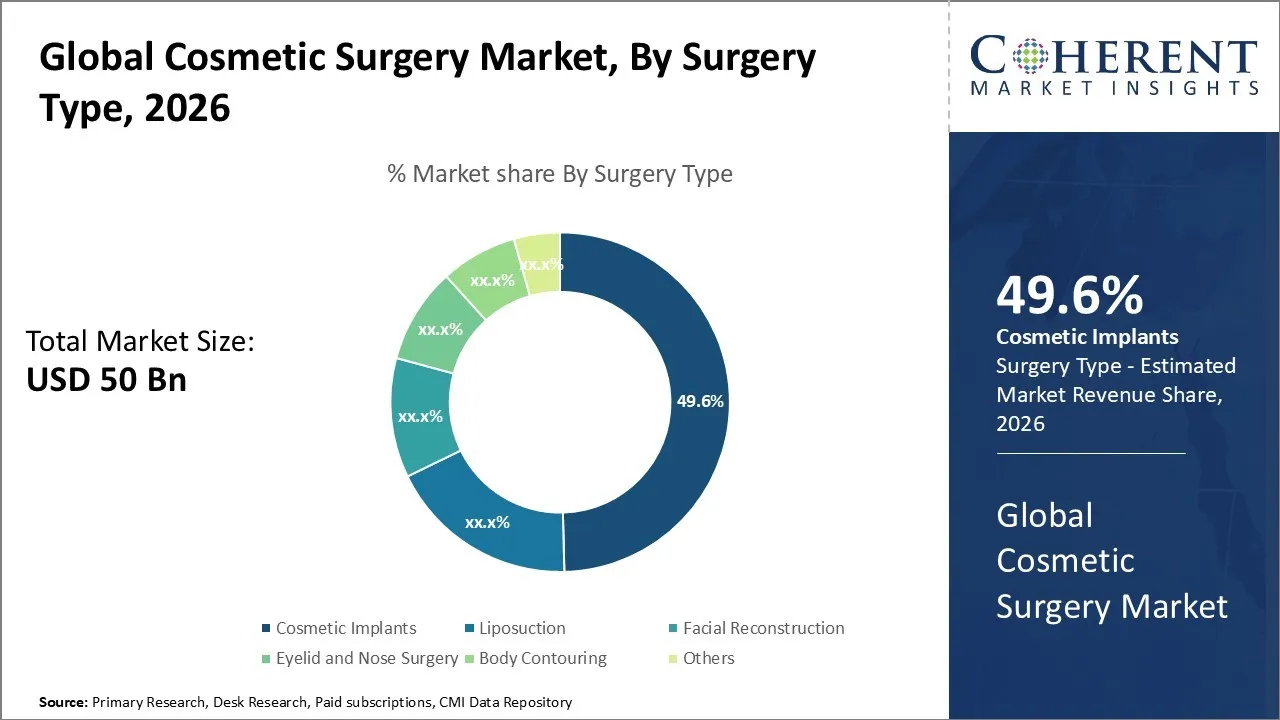
Cosmetic Surgery Market Insights, By Surgery Type- High Demand For Enhancement Implants Drives Preference for Cosmetic Implants
In terms of surgery type, the cosmetic implants segment contributes the highest share of 49.6% in 2026 of the market owing to the high demand for aesthetic solutions. The increasing popularity of facial implants, breast augmentations, and buttock enhancements is also helping the segment to grow. The increasing society pressure to focus on physical appearance and the influence of social media platforms are resulting in more people undergoing these surgeries. The progress in silicone gel technology helps in increasing the user's confidence to explore them. New cohesive gel breast implants provide users with more natural looks and increase patient trust. The cosmetic implants provide long-term aesthetic improvements, making them a popular choice for those seeking permanent alterations changes.
For instance, in October 2024, Morales Plastic Surgery, a leading provider of cutting-edge cosmetic procedures, launched Motiva breast implants. These are the most advanced breast augmentation option available in the market. Recently approved by the FDA, Motiva implants are manufactured by Establishment Labs. They use a combination of cutting-edge design and technology to give patients results that look natural and are of high quality.
Cosmetic Surgery Market Insights, By End User – Hospitals Leads with Advanced Clinical Infrastructure
In terms of end user, the hospitals segment contributes the highest share of 64.2% in 2026 of the market owing to their advanced infrastructure. They have access to cutting-edge equipment, AI diagnostics, and robotic systems required for these surgeries. The hospitals provide surgical and non-surgical procedures combined with the provision of operative care before and after the surgeries, thus helping in building patient trust. The presence of expert surgeons, comprehensive care, and stringent safety standards are making these settings lead in the industry for cosmetic surgeries.
For instance, in August 2025, Sakra World Hospital, India's first tertiary care hospital to be fully funded by FDI, has introduced its newest service called Comprehensive Cosmetic Care. This is a full-service cosmetic program that combines three super-specialty departments. Thees include Cosmetic Surgery, Cosmetic Dermatology, and Cosmetic Dentistry, which are conveniently located under one roof.
Regional Insights
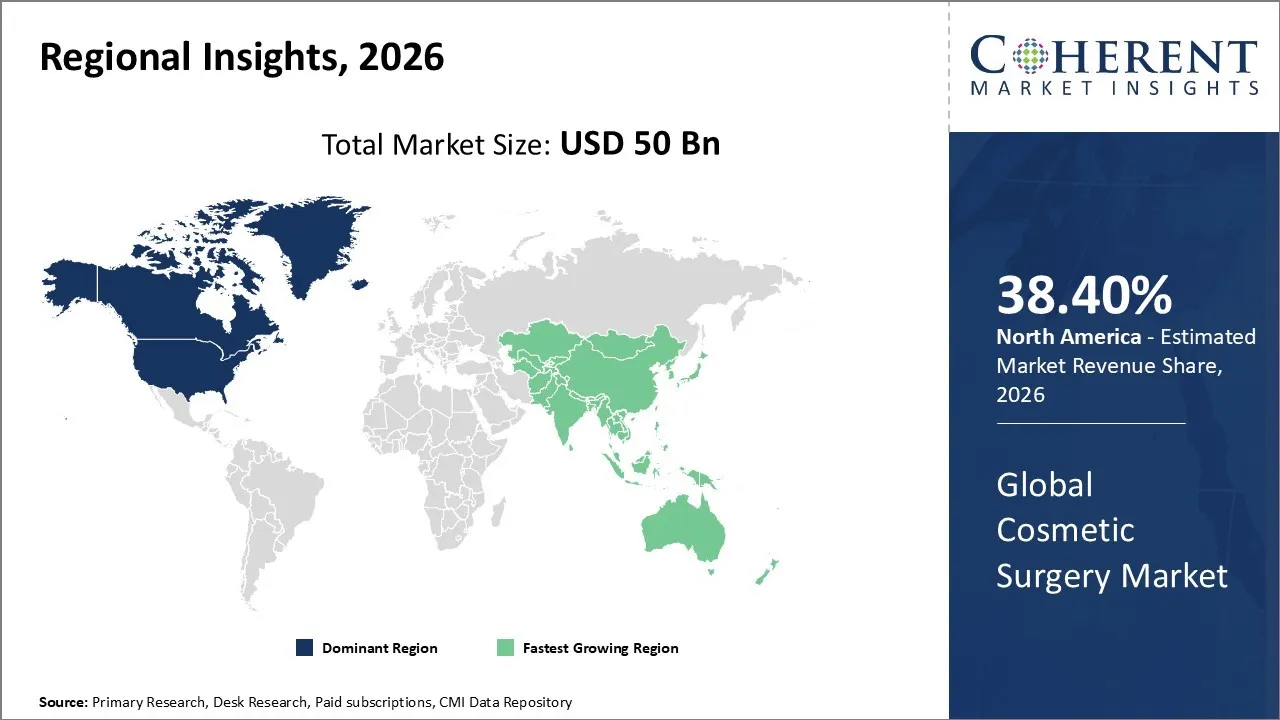
North America Cosmetic Surgery Market Analysis & Trends
North America has remained the dominant region with 38.40% in 2026 of the global Cosmetic Surgery Market over the past decade. The increasing societal acceptance and major influence of social media platforms alongside celebrity culture are normalizing the aesthetic enhancements. The presence of cutting-edge healthcare infrastructure combined with a higher number of skilled, recognized plastic surgeons and leading clinics is also helping the industry to witness growth. The increasing consumer disposable incomes and a strong focus on personal appearance help more users to afford these procedures.
The technological progress like minimally invasive surgery and 3D imaging, helps in making these procedures safer and appealing to a wider population. The US, in particular, leads the global industry in the total number of aesthetic procedures performed. These factors collectively ensure the region’s continued leadership in the dynamic industry
For instance, in January 2024, United Aesthetics Alliance announced a new collaboration with The Bengtson Center for Aesthetics & Plastic Surgery. The center is operated by Drs. Brad Bengtson and David Alfonso, both well-known board-certified plastic surgeons, and is recognized as the premier destination for plastic surgery and aesthetics in West Michigan.
Asia Pacific Cosmetic Surgery Market Analysis & Trends
The Asia Pacific region has emerged as the fastest growing market globally in recent years owing to the K-beauty influence and medical tourism. South Korea and Thailand are leading as hubs, providing both invasive surgeries and noninvasive treatments for a diverse demographic. They have led in increasing demand for specific procedures like double eyelid and jawline, attracting international patients for high-quality care. The younger population is seeking self-improvement while the aging populations are looking for rejuvenation treatments in Japan and other developed nations. The increasing disposable income has resulted in more people affording these aesthetic enhancements. The increasing focus on non-invasive treatments is generating high demand for botox, fillers, laser hair removal, and skin rejuvenation.
For example, in January 2025, Hugel Inc. obtained approval from the United Arab Emirates (UAE) to sell its botulinum toxin Botulax for both cosmetic and medical uses. This was a big step forward for the company's plans to expand around the world. The company intends to enhance its complete range of medical aesthetic products.
Cosmetic Surgery Market Outlook Country-Wise
The U.S. Cosmetic Surgery Market Trends
In 2026, the market in the U.S. is expected to be strong owing to rising body confidence trends, social media influence, and advancements in minimally invasive technologies like Botox and fillers. The aging population is looking for youth preserving treatment, which helps in increasing the demand. The industry benefits from established medical infrastructure, skilled practitioners, and high disposable incomes. The Millennials and Gen Z are emerging as key demographics that are adopting preventative treatments.
For instance, in January 2023, Apyx Medical Corporation introduced its Apyx One Console, the newest Renuvion generator, now available in the US. The Apyx One Console is a multi-purpose generator that has a cutting-edge 3-in-1 energy system. This lets plastic and cosmetic surgeons use Renuvion technology, as well as full monopolar and bipolar energy.
China Cosmetic Surgery Market Trends
In 2026, the market in China is booming due to increasing disposable incomes, the influence of social media, and evolving beauty standards. Younger women particularly those under 30 are driving the demand for cosmetic procedures like eyelid surgery, rhinoplasty, fillers, and laser treatments. Influences from K-Pop and Western beauty ideals often shape the popularity of these procedures.
For instance, in April 2025, Galderma introduced Sculptra in China, establishing the company as one of the fastest growing beauty product markets. Sculptra is recognized as the first proven regenerative biostimulator. This product will provide patients in China seeking innovative solutions for mid-facial volume loss and contour issues.
Market Report Scope
Cosmetic Surgery Market Report Coverage
| Report Coverage | Details | ||
|---|---|---|---|
| Base Year: | 2025 | Market Size in 2026: | USD 50 Bn |
| Historical Data for: | 2020 To 2024 | Forecast Period: | 2026 To 2033 |
| Forecast Period 2026 to 2033 CAGR: | 9.2% | 2033 Value Projection: | USD 92.5 Bn |
| Geographies covered: |
| ||
| Segments covered: |
| ||
| Companies covered: | Allergan plc. (AbbVie) , Alma Lasers Ltd., Anika Therapeutics Inc., Cutera Inc., Cynosure Inc., Johnson & Johnson, Foton D.O.O., Abbott Laboratories, Merz Aesthetics, and Mentor Worldwide LLC. | ||
| Growth Drivers: |
| ||
| Restraints & Challenges: |
| ||
Cosmetic Surgery Market Drivers
Rising beauty consciousness fueled by social media
Social media has fundamentally transformed how people perceive beauty and themselves. Platforms like Instagram, TikTok, Snapchat are continually exposing users to filtered, perfected images, thus creating new beauty standards that feel both aspirational and attainable. This digital environment has normalized cosmetic procedures, with influencers openly sharing their enhancement journeys and making once-taboo treatments seem more acceptable. The selfie culture is also propelling this demand as people want to look good for their online presence.
Younger demographics, particularly millennials and Gen Z, view cosmetic procedures as smart investments in personal branding rather than just vanity. This shift in thinking has significantly expanded the market’s consumer base. The social media platform has become a key marketing channel for clinics and practitioners, showcasing before and after transformation that get tons of engagement. The easy access to information alongside peer validation through likes and comments, creates cycle that continually fuels beauty consciousness and, thereby, market growth.
Cosmetic Surgery Market Opportunities
Preference for minimally invasive procedures
The industry is experiencing a major shift as consumers now prefer minimally invasive and non-surgical treatments compared to traditional procedures. Options like Botox, dermal fillers, laser treatments, and chemical peels are becoming popular due to their convenience and lower risk profiles. These procedures require little to no downtime and allow people to get back to daily activities right away. This growing preference is opening up market opportunities for practitioners and clinics. The treatments are more affordable than surgical option. It also makes cosmetic enhancements accessible to a wider audience. The younger consumers in their twenties and thirties are now entering the market earlier while looking for preventative treatments rather than corrective surgery. The lower financial and psychological barriers are normalizing these procedures as routine self-care investments.
Analyst Opinion (Expert Opinion)
- The cosmetic surgery market reflects sustained expansion supported by high procedure volumes, increasing treatment accessibility, and evolving consumer preferences. Global procedural statistics indicate that more than 35 million cosmetic procedures are performed annually, with non-surgical treatments accounting for the majority of total interventions. Injectable procedures such as botulinum toxin and dermal fillers together represent well over half of all cosmetic treatments worldwide, highlighting strong demand for minimally invasive options with shorter recovery periods and repeat usage potential.
- Surgical procedures continue to show stable demand, particularly facial surgeries such as eyelid correction, rhinoplasty, and facial contouring, which have gained prominence over traditional body-focused surgeries in several regions. This shift is reinforced by demographic data showing strong participation from individuals aged 30–54, a group increasingly focused on aesthetic maintenance rather than corrective surgery alone. Female patients account for a significant proportion of procedures globally, though male participation is steadily rising, particularly in facial and hair-related treatments.
- Regionally, North America remains a leading market due to high procedural density, advanced clinical infrastructure, and a large base of board-certified surgeons. Europe demonstrates strong adoption of non-surgical aesthetics, while Asia Pacific stands out for high procedure volumes driven by urban populations, medical tourism, and cultural acceptance of cosmetic enhancements. Overall, the market is characterized by data-backed procedural growth, technological refinement, and widening demographic adoption, supporting its long-term structural strength.
Speak to the analyst
Want personalized insights?
Take the findings above to one of our principal consultants, or have the report rebuilt around the segments, geographies and competitors you actually track.
Cosmetic Surgery Industry News
- In April 2025, Trina Eliassen’s Azurite Medical and Wellness unveiled a new medical tourism offering. The service pairs budget friendly cosmetic procedures with premium recovery care in Thailand. This approach changes how patients view international surgical options.
- In August 2025, ELIXIR MD, Inc. established a subsidiary in Australia and New Zealand. The medical technology company also partnered with High Tech Medical Pty Ltd. Together, they will introduce the ELIXIR MD™ device to the region’s facial surgery market.
- In January 2025, Altera Aesthetix introduced its franchise program. The Georgia based medical aesthetics practice currently operates four locations. The franchise model enables businesses owners to expand Altera’s brand nationwide. Services include injectable treatments, skin rejuvenation, facials, and other cosmetic procedures. The practice has grown by maintaining high standards and diverse service offerings.
- In September 2024, Allergan Aesthetics made BOTOX® Cosmetic available in China for masseter muscle prominence treatment. The masseter muscle affects jaw shape during chewing. When prominent, it creates a wider, square lower face appearance. Chinese regulators recently approved the product for improving masseter muscle prominence in adults. BOTOX® Cosmetic is China’s first approved f neurotoxin for this condition. Allergan Aesthetics plans to pursue similar approvals in other markets.
Market Segmentation
- Surgery Type Insights (Revenue, USD Bn, 2026 - 2033)
- Liposuction
- Facial Reconstruction
- Eyelid and Nose Surgery
- Body Contouring
- Cosmetic Implants
- Others
- End User Insights (Revenue, USD Bn, 2026 - 2033)
- Hospitals
- Ambulatory Surgery Centers
- Skin Clinics
- Others
- Regional Insights (Revenue, USD Bn, 2026 - 2033)
- North America
- U.S.
- Canada
- Latin America
- Brazil
- Argentina
- Mexico
- Rest of Latin America
- Europe
- Germany
- U.K.
- France
- Italy
- Russia
- Rest of Europe
- Asia Pacific
- China
- India
- Japan
- Australia
- South Korea
- ASEAN
- Rest of Asia Pacific
- Middle East & Africa
- GCC Countries
- South Africa
- Rest of Middle East & Africa
- Key Players Insights
- Allergan plc. (AbbVie)
- Alma Lasers Ltd.
- Anika Therapeutics Inc.
- Cutera Inc.
- Cynosure Inc.
- Johnson & Johnson
- Foton D.O.O.
- Abbott Laboratories
- Merz Aesthetics
- Mentor Worldwide LLC.
Sources
Primary Research Interviews
- Cosmetic & Plastic Surgeons
- Aesthetic Dermatologists
- Hospital & Specialty Aesthetic Clinic Administrators
- Medical Aesthetic Device Manufacturers
- Injectable & Implant Product Suppliers
- Distributors and Channel Partners
- Others
Databases
- Bloomberg Terminal
- Thomson Reuters Eikon
- S&P Global Market Intelligence
- IQVIA
- GlobalData Healthcare
- Others
Magazines
- Aesthetic Surgery Journal Magazine
- Plastic Surgery News
- Dermatology Times
- Medical Aesthetics Magazine
- Healthcare Business Today
- Others
Journals
- Aesthetic Surgery Journal
- Plastic and Reconstructive Surgery
- Journal of Cosmetic Dermatology
- Journal of Plastic, Reconstructive & Aesthetic Surgery
- Dermatologic Surgery
- Others
Newspapers
- The Wall Street Journal
- Financial Times
- The New York Times
- Reuters
- Bloomberg News
- Others
Associations
- International Society of Aesthetic Plastic Surgery (ISAPS)
- American Society of Plastic Surgeons (ASPS)
- American Academy of Dermatology (AAD)
- British Association of Aesthetic Plastic Surgeons (BAAPS)
- European Association of Plastic Surgeons (EURAPS)
- Others
Public Domain Sources
- World Health Organization (WHO)
- U.S. Food and Drug Administration (FDA) – Medical Devices & Aesthetics
- National Institutes of Health (NIH)
- Centers for Disease Control and Prevention (CDC)
- World Bank Open Data
- Others
Proprietary Elements
- CMI Data Analytics Tool
- Proprietary CMI Existing Repository of Information for the Last 8 Years
*Definition: The Cosmetic Surgery Market encompasses elective medical procedures performed to alter, restore, or enhance physical appearance and aesthetic appeal. This market includes both surgical interventions and non-surgical treatments. Patients access these services through plastic surgeons, dermatologists, and certified practitioners. The industry serves individuals looking for personal, professional, or reconstructive purposes following injury or illness.
Get access to 250+ pages report
Every segment, forecast, competitor profile and data table behind the analysis above — available for instant download.
- ESOMAR Member
- ISO 9001:2015 Certified
- D-U-N-S Registered
- GDPR & CCPA Compliant
Missing comfort of reading report in your local language? Find your preferred language:
Transform your Strategy with Exclusive Trending Reports
Frequently Asked Questions
The Cosmetic Surgery Market is estimated to be valued at USD 50 Bn in 2026, and is expected to reach USD 92.5 Bn by 2033.
The CAGR of the Cosmetic Surgery Market is projected to be 9.2% from 2026 to 2033.
The rising disposable incomes and the advancements in technology are the major factors driving the growth of the Cosmetic Surgery Market.
The high procedure costs, safety concerns, and the complex and stringent regulatory environment are the major factors hampering the growth of the Cosmetic Surgery Market.
In terms of surgery type, the cosmetic implants is estimated to dominate the market revenue share in 2026.
Allergan plc. (AbbVie) , Alma Lasers Ltd., Anika Therapeutics Inc., Cutera Inc., Cynosure Inc., Johnson & Johnson, Foton D.O.O., Abbott Laboratories, Merz Aesthetics, and Mentor Worldwide LLC. are the major players.
North America is expected to lead the Cosmetic Surgery Market in 2026