

Global Doughnuts Market Size and Forecast – 2026 To 2033
The Global Doughnuts Market is estimated to be valued at USD 12.28 Bn in 2026 and is expected to reach USD 16.37 Bn by 2033, growing at a compound annual growth rate (CAGR) of 4.20% from 2026 to 2033. Growth is supported by wider bakery and foodservice availability, evolving snack products on occasions, premium flavor innovation, and consumer interest in fresh and artisanal doughnuts.
Expansion into high-footfall retail, entertainment, and convenience locations is also creating additional points of consumption beyond conventional bakery shops. In July 2026, Randy’s Donuts opened a new location at Commerce Casino in California, illustrating how specialist doughnut brands are extending their physical presence into diversified consumer venues and broadening accessibility.
Key Takeaways of the Global Doughnuts Market
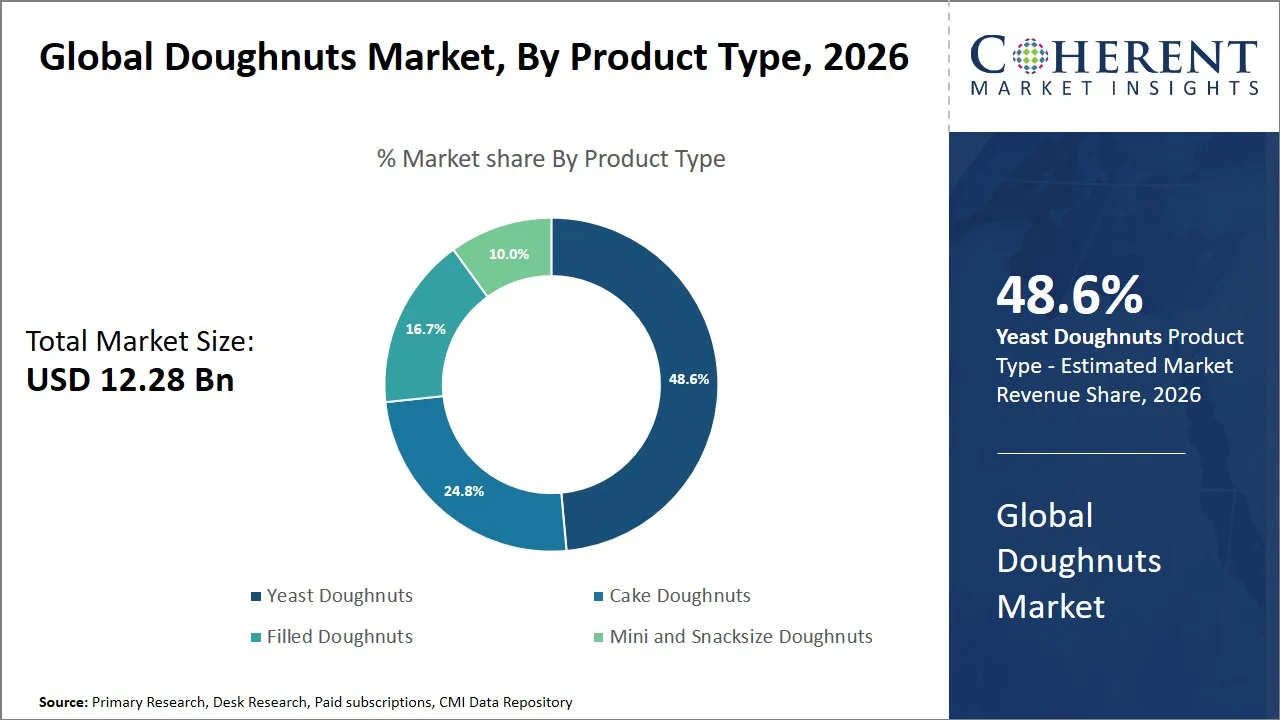
- Yeast Doughnuts are estimated to expand at a 4.4% CAGR during 2026–2033 while accounting for 48.6% of the global doughnuts market in 2026. Their scalable proofing process, soft texture, and compatibility with glazing, filling, and high-volume foodservice programs support broad menu use and efficient unit economics. In March 2024, McDonald’s announced a U.S. rollout of three fresh Krispy Kreme doughnuts, led by Original Glazed.
- Classic and Glazed flavors are projected to register a 4.0% CAGR through 2033 and hold 42.6% of the global doughnuts market in 2026. The segment benefits from familiar taste profiles, low customization complexity, strong coffee pairing, and dependable repeat purchase across breakfast and snack occasions. In March 2026, Tim Hortons reported that Chocolate Glazed remained Canada’s most popular classic Timbits flavor and that 2025 set a record for Timbits sales.
- Artisanal and Fresh products are expected to grow at a 4.6% CAGR during 2026–2033 and capture 57.8% of the global doughnuts market in 2026. Freshly prepared formats command attention through sensory quality, premium presentation, seasonal rotation, and bakery-cafe immediacy, allowing operators to defend pricing without relying solely on pack size. In March 2026, Paris Baguette’s U.S. Spring menu featured a limited-time Croissant Donut with Nutella.
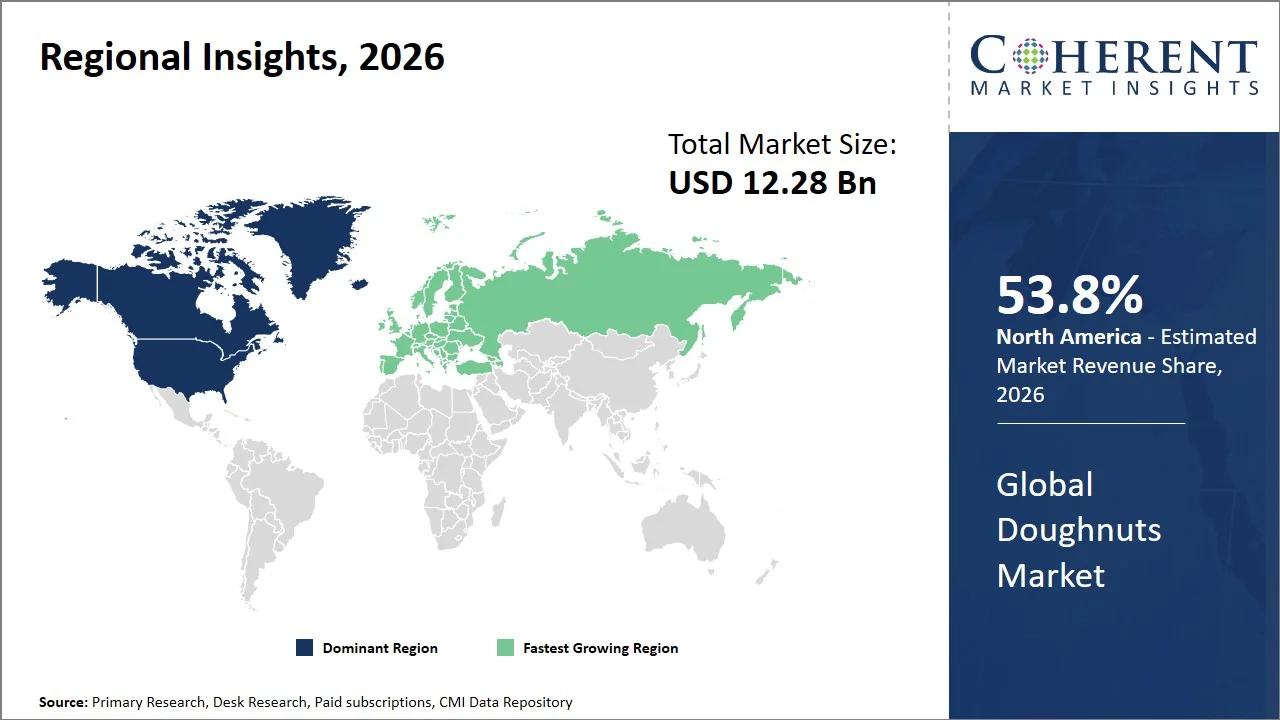
- North America is estimated to advance at a 3.8% CAGR through 2033 while representing 53.8% of the global doughnuts market in 2026. Dense coffee-and-doughnut networks, habitual breakfast purchasing, franchise-led accessibility, and strong promotional frequency sustain the region’s unusually deep consumption base. In May 2026, Dunkin’ said it serves more than 2 Bn donuts and MUNCHKINS annually and continued its nationwide National Donut Day offer.
- Europe, projected to grow at a 5.1% CAGR during 2026–2033, is expected to hold 19.6% of the global doughnuts market in 2026 and remain the fastest-growing region. Expansion potential comes from lower chain penetration than North America, established bakery-café culture, urban footfall, and room for branded fresh-doughnut concepts to localize assortments. In August 2024, Krispy Kreme announced Spain entry with plans for more than 500 fresh points of access.
Segmental Insights
Why Do Yeast Doughnuts Dominate the Global Doughnuts Market?
Yeast Doughnuts are expected to account for 48.6% of the global doughnuts market in 2026, reflecting their strong fit with both high-volume production and fresh bakery merchandising. Fermentation creates the light, aerated structure consumers associate with mainstream ring doughnuts, while the same dough platform can be adapted into rings, twists, fritters, long johns, and filled formats. For producers, standardized yeast-raised mixes improve dough tolerance, machinability, yield control, and consistency across shifts, making the format practical for wholesale bakeries, foodservice suppliers, and multi-unit chains. The segment also supports efficient flavor extension because coatings and fillings can be changed without rebuilding the base recipe. In September 2025, BakeMark showcased its Westco 2880 Yeast Raised Donut Mix & Base at IBIE 2025, positioning extended freshness, lower labor requirements, and waste reduction as key bakery benefits.
- Current Industry Events of 2026
- Market Size Estimation
- Regional Breakdown
- Competitive Landscape
- Customer Intelligence
- Segmental Analysis
- Pricing Analysis
- Key Market Drivers, Challenges & Future Trends
- Customized Insights Section
Why Do Classic and Glazed Represent the Largest Flavor Segment in the Global Doughnuts Market?
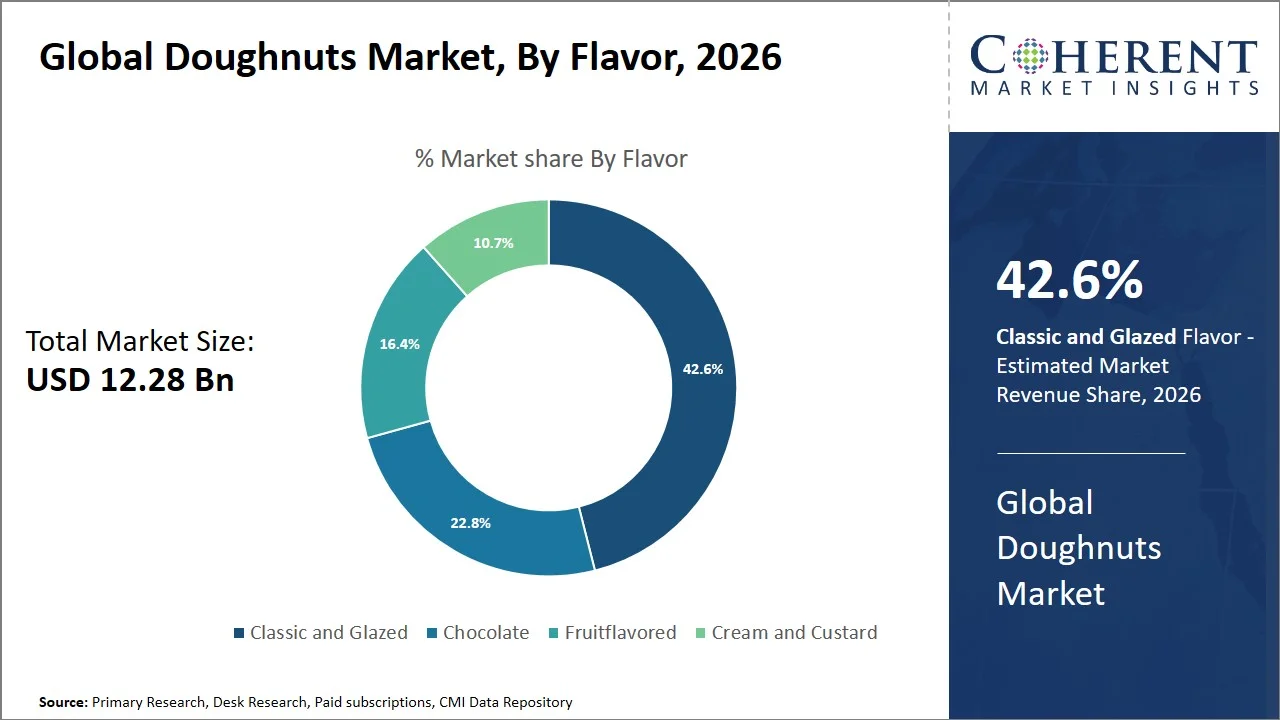
Classic and Glazed flavors are expected to represent 42.6% of the global doughnuts market in 2026, supported by their broad consumer appeal, operational simplicity, and strong fit across breakfast, snacking, and foodservice occasions. Their familiar taste profile makes them suitable for everyday purchases, while the basic dough-and-glaze format allows producers to maintain consistent quality, control ingredient costs, and achieve efficient production at scale. Retailers and bakery chains can also use classic and glazed doughnuts as dependable traffic-driving products, pairing them with coffee, meal deals, seasonal promotions, and assorted bakery boxes. In May 2025, Krispy Kreme expanded its partnership with McDonald’s across the U.S., making its Original Glazed doughnuts available at participating restaurants and reinforcing the continued importance of familiar glazed products in high-volume foodservice distribution.
Why Do Artisanal and Fresh Doughnuts Dominate the Product Category of the Global Doughnuts Market?
Artisanal and Fresh doughnuts are expected to hold 57.8% of the global doughnuts market in 2026 because immediate consumption allows producers to compete on texture, craftsmanship, visual finish, and product rotation rather than shelf-life engineering alone. Fresh production supports brioche-style doughs, hand finishing, premium fillings, seasonal ingredients, and small-batch launches that can command higher perceived value at specialist shops, cafés, travel locations, and catering occasions. The model also gives operators direct feedback on flavor performance and enables faster assortment changes than packaged retail programs. Commercially, this favors businesses able to combine skilled preparation with disciplined daily batch planning so freshness does not translate into excessive waste. In August 2024, Blue Star Donuts returned to Portland International Airport’s new terminal area, extending its locally rooted premium doughnut proposition into a high-footfall travel environment and widening access beyond neighborhood bakery traffic.
Current Events and their Impact
Current Event | Description and Its Impact |
U.S. FDA Revokes Authorization for FD&C Red No. 3 – January 2025 |
|
EU Packaging and Packaging Waste Regulation Enters into Force – February 2025 |
|
UK Less-Healthy Food Advertising Restrictions Take Effect – January 2026 |
|
Global Doughnuts Market Dynamic
Key Market Drivers
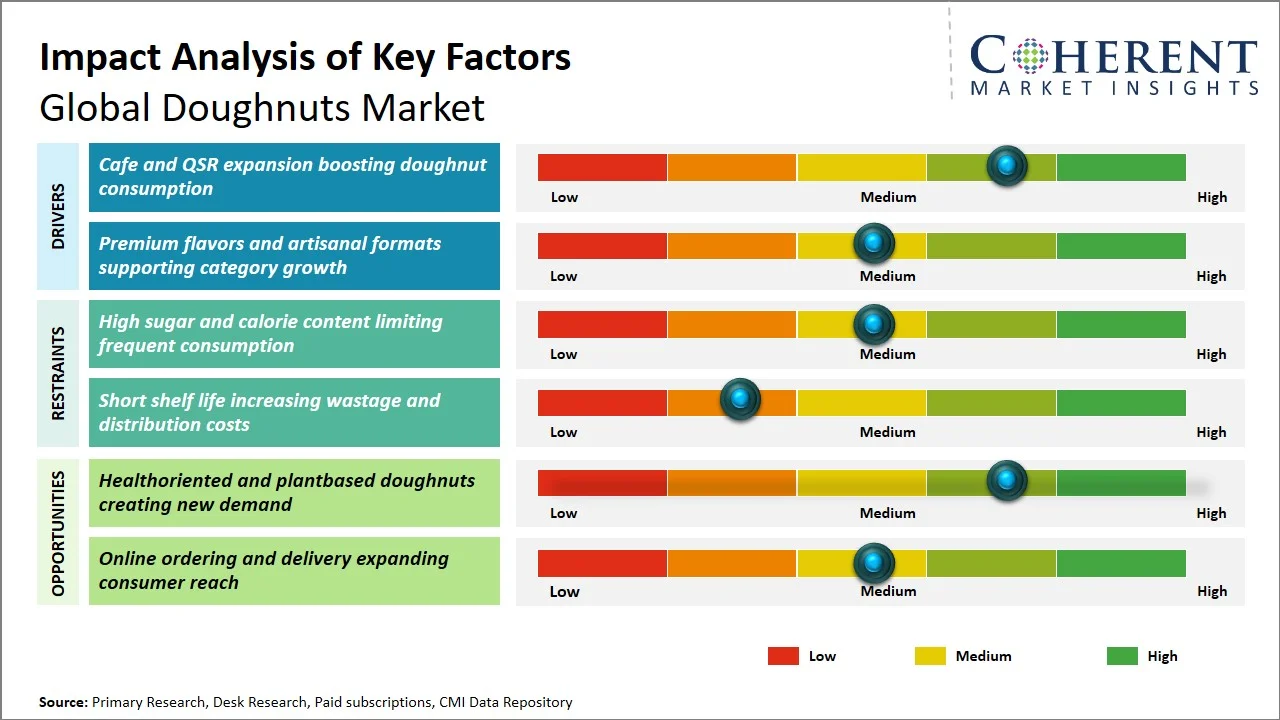
Cafe and QSR Expansion Boosting Doughnut Consumption
Cafe and QSR expansion is widening the number of everyday purchase points where doughnuts can compete for breakfast, coffee-break, and impulse-snacking occasions. Compact formats in transport and commuter locations are particularly valuable because they add sales access without requiring a full bakery footprint, benefiting food-to-go operators, ingredient suppliers, and distribution partners. The commercial effect is higher product visibility and more opportunities for beverage-led basket building. In June 2026, Greggs opened its fourth Bitesize shop at London Bridge Station, extending a smaller-format model designed for high-footfall, space-constrained locations.
Premium Flavors and Artisanal Formats Supporting Category Growth
Premium flavors and artisanal formats are shifting doughnuts from a routine bakery item toward a higher-value treat that can support better ticket economics. Filled centers, layered toppings, dessert-inspired recipes, and visually distinctive finishes give specialist bakeries and in-store bakery operators more room to differentiate without changing the core production platform. This encourages flavor rotation and premium box merchandising while protecting the category from purely price-based competition. In March 2025, Rich Products highlighted seasonal flavors, variety packs, and visually engaging presentations as commercial opportunities within fresh bakery doughnuts.
Emerging Market Trends
Ingredient Transparency Is Reshaping Doughnut Formulation
Ingredient transparency is becoming a stronger product-development consideration as consumers scrutinize colors, flavors, sweeteners, oils, and allergen declarations more closely. Doughnut producers are therefore likely to place greater value on formulations that preserve indulgent taste and visual appeal while using simpler, more recognizable ingredient systems. This can change supplier selection, decoration choices, and reformulation cycles across fresh and packaged products. Ingredient manufacturers with bakery-specific clean-label solutions should benefit, while producers dependent on highly artificial visual cues may face higher reformulation costs and greater inconsistency during recipe transitions.
Freshness Economics Are Shifting Toward Waste-Aware Production
Fresh doughnut economics are pushing operators toward tighter control of daily production and unsold inventory. Instead of maximizing display abundance throughout the day, more operators are likely to use smaller replenishment batches, narrower late-day assortments, markdown pathways, and planned redistribution of surplus. This trend changes how freshness is measured commercially: the objective becomes high sell-through with acceptable choice rather than permanently full displays. Vertically integrated chains and disciplined bakery operators should gain margin resilience, while businesses with inflexible batch sizes may experience greater waste exposure as ingredient and labor costs rise.
Regional Insights
Why Does North America Dominate the Global Doughnuts Market?
North America is expected to account for 53.8% of the global doughnuts market in 2026, supported by deeply established breakfast and snack consumption, dense convenience-store and bakery access, and frequent pairing of doughnuts with coffee. The region also benefits from mature franchising systems, centralized dough production, digital ordering, and broad availability across foodservice and retail channels. Promotional pricing and limited-time flavors keep the category relevant beyond traditional morning occasions, while strong brand familiarity sustains repeat purchases. Convenience retail is particularly important because it places doughnuts directly in commuter and impulse-purchase traffic. In May 2025, 7-Eleven announced a 50-cent glazed doughnut offer for National Donut Day across participating 7-Eleven, Speedway, and Stripes stores, illustrating how large convenience networks reinforce everyday category accessibility.
Why Is Europe Emerging as the Fastest-Growing Region in the Global Doughnuts Market?
Europe is expected to hold 19.6% of the global doughnuts market in 2026 and emerge as the fastest-growing region as doughnuts gain space within bakery cafés, supermarket bakeries, food-to-go outlets, and travel retail. Growth is supported by consumers seeking affordable indulgence, premium fillings, seasonal flavors, and smaller sweet snacks that complement established coffee and bakery habits. Retailers are also using in-store bakeries to increase product visibility and encourage spontaneous purchases alongside everyday grocery trips. This creates a broader distribution base than specialist doughnut stores alone and supports experimentation with premium toppings and limited-time recipes. In May 2025, Lidl Great Britain highlighted Chocolate Hazelnut Doughnuts within a bakery range of more than 40 daily products while promoting its bakery offer nationally, demonstrating greater mainstream retail exposure for doughnut-led bakery formats.
Global Doughnuts Market Outlook for Key Countries
Why Is the U.S. a Key Market for the Global Doughnuts Market?
The U.S. remains a key country in the global doughnuts market because doughnuts are embedded in breakfast, workplace, convenience, gifting, and coffee occasions, giving the category unusually broad daypart relevance. A large franchise ecosystem supports rapid menu replication, while independent shops sustain premium, made-to-order, and regional flavor innovation. Digital loyalty programs and online ordering further increase purchase frequency by enabling customized boxes, office orders, and promotional bundles. Product development is also moving beyond standard rings toward bite-sized formats and dipping concepts that can support sharing and incremental add-on sales. In July 2025, Duck Donuts introduced Donut Hole Dippers as an everyday menu item for the first time, alongside customizable value deals, showing how U.S. operators are creating new formats around portion flexibility, customization, and snackability rather than relying only on conventional full-size doughnuts.
Why Does China Support Growth in the Global Doughnuts Market?
China supports growth in the global doughnuts market through the evolution of urban bakery culture, premium café consumption, visually led dessert discovery, and consumer interest in internationally influenced sweet baked goods. The strongest opportunity is concentrated in major cities where younger consumers respond to novel textures, rotating flavors, social-media-friendly presentation, and hybrid bakery concepts. Doughnuts can also compete as an affordable premium treat when localized with pistachio, fruit, cream, matcha, or less-sweet profiles. Shanghai illustrates this shift particularly well. In October 2025, Shanghai’s official tourism platform highlighted contemporary doughnut offerings from businesses including TonTon, Sloppy Gin, and Apoli Itabakery, with products ranging from pistachio to birthday-cake styles. The development indicates increasing commercial space for differentiated artisanal doughnuts within China’s metropolitan bakery and dessert ecosystem.
Why Is Japan Important in the Global Doughnuts Market?
Japan is important to the global doughnuts market because the category operates within a sophisticated bakery and confectionery culture where texture, seasonality, gifting, and limited-edition products materially influence purchasing. Consumers are accustomed to frequent flavor rotation, carefully portioned sweets, and products combining Western formats with Japanese ingredients and sensory preferences. This makes the country especially attractive for mochi-like textures, matcha, sweet potato, chestnut, chocolate, and restrained-sweetness formulations. Established retail networks also provide visibility through stations, malls, neighborhood locations, and digital ordering. In July 2025, Mister Donut announced six limited-time “New Home Cut” doughnuts for its 55th anniversary, refreshing an original product with improved texture and updated flavor combinations. The launch demonstrates how Japanese operators can renew mature doughnut formats through craftsmanship, nostalgia, and continuous product reinterpretation.
Why Is India an Important Market in the Global Doughnuts Market?
India is becoming increasingly relevant to the global doughnuts market as urban consumers expand spending on café desserts, food delivery, celebration boxes, and branded quick-service snacks. Demand is concentrated in metropolitan areas where younger consumers are familiar with chocolate, hazelnut, filled, and customized doughnuts, while eggless formulations widen the addressable consumer base. The category also benefits from mall-based foodservice, corporate catering, digital ordering, and gifting occasions that support multi-unit boxes rather than only individual purchases. Domestic operators are adapting products to local preferences and price points while extending physical availability beyond a few premium districts. As of September 2026, Mad Over Donuts’ official store locator lists outlets across Mumbai, Bengaluru, Chennai, Delhi, Hyderabad, Kolkata, Pune, Ahmedabad, Noida, Gurugram, and other cities, illustrating the widening metropolitan distribution base for specialist doughnut retail.
Why Is Australia an Important Growth Market for the Global Doughnuts Market?
Australia is an important growth market for the global doughnuts market because the country combines a strong café culture with high acceptance of fresh bakery snacks, takeaway coffee, shopping-center foodservice, and convenience-led indulgence. Consumers respond well to hot fresh doughnuts, familiar cinnamon formats, and limited-edition collaborations that create reasons for repeat visits. The market also supports premiumization through branded chocolate, biscuit, and nut-based toppings without requiring major changes to the underlying product platform. Franchise networks provide broad consumer access, while seasonal promotions help operators generate traffic outside conventional breakfast periods. In March 2026, Donut King launched a limited-edition KitKat collaboration featuring a soft doughnut with KitKat chocolate crunch, available through early May. The promotion demonstrates how Australian operators use recognizable confectionery partnerships to refresh established doughnut formats and stimulate incremental purchases.
Consumption Occasion & Demand Landscape
Consumption Occasion | Demand Intensity | Preferred Product Format | Commercial Significance |
Breakfast & Morning Coffee | High | Classic glazed, yeast doughnuts, single-serve formats | Supports recurring weekday purchases and beverage bundling across cafés, QSRs, convenience stores, and bakery chains. |
Mid-Day & Impulse Snacking | High | Mini doughnuts, filled varieties, bite-sized assortments | Expands consumption beyond breakfast and supports checkout, food-to-go, and convenience-led purchases. |
Office & Workplace Sharing | Medium-High | Assorted boxes, dozen packs, mixed-flavor selections | Creates higher-value multi-unit transactions and supports corporate catering, meetings, employee treats, and group ordering. |
Celebrations & Gifting | Medium | Premium decorated, customized, filled, and themed doughnuts | Enables premium pricing through personalized presentation, seasonal designs, gifting boxes, and occasion-specific assortments. |
Travel & On-the-Go Consumption | Medium | Portable glazed, mini, packaged, and filled doughnuts | Supports distribution through airports, railway stations, fuel stations, convenience stores, and other high-footfall locations. |
Late-Day Dessert & Indulgence | Medium | Chocolate, cream-filled, specialty, and artisanal doughnuts | Positions doughnuts as an alternative to cakes, pastries, and desserts while widening sales opportunities beyond traditional morning consumption. |
How Are Free-From and Allergen-Managed Doughnuts Creating New Growth Opportunities in the Global Doughnuts Market?
Free-from and allergen-managed doughnuts represent an underdeveloped opportunity because many mainstream assortments still rely on wheat, milk, eggs, or shared production environments. The opportunity is strongest among specialist bakeries, supermarket private labels, frozen bakery suppliers, schools, family-oriented foodservice, and digital gifting platforms seeking more inclusive assortments. Commercial capture will require recipe reformulation, validated allergen controls, segregated handling, reliable ingredient sourcing, and packaging that communicates suitability clearly without compromising indulgent positioning. Frozen or centralized production can help improve consistency and widen distribution where dedicated in-store preparation is impractical. Specialists may initially hold an advantage because they can build credibility around dietary assurance, but established chains can scale faster once they create defensible operating protocols. Companies should avoid treating free-from doughnuts as simple ingredient substitutions; texture, frying behavior, shelf life, cross-contact management, and sensory quality must be solved together. Success will depend on making dietary inclusion commercially scalable, not merely technically feasible.
Market Players, Key Development, and Competitive Intelligence
Key Developments
- In February 2026, Planet Doughnut made its doughnuts available at Principality Stadium during Six Nations games. The development expands specialist doughnuts into high-footfall event foodservice, demonstrating how producers can diversify beyond bakery counters and e-commerce by supplying portable, branded products to entertainment and sporting venues.
- In March 2025, Shipley Do-Nuts announced a 30-store development agreement covering New Mexico and Miami-Dade, Florida. The expansion is important for the global doughnuts market because multi-unit franchising increases physical category access while strengthening procurement scale, brand visibility, and recurring demand for standardized doughnut inputs.
- In September 2024, J Sainsbury plc began transitioning in-store bakery doughnuts from plastic clamshells to card boxes with small windows. The change is commercially important because doughnut packaging increasingly needs to balance product visibility, grease management, handling protection, recyclability, and retailer sustainability specifications without weakening consumer presentation.
Competitive Landscape
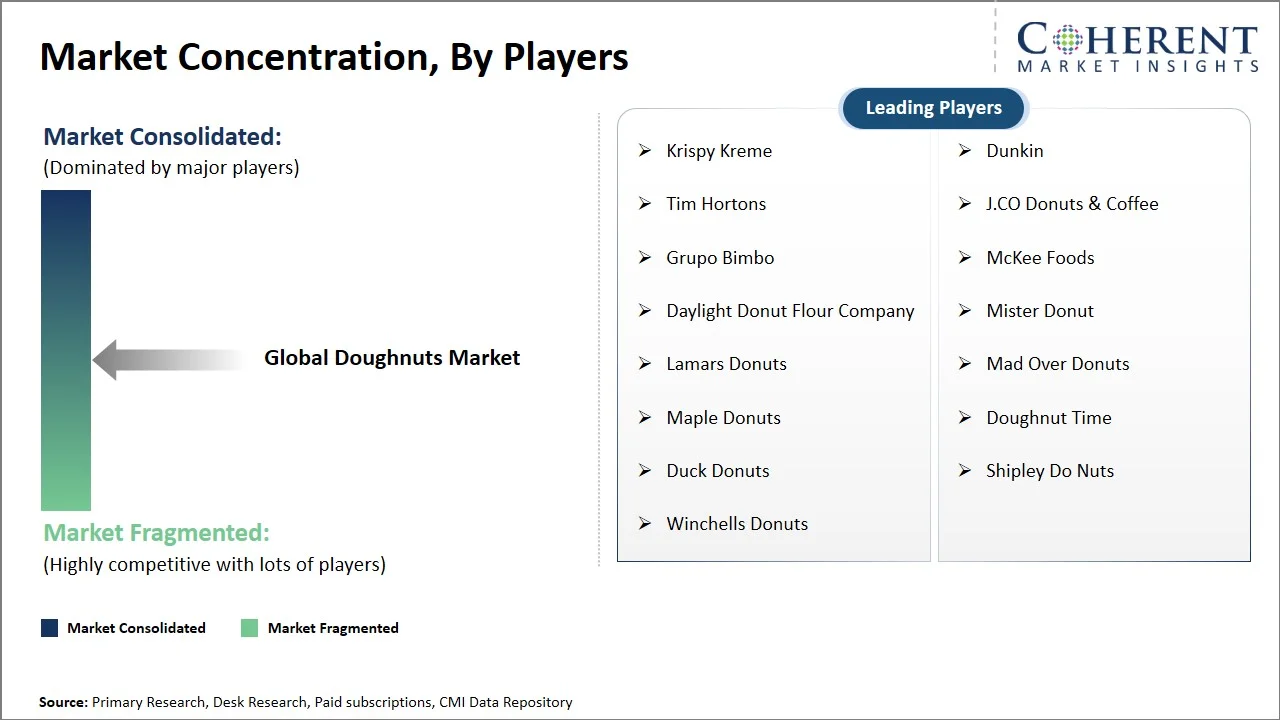
The global doughnuts market remains fragmented, combining multinational bakery and coffee chains with regional specialists, supermarket private labels, industrial bakers, and thousands of independent shops. Competition centers on freshness, convenient access, value architecture, product consistency, and execution reliability. Regional players remain influential because local taste preferences matter, while larger operators gain leverage from standardized processes, procurement scale, franchise systems, digital ordering infrastructure, and broader distribution.
Key focus areas include:
- Production consistency across outlets: Standardized dough preparation, frying, filling, and finishing become increasingly important as chains expand geographically.
- Store and format economics: Compact shops, kiosks, transport locations, drive-through formats, and concession models can improve access while reducing capital intensity.
- Ingredient procurement resilience: reliable flour, fats, oils, cocoa, dairy ingredients, fillings, and coatings are critical for protecting margins and maintaining consistent recipes.
- Frozen and packaged capabilities: Suppliers with strong shelf-life management can reach supermarkets, convenience retailers, institutional buyers, and geographically dispersed foodservice customers.
- Private-label manufacturing: Industrial bakers can compete for retailer programs through scalable production, specification compliance, packaging flexibility, and dependable service levels.
- Food-safety and allergen assurance: Traceability, cross-contact controls, labeling discipline, and quality management increasingly influence retailer and institutional procurement decisions.
- Localization without operational complexity: Successful operators must adapt assortments to local tastes while limiting ingredient proliferation, training burden, and excessive SKU complexity.
Market Report Scope
Doughnuts Market Report Coverage
| Report Coverage | Details | ||
|---|---|---|---|
| Base Year: | 2025 | Market Size in 2026: | USD 12.28 Bn |
| Historical Data for: | 2020 To 2024 | Forecast Period: | 2026 To 2033 |
| Forecast Period 2026 to 2033 CAGR: | 4.20% | 2033 Value Projection: | USD 16.37 Bn |
| Geographies covered: |
| ||
| Segments covered: |
| ||
| Companies covered: | Krispy Kreme, Dunkin, Tim Hortons, J.CO Donuts & Coffee, Grupo Bimbo, McKee Foods, Daylight Donut Flour Company, Mister Donut, Lamars Donuts, Mad Over Donuts, Maple Donuts, Doughnut Time, Duck Donuts, Shipley Do Nuts, Winchells Donuts | ||
| Growth Drivers: |
| ||
| Restraints & Challenges: |
| ||
Analyst Opinion (Expert Opinion)
- The global doughnuts market leadership should increasingly be judged by profitability per production platform rather than assortment breadth alone. Operators that standardize core dough systems, ingredients, training, and store execution while creating differentiated consumer propositions around them should achieve stronger economics. Excessive menu complexity can weaken throughput and purchasing efficiency, making disciplined portfolio architecture a more defensible advantage than simply offering the largest number of doughnut varieties.
- The market risks developing a strategic squeeze in the undifferentiated middle. Value-focused operators can defend traffic through scale and simplified execution, while premium specialists can justify higher tickets through craftsmanship and distinctive positioning. Conventional operators that are neither cost-efficient nor clearly differentiated may face pressure from both directions. This polarization could make brand clarity, operating discipline, and deliberate price architecture essential to maintaining viable margins.
- Doughnut companies should invest in repeatable unit economics, supplier resilience, quality control, and market-specific assortment discipline before accelerating geographic expansion. New stores cannot compensate indefinitely for weak productivity or excessive complexity. Management teams should monitor ingredient exposure, labor intensity, catchment quality, and franchise execution closely, while developing supplier partnerships that support specification consistency. Overinvestment in low-frequency novelty products or marginal locations should be avoided where operational burden exceeds sustainable revenue potential.
Speak to the analyst
Want personalized insights?
Take the findings above to one of our principal consultants, or have the report rebuilt around the segments, geographies and competitors you actually track.
Market Segmentation
- Product Type Insights (Revenue, USD Bn, 2021 - 2033)
- Yeast Doughnuts
- Cake Doughnuts
- Filled Doughnuts
- Mini and Snack size Doughnuts
- Flavor Insights (Revenue, USD Bn, 2021 - 2033)
- Classic and Glazed
- Chocolate
- Fruit flavored
- Cream and Custard
- Specialty and Exotic
- Product Category Insights (Revenue, USD Bn, 2021 - 2033)
- Artisanal and Fresh
- Packaged
- Frozen
- Distribution Channel Insights (Revenue, USD Bn, 2021 - 2033)
- Foodservice Channels
- Bakery Shops
- Supermarkets and Hypermarkets
- Convenience Stores
- Online Retail
- Regional Insights (Revenue, USD Bn, 2021 - 2033)
- North America
- U.S.
- Canada
- Latin America
- Brazil
- Argentina
- Mexico
- Rest of Latin America
- Europe
- Germany
- U.K.
- Spain
- France
- Italy
- Russia
- Rest of Europe
- Asia Pacific
- China
- India
- Japan
- Australia
- South Korea
- ASEAN
- Rest of Asia Pacific
- Middle East
- GCC Countries
- Israel
- Rest of Middle East
- Africa
- South Africa
- North Africa
- Central Africa
- North America
Sources
Primary Research Interviews
- Doughnut manufacturers, bakery chains, QSR operators, foodservice companies, distributors, retailers, and e-commerce sellers
- Bakery technologists, product developers, chefs, ingredient specialists, franchise operators, and food industry experts
Stakeholders
- Doughnut and bakery-product manufacturers
- Flour, sugar, fats and oils, fillings, flavors, toppings, yeast, and packaging suppliers
- Bakery shops, cafés, QSRs, supermarkets, convenience stores, distributors, and online delivery platforms
End-use Sectors
- Foodservice and QSR
- Bakery and café retail
- Supermarkets and convenience retail
- Online food delivery and catering
Regulatory and Industry Bodies
- U.S. Food and Drug Administration
- European Commission
- Food Standards Agency, U.K.
- Food Standards Australia New Zealand
- National food-safety and labeling authorities
Databases
- UN Comtrade and ITC Trade Map
- Government import-export and customs databases
- Company annual reports, investor presentations, and product portfolios
- Foodservice, bakery, retail, and consumer-food industry databases
Magazines and Journals
- Baking & Snack
- Bake Magazine
- Food Business News
- Journal of Food Science
- International Journal of Gastronomy and Food Science
Associations
- American Bakers Association
- International Dairy Deli Bakery Association
- Retail Bakers of America
- Federation of Bakers
- National Restaurant Association
Public Domain Sources
- Bakery and foodservice industry publications
- Doughnut product launches and menu innovation announcements
- Food-safety and labeling guidelines
- Bakery ingredient, packaging, retail, and consumer-trend publications
Key Standards and Regulations
- Food safety and hygiene requirements
- Ingredient and allergen labeling regulations
- Food additive and coloring regulations
- Packaging and food-contact material standards
- Quality-management and bakery manufacturing standards
Proprietary Elements
- CMI Data Analytics Tool
- Proprietary CMI Existing Repository of information for the last 10 years
Get access to 250+ pages report
Every segment, forecast, competitor profile and data table behind the analysis above — available for instant download.
- ESOMAR Member
- ISO 9001:2015 Certified
- D-U-N-S Registered
- GDPR & CCPA Compliant
Missing comfort of reading report in your local language? Find your preferred language:
Frequently Asked Questions
The CAGR of global doughnuts market is projected to be 4.20% from 2026 to 2033.
The global doughnuts market is estimated to be valued at USD 12.28 Bn in 2026 and is expected to reach USD 16.37 Bn by 2033.
Premiumization, artisanal preparation, innovative flavors, customized toppings, digital ordering, and greater focus on fresh and convenient snacking formats are key trends shaping the global doughnuts market.
The global doughnuts market is fragmented, with international chains, regional bakery brands, specialty doughnut operators, foodservice companies, and independent bakeries competing on product quality, pricing, flavor innovation, store accessibility, and brand positioning.
Major opportunities include expansion of specialty doughnut chains, premium and customized offerings, online ordering and delivery, convenience-focused retail formats, free-from products, and entry into underpenetrated urban markets.
Companies are expanding franchise networks, introducing limited-edition flavors, developing premium and artisanal products, strengthening digital ordering capabilities, entering new geographic markets, and forming foodservice and retail distribution partnerships.
Cafe and QSR expansion boosting doughnut consumption and premium flavors and artisanal formats supporting category growth are the major factors driving the growth of global doughnuts market.