

Global Drone Taxi Market Size and Forecast – 2026 To 2033
The global drone taxi market is expected to grow from USD 1,020 Mn in 2026 to USD 1,485 Mn by 2033, registering a compound annual growth rate (CAGR) of 11.7% from 2026 to 2033. The global drone taxi market is driven by expansion of urban air mobility programs. On June 15, 2025, Eve Air Mobility signed a binding agreement with Revo and Omni Helicopters International. The agreement covers up to 50 eVTOL aircraft and associated services for urban air mobility operations.
Key Takeaways of the Global Drone Taxi Market
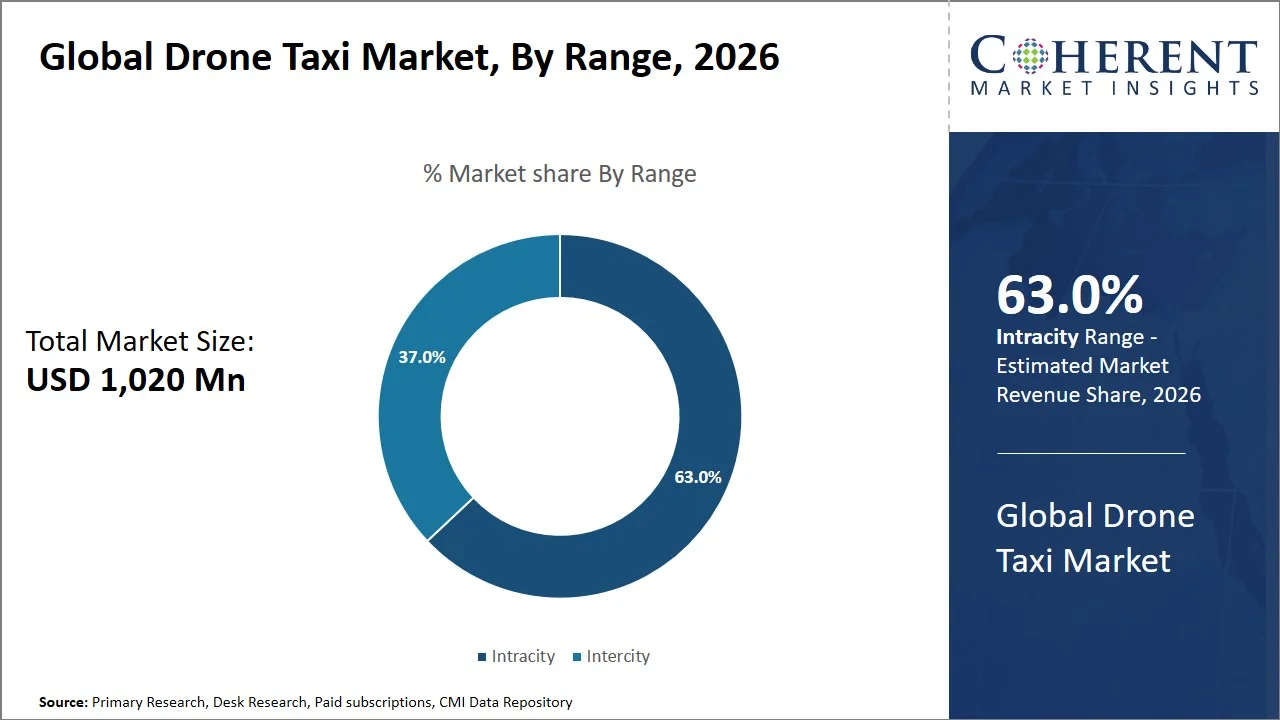
- The Intracity segment is expected to account for 63.0 % of the global drone taxi market share in 2026. Government support for advanced air mobility is driving the growth of the segment. On March 9, 2026, the U.S. Department of Transportation selected eight projects under its eVTOL Integration Pilot Program.
- The Fully Electric segment is estimated to capture 42.0 % of the market share in 2026. Increasing technological improvements in electric propulsion systems is majorly driving the growth of the segment. On November 17, 2025, Archer Aviation agreed to supply its proprietary electric powertrain to Anduril Industries and EDGE Group. The powertrain currently operates on Archer's Midnight aircraft and is being adapted for Anduril's Omen aircraft.
- The Remotely Piloted segment is estimated to capture 46.0 % of the market share in 2026. Development of dedicated vertiport infrastructure is driving the growth of the segment. In November 2025, Skyports Infrastructure announced important development milestone for Dubai’s DXV vertiport. The plant was 60% complete and on track to be completed and operational in the first quarter of 2026.
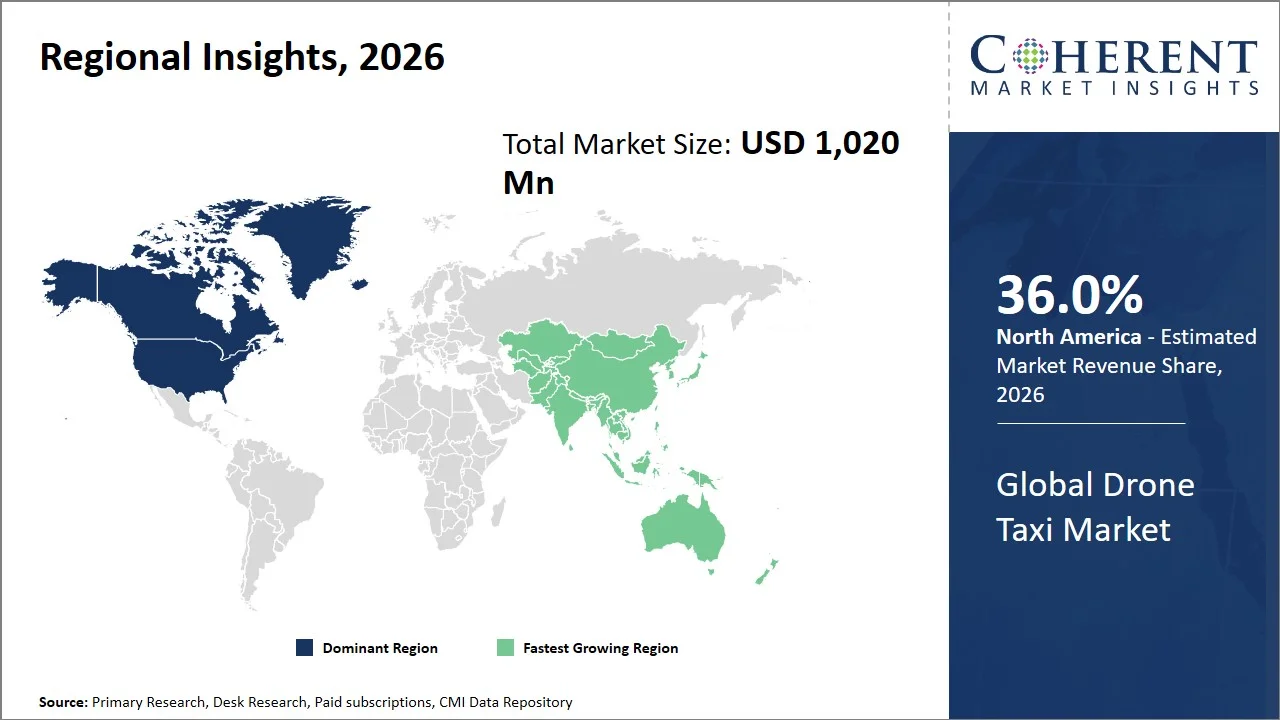
- North America is expected to dominate the drone taxi market in 2026 with a market share of 36.0 %. Increasing integration with public transportation systems in North America is driving the growth of the regional market. On September 10, 2025, Joby Aviation announced plans to integrate Blade flights into the Uber application. Blade already connected Manhattan with major New York airports, including Newark and John F Kennedy.
- Asia Pacific is expected to account for 31.0 % share in 2026. Growing developments in fleet management and charging services in Asia Pacific is driving the growth of the regional market. On December 28, 2025, EHang introduced the VT35 long-range passenger eVTOL. The aircraft integrates conventional vertiports, charging platforms and EHang’s command-and-control system.
Segmental Insights
Why Does Intracity Dominate the Global Drone Taxi Market?
The intracity segment is expected to account for 63.0% of the global drone taxi market share in 2026. Intracity operations indicate less distance to travel and easier flight planning within established urban corridors. The traffic congestion is often heavy. This creates a great demand for quicker point-to-point transit throughout huge metropolitan regions. Shorter itineraries also require less battery capacity, which makes practical electric aircraft operations possible and enables faster charging cycles. Vertiports can be located in proximity to airports, business centers, hospitals and important transportation hubs. These factors make urban passenger routes easier to commercialize during the early deployment phase. On April 27, 2026, Joby Aviation, Inc. announced the completion of the first-ever point-to-point electric vertical takeoff and landing (eVTOL) air taxi demonstration flights in New York City’s history, marking the start of a week-long public campaign across the city’s existing heliport network.
- Current Industry Events of 2026
- Market Size Estimation
- Regional Breakdown
- Competitive Landscape
- Customer Intelligence
- Segmental Analysis
- Pricing Analysis
- Key Market Drivers, Challenges & Future Trends
- Customized Insights Section
Why is Fully Electric the Most Preferred Propulsion Type?
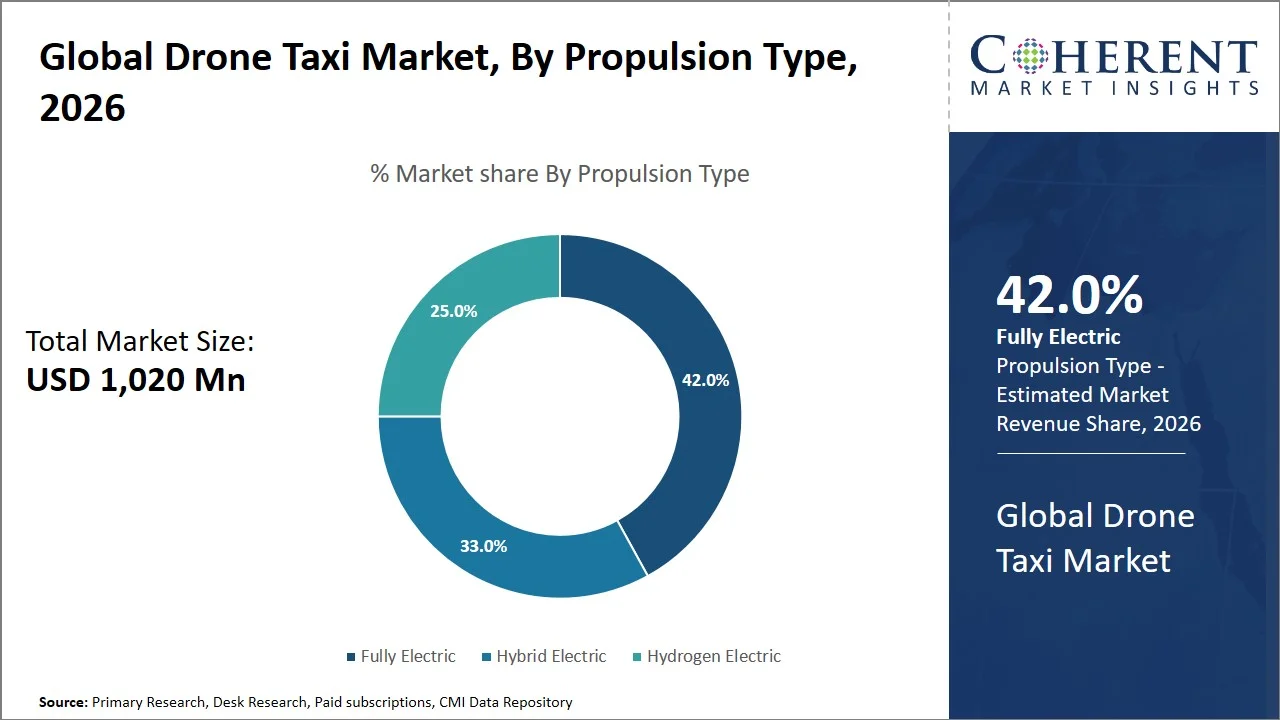
The fully electric segment is expected to account for 42.0% of the global drone taxi market share in 2026. Fully electric propulsion cuts local emissions and is appropriate for passenger operations in dense urban situations. Battery-electric systems also have fewer moving parts than traditional combustion-based propulsion systems. This could help enable simplified maintenance needs and potentially reduce the operational complexity for commercial fleets. Electric propulsion also corresponds with urban environmental policies and airport decarbonization efforts. These advantages are more suited to emerging drone taxi operations in cities. On May 27, 2026, Eve Air Mobility performed 59 flights during its hover and low-speed testing phase. The campaign generated detailed data covering propulsion, energy management, aerodynamics, and aircraft loads.
Remotely Piloted Dominates the Global Drone Taxi Market
The remotely piloted segment is expected to account for 46.0% of the global drone taxi market share in 2026. Remotely piloted vehicles can help early commercial operations while autonomous flight systems are being extensively certified. Human operators can monitor aircraft performance and intervene if unforeseen weather, technical problems or conflicts in the airspace occur. This technique may give authorities better operational oversight during first passenger services. Remote piloting also helps organizations get operational experience before rolling out higher levels of autonomy. These characteristics can speed up deployment, while keeping stronger safety oversight during the early development of the market. SkyDrive made demonstration flights at Expo 2025 Osaka in July 2025. The unmanned aircraft was operated through remote control and stabilized using automatic flight controls. The aircraft reached four meters and flew for approximately three minutes.
Current Events and their Impact
Current Events | Description and its Impact |
U S - Federal Aviation Administration Powered Lift Final Rule |
|
European Union - Drone And U Space Regulatory Framework |
|
Drone Taxi Market Dynamics
Market Drivers
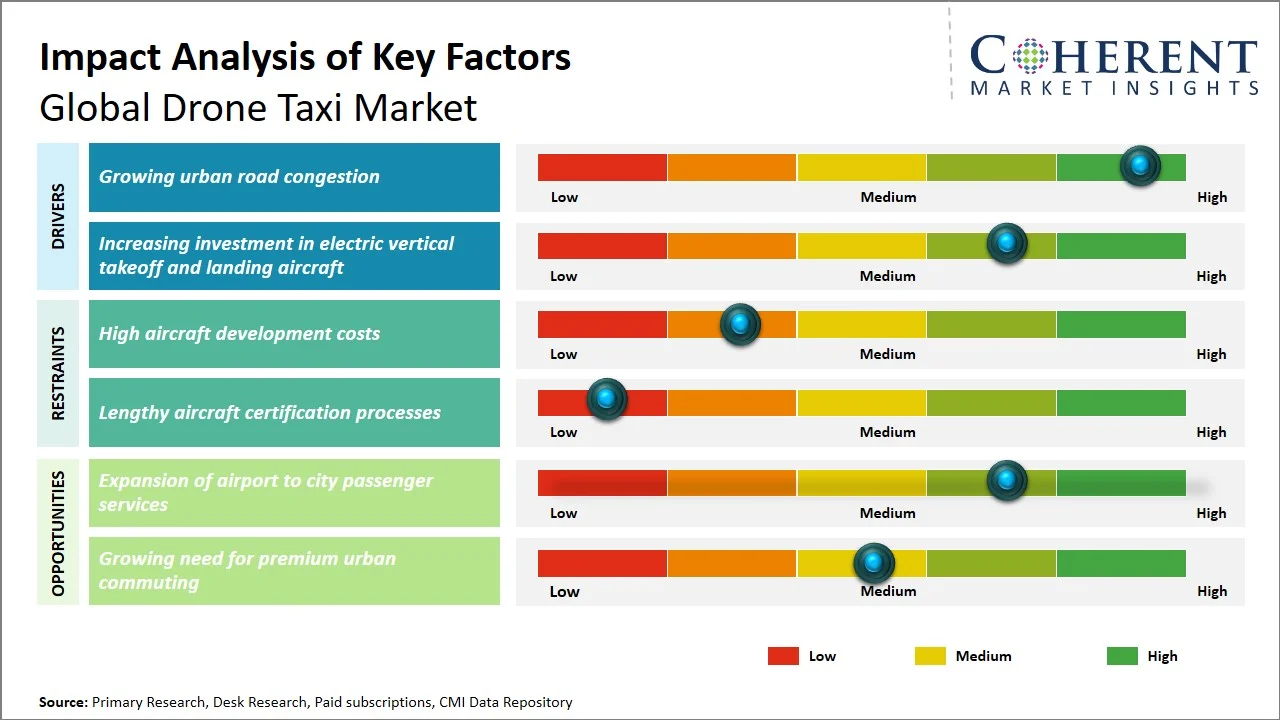
- Growing urban road congestion: The rapid pace of urbanization has led to increased traffic congestion in the main metropolitan centers. Longer road trips are driving demand for faster point-to-point transit options. Drone taxis might fly over the crowded arteries of modern transportation networks. Airport links and business district linkages could especially benefit from shorter travel times. This transit benefit can boost adoption in highly populated places. In December 2025, Archer Aviation revealed plans to establish a South Florida air-taxi network. The network will connect Miami, Fort Lauderdale, Boca Raton and West Palm Beach. Selected journeys are expected to take about 10-20 minutes. The proposed routes will be targeting metropolitan regions with considerable automobile traffic.
- Increasing Investment in Electric Vertical Takeoff and Landing Aircraft: The investment in electric vertical takeoff and landing aircraft is increasing technology development and commercialization activities. The industry is increasing expenditures on aircraft certification, production facilities, battery systems and flight testing. Commercialization activities are also being supported by strategic alliances with airlines and transportation businesses. Investment is rising to enhance aircraft capabilities and grow the ecosystem that will support future passenger operations. These developments are laying the groundwork for large-scale deployment of drone taxis. On September 4, 2025, GE Aerospace and BETA Technologies Inc. announced a new strategic partnership and equity investment agreement, subject to regulatory approval, to accelerate the development of hybrid electric aviation by combining BETA’s rapid innovation approach with GE Aerospace’s global scale and experience.
Emerging Trends
- Expansion of Commercial Air Taxi Networks: Operators are progressing from demonstration flights toward structured commercial routes connecting airports, business districts, tourist destinations, and residential areas within major metropolitan regions.
- Greater Integration with Autonomous Flight Technologies: Manufacturers are developing automated flight controls, obstacle detection, navigation systems and the ability to remotely supervise flights to reduce pilot workload and provide future autonomous vehicle transportation services.
- Development of Dedicated Vertiport Infrastructure: Airports, transport companies and infrastructure developers are developing vertiports with charging systems, passenger facilities, maintenance areas and digital traffic management capabilities for scalable urban operations.
- Growing Partnerships Across Mobility Ecosystems: Drone taxi manufacturers are partnering more and more with airlines, automakers, technology companies, infrastructure developers, and local governments to accelerate the certification, manufacturing, operations, and commercialization of passenger services.
Regional Insights
Why is North America a Strong Market for Drone Taxi?
North America is expected to account for a market share of 36.0% in 2026. North America is moving ahead with aircraft certification, launch alliances and existing aerospace capabilities. Joby Aviation, Archer Aviation and Beta Technologies are on the list, according to the Federal Aviation Administration. These firms are aiming to begin service in 2026-2027. Joby Aviation is developing commercial operations, while Archer Aviation is preparing its Midnight aircraft for urban transportation. Archer describes Midnight as a piloted, all-electric aircraft designed for repeated flights across congested cities. Certification progress is therefore becoming the key growth catalyst. The region also benefits from established aviation infrastructure, experienced aerospace suppliers, and strong investor participation.
Why Does Asia Pacific Drone Taxi Market Exhibit High Growth?
Asia Pacific is expected to register the fastest growth with a CAGR of 12.2% over the forecast period. It is projected to account for 31.0% of the global drone taxi market in 2026. Asia Pacific is progressing through government-backed low-altitude aviation programs and early passenger operations. China, Japan, and other countries are building dedicated advanced air mobility ecosystems. China has already pushed a number of pilotless passenger aircraft closer to commercial operations. Japan offered the public a glimpse of electric air mobility, showing SkyDrive aircraft at Expo 2025 in Osaka. Vertiports, charging stations, flying corridors and remote-control systems are also being developed in the area. The strong technology manufacture ability further supports the airplane production. These developments are creating distinct commercialization pathways across major Asian cities.
Global Drone Taxi Market Outlook for Key Countries
Why is U.S. Emerging as a Major Hub in the Drone Taxi Market?
The U.S drone taxi market is being driven primarily by Federal Aviation Administration certification progress and airline partnerships. Joby Aviation, Archer Aviation, and Beta Technologies aim to begin service in 2026-2027. Archer Aviation is designing Midnight for frequent daily operations and small urban passenger trips. The Federal Aviation Administration is creating operational rules for powered-lift aircraft, providing a more transparent certification process. Joby Aviation is likewise making headway with significant transportation partners toward commercial operations. What makes this special is the combination of modern aircraft certification with existing airline and aviation infrastructure.
Is China the Next Growth Engine for the Drone Taxi Market?
China has established one of the strongest regulatory foundations for pilotless passenger eVTOL operations. EHang received the world's first type certificate for an unmanned eVTOL aircraft from the Civil Aviation Administration of China. Its EH216-S subsequently received production and standard airworthiness certificates. In 2025, operators received the first batch of Air Operator Certificates for pilotless passenger services. EHang also reported continued cooperation with the Civil Aviation Administration of China during 2026. China's distinctive growth factor is its rapid transition from aircraft certification toward actual pilotless passenger operations.
Japan Drone Taxi Market Analysis and Trends
Japan is developing drone taxi services around major events, railway integration, and regional tourism. SkyDrive conducted public SKYDRIVE demonstrations at Expo 2025 Osaka. One demonstration reached 27 meters and covered 720 meters during a 5-minute flight. SkyDrive is targeting commercial eVTOL operations in Osaka from as early as 2028. The company is also working with Osaka Metro on urban mobility services. Collaboration with JR Kyushu could support future tourism routes around Beppu and Yufuin. Japan's distinctive growth factor is integrating eVTOL services with established rail and tourism networks.
UAE Drone Taxi Market Analysis and Trends
UAE is developing drone taxi services, tapping on Dubai’s collaborative governance and infrastructure model. Joby Aviation has been chosen by Dubai’s Roads and Transport Authority for planned aerial taxi operations. The initial network includes stations near Dubai International Airport, Downtown Dubai, Palm Jumeirah, and Dubai Marina. The Roads and Transport Authority is targeting commercial air taxi services during 2026. Skyports Infrastructure is building the station infrastructure while Joby Aviation is handling the aircraft operations and passenger services. Dubai's integrated strategy with vertiports, regulation, tourism, and public transport is the unique growth force.
India Drone Taxi Market Analysis and Trends
India's drone taxi opportunity is closely connected with severe metropolitan congestion and emerging advanced air mobility partnerships. Archer Aviation and InterGlobe are to establish electric air taxi operations in India. The proposed services are meant to link large urban centers, cutting travel times across busy cities. India’s enormous pool of IT workers might lend a hand with software, autonomous systems and aviation operations. Major airports also provide possible integration points for future vertiport networks. The country’s growth engine is a combination of high urban transport demand and fast development of digital mobility infrastructure. This might pave the way for premium airport connectivity ahead of wider passenger routes.
Airport-to-City Travel Time Comparison by Major City, 2025 - 2026
Major City | Airport-to-City Route | Conventional Ground Travel Time | eVTOL Travel Time |
Dubai
| DXB to Downtown Dubai | 28.5-32 minutes | 9.3 minutes |
DXB to Palm Jumeirah | 45-60 minutes | 12.9 minutes | |
DXB to Dubai Marina | 47.5-60 minutes | 15 minutes | |
DXB to Al Maktoum International Airport | 60-75 minutes | 19.2 minutes | |
New York | JFK to Manhattan | 60-90+ minutes | 7-10 minutes |
Newark Airport to Manhattan | 60-120 minutes | 5-15 minutes | |
Miami | Miami International Airport to South Beach | 35 minutes | 6 minutes |
Los Angeles | Los Angeles International Airport to Santa Monica | 40 minutes | 8 minutes |
Osaka | Kansai International Airport to Osaka Expo area | 90 minutes | 8 minutes |
London | Heathrow Airport to Central London | 60-75 minutes | 12 minutes |
How is Expansion of Airport to City Passenger Services Creating New Growth Opportunities in the Drone Taxi Market?
Services from airports to cities are a real beachhead for drone taxis, as they focus on predictable, high-value travel corridors. One impressive example is Dubai, where Joby Aviation and the Roads and Transport Authority are creating connections linking Dubai International Airport with Palm Jumeirah, Downtown Dubai and Dubai Marina. The Dubai International Airport to Palm Jumeirah route is estimated to be around 10 minutes compared to about 45 minutes by automobile. The first Dubai vertiport is 3,100 square meters and include charging infrastructure, passenger spaces and two landing pads. It is designed to serve up to 170,000 passengers annually. This model creates opportunities for premium airport transfers, airline partnerships, integrated ticketing, and multimodal connections. Joby Aviation is also developing similar vertiport networks around U S airports, including Santa Monica Airport and John Wayne Airport.
On December 9, 2025, Archer Aviation announced that it has completed the first phase of its Hawthorne Airport transactions that includes the acquisition of the master lease from the City of Hawthorne and the associated subleases, giving it control of the real estate that makes up the airport. In early November, Archer signed a series of definitive agreements to acquire control of this one-of-a-kind Los Angeles aviation asset.
Market Players, Key Development, and Competitive Landscape
Key Developments
- On March 12, 2026, Surf Air Mobility Inc. and BETA Technologies announced an Aircraft Purchase Agreement and strategic partnership intended to accelerate the introduction of safe, reliable, and profitable advanced air mobility solutions. Under the terms of the Aircraft Purchase Agreement, Surf Air Mobility has signed a firm order for 25 all-electric ALIA CTOL aircraft and has the option to add up to 75 additional aircraft to its order.
- On October 15, 2025, EHang Holdings Limited announced the launch of an AAM Sandbox Initiative in Thailand, in collaboration with the Civil Aviation Authority of Thailand and local partners. The Initiative aims to fast-track the future commercial operations of EHang's EH216-S pilotless eVTOL aircraft in the country.
Competitive Landscape
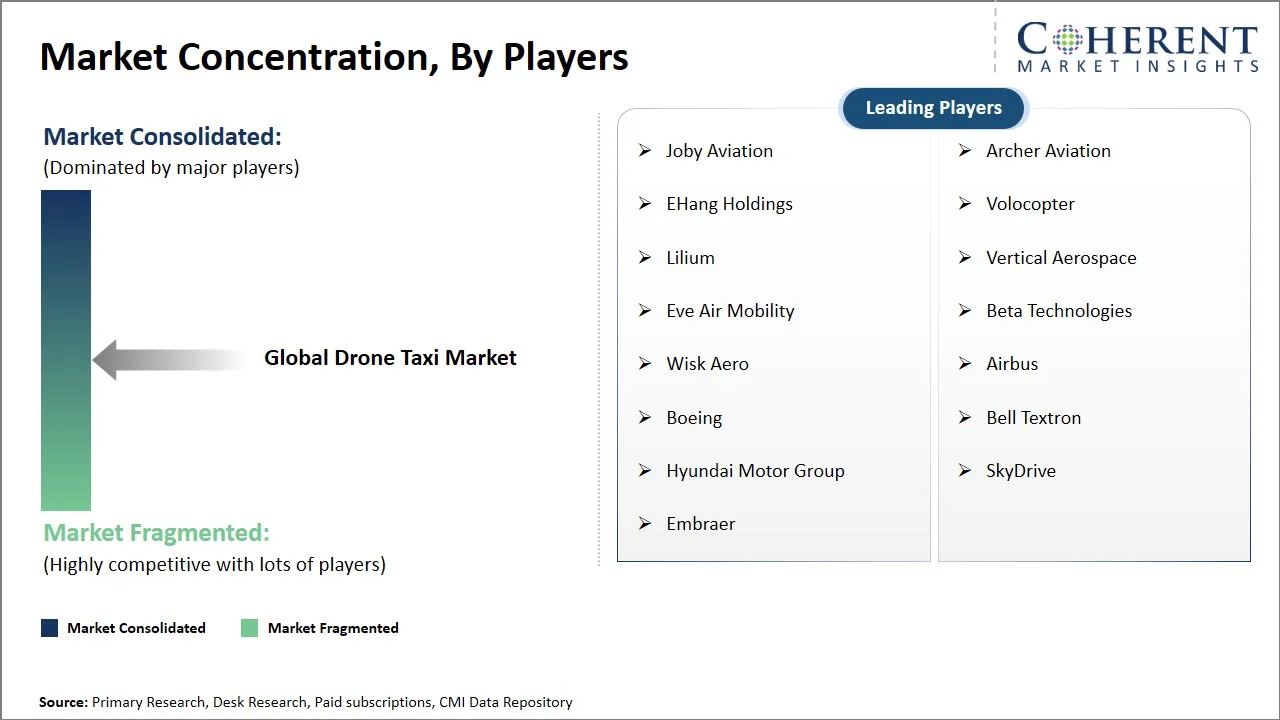
Joby Aviation, Archer Aviation, EHang and SkyDrive are leading the pack, each pursuing a different route to commercialization. Joby Aviation plans to operate comprehensive air taxi networks, not just sell airplanes. Its Dubai plan is a combination of aircraft, vertiports, government collaboration and airport connectivity. Joby is also increasing its work with airlines, ground transportation and infrastructure developers. Archer Aviation has been developing piloted urban air taxis and Midnight received its Federal Aviation Administration type certificate in January 2026. EHang is pushing toward autonomous passenger operation, with Chinese certification and Air Operator Certificates. SkyDrive is emphasizing compact aircraft suitable for rooftops and smaller vertiports. Its strategy includes partnerships with rail operators and regional mobility providers.
Market Report Scope
Drone Taxi Market Report Coverage
| Report Coverage | Details | ||
|---|---|---|---|
| Base Year: | 2025 | Market Size in 2026: | USD 1,020 Mn |
| Historical Data for: | 2020 To 2024 | Forecast Period: | 2026 To 2033 |
| Forecast Period 2026 to 2033 CAGR: | 11.7% | 2033 Value Projection: | USD 1,485 Mn |
| Geographies covered: |
| ||
| Segments covered: |
| ||
| Companies covered: | Joby Aviation, Archer Aviation, EHang Holdings, Volocopter, Lilium, Vertical Aerospace, Eve Air Mobility, Beta Technologies, Wisk Aero, Airbus, Boeing, Bell Textron, Hyundai Motor Group, SkyDrive, Embraer | ||
| Growth Drivers: |
| ||
| Restraints & Challenges: |
| ||
Analyst Opinion (Expert Opinion)
- The industry's future will shift from demonstration flights toward scheduled passenger networks and repeatable commercial routes. Airport transfers should become an important early application because they offer predictable demand and established passenger flows. Joby's Dubai network illustrates this approach through planned connections between airports, hotels, business districts, and tourism destinations. Autonomous passenger services will also gain importance as certification frameworks mature. EHang's commercial deployment of pilotless aircraft in China provides an early operational pathway for this model.
- The strongest opportunities should emerge in fully electric aircraft serving short urban and airport-to-city routes. The U.S., China, United Arab Emirates, Japan, and India should remain important commercialization markets. China offers an immediate opportunity for autonomous passenger operations because EHang already has certified aircraft and authorized operators. The United Arab Emirates offers another strong opportunity because Dubai is developing dedicated vertiports around major passenger destinations. India could become particularly attractive for airport transfers because major cities combine severe road congestion with large airport passenger flows.
- Players should acquire certification, infrastructure and operating relationships simultaneously, not treat aircraft development in isolation. Joby’s approach to Dubai highlights the advantages of the combination of aircraft deployment, vertiport building and government collaboration. Manufacturers should also prioritize aircraft usage, quick turn-around, charging capacity and dependable passenger scheduling. Collaborations with airlines, airports, ride-hailing platforms and transport agencies can boost customer access. Aircraft manufacturers should also establish a number of operating models such as direct operations, collaborations and aircraft sales. Joby has explicitly pursued these models while expanding into specialized markets.
Speak to the analyst
Want personalized insights?
Take the findings above to one of our principal consultants, or have the report rebuilt around the segments, geographies and competitors you actually track.
Market Segmentation
- Range Insights (Revenue, USD Million, 2021 - 2033)
- Intracity
- Intercity
- Propulsion Type Insights (Revenue, USD Million, 2021 - 2033)
- Fully Electric
- Hybrid Electric
- Hydrogen Electric
- Autonomy Type Insights (Revenue, USD Million, 2021 - 2033)
- Remotely Piloted
- Semi Autonomous
- Fully Autonomous
- Aircraft Type Insights (Revenue, USD Million, 2021 - 2033)
- Electric Vertical Takeoff and Landing Aircraft
- Passenger Drones
- Autonomous Air Taxis
- Passenger Capacity Insights (Revenue, USD Million, 2021 - 2033)
- Up to 2 Passengers
- 3-5 Passengers
- Above 5 Passengers
- System Type Insights (Revenue, USD Million, 2021 - 2033)
- Propulsion Systems
- Avionics
- Aircraft Structures
- Cabin Interiors
- Flight Control Systems
- Charging Systems
- Application Insights (Revenue, USD Million, 2021 - 2033)
- Urban Mobility
- Tourism and Sightseeing
- Emergency Services
- Corporate Transportation
- Medical Transportation
- End User Insights (Revenue, USD Million, 2021 - 2033)
- Ride Sharing Companies
- Scheduled Air Mobility Operators
- Hospitals
- Private Operators
- Government Agencies
- Regional Insights (Revenue, USD Million, 2021 - 2033)
- North America
- U.S.
- Canada
- Latin America
- Brazil
- Argentina
- Mexico
- Rest of Latin America
- Europe
- Germany
- U.K.
- Spain
- France
- Italy
- Russia
- Rest of Europe
- Asia Pacific
- China
- India
- Japan
- Australia
- South Korea
- ASEAN
- Rest of Asia Pacific
- Middle East
- GCC Countries
- Israel
- Rest of Middle East
- Africa
- South Africa
- North Africa
- Central Africa
- North America
- Key Players Insights
- Joby Aviation
- Archer Aviation
- EHang Holdings
- Volocopter
- Lilium
- Vertical Aerospace
- Eve Air Mobility
- Beta Technologies
- Wisk Aero
- Airbus
- Boeing
- Bell Textron
- Hyundai Motor Group
- SkyDrive
- Embraer
Sources
Primary Research Interviews
- Drone Taxi Manufacturers & OEMs
- Urban Air Mobility (UAM) Service Operators
- Aviation Regulatory Authorities & Policymakers
- Infrastructure & Vertiport Developers
Magazines
- Aviation Week & Space Technology
- Vertical Magazine (Urban Air Mobility Focus)
- Aerospace America
- Rotor & Wing International
Journals
- Journal of Air Transport Management
- Aerospace Science and Technology (Elsevier)
- Journal of Urban Mobility
Associations
- General Aviation Manufacturers Association (GAMA)
- Urban Air Mobility Association (UAMA)
- Aerospace Industries Association (AIA)
- European Business Aviation Association (EBAA)
Public Domain Sources
- NASA Urban Air Mobility (UAM) Grand Challenge Reports
- European Commission Aviation & Transport Policy Reports
- U.S. Department of Transportation (DOT) Publications
- World Economic Forum (WEF) Future of Aviation Reports
Proprietary Elements
- CMI Data Analytics Tool
- Proprietary CMI Existing Repository of Information for the Last 10 Years
Get access to 250+ pages report
Every segment, forecast, competitor profile and data table behind the analysis above — available for instant download.
- ESOMAR Member
- ISO 9001:2015 Certified
- D-U-N-S Registered
- GDPR & CCPA Compliant
Missing comfort of reading report in your local language? Find your preferred language:
Frequently Asked Questions
Airport transfers connect established passenger hubs with congested urban destinations while offering substantially shorter journey times.
Vertiports will provide passenger processing, charging, aircraft servicing, and dedicated takeoff and landing facilities.
Drone taxis can compete through faster airport transfers and reduced exposure to congested road networks.
Piloted operations are likely to expand first, while autonomous services develop alongside regulatory and technological advances.
Electric systems offer lower local emissions, reduced mechanical complexity, and quieter operation than conventional propulsion.
The global drone taxi market is expected to stand at USD 1,020 Mn in 2026 and is expected to reach USD 1,485 Mn by 2033.
The CAGR of the global drone taxi market is projected to be 11.7% from 2026 to 2033.