

Global ECG Telemetry Devices Market Size and Forecast – 2026 To 2033
The global ECG telemetry devices market is expected to grow from USD 5.84 Bn in 2026 to USD 9.49 Bn by 2033, registering a compound annual growth rate (CAGR) of 7.2% from 2026 to 2033. The market for global ECG telemetry devices is poised for significant expansion, fueled by the soaring global burden of cardiovascular diseases, which is increasing the need for continuous and timely cardiac monitoring.
The World Health Organization (WHO), reported that cardiovascular diseases caused an estimated 19.8 million deaths globally in 2022, accounting for approximately 32% of all deaths worldwide. The substantial cardiovascular disease burden is increasing the need for continuous cardiac monitoring and early detection, supporting demand for ECG telemetry devices.
Key Takeaways of the Global ECG Telemetry Devices Market
- Holter monitors are projected to hold 32.8% of the global ECG telemetry devices market share in 2026, making it dominant product type segment, across North America due to its established regulatory pathway for ambulatory ECG devices. The U.S. FDA classifies ambulatory Holter ECG systems as Class II medical devices under 21 CFR 870.2800, with multiple Holter systems currently listed in its device database.
- Arrhythmia monitoring is projected to hold 56.7% of the global ECG telemetry devices market share in 2026, making it dominant application segment, across North America due to the established use of telemetry for continuous rhythm surveillance. The U.S. FDA classifies outpatient cardiac telemetry devices under 21 CFR §870.1025 as Class II devices specifically intended to continuously record and analyze ECGs for automatic detection and transmission of cardiac events to clinicians.
- Hospitals and clinics are projected to hold 45.8% of the global ECG Telemetry Devices market share in 2026, making it dominant end user segment, across Asia Pacific offering a significant established-use market for telemetry-based cardiac monitoring. For instance, Japan’s PMDA classifies ECG telemetry receivers as Class II medical devices and maintains a specific certification standard for telemetry ECG receivers under the country’s medical-device framework, supporting regulated deployment of ECG telemetry equipment in healthcare facilities.
- North America market maintains dominance with an expected share of 41.7% in 2026, bolstered by the mature regulatory oversight and established adoption of ambulatory cardiac monitoring. For instance, Health Canada maintains an active licensing database for Class II–IV medical devices, with wireless dynamic multi-parameter Holter and dynamic ECG recorder devices receiving Class II licences in 2025, supporting regulated availability of ambulatory ECG technologies in the region.
- Asia Pacific is expected to exhibit the fastest growth in the global ECG telemetry devices market, registering an estimated CAGR of 9.3% during 2026–2033, driven by expanding medical-device regulation and cardiac-monitoring adoption. For instance, India’s CDSCO regulates medical devices used for diagnosis and monitoring under the Medical Devices Rules, 2017, while its 2025 regulatory agenda included updates to the cardiovascular and neurological device classification framework, supporting the development and regulated adoption of cardiac-monitoring technologies.
Segmental Insights
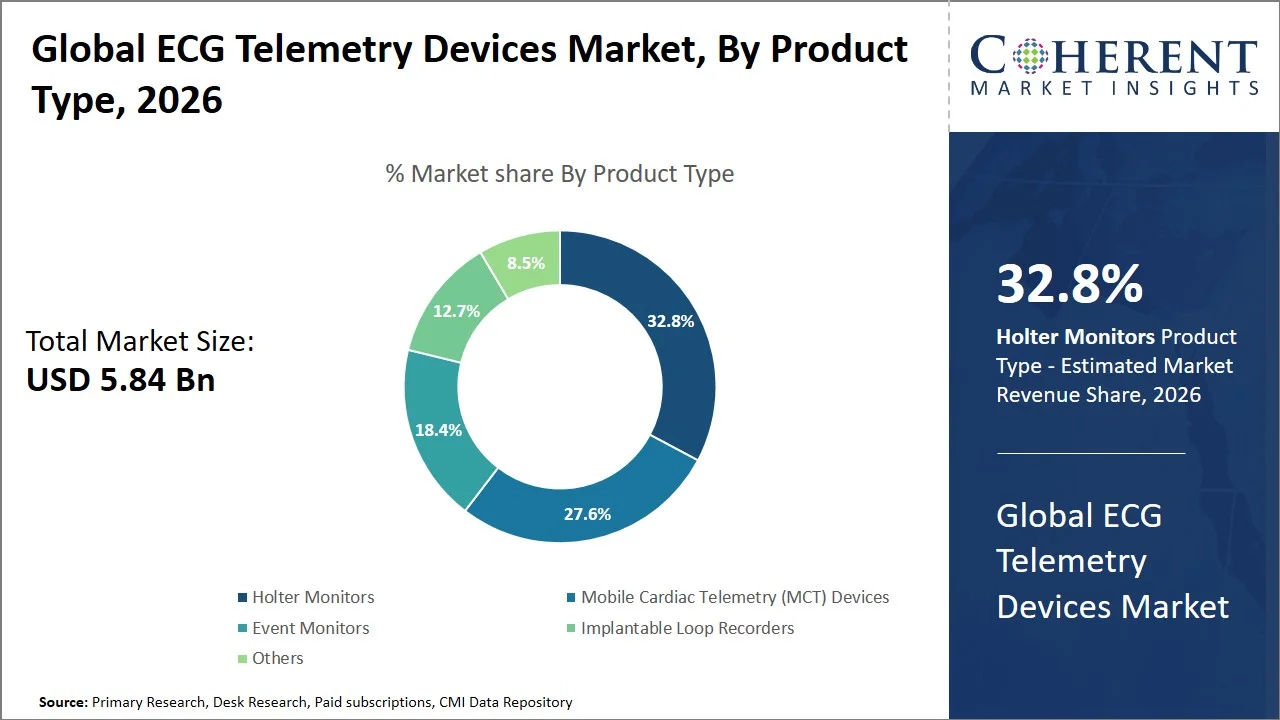
Why Do Holter Monitors Dominate the Global ECG Telemetry Devices Market?
Holter monitors are projected to hold the market share of 32.8% in 2026, because they have already been employed and extensively used for non-invasive monitoring of ECG over prolonged periods and detection of paroxysmal arrhythmias that are not manifested by a short recording of ECG. Holter monitoring is practical due to its portability and applicability in outpatients. For instance, in February 2026, U.S Food and Drug Administration (FDA) expanded the regulatory approval of Holter-based monitoring technologies and granted 510(k) clearance for the Holter ECG and ABP System (HolterABP) by Edan Instruments, Inc. in the cardiovascular devices category.
- Current Industry Events of 2026
- Market Size Estimation
- Regional Breakdown
- Competitive Landscape
- Customer Intelligence
- Segmental Analysis
- Pricing Analysis
- Key Market Drivers, Challenges & Future Trends
- Customized Insights Section
Why Does Arrhythmia Monitoring Represent the Largest Application Segment in the ECG Telemetry Devices Market?
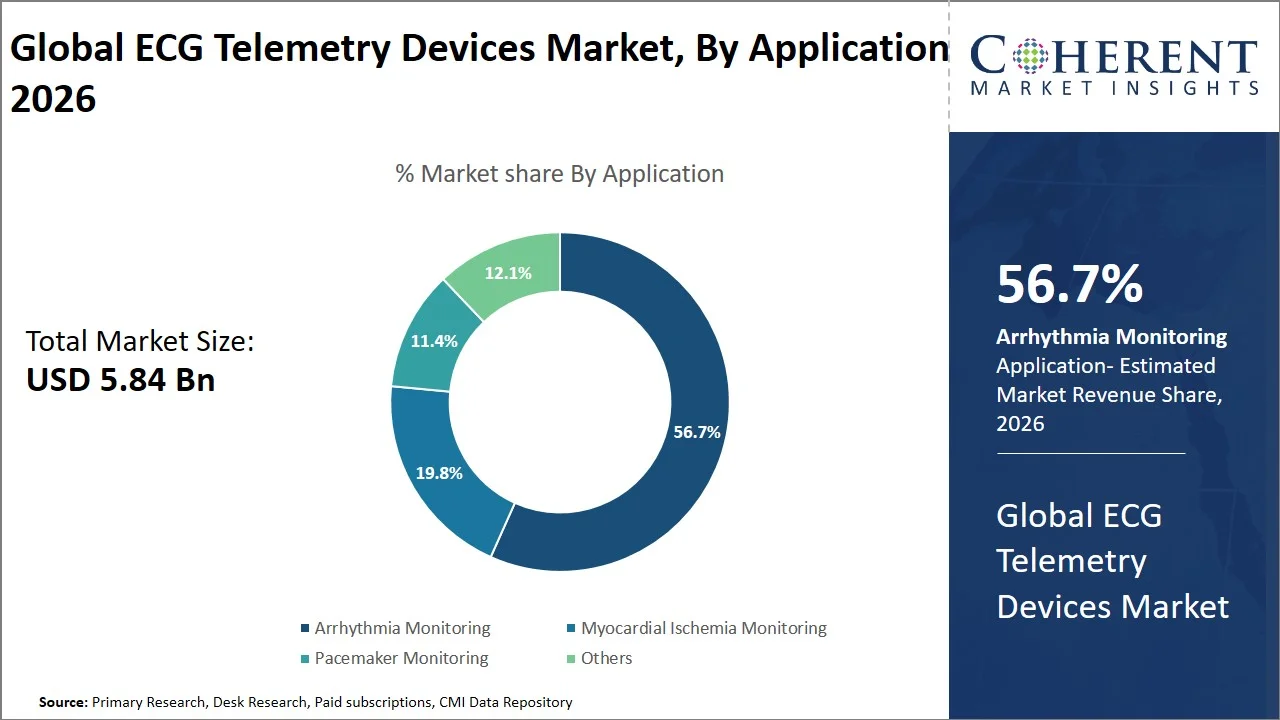
Arrhythmia monitoring is projected to hold a market share of 56.7% in 2026, driven by the requirement for continuous long-term ECG to diagnose and confirm transient, non-symptomatic rhythm disturbance that are not evident on short clinical ECG tracing. The increased burden of atrial fibrillation and aging population further supports persistent demand for continuous and remote rhythm monitoring. For instance, the 2024 European Society of Cardiology (ESC) guidelines emphasize the necessity of atrial fibrillation screening and assessment and the clinical need for ongoing rhythm surveillance, including the need to re-assess patients at regular intervals.
Hospitals and Clinics Segment Dominates the Global ECG Telemetry Devices Market
The hospitals and clinics segment is projected to hold a market share of 45.8% in 2026, owing to large volume of cardiac patients along with advanced infrastructure & trained manpower required for continuous monitoring of ECG. It facilitates the immediate assessment along with follow-up of the cardiac evaluation including arrhythmias, immediate and follow-up after procedure and management. For instance, the American Heart Association recommends continuous monitoring for patients in specific inpatient conditions such as arrhythmia detection, acute myocardial ischemia and QT- interval monitoring leading to a sustainable market for inpatient telemetry systems.
Currents Events and their Impact
Current Events | Description and its Impact |
U.S. FDA Updates Outpatient Cardiac Telemetry Classification (August 2026) |
|
U.S. Centers for Medicare & Medicaid Services (CMS) Revises Coverage for Ambulatory Cardiac Monitoring (August 2026) |
|
CDSCO Issues Updated Medical Device Software Guidance (July 2026) |
|
ECG Telemetry Devices Market Dynamics
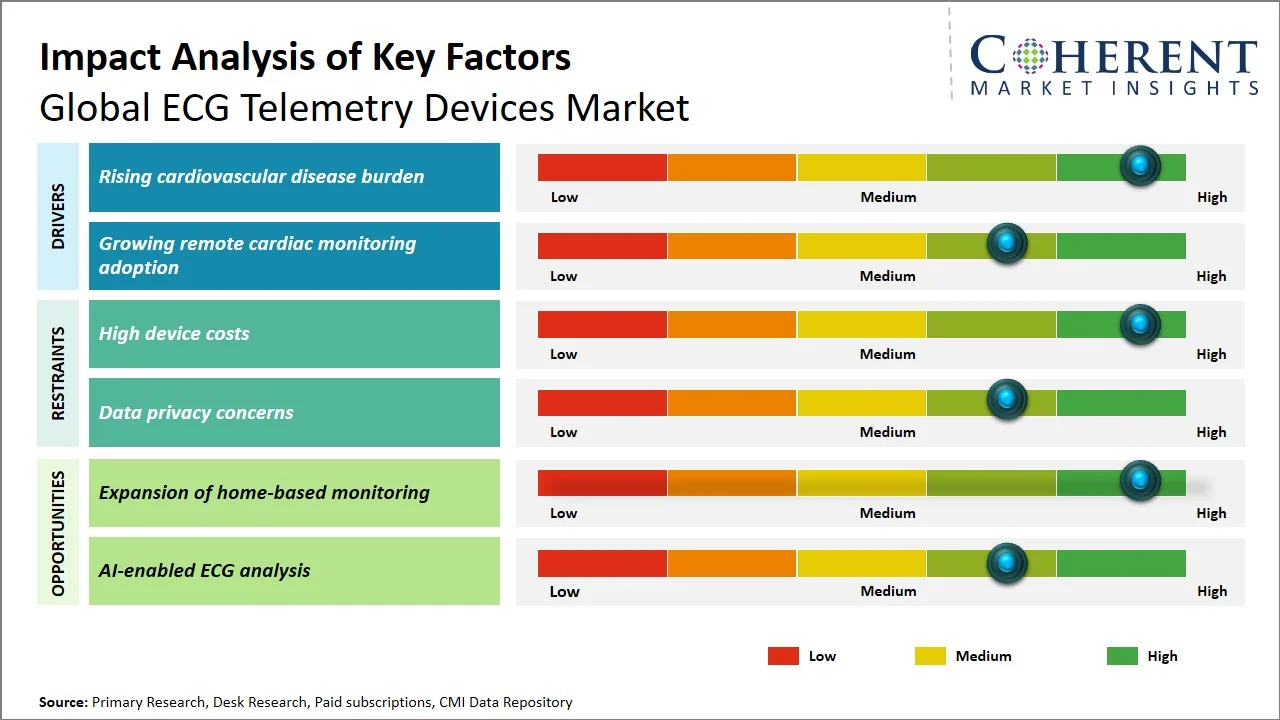
Market Drivers
Rising cardiovascular disease burden
The increasing prevalence of cardiovascular diseases is driving the need for continuous cardiac monitoring and early detection of abnormalities, supporting demand for ECG telemetry devices. For instance, the World Heart Federation reports that CVD causes more than 20.5 million deaths annually, with over 75% of CVD deaths occurring in low- and middle-income countries. The substantial disease burden and need for timely diagnosis and follow-up are encouraging greater adoption of remote and ambulatory ECG monitoring solutions.
Growing remote cardiac monitoring adoption
The increasing shift toward remote and ambulatory cardiac care is driving adoption of ECG telemetry devices that enable continuous monitoring outside conventional clinical settings. For instance, U.S. Centers for Medicare & Medicaid Services (CMS)’s 2026 coverage framework expanded coverage for temporary ambulatory cardiac monitoring technologies, including Holter, event, patch, external loop, and mobile cardiac telemetry devices, to support arrhythmia detection. This broader coverage supports the use of remote ECG monitoring across outpatient and home-based care, creating further demand for connected telemetry solutions.
Increasing integration of connected ECG technologies
The integration of ECG telemetry devices with smartphones, cloud platforms, and electronic health records is improving real-time data exchange and clinical accessibility. For instance, in May 2026, the U.S. FDA recognized IEEE 11073-10406-2023 as a consensus standard for basic ECG device interoperability, supporting plug-and-play communication between ECG devices and connected systems. This standardization is expected to facilitate broader deployment of connected ECG telemetry solutions and improve interoperability across cardiac-monitoring
Emerging Trends
AI-Enabled ECG Analysis and Predictive Monitoring
Integration of AI and machine learning is enabling automated arrhythmia detection, early-warning alerts, and predictive cardiac risk assessment. ECG telemetry is increasingly shifting from simple monitoring toward proactive and personalized cardiac care.
Expansion of Wearable and Remote ECG Monitoring
Wearable patches, portable monitors, and connected devices are enabling continuous cardiac monitoring beyond traditional clinical settings. This trend is supporting the growing adoption of home-based and ambulatory ECG telemetry solutions.
Greater Interoperability and Connected ECG Ecosystems
ECG telemetry systems are increasingly being designed for seamless connectivity with smartphones, cloud platforms, electronic health records, and other medical devices. Standardized communication frameworks are supporting more integrated and remotely accessible cardiac-monitoring workflows.
Regional Insights
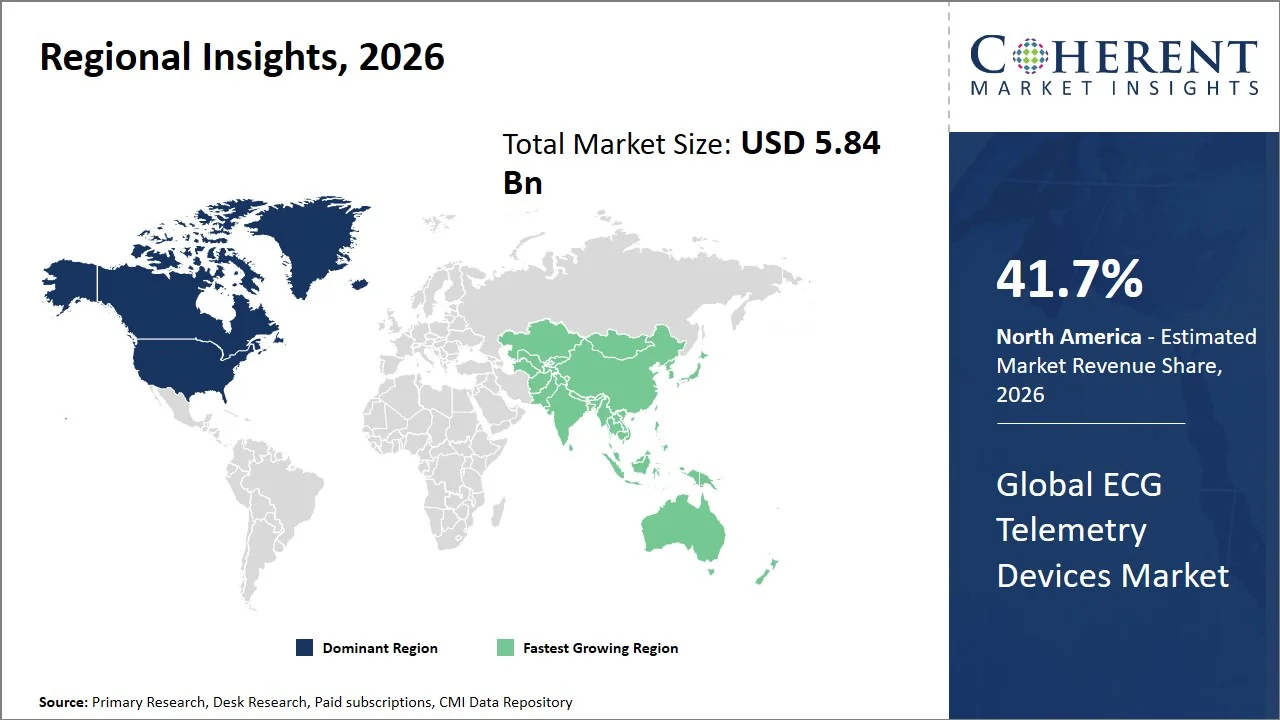
Why is North America a Strong Market for ECG Telemetry Devices?
North America leads the global ECG telemetry devices market, accounting for an estimated 41.7% share in 2026, owing to the well-established healthcare infrastructure, widespread acceptance of interconnected cardiac monitoring, and mature clinical expertise in managing remote and ambulatory ECG analysis. The market in the region also gains from advantageous reimbursement practices towards cardiac monitoring devices, and existence of effective trade routes, in addition to increased use of cardiac monitoring devices in various settings. For instance, U.S. Centers for Medicare & Medicaid Services (CMS) assigns CPT codes 93224–93227 for Holter monitoring and 93228–93229 for mobile cardiac telemetry, providing defined reimbursement pathways for ambulatory ECG monitoring in the U.S. This supports broader clinical utilization of ECG telemetry devices across outpatient cardiac care.
Why Does Asia Pacific ECG Telemetry Devices Market Exhibit High Growth?
Asia Pacific is expected to exhibit the fastest growth in the global ECG telemetry devices market, registering an estimated CAGR of 9.3% during 2026–2033. The region is projected to account for 21.1% of the global market in 2026, driven by the increased demand for remote cardiac monitoring services and proliferation of healthcare infrastructure coupled with increased digitization in healthcare. Government initiatives for the enhanced cardiac care and higher investment in telemonitoring platforms are the major drivers for accelerated growth in countries like China, India and South Korea.
For instance, India’s eSanjeevani National Telemedicine service enabled 493.9 million consultations by August 2026 and enables interconnectivity with medical/ diagnostic devices paving the way for remote monitoring and connected care. (National Portal of India) Furthermore, ease of access to affordable cardiac monitoring devices for patients is developing opportunities for wireless ECG telemetry devices and for home care.
Global ECG Telemetry Devices Market Outlook for Key Countries
Why is the U.S. Leading Innovation and Adoption in the ECG Telemetry Devices Market?
The U.S. is at the forefront of innovation and adoption in the ECG telemetry devices due to its mature regulatory path classifying specifically cardiac telemetry performed in hospital or ambulatory sites, under Class II devices (21 CFR 870.1025). The U.S. FDA guidelines provide classification for body-worn portable wireless units designed for ECG interpretation, and for transmission of the signal from patient site for remote analysis, of relevance for the design of connected telemetry. Beyond that, the wireless medical telemetry service has its own spectrum for dedicated and exclusive use by medical telemetry, allowing for reliable wireless cardiac monitoring in health care environments.
Is Japan a Favorable Market for ECG Telemetry Devices Market?
Japan has an attractive market for ECG telemetry devices due to the clear regulatory pathway existing for ECG telemetry equipment. ECG telemeters are classified as class II medical devices with telemetry ECG transmitters and telemetry ECG receivers (which also include ECG systems) for telemetry. They are supported with separate certification standards for telemetry systems and are also addressed under the clinical recommendations. This framework of regulation and clinical care fosters advanced ambulatory and remote ECG monitoring solutions.
Is China Emerging as a Key Growth Hub for the ECG Telemetry Devices Market?
China is rapidly developing into a global center for growth, with a national specific standard for ECG monitoring devices as part of its medical-device system. In China, GB 9706.227-2021 specifies the general requirements for basic safety and essential performance of ECG monitoring equipment and the requirements of this standard explicitly address ECG telemetry systems that have been utilized in hospitals. This is effective from May 2023 and administered by National Medical Products Administration (NMPA). It constitutes a framework for technology and regulation applicable to ECG telemetry technologies within China.
Why Does Germany Top the European ECG Telemetry Devices Market?
Technical specifications for ECG telemetry systems have been standardized and embedded within the robust telemedicine and cardiac monitoring structures available in Germany. A German DKE standard for electrical safety and necessary performance aspects of medical devices including ECG telemetric systems has been defined (DIN EN 60601-2-27). The structured cardiology telemedicine is also being developed in Germany, as of April 2026, where 4 certified telemedicine centers have already been registered.
Is ECG Telemetry Devices Market Developing in India?
India is emerging as a new market for ECG telemetry devices backed by Medical Devices Rules, 2017 and growing regulatory scrutiny on software-enabled medical devices. CDSCO guidance 2026 on medical devices software provides a well-defined framework for the connected and digitally enabled cardiac monitoring devices which can promote the use of remotely monitored ECG, computer aided analysis and connected telemetry devices in evolving medical ecosystem in India.
Comparison of ECG Telemetry Monitoring Technologies
Monitoring Technology | Typical Monitoring Duration | Recording Approach | Data Transmission | Key Clinical Use |
Holter Monitor | 24–72 hours or longer | Continuous | Post-monitoring / connected transfer | Frequent arrhythmias |
Event Monitor | Several weeks | Patient/event activated or automatic | Remote or post-monitoring | Infrequent symptoms |
Mobile Cardiac Telemetry (MCT) | Up to ~30 days | Continuous with automated analysis | Real-time/near-real-time | Intermittent arrhythmias requiring extended monitoring |
External Loop Recorder | Several weeks | Continuous loop with event capture | Remote or post-monitoring | Transient arrhythmias |
Implantable Loop Recorder | Months to years | Continuous/intermittent | Remote transmission | Rare, unexplained arrhythmias |
How is the expansion of home-based monitoring creating new growth opportunities in the ECG telemetry devices market?
The increase in in-home cardiac care is developing a growing market for portable ECG telemetry device that allow patients for long term cardiac monitoring outside of a clinical setting. The advancements in wireless communication and micro-device miniaturization technology continue to enhance the viability of distributed cardiac monitoring. In May 2026, the M12 telemetry system by Global Instrumentation, LLC was approved by the U.S. Food and Drug Administration (FDA) under 21 CFR 870.1025 for physiological monitoring with arrhythmia detection, highlighting the ongoing progress within regulations for connected telemetry.
Market Players, Key Development, and Competitive Intelligence
Key Developments
- In August 2026, iRhythm announced an agreement to acquire VitalConnect for approximately USD 287.5 million, expanding its cardiac monitoring platform across ambulatory, inpatient, and hospital-to-home care. The transaction adds VitalConnect’s U.S. FDA-cleared mobile cardiac telemetry, wearable biosensors, multi-vitals monitoring, and AI-enabled capabilities to iRhythm’s portfolio. The acquisition is expected to close by the end of 2026, subject to regulatory and customary closing conditions.
- In July 2026, AccurKardia, Inc. and Wellysis signed a multi-year agreement to provide Wellysis’ turnkey cardiac monitoring offering in the U.S. market. Under the agreement, Wellysis’ S-Patch wearable ECG monitor will be paired with AccurKardia’s FDA-cleared AccurECG 2.0 automated ECG analytics and reporting platform for Holter, extended Holter, and mobile cardiac telemetry workflows.
- In June 2026, HeartBeam, Inc. announced a strategic shift to accelerate global adoption of its ambulatory ECG signal platform, including plans to license its 3D ECG technology to established partners rather than focus solely on direct medical-device sales. The company is also advancing its 12-lead ECG patch and pursuing heart-attack detection capabilities, expanding the potential applications of its portable ECG technology.
- In April 2026, Rhythmed, LLC launched its next-generation RhythmStar SL cardiac monitor, designed to improve patient comfort, wearability, and adherence through a compact lead configuration, IPX-6 water resistance, and increased battery life. The device also features built-in cellular connectivity for automatic ECG data transmission to the cloud and supports advanced arrhythmia detection.
Competitive Landscape
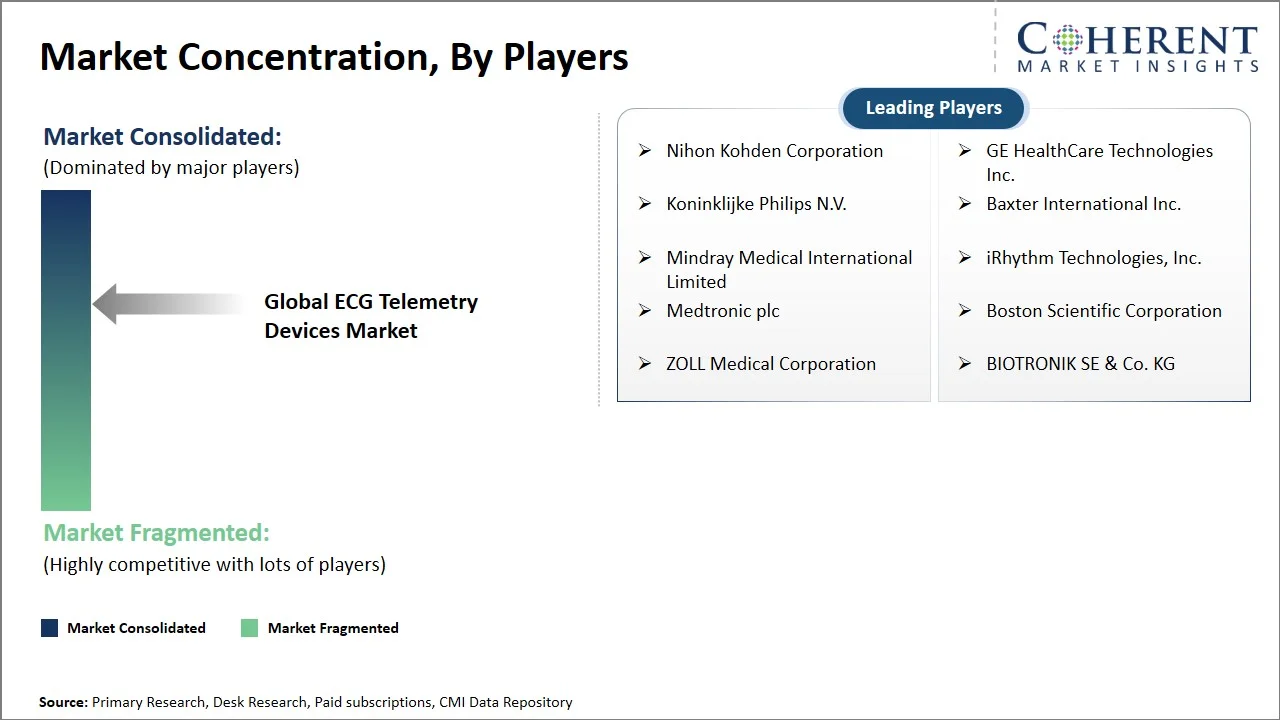
The global ECG telemetry devices market is moderately competitive, with competition centered on monitoring accuracy, continuous data transmission, device portability, patient comfort, interoperability, and clinical workflow integration. Market participants are increasingly focusing on connected cardiac monitoring technologies while advancing AI-enabled ECG analysis, wearable form factors, and cloud-based platforms to strengthen adoption across hospital, ambulatory, and home-care settings.
Key focus areas include
- Development of compact and wearable ECG telemetry devices
- Integration of AI and automated ECG analytics
- Advancement of wireless and cloud-connected telemetry platforms
- Improvement of interoperability with electronic health records and remote patient monitoring systems
- Expansion of home-based and ambulatory cardiac monitoring solutions
Market Report Scope
ECG Telemetry Devices Market Report Coverage
| Report Coverage | Details | ||
|---|---|---|---|
| Base Year: | 2025 | Market Size in 2026: | USD 5.84 Bn |
| Historical Data for: | 2020 To 2024 | Forecast Period: | 2026 To 2033 |
| Forecast Period 2026 to 2033 CAGR: | 7.2% | 2033 Value Projection: | USD 9.49 Bn |
| Geographies covered: |
| ||
| Segments covered: |
| ||
| Companies covered: | Nihon Kohden Corporation, GE HealthCare Technologies Inc., Koninklijke Philips N.V., Baxter International Inc., Mindray Medical International Limited, iRhythm Technologies, Inc., Medtronic plc, Boston Scientific Corporation, ZOLL Medical Corporation, BIOTRONIK SE & Co. KG | ||
| Growth Drivers: |
| ||
| Restraints & Challenges: |
| ||
Analyst Opinion (Expert Opinion)
- In the coming years, the global ECG telemetry devices market is expected to move from conventional episodic monitoring toward continuous, connected, and AI-enabled cardiac surveillance. Growth will increasingly be driven by wearable and wireless devices, cloud-based ECG data management, automated arrhythmia detection, and expansion of monitoring into home and ambulatory settings. Over the longer term, ECG telemetry is likely to evolve into an integrated cardiac-care platform combining device, connectivity, analytics, and clinical decision support.
- The maximum opportunities will probably exist within mobile cardiac telemetry (MCT) for arrhythmia monitoring in India. MCT can provide longer-duration monitoring and automated event detection, while arrhythmia monitoring addresses a broad and recurring clinical need. India offers strong long-term potential because of its large patient population, expanding digital-health infrastructure, increasing access to remote care, and growing need for cost-efficient cardiac monitoring solutions.
- In order to obtain a competitive advantage, market participants should focus on developing compact, comfortable, long-duration devices while strengthening AI-based arrhythmia detection and real-time data transmission. Competitive advantage will increasingly depend on seamless integration with hospital information systems, EHRs, telehealth platforms, and remote patient monitoring workflows. Companies should also prioritize clinical validation, cybersecurity, interoperability, and region-specific regulatory/reimbursement strategies rather than competing primarily on hardware features.
Speak to the analyst
Want personalized insights?
Take the findings above to one of our principal consultants, or have the report rebuilt around the segments, geographies and competitors you actually track.
Market Segmentation
- Product Type Insights (Revenue, USD Bn, 2021 - 2033)
- Holter Monitors
- Mobile Cardiac Telemetry (MCT) Devices
- Event Monitors
- Implantable Loop Recorders
- Others
- Application Insights (Revenue, USD Bn, 2021 - 2033)
- Arrhythmia Monitoring
- Myocardial Ischemia Monitoring
- Pacemaker Monitoring
- Others
- End User Insights (Revenue, USD Bn, 2021 - 2033)
- Hospitals and Clinics
- Diagnostic Centers
- Ambulatory Care Centers
- Home Healthcare Settings
- Others
- Regional Insights (Revenue, USD Bn, 2021 - 2033)
- North America
- U.S.
- Canada
- Latin America
- Brazil
- Argentina
- Mexico
- Rest of Latin America
- Europe
- Germany
- U.K.
- Spain
- France
- Italy
- Russia
- Rest of Europe
- Asia Pacific
- China
- India
- Japan
- Australia
- South Korea
- ASEAN
- Rest of Asia Pacific
- Middle East
- GCC Countries
- Israel
- Rest of Middle East
- Africa
- South Africa
- North Africa
- Central Africa
- North America
Sources
Primary Research Interviews
- Cardiologists and electrophysiologists involved in cardiac rhythm monitoring and arrhythmia management
- Clinical engineers and biomedical professionals responsible for ECG telemetry systems and hospital monitoring infrastructure
- Cardiac monitoring specialists using Holter, mobile cardiac telemetry, and event-monitoring technologies
- Remote patient monitoring and telehealth professionals implementing connected cardiac monitoring solutions
- Healthcare administrators and procurement professionals evaluating ECG telemetry devices for hospitals and ambulatory care settings
Stakeholders
- ECG telemetry device and cardiac monitoring system manufacturers
- ECG sensor, electrode, leadwire, and wearable-device component suppliers
- Remote patient monitoring and digital cardiac-care technology providers
- Hospitals, clinics, cardiac centers, and ambulatory healthcare providers
- Diagnostic laboratories and cardiac testing centers
- Telehealth providers and remote monitoring service organizations
- Academic and cardiovascular research institutions
- Healthcare IT and electronic health record (EHR) integration providers
- End-use Sectors
- Hospitals and multispecialty clinics
- Cardiology and electrophysiology centers
- Diagnostic and cardiac testing centers
- Ambulatory healthcare facilities
- Home healthcare and remote patient monitoring providers
- Telehealth and virtual-care providers
- Academic and clinical research institutions
- Long-term care and skilled nursing facilities
- Emergency and acute-care centers
- Occupational and preventive healthcare centers
- Regulatory & Health Bodies
- U.S. Food and Drug Administration (FDA)
- Centers for Medicare & Medicaid Services (CMS), U.S.
- European Medicines Agency (EMA)
- Medicines and Healthcare products Regulatory Agency (MHRA), U.K.
- Pharmaceuticals and Medical Devices Agency (PMDA), Japan
- National Medical Products Administration (NMPA), China
- Central Drugs Standard Control Organisation (CDSCO), India
- Therapeutic Goods Administration (TGA), Australia
- Health Canada
Databases
- FDA Device Classification Database
- FDA Total Product Life Cycle (TPLC) Database
- FDA 510(k) Premarket Notification Database
- CMS Medicare Coverage Database
- ClinicalTrials.gov
- NIH RePORTER
- Global Health Data Exchange (GHDx)
- WHO Global Health Observatory
Journals
- Journal of the American College of Cardiology
- Heart Rhythm
- Journal of Electrocardiology
- Europace
- JAMA Cardiology
- Nature Digital Medicine
- IEEE Journal of Biomedical and Health Informatics
Associations
- American Heart Association (AHA)
- American College of Cardiology (ACC)
- Heart Rhythm Society (HRS)
- European Society of Cardiology (ESC)
- European Heart Rhythm Association (EHRA)
- International Society for Holter and Noninvasive Electrocardiology (ISHNE)
- Asia Pacific Heart Rhythm Society (APHRS)
Public Domain Sources
- U.S. FDA – Cardiac monitoring, ECG telemetry, arrhythmia detection, device classification, and medical-device guidance
- CMS – Ambulatory ECG monitoring coverage, coding, monitor classifications, and utilization criteria
- American Heart Association – ECG monitoring standards, arrhythmia monitoring, ischemia monitoring, and clinical applications
- FDA Consensus Standards Resources – ECG performance, cardiac rhythm, ST-segment measurement, and monitoring standards
- World Health Organization (WHO) – Cardiovascular disease burden and global cardiovascular health statistics
Proprietary Elements
- CMI Data Analytics Tool
- Proprietary CMI Existing Repository of information for last 10 years.
Get access to 250+ pages report
Every segment, forecast, competitor profile and data table behind the analysis above — available for instant download.
- ESOMAR Member
- ISO 9001:2015 Certified
- D-U-N-S Registered
- GDPR & CCPA Compliant
Missing comfort of reading report in your local language? Find your preferred language:
Frequently Asked Questions
The global ECG telemetry devices market is estimated to be valued at USD 5.84 Bn in 2026 and is expected to reach USD 9.49 Bn by 2033.
Holter Monitors dominate due to their established clinical use for continuous, extended ECG recording and routine detection of intermittent arrhythmias.
ECG telemetry devices are portable or wearable systems that continuously record, analyze, and wirelessly transmit ECG data for remote cardiac monitoring and detection of abnormal rhythms.
The CAGR of global ECG telemetry devices market is projected to be 7.2% from 2026 to 2033.
Rising cardiovascular disease burden, and growing remote cardiac monitoring adoption are the major factors driving the growth of the global ECG telemetry devices market.
High device costs, and data privacy concerns are the major factors hampering the growth of the global ECG telemetry devices market.
In terms of end user, hospitals and clinics are estimated to dominate the market revenue share in 2026.