

Global Educational Toy Market Size and Forecast – 2026 To 2033
The Global Educational Toy Market is estimated to be valued at USD 63.21 Bn in 2026 and is expected to reach USD 103.51 Bn by 2033, growing at a compound annual growth rate (CAGR) of 7.3% from 2026 to 2033. This growth is supported by increasing recognition among parents, educators, and institutions that educational toys contribute to cognitive development, creativity, problem-solving abilities, and practical learning outcomes.
The market is further gaining momentum as manufacturers integrate learning-based experiences with storytelling, digital platforms, and skill-development activities. For instance, Mattel expanded its educational initiatives through the Barbie Dream Gap Project Curriculum, developed in partnership with UCLA’s Center for Scholars & Storytellers, offering interactive learning resources focused on confidence, leadership, and career exploration among children. Such initiatives highlight the growing shift toward toys that combine play with measurable educational and developmental benefits.
Key Takeaways of the Global Educational Toy Market
- STEM Toys is expected to register an estimated CAGR of 8.1% and capture 28.6% of the global educational toy market in 2026, supported by coding, engineering, and experiment-based learning adoption among children. In August 2025, The Toy Association introduced its STEAM Toy Shopping List highlighting toys that combine learning and play.
- 6 to 12 Years is projected to achieve an estimated CAGR of 7.5% and account for 46.6% % of the global educational toy market in 2026, supported by children’s growing ability to engage with structured learning activities, advanced construction sets, coding toys, science kits, and strategy-based games. This age group represents a critical stage where parents and educators increasingly prioritize products that strengthen analytical thinking, creativity, and academic readiness.
- Cognitive and Problem Solving Skills is forecast to show an estimated CAGR of 7.6% and represent 34.7% of the global educational toy market in 2026, reflecting preference for toys that strengthen reasoning, decision-making, and analytical abilities. In January 2025, LEGO Education announced its K-8 Science solution featuring hands-on learning activities designed to build critical thinking and problem-solving skills.
- North America is anticipated to record an estimated CAGR of 6.9% and hold 36.8% of the global educational toy market in 2026, supported by established toy brands, educational purchasing channels, and strong parent interest in skill-building products. In May 2025, Horace Mann and Crayola announced a partnership supporting educators through creativity-focused learning initiatives across U.S. schools.
- Europe is expected to achieve an estimated CAGR of 7.9% and account for 27.6% of the global educational toy market in 2026, with growth supported by early learning priorities, safety standards, and educational play adoption. In January 2025, the European School Education Platform published updated insights on early childhood education and care developments across Europe.
Segmental Insights
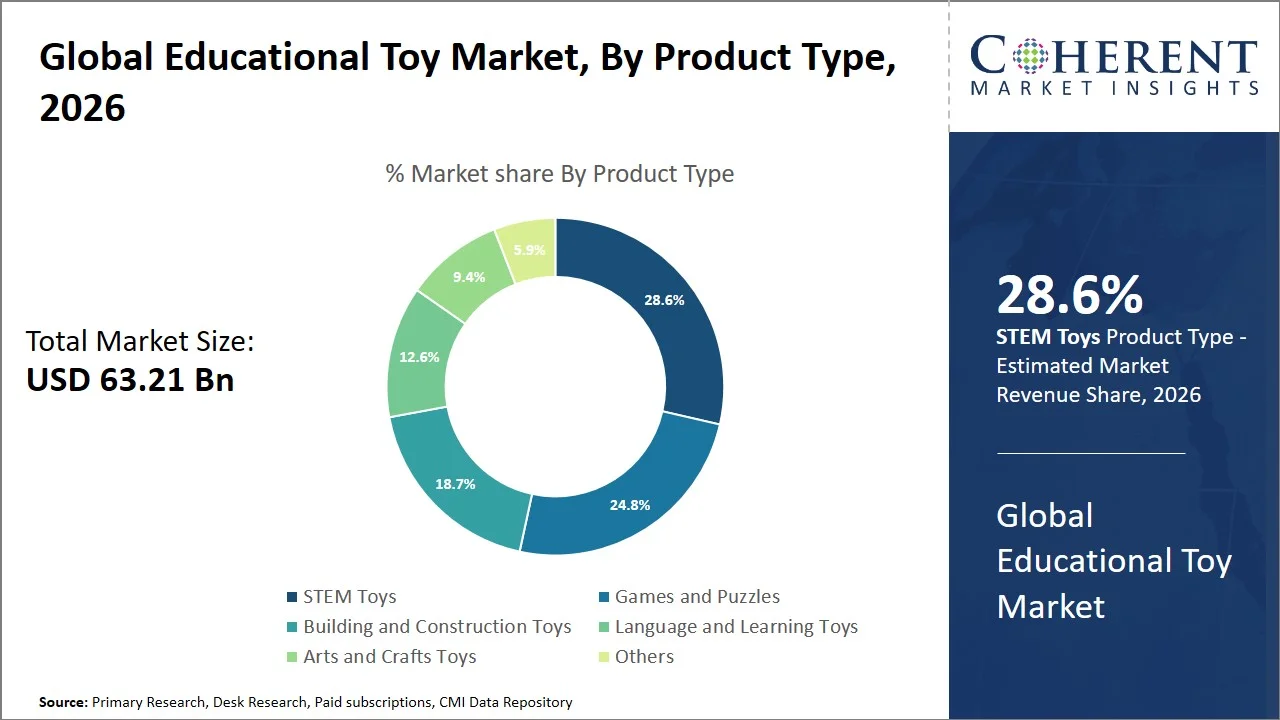
Why Do STEM Toys Dominate the Product Type Segment of the Global Educational Toy Market?
STEM Toys are expected to account for 28.6% share of the global educational toy market in 2026, supported by strong preference for products that combine play with science, technology, engineering, and mathematics skill development. These toys enable children to learn through experimentation, construction, coding, and problem-solving activities, making them increasingly relevant for parents, schools, and after-school learning programs. Manufacturers are expanding portfolios with robotics kits, engineering sets, and interactive science products that integrate physical components with digital learning resources. The segment benefits from strong institutional adoption as educators seek hands-on tools that complement classroom instruction. In January 2025, LEGO Education introduced its K-8 Science solution featuring more than 120 standards-aligned lessons, reusable hardware, and hands-on activities designed to improve science engagement and develop critical thinking skills among students.
- Current Industry Events of 2026
- Market Size Estimation
- Regional Breakdown
- Competitive Landscape
- Customer Intelligence
- Segmental Analysis
- Pricing Analysis
- Key Market Drivers, Challenges & Future Trends
- Customized Insights Section
Why Does the 6 to 12 Years Segment Represent the Largest Age Group Category in the Global Educational Toy Market?
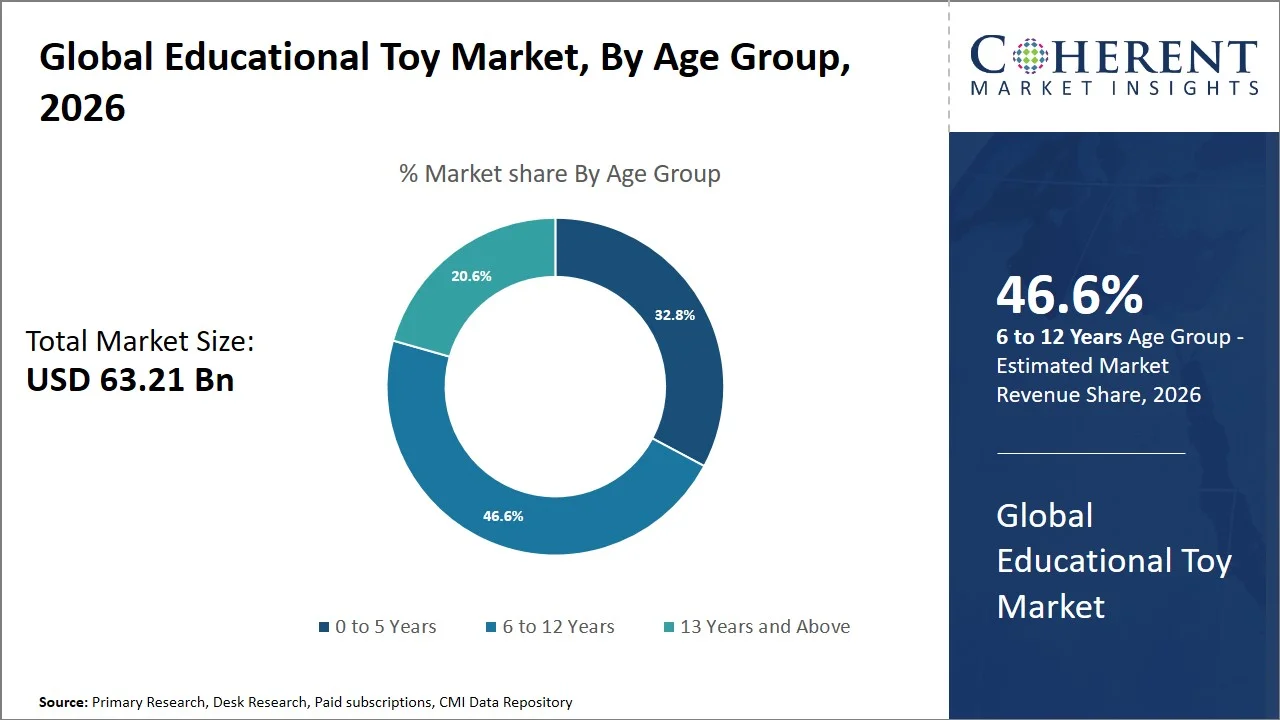
The 6 to 12 Years segment is expected to represent 46.6% share of the global educational toy market in 2026, supported by children’s increasing ability to engage with structured learning activities, complex games, construction systems, and skill-based educational products. This age group represents a critical stage where parents and educators actively seek tools that strengthen reasoning, creativity, collaboration, and academic readiness. Manufacturers benefit from opportunities to develop advanced educational toys with progressive difficulty levels, allowing products to remain relevant as children develop new capabilities. Schools, learning centers, and extracurricular programs also contribute to demand through classroom integration of educational play solutions. In October 2024, FIRST announced the expansion of its robotics-focused learning programs, including FIRST LEGO League offerings designed for elementary and middle school students, strengthening structured STEM engagement among children in this age category.
Why Does Cognitive and Problem Solving Skills Dominate the Learning Category Segment of the Global Educational Toy Market?
Cognitive and Problem Solving Skills are expected to capture 34.7% share of the global educational toy market in 2026, as parents and institutions increasingly prioritize toys that develop logical reasoning, decision-making, memory, and analytical thinking abilities. Products supporting puzzles, strategy-based games, construction activities, and interactive challenges are widely adopted because they encourage children to explore solutions independently rather than follow fixed outcomes. Suppliers are focusing on adaptable designs that combine entertainment with measurable developmental benefits, strengthening demand among households, schools, and educational programs. The segment also benefits from broader acceptance of play-based learning approaches that connect creativity with intellectual development. In March 2025, the Toy Association highlighted the role of play in developing essential childhood skills, including creativity, problem-solving, and social development, through its industry initiatives promoting purposeful play.Top of Form
Current Events and their Impact
Current Event | Description and Its Impact |
European Union Toy Safety Regulation Revision Discussions – 2024 |
|
U.S. Consumer Product Safety Commission Toy Safety Enforcement Activities – 2025 |
|
China National Standards Updates for Children’s Products – 2024 |
|
Global Educational Toy Market Dynamics
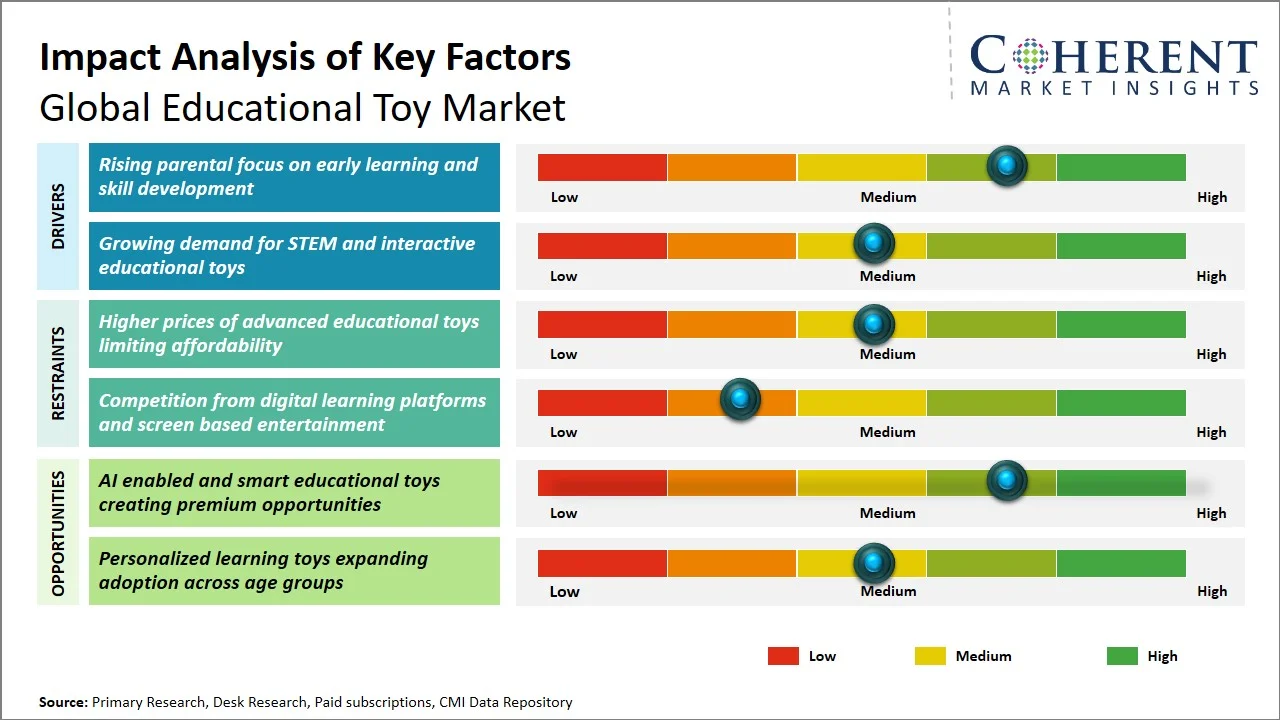
Key Market Drivers
- Rising Parental Focus on Early Learning and Skill Development: Increasing parental emphasis on early cognitive development, creativity building, and school-readiness skills is strengthening demand for educational toys that provide measurable learning outcomes beyond entertainment. Parents are increasingly selecting products that support problem-solving, language development, motor skills, and emotional growth, benefiting manufacturers of preschool learning toys, activity kits, and developmental play products. Retailers and educational suppliers are also expanding curated learning categories to address this preference shift. In January 2025, LEGO Education introduced its K-8 Science solution featuring hands-on lessons designed to improve student engagement, collaboration, creativity, and problem-solving through classroom-based learning experiences.
- Growing Demand for STEM and Interactive Educational Toys: The increasing importance of science, technology, engineering, and mathematics skills is encouraging schools, parents, and institutions to adopt interactive educational toys that combine physical play with experimentation and structured learning. STEM-focused toy manufacturers benefit from demand for robotics kits, coding toys, engineering sets, and science-based activities that prepare children for future skill requirements. This shift is also encouraging traditional toy companies to invest in digital integration and classroom-oriented product portfolios. In January 2025, LEGO Education announced LEGO Education Science, a hands-on learning solution containing standards-aligned science lessons and reusable hardware designed for K-8 classrooms.
Emerging Market Trends
- Integration of Physical Play with Digital Learning Ecosystems: Educational toy development is increasingly moving toward hybrid experiences that combine traditional toys with digital platforms, interactive applications, sensors, and connected learning environments. Manufacturers are shifting from standalone products toward ecosystems where children can build, experiment, track progress, and receive guided learning support. This trend is influencing product design, pricing models, and customer expectations, while companies with software capabilities, educational content partnerships, and platform-based offerings are positioned to gain stronger engagement from parents and institutions.
- Shift Toward Personalized and Skill-Based Learning Products: Educational toy purchasing is gradually shifting from age-based selection toward products designed around specific learning outcomes, including creativity, logical reasoning, communication, and technical skills. Parents and educators increasingly prefer toys that support individual learning pathways rather than standardized play experiences. This transition is encouraging manufacturers to develop modular products, adaptable difficulty levels, and activity-based formats that can serve different learning abilities. Companies capable of combining educational value with personalization will have stronger opportunities to differentiate in a competitive consumer market.
Regional Insights
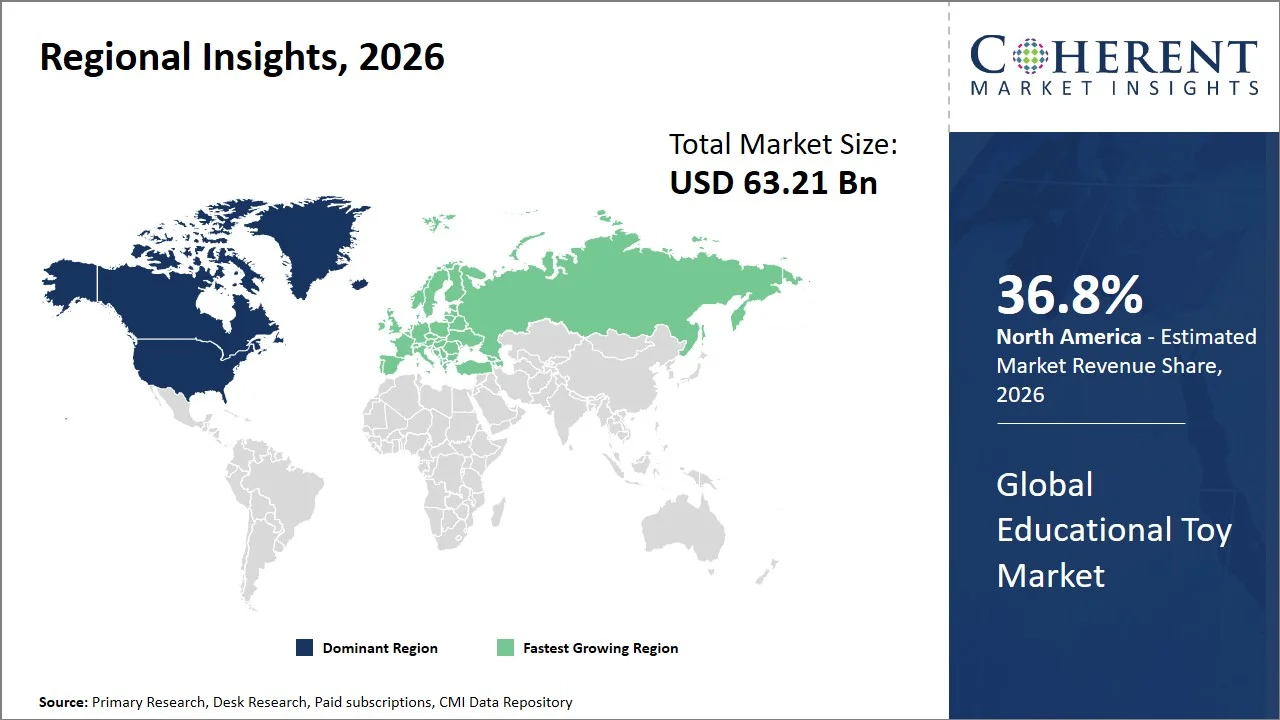
Why Does North America Dominate the Global Educational Toy Market?
North America is expected to maintain its leading position in the global educational toy market, accounting for 36.8% share in 2026, supported by strong consumer spending on child development products, high adoption of STEM-based learning solutions, and established retail and e-commerce ecosystems. The region benefits from a large presence of global toy manufacturers, educational technology providers, specialty retailers, and institutional buyers such as schools and learning centers. Parents in the U.S. and Canada increasingly prioritize products that improve creativity, problem-solving, coding, and scientific skills, strengthening demand for STEM kits, robotics toys, and interactive learning systems. The region also has strong acceptance of premium educational products due to higher purchasing power and widespread digital learning adoption. In September 2025, the U.S. Department of Education highlighted continued emphasis on advancing STEM education through federal STEM learning initiatives, supporting the broader ecosystem for educational products.
Why Is Europe Emerging as the Fastest-Growing Region in the Global Educational Toy Market?
Europe is projected to be the fastest-growing region in the global educational toy market, representing 27.6% share in 2026, supported by increasing demand for sustainable toys, strong child safety regulations, and growing adoption of educational products within schools and households. European consumers demonstrate high preference for safe, durable, environmentally responsible, and development-focused toys, encouraging manufacturers to improve material quality and product transparency. The region’s structured education systems and emphasis on early childhood learning create opportunities for STEM toys, creative learning products, and classroom-oriented solutions. Regulatory developments are also reshaping supplier strategies by increasing focus on compliance and traceability. In December 2025, the European Commission announced stronger toy safety rules introducing stricter chemical requirements and digital product passports, influencing future toy manufacturing and compliance practices across the region.
Global Educational Toy Market Outlook for Key Countries
Why Is the U.S. a Key Market for the Global Educational Toy Market?
The U.S. represents one of the most important countries in the global educational toy market due to strong household expenditure on children’s learning products, extensive adoption of STEM education programs, and a well-developed ecosystem of toy brands, retailers, and educational institutions. Demand is concentrated around robotics kits, coding toys, science experiment sets, construction-based learning products, and digital-enhanced educational platforms. The country benefits from the presence of established companies developing curriculum-linked solutions for schools and home learning environments. Large retail networks, including specialty toy stores and online marketplaces, provide manufacturers with broad consumer access. The increasing integration of technology into education is further encouraging demand for interactive learning tools. In April 2025, the U.S. National Science Foundation announced continued investments supporting STEM education initiatives, strengthening the national focus on science and technology learning.
Why Is India Important in the Global Educational Toy Market?
India is becoming an increasingly important market for educational toys due to its expanding child population, rising parental focus on skill development, growing disposable income among urban households, and increasing acceptance of experiential learning products. The market opportunity is supported by demand for affordable STEM kits, activity-based learning toys, language development products, and school-oriented educational solutions. Domestic manufacturers and startups are expanding offerings focused on creativity, science learning, and problem-solving skills, while online retail platforms are improving accessibility beyond major cities. Government emphasis on improving foundational learning and encouraging innovation-based education is also creating favorable conditions for educational toy adoption. In July 2024, India’s Ministry of Education launched initiatives under the National Education Policy framework emphasizing experiential learning and competency-based education, supporting demand for learning tools aligned with practical skill development.
Why Does China Support Growth in the Global Educational Toy Market?
China plays a critical role in the global educational toy market due to its extensive toy manufacturing infrastructure, strong supplier ecosystem, cost-efficient production capabilities, and significant export contribution. The country has developed large-scale clusters specializing in plastic molding, electronics integration, packaging, and toy assembly, enabling global brands to source diverse educational toy categories. In addition to manufacturing strength, China represents a large domestic consumer market where parents increasingly seek early learning products, STEM toys, and technology-enabled educational solutions. The expansion of e-commerce channels has further improved access to educational products across urban and emerging regions. Chinese manufacturers are also improving product quality and innovation capabilities to compete in premium educational toy segments. In April 2025, China’s Ministry of Education highlighted continued implementation of digital education initiatives, supporting technology integration within learning environments and related educational product ecosystems.
Why Is Germany a Strategic Country in the Global Educational Toy Market?
Germany holds strategic importance in the global educational toy market due to its strong engineering culture, premium consumer preference, advanced manufacturing capabilities, and emphasis on product safety and sustainability. German consumers typically prioritize durable, high-quality educational products, supporting demand for construction toys, science learning products, creative activity kits, and environmentally responsible toys. The country also benefits from a mature specialty retail network and strong participation in international toy trade activities. Manufacturers operating in Germany often compete through product quality, educational value, safety compliance, and innovative design rather than price-based positioning. The country’s strong industrial ecosystem supports development of technically advanced learning products, particularly in STEM and engineering-related categories. In January 2025, Spielwarenmesse Nürnberg showcased global educational toy innovations, highlighting Germany’s continued role as a major hub for toy industry networking and product development.
Why Is Brazil an Important Growth Market for the Global Educational Toy Market?
Brazil represents an important growth opportunity in the global educational toy market due to its large child population, expanding middle-class consumer base, increasing digital retail adoption, and rising awareness of learning-focused play products. Demand is growing for affordable educational toys that support literacy, creativity, mathematics, and early developmental skills. The country’s retail ecosystem, including supermarkets, specialty stores, and online marketplaces, provides multiple channels for manufacturers to reach consumers across different income groups. Local and international brands are increasingly adapting products to meet regional affordability requirements while maintaining educational value. Government initiatives focused on improving learning outcomes and early childhood education also support broader adoption of educational tools. In October 2024, Brazil’s Ministry of Education continued advancing early childhood education programs through national education initiatives, reinforcing the importance of learning resources for young children.
Market Players, Key Development, and Competitive Landscape
Key Developments
- In February 2026, Mattel announced strategic investments to accelerate organic growth through technology, digital games, direct-to-consumer capabilities, and toy innovation as part of its broader brand-focused strategy. This development is important for the educational toy ecosystem as major toy companies increasingly integrate digital experiences and interactive platforms alongside traditional physical products.
- In January 2026, FIRST announced the next era of FIRST LEGO League, introducing a more accessible classroom-oriented model integrating computer science and robotics learning experiences for students globally. This development supports wider adoption of STEM-focused educational play by connecting robotics activities with structured learning environments and expanding opportunities for schools to incorporate hands-on technology education.
- In January 2026, LEGO Education announced its hands-on Computer Science & AI learning solution for K-8 classrooms, combining LEGO bricks, hardware, and curriculum-based lessons to support computer science and artificial intelligence education. This development strengthens LEGO Education’s position in technology-enabled learning solutions by connecting physical play with classroom-focused digital literacy requirements.
Competitive Landscape
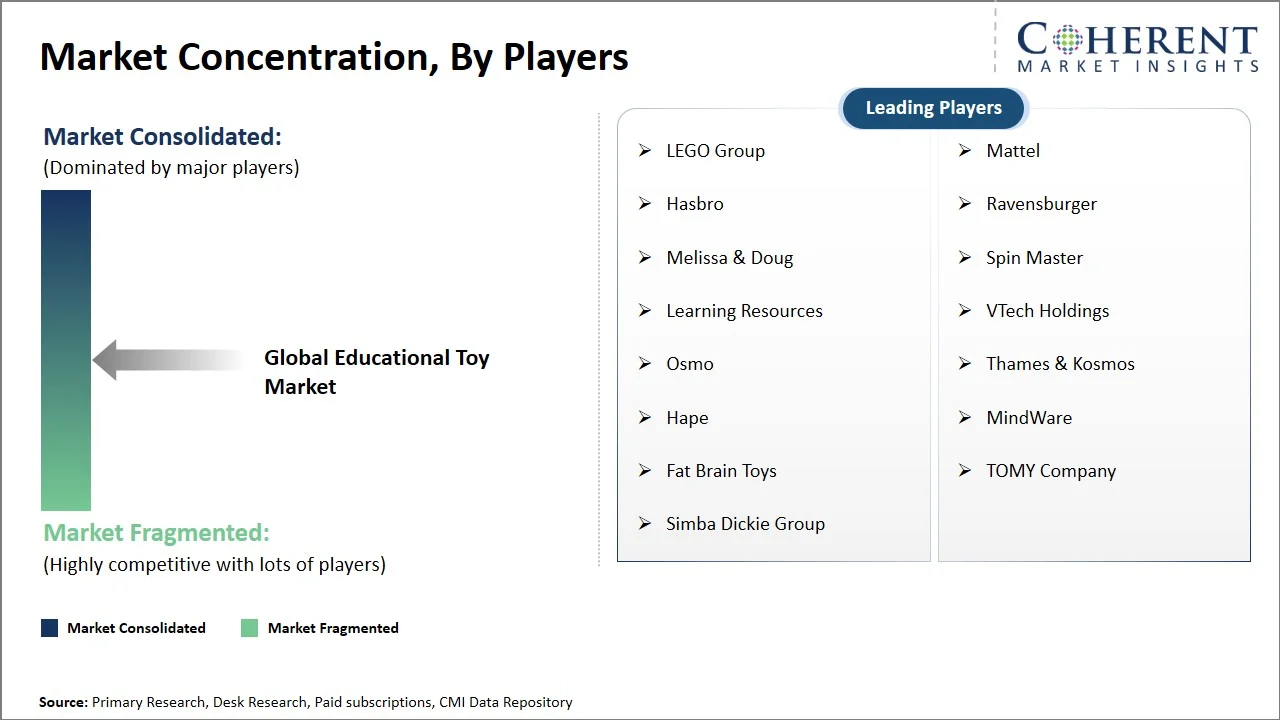
The global educational toy market is moderately fragmented, with competition involving multinational toy manufacturers, specialized educational toy companies, STEM-focused brands, digital learning providers, and regional manufacturers. Competition is shaped by product innovation, educational effectiveness, brand reputation, safety compliance, pricing, and distribution strength. Large players benefit from global retail networks and strong brand recognition, while specialized companies compete through customized learning solutions, technology integration, and niche educational categories.
Key focus areas include:
- Product Innovation: Development of STEM toys, robotics kits, coding platforms, and interactive learning products.
- Technology Integration: Adoption of AI, AR, and app-based solutions to create engaging learning experiences.
- Brand Partnerships: Collaborations with schools and educators to strengthen product credibility.
- Safety & Sustainability: Focus on certified, child-safe, and eco-friendly materials.
- Distribution Expansion: Growth of online, retail, and direct-to-consumer sales channels.
- Niche Segment Development: Expansion into early learning, language skills, sensory play, and customized educational solutions.
Market Report Scope
Educational Toy Market Report Coverage
| Report Coverage | Details | ||
|---|---|---|---|
| Base Year: | 2025 | Market Size in 2026: | USD 63.21 Bn |
| Historical Data for: | 2020 To 2024 | Forecast Period: | 2026 To 2033 |
| Forecast Period 2026 to 2033 CAGR: | 7.3% | 2033 Value Projection: | USD 103.51 Bn |
| Geographies covered: |
| ||
| Segments covered: |
| ||
| Companies covered: | LEGO Group, Mattel, Hasbro, Ravensburger, Melissa & Doug, Spin Master, Learning Resources, VTech Holdings, Osmo, Thames & Kosmos, Hape, MindWare, Fat Brain Toys, TOMY Company, Simba Dickie Group | ||
| Growth Drivers: |
| ||
| Restraints & Challenges: |
| ||
Analyst Opinion (Expert Opinion)
- The global educational toy market is expected to shift toward integrated learning ecosystems combining physical toys, digital platforms, educational content, and personalized learning experiences. Companies integrating technology, curriculum alignment, and strong brands are likely to strengthen their market position.
- AI, adaptive learning, and connected technologies are expected to transform educational toys by enabling personalized challenges, real-time feedback, and enhanced engagement, while traditional toy manufacturers may face pressure to demonstrate measurable learning value.
- Market participants should focus on safe digital integration, sustainable materials, educational partnerships, and scalable product ecosystems, while addressing challenges related to regulatory compliance, data privacy, affordability, and competition from digital learning providers.
Speak to the analyst
Want personalized insights?
Take the findings above to one of our principal consultants, or have the report rebuilt around the segments, geographies and competitors you actually track.
Market Segmentation
- Product Type Insights (Revenue, USD Bn, 2021 - 2033)
- STEM Toys
- Games and Puzzles
- Building and Construction Toys
- Language and Learning Toys
- Arts and Crafts Toys
- Others
- Age Group Insights (Revenue, USD Bn, 2021 - 2033)
- 0 to 5 Years
- 6 to 12 Years
- 13 Years and Above
- Learning Category Insights (Revenue, USD Bn, 2021 - 2033)
- Cognitive and Problem Solving Skills
- Science Technology Engineering and Mathematics (STEM) Skills
- Creativity and Arts Skills
- Language and Communication Skills
- Social and Emotional Skills
- Distribution Channel Insights (Revenue, USD Bn, 2021 - 2033)
- Online Retail
- Specialty Toy Stores
- Supermarkets and Hypermarkets
- Educational Institutions
- Others
- Regional Insights (Revenue, USD Bn, 2021 - 2033)
- North America
- U.S.
- Canada
- Latin America
- Brazil
- Argentina
- Mexico
- Rest of Latin America
- Europe
- Germany
- U.K.
- Spain
- France
- Italy
- Russia
- Rest of Europe
- Asia Pacific
- China
- India
- Japan
- Australia
- South Korea
- ASEAN
- Rest of Asia Pacific
- Middle East
- GCC Countries
- Israel
- Rest of Middle East
- Africa
- South Africa
- North Africa
- Central Africa
- North America
- Key Players Insights
- LEGO Group
- Mattel
- Hasbro
- Ravensburger
- Melissa & Doug
- Spin Master
- Learning Resources
- VTech Holdings
- Osmo
- Thames & Kosmos
- Hape
- MindWare
- Fat Brain Toys
- TOMY Company
- Simba Dickie Group
Sources
Primary Research Interviews
- Educational toy manufacturers, STEM toy companies, learning toy brands, toy distributors, retailers, e-commerce sellers, and educational product suppliers
- Product developers, toy designers, child development specialists, educators, curriculum experts, technology providers, and industry executives
Stakeholders
- Educational toy manufacturers, multinational toy companies, STEM learning brands, interactive toy developers, and private-label toy producers
- Raw material suppliers, electronic component suppliers, technology providers, distributors, online marketplaces, specialty toy retailers, and educational institutions
- Parents, schools, teachers, childcare centers, learning communities, and child development organizations
End-use Sectors
- Early childhood education and cognitive development applications
- STEM learning, coding, robotics, and skill-development activities
- Schools, educational institutions, and home-based learning environments
- Special education, sensory learning, and developmental support applications
Regulatory and Industry Bodies
- Toy safety organizations and child development associations
- Consumer product safety authorities
- Educational standards and curriculum development organizations
- Environmental and sustainability compliance organizations
- Regional toy industry associations
Databases
- Company annual reports, investor presentations, and corporate filings
- Toy industry databases and retail intelligence platforms
- E-commerce product listings, pricing databases, and consumer review platforms
- Education technology and learning solutions databases
- Trade statistics, import-export datasets, and manufacturing databases
- Product portfolio and competitive intelligence databases
Magazines and Journals
- Toy industry publications
- Education and child development journals
- STEM education and learning technology publications
- Consumer behavior and retail research journals
- Technology innovation and parenting publications
Associations
- Toy Association
- Toy Industries of Europe (TIE)
- International Council of Toy Industries (ICTI)
- National education and child development associations
- STEM education and learning technology organizations
Public Domain Sources
- Child learning trends and parental spending behavior developments
- STEM education adoption and skill-development initiatives
- Digital learning and interactive toy innovations
- Retail and e-commerce channel expansion
- Sustainable materials and eco-friendly toy manufacturing trends
Key Standards and Regulations
- Toy safety and child product safety requirements
- Material safety, chemical compliance, and testing standards
- Product labeling and age-appropriate usage requirements
- Sustainability and environmental regulations for toy manufacturing
- International trade and import regulations for educational toys
Proprietary Elements
- CMI Data Analytics Tool, Proprietary CMI repository containing 10+ years of toy, education, consumer goods, retail, and technology market intelligence.
Get access to 250+ pages report
Every segment, forecast, competitor profile and data table behind the analysis above — available for instant download.
- ESOMAR Member
- ISO 9001:2015 Certified
- D-U-N-S Registered
- GDPR & CCPA Compliant
Missing comfort of reading report in your local language? Find your preferred language:
Frequently Asked Questions
The global educational toy market is estimated to be valued at USD 63.21 billion in 2026 and is expected to reach USD 103.51 billion by 2033.
The CAGR of global educational toy market is projected to be 7.3% from 2026 to 2033.
The global educational toy market is being shaped by increasing adoption of STEM-based learning, integration of digital technologies, demand for personalized learning experiences, and growing preference for toys that combine entertainment with skill development.
Companies are focusing on interactive learning solutions, AI-enabled toys, robotics kits, coding-based products, and connected play experiences to enhance engagement and provide more effective learning outcomes.
Consumers primarily consider educational value, product safety, age appropriateness, durability, brand reputation, ease of use, and the ability of toys to support cognitive and skill development.
Technology is transforming the educational toy market through the integration of artificial intelligence, augmented reality, mobile applications, and digital content, enabling more interactive and personalized learning experiences.
Rising parental focus on early learning and skill development and Growing demand for STEM and interactive educational toys are the major factors driving the growth of global educational toy market.