

Global Epoxy Flooring Market Size and Forecast – 2026 To 2033
The Global Epoxy Flooring Market is estimated to be valued at USD 4.72 Bn in 2026 and is expected to reach USD 7.60 Bn by 2033, growing at a compound annual growth rate (CAGR) of 6.4% from 2026 to 2033. This growth is supported by increasing adoption across industrial, commercial, and residential environments where end users require flooring systems with high durability, chemical resistance, low maintenance requirements, and aesthetic flexibility.
Demand is further strengthened by refurbishment activities in manufacturing facilities, logistics centers, and specialized production environments where epoxy flooring improves operational efficiency and surface protection. In August 2025, Flowcrete supplied its SF41 solvent-free epoxy flooring system for a defense and nuclear facility in Europe, demonstrating continued preference for high-performance epoxy solutions in demanding industrial environments requiring durability, chemical resistance, and safety compliance.
Key Takeaways of the Global Epoxy Flooring Market
- Self Leveling Epoxy Flooring is expected to record a CAGR of 6.9% and capture 34.8 % of the global epoxy flooring market in 2026, supported by seamless finishes, chemical resistance, and suitability for high-traffic facilities. In March 2025, Nedis highlighted long-term performance of an epoxy self-leveling floor project recognized with China’s Luban Prize, reinforcing durability requirements in demanding applications.
- Epoxy Mortar Flooring is projected to achieve a CAGR of 6.5% and account for 27.6 % of the global epoxy flooring market in 2026, as heavy-duty environments prioritize impact resistance, load-bearing capability, and extended service life. In October 2025, Hempel introduced Hempaline Defend 430, a solvent-free epoxy phenolic lining solution emphasizing durability and reduced maintenance requirements for demanding industrial environments.
- Solvent Free Epoxy Flooring is estimated to grow at a CAGR of 6.7% and represent 41.8 % of the global epoxy flooring market in 2026, reflecting preference for low-emission formulations, safer application conditions, and durable protective surfaces. In March 2025, BASF and Sika launched Baxxodur EC 151, an epoxy hardener designed for low-emission flooring coatings used in production plants, storage halls, and parking applications.
- Asia Pacific is expected to expand at a CAGR of 7.0% and hold 44.1 % of the global epoxy flooring market in 2026, supported by industrial expansion, manufacturing infrastructure, and increasing adoption of hygienic flooring systems. In August 2025, Nedis participated in the Asia Concrete World Expo in Shanghai, showcasing flooring solutions aligned with regional construction and industrial facility requirements.
- North America is forecast to register a CAGR of 6.8% and contribute 24.2 % of the global epoxy flooring market in 2026, supported by refurbishment activities, industrial facility upgrades, and demand for durable commercial flooring systems. In May 2025, Balmoral Tanks launched its Ohio manufacturing facility featuring epoxy-coated steel tank production, reflecting continued investment in advanced protective coating applications across the U.S. industrial infrastructure.
Segmental Insights
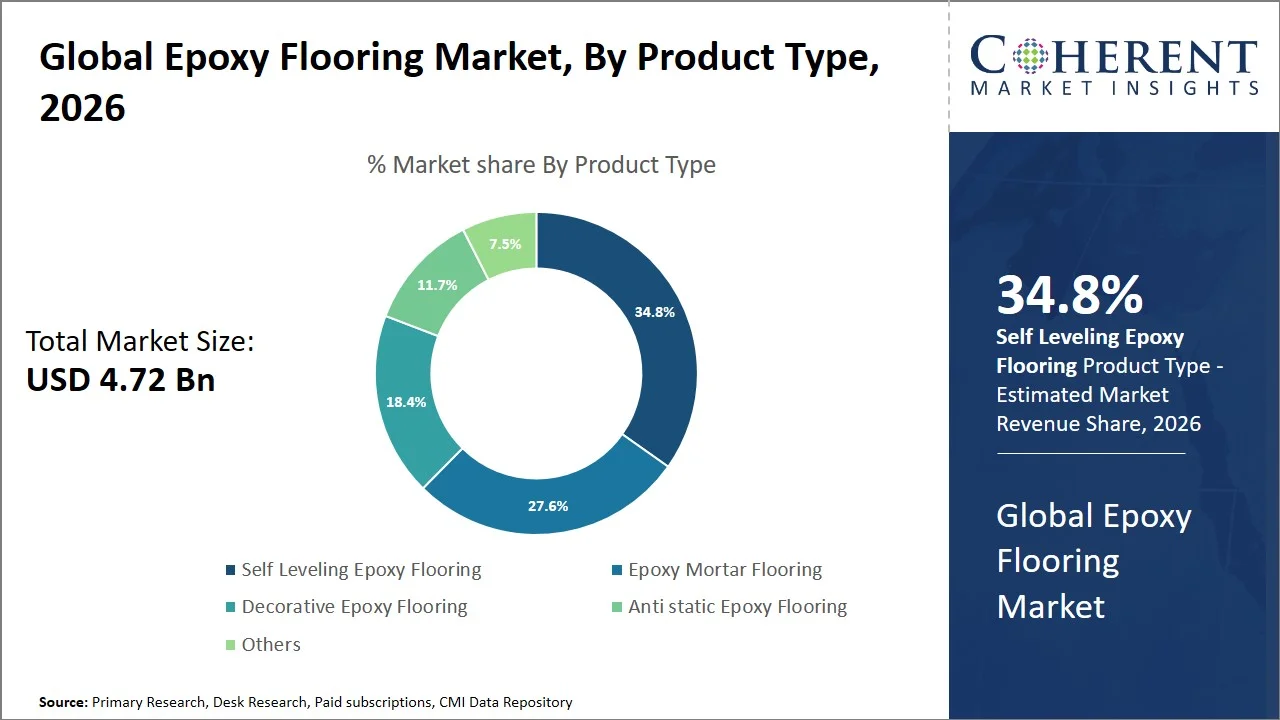
Why Does Self Leveling Epoxy Flooring Dominate the Global Epoxy Flooring Market?
Self Leveling Epoxy Flooring is expected to account for 34.8% of the global epoxy flooring market in 2026, supported by its ability to deliver seamless surfaces, uniform thickness, and efficient installation across large industrial and commercial spaces. The segment benefits from demand in warehouses, manufacturing facilities, laboratories, and cleanroom environments where smooth finishes reduce contamination risks and simplify maintenance activities. Manufacturers and contractors gain commercial advantages through faster project execution and reduced installation complexity compared with manually applied flooring systems. Growing preference for high-performance flooring solutions in refurbishment projects further strengthens adoption. In September 2024, Flowcrete launched its Flowshield seamless resin flooring systems designed for commercial and industrial environments, supporting wider use of advanced self-leveling flooring technologies.
- Current Industry Events of 2026
- Market Size Estimation
- Regional Breakdown
- Competitive Landscape
- Customer Intelligence
- Segmental Analysis
- Pricing Analysis
- Key Market Drivers, Challenges & Future Trends
- Customized Insights Section
Why Does Solvent Free Epoxy Represent the Largest Formulation Category in the Global Epoxy Flooring Market?
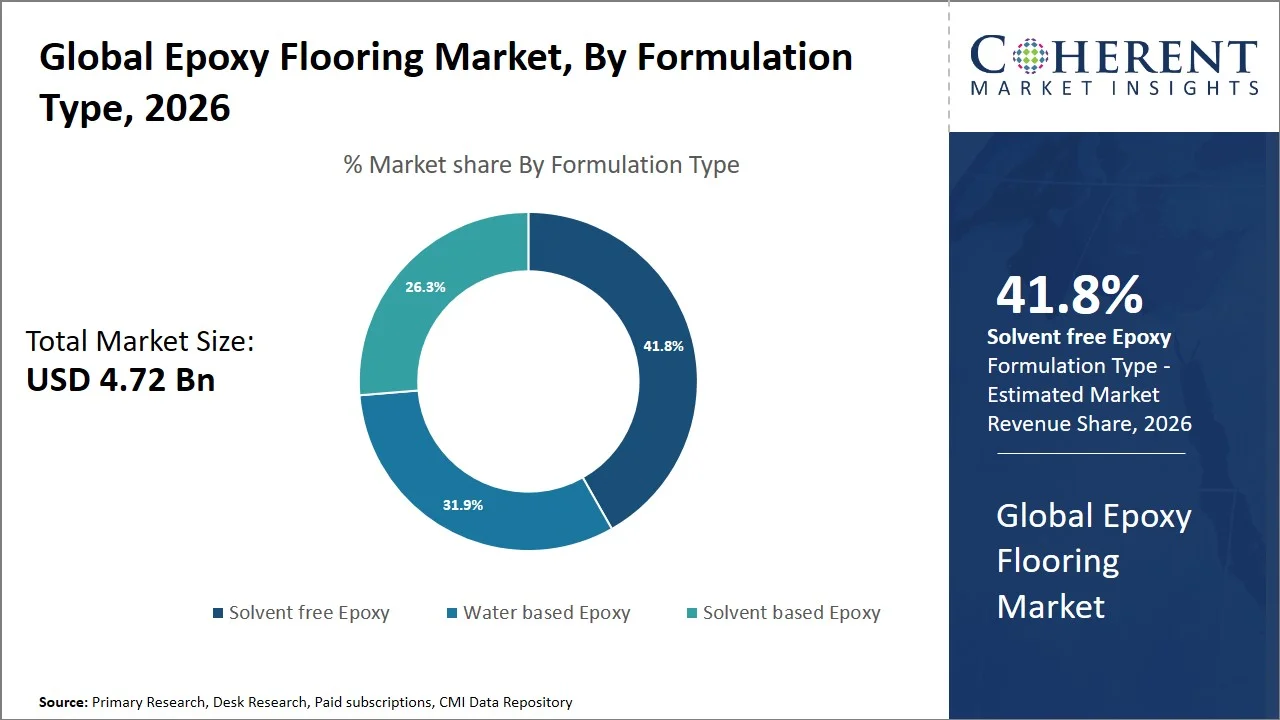
Solvent Free Epoxy is projected to represent 41.8% of the global epoxy flooring market in 2026, driven by its suitability for applications requiring strong mechanical performance, chemical resistance, and improved environmental compliance. Unlike solvent-containing alternatives, these formulations support lower-emission installation practices while maintaining durability in industrial environments such as processing plants, warehouses, and production facilities. Flooring manufacturers benefit from increasing customer preference for solutions that balance operational performance with workplace safety requirements. The segment also gains from advancements in resin chemistry that improve curing behavior and application efficiency. In November 2024, PPG introduced updated protective and floor coating solutions emphasizing sustainable coating technologies and performance requirements for industrial applications.
Why Does Industrial Application Dominate the Application Category of the Global Epoxy Flooring Market?
Industrial applications are expected to hold 49.6% of the global epoxy flooring market in 2026, supported by extensive usage across manufacturing plants, logistics facilities, automotive units, and processing industries where flooring performance directly affects operational continuity. Industrial buyers prioritize epoxy systems because they provide resistance against abrasion, impact, chemicals, and heavy equipment movement while reducing maintenance interruptions. Suppliers and installation specialists benefit from recurring demand linked to facility upgrades, expansion projects, and production environment improvements. The segment remains commercially important as industries increasingly evaluate flooring as part of overall facility efficiency and safety infrastructure. In June 2025, Toyota Material Handling expanded its manufacturing facility in the U.S., reflecting continued industrial infrastructure investment where durable flooring solutions are required for production environments.
Current Events and their Impact
Current Event | Description and Its Impact |
EU Construction Products Regulation Update – January 2025 |
|
U.S. EPA Chemical Safety and Risk Management Actions – 2025 |
|
China Green Building Standards Expansion – 2025 |
|
Global Epoxy Flooring Market Dynamics
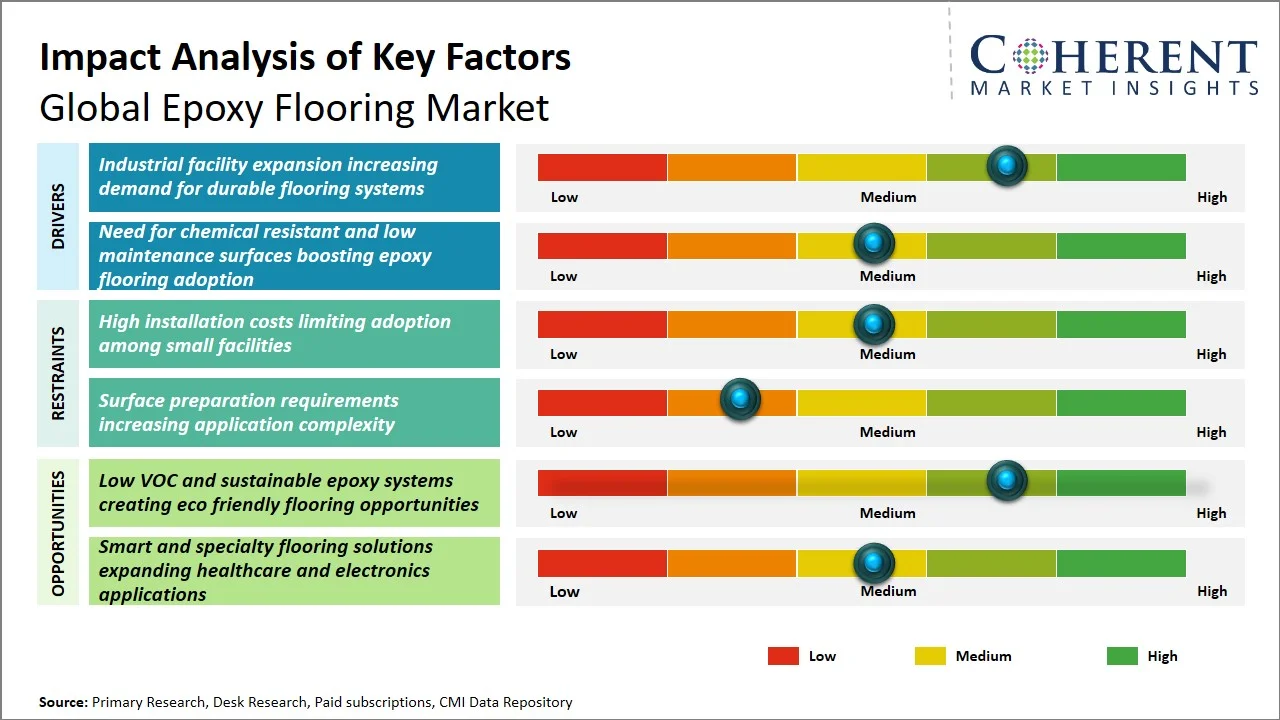
Key Market Drivers
- Industrial Facility Expansion Increasing Demand for Durable Flooring Systems: Expansion of manufacturing plants, logistics centers, processing units, and industrial warehouses is strengthening demand for epoxy flooring systems that provide mechanical durability, chemical resistance, and reduced maintenance requirements. Facility owners, contractors, and flooring suppliers benefit as epoxy solutions support longer operational cycles and minimize downtime caused by surface degradation. Automotive, food processing, pharmaceutical, and electronics facilities increasingly specify high-performance flooring during new construction and refurbishment projects. In February 2025, the U.S. Department of Energy announced additional investments supporting domestic industrial manufacturing capacity, creating demand for upgraded production infrastructure where protective flooring systems are required.
- Need for Chemical Resistant and Low Maintenance Surfaces Boosting Epoxy Flooring Adoption: Growing emphasis on operational efficiency and hygiene standards is increasing adoption of epoxy flooring in environments exposed to chemicals, moisture, abrasion, and heavy traffic. Industrial operators, healthcare facilities, laboratories, and food processing companies prefer epoxy systems because they provide seamless surfaces, easier cleaning, and lower lifecycle maintenance compared with conventional flooring alternatives. Manufacturers benefit from opportunities to develop specialized formulations addressing performance, safety, and regulatory requirements. In April 2025, the U.S. Food and Drug Administration continued emphasizing facility sanitation requirements for food processing environments, reinforcing demand for flooring systems compatible with strict hygiene practices.
Emerging Market Trends
- Shift Toward Low-Emission and Sustainable Epoxy Flooring Formulations: The epoxy flooring industry is increasingly moving toward formulations with reduced volatile organic compounds, improved indoor air quality characteristics, and lower environmental impact. Manufacturers are investing in water-based, solvent-free, and bio-content epoxy technologies to address changing building standards and customer sustainability expectations. This transition is influencing product development strategies, especially among suppliers serving commercial buildings, healthcare facilities, and industrial customers seeking environmentally responsible materials. Companies with strong formulation capabilities and compliance expertise are positioned to capture premium opportunities, while traditional solvent-heavy systems may face increasing specification challenges.
- Growing Integration of Decorative and Functional Flooring Solutions: Epoxy flooring demand is evolving beyond industrial protection toward solutions combining aesthetics, branding, safety, and performance. Commercial spaces, retail facilities, hospitality venues, and institutional buildings are increasingly adopting decorative epoxy systems that provide customized finishes while maintaining durability advantages. This trend is encouraging flooring contractors and manufacturers to expand design capabilities, including color customization, textured surfaces, and specialized finishes. Companies capable of delivering both technical performance and visual customization are likely to gain stronger relationships with architects, designers, and facility owners during project specification stages.
Regional Insights
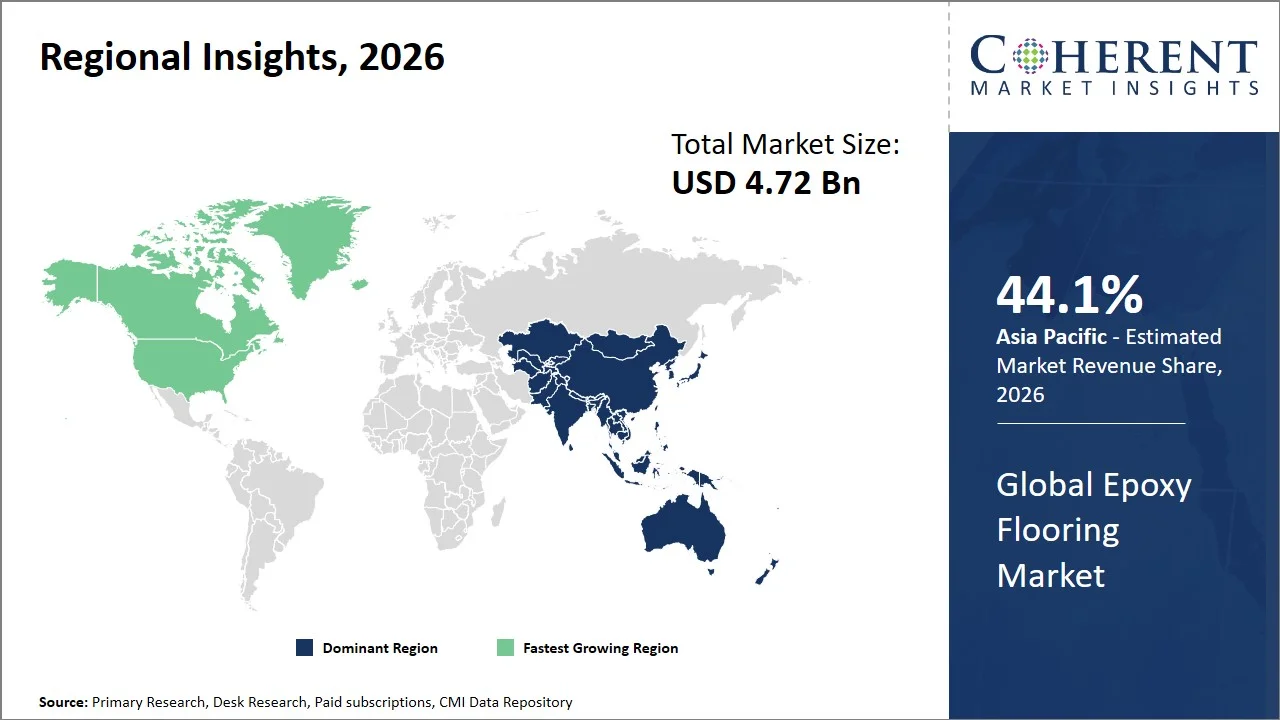
Why Does Asia Pacific Dominate the Global Epoxy Flooring Market?
Asia Pacific is projected to maintain its leading position in the global epoxy flooring market, accounting for a 44.1% share in 2026. This dominance is supported by rapid manufacturing expansion, warehouse construction, infrastructure modernization, and rising demand for durable flooring systems across industrial facilities. China and India are driving regional growth through investments in automotive, electronics, pharmaceutical, food processing, and logistics infrastructure, where chemical resistance, hygiene, and long service life are critical requirements. The region is also witnessing strong construction activity and a growing shift toward advanced protective flooring solutions instead of conventional materials. In February 2025, India’s Ministry of Statistics and Programmer Implementation reported continued growth in the country’s infrastructure and construction-related activity, supported by public and private capital expenditure. This expansion is increasing demand for durable, low-maintenance flooring systems in factories, warehouses, transport facilities, and commercial infrastructure
Why Is North America Emerging as the Fastest-Growing Region in the Global Epoxy Flooring Market?
North America is expected to account 24.2% of the global epoxy flooring market in 2026, driven by renovation of industrial facilities, growth of distribution centers, increasing demand for high-performance commercial flooring, and stricter expectations for workplace safety and maintenance efficiency. The region’s mature manufacturing ecosystem and emphasis on lifecycle cost reduction encourage adoption of epoxy systems in warehouses, healthcare facilities, food processing units, and commercial buildings. In June 2025, the U.S. Department of Energy highlighted continued investments in advanced manufacturing facilities and domestic industrial capacity, supporting the need for durable facility infrastructure solutions.
Global Epoxy Flooring Market Outlook for Key Countries
Why Is the U.S. a Key Market for the Global Epoxy Flooring Market?
The U.S. is estimated to represent 19.5% share of the global epoxy flooring market in 2026, supported by extensive industrial infrastructure, advanced warehousing networks, healthcare construction, and demand for low-maintenance flooring solutions. Epoxy flooring adoption remains strong across manufacturing plants, automotive facilities, commercial spaces, and logistics centers because of its resistance to abrasion, chemicals, and heavy traffic. The country’s focus on reshoring manufacturing activities and upgrading industrial assets further strengthens market opportunities for specialized flooring providers. In 2025, the U.S. continued expanding domestic manufacturing investment programs, creating additional demand for industrial facility upgrades requiring durable surface protection systems.
Why Is India Important in the Global Epoxy Flooring Market?
India is expected to account for approximately 8.7% share of the global epoxy flooring market in 2026, supported by rapid industrialization, pharmaceutical manufacturing expansion, organized warehousing growth, and increasing investments in modern production facilities. Epoxy flooring is increasingly preferred in Indian industrial environments where hygiene compliance, easy maintenance, and resistance to chemical exposure are important operational requirements. Growth in food processing, automotive manufacturing, electronics assembly, and logistics infrastructure is creating additional opportunities for industrial-grade flooring solutions. In 2025, India continued promoting manufacturing expansion through industrial investment initiatives and production-focused policies, strengthening the need for upgraded factory infrastructure and specialized flooring applications.
Why Does China Support Growth in the Global Epoxy Flooring Market?
China is projected to contribute 15.2% share of the global epoxy flooring market in 2026, supported by its extensive manufacturing base, construction ecosystem, raw material availability, and concentration of industrial facilities. The country’s large automotive, electronics, chemical, and logistics sectors require flooring systems capable of supporting heavy operations, contamination control, and frequent maintenance cycles. Domestic production capabilities for epoxy resins and coatings also provide supply advantages for regional manufacturers and contractors. In February 2025, China’s Ministry of Commerce introduced measures to stabilize foreign investment and support advanced industrial development, reinforcing continued manufacturing activity that supports demand for industrial flooring solutions.
Why Is Germany a Strategic Country in the Global Epoxy Flooring Market?
Germany is expected to hold 6.4% share of the global epoxy flooring market in 2026, supported by its advanced manufacturing sector, automotive production base, engineering industries, and strong emphasis on sustainable building practices. Epoxy flooring solutions are widely relevant in German industrial environments where precision manufacturing, clean production areas, and durable facility surfaces are critical. Regulatory focus on lower emissions and environmentally responsible coatings is also encouraging innovation in advanced flooring formulations. In December 2025, the European Commission established updated EU Ecolabel criteria covering performance coatings and related products, including floor coatings, strengthening sustainability considerations for coating applications across European markets.
Why Is Brazil an Important Growth Market for the Global Epoxy Flooring Market?
Brazil is expected to represent 3.8% share of the global epoxy flooring market in 2026, supported by industrial activity, food and beverage processing, automotive production, agricultural supply chains, and modernization of commercial facilities. Demand for epoxy flooring is increasing in environments requiring resistance to moisture, chemicals, and operational wear, particularly warehouses, processing units, and industrial plants. Brazil’s position as a major agricultural and manufacturing economy creates opportunities for flooring solutions that improve facility durability and hygiene standards. In 2025, Brazil continued attracting industrial investment across manufacturing and infrastructure sectors, supporting expansion of facilities that require protective flooring systems.
Product Innovation and Market Differentiation Landscape
Innovation Area | Key Application Area | Strategic Impact |
Performance-Enhanced Flooring Systems | Industrial plants, warehouses, heavy-duty facilities | Improves durability, chemical resistance, and lifecycle performance, helping suppliers compete in demanding industrial applications. |
Sustainable Flooring Solutions | Green buildings, commercial projects, institutional facilities | Supports compliance with environmental requirements and increases acceptance among sustainability-focused buyers. |
Decorative and Customized Flooring Solutions | Retail, hospitality, premium commercial spaces | Enables value-added offerings through customized designs, finishes, and aesthetic differentiation beyond functional flooring. |
Hygiene-Focused Flooring Solutions | Healthcare, food processing, pharmaceutical facilities | Addresses strict cleanliness requirements through seamless, easy-to-maintain surfaces suitable for controlled environments. |
Specialty Flooring Solutions | Electronics, laboratories, safety-critical facilities | Creates niche opportunities through application-specific performance such as static control, safety, and operational reliability. |
How Are Low-Emission and Performance-Enhanced Epoxy Formulations Creating New Growth Opportunities in the Global Epoxy Flooring Market?
Low-emission and advanced-performance epoxy formulations represent a significant opportunity as customers increasingly evaluate flooring systems based on environmental compliance, lifecycle cost, and operational reliability rather than only installation price. This opportunity is particularly relevant for healthcare facilities, food processing plants, electronics manufacturing units, and commercial buildings where odor control, hygiene, and durability influence purchasing decisions. Manufacturers capable of combining solvent-free chemistry, improved curing performance, and application-specific formulations can capture premium positioning. The opportunity favors companies with strong formulation expertise, regional technical support networks, and partnerships with contractors and construction specialists. Suppliers entering this space will need investment in research capabilities, regulatory compliance, and customized product portfolios to address diverse end-user requirements across industrial and commercial applications.
Market Players, Key Development, and Competitive Landscape
Key Developments
- In March 2025, Westlake Corporation introduced its EpoVIVE portfolio of lower-VOC waterborne epoxy resin dispersions at the European Coatings Show. This development is important for the global epoxy flooring market because it supports demand for cleaner formulation technologies and enables flooring manufacturers to develop compliant high-performance systems.
- In January 2025, RPM International Inc continued strengthening its industrial flooring solutions portfolio through its flooring businesses, including systems designed for protective and high-performance environments. This is important for the global epoxy flooring market because RPM’s integrated coating and flooring capabilities enhance access to industrial customers requiring specialized surface protection solutions.
- In May 2024, the Sherwin-Williams Company expanded production capability for its non-BPA epoxy coatings portfolio in Europe through increased manufacturing availability of its valPure V70 series. This is important for the global epoxy flooring market because it demonstrates continued investment in advanced epoxy chemistry and regional supply capabilities for performance coating applications.
Competitive Landscape
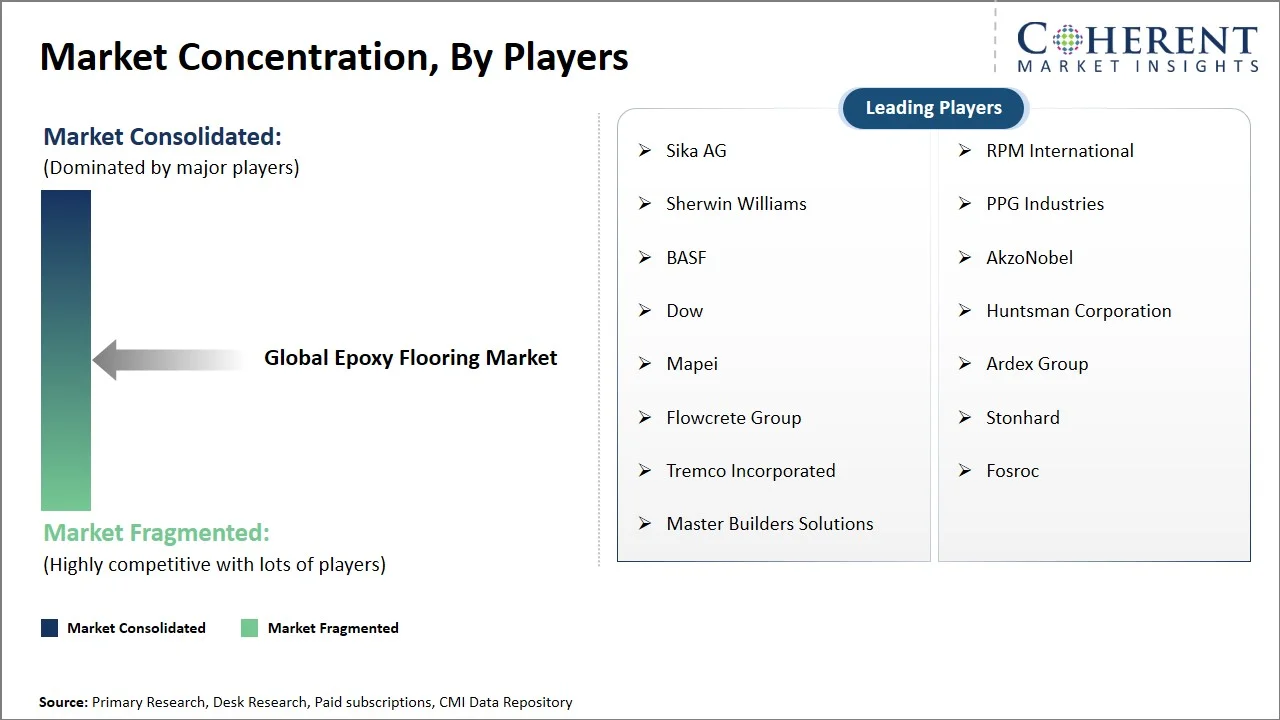
The global epoxy flooring market is moderately consolidated, with multinational coating manufacturers competing alongside regional flooring specialists and application contractors. Competition is influenced by formulation performance, durability, installation expertise, pricing, distribution networks, and compliance capabilities. Global suppliers focus on advanced resin technologies and broad product portfolios, while regional players compete through localized service, faster delivery, and application-specific solutions. Key Focus Areas Include:
- Product durability, chemical resistance, and long-term performance differentiation
- Development of low-VOC and environmentally compliant epoxy formulations
- Manufacturing capacity and reliable supply of epoxy resins and curing agents
- Contractor networks and technical installation support capabilities
- Customization of decorative, industrial, and specialty flooring systems
- Compliance with regional environmental and safety standards
- Pricing competitiveness and lifecycle cost advantages
- Expansion into emerging industrial and commercial construction markets
Market Report Scope
Epoxy Flooring Market Report Coverage
| Report Coverage | Details | ||
|---|---|---|---|
| Base Year: | 2025 | Market Size in 2026: | USD 4.72 Bn |
| Historical Data for: | 2020 To 2024 | Forecast Period: | 2026 To 2033 |
| Forecast Period 2026 to 2033 CAGR: | 6.4% | 2033 Value Projection: | USD 7.60 Bn |
| Geographies covered: |
| ||
| Segments covered: |
| ||
| Companies covered: | Sika AG, RPM International, Sherwin Williams, PPG Industries, BASF, AkzoNobel, Dow, Huntsman Corporation, Mapei, Ardex Group, Flowcrete Group, Stonhard, Tremco Incorporated, Fosroc, Master Builders Solutions | ||
| Growth Drivers: |
| ||
| Restraints & Challenges: |
| ||
Analyst Opinion (Expert Opinion)
- The global epoxy flooring market is likely to move from traditional product-based competition toward solution-oriented offerings where manufacturers provide complete flooring systems, including formulation selection, technical guidance, installation support, and lifecycle maintenance expertise. Companies able to integrate material science with application services will have stronger opportunities to influence customer specifications.
- A major market transformation could emerge from the convergence of sustainability requirements and performance expectations. Flooring suppliers that successfully develop environmentally compliant formulations without sacrificing chemical resistance, curing speed, and durability may reshape competitive positioning, while suppliers dependent on conventional high-emission products may face specification limitations.
- Market participants should prioritize formulation innovation, contractor relationships, and localized technical capabilities. Companies should focus on industrial sectors where flooring performance directly affects operational efficiency while monitoring risks from raw material volatility, regulatory changes, and application skill shortages. Overinvestment in undifferentiated commodity flooring systems may create margin pressure as competition intensifies.
Speak to the analyst
Want personalized insights?
Take the findings above to one of our principal consultants, or have the report rebuilt around the segments, geographies and competitors you actually track.
Market Segmentation
- Product Type Insights (Revenue, USD Bn, 2021 - 2033)
- Self Leveling Epoxy Flooring
- Epoxy Mortar Flooring
- Decorative Epoxy Flooring
- Anti static Epoxy Flooring
- Others
- Formulation Type Insights (Revenue, USD Bn, 2021 - 2033)
- Solvent free Epoxy
- Water based Epoxy
- Solvent based Epoxy
- Application Insights (Revenue, USD Bn, 2021 - 2033)
- Industrial
- Commercial
- Residential
- End Use Industry Insights (Revenue, USD Bn, 2021 - 2033)
- Manufacturing and Warehousing
- Healthcare and Pharmaceuticals
- Food and Beverage Processing
- Automotive
- Retail and Hospitality
- Others
- Distribution Channel Insights (Revenue, USD Bn, 2021 - 2033)
- Direct Sales
- Indirect Sales
- Regional Insights (Revenue, USD Bn, 2021 - 2033)
- North America
- U.S.
- Canada
- Latin America
- Brazil
- Argentina
- Mexico
- Rest of Latin America
- Europe
- Germany
- U.K.
- Spain
- France
- Italy
- Russia
- Rest of Europe
- Asia Pacific
- China
- India
- Japan
- Australia
- South Korea
- ASEAN
- Rest of Asia Pacific
- Middle East
- GCC Countries
- Israel
- Rest of Middle East
- Africa
- South Africa
- North Africa
- Central Africa
- North America
- Key Players Insights
- Sika AG
- RPM International
- Sherwin Williams
- PPG Industries
- BASF
- AkzoNobel
- Dow
- Huntsman Corporation
- Mapei
- Ardex Group
- Flowcrete Group
- Stonhard
- Tremco Incorporated
- Fosroc
- Master Builders Solutions
Sources
Primary Research Interviews
- Epoxy flooring manufacturers, resin producers, coating suppliers, flooring contractors, applicators, architects, construction companies, and industrial facility operators
- Product development specialists, flooring consultants, construction experts, and surface coating professionals
Stakeholders
- Epoxy resin manufacturers, flooring solution providers, raw material suppliers, distributors, contractors, and construction service companies
- Industrial facility owners, commercial developers, healthcare facilities, warehouses, and infrastructure project operators
End-use Sectors
- Manufacturing and industrial facilities
- Warehousing and logistics centers
- Healthcare and pharmaceutical facilities
- Food and beverage processing units
- Commercial, retail, hospitality, and residential spaces
Regulatory and Industry Bodies
- Construction and building material regulatory authorities
- Environmental and chemical safety organizations
- Green building certification organizations
- Industrial safety and workplace compliance bodies
- International construction standards organizations
Databases
- UN Comtrade and ITC Trade Map – epoxy resin, flooring material, coating, and construction product trade analysis
- Government import-export databases and customs records
- Company annual reports, investor presentations, product catalogues, and technical documentation
- Construction industry databases and coating market intelligence sources
Magazines and Journals
- Coatings World
- European Coatings Journal
- Construction Chemicals Magazine
- Paint & Coatings Industry (PCI) Magazine
- Journal of Coatings Technology and Research
Associations
- American Coatings Association (ACA)
- European Association of Paints, Printing Inks and Artists’ Colours (CEPE)
- World Floor Covering Association (WFCA)
- National Association of Floor Covering Technicians (NAFCT)
- Construction and building material industry organizations
Public Domain Sources
- Construction industry development reports and infrastructure investment updates
- Flooring technology developments, product innovations, and sustainability initiatives
- Chemical safety guidelines and environmental compliance updates
- Trade statistics and industrial construction publications related to flooring materials
Key Standards and Regulations
- Building material safety and performance standards
- VOC emission and environmental compliance requirements
- Chemical handling and workplace safety regulations
- Green building and sustainability certification standards
- Quality management standards for coating and flooring manufacturing processes
Proprietary Elements
- CMI Data Analytics Tool, Proprietary CMI Existing Repository of information for the last 10 years
Get access to 250+ pages report
Every segment, forecast, competitor profile and data table behind the analysis above — available for instant download.
- ESOMAR Member
- ISO 9001:2015 Certified
- D-U-N-S Registered
- GDPR & CCPA Compliant
Missing comfort of reading report in your local language? Find your preferred language:
Transform your Strategy with Exclusive Trending Reports
Frequently Asked Questions
The global epoxy flooring market is estimated to be valued at USD 4.72 billion in 2026 and is expected to reach USD 7.60 billion by 2033.
The CAGR of global epoxy flooring market is projected to be 6.4% from 2026 to 2033.
Epoxy flooring is widely used in manufacturing facilities, warehouses, automotive plants, healthcare facilities, food processing units, commercial buildings, retail spaces, and residential applications due to its durability and protective properties.
Epoxy flooring offers benefits such as high resistance to chemicals, abrasion, impact, and moisture, along with easier maintenance, seamless finishes, and longer service life compared with conventional flooring materials.
Companies should evaluate application requirements, surface conditions, environmental exposure, expected traffic levels, maintenance needs, installation expertise, and compliance requirements before selecting an epoxy flooring system.
Major end users include industrial manufacturers, warehouse operators, healthcare facilities, pharmaceutical companies, food and beverage processors, automotive companies, commercial property owners, and construction contractors.
Industrial facility expansion increasing demand for durable flooring systems and need for chemical resistant and low maintenance surfaces boosting epoxy flooring adoption are the major factors driving the growth of global epoxy flooring market.