

Power Tools Market Size and Forecast – 2026 to 2033
Power Tools Market is estimated to be valued at USD 38,234.7 Mn in 2026 and is expected to reach USD 67,943.3 Mn in 2033, exhibiting a compound annual growth rate (CAGR) of 8.6% from 2026 to 2033.
Key Takeaways
- By Tool Type, Drilling Solutions hold the largest market share of 38.1% in 2026 owing to its growth in construction & infrastructure.
- By Mode of Operations, Electric (Cordless) expected to hold largest market share of 49.9% in 2026 owing to its advancements in battery & motor technology.
- By Applications, Industrial acquired the prominent market share of 58.3% in 2026 owing to the industrial automation & manufacturing modernization.
- By Region, Asia Pacific dominates the overall market with an estimated share of 34.7% in 2026 owing to the infrastructure & urbanization boom.
Market Overview
The global power tools market offers a broad array of electric, pneumatic, and manual tools that serve the construction, manufacturing, and DIY sectors. Rising infrastructure development, industrialization, and urbanization drive market growth, while users increasingly adopt cordless and technologically advanced tools. Manufacturers introduce innovations like ergonomic designs, battery-powered mobility, and smart connectivity to enhance efficiency and convenience. Growing consumer awareness, the DIY trend, and expanded distribution channels actively fuel demand, especially in emerging markets across Asia-Pacific and Latin America.
Current Events and their Impact on the Power Tools Market
Current Events | Description and its impact |
Macro-Level Economic Trends |
|
Technological Advancements and Innovation |
|
Geopolitical and Trade Dynamics |
|
Segmental Insights
- Current Industry Events of 2026
- Market Size Estimation
- Regional Breakdown
- Competitive Landscape
- Customer Intelligence
- Segmental Analysis
- Pricing Analysis
- Key Market Drivers, Challenges & Future Trends
- Customized Insights Section
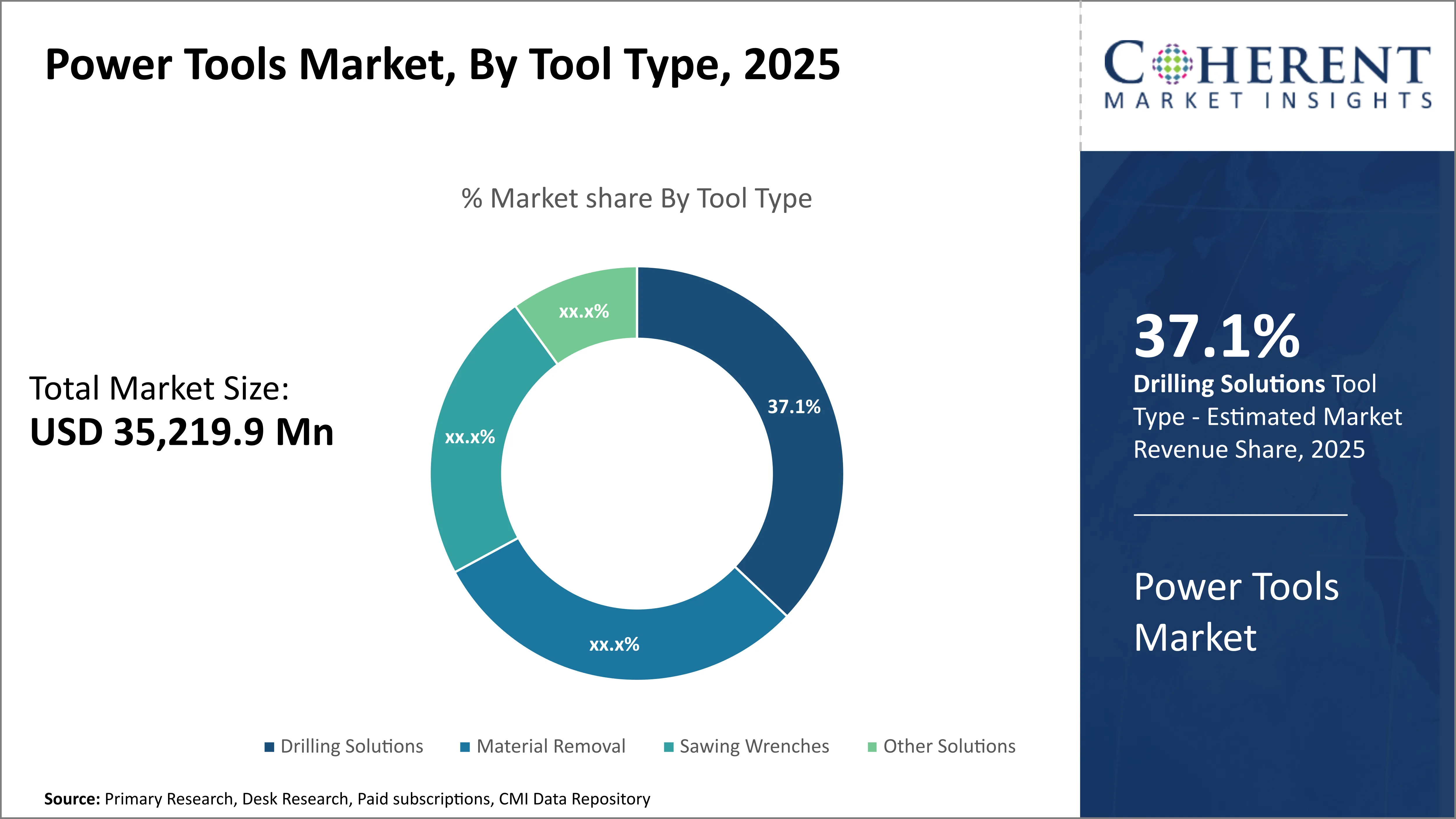
Power Tools Market Insights, By Tool Type: Drilling Solutions contribute the highest share of the market owing to its DIY/home improvement culture.
Drilling Solutions hold the largest market share of 38.1% in 2026. The drilling solutions segment in the power‑tools market grows as infrastructure and construction projects increase the need for reliable, efficient equipment. Advances in battery technology, brushless motors, and cordless models boost mobility and simplify usage. The rising DIY and home renovation culture motivates consumers to buy user-friendly drilling tools. Industries such as manufacturing, automotive, and aerospace drive demand for advanced, high-precision drilling solutions. Expanding distribution networks and entry into emerging markets actively reinforce this market growth. For instance, in July 2025, Versalis, the chemical arm of E, launched Versalis Oilfield Solutions S.r.l. to spin off its Oilfield Chemicals unit into a standalone subsidiary, focusing operations and driving growth in the global oil drilling industry.
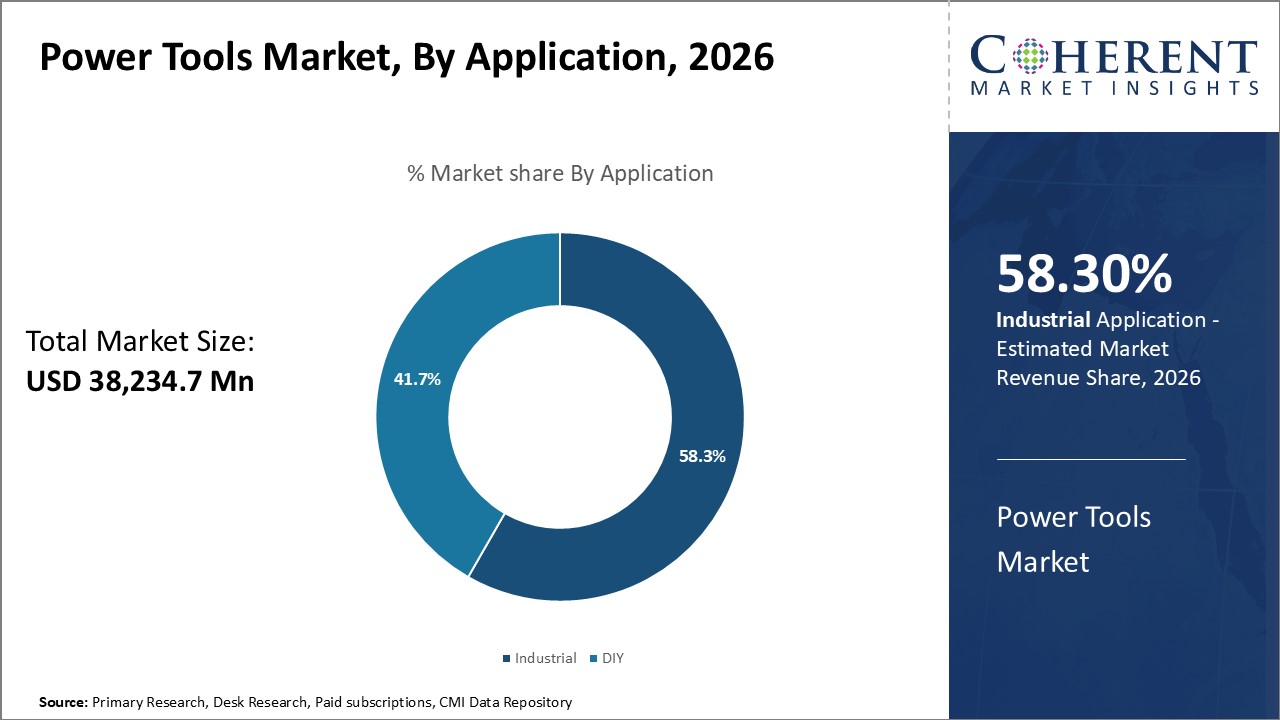
Power Tools Market Insights, By Application: Industrial contribute the highest share of the market owing to its infrastructure, construction & heavy industry expansion.
Industrial acquired the prominent market share of 58.3% in 2026. Factory automation drives the industrial segment in the power‑tools market, as manufacturers adopt high-performance tools to achieve precision, reliability, and productivity. Expanding industrial construction, growing manufacturing activities, and heavy-duty applications push companies to use rugged, durable tools designed for continuous operation. Increasing safety requirements and the demand for efficient maintenance and tool fleet management motivate industries to invest in advanced equipment. Expanding global distribution and the move toward electrified, battery-powered systems actively accelerate the adoption of industrial power tools. For instance, in March 2025, Bosch Limited, a leading global technology and services provider, launched its latest Hand Tools for professionals and artisans, along with advanced Industrial Tools to streamline assembly line operations.
Power Tools Market Insights, By Mode of Operation: Electric (Cordless) contribute the highest share of the market owing to its mobility, flexibility & safety on job sites.
Electric (Cordless) expected to hold largest market share of 49.9% in 2026. Breakthroughs in lithium‑ion batteries and brushless motor technology drive the growth of cordless power tools, providing longer runtime, lighter weight, and faster charging. By eliminating cords, these tools give users greater flexibility, mobility, and safety both on worksites and at home. The rising home-improvement trend and expanding DIY culture encourage consumers to choose convenient, easy-to-use cordless tools. Professionals in construction, manufacturing, and maintenance increasingly rely on cordless platforms for their portability, efficiency, and ease of operation. For instance, in October 2024, Bosch Power Tools launched new products that expand its cordless 18V lineup.
Regional Insights
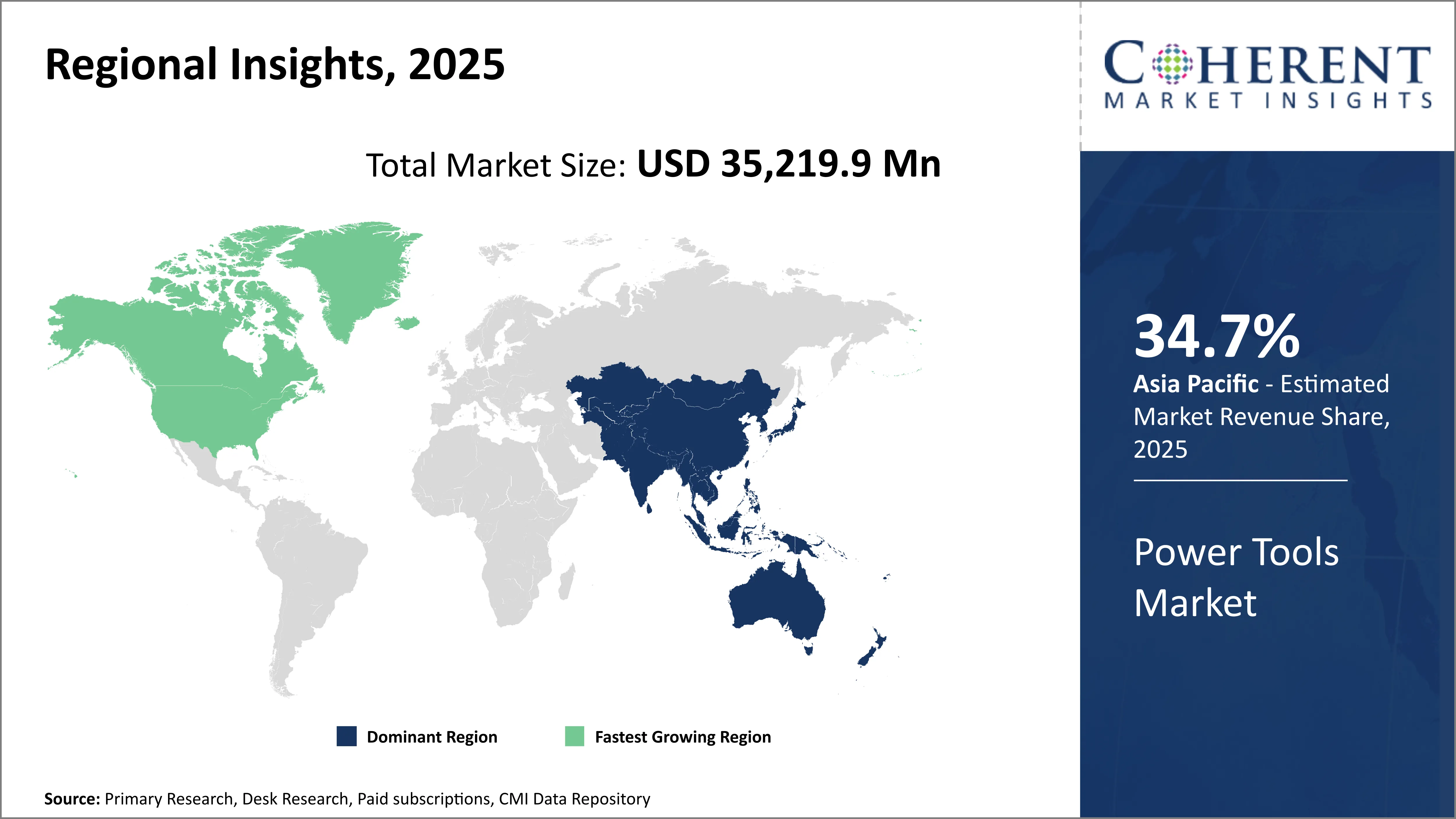
Asia Pacific Power Tools Market Trends
Asia Pacific dominates the overall market with an estimated share of 34.7% in 2026. The Asia‑Pacific power‑tools market is rapidly evolving, driven by several key trends. Expanding infrastructure projects and growing urbanization increase the demand for durable construction and renovation tools. Online retail growth makes advanced cordless and battery-powered tools more accessible to both professionals and DIY users. Manufacturers actively launch lighter, ergonomically designed models with smart features to attract urban consumers. Simultaneously, local manufacturing hubs expand production to meet regional demand and support exports.
North America Power Tools Market Trends
The North American power‑tools market increasingly favors premium, professional-grade equipment as contractors and dedicated DIYers prioritize performance over cost. Brands actively integrate smart technology and battery ecosystems, offering brushless motors, built-in diagnostics, and seamless tool-to-battery compatibility. Homeowners continue to drive the DIY segment by handling renovations and repairs themselves. At the same time, ongoing construction, maintenance, and manufacturing activities sustain strong demand for durable corded and cordless power tools throughout the region. For instance, in January 2026, Bosch Power Tools unveiled over 15 new products in the first quarter of 2026, mostly within its 18V category. The company will also introduce more than 30 cordless tools, batteries, and chargers for the third consecutive year, reinforcing its commitment to cordless technology and expanding its offerings across multiple trades.
India Power Tools Market Trends
Rapid urban expansion and infrastructure projects are boosting demand for construction-grade power tools in India. Manufacturing hubs and the automotive supply chain are increasingly adopting high-performance, cordless, and smart tools. Middle-income consumers actively drive the DIY segment by choosing compact, user-friendly models. Meanwhile, e-commerce platforms and organized retail channels expand access to tools across tier‑2 and tier‑3 cities, while local manufacturers ramp up production to meet growing domestic demand. For instance, in September 2026, OJUS Power and Technologies Pvt Ltd (Ojus), a leading Indian power and engineering solutions provider, partnered with Hitachi Industrial Equipment Systems (HIES) to launch a new range of industrial air compressors for the Indian market.
United States Power Tools Market Trends
The U.S. power‑tools market increasingly adopts cordless and smart-enabled platforms as professionals and homeowners seek greater flexibility and connectivity. Manufacturers actively introduce brushless motors, integrated diagnostics, and battery systems that manage tool fleets and track data. The DIY boom drives consumers to choose compact, user-friendly tools, while ongoing construction and industrial maintenance sustain strong demand in professional segments. At the same time, production sites and supply chains adapt to material costs, regulatory standards, and export opportunities.
End-user Feedback and Unmet Needs in the Power Tools Market
- Durability and Reliability Concerns: Users often report that tools wear out quickly under heavy or continuous use. There is a demand for products with more robust construction, longer lifespans, and better resistance to heat, dust, and moisture, especially for professional and industrial applications where downtime affects productivity.
- Battery Life and Charging Limitations: Cordless tool users frequently highlight insufficient battery runtime and long charging periods as major pain points. End-users seek longer-lasting batteries, faster charging solutions, and improved battery management systems that maintain consistent power for extended tasks without performance drops.
- Ergonomics and User Comfort: Consumers and professionals often experience fatigue or strain during extended use. Tools with poor weight distribution, grip design, or vibration control create challenges. Users desire ergonomic designs, lighter materials, and anti-vibration technology that reduce physical stress and improve efficiency during prolonged operations.
Power Tools Market Trend
Smart & Connected Tools
Manufacturers are increasingly embedding digital features into power tools—Bluetooth connectivity, IoT sensors, real‑time usage monitoring and predictive maintenance capabilities are becoming standard. These smart tools appeal to professional users managing fleets on job sites, enabling oversight of battery health, tool usage and inventory. At the same time, they offer advanced functionality to tech‑savvy consumers in DIY segments. As construction and manufacturing adopt more data‑driven processes, power‑tool ecosystems evolve to support connectivity, analytics and integration with workflows rather than simply offering raw power.
Cordless & Battery‑Driven Evolution
The shift from corded to cordless platforms is accelerating, thanks to advances in lithium‑ion batteries, higher energy density, faster charging and brushless motors. Portability, flexibility and convenience are now key decision factors—and cordless tools meet the needs of job sites without power outlets, remote maintenance tasks, and DIY projects. With industry‑grade performance increasingly matching corded models, professionals and hobbyists alike embrace the freedom of no cables. Manufacturers are launching integrated battery systems and ecosystem kits, moving away from single‑tool sales toward platform strategy.
Power Tools Market Opportunity
Cordless & Battery Platform Expansion
As cordless technology continues to evolve, there is significant opportunity in developing universal battery platforms, fast‑charging solutions and high‑power cordless tools that match traditional corded performance. Brands can promote ecosystem lock‑in by offering multiple tools that share the same battery pack and charger, reducing total system cost for users. For markets with limited power infrastructure or remote job sites, battery‑powered tools offer clear advantages. Manufacturers can also launch accessory kits, retrofit solutions and battery upgrade programmes to accelerate adoption and drive repeat sales.
Market Report Scope
Power Tools Market Report Coverage
| Report Coverage | Details | ||
|---|---|---|---|
| Base Year: | 2025 | Market Size in 2026: | USD 38,234.7 Mn |
| Historical Data for: | 2020 To 2024 | Forecast Period: | 2026 To 2033 |
| Forecast Period 2026 to 2033 CAGR: | 8.6% | 2033 Value Projection: | USD 67,943.3 Mn |
| Geographies covered: |
| ||
| Segments covered: |
| ||
| Companies covered: | Apex Tool Group LLC, Atlas Copco AB, Emerson Electric, Co Techtronic Industries, Hilti Corporation, Stanley Black & Decker, Ingersoll-Rand plc, Robert Bosch, Koki Holdings Co., Ltd., and Makita Corporation. | ||
| Growth Drivers: |
| ||
| Restraints & Challenges: |
| ||
Power Tools Market News
- In August 2025, Kreg Tool launched its first cordless power tool line, debuting 23 SKUs at the start of the month, including core and specialty woodworking tools like the Kreg Rebel Ionic Drive 20V pocket hole joiner.
- In July 2025, Renesas Electronics Corporation launched the RA2T1 microcontroller series, built on the Arm® Cortex®-M23 processor and optimized for motor control. Designed for single-motor applications, it targets products like fans, power tools, vacuum cleaners, refrigerators, printers, and hair dryers.
Analyst Opinion (Expert Opinion)
- The professional and industrial sectors continue to anchor the power tools market, with the industrial/professional segment accounting for roughly 71% of revenue in 2024, and electric tools dominating at about 72% of the mix. In my view, this underscores a fundamental shift: tool manufacturers that confine themselves to the consumer DIY space risk missing the real engines of growth—heavy‑duty, connected, industrial‑grade platforms are where margin and scale converge.
- The transition to cordless, lithium‑ion platforms isn’t merely about convenience for homeowners—it’s now standard in job‑site environments. One report notes cordless variants are gaining fastest growth in the segment. My belief is that the next wave will focus on ecosystems—battery systems, tool fleets, diagnostics—rather than standalone devices. Brands that lock a professional contractor into their battery/charger suite will strengthen customer loyalty and raise switching barriers.
- With the Asia‑Pacific region holding over 34.7% of market share in 2025 and being identified as the largest region, the real opportunity lies not in saturated Western markets, but in emerging markets where industrialization, infrastructure build‑out and urbanization are accelerating. However, success there will depend on localized service, distribution, and product adaptation—not just global standard platforms.
Speak to the analyst
Want personalized insights?
Take the findings above to one of our principal consultants, or have the report rebuilt around the segments, geographies and competitors you actually track.
Market Segmentation
- Global Power Tools Market, By Tool Type
- Drilling Solutions
- Material Removal
- Sawing
- Wrenches
- Other Solutions
- Global Power Tools Market, By Mode of Operation
- Electric
- Corded
- Cordless
- Pneumatic
- Electric
- Global Power Tools Market, By Application
- Industrial
- DIY
- Regional Insights (Revenue, USD Mn, 2021 - 2033)
- North America
- U.S.
- Canada
- Latin America
- Brazil
- Argentina
- Mexico
- Rest of Latin America
- Europe
- Germany
- K.
- Spain
- France
- Italy
- Russia
- Rest of Europe
- Asia Pacific
- China
- India
- Japan
- Australia
- South Korea
- ASEAN
- Rest of Asia Pacific
- Middle East
- GCC Countries
- Israel
- Rest of Middle East
- Africa
- South Africa
- North Africa
- Central Africa
- North America
- Key Players Insights
- Apex Tool Group LLC
- Atlas Copco AB
- Emerson Electric
- Co Techtronic Industries
- Hilti Corporation
- Stanley Black & Decker
- Ingersoll-Rand plc
- Robert Bosch
- Koki Holdings Co., Ltd.
- Makita Corporation.
Sources
Primary Research interviews
- Interviews with professionals from construction, manufacturing, and automotive industries
- Discussions with tool distributors, wholesalers, and retail chains
- Insights from DIY community leaders and professional tradespeople
- Consultations with maintenance and facility management heads in industrial setups
Databases
- U.S. Energy Information Administration (EIA) Industrial Data
- International Trade Centre (ITC) Trade Statistics
- National Institute of Standards and Technology (NIST) databases
- Customs and import-export databases for machinery and equipment
Magazines
- Tooling & Production
- Construction Equipment
- Modern Machine Shop
- Hardware + Tools Today
Journals
- Journal of Manufacturing Processes
- Journal of Industrial Engineering and Management
- International Journal of Production Research
- Applied Ergonomics
Newspapers
- The Wall Street Journal – Industry & Technology Section
- The New York Times – Business Section
- Financial Times – Manufacturing & Industry
- The Economic Times – Industrial & Construction News
Associations
- Association of Equipment Manufacturers (AEM)
- Power Tool Institute (PTI)
- National Association of Home Builders (NAHB)
- Industrial Supply Association (ISA)
Public Domain sources
- Government publications on industrial and construction growth
- Trade reports from chambers of commerce
- Patent filings for power tool innovations
- Industry-specific whitepapers and technical reports
Proprietary Elements
- CMI Data Analytics Tool
- Proprietary CMI Existing Repository of information for last 8 years
Get access to 250+ pages report
Every segment, forecast, competitor profile and data table behind the analysis above — available for instant download.
- ESOMAR Member
- ISO 9001:2015 Certified
- D-U-N-S Registered
- GDPR & CCPA Compliant
Missing comfort of reading report in your local language? Find your preferred language:
Transform your Strategy with Exclusive Trending Reports
Frequently Asked Questions
The Power Tools Market is estimated to be valued at USD 38,234.7 Mn in 2026, and is expected to reach USD 67,943.3 Mn by 2033.
The CAGR of the Power Tools Market is projected to be 8.6% from 2026 to 2033.
Rising adoption cordless power tools such as cordless wrenches, cordless rotary hammers, is attributing the growth of market.
Asia Pacific region hold the largest share in the market in 2026, accounting for 34.7% share in terms of value.
Key players operating in the market are Apex Tool Group LLC, Atlas Copco AB, Emerson Electric, Co Techtronic Industries, Hilti Corporation, Stanley Black & Decker, Ingersoll-Rand plc, Robert Bosch, Koki Holdings Co., Ltd., and Makita Corporation.