

Global EUV Photoresist Outgassing Control Systems Market Size and Forecast – 2026-2033
The global EUV photoresist outgassing control systems market is expected to grow from USD 216.3 Mn in 2026 to USD 475.0 Mn by 2033, at a compound annual growth rate (CAGR) of 11.9% over 2026–2033. These systems keep the vapors released by resist during extreme ultraviolet exposure away from the scanner's mirrors. They combine vacuum and hydrogen management, contamination mitigation, residual gas monitoring and qualification testing. The need comes from the scanners themselves. ASML builds EUV scanners in a 0.33 numerical aperture (NA) and a 0.55 NA High NA format, and the National Institute of Standards and Technology describes the witness-sample test, which exposes a witness substrate next to a resist-coated wafer, as the resist qualification method required by ASML. EUV light at 13.5 nanometers is absorbed by almost every material, so the optics have to be mirrors, and ZEISS SMT reports that these mirrors project structures below 10 nanometers. A thin carbon film on a single mirror can cost a fab real output.
The market sits where chipmaking equipment meets materials. It grows with the wider Extreme Ultraviolet (EUV) Lithography Market and follows every change in resist chemistry tracked in the Photoresist Chemicals Market.
Key Takeaways of the Global EUV Photoresist Outgassing Control Systems Market:
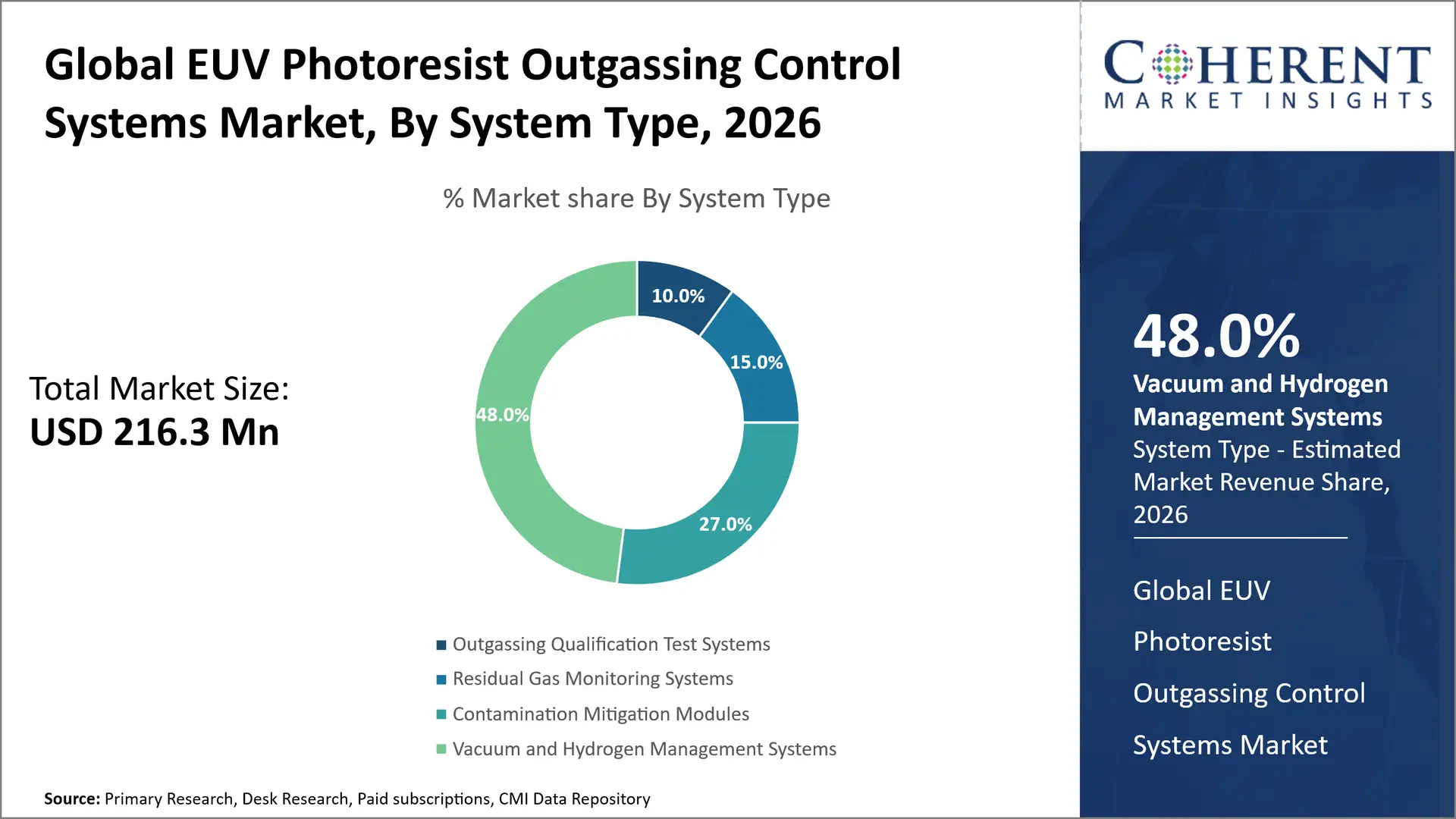
- By system type, the vacuum and hydrogen management segment is expected to account for 48.0% of the global EUV photoresist outgassing control systems market share in 2026. Pumps, hydrogen supply and exhaust handling run for as long as a scanner runs, so every tool needs them. Edwards reports that it has delivered more than 200 vacuum and exhaust gas management systems for EUV lithography, with 99.9% average availability.
- By resist type, chemically amplified resists are expected to account for 74.0% share in 2026. A single absorbed EUV photon sets off many reactions in these resists, which keeps them the volume choice, and the organic fragments they release are what most outgas tests are built to detect.
- By scanner type, Low NA EUV systems are expected to hold 88.0% share in 2026, because the installed base of 0.33 NA scanners is far larger than the number of High NA tools.
- By application, logic chip manufacturing is expected to account for 56.0% share in 2026. Each new logic node moves more layers onto EUV, and every added layer is one more exposure that has to be cleared for outgassing.
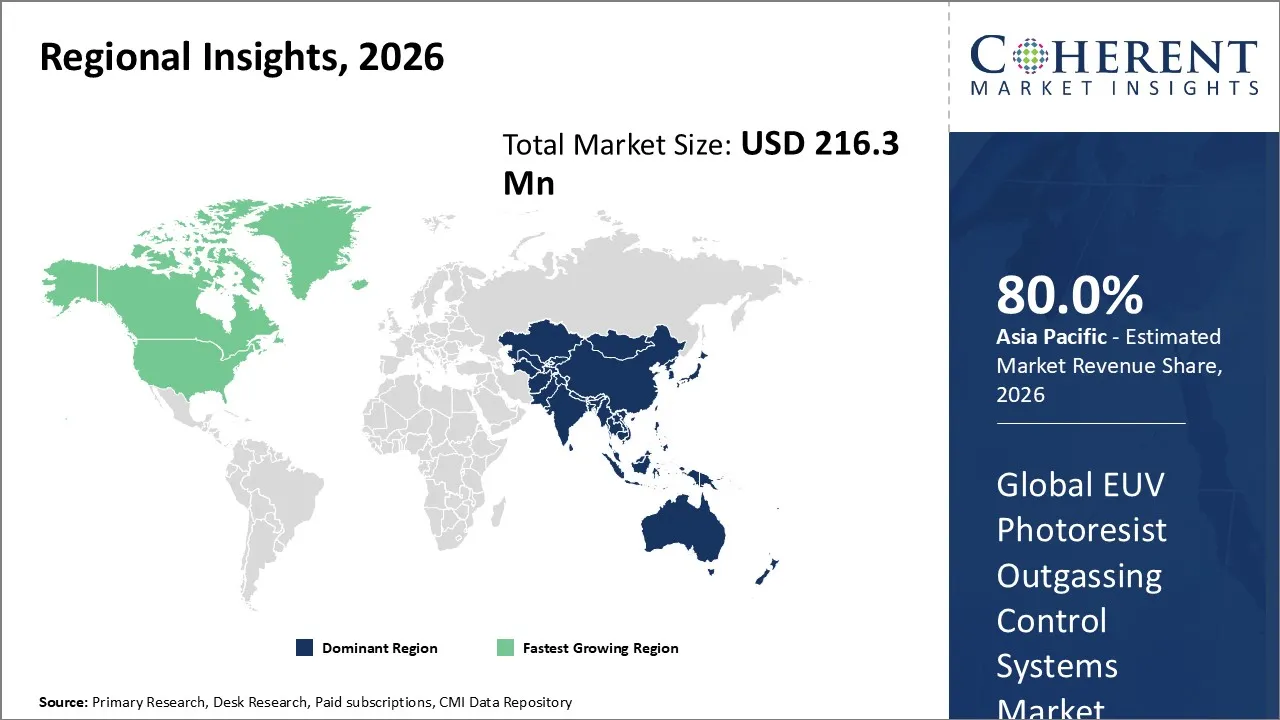
- Asia Pacific is expected to dominate the market in 2026, with a share of 80.0%. The region runs the largest concentration of EUV scanners for logic and memory. On April 1, 2025, Rapidus reported its first successful EUV exposure at the IIM-1 foundry in Hokkaido, about three months after the scanner was delivered.
- North America is expected to account for 18.5% share in 2026 and to be the fastest-growing region. New fab capacity is being added to an installed base that is still small. On July 15, 2026, ASML announced that Intel Foundry is using High NA EUV on its Intel 18A process in Oregon to produce a subset of Intel Core Ultra Series 3 processors.
Segmental Insights
Why Do Vacuum and Hydrogen Management Systems Dominate the Global EUV Photoresist Outgassing Control Systems Market?
In terms of system type, vacuum and hydrogen management is expected to account for 48.0% of the global EUV photoresist outgassing control systems market share in 2026. An EUV scanner works in a low-pressure hydrogen atmosphere. Hydrogen sweeps resist vapor away from the optics and reacts with carbon deposits, so every scanner needs pumps that can move a very large gas flow and exhaust systems that can handle it safely. The hardware is bought with the scanner and replaced as pumps wear, which keeps demand tied to scanner shipments.
Suppliers are now cutting the energy and floor space these systems take. Edwards designed its EUV Vizeon platform for hydrogen flow rates of up to 1000 standard liters per minute in a package under 2 meters high. The company states that pump power consumption falls by 24% against its previous platform and total energy use by 49% against earlier systems.
- Current Industry Events of 2026
- Market Size Estimation
- Regional Breakdown
- Competitive Landscape
- Customer Intelligence
- Segmental Analysis
- Pricing Analysis
- Key Market Drivers, Challenges & Future Trends
- Customized Insights Section
Why Do Chemically Amplified Resists Dominate the Global EUV Photoresist Outgassing Control Systems Market?
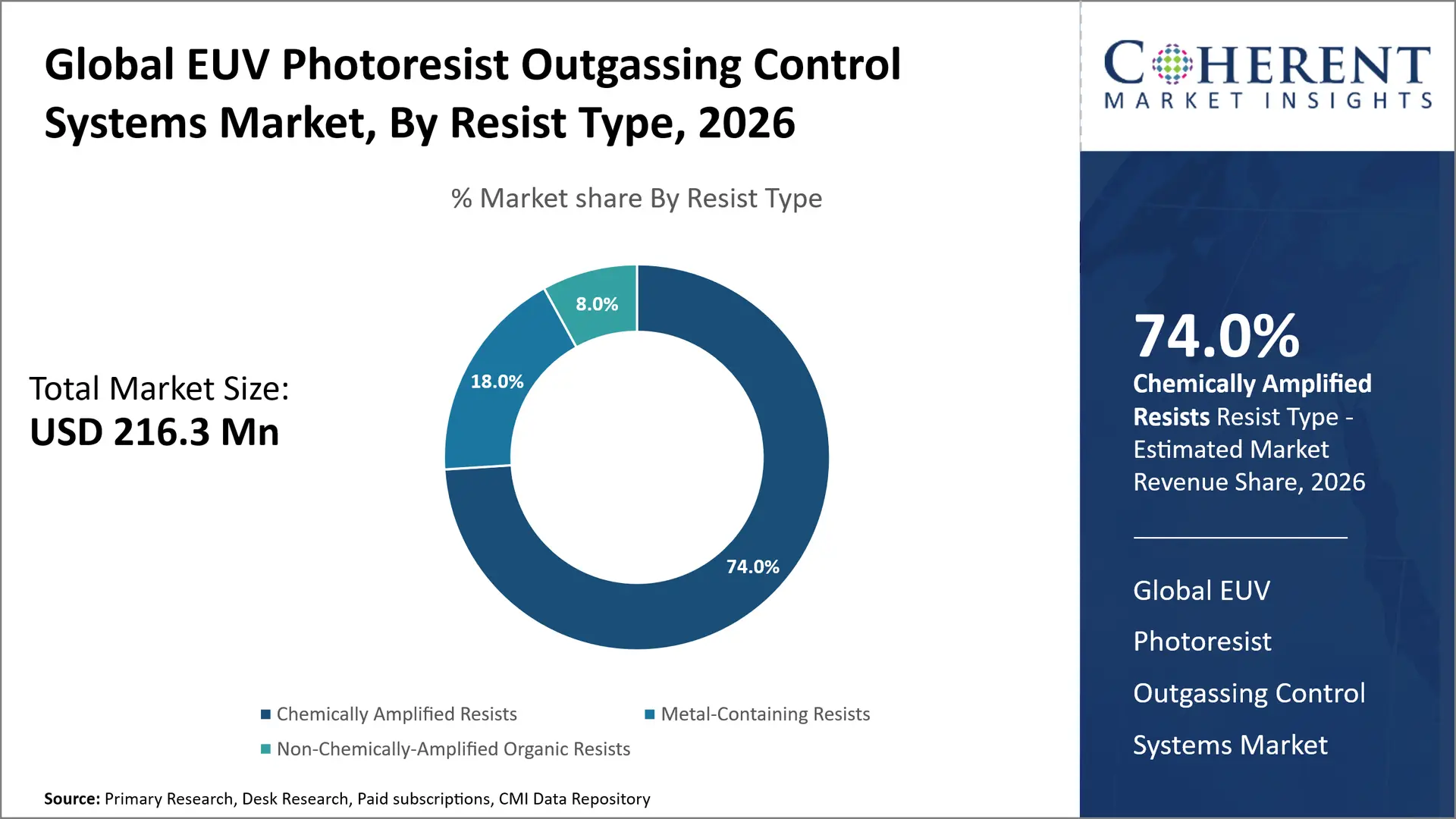
In terms of resist type, chemically amplified resists are expected to account for 74.0% of the global EUV photoresist outgassing control systems market share in 2026. In these resists, an absorbed EUV photon releases an acid that then drives many chemical reactions during the post-exposure bake, so a modest dose is enough to form a pattern. That sensitivity keeps them in volume production, and it also defines the outgassing task, because fragments of the polymer and of the acid generator can leave the film once it sits in vacuum. A study by MIRAI-Semiconductor Leading Edge Technologies in the Journal of Photopolymer Science and Technology found that outgassing from polyhydroxystyrene-based chemically amplified resists rose with pre-bake temperature and time, with film thickness and with the delay in vacuum before exposure. Fabs therefore tie their gas-monitoring limits to the exact process recipe, not only to the resist name.
Suppliers continue to extend this chemistry. On February 20, 2025, Fujifilm announced that it would present two papers at the SPIE Advanced Lithography + Patterning 2025 conference on its negative-tone EUV resist and EUV developer. In its launch release, Fujifilm reported that bonding a photo-decomposable quencher to the acid generator evens out the acid concentration in the film and reduces pattern fluctuation, a known weakness of conventional chemically amplified resists, by about 17%.
Why Do Low NA EUV Systems Lead the Scanner Type Segment?
In terms of scanner type, Low NA EUV systems, which use 0.33 numerical aperture optics, are expected to account for 88.0% of the global EUV photoresist outgassing control systems market share in 2026. These scanners are the production backbone of leading-edge logic and memory fabs. ASML states that its NXE:3800E supports high-volume manufacturing of 2 nm logic nodes and leading-edge DRAM nodes. The NXE platform generates 13.5 nm light from a tin-based plasma and exposes 300 mm wafers, so each tool needs the same vacuum, hydrogen and gas-monitoring support around its exposure chamber.
Demand for these tools stayed firm through 2025. In its 2025 annual report, ASML reported strong sales of the TWINSCAN NXE:3800E and a significant number of NXE:3800E field upgrades, which moved a substantial portion of EUV system revenue into installed base revenue. Upgrades keep the vacuum and monitoring equipment around existing scanners in play, not only equipment sold with new tools.
Why Does Logic Chip Manufacturing Lead the Application Segment?
In terms of application, logic chip manufacturing is expected to account for 56.0% of the global EUV photoresist outgassing control systems market share in 2026. Each new logic node moves more layers onto EUV, and foundries run their scanners at very high utilization, which makes gas stability a daily concern instead of an occasional check. Capital spending reflects this. On April 1, 2026, SEMI projected that worldwide 300mm fab equipment spending would rise 18% to USD 133 billion in 2026 and 14% to USD 151 billion in 2027, with spending in the Taiwan region driven mainly by leading-edge foundry capacity, including 2nm and sub-2nm technologies.
The roadmap points further out. On April 16, 2026, TSMC reported on its earnings call that development of its A14 technology was progressing well and that volume production was scheduled for 2028.
Current Events and their Impact
Current Events | Description and its Impact |
IBM and Lam Research collaboration on High NA dry resist (March 10, 2026) |
|
First high-volume logic product made with High NA EUV (July 15, 2026) |
|
EUV Photoresist Outgassing Control Systems Market Dynamics
Market Drivers
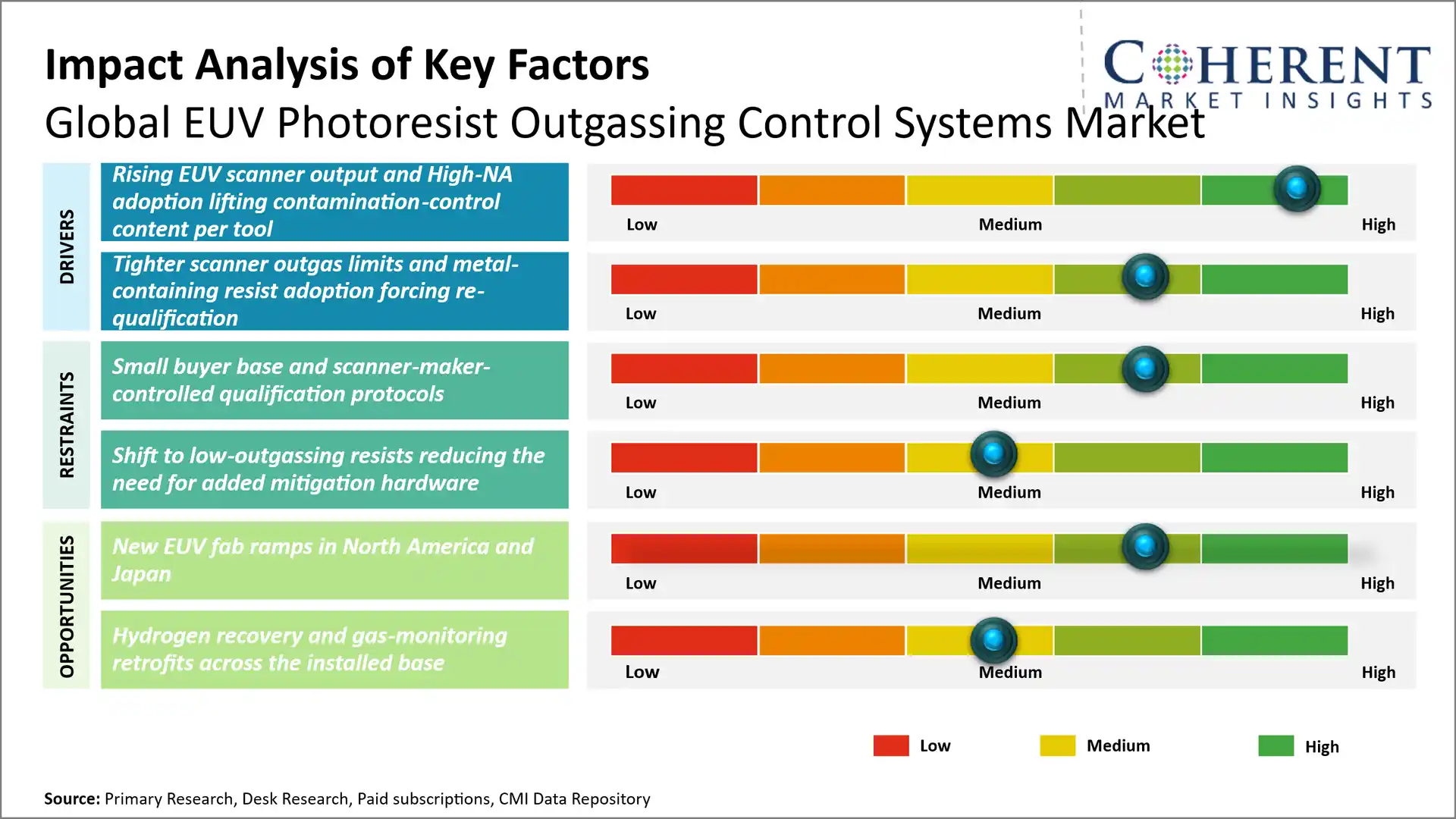
- Rising EUV scanner output and High-NA adoption lifting contamination-control content per tool: Larger optics mean more surface to protect and more gas volume to manage in each scanner. ZEISS reports that the projection optics of a High NA scanner contain more than 40,000 parts and weigh around twelve tons, about seven times the volume and weight of established EUV optics. Protecting an asset of that size justifies more pumping, cleaning and monitoring hardware on every tool, so supplier revenue per scanner rises even when scanner counts grow slowly.
- Tighter scanner outgas limits and metal-containing resist adoption forcing re-qualification: Metal-oxide and dry-deposited resists respond better to EUV light but release different species than organic resists, so they must be re-tested before use. On September 15, 2025, Lam Research and JSR announced a cross-licensing agreement to integrate JSR and Inpria patterning resists and films with Lam's etch and dry resist deposition technologies. Every such material needs witness-sample testing and gas analysis before it can enter volume production, which sustains steady demand for test benches and analyzers.
Emerging Trends
- Dry-deposited resists entering memory production: Resist is now applied as a vapor-deposited film instead of a spun liquid, which changes both the film and its outgassing behavior. On January 29, 2025, Lam Research announced that a leading memory manufacturer adopted its Aether dry photoresist technology for DRAM patterning.
- Impact: The gas species fabs must watch shift from solvent and polymer fragments toward metal-bearing compounds, so analyzer settings and test protocols are rewritten.
- Relevance to the market: This favors suppliers whose gas analyzers and test benches can be updated quickly for new resist families.
- Qualification and inspection tools built for both scanner generations: Test and inspection equipment is being designed to serve Low NA and High NA scanners from one platform. On February 4, 2026, ZEISS SMT reported the continued global deployment of its AIMS EUV 3.0 actinic mask qualification system, which supports both Low NA and High NA lithography.
- Impact: Fabs avoid buying separate benches for each scanner type.
- Relevance to the market: Dual-generation qualification equipment lowers entry cost for small fabs and research centers and widens the buyer base.
Regional Insights
Why Does Asia Pacific Lead the Global EUV Photoresist Outgassing Control Systems Market?
Asia Pacific is expected to account for a market share of 80.0% in 2026. The region holds the largest scanner fleets for leading-edge logic and DRAM, and its buyers sit close to their suppliers. SCREEN, Tokyo Electron and Litho Tech Japan, three of the eleven companies profiled in this report, are headquartered in Japan, so a fab in the region can work with a nearby vendor when it qualifies a new resist or tool.
On July 14, 2026, SEMI reported that global equipment sales are forecast to reach a record USD 165.9 billion in 2026, up 23.2% year-on-year, and that Taiwan and Korea remain among the top three destinations for equipment spending through 2028. Taiwan's spending is supported by leading-edge capacity builds for AI and high-performance computing, while Korea's is driven by advanced memory technologies, including HBM.
Why Is North America the Fastest-Growing Region in the EUV Photoresist Outgassing Control Systems Market?
North America is expected to account for 18.5% of the global market in 2026 and to register the fastest growth over the forecast period. The installed base of EUV scanners is small, so each new fab or High NA line changes regional demand noticeably. Energetiq Technology, which makes EUV light sources used in resist sensitivity and outgassing studies, is based in Wilmington, Massachusetts, which keeps test-equipment supply close to U.S. buyers.
On February 25, 2025, Micron announced that it was the first in the industry to ship samples of its 1γ DRAM, the company's first EUV memory node. A U.S.-headquartered memory maker moving onto EUV brings its fabs into scope for outgassing qualification as well.
Global EUV Photoresist Outgassing Control Systems Market Outlook for Key Countries
Is South Korea the Largest Market for EUV Photoresist Outgassing Control Systems?
South Korea's EUV photoresist outgassing control systems market is projected to reach USD 83.19 Mn in 2026, the largest of any country. Memory makers use EUV on several DRAM layers, and those fabs run scanners at high utilization. On September 8, 2026, ASML announced an expanded collaboration with Samsung Electronics, under which Samsung plans to bring High NA EUV into future DRAM high-volume manufacturing by 2028.
Taiwan EUV Photoresist Outgassing Control Systems Market Analysis and Trends
Taiwan's market is projected to reach USD 73.21 Mn in 2026. The island is home to the world's largest contract chipmaker, and its fabs add EUV layers with every new node. In April 2026, TSMC reported that its N2 node entered high-volume manufacturing in the fourth quarter of 2025 and is ramping in phases at its Hsinchu and Kaohsiung sites.
U.S. EUV Photoresist Outgassing Control Systems Market Analysis and Trends
The U.S. market is projected to reach USD 39.93 Mn in 2026, the largest in North America. On October 15, 2025, TSMC reported on its third-quarter earnings call that construction of its second Arizona fab is complete and that tool move-in is under way, with volume production planned for the third quarter of 2027. Each EUV scanner installed there brings a full set of vacuum, hydrogen and monitoring hardware.
Japan EUV Photoresist Outgassing Control Systems Market Analysis and Trends
Japan's market is projected to reach USD 16.64 Mn in 2026. On July 18, 2025, Rapidus announced that prototyping had started for its 2nm gate-all-around transistor structure at the IIM-1 foundry, and it targets mass production in 2027. A new EUV line starts its outgassing program from zero, which creates first-time orders across the control stack.
Europe EUV Photoresist Outgassing Control Systems Market Analysis and Trends
Europe is projected to reach USD 3.33 Mn in 2026, a small fab base but the home of the supply chain. ASML builds its scanners in Veldhoven in the Netherlands, ZEISS makes the optics in Oberkochen, and Pfeiffer Vacuum+Fab Solutions designs vacuum and gas analysis products in Asslar, Germany. Local demand comes mainly from research pilot lines and tool development labs.
Global EUV Photoresist Outgassing Control Systems Market – ASML EUV Scanner Platforms and What Each Means for Outgassing Control:
Scanner Platform | Optics | Key Platform Feature | Relevance to Outgassing Control | Source |
TWINSCAN NXE:3600D | 0.33 NA reflective projection optics | Flexible mask illumination optics supports low-k1 applications while maintaining high productivity | Sets the baseline gas environment against which newer platforms are compared | |
TWINSCAN NXE:3800E | 0.33 NA | New bottom module with a new wafer handler and faster wafer stages, shared with the 0.55 NA EXE platform | More wafers per hour means resist enters and leaves the vacuum environment more often | |
TWINSCAN EXE:5000 | 0.55 NA (High NA) | First High NA system, with 8 nm resolution; exposure field half the size of NXE systems | Twice as many exposures per wafer, so each wafer spends longer under EUV light | |
TWINSCAN EXE:5200B | 0.55 NA (High NA) | 40% more imaging contrast than NXE systems; single-exposure features 1.7 times smaller, with 2.9 times higher transistor density | Single exposure can replace multiple patterning steps, so total resist passes per layer can fall |
Do New EUV Fab Ramps in North America and Japan Open a Fresh Market for Outgassing Control?
They do. A new fab buys the whole control stack at once, from pumps and hydrogen supply to gas analyzers and access to qualification testing, while an established fab mostly replaces parts. New builds are therefore the largest single orders in this market, and they arrive in clusters when a node is ramped.
The scanner pipeline behind them is deep. On January 28, 2026, ASML reported that more than half of its fourth-quarter 2025 net bookings were for EUV systems. The new capacity is also moving to the regions in this question. On April 16, 2026, TSMC outlined on its earnings call that its second Arizona fab will begin 3nm volume production in the second half of 2027 and that its second Japan fab will deploy 3nm technologies, with volume production in 2028.
A second stream comes from the installed base. Hydrogen recovery and gas-monitoring retrofits let a fab lower its gas costs and add measurement points to scanners that are already running. Because the buyer base is small and relationships last for years, suppliers that can serve both new builds and retrofits are best placed.
Market Players, Key Development, and Competitive Landscape
Key Developments
- On July 24, 2026, ZEISS SMT announced the expansion of its capacity for lithography optics and photomask solutions, reporting that the move into a new office building in July 2026 was a milestone of its Oberkochen site expansion and that a new ZEISS Innovation Center in Korea opened the same month.
- On December 15, 2025, Tokyo Electron announced the CLEAN TRACK LITHIUS Pro DICE, a 300 mm coater/developer for EUV and DUV exposure processes that cuts defects caused by resist coating to less than half of the previous model.
- On September 24, 2025, SCREEN Semiconductor Solutions and IBM announced an agreement to develop cleaning processes for High NA EUV lithography, where minute particles or scratches on the wafer can harm patterning.
- On April 15, 2025, Pfeiffer Vacuum+Fab Solutions launched the HiCube Neo RGA, which integrates a HiCube Neo vacuum pump unit and a PrismaPro mass spectrometer for residual gas analysis from atmospheric pressure to high vacuum.
- On January 28, 2025, Energetiq Technology announced the EQS-10 electrodeless Z-pinch EUV light source for metrology, resist development and defect inspection, with up to four times the energy per pulse and a repetition rate of up to 5 kHz.
Competitive Landscape
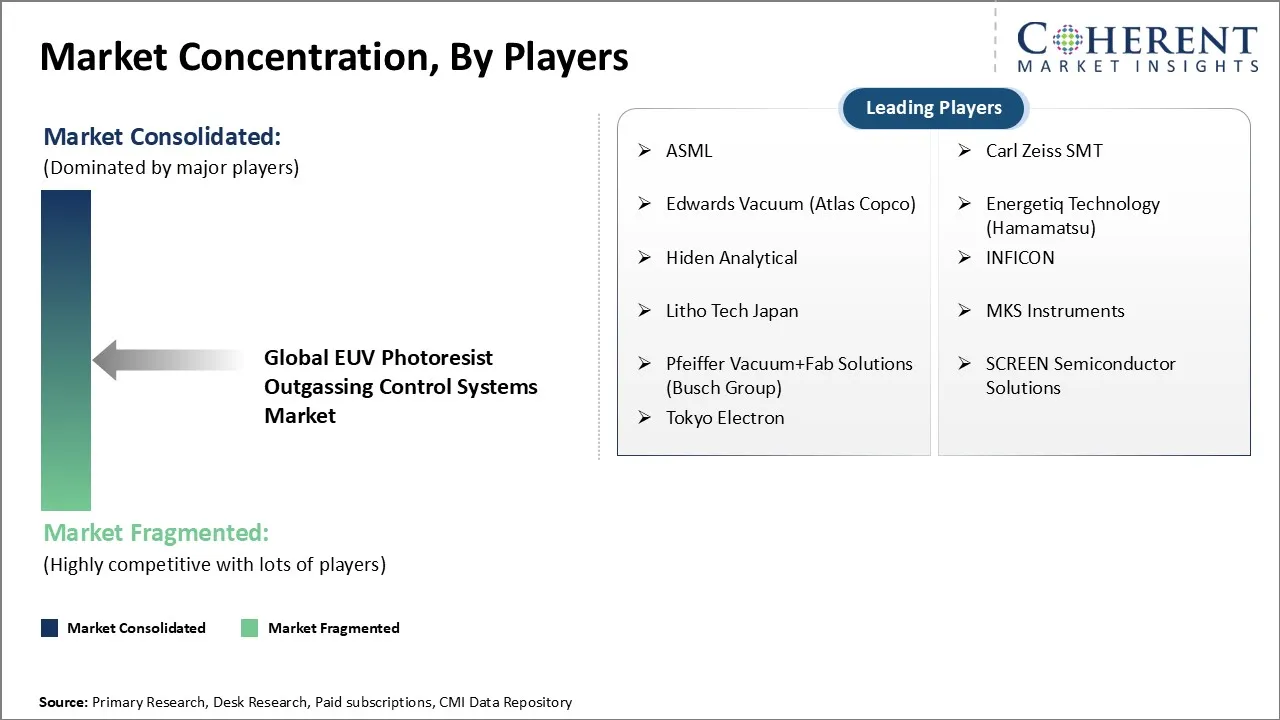
The market is highly specialized and concentrated around a few buyers. Scanner and optics makers such as ASML and Carl Zeiss SMT set the contamination limits that every other supplier must meet. Vacuum and gas management specialists such as Edwards Vacuum, Pfeiffer Vacuum+Fab Solutions and MKS Instruments supply the pumps and gas handling. Analyzer makers such as INFICON and Hiden Analytical supply the gas monitoring, while Energetiq Technology and Litho Tech Japan supply the EUV sources and resist evaluation tools used in qualification. Tokyo Electron and SCREEN Semiconductor Solutions affect outgassing from the resist-processing side. Competition centers on how fast a supplier can qualify its product with scanner makers, the sensitivity of its gas measurements and the energy its vacuum systems use. Long qualification cycles with scanner makers make it hard for new entrants to break in.
Top Companies and Notable Products in the EUV Photoresist Outgassing Control Systems Market
Company | Notable Product | Key Features |
TWINSCAN NXE and EXE EUV scanners | Low NA (0.33) and High NA (0.55) systems whose contamination limits shape the whole control stack | |
EUV illumination system and projection optics | Illumination system of 15,000 parts weighing 1.5 tons, protected by the control systems in this market | |
EUV Vizeon | Integrated vacuum and exhaust management platform with hydrogen recovery and an availability of 99.9% | |
EQS-10 EUV light source | Xenon electrodeless Z-pinch source used for resist sensitivity and outgassing studies | |
HAL 201 RC residual gas analyzer | Vacuum-fired ion source built for ultra-high vacuum below 5 × 10⁻¹⁰ mbar total pressure | |
Transpector CPX | Residual gas analyzer with a HexBlock inlet that takes up to three pressure inlets | |
Resist development analyzer (RDA) | Measures photoresist development rate, used with Z-pinch EUV flood exposure in resist studies | |
Microvision 2 Smart Head quadrupole mass spectrometer | Analog scanning at under 3 ms per point for vacuum quality and contamination detection | |
HiCube Neo turbo pumping station | Desktop or floor-standing unit with pumping speeds from 80 to 800 l/s | |
Wafer cleaning systems | Single-wafer cleaning lines for particle control ahead of EUV exposure | |
CLEAN TRACK LITHIUS Pro DICE | 300 mm coater/developer for EUV and DUV processes with a gain of over 25% in productivity and environmental performance |
Market Report Scope
EUV Photoresist Outgassing Control Systems Market | |||
Report Coverage | Details | ||
Base Year | 2025 | Market Size in 2026: | USD 216.3 Mn |
Historical Data For: | 2020 To 2024 | Forecast Period: | 2026 To 2033 |
Forecast Period 2026 To 2033 CAGR: | 11.9% | 2033 Value Projection: | USD 475.0 Mn |
Geographies covered: |
| ||
Segments covered: |
| ||
Companies covered: | ASML, Carl Zeiss SMT, Edwards Vacuum (Atlas Copco), Energetiq Technology (Hamamatsu), Hiden Analytical, INFICON, Litho Tech Japan, MKS Instruments, Pfeiffer Vacuum+Fab Solutions (Busch Group), SCREEN Semiconductor Solutions, Tokyo Electron | ||
Growth Drivers: |
| ||
Restraints & Challenges: |
| ||
Analyst Opinion (Expert Opinion)
- Pumps and hydrogen handling carry the revenue, while analyzers and test benches decide qualification. Vacuum and hydrogen management holds 48.0% of the market in 2026 and contamination mitigation holds 27.0%, so three-quarters of spending goes to hardware that runs inside or beside every scanner. Residual gas monitoring, at 15.0%, and qualification test, at 10.0%, are smaller, but they decide whether a new resist or scanner is allowed into production. Suppliers that sell the gas data together with the hardware are better placed than those that sell pumps alone.
- Resist, scanner and application mix point to a mature spending base. Chemically amplified resists (74.0%), Low NA scanners (88.0%) and logic chip manufacturing (56.0%) lead their segments in 2026, so near-term revenue follows the established scanner fleet. The larger long-run change comes from metal-containing resists and High NA tools, which raise the qualification workload for every scanner they touch.
- Asia Pacific is the volume base, North America the growth edge, and two risks remain. Asia Pacific holds 80.0% in 2026, while North America, at 18.5%, grows fastest as new fabs are added, and Europe holds 1.5% as a supplier base. The first risk is the small buyer base and scanner-maker-controlled qualification protocols, which limit how quickly a new supplier can sell. The second is the shift to low-outgassing resists, which can reduce the need for added mitigation hardware. Vendors with a retrofit offer for hydrogen recovery and gas monitoring are the least exposed to both.
Speak to the analyst
Want personalized insights?
Take the findings above to one of our principal consultants, or have the report rebuilt around the segments, geographies and competitors you actually track.
Market Segmentation
- System Type Insights (Revenue, USD Million, 2021 - 2033)
- Outgassing Qualification Test Systems
- Residual Gas Monitoring Systems
- Contamination Mitigation Modules
- Vacuum and Hydrogen Management Systems
- Resist Type Insights (Revenue, USD Million, 2021 - 2033)
- Chemically Amplified Resists
- Metal-Containing Resists
- Non-Chemically-Amplified Organic Resists
- Scanner Type Insights (Revenue, USD Million, 2021 - 2033)
- Low-NA EUV Scanners
- High-NA EUV Scanners
- Application Insights (Revenue, USD Million, 2021 - 2033)
- Logic Chip Manufacturing
- Memory Chip Manufacturing
- R&D and Resist Qualification
- Regional Insights (Revenue, USD Million, 2021 - 2033)
- North America
- U.S.
- Canada
- Latin America
- Brazil
- Argentina
- Mexico
- Rest of Latin America
- Europe
- Germany
- U.K.
- Spain
- France
- Italy
- Russia
- Rest of Europe
- Asia Pacific
- China
- India
- Japan
- Australia
- South Korea
- ASEAN
- Rest of Asia Pacific
- Middle East
- GCC Countries
- Israel
- Rest of Middle East
- Africa
- South Africa
- North Africa
- Central Africa
- North America
- Key Players Insights
- ASML
- Carl Zeiss SMT
- Edwards Vacuum (Atlas Copco)
- Energetiq Technology (Hamamatsu)
- Hiden Analytical
- INFICON
- Litho Tech Japan
- MKS Instruments
- Pfeiffer Vacuum+Fab Solutions (Busch Group)
- SCREEN Semiconductor Solutions
- Tokyo Electron
Sources
Primary Research Interviews
- EUV Scanner and Optics Engineers
- Fab Lithography and Contamination-Control Engineers
- Vacuum, Hydrogen and Gas Analysis Equipment Makers
- EUV Resist and Materials Developers
- Research Institutes and Pilot-Line Operators
Magazines
- Semiconductor Digest
- EE Times
- Solid State Technology
- SPIE Newsroom
Journals
- Journal of Photopolymer Science and Technology
- Journal of Micro/Nanopatterning, Materials, and Metrology
- Proceedings of SPIE: Extreme Ultraviolet (EUV) Lithography
- Journal of Vacuum Science & Technology B
Associations
- SEMI
- SPIE
- imec
- International Roadmap for Devices and Systems (IRDS)
Public Domain Sources
- National Institute of Standards and Technology (NIST): EUV resist qualification publications
- Company annual reports and investor presentations
- Company press releases
- Government and trade ministry announcements on semiconductor investment
Proprietary Elements
- CMI Data Analytics Tool
- Proprietary CMI Existing Repository of information for last 10 years
Get access to 250+ pages report
Every segment, forecast, competitor profile and data table behind the analysis above — available for instant download.
- ESOMAR Member
- ISO 9001:2015 Certified
- D-U-N-S Registered
- GDPR & CCPA Compliant
Frequently Asked Questions
The global EUV photoresist outgassing control systems market is valued at USD 216.3 Mn in 2026 and is expected to reach USD 475.0 Mn by 2033.
The CAGR of the global EUV photoresist outgassing control systems market is projected to be 11.9% from 2026 to 2033.
Rising EUV scanner output and High-NA adoption lifting contamination-control content per tool, and tighter scanner outgas limits and metal-containing resist adoption forcing re-qualification, are the major factors driving market growth.
A small buyer base with scanner-maker-controlled qualification protocols, and the shift to low-outgassing resists reducing the need for added mitigation hardware, are the major factors hampering market growth.
In terms of system type, vacuum and hydrogen management is expected to dominate the market, with a revenue share of 48.0% in 2026.
In terms of resist type, chemically amplified resists are expected to dominate the market, with a revenue share of 74.0% in 2026.
In terms of scanner type, Low NA EUV systems are expected to dominate the market, with a revenue share of 88.0% in 2026.