

Photoresist Chemicals Market Size and Forecast — 2026-2033
The Global Photoresist Chemicals Market size is estimated to be valued at USD 3.76 billion in 2026 and is expected to reach USD 5.7 billion by 2033, exhibiting a compound annual growth rate (CAGR) of 7.3% from 2026 to 2033.
Overview
Photoresist chemicals are light-sensitive materials used in photolithography for semiconductor and microelectronics fabrication. These materials form thin films on silicon wafers and undergo selective exposure to UV light to define intricate circuit patterns. The product range includes positive and negative resists, photoactive compounds (PACs), and solvent developers. Advances in photoresist formulation—such as chemically amplified resists and extreme ultraviolet (EUV) resists—have enabled the miniaturization of semiconductor nodes below 5 nm. These chemicals are engineered for high resolution, low line-edge roughness, and superior etch resistance, essential for producing next-generation integrated circuits, memory chips, and microelectromechanical systems (MEMS).
Key Takeaways
Chemically Amplified Photoresists dominate the market with over 56% share, driven by their critical role in sub-7nm semiconductor nodes.
The logic devices application segment leads market revenue, attributed to escalating production of high-performance processors.
Asia Pacific holds the largest industry share, propelled by significant semiconductor manufacturing infrastructure in Taiwan, South Korea, and China.
North America, led by the USA, represents the fastest growing market with substantial market revenue supported by robust R&D ecosystems and end-user demand in the AI and automotive sectors.
Photoresist Chemicals Market Segmentation Analysis
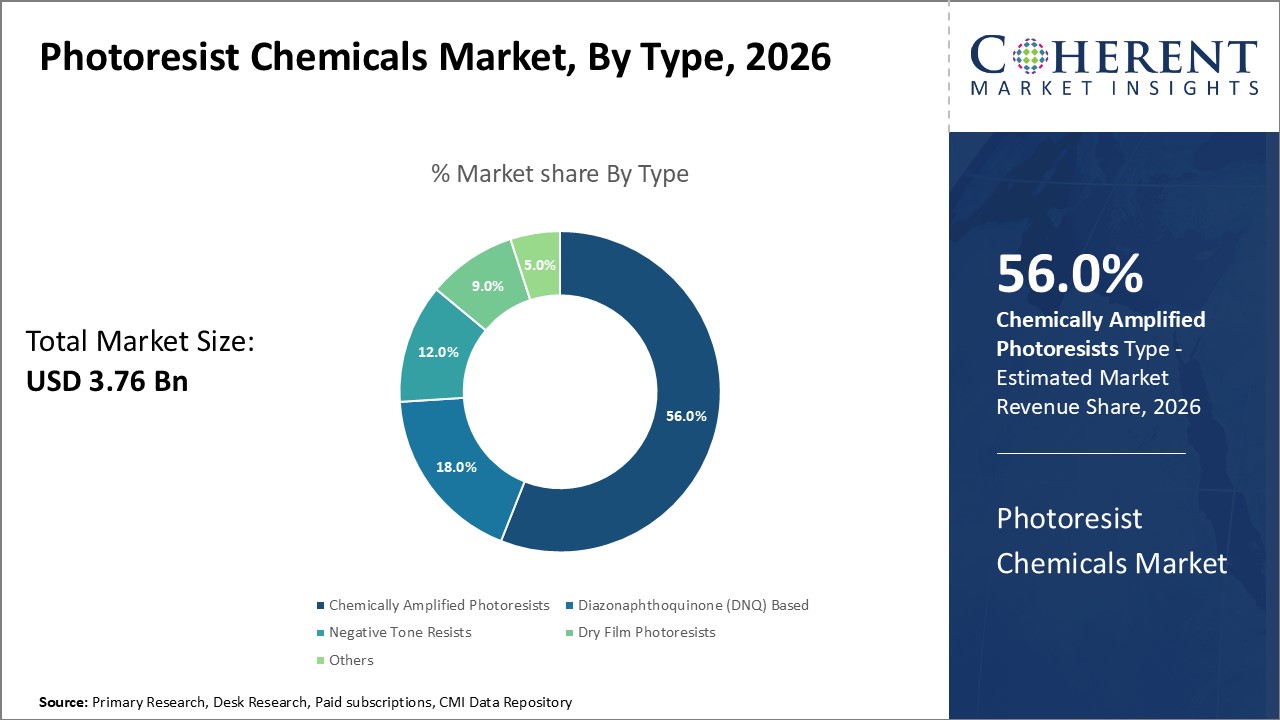
Photoresist Chemicals Market Insights, By Type
Chemically Amplified Photoresists dominate the market share with 55%. This subsegment benefits from unmatched chemical sensitivity and compatibility with emerging EUV lithographic processes, making them indispensable for advanced semiconductor fabrication. Their ability to enable smaller node geometries and higher throughput fuels continuous adoption, particularly in logic devices and memory chip manufacturing. The fastest-growing subsegment is Negative Tone Resists, whose market demand has surged due to increasing utilization in backside illumination (BSI) sensors and microelectromechanical systems (MEMS).
Photoresist Chemicals Market Insights, By Application
Logic Devices dominate this segment, constituting the largest revenue share, driven by the surge in high-performance computing and AI chip fabrication requiring cutting-edge photoresist materials. Their complexity and sensitivity requirements make this subsegment a high-growth revenue generator. Memory Devices represent the fastest-growing subsegment due to expanding demand for DRAM and NAND flash in data centers and mobile devices. Innovations in multilayer lithography and 3D stacking accelerate the need for sophisticated photoresists optimized for high aspect ratio patterning
Photoresist Chemicals Market Insights, By Technology
DUV Lithography continues to dominate the market share, supported by its maturity and broad utility in semiconductor nodes above 7nm, catering to a vast majority of production volume globally. EUV Lithography is the fastest-growing subsegment, experiencing rapid adoption as chipmakers aggressively shift to advanced nodes below 5nm. This technology demands tailored photoresist materials with extreme resolution and sensitivity, stimulating substantial R&D investments. The adoption of EUV-compatible photoresists increased by over 30% in 2026 compared to the previous year, signifying a critical market shift.
Photoresist Chemicals Market Trends
Market trends reveal a surge in EUV lithography adoption, which has redefined the technical requirements for photoresist chemicals, compelling producers to innovate rapidly or risk losing market share.
For example, EUV-compatible chemically amplified resists now constitute over 41% of total photoresist sales in advanced foundries, such as those in South Korea and Taiwan.
Additionally, there is an increasing shift toward environmentally sustainable and low-VOC photoresist formulations responding to tightening regulatory frameworks and growing consumer demand for greener production processes.
Photoresist Chemicals Market Insights, By Geography
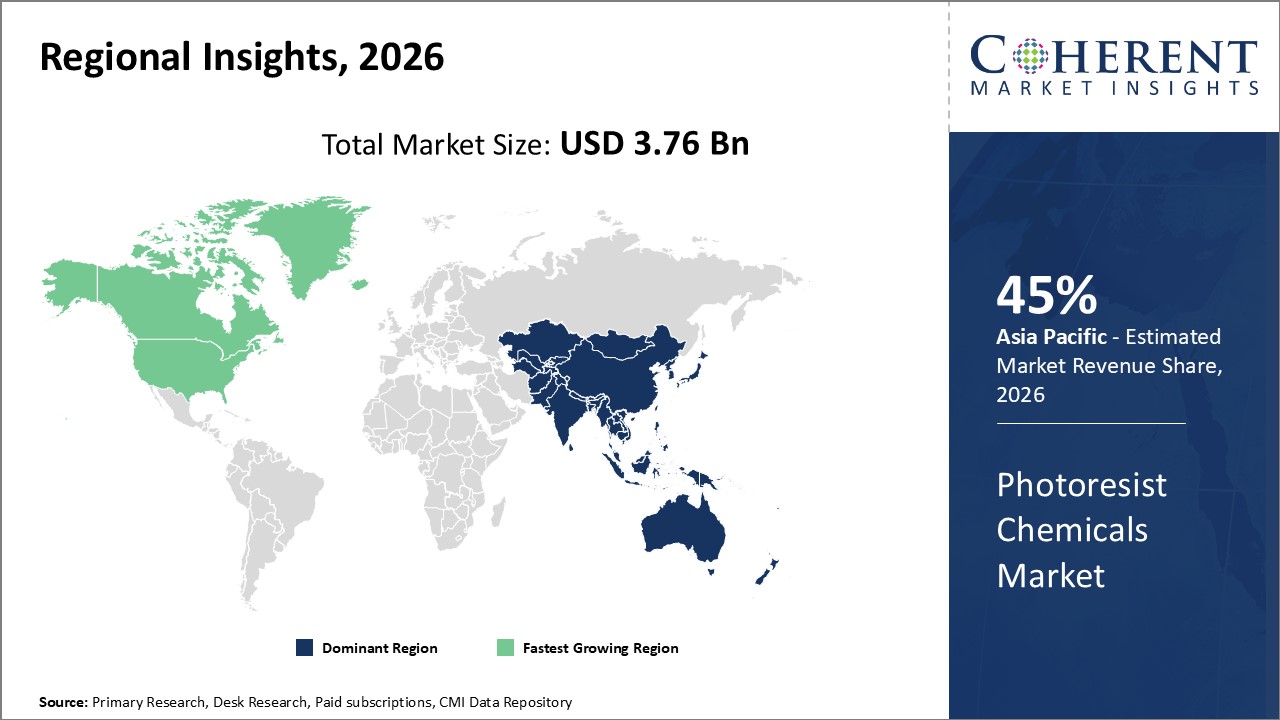
Asia Pacific Photoresist Chemicals Market Analysis and Trends
In Asia Pacific, the dominance in the Photoresist Chemicals market is underpinned by well-established semiconductor manufacturing hubs in Taiwan, South Korea, and China, accounting for nearly 45% of the global market share. The region benefits from integrated supply chains, government subsidies promoting semiconductor self-sufficiency, and investments by leading market companies such as JSR Corporation and TOK investing heavily in production capacity enhancements.
North America Photoresist Chemicals Market Analysis and Trends
Meanwhile, North America exhibits the fastest growth with a CAGR exceeding 8% driven by the USA's expanding semiconductor R&D and fabrication footprint focused on AI and automotive applications. The aggressive push for domestic chip manufacturing and recent legislative incentives have accelerated demand for high-performance photoresist chemicals, with significant contributions from companies like DuPont and Merck.
Photoresist Chemicals Market Outlook for Key Countries
USA Photoresist Chemicals Market Analysis and Trends
The USA’s Photoresist Chemicals market benefits from an extensive semiconductor manufacturing ecosystem that integrates chip design, R&D, and pilot production facilities. In 2025, US-based manufacturers increased photoresist imports by 10%, driven by demand for next-generation node fabrication and automotive semiconductors. Major players, including DuPont and Merck, have ramped up production and innovation capabilities, securing vital contracts and nurturing collaborations with government-backed initiatives aimed at boosting semiconductor sovereignty.
China Photoresist Chemicals Market Analysis and Trends
China’s market is rapidly expanding, supported by ambitious national semiconductor strategies and capital infusions in domestic capacity expansions. The country has seen a marked increase in the adoption of both DUV and EUV photoresist chemicals, with 2026 shipments growing by over 14%. Prominent local and international companies are accelerating plant builds and technology transfers, addressing import dependence and enhancing competitive positioning in the global market.
Analyst Opinion
Production capacity expansions in Asia-Pacific have played a significant role in meeting growing semiconductor demand, with manufacturers in South Korea and Taiwan increasing photoresist chemical output by approximately 12% in 2025, reflecting strategic supply-side adaptations.
Rising complexity in semiconductor nodes below 5nm has driven demand for advanced photoresist materials with enhanced sensitivity and resolution. For instance, in 2026, over 61% of new photolithography processes in leading chip foundries use chemically amplified resists optimized for EUV lithography.
Import statistics from North America indicate a 9% year-over-year growth in photoresist chemical shipments, emphasizing strong consumption by major semiconductor fabrication plants targeting automotive and AI chipset applications.
Pricing trends show stabilization in 2025 despite raw material volatility, largely due to expanding capacity and supply agreements between chemical producers and integrated device manufacturers. This supply-demand balance supports sustained market revenue growth.
- Current Industry Events of 2026
- Market Size Estimation
- Regional Breakdown
- Competitive Landscape
- Customer Intelligence
- Segmental Analysis
- Pricing Analysis
- Key Market Drivers, Challenges & Future Trends
- Customized Insights Section
Market Scope
| Report Coverage | Details | ||
|---|---|---|---|
| Base Year: | 2025 | Market Size in 2026: | USD 3.76 billion |
| Historical Data for: | 2020 To 2024 | Forecast Period: | 2026 To 2033 |
| Forecast Period 2026 to 2033 CAGR: | 7.3% | 2033 Value Projection: | USD 5.7 billion |
| Geographies covered: |
| ||
| Segments covered: |
| ||
| Companies covered: | JSR Corporation, Tokyo Ohka Kogyo Co., Ltd. (TOK), Fujifilm Holdings Corporation, DuPont, Merck KGaA, Avantor, Inc., Sumitomo Chemical Co., Ltd., Shin-Etsu Chemical Co., Ltd., Dow Inc., LG Chem, BASF SE, Hitachi Chemical Co., Ltd. | ||
| Growth Drivers: |
| ||
Photoresist Chemicals Market Growth Factors
The increasing semiconductor content in automotive and IoT devices is driving consistent demand for photoresists; shipments of advanced photoresist chemicals to the automotive sector grew 18% in 2025 alone. Secondly, the transition toward EUV lithography technologies necessitates novel resist materials with ultra-high resolution, sparking R&D investments projected to surge by 20% annually through 2027. Third, growing government incentives in the Asia Pacific aimed at strengthening semiconductor ecosystems have lowered market entry barriers for photoresist producers. Finally, escalating digital transformation across healthcare and AI applications creates diverse end-user demand, supporting robust market revenue growth and sustaining industry size expansion.
Photoresist Chemicals Market Development
In May 2026, Asahi Kasei Corporation launched the TA Series of Sunfort™ dry film photoresist, targeting the advanced semiconductor-packaging market, especially applications in AI servers. The product enables ultra-high resolution patterning with both conventional stepper exposures and laser direct imaging (LDI). This positions Asahi Kasei to better support panel-level processing for redistribution layers (RDL) and other complex back-end wiring needs.
In July 2021, Merck KGaA launched a new line of “green solvents” for photoresist removal in chip production. The product portfolio, branded as AZ® 910 Remover, is a non-NMP (N-methylpyrrolidone) based chemistry set designed for high-throughput, environmentally-friendlier removal of both positive- and negative-tone photoresists in wafer processing. The launch emphasised reductions in solvent volume (less than three times vs older methods), faster dissolution of cross-linked resists, compatibility with sensitive metals and substrates, and a significantly improved environmental footprint.
Key Players
Leading Companies of the Market
JSR Corporation
Tokyo Ohka Kogyo Co., Ltd. (TOK)
Fujifilm Holdings Corporation
DuPont
Merck KGaA
Avantor, Inc.
Sumitomo Chemical Co., Ltd.
Shin-Etsu Chemical Co., Ltd.
Dow Inc.
LG Chem
BASF SE
Hitachi Chemical Co., Ltd.
Among these, several companies have adopted aggressive R&D and strategic partnerships to expand their market share. For example, a notable collaboration between Tokyo Ohka Kogyo and a leading semiconductor foundry in 2025 resulted in a 16% improvement in photoresist sensitivity, directly contributing to increased yield in 3nm node production. Similarly, Fujifilm's investment in EUV photoresist innovation secured contracts worth over $250 million by mid-2026, showcasing exemplary market growth strategies.
Photoresist Chemicals Market Future Outlook
With the expansion of semiconductor fabrication and increasing demand for advanced logic and memory chips, the photoresist market is set for robust growth. The shift toward EUV and multi-patterning processes will continue to drive innovation in resist composition, focusing on higher sensitivity and reduced line-edge roughness. The rise of 5G, IoT, and AI hardware will accelerate production volumes, while sustainable and less toxic formulations will gain traction due to stricter environmental standards. Strategic investments in Asia-Pacific, particularly in Taiwan, South Korea, and Japan, will strengthen supply chains and support ongoing technological upgrades.
Photoresist Chemicals Market Historical Analysis
The photoresist chemicals market has evolved alongside the semiconductor industry, beginning with the early use of novolak-based resins for basic photolithography. As chip manufacturing transitioned from micrometer to nanometer scales, the demand for higher precision and defect-free patterning led to breakthroughs in chemically amplified resists. In the 2000s, the rise of deep ultraviolet (DUV) lithography drove large-scale commercialization, followed by extreme ultraviolet (EUV) resists for sub-10 nm node applications. Semiconductor miniaturization, flat-panel displays, and printed circuit boards became the primary end uses, each requiring distinct photoresist chemistries. The industry’s growth has been marked by collaborations between chemical formulators and chip manufacturers to tailor resists for next-generation devices.
Sources
Primary Research Interviews:
Semiconductor Engineers
Chemical Process Experts
Photolithography Technicians
R&D Chemists
Databases:
Semiconductor Industry Association (SIA) Data Center
U.S. Geological Survey (USGS) Materials Data
NIST Chemistry Database
IEEE DataPort
Magazines:
Semiconductor Digest
- Chemical Week
Solid State Technology
Photonics Spectra
Journals:
Journal of Photopolymer Science and Technology
Microelectronic Engineering
Applied Surface Science
ACS Applied Materials & Interfaces
Newspapers:
Nikkei Asia (Tech)
Financial Express (Industry)
The Wall Street Journal (Technology)
The Korea Herald (Semiconductors)
Associations:
Semiconductor Equipment and Materials International (SEMI)
American Chemical Society (ACS)
Institute of Electrical and Electronics Engineers (IEEE)
Japan Photopolymer Association
Get access to 250+ pages report
Every segment, forecast, competitor profile and data table behind the analysis above — available for instant download.
- ESOMAR Member
- ISO 9001:2015 Certified
- D-U-N-S Registered
- GDPR & CCPA Compliant
Missing comfort of reading report in your local language? Find your preferred language:
Transform your Strategy with Exclusive Trending Reports
Frequently Asked Questions
Prominent market players include JSR Corporation, Tokyo Ohka Kogyo, Fujifilm Holdings, DuPont, and Merck KGaA, which collectively lead innovation and control significant market share.
The market size is projected to grow from USD 3.76 billion in 2026 to USD 5.7 billion by 2033, reflecting a CAGR of 7.3%, driven by technology advancements and diversified applications.
The logic devices segment presents the largest growth opportunity, fueled by rising demand for advanced semiconductors in high-performance computing and consumer electronics.
The market will witness accelerated adoption of EUV lithography photoresists, enhanced focus on sustainable chemistries, and expanded applications in emerging sectors like flexible electronics and IoT.
The competitive landscape is marked by intense R&D competition and collaboration-driven innovation, while challenges include raw material supply constraints and stringent environmental regulations.
Key strategies include innovation-led product development, strategic alliances with chipmakers, capacity expansion in growth regions, and targeted investments in EUV technology-compatible materials.