

Global Fire Doors Market Size and Forecast – 2026 To 2033
The global fire doors market is estimated to be valued at USD 14.33 Bn in 2026 and is expected to reach USD 19.50 Bn by 2033, exhibiting a compound annual growth rate (CAGR) of 4.5% from 2026 to 2033. This growth is strongly supported by rising construction, renovation, and fire-safety compliance activity. Globally, Oxford Economics projects construction output to increase by 42% between 2020 and 2030, reaching USD 15.2 trillion, with Asia Pacific construction output expected to grow by over 50% by 2030. This directly supports demand for fire doors in high-rise buildings, commercial complexes, hospitals, airports, warehouses, and industrial facilities. (Source: Oxford Economics)
Key Takeaways of the Global Fire Doors Market
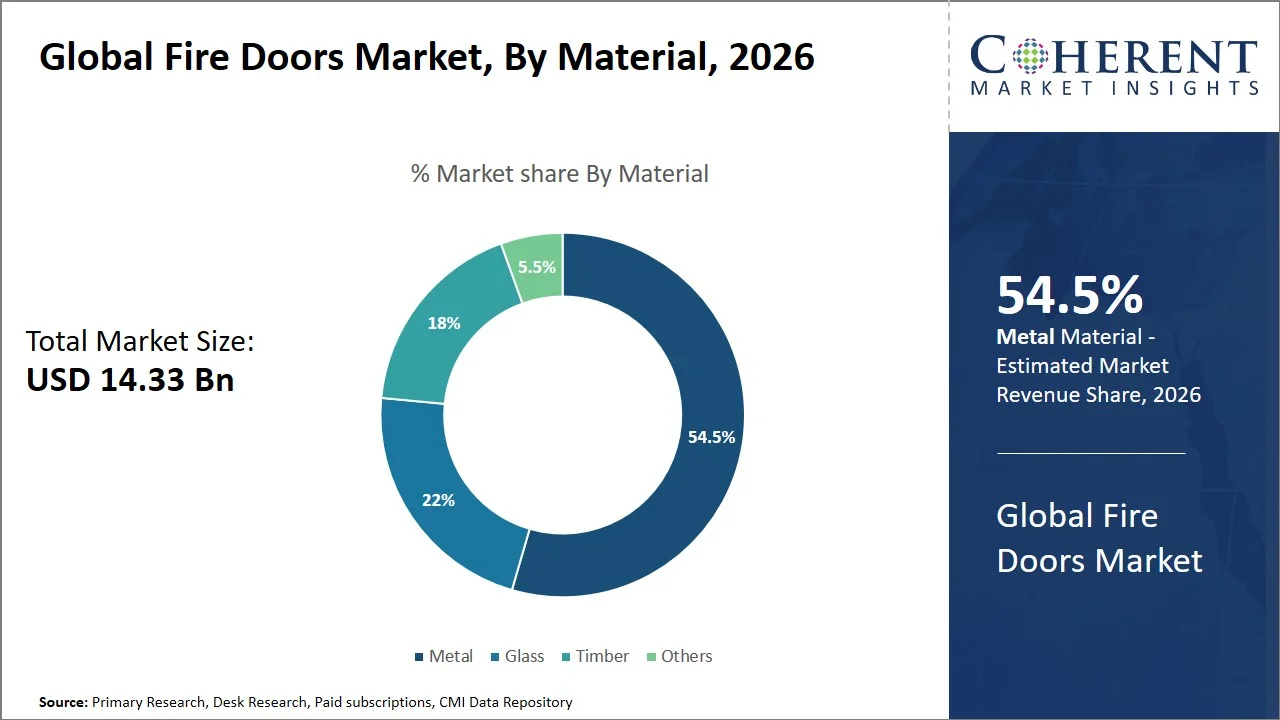
- Metal segment is expected to hold 54.5 % share of the fire doors market in 2026, making it the dominant material segment. Metal fire doors are preferred due to their high durability, structural strength, longer lifecycle, and suitability for high-traffic commercial, industrial, and institutional buildings. Their use is especially strong in factories, warehouses, hospitals, stairwells, utility rooms, and fire-rated corridors where fire resistance, smoke control, and impact resistance are critical. European fire-door standards such as EN 16034 also emphasize performance requirements for fire-resisting and smoke-control doorsets, supporting demand for certified metal fire doors.
- Industrial segment is expected to hold 46.8 % share of the fire doors market in 2026, owing to the strong need for fire compartmentalization across manufacturing plants, warehouses, energy facilities, chemical processing units, and logistics hubs. Industrial facilities often contain machinery, electrical systems, flammable materials, and high-value inventory, making certified fire doors essential for limiting fire spread and protecting escape routes.
- Automatic segment is expected to hold 51.7 % share of the fire doors market in 2026, driven by rising demand for safer and more convenient fire-rated access systems in commercial, healthcare, industrial, and public buildings. Automatic fire doors are preferred in areas where doors need to remain open for movement but must close immediately during a fire or smoke event.
- Europe leads the global fire doors market, accounting for an estimated 41.5 % share in 2026, supported by strict fire safety compliance, mature building codes, and strong renovation activity across commercial and residential buildings. The EU Construction Products Regulation provides harmonized rules for construction products, while Europe’s Renovation Wave targets the renovation of 35 million buildings by 2030, creating replacement and retrofit demand for compliant fire-rated doors. (Source: European Commission)
- Asia Pacific fire doors market is expected to exhibit the fastest growth with an estimated 24.3 % share in 2026, owing to rapid urbanization, industrial expansion, high-rise construction, and infrastructure development. Growing construction of airports, metro stations, hospitals, commercial towers, manufacturing plants, and warehouses is increasing the need for fire-rated doors across escape routes and compartmentalized zones. UN-Habitat notes that Asia’s urban population is expected to grow by 50% by 2050, while ADB estimates developing Asia requires USD 1.7 trillion annually in infrastructure investment through 2030, supporting market growth. (Source: ADB)
- Fire Safety Compliance Alignment: Certified fire doors are increasingly supporting building code compliance by improving fire compartmentation, smoke control, metal building system, and safe evacuation in residential, commercial, healthcare, hospitality, and industrial buildings.
- Market Expansion Catalysts: Rising high-rise construction, stricter fire safety inspections, and demand for complete fire-rated door assemblies with frames, seals, hinges, closers, and hardware are propelling the market expansion.
Segmental Insights
Why Does Metal Dominate the Fire Doors Market?
Metal segment is expected to hold 54.5% share of the fire doors market in 2026, due to their exceptional strength and reliability in fire protection. Metal doors are typically made of steel or aluminum alloys and are generally tougher in high-heat environments, as well as in resisting direct flame exposure and structural deformation more than other types of materials. This makes them a preferred choice in environments where stringent fire safety regulations must be adhered to, such as industrial facilities and commercial buildings. The metal door's form and composition make it more difficult to break and burn it, resulting in a longer period of structural integrity and better fire and smoke containment. The Steel Door Institute claims only steel doors and frames can be rated for up to 3 hours, and that it has a preference for high-risk applications that involve steel doors and frames. applications. (Source: Steel Door Institute)
- Current Industry Events of 2026
- Market Size Estimation
- Regional Breakdown
- Competitive Landscape
- Customer Intelligence
- Segmental Analysis
- Pricing Analysis
- Key Market Drivers, Challenges & Future Trends
- Customized Insights Section
Why is the Industrial Segment More Preferred in Application?
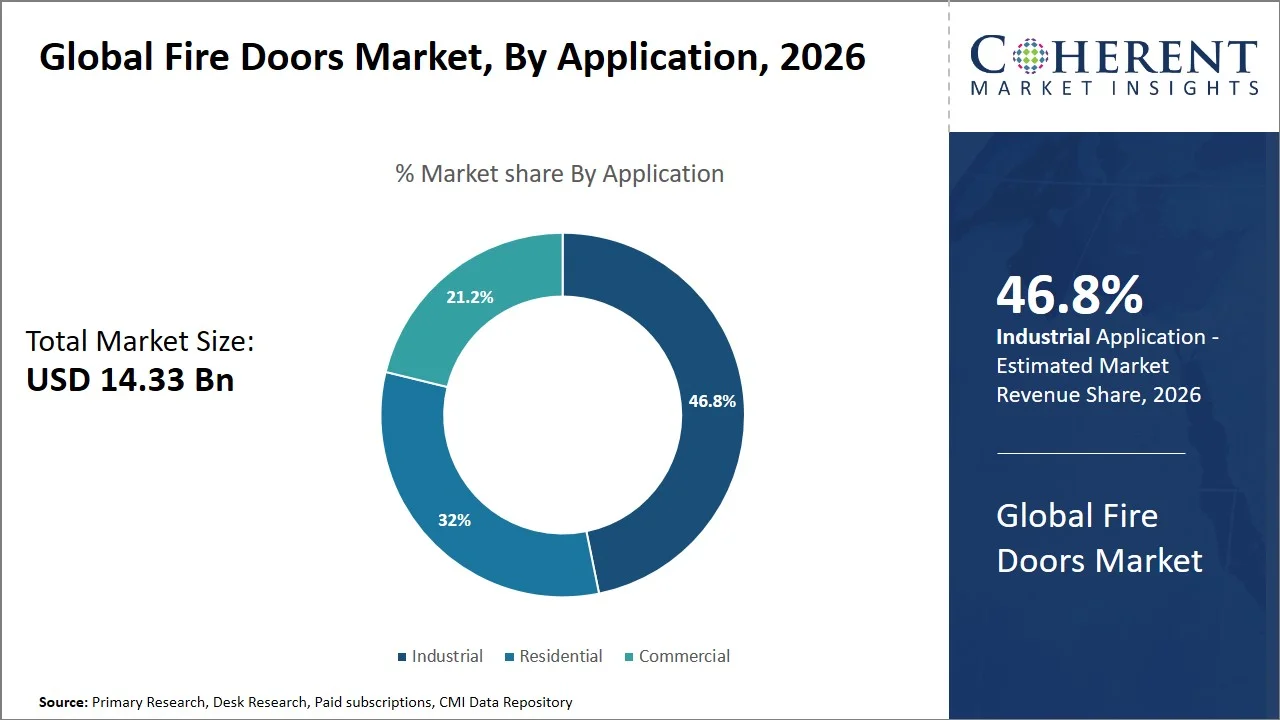
The industrial segment is expected to hold 46.8% share of the fire doors market in 2026, due to the critical need for hazard mitigation and compliance with rigorous safety standards. Industrial operations like manufacturing plants, warehouses, chemical processing facilities, power generation plants, and similar industries typically store flammable substances, use heavy machinery and machinery that have complex operations, and increase the likelihood of fire occurrences. This has resulted in the requirement for reliable fire suppression systems to be installed, including the installation of fire doors as a key barrier to limit the spread of fire and safeguard personnel, equipment, and goods.
Nonresidential buildings were exposed to 110,000 fires in 2023, resulting in 130 fatalities, 1,200 injuries, and USD 3.16 billion in direct dollar loss, according to the U.S. Fire Administration. (Source: U.S. Fire Administration)
Automatic Dominates the Fire Doors Market
Automatic segment is expected to hold 51.7% share of the fire doors market in 2026, because they offer unparalleled advantages in terms of functionality and user safety. Fire doors can be automatically opened and closed depending on the environmental conditions, including smoke alarm, heat sensor, and emergency alarm, by using automation technology. The quick response is essential to stopping the spread of fire and smoke, safely evacuate the building, and keep the fire control system working properly in emergencies.
In addition, the International Building Code (IBC) has provisions for automatic fire door use. IBC Chapter 7 requires doors in smoke partitions to be self-closing or automatic-closing upon smoke detection, directly supporting the need for automatic fire doors in conjunction with smoke detectors, alarms, hold-open devices, and fire-control systems. (Source: ICC Safe.org)
Currents Events and their Impact
Current Events | Description and its Impact |
Annual fire door inspection becoming a stronger compliance practice in North America |
|
EU Construction Products Regulation strengthening performance documentation |
|
(Source: National Fire Protection Association)
Market Dynamics
Market Driver
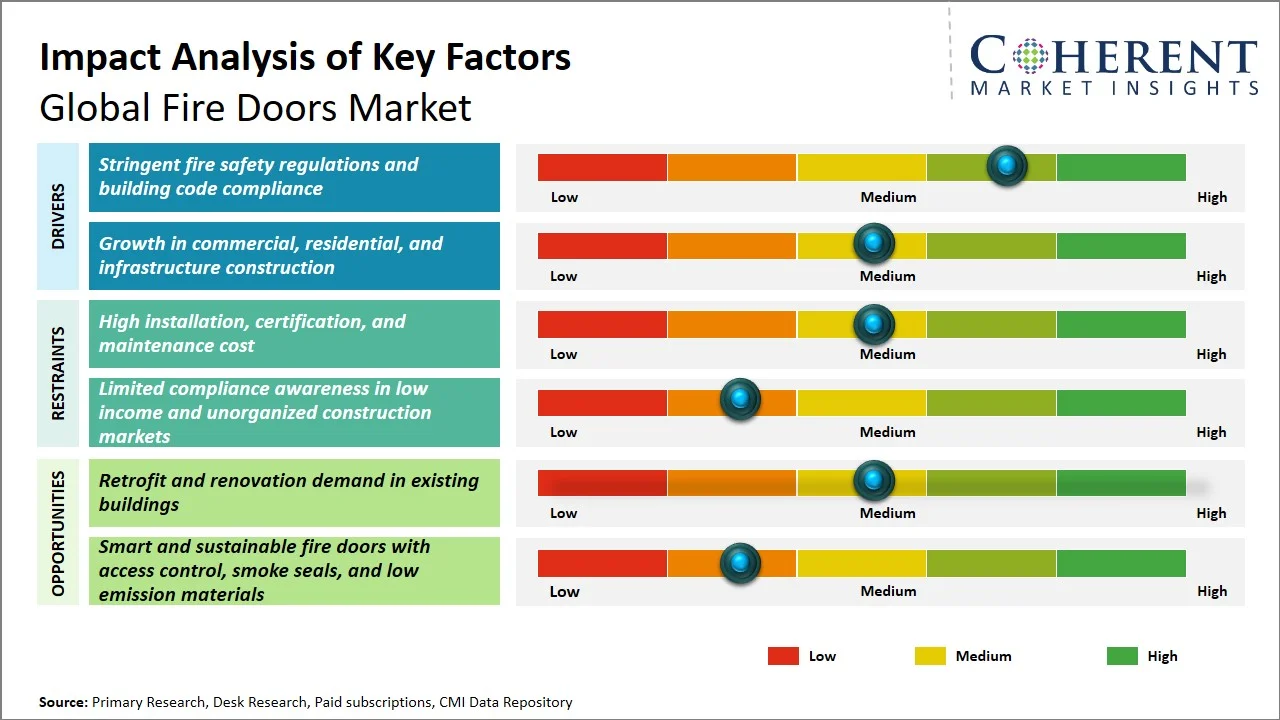
- Stringent fire safety regulations and building code compliance: Growing focus on fire safety measures in both residential and commercial buildings and industrial plants is a major factor in the global fire doors market. Governments and regulatory bodies worldwide have been enforcing more rigorous building codes and fire safety regulations to minimize risks associated with fire hazards. This has resulted in the requirement of fire-resistant doors in many construction projects for evacuation and fire containment. Builders and developers must adhere to strict regulations because fire doors must have specific characteristics such as fire resistance, material requirements, and installation requirements. Fire doors are becoming more common in commercial buildings, hospitals, schools, high rise buildings, apartments, and industrial facilities. NFPA 80 stipulates that fire doors be inspected and tested after installation and at least once a year thereafter, thus encouraging continuing demand for fire doors certification, replacement, repair and maintenance. (Source: NFPA)
- Growth in commercial, residential, and infrastructure construction: The increasing demand for certified fire doors as a direct result of the growth in commercial, residential, and infrastructure construction activities: more high-rise residential structures are being built, hospitals, airports, schools, hotels, data centers, industrial plants, and public infrastructure are all seeing increases as well. The increasing size and compartmentalization of buildings have resulted in the need for fire-rated doors to be installed in stairways, corridors, lift lobbies, plant rooms, basements, and escape routes to slow the spread of fire and smoke. In May 2026, the U.S. Census Bureau reported that U.S. construction spending has reached an annualized rate of USD 2,185.5 billion in March 2026, with residential construction spending at USD 929.7 billion, a large base of active construction projects that includes the need for life-safety products. (Source: Census.gov)
Emerging Trends
- Rising Demand for Fully Certified Door Assemblies: There is an increased demand for fully certified door assemblies, rather than just door leaves, and these assemblies now include the frame, seal, glazing, closer, hinge, and lock. This is due to more rigorous inspection procedures and the desire to prevent failures due to incompatible components at fire safety audit inspections.
- Growth in Fire Door Inspection and Maintenance and retrofit services: Greater emphasis is being paid to the inspection, repair, and retrofit of fire doors within existing commercial and residential buildings. In the U.K., the government's guidance states that protected stairways must be encased in fire-resistant construction and fire doorsets to increase retrofit demand in escape-route safety upgrades.
Regional Insights

Why is Europe a Strong Market for Fire Doors Market
Europe leads the global fire doors market, accounting for an estimated 41.5% share in 2026, owing to the development of the construction industry and the implementation of stringent fire safety regulations and building codes in the region. The stringent regulations set by the European Union (EU) for fire protection are driving the use of the latest fire door systems in homes, offices, and buildings. Furthermore, Europe has a sophisticated market ecosystem with established manufacturers like ASSA ABLOY, Hörmann, and Dierre that are constantly developing new ideas to provide better fire resistance and design integration. Sustainability is another key focus in the region that influences the demand for fire doors with sustainable materials. Also, the exchange of ideas in the field of international trade enables technology transfer and competitive prices, which strengthens Europe's role as the world leader.
Why Does Asia Pacific Fire Doors Market Exhibit High Growth?
The Asia Pacific fire doors market is expected to exhibit the fastest growth with an estimated contribution of 24.3% share to the global market in 2026, due to the high rate of urbanization, growing infrastructure activities, and spread awareness of fire safety concerns among the emerging economies. The demand is further driven by the comprehensive fire safety codes and incentives for compliance being enforced by the governments of China, India, Japan, and other countries in SE Asia. The relative newness and growing construction and real estate activity in this area has enabled a fertile ground for the market expansion.
Major companies, including Masonite, Kuraray, and local manufacturers, are taking advantage of the cost-effective approach to production and solutions that are customized to local needs. The dynamics of trade, such as the import and export of products and foreign investment in infrastructure also facilitate the penetration of the market and the use of technologically advanced fire door solutions.
Global Fire Doors Market Outlook for Key Countries
Why is the U.S. Leading Innovation and Adoption in the Fire Doors Market?
The U.S. market is heavily compliance based, as both the OSHA code and the fire door assembly (frame and hardware) must be listed or approved by a nationally recognized testing laboratory and the door must be self-closing or closed during an alarm. This directly contributes to the demand of commercial, industrial, healthcare, institutional, and public buildings. Construction activity is also a driver of replacement and new installation demand, with the U.S. Census Bureau reporting construction spending of USD 2,185.5 billion in March 2026, with USD 729.4 billion in private nonresidential construction and USD 526.4 billion in public construction. Fire-safety projects are also available under FEMA's Fire Prevention & Safety grants, but are fire-prevention grants and not exclusively for fire-doors. (Source: OSHA)
Is Germany a Favorable Market for Fire Doors Market?
Germany’s fire doors market is supported by strict building-safety expectations, EU-aligned product standards, and a strong domestic manufacturing base. Fire-rated doors supplied in Europe are linked to EN 16034 fire-resisting and smoke-control requirements, while Germany’s participation in EU harmonized construction product rules supports the cross-border acceptance of compliant products. The European supply of fire-rated doors also meets the requirements of EN 16034:2012 for fire-resisting doors and smoke-control requirements, and the involvement of Germany in the EU harmonized construction product rules facilitates the acceptance of compliant products in other EU member states.
The demand for construction continues to be of relevance: Destatis reported in March 2026 a total of 13,410 building construction permits, which are used for the construction of 21,775 dwellings and estimated building costs of USD 11.35 billion. The manufacturing capacity is also good in Germany: Hörmann says it has the widest selection of fire-resistant doors and multi-purpose doors for construction projects.
Is China Emerging as a Key Growth Hub for the Fire Doors Market?
China's market is backed by the fact the nation has a clear national standard framework for fire-resistant doors, and rapid urbanization. China's permanent-resident urbanization rate had risen to 67.89% at the end of 2025, a 0.89 percentage point increase from 2024, which further drove the demand for fire-rated doors in high-rise residential, commercial, transport, healthcare, and public buildings. The National Fire and Rescue Administration issued the official standards platform of China "Fire-resistant doorsets" as a mandatory national standard with effect from May 1, 2026 (28th October 2024). The acquisition of Chinese fire-door manufacturers also indicates a long-term interest of ASSA ABLOY as a global player in China's fire-door supply base.
Why Does India Top the Asian Fire Doors Market?
The market in India is expanding as the enforcement of the fire-safety provisions in buildings is becoming more stringent, with a focus on high-rise, commercial, institutional, and industrial buildings, along with infrastructure growth. The fire protection requirements set by MoHUA for enclosed stairs are that they should be accessible through self-closing doors that are 1 hour fire rated; lift landing doors should be not less than 1 hour fire rated; and lift lobby exits should use self-closing fire-smoke check doors.
To achieve working and productivity in other business sectors and India's ambitious goal to be a USD 5 trillion economy by 2025, strong infrastructure growth is essential. In particular, the success of India's manufacturing sector and the focus on "Make in India" are directly influenced by how strong the backbone of India's infrastructure is. There is a constant need for government intervention, solid funding and constant monitoring of projects.
How is Retrofit and Renovation Demand in Existing Buildings Creating New Growth Opportunities in the Fire Doors Market?
Retrofit and renovation activity represents a good growth opportunity for the global fire doors market as it is not just about “new building compliance” anymore, but is about continuous fire-safety compliance in existing occupied buildings. The Fire Safety (England) Regulations 2022 (the Regulations) set out the duties for quarterly checks to be carried out on communal fire doors and the best endeavors annual checks for flat entrance fire doors in multi-occupied residential buildings with a height greater than 11 meters. In July 2023, the U.K. government also made it clear that flat entrance doors are included in the scope of fire-risk assessment and, therefore, there is a direct demand for replacement, repair, upgraded closers, smoke seals and certified fire-door assemblies. (Source: OGL)
Mandatory Fire-Door Installation Regulations by Region/Country – Fire Doors Market
Region/Country | Key Regulation / Code Reference | Mandatory Installation Requirement |
Europe / UK | EU EN 16034 for fire-resisting and smoke-control doorsets; U.K. Approved Document B and Fire Safety Regulations | Fire doorsets are specified for protected stairs, flat entrances, corridors, compartment walls, and escape routes. U.K. guidance states that fire doorsets should generally be self-closing, with specific exemptions. |
Asia Pacific – India & Singapore Example | India NBC Part 4 – Fire and Life Safety; Singapore Fire Code 2023 | India’s NBC defines fire door assemblies as rated door, frame, hardware, and accessories installed in fire separation walls; access to exit staircases may require minimum 120-minute fire doors. |
Market Players, Key Development, and Competitive Intelligence
Key Developments
- In April 2025, ASSA ABLOY acquired Door System, a Denmark-based firm known for its expertise in fire-rated, freezer, and hygienic doors used across various industries. Established in 1998 and headquartered in Hørning, the company has around 80 employees supporting its operations. The deal is expected to be completed in the second quarter of 2025 and will add immediate value to ASSA ABLOY’s earnings.
- In January 2024, Clestra Asia announced the launch of a new fire-rated partition system designed to deliver both fire safety and sound insulation while maintaining a modern architectural look. The solution is available in framed and frameless versions, offering acoustic performance of around 41-42 dB. Its construction features steel channels with fire-resistant gypsum and Rockwool, meeting Grade-A certification standards in China. Suitable for corridors, lobbies, and escape routes, the system enhances safety compliance and can help lower insurance risks.
- In September 2024, Tufwud rolled out FD120 ID, India’s first fully insulated fire door with ISI certification. The new door is engineered to provide enhanced fire resistance along with durability and modern aesthetics. Its certification ensures compliance with national safety standards and proven performance under critical conditions. This launch marks a major step in advancing fire safety solutions for buildings across India.
Competitive Landscape
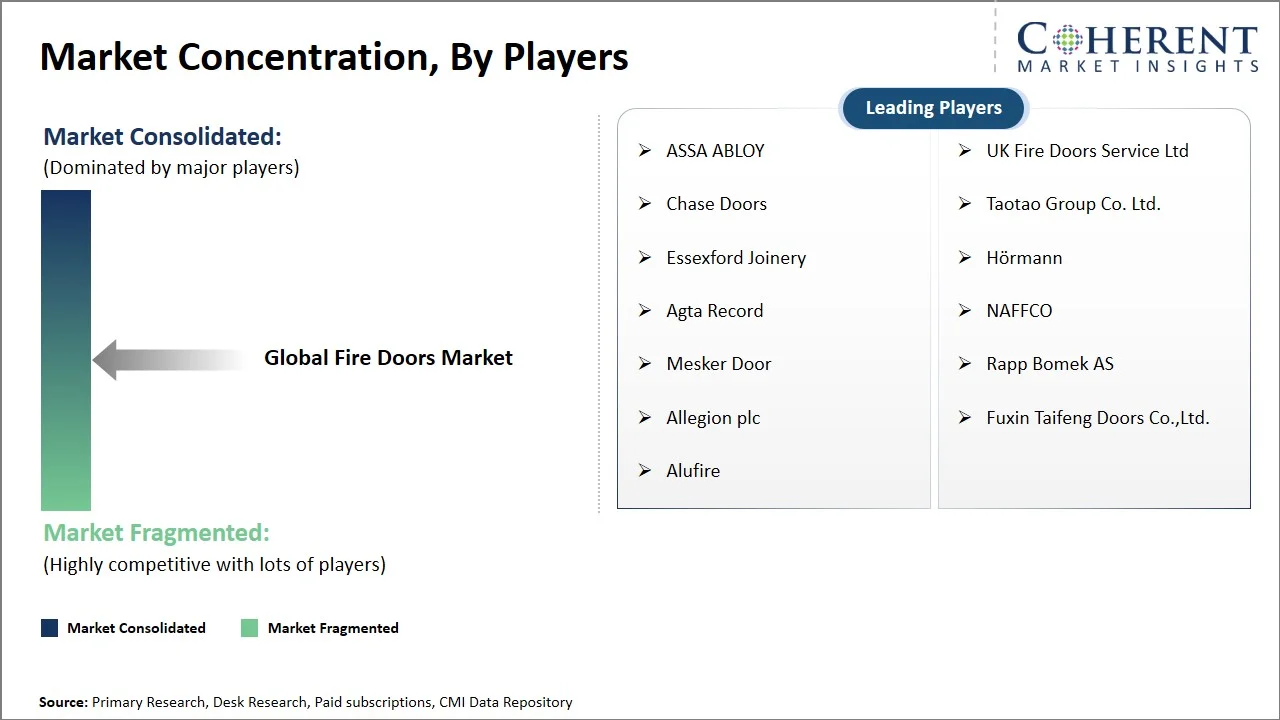
The fire doors market is extremely competitive due to the stringent building safety codes, increase in commercial construction, and the increased demand for fire rated door assemblies. The established players provide a portfolio of proven products, compliance certifications, a network of contractors, and a capacity for large-scale supply, while regional manufacturers can offer customization, pricing, and speed of project delivery. The following are key focus areas: Some of the key focus areas are:
- Certified and code compliant products
- Diversification of products into steel, timber and glazed and composite fire doors.
- Coordinated involvement with contractors, architects, facility managers and safety consultants.
Market Report Scope
Fire Doors Market Report Coverage
| Report Coverage | Details | ||
|---|---|---|---|
| Base Year: | 2025 | Market Size in 2026: | USD 14.33 Bn |
| Historical Data for: | 2020 To 2024 | Forecast Period: | 2026 To 2033 |
| Forecast Period 2026 to 2033 CAGR: | 4.5% | 2033 Value Projection: | USD 19.50 Bn |
| Geographies covered: |
| ||
| Segments covered: |
| ||
| Companies covered: | ASSA ABLOY, UK Fire Doors Service Ltd, Chase Doors, Taotao Group Co. Ltd., Essexford Joinery, Hörmann, Agta Record, NAFFCO, Mesker Door, Rapp Bomek AS, Allegion plc, Fuxin Taifeng Doors Co.,Ltd., and Alufire | ||
| Growth Drivers: |
| ||
| Restraints & Challenges: |
| ||
Analyst Opinion (Expert Opinion)
- The market for fire doors will shift from the supply of basic fire doors to the supply of certified fire safety systems. As the fire resistance codes become more stringent, buyers will be seeking out full assemblies that are rated fire-resistant (door leaf, frame, hinges, seals, closers, locks, glazing and access-control compatibility). The market will also be moving toward lifecycle compliance, so that testing, maintenance, replacing, and retrofitting services are as significant as new door sales. Projects with a strong focus on fire doors as a regulatory and insurance critical tool for the building will benefit the most.
- India has immense volume potential with fast construction of multi-family housing, metro, hospitals, malls and commercial buildings. Saudi Arabia and UAE's hospitality, airports, mixed-use developments and smart city projects provide leaders in lucrative projects. Retrofit/replacement opportunities will be steady in developed markets like the U.S. and Europe, where older buildings will seek to upgrade non-compliant fire door systems.
- Players need to be specification-led suppliers instead of price-led vendors. The edge will be gained by collaborating closely with architects early in the process as well as MEP consultants, fire safety consultants, contractors, and real estate developers. Companies that offer proven assemblies, easy documents, BIM files, installation support, and annual inspection services will get increased project conversion.
Speak to the analyst
Want personalized insights?
Take the findings above to one of our principal consultants, or have the report rebuilt around the segments, geographies and competitors you actually track.
Market Segmentation
- Material Insights (Revenue, USD Bn, 2021 - 2033)
- Metal
- Glass
- Timber
- Others
- Application Insights (Revenue, USD Bn, 2021 - 2033)
- Industrial
- Residential
- Commercial
- Operation Insights (Revenue, USD Bn, 2021 - 2033)
- Automatic
- Manual
- Electric
- Regional Insights (Revenue, USD Bn, 2021 - 2033)
- North America
- U.S.
- Canada
- Latin America
- Brazil
- Argentina
- Mexico
- Rest of Latin America
- Europe
- Germany
- U.K.
- Spain
- France
- Italy
- Russia
- Rest of Europe
- Asia Pacific
- China
- India
- Japan
- Australia
- South Korea
- ASEAN
- Rest of Asia Pacific
- Middle East
- GCC Countries
- Israel
- Rest of Middle East
- Africa
- South Africa
- North Africa
- Central Africa
- North America
- Key Players Insights
- ASSA ABLOY
- UK Fire Doors Service Ltd
- Chase Doors
- Taotao Group Co. Ltd.
- Essexford Joinery
- Hörmann
- Agta Record
- NAFFCO
- Mesker Door
- Rapp Bomek AS
- Allegion plc
- Fuxin Taifeng Doors Co.,Ltd.
- Alufire
Sources
Primary Research Interviews
- Fire door manufacturer
- Supply Chain Director of a building products or door systems producer
- Technical/Product Director at a fire-rated door specialist
- Sustainability or compliance officer at a building envelope / life-safety certification body
- Fire protection consultant, code consultant, or door hardware systems integrator
Stakeholders
- Manufacturers of fire doors and fire-rated assemblies, such as Allegion, ASSA ABLOY, dormakaba, and specialist regional producers
- End-use sectors: commercial builders, residential developers, industrial and warehouse developers, healthcare facilities, education facilities, and hospitality operators
- Contractors and installers: doors, hardware, glazing, and fire-stopping contractors
- Regulatory and certification bodies: ICC, UL, NFPA, and local building-code authorities
Databases
- UN Comtrade Database, using relevant HS headings for doors, frames, and building components
- India Import Export (EXIM) Database
- USITC DataWeb for U.S. imports of doors, frames, hardware, and related construction products
- Eurostat trade statistics for doors and building components
- OECD and World Bank construction/materials trade datasets for broader macro context
- National customs and tariff databases for country-level import/export tracking
Magazines
- Door and hardware trade magazines
- Building products and specification publications
- Construction and architectural envelopes magazines
- Safety and fire-protection industry magazines
- Commercial building and facility-management publications
Journals
- Journal of Building Engineering
- Fire Safety Journal
- Construction and Building Materials
- Journal of Architectural Engineering
Newspapers
- The Wall Street Journal, for construction demand, commercial real estate, and building-products supply trends
- Business Standard, for India’s construction and building-materials
- Construction Dive, for supply chain, code, and commercial construction trends
Associations
- National Fire Protection Association (NFPA)
- International Code Council (ICC)
- Underwriters Laboratories (UL)
- Door and Hardware Institute (DHI)
- Steel Door Institute (SDI)
- Builders Hardware Manufacturers Association (BHMA)
- National Association of Home Builders (NAHB)
Public Domain Sources
- ICC building codes and model code references for fire-rated openings
- UL fire door application guides and certification references
- ASTM International performance and fire-test standards relevant to door assemblies
- NFPA codes and standards for life safety and fire protection
Proprietary Elements
- CMI Data Analytics Tool, Proprietary CMI Existing Repository of information for last 10 years.
Get access to 250+ pages report
Every segment, forecast, competitor profile and data table behind the analysis above — available for instant download.
- ESOMAR Member
- ISO 9001:2015 Certified
- D-U-N-S Registered
- GDPR & CCPA Compliant
Missing comfort of reading report in your local language? Find your preferred language:
Transform your Strategy with Exclusive Trending Reports
Frequently Asked Questions
The global fire doors market is estimated to be valued at USD 14.33 Bn in 2026 and is expected to reach USD 19.50 Bn by 2033.
The CAGR of global fire doors market is projected to be 4.5% from 2026 to 2033.
Fire doors are specially designed doors used to slow the spread of fire, smoke, and heat between building compartments, helping occupants evacuate safely and protecting property.
Fire-rated doors help maintain compartmentation by restricting fire and smoke movement, supporting safe evacuation and reducing damage during fire incidents. Fire doors must not be blocked or made inoperable under fire safety codes.
Stringent fire safety regulations and building code compliance and growth in commercial, residential, and infrastructure construction are the major factors driving the growth of the global fire doors market.
High installation, certification, and maintenance cost and Limited compliance awareness in low income and unorganized construction markets are the major factors hampering the growth of the global fire doors market.
In terms of Material, Metal is estimated to dominate the market revenue share in 2026.