

Metal Building System Market Size & Forecast 2026-2033
Metal building systems market is estimated to be valued at USD 25,194.9 Mn in 2026 and is expected to reach USD 56,047.0 Mn in 2033, exhibiting a compound annual growth rate (CAGR) of 12.1% from 2026 to 2033.
Key Takeaways
- Based on Product, the Roof System segment is expected to maintain its dominance in the metal building system market with the largest share in 2026, as they are the most critical structural component, providing durability, weather resistance, and energy efficiency.
- Based on Application, the Industrial segment leads the market, capturing an estimated 49.7% of the market share in 2026, due to its need for cost-efficient, durable, and flexible building solutions.
- Based on Region, Asia Pacific is expected to lead the market, holding a share of 38.8% in 2026. While, North America is anticipated to be the fastest-growing region, with a market share of 30.4% in 2026.
Market Overview
Metal building systems are engineered constructions designed for cost-effectiveness and efficiency in low-rise buildings. Using CADD tools, producers customize structures to meet specific requirements and building codes. Key components such as rigid frames, roof purlins, wall girts, and cladding are integrated to ensure durability and flexibility. Widely used in warehouses, production facilities, distribution centers, shopping malls, offices, hospitals, and hangars, these systems are gaining popularity for their affordability and adaptability. Rising preference for durable and customizable solutions is fueling strong metal building system market demand across industrial, commercial, and institutional sectors.
Current Events and their Impact on the Metal Building System Market
Current Event | Description and its Impact |
E-commerce and Industrial Real Estate Boom |
|
Construction Industry Labor Shortage Crisis |
|
Price Analysis
The Metal Building System Market demonstrates significant price variability depending on building type, complexity, and intended application. Prefabricated kits alone are typically priced between $10 and $25 per square foot, making them the most economical option for basic structures, while fully installed systems range from $24 to $43 per square foot when accounting for labor and site preparation. Agricultural and storage buildings are among the most affordable, averaging $10 to $20 per square foot, whereas industrial-grade or specialized projects requiring reinforced designs can climb to $50 to $100 per square foot. For Pre-Engineered Metal Building (PEMB) materials alone, prices are about $17 to $20 per square foot, but when including construction for smaller footprints (under 100,000 sq. ft), costs can reach $110 to $150 per square foot. Standard-size projects such as 30×40 ft to 100×100 ft typically average $18 to $25 per square foot, while barndominiums, metal structures adapted for residential use, can be much higher, ranging from $30 to $50 per square foot for shell kits and $65 to $160 per square foot for fully finished interiors.
Several key factors influence these price variations. Economies of scale play a major role, as larger structures usually lower per-square-foot costs. Design complexity also matters; straight rectangular layouts are cheaper, whereas custom or multi-story designs drive up expenses. The inclusion of accessories and custom features such as insulation, mezzanines, or specialized doors and windows can add 15–20% to total costs.
- Current Industry Events of 2026
- Market Size Estimation
- Regional Breakdown
- Competitive Landscape
- Customer Intelligence
- Segmental Analysis
- Pricing Analysis
- Key Market Drivers, Challenges & Future Trends
- Customized Insights Section
Segmental Insights
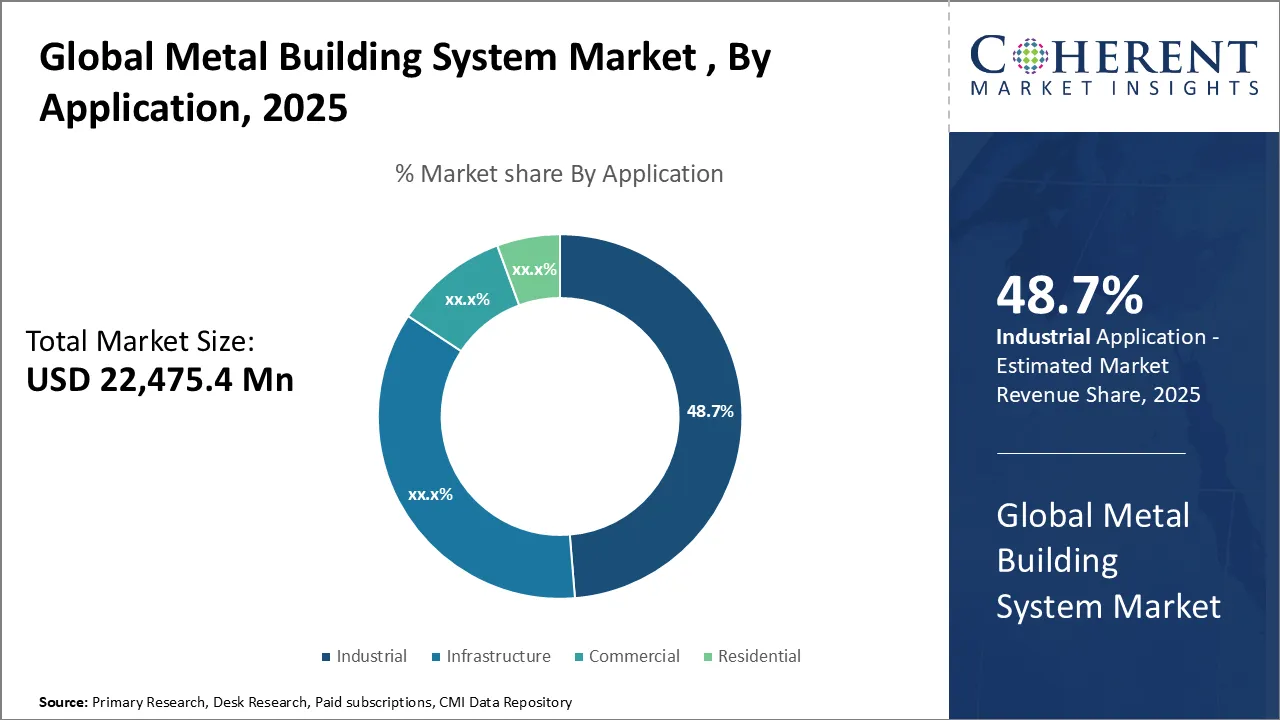
Metal Building System Market Insights, By Application: Industrial Dominates Owing to its Cost-Effectiveness, Durability and Flexibility
In terms of application, the industrial segment is highly demanding in the metal building systems market, accounting for 49.7% in 2026, due to its need for cost-efficient, durable, and flexible building solutions. Metal building systems are widely preferred for factories, warehouses, logistics hubs, and production facilities because they offer faster construction timelines, reduced maintenance costs, and the ability to create large clear-span spaces without interior columns. This structural flexibility allows industries to optimize floor layouts for machinery, material handling, and storage. Additionally, the rising demand for warehousing and logistics facilities driven by e-commerce expansion and global trade has further accelerated industrial adoption.
For instance, in August 2025, Central States Inc. opened its 12th facility, a 105,000-square-foot, steel frame plant in Springdale, Arkansas, designed to support the rapid expansion of its Central States Building Works division Central States. The new plant features cutting-edge automation; welding systems and robotics aimed at enhancing precision and reducing lead time. With a $24 million investment, the facility is expected to generate around 50 jobs in 2025, with projection to scale to 140 employee-owners as capacity grows.
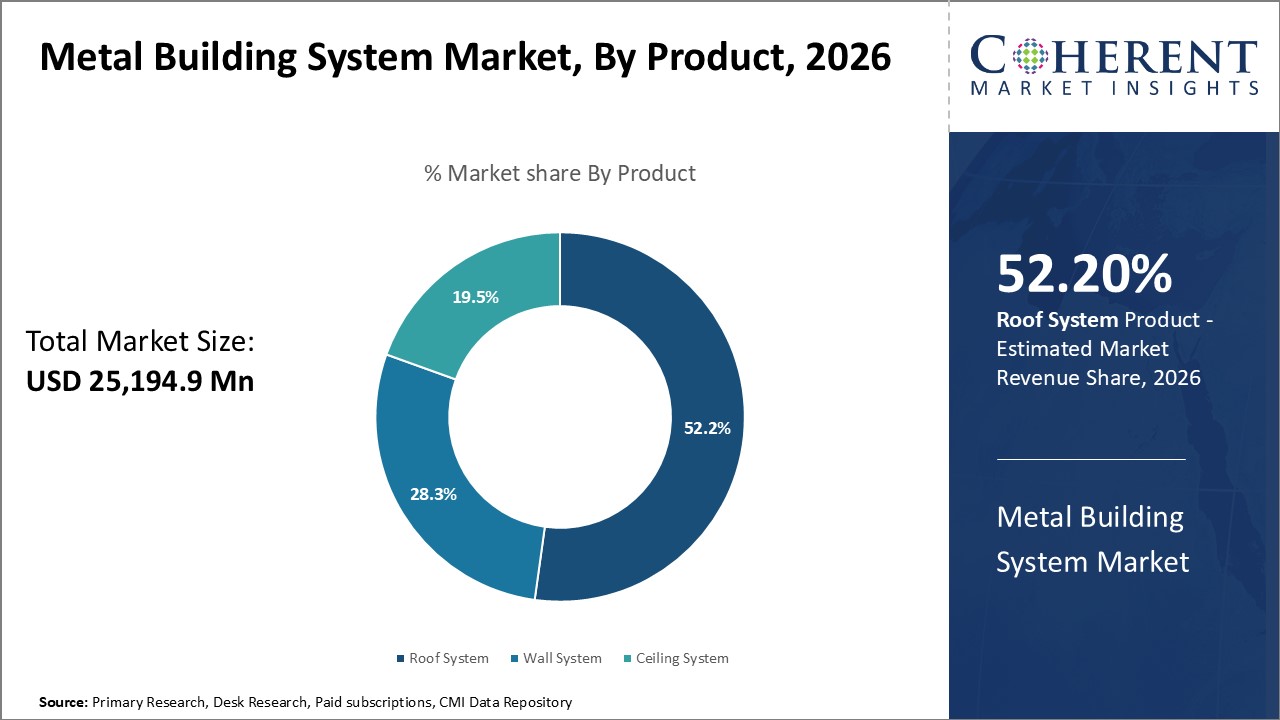
Metal Building System Market Insights, By Product: Roof System Dominance is Driven By its Critical Structural Component, Providing Durability
In terms of product, the roof system segment is dominating the metal building systems market, holding the largest share in 2026, as they are the most critical structural component, providing durability, weather resistance, and energy efficiency for industrial, commercial, and residential applications. Increasing demand for sustainable and insulated roofing solutions, particularly in warehouses, manufacturing facilities, and large-scale commercial spaces, has further strengthened this segment’s dominance. Additionally, advancements in cool roofing technologies and the integration of solar-ready metal roof panels are expected to boost adoption, reinforcing the roof system’s leading position in the market.
For instance, in August 2025, Jackson Metal Roofing launched a new "Design Your Building" online configurator, enabling homeowners, contractors, and architects in Central Georgia and beyond, to design, visualize, and request quotes for custom metal roofs and pole barns with ease. The intuitive digital platform allows users to mix panel types (color-finished or galvalume), choose structural features for barndominiums, equestrian or hybrid structures, and preview designs in real time.
Regional Insights
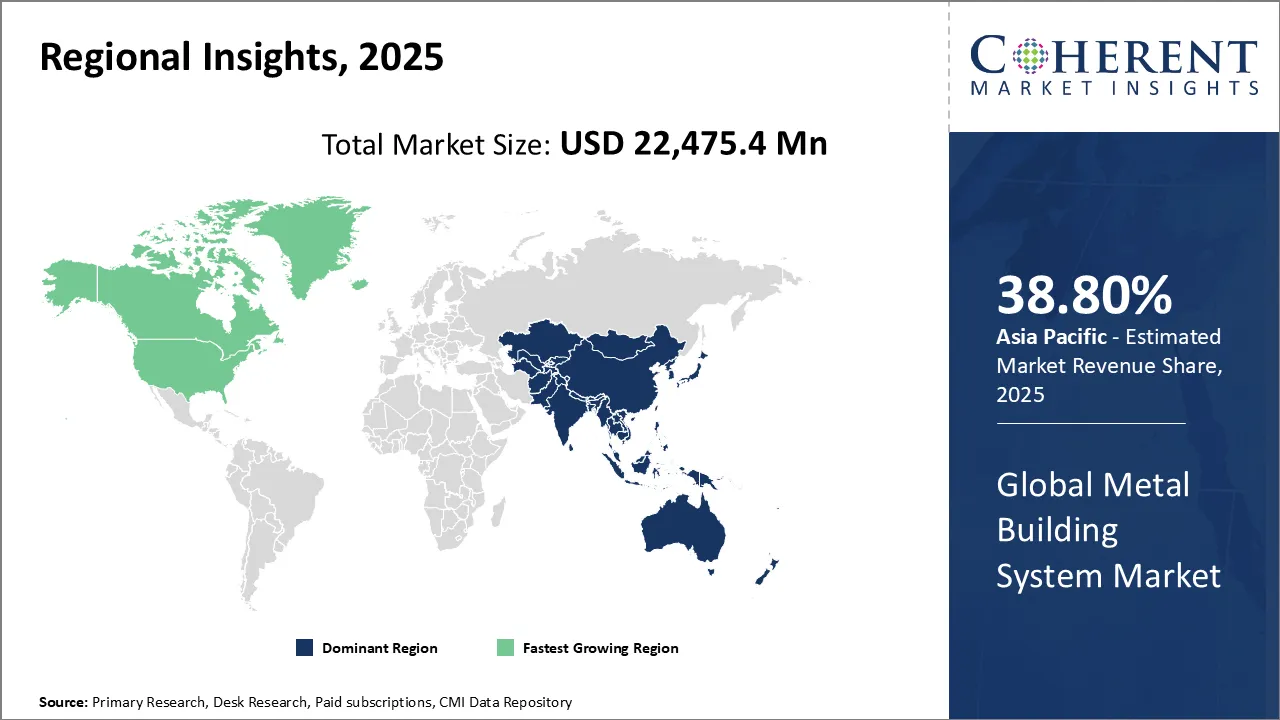
Asia Pacific Metal Building System Market Analysis & Trends
Asia Pacific is expected to dominate the global metal building system market with 38.80% of the market share in 2026 due to rapid urbanization, industrialization, and infrastructure development across emerging economies such as China, India, and Southeast Asian nations. According to the Asian Development Bank (ADB), developing Asia and the Pacific will require over $22.6 trillion in infrastructure investments by 2030, equivalent to $1.5 trillion annually, to sustain economic growth. When factoring in climate change mitigation and adaptation, the estimated need rises to more than $26 trillion, or $1.7 trillion per year. Rising demand for cost-effective, durable, and energy-efficient construction solutions is fueling adoption in industrial facilities, warehouses, commercial complexes, and residential projects.
Government initiatives promoting smart cities, logistics hubs, and green building standards are further boosting demand. Additionally, the region’s booming e-commerce sector is driving the need for large-scale distribution centers and warehouses, where metal building systems are increasingly preferred for their quick installation and lower lifecycle costs. The availability of affordable raw materials and expanding construction investments also contribute to Asia Pacific’s dominant position in the global market.
North America Metal Building System Market Analysis & Trends
North America is expected to be the fastest-growing market with 30.4% share metal building system market during the forecast period. The region has a strong focus on sustainable construction practices, with rising adoption of eco-friendly and energy-efficient building solutions. Growing investments in commercial infrastructure, such as warehouses, retail outlets, and office buildings, are boosting the demand for metal building systems due to their cost-effectiveness and faster construction timelines. For instance, CaratLane has launched its first international store in New Jersey. In addition, the thriving e-commerce and logistics sector in the U.S. and Canada is creating high demand for warehouses and distribution centers, further fueling market growth. Strict building codes and government regulations encouraging green construction also support adoption. Moreover, the presence of advanced CADD-based design technologies and well-established manufacturers makes North America a leading market for metal building systems.
Metal Building System Market Outlook Country-Wise
The U.S. Metal Building System Market Trends
The United States holding the largest share at 26.1%. The U.S. market is driven by extensive adoption of metal building systems in warehouses, logistics hubs, retail outlets, and government projects, supported by the surge in e-commerce and rising investments in sustainable commercial infrastructure.
For instance, in December 2024, U.S. startup Plant Prefab unveiled plans for the nation’s first fully automated prefabricated construction factory, with a $30 million investment, the 25,000 sqm facility will serve as the company’s third factory and its first regional production hub, capable of employing up to 440 staff. Leveraging advanced digital modeling and automated machinery, the factory will industrialize Plant Prefab’s Plant Building System™, delivering modular housing components 20–50% faster and with up to 30 percent less waste, while cutting labor costs by 10–25%.
China Metal Building System Market Trends
China accounts for 16.0% of the market, fueled by rapid urbanization, large-scale industrial expansion, and government-backed infrastructure projects, with a strong push toward prefabricated and green building solutions.
For instance, in August 2026, The Asia Metal Building Design & Industry Expo (MBE 2026) will take place at the Shanghai New International Expo Center, spotlighting the convergence of metal construction, insulation materials, green factories, clean technology, and smart cold-chain innovation. Co-organized by multiple national and provincial industry bodies, the event supports China’s dual-carbon goals and international sustainability trends.
India Metal Building System Market Trends
India represents 7.5% of the market, supported by investments in manufacturing, smart cities, and infrastructure development, alongside the increasing demand for cost-effective and quickly deployable structures.
In July 2026, M&B Engineering Ltd, a leading player in pre-engineered buildings (PEBs) and self-supported steel roofing solutions, launched its ₹650 crore IPO, with a price band set at ₹366–385 per share. The issue comprises a ₹275 crore fresh issue and ₹375 crore offer-for-sale, and closes on August 1. The IPO is drawing strong investor interest, trading at a grey market premium of around 11%, with retail and non-institutional segments showing robust subscription trends.
Germany Metal Building System Market Trends
Germany contributes about 5.1% of market share which is driven by energy-efficient and sustainable construction practices. Metal building systems are being widely adopted in logistics, automotive, and industrial facilities.
For instance, in June 2026, Siemens Smart Infrastructure, Cadolto Datacenter, and Legrand Data Center Solutions launched a new turnkey, prefabricated modular Edge data-centre. Siemens will integrate its full Smart Infrastructure suite, including power distribution, automation, fire safety, and security, supported by optional maintenance and 24/7 emergency services.
Japan Metal Building System Market Trends
In Japan, the 5.1% market share is driven by the need for earthquake-resistant and sustainable construction, coupled with space-efficient building designs, fuels demand for metal building systems in both industrial and commercial sectors.
For instance, in April 2026, Air Danshin Systems has unveiled a pioneering “floating home” system that lifts houses approximately 3 cm off their foundations during earthquakes, isolating them from ground shaking. The system uses deflated airbags and rapid-response compressors triggered by seismic sensors; once the quake subsides, homes gently settle back intact. A successful shake-table demonstration even proved that glasses of wine remained undisturbed.
Market Report Scope
Metal Building System Market Report Coverage
| Report Coverage | Details | ||
|---|---|---|---|
| Base Year: | 2025 | Market Size in 2026: | USD 25,194.9 Mn |
| Historical Data for: | 2020 To 2024 | Forecast Period: | 2026 To 2033 |
| Forecast Period 2026 to 2033 CAGR: | 12.1% | 2033 Value Projection: | USD 56,047.0 Mn |
| Geographies covered: |
| ||
| Segments covered: |
| ||
| Companies covered: | Butler Manufacturing (a division of BlueScope Steel), Nucor Building Systems (part of Nucor Corporation), Zamil Steel, Kirby Building Systems (a division of Alghanim Industries), Tata BlueScope Steel (joint venture between Tata Steel and BlueScope), Interarch Building Products, NCI Building Systems / Cornerstone Building Brands, Mabani Steel, Everest Industries Limited, and Lindab Group | ||
| Growth Drivers: |
| ||
| Restraints & Challenges: |
| ||
Metal Building System Market Driver
- Rapid Urbanization and Infrastructure Development
Rapid urbanization and large-scale infrastructure development are key factors driving the metal building system market share. With growing population density and the expansion of cities, there is a rising need for cost-effective, durable, and quickly deployable construction solutions. Metal building systems provide faster installation, design flexibility, and lower maintenance compared to traditional materials, making them ideal for warehouses, shopping centers, airports, and residential complexes. Governments and private players are increasingly investing in modern infrastructure projects such as smart cities, transport hubs, and commercial spaces, further boosting adoption. As a result, the demand for metal building systems continues to rise, strengthening their market share globally. For instance, in May 2025, The World Bank has approved a $400 million IDA package, comprising a $380 million credit and a $20 million grant to fund the Southern Niger Connectivity and Integration Project in southern Niger. The initiative will rehabilitate the Maradi–Zinder section of National Road 1 (RN1) and upgrade 525 km of feeder and rural roads to climate-resilient standards, enhancing year-round access to markets, schools, health services, and jobs.
- Focus On Sustainable Construction
A strong focus on green construction is significantly shaping the metal building system market growth. Metal building systems are highly recyclable, energy-efficient, and designed to reduce construction waste, making them ideal for green building initiatives. Their adaptability allows integration of eco-friendly solutions such as solar panels, energy-efficient insulation, and natural ventilation systems. Governments and regulatory bodies worldwide are also emphasizing sustainable infrastructure, further encouraging the adoption of metal building systems. As industries and developers prioritize environmental compliance and cost-effective solutions, the demand for eco-friendly metal structures is expected to accelerate in the coming years.
Analyst Opinion (Expert Opinion)
The metal building system market is entering a decisive phase where its speed, durability, and lifecycle efficiency are offset by raw-material price volatility. Tariff-driven increases in steel and aluminum costs are directly raising metal building system market price, with clear-span kits averaging $15–$30/ft² and turnkey projects $35–$60/ft². This pricing pressure is reshaping procurement behavior as buyers weigh total installed costs over speed alone.
Market differentiation now hinges on supply-chain resilience, digital BIM integration, and low-carbon steel adoption. Industrial warehousing, cold storage, and logistics remain growth drivers, while education and small retail favor hybrids. Suppliers who secure material hedges and adopt indexed contracts will protect margins and reinforce metal building system market value. Conversely, firms competing solely on price risk erosion as volatility becomes the defining competitive factor.
Speak to the analyst
Want personalized insights?
Take the findings above to one of our principal consultants, or have the report rebuilt around the segments, geographies and competitors you actually track.
Recent Developments
- In August 2025, the STEAD School unveiled its first five buildings, crafted from custom-engineered metal in just four years, laying the foundation for its innovative, award-winning educational model. With a $32.3 million charter school project, co-founder Kelly Leid leveraged metal structures for their flexibility, streamlined construction, durability, and energy efficiency.
- In July 2025, Aludecor, a pioneer in metal façade solutions, launched Alubreeze Metal Louvers, India’s first indigenously designed and manufactured metal sun-louver system. Engineered in aluminum and factory-finished using the country’s only roller-coating lines, Alubreeze offers preset blade angles of 30°, 45°, and 90°. The system is designed to reduce solar heat gain, lower HVAC loads, and enhance architectural aesthetics in glass-façade buildings.
- In March 2025, Cordatus Capital announced a majority-investment partnership with Red Dot Buildings, a renowned manufacturer of complex, pre-engineered metal building systems serving the Southern United States. The partnership aims to boost production capacity, broaden product offerings, and fuel geographic expansion.
Market Segmentation
- By Product (Revenue, USD Mn, 2021 - 2033)
- Roof System
- Wall System
- Ceiling System
- By Application (Revenue, USD Mn, 2021 - 2033)
- Residential
- Commercial
- Infrastructure
- Industrial
- By Region (Revenue, USD Mn, 2021 - 2033)
- North America
- U.S.
- Canada
- Latin America
- Brazil
- Argentina
- Mexico
- Rest of Latin America
- Europe
- Germany
- U.K.
- Spain
- France
- Italy
- Russia
- Rest of Europe
- Asia Pacific
- China
- India
- Japan
- Australia
- South Korea
- ASEAN
- Rest of Asia Pacific
- Middle East
- GCC Countries
- Israel
- Rest of Middle East
- Africa
- South Africa
- North Africa
- Central Africa
- North America
- Metal Building System Market Companies
- Butler Manufacturing (a division of BlueScope Steel)
- Nucor Building Systems (part of Nucor Corporation)
- Zamil Steel
- Kirby Building Systems (a division of Alghanim Industries)
- Tata BlueScope Steel (joint venture between Tata Steel and BlueScope)
- Interarch Building Products
- NCI Building Systems / Cornerstone Building Brands
- Mabani Steel
- Everest Industries Limited
- Lindab Group
Sources
Primary Research Interviews from the following stakeholders
Stakeholders
- Interviews with structural engineers, project managers, architects, civil contractors, facility managers, procurement heads, and sustainability consultants across global construction markets.
Specific Stakeholders
- Design and project heads at infrastructure and real estate developers
- Operations managers at industrial facilities and warehouses
- Facility and construction managers at airports and transportation hubs
- Procurement and supply chain managers at EPC contractors
- Government and municipal engineers handling public infrastructure projects
- Product managers at steel producers and component suppliers
Databases
- World Steel Association (WSA) Statistics
- UN Comtrade Database
- World Trade Organization (WTO) Trade Statistics
- Eurostat
- U.S. Census Bureau – Construction Statistics
- Bureau of Economic Analysis (U.S.)
- China Customs Statistics
- Japan External Trade Organization (JETRO)
- Korea Customs Service Data Portal
- Directorate General of Commercial Intelligence and Statistics (DGCIS), India
Magazines
- Metal Construction News
- Construction Week Online
- Engineering News-Record (ENR)
- Steel Times International
- The Constructor
- Building Design + Construction (BD+C)
- World Construction Today
- Modern Steel Construction
Journals
- Journal of Constructional Steel Research
- International Journal of Steel Structures
- Construction and Building Materials (Elsevier)
- Journal of Civil Engineering and Management
- Journal of Architecture and Planning Research
- Journal of Performance of Constructed Facilities (ASCE)
Newspapers
- The Economic Times – Infrastructure & Industry
- The Hindu Business Line – Construction & Steel
- Financial Times – Global Construction & Real Estate
- Nikkei Asia – Industrial Materials & Construction
- South China Morning Post – Infrastructure and Steel Industry
- The Wall Street Journal – Real Estate & Construction Markets
Associations
- Metal Building Manufacturers Association (MBMA)
- American Institute of Steel Construction (AISC)
- World Steel Association (WSA)
- Confederation of Indian Industry (CII) – Infrastructure & Steel Forum
- Steel Construction Institute (SCI), U.K.
- Construction Industry Development Council (CIDC), India
- European Convention for Constructional Steelwork (ECCS)
Public Domain Sources
- Ministry of Steel (Government of India)
- Ministry of Housing and Urban Affairs (India)
- National Institute of Standards and Technology (NIST), U.S. – Construction and Materials Division
- U.S. International Trade Commission (USITC)
- Ministry of Economy, Trade and Industry (METI), Japan
- NITI Aayog – Infrastructure Reports
- EU Single Market Observatory – Construction Reports
- Reserve Bank of India (RBI) Reports on Infrastructure & Industrial Growth
Proprietary Elements
- CMI Data Analytics Tool, and Proprietary CMI Existing Repository of information for last 8 years
Get access to 250+ pages report
Every segment, forecast, competitor profile and data table behind the analysis above — available for instant download.
- ESOMAR Member
- ISO 9001:2015 Certified
- D-U-N-S Registered
- GDPR & CCPA Compliant
Missing comfort of reading report in your local language? Find your preferred language:
Transform your Strategy with Exclusive Trending Reports
Frequently Asked Questions
The global Metal Building System Market size is estimated to be valued at USD 25,194.9 Mn in 2026 and is expected to reach USD 56,047.0 Mn in 2033.
The major factors driving the Global Metal Building System Market growth are Increasing Demand for Sustainable and Energy-Efficient Buildings, Rapid Urbanization and Infrastructure Development, Advancements in Technology.
The Roof system is the leading Product segment in the Global Metal Building System Market.
Butler Manufacturing (a division of BlueScope Steel), Nucor Building Systems (part of Nucor Corporation), Zamil Steel, Kirby Building Systems (a division of Alghanim Industries), Tata BlueScope Steel (joint venture between Tata Steel and BlueScope), Interarch Building Products, NCI Building Systems / Cornerstone Building Brands, Mabani Steel, Everest Industries Limited, and Lindab Group.
The CAGR of the Global Metal Building System Market is projected to be 12.1% from 2026-2033.
A metal building system is a pre-engineered structure using steel components, designed for durability, flexibility, and cost-efficient construction.
Building management systems trend towards IoT integration, energy efficiency, predictive maintenance, and AI-driven automation for sustainable smart infrastructure growth.