

Self-Healing Grid Market Size and Forecast — 2026-2033
The Global Self-Healing Grid Market size is estimated to be valued at USD 8.12 billion in 2026 and is expected to reach USD 20.83 billion by 2033, exhibiting a compound annual growth rate (CAGR) of 14.4% from 2026 to 2033.
Overview
Self-healing grid technology refers to advanced power distribution systems designed to automatically detect faults, isolate problem areas, and restore electricity service without human intervention. These systems rely on a network of intelligent electronic devices, sensors, automated switches, and communication infrastructure that work together to monitor grid conditions in real time. When a disturbance such as a line fault or equipment failure occurs, the grid can quickly reroute power to unaffected areas, minimizing outage duration and impact.
Modern self-healing grid solutions combine hardware components like automated circuit breakers and reclosers with software platforms that use data analytics, artificial intelligence, and predictive algorithms.
Key Takeaways
Advanced Sensors dominate the technology segment with 36% market share, leveraging real-time fault detection capabilities that reduce response times significantly.
Automated Reclosers exhibit the fastest growth due to increasing adoption for grid automation.
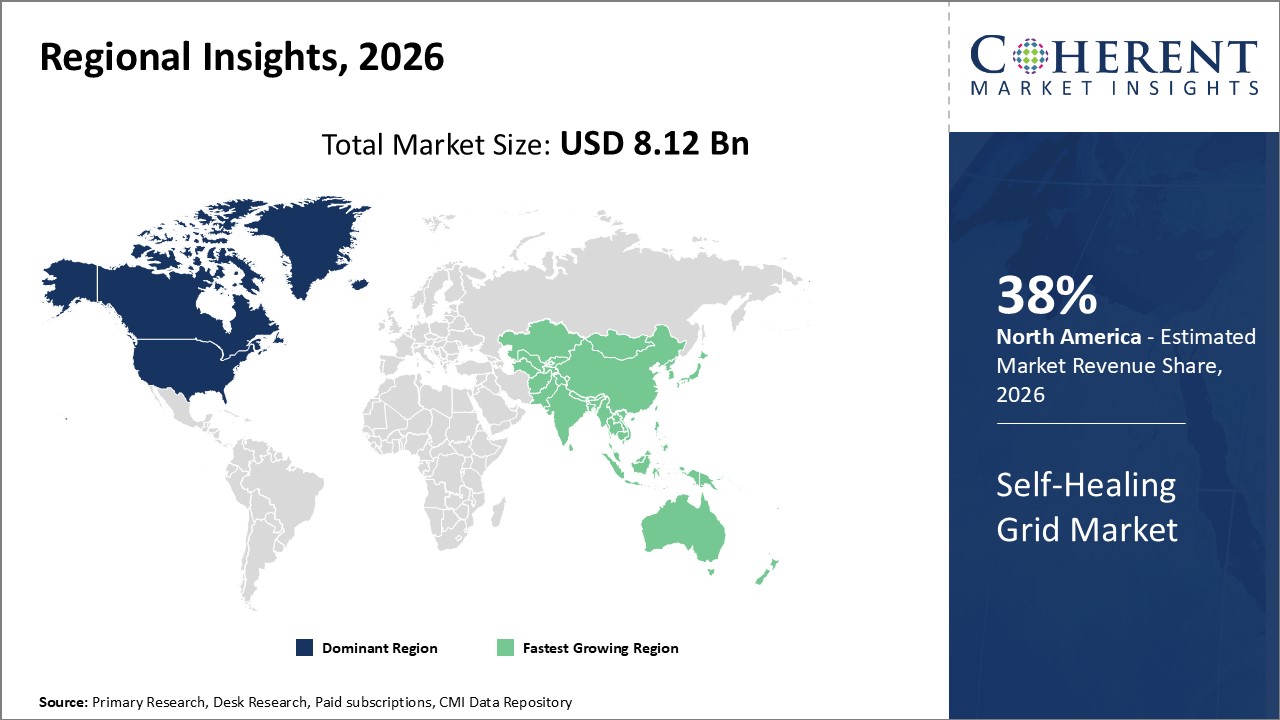
North America leads the regional market, accounting for approximately 38% of total industry revenue due to early adoption and robust smart grid initiatives.
Asia Pacific is the fastest-growing region with a CAGR surpassing 16%, fueled by expanding grid networks and government-supported renewable integration.
Self-Healing Grid Market Segmentation Analysis
Self-Healing Grid Market Insights, By Technology
In terms of technology, the Advanced Sensors dominate the market share with 36%, propelled by their ability to provide granular fault detection and real-time grid health data. Their proliferation in smart grids significantly reduces fault detection time and service interruptions. Automated Reclosers represent the fastest growing subsegment, growing due to heightened demand for automated fault handling and restoration capabilities in both urban and rural grids.
Self-Healing Grid Market Insights, By Grid-Type
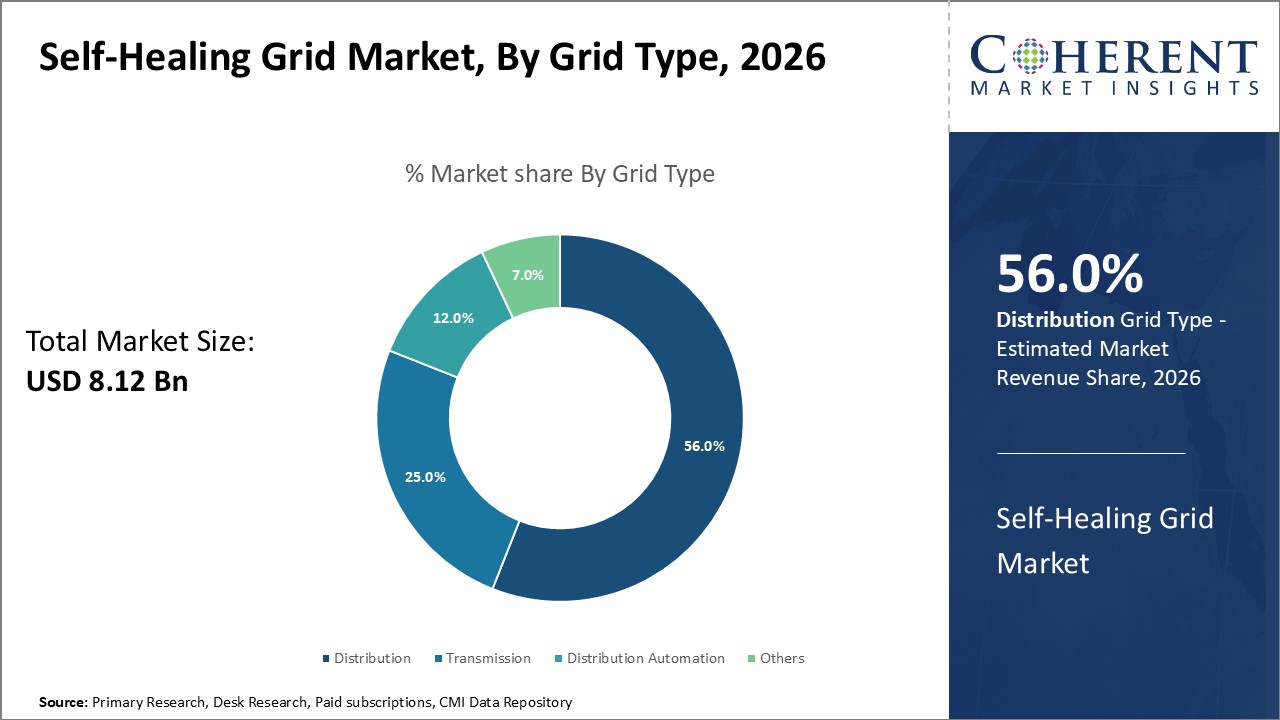
Distribution grids possess the largest market share at 56%, chiefly as these grids face the highest incidence of faults and outages due to their extensive reach and exposure to environmental factors. The Distribution Automation subsegment is the fastest-growing sector, driven by utilities prioritizing automation to manage decentralized generation sources and reduce outage costs. Transmission grids, while critical for long-distance power transfer, have relatively fewer automation upgrades but remain vital for infrastructure resilience.
Self-Healing Grid Market Insights, By End-User
Industrial applications dominate with 45% market share, as industries demand high grid reliability to avoid costly production downtimes. This segment benefits from large-scale self-healing grid investments aimed at sustaining critical operations. Utilities follow as substantial users, deploying solutions to maintain service consistency for millions of consumers. Residential and commercial sectors, while growing, exhibit moderate adoption rates but are rapidly progressing due to rising smart home integrations and energy management systems.
Self-Healing Grid Market Trends
The self-healing grid market is increasingly influenced by technological convergence, with AI and IoT playing pivotal roles in fault management and system automation.
In 2026, utilities deploying AI-driven platforms reported up to a 36% increase in real-time grid efficiency, underscoring a clear trend towards intelligent automation.
Additionally, blockchain applications for grid transparency are redefining asset and transaction management, enhancing grid security and stakeholder confidence.
The accelerating adoption of edge computing has reduced fault isolation times substantially, with major deployments in North America and Europe.
Self-Healing Grid Market Insights, By Geography
North America Self-Healing Grid Market Analysis and Trends
In North America, the dominance in the Self-Healing Grid market is underpinned by extensive government-funded smart grid initiatives and a mature utility ecosystem. The U.S. alone accounted for over 30% of the global market revenue in 2026 due to rapid deployments of advanced sensors and automation devices. Key companies such as General Electric and ABB have established robust partnerships with local utilities, fostering innovations that further strengthen industry share.
Asia Pacific Self-Healing Grid Market Analysis and Trends
Meanwhile, the Asia Pacific exhibits the fastest growth with a CAGR exceeding 16%, driven by aggressive infrastructure investments in countries like China and India. Government incentives for renewable energy integration and grid modernization programs are significant contributors. Companies such as Schneider Electric and Siemens have expanded manufacturing and R&D facilities in the region to capitalize on these dynamics.
Self-Healing Grid Market Outlook for Key Countries
USA Self-Healing Grid Market Analysis and Trends
The U.S. self-healing grid market is a growth engine in North America owing to progressive grid modernization frameworks and the rising need to mitigate storm-induced outages, which caused losses upward of USD 30 billion in recent years. Deployment of advanced automation at distribution transformers increased by 40% in 2025, facilitating utility operators’ shift toward self-healing capabilities. Major players like Siemens and ABB have delivered turnkey solutions with integrated AI analytics, boosting operational efficiency as reflected in a reported 22% decline in maintenance expenditures.
China Self-Healing Grid Market Analysis and Trends
China's market is expanding rapidly due to aggressive government policies supporting smart grid rollouts designed to integrate renewable energy sources and enhance grid reliability. Key projects under China’s 14th Five-Year Plan have led to the installation of over 500,000 intelligent fault detectors in 2026, contributing to improved electric reliability indices. Companies, including Schneider Electric and Mitsubishi Electric Corporation, have engaged in joint ventures with local utilities, allowing technology transfer and localized innovation, facilitating business growth and increasing market revenue substantially.
Analyst Opinion
The growing deployment of advanced communication and sensor technologies is a significant demand-side indicator driving market growth. For example, the use of next-generation fiber optics and IoT sensors in smart grids increased by 39% globally in 2025, enabling quicker fault detection and response times. Utilities leveraging these technologies reported a 26% reduction in outage durations, a critical factor that expanded the self-healing grid market share.
On the supply side, production capacities for self-healing grid components such as fault isolation switches and automated reclosers surged by over 31% in 2026, driven by increasing capital investments from key market players. Enhanced manufacturing efficiencies lowered component costs by 13%, facilitating wider adoption, particularly in emerging economies where infrastructure modernization is a priority.
Import patterns reveal accelerated cross-border trade of self-healing grid equipment, with Asia Pacific emerging as a leading importer, accounting for 40% of global imports in 2025. This reflects market dynamics where regional demand outpaces domestic manufacturing capabilities, signaling substantial opportunities for market players to expand production or partnerships in APAC.
Micro-indicators, including real-time grid monitoring software deployments, saw a 50% YoY increase in 2026 within North American utilities. This microscopic adoption trend correlates directly with increased investment in grid resilience amid rising climatic disturbances, underlining the pivotal role of software and analytics in market growth strategies.
- Current Industry Events of 2026
- Market Size Estimation
- Regional Breakdown
- Competitive Landscape
- Customer Intelligence
- Segmental Analysis
- Pricing Analysis
- Key Market Drivers, Challenges & Future Trends
- Customized Insights Section
Market Scope
| Report Coverage | Details | ||
|---|---|---|---|
| Base Year: | 2025 | Market Size in 2026: | USD 8.12 billion |
| Historical Data for: | 2020 To 2024 | Forecast Period: | 2026 To 2033 |
| Forecast Period 2026 to 2033 CAGR: | 14.4% | 2033 Value Projection: | USD 20.83 billion |
| Geographies covered: |
| ||
| Segments covered: |
| ||
| Companies covered: | ABB Ltd., Siemens AG, Schneider Electric SE, General Electric Company, Mitsubishi Electric Corporation, Honeywell International Inc., Eaton Corporation, Toshiba Corporation, Hitachi Ltd., SEL (Schweitzer Engineering Labs), National Grid Corporation, Landis+Gyr AG, Cisco Systems, Inc., | ||
| Growth Drivers: |
| ||
Self-Healing Grid Market Growth Factors
The acceleration of smart grid infrastructure investments globally is a critical growth driver, with government incentives in North America and Europe pushing capital expenditure by over USD 3 billion in 2025 alone. The need to minimize outage costs, often exceeding billions annually for utilities, fuels adoption of self-healing grid solutions, as evidenced by a 30% drop in outage-related penalties experienced by early adopters in 2023. Rising integration of distributed energy resources (DERs) such as solar and wind necessitates dynamic grid management, compelling utilities to enhance grid automation and adaptability. Lastly, increasing cyber-physical threats on traditional grids are steering operators towards self-healing capabilities that include cybersecurity-enhanced automation systems, with reported cyberattack mitigations improving by 40% following implementation in pilot programs across Europe.
Self-Healing Grid Market Development
Duke Energy Florida expansion — In 2026, Duke Energy Florida announced plans to expand self-healing grid technology across its service territory, enabling automatic outage detection and dynamic rerouting of power. This system has already helped the utility avoid many extended outages and reduce customer disruption.
Hurricanes Helene & Milton resilience — In 2025, during back-to-back hurricanes in Florida, Duke Energy’s self-healing grid systems significantly mitigated outage impact. The technology enabled rapid fault isolation and power rerouting, reducing total lost outage time by hundreds of millions of minutes.
Key Players
ABB Ltd.
Siemens AG
Schneider Electric SE
General Electric Company
Mitsubishi Electric Corporation
Honeywell International Inc.
Eaton Corporation
Toshiba Corporation
Hitachi Ltd.
SEL (Schweitzer Engineering Labs)
National Grid Corporation
Landis+Gyr AG
Cisco Systems, Inc.
Competitive strategies include ABB Ltd.’s recent partnership with several U.S. utilities to deploy automated fault isolation technologies, which contributed to a reported 20% improvement in grid resiliency in pilot regions during 2025. Siemens AG focused on integrating AI-driven analytics platforms to bolster predictive maintenance, leading to a 15% reduction in operational downtime. Schneider Electric’s acquisitions of local grid automation firms in the Asia Pacific enhanced their regional market penetration, directly influencing their revenue growth by 18% in 2026.
Self-Healing Grid Market Future Outlook
Self-healing grid technology is expected to continue advancing in complexity and capability. Key directions include greater use of artificial intelligence and predictive analytics to foresee and preempt faults before they occur; tighter integration of distributed energy resources such as solar panels, battery storage, and microgrids into restoration logic; and improved algorithms for faster reconfiguration of the grid under stress. Communication and sensing infrastructures are likely to become more resilient and secure, with edge computing playing a larger role so that grid segments can act autonomously even when central control is compromised.
Self-Healing Grid Market Historical Analysis
Self-healing grid technology has developed in tandem with smart grid initiatives over the past decade. Early efforts focused on basic automation and remote sensing in the distribution network—integrating smart switchgear and sensors so that faults could be detected more quickly. Pilot projects demonstrated that reconfiguration and decentralized control could significantly shorten outage duration and improve reliability.
Over time, advances in communications infrastructure, control relays, monitoring devices, and distributed energy resources (DERs) made more ambitious forms of self-healing possible, including islanding, microgrids, and autonomous restoration routines. Researchers and utilities have increasingly incorporated machine learning and algorithmic control into grid relays and substation logic.
Sources
Primary Research Interviews
Power Grid Operators
Electrical Engineers (Smart Grid Specialists)
Utility Company Executives
Smart Grid Technology Providers
Databases:
International Energy Agency (IEA) Database
U.S. Department of Energy (DOE) Database
Federal Energy Regulatory Commission (FERC)World Bank Energy Data
Magazines:
T&D World
Power Grid International
Smart Energy International
Electric Light & Power
Journals:
IEEE Transactions on Smart Grid
International Journal of Electrical Power & Energy Systems
Energy Policy
Journal of Modern Power Systems and Clean Energy
Newspapers:
The Hindu (Energy & Infrastructure)
Times of India (Energy & Power)
The Guardian (Sustainable Energy)
The New York Times (Energy & Climate)
Associations:
Institute of Electrical and Electronics Engineers (IEEE) – Power & Energy Society
Electric Power Research Institute (EPRI)
International Smart Grid Action Network (ISGAN)
Smart Electric Power Alliance (SEPA)
Get access to 250+ pages report
Every segment, forecast, competitor profile and data table behind the analysis above — available for instant download.
- ESOMAR Member
- ISO 9001:2015 Certified
- D-U-N-S Registered
- GDPR & CCPA Compliant
Missing comfort of reading report in your local language? Find your preferred language:
Transform your Strategy with Exclusive Trending Reports
Frequently Asked Questions
Leading companies include ABB Ltd., Siemens AG, Schneider Electric SE, General Electric Company, and Mitsubishi Electric Corporation, recognized for their broad portfolio and innovation in grid automation technologies.
The market size is expected to reach USD 20.83 billion by 2033, growing at a CAGR of 14.4% from 2026 to 2033, driven by rising smart grid deployments and technological advancements.
The Industrial grid segment, particularly utilities and industrial sectors, presents the largest growth opportunity, benefiting from increasing DER integration and automation needs.
Market trends will evolve towards AI-enabled fault management, blockchain integration for asset tracking, and edge computing for decentralized control, enhancing grid resilience and operational efficiency.
The competitive landscape is marked by aggressive technology innovation and strategic partnerships; however, market challenges include high initial investment costs and interoperability issues among legacy grid systems.
Strategies frequently involve collaborations with utility companies, government-backed pilot programs, and acquisitions of niche technology providers to expand the portfolio and geographical reach.