

Cryogenic Pump Market Analysis & Forecast: 2026 to 2033
Cryogenic Pump Market is estimated to be valued at USD 4,071.1 Mn in 2026 and is expected to reach USD 14,844.6 Mn in 2033, exhibiting a compound annual growth rate (CAGR) of 20.3% from 2026 to 2033.
Key Takeaways
- Based on Type, the Dynamic segment is expected to lead the market with 68.2% share in 2026, due to efficiency and lower maintenance costs.
- Based on Gas, the LNG segment is projected to account for the largest share of the market in 2026, due to rising clean energy demand and global terminal expansion.
- Based on End-user, the Oil and Gas segment is expected to account for the highest share of the market in 2026, driven by extensive applications in gas storage, transportation, and processing.
- Based on Region, North America is set to lead the cryogenic pump market with 32.6% share in 2026. While, Asia Pacific is anticipated to be the fastest growing region.
Market Overview
The metallurgy industry is also expected to experience a rise in the demand for cryogenic pumps. Increasing demands for petrochemical products and rising demand from refining and fertilizer industries will also support the growth of this sector. Growing urbanization in the Asia-Pacific region and an increased demand for liquefied natural gas are projected to increase the demand for cryogenic pumps, which is likely to drive the market growth.
Current Events and Its Impacts on the Cryogenic Pump Market
Current Event | Description and its Impact |
Global Energy Transition and LNG Infrastructure Expansion |
|
Space Industry Commercialization and Launch Market Growth |
|
Price Analysis
Pump Type / Application | Typical Price Range (USD) | Key Use Cases | Market Notes |
Positive Displacement (Reciprocating) | 10,000 – 80,000 | High-pressure gas transfer, cylinder filling, hydrogen stations | Popular for smaller but high-pressure applications |
Centrifugal Pumps | 50,000 – 250,000+ | LNG terminals, bulk gas transfer, industrial plants | Largest share due to LNG demand |
Vacuum Cryopumps | 20,000 – 100,000 | Semiconductor manufacturing, research labs, vacuum systems | Specialized niche market |
Medical Cryogenic Pumps | 5,000 – 20,000 | Cryoablation, medical gas handling | Smaller but fast-growing segment |
Aerospace & Defense Pumps | 100,000+ | Rocket propulsion (LOX, LH2), military systems | High engineering cost, limited suppliers |
- Current Industry Events of 2026
- Market Size Estimation
- Regional Breakdown
- Competitive Landscape
- Customer Intelligence
- Segmental Analysis
- Pricing Analysis
- Key Market Drivers, Challenges & Future Trends
- Customized Insights Section
Segmental Insights
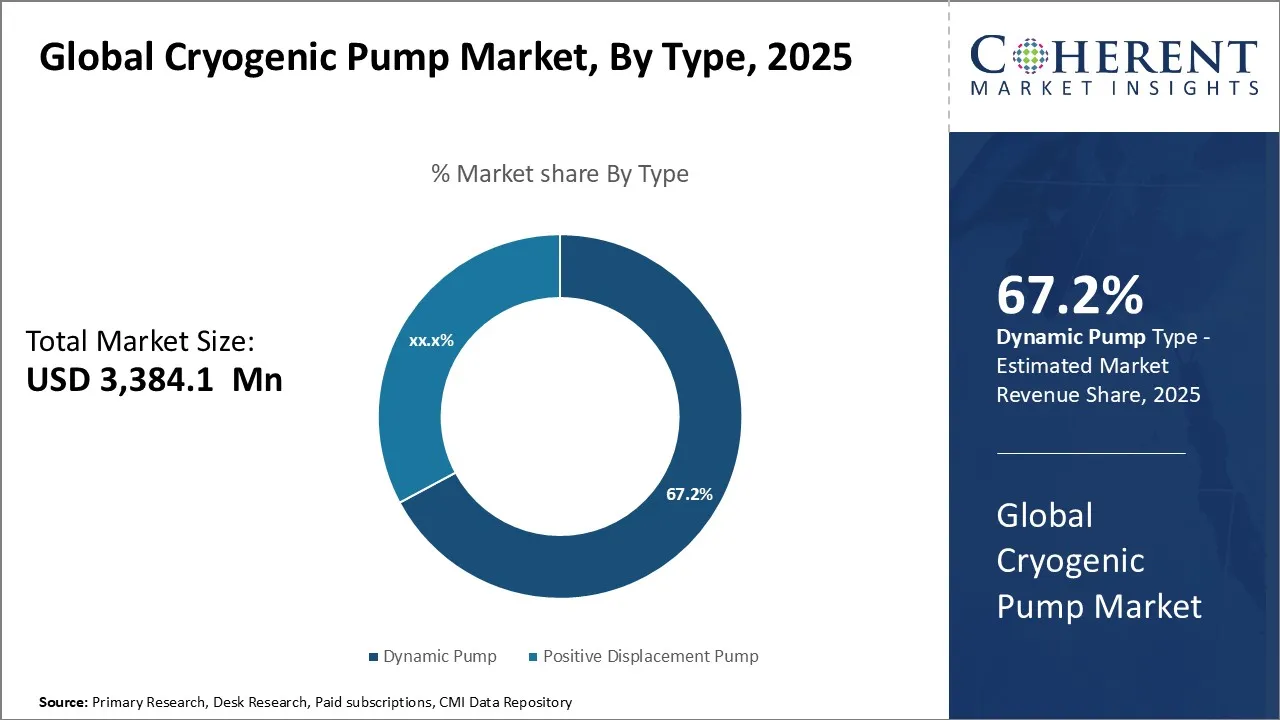
Global Cryogenic Pump Market Insights, By Type - Dynamic Pumps Dominates Due To Efficiency and Lower Maintenance Costs
Based on Type, the dynamic pump segment is expected to dominate the global market with 68.2% share in 2026, and this is attributed to the various advantages of dynamic cryogenic pumps such as fewer moving parts reducing installation and maintenance cost. Moreover, these pumps offer higher efficiency compared to others. Thus, demand for dynamic pumps is increasing, which is driving growth of the segment.
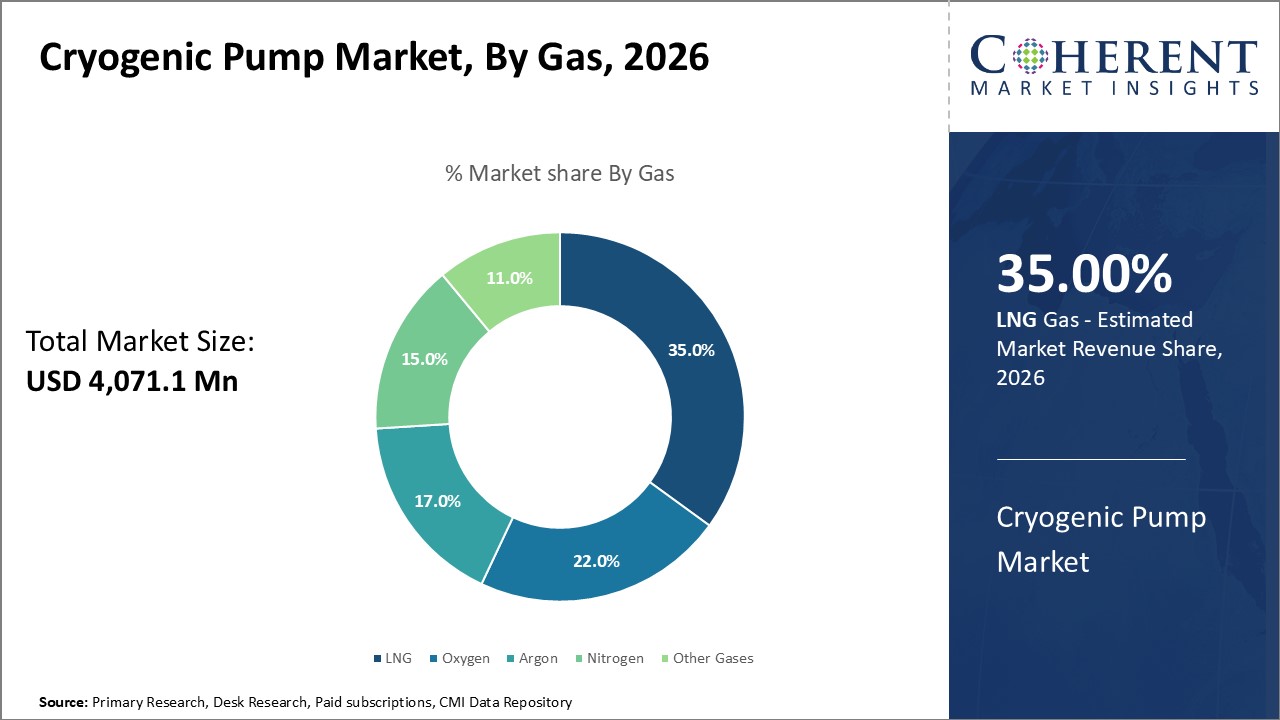
Global Cryogenic Pump Market Insights, By Gas - LNG Dominates Due To Rising Clean Energy Demand and Global Terminal Expansion
Based on Gas, the LNG segment is expected to lead the market with the largest share in 2026, due to rising global energy demand, expansion of LNG import and export terminals, and its role as a cleaner alternative to coal and oil. Large-scale infrastructure projects require high-capacity cryogenic pumps, making LNG the most pump-intensive and market-leading segment.
For instance, in November 2026, Nikkiso Clean Energy & Industrial Gases (CEIG) captured a big contract to provide cryogenic pumps for floating storage and regasification unit (FSRU) conversions. The deal shows how LNG is becoming more important in the world's energy infrastructure, with cryogenic pumps making safe transfer and regasification possible. This makes Nikkiso's position in the cryogenic pump market for LNG even stronger.
Global Cryogenic Pump Market Insights, By End User - Oil and Gas Lead Is Driven by Extensive Applications in Gas Storage, Transportation, And Processing
Based on End User, the Oil and Gas segment is expected to dominate the global market over the forecast period and this is attributed to the growing use in oil and gas industry due to various applications such as gas storage, gas transportation, gas processing and more.
For instance, in July 2024, ITT’s Svanehøj obtained a major contract to make cryogenic deepwell pumps for the first group of large LNG carriers. The pumps are set to be very important for moving liquefied natural gas at very low temperatures. This will help Svanehøj become a stronger player in the global oil and gas industry and help build up the infrastructure for LNG shipping.
Regional Insights
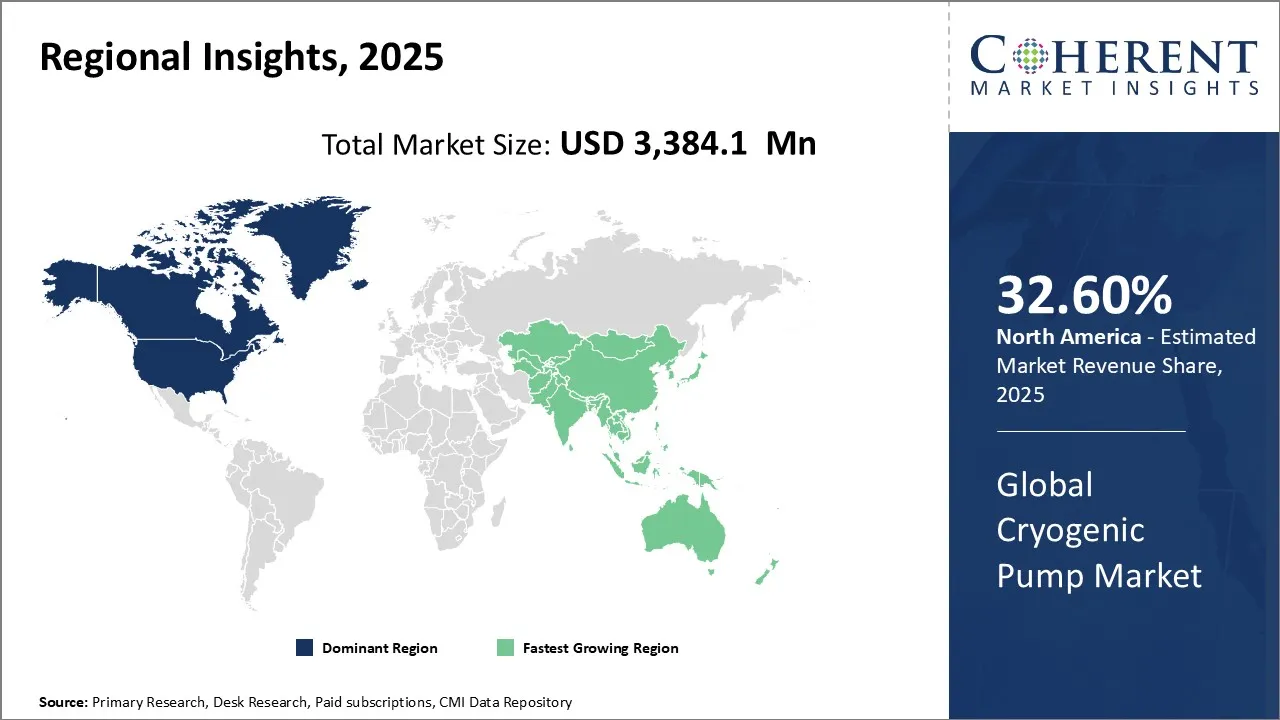
North America Global Cryogenic Pump Market Analysis & Trends
North America is expected to lead the global cryogenic pump market with 32.6% share in 2026. This is attributed to low cost of natural gases, and rise in number of gas plants in the U.S. Moreover, increasing LNG infrastructure and growing LNG industry in Canada is also aiding in rapid growth of the market in North America region. Thus, the region will witness strong growth in the coming future.
For instance, in November 2026, PSG Dover announced the integration of Cryogenic Machinery Corp. into its Blackmer portfolio under the new Cryo-Mach Series. The move strengthens Blackmer’s offerings in cryogenic pumps designed for liquefied gases including LNG, hydrogen, oxygen, and nitrogen. This strategic transition enhances PSG’s position in industrial energy and transportation markets, expanding its cryogenic solutions globally.
Asia Pacific Global Cryogenic Pump Market Analysis & Trends
Asia Pacific is also expected to show robust growth in the global cryogenic pump market over the forecast period. This is due to rise in demand for electricity, owing to growing industrialization, urbanization, and infrastructural developments along with subsequent investments in development of large gas-fired power generation. These factors in turn are creating demand for cryogenic pumps in the region, which in turn is expected to propel growth of the global cryogenic pump market over the forecast period.
For instance, in September 2026, At the BRICS Innovation Summit in Russia, Astrophel Aerospace showed off India's first homegrown cryogenic pump for reusable rockets. The pump is an enormous advancement in aerospace technology as it can handle liquid oxygen and hydrogen. This new technology strengthens India's position in space propulsion systems and shows off the country's advanced cryogenic engineering skills for future launch vehicles.
Global Cryogenic Pump Market Outlook Country-Wise
The U.S. Global Cryogenic Pump Market Trends
The U.S. cryogenic pump market will grow in 2026 because more LNG export facilities are being built, more hydrogen infrastructure projects are being planned, and there is a lot of demand from the industrial gas sectors. Investments in clean energy projects and technologies that are good for the environment, backed by the government, also help adoption. This makes the U.S. a key player in cryogenic pump applications in both the industrial and energy markets around the world.
For instance, in January 2026, Dover Corporation, which is based in Downers Grove, Illinois, added cryogenic pumps to its Pumps & Process Solutions line-up. Dover's move strengthens its position in the energy, chemical, and industrial gas markets and makes it the world leader in advanced pump technologies. The move is meant to help the company handle liquefied gases like LNG, hydrogen, oxygen, and nitrogen.
China Global Cryogenic Pump Market Trends
The cryogenic pump market in China is seeing a lot of demand in 2026 because LNG terminals are growing quickly, hydrogen infrastructure projects are growing, and industrial gas use is rising. Adoption is being driven by government-backed clean energy projects and investments in technologies that are good for the environment. This makes China the world's leader in using cryogenic pumps in both the energy and industrial sectors.
For instance, in March 2026, IceCure Medical received a Notice of Allowance in China for its new cryogenic pump, which is going to be used to power the next generation of cryoablation technology. The innovation enables the use of thinner cryoprobes and catheters, advancing minimally invasive cancer treatments. This milestone makes IceCure more well-known around the world and shows how far medical cryogenic engineering has come in helping people with cancer
Market Report Scope
Cryogenic Pump Market Report Coverage
| Report Coverage | Details | ||
|---|---|---|---|
| Base Year: | 2025 | Market Size in 2026: | USD 4,071.1 Mn |
| Historical Data for: | 2020 To 2024 | Forecast Period: | 2026 To 2033 |
| Forecast Period 2026 to 2033 CAGR: | 20.3% | 2033 Value Projection: | USD 14,844.6 Mn |
| Geographies covered: |
| ||
| Segments covered: |
| ||
| Companies covered: | KSB SE & Co. KGaA, SHI Cryogenics Group, Nikkiso Co. Ltd., Ebara Corporation, and Fives SAS | ||
| Growth Drivers: |
| ||
| Restraints & Challenges: |
| ||
Global Cryogenic Pump Market Drivers
Rise in demand from petrochemical and chemical sector to boost the market growth
Chemical and petrochemical sector are one of the major users of cryogenic pumps. In chemical and petrochemical sector, these devices are used in various applications such as sulfur recovery units, oxidation process, coal gasification, regenerate catalysts, and cool reactors. The chemical industry across the globe is witnessing a stable growth for a long time as the demand for chemicals from developing countries around the world is constant. These factors are further driving the adoption and demand of cryogenic pumps. This in turn is expected to augment growth of the global cryogenic pump market over the forecast period.
Rise in consumption of LNG to fuel the market growth
The rise in global LNG consumption is significantly boosting demand for cryogenic pumps, essential in storage, transfer, and regasification processes. This surge directly expands the Cryogenic Pump Market size, driven by energy transition initiatives, increasing LNG trade, and infrastructure investments, positioning cryogenic technology as a cornerstone of sustainable energy growth.
Global Cryogenic Pump Market Opportunities
Growing use of cryogenic pumps at hydrogen refueling stations is expected to create several growth opportunities in the global cryogenic pump market over the forecast period. Hydrogen sources continue to diversify and a zero-carbon source of hydrogen production is nuclear. Moreover, renewable feedstocks are environment-friendly hydrogen sources, the use of which has grown in recent times significantly. Traditionally, hydrogen refueling stations utilize hydrogen compressors for storing gas, however, now the use of cryo pumps has increased for storing the gas in the liquid form. This is further creating several growth opportunities in the market.
Rise in demand for liquefied natural gas is expected to offer multiple lucrative opportunities in the global cryogenic pump market over the forecast period. Due to the efficiency of liquefied natural gas in safety and transport, it is considered a fuel for the future. The infrastructure of pipeline is developing rapidly along with favorable government policies, and demand from natural gas. These factors are leading to rise in adoption of liquefied natural gases, which is expected to create various business opportunities in the global cryogenic pump market over the forecast period.
Global Cryogenic Pump Market Trends
Rise in demand from pharmaceutical industry is a growing trend
Pharmaceutical industry currently makes use of cold storage for safely transporting its products around the globe. These shipments are moved from the site of manufacturing through storage depots, planes, trucks, and ships for reaching the ultimate destination, usually a clinic, hospital, or pharmacy. Due to increased transport, the demand to maintain the product at cryogenic temperatures is high in pharmaceutical industry around the world. This is thus creating demand for cryogenic pumps in pharmaceutical industry, which is expected to propel growth of the global cryogenic pump market over the forecast period.
Increase government investments in natural gas extraction is a major trend
Several governments around the world are investing in natural gas extraction for domestic use. Along with this, the consumer awareness regarding extraction of natural gas is also increase all over the world. The demand for natural gas has further increased due to which liquefaction of gases is increasingly being adopted for purposes such as power plants, transportation, and medical gas supply. This is in turn is creating demand for cryogenic pumps, and thus, the trend is likely to continue in the market over the coming future.
Analyst Opinion (Expert Opinion)
The cryogenic pump market value is affected by the growth of liquefied gas value chains, especially LNG, industrial gases, and new hydrogen applications. Even though there is a lot of variation, mid-range studies show that the demand for equipment is stable because LNG throughput is growing over time and the use of liquefied nitrogen, oxygen, and argon in healthcare, electronics, and metals processing is also growing.
Most of the installed capacity for large LNG and industrial systems comes from centrifugal pumps. Positive-displacement pumps, on the other hand, are becoming more common in high-pressure and precision-metering applications. Magnetic-drive systems, better bearings, low-leakage sealing, and submersible designs are just a few examples of how technology is improving and lowering lifecycle costs while making it easier for suppliers to stand out. Aftermarket services and spare parts still make up a large part of the revenue for established OEMs, so lifecycle cost is a key factor in buying decisions.
Speak to the analyst
Want personalized insights?
Take the findings above to one of our principal consultants, or have the report rebuilt around the segments, geographies and competitors you actually track.
Global Cryogenic Pump Market: Key Developments
- In November 2025, ISRO successfully completed an engine restart test on the CE-20 cryogenic engine of the launch vehicle for the Gaganyaan mission. The test shows that cryogenic systems, like pumps that move supercooled propellants like liquid hydrogen and oxygen, are reliable.
- In September 2025, Astrophel Aerospace created a cryogenic pump that will assist rocket engines reach orbit. The breakthrough makes India's aerospace capabilities stronger by making it easier to work with super-cooled propellants like liquid hydrogen and oxygen.
- In September 2025, Edwards Vacuum announced he expansion on greater cryogenic technology to its line of products, which will make it stronger in the field of advanced vacuum solutions. The move shows that the company is focused on cryogenic pumps, which are very important for ultra-high vacuum environments in semiconductor manufacturing, research, and industrial uses.
- In November 2024, Graham Corporation announced plans to improve its cryogenic technology portfolio, which will help it become even better at working with super-cooled fluids like liquid hydrogen and oxygen. The project shows how much the company cares about cryogenic pumps, which are very important for aerospace, energy, and industrial uses.
Market Segmentation
- By Type (Revenue, USD Mn, 2021 - 2033)
- Dynamic Pump
- Positive Displacement Pump
- By Gas (Revenue, USD Mn, 2021 - 2033)
- Nitrogen
- Oxygen
- Argon
- LNG
- Other Gases
- By End User (Revenue, USD Mn, 2021 - 2033)
- Oil and Gas
- Healthcare
- Chemicals
- Other End Users
- By Geography (Revenue, USD Mn, 2021 - 2033)
- North America
- U.S.
- Canada
- Latin America
- Brazil
- Argentina
- Mexico
- Rest of Latin America
- Europe
- Germany
- U.K.
- Spain
- France
- Italy
- Russia
- Rest of Europe
- Asia Pacific
- China
- India
- Japan
- Australia
- South Korea
- ASEAN
- Rest of Asia Pacific
- Middle East & Africa
- GCC Countries
- Israel
- Rest of Middle East & Africa
- North America
- Key Companies Insights (Revenue, USD Mn, 2021 - 2033)
- KSB SE & Co KGaA
- SHI Cryogenics Group
- Nikkiso Co. Ltd.
- Ebara Corporation
- Fives SAS
Sources
Primary Research Interviews
- Cryogenic Pump Manufacturers
- Industrial Gas Companies (Linde, Air Liquide, Air Products engineers)
- LNG Plant Operators & EPC Contractors
- Cryogenic System Integrators
- Oil & Gas Processing Engineers
- Cryogenic Storage & Transport Tank Manufacturers
- Vacuum Insulation Technology Specialists
- Others
Databases
- Bloomberg Terminal
- Thomson Reuters Eikon
- Euromonitor International
- Factiva
- Others
Magazines
- Gasworld Magazine
- LNG Industry Magazine
- CryoGas International
- Hydrocarbon Processing Magazine
- Chemical Engineering Magazine
- Pumps & Systems Magazine
- Others
Journals
- Cryogenics (Elsevier)
- International Journal of Refrigeration
- Journal of Natural Gas Science & Engineering
- International Journal of Hydrogen Energy
- Journal of Energy Storage
- Others
Newspapers
- Financial Times
- The Wall Street Journal
- Reuters
- Bloomberg News
- The Economic Times (Energy & Infra)
- Others
Associations
- Compressed Gas Association (CGA)
- Gas Processors Association (GPA)
- International Gas Union (IGU)
- European Industrial Gases Association (EIGA)
- American Petroleum Institute (API)
- Others
Public Domain Sources
- U.S. Department of Energy (DOE)
- International Energy Agency (IEA)
- European Commission – Energy Directorate
- World Bank Open Data
- National Renewable Energy Laboratory (NREL)
- U.S. Energy Information Administration (EIA)
- Others
Proprietary Elements
- CMI Data Analytics Tool
- Proprietary CMI Existing Repository of Information for the Last 8 Years
Definition: Cryogenic pumps are used in the energy industries. They are used for gas-to-liquid and gas-to-gas activities, including power generation. Typically, these pumps are used in oil and gas fields. Moreover, they are utilized in LNG terminals. Moreover, they are also used in compressed natural gas refueling stations.
Get access to 250+ pages report
Every segment, forecast, competitor profile and data table behind the analysis above — available for instant download.
- ESOMAR Member
- ISO 9001:2015 Certified
- D-U-N-S Registered
- GDPR & CCPA Compliant
Missing comfort of reading report in your local language? Find your preferred language:
Transform your Strategy with Exclusive Trending Reports
Frequently Asked Questions
The Cryogenic Pump Market is estimated to be valued at USD 4,071.1 Mn in 2026, and is expected to reach USD 14,844.6 Mn by 2033.
The CAGR of the Cryogenic Pump Market is projected to be 20.3% from 2026 to 2033.
Rise in demand from petrochemical and chemical sector and rise in consumption of LNG are fuelling the market.
The Dynamic Pump segment is the leading type segment in the market.
Volatility in prices of raw materials and regulatory implications are the major factors restraining market.
KSB SE & Co. KGaA, SHI Cryogenics Group, Nikkiso Co. Ltd., Ebara Corporation, and Fives SAS