

Global Construction Robots Market Size and Share Analysis – (2026-2033)
Construction Robots Market is estimated to be valued at USD 105.8 Mn in 2026 and is expected to reach USD 315.0 Mn in 2033, exhibiting a compound annual growth rate (CAGR) of 16.9% from 2026 to 2033.
Key Takeaways
- Based on Type, Demolition segment is expected to dominate the global market over the forecast period. This is due to the increase in number of partnership activities among market players.
- North America is projected to gain 34.18% market share in the global construction robots’ market over the forecast period. This is due to steady technological advancements in the region, shortage of skilled labor, and growing automation across various sectors.
Market Overview
The Construction Robots market has been experiencing rapid momentum over the last few years with mounting labor shortages, rising construction expenses, and demands for safer, faster, and more efficient methods of building. Application of robot systems for construction activities such as bricklaying, welding, concrete printing, demolition, and surveying is transforming traditional building methods. With urbanization accelerating and the development of smart cities underway all over the world, the need for accuracy-focused and automated building solutions increases day by day. Technologies like these find especially high importance in countries where the absence of skilled labor and dangerous conditions in risky construction sites prevail.
Current Events and Its Impact on Construction Robots Market
Current Events | Description and its impact |
Boom in Autonomous Construction Robots for Workforce Deficit Prevention |
|
Adoption of AI-Powered Robotic Inspection Systems in Infrastructure Projects |
|
Global Construction Robots Market Drivers
- Rapidly growing urbanization around the world to propel the market growth
In recent years, there has been a dramatic rise in urbanization all over the world, and it is growing at an exponential rate. For instance, as per the World Bank data, nearly 55% of the global population, or 4.2 billion individuals, live in cities. This trend will grow in the coming years, and by 2050, the number of urban populations globally is likely to double with seven out of 10 people around the globe living in the cities.
With increasing urbanization, the demand for affordable housing is increasing. This, in turn, is driving construction activities, which is expected to boost the global demand for construction robots’ market in the coming future.
In 2025, ICON, a leader in robotic 3D printing construction, announced a large-scale collaboration with the City of Austin, Texas, to build over 400 affordable 3D-printed homes in rapidly urbanizing neighborhoods. The project uses ICON’s Vulcan robotic construction system, which automates concrete layer printing to build durable structures with less manual labor and at reduced costs.
- Stringent regulations by governments regarding worker’s safety to augment the market pace
Construction industry often faces high number of accidents, due to which it is subjected to stringent regulations. For instance, as per OSHA, one in five deaths among workers in the U.S. is in the construction industry of the country. Furthermore, as per the Bureau of Labor Statistics, total 1,061 construction laborers died in the U.S. on the job site.
Thus, governments around the world are implementing regulations for equipment vendors too, in order to make construction sites and workplaces safe. This, in turn, is expected to drive growth of the global construction robots’ market over the forecast period.
Global Construction Robots Market Opportunities
Rise in adoption of robots in construction industry around the world is expected to offer growth opportunities in the global construction robots’ market over the forecast period. In the next 10 years, this industry will be transformed with growing use of robots at the construction site for supplying material and helping in construction work.
In the near future, the additive manufacturing used for developing infrastructure parts, will be done on job site with bigger and enhanced 3D printing construction robot’s market. For instance, in January 2020, the largest 3D printed building having five stories and 6,000 sq. ft of floor space was opened in Dubai. Thus, these factors are expected to offer several growth opportunities in the market.
Rise in urban construction in metropolitan cities is expected to create opportunities in the market over the forecast period. Major share of urban construction in these cities is subjected to strict environmental regulations, this in turn is anticipated to drive the adoption of construction robots around the world. Along with this, the industry is seeking solutions for reducing wastage of materials.
For instance, as per several experts, construction companies could replace only 25% of their projects with 3D printed structures, which will reduce the demand for labor by 70% and cost by 90%. Thus, this is likely to benefit the global construction robots’ market in the coming future.
Global Construction Robots Market Trends
- Shortage in skilled laborers leading to demand for robotic solutions is a growing trend
Due to the shortage of skilled workforce in construction industry, there is an increase in demand for robotic solutions in the industry. In the coming years, 3D printing robots along with masonry robots will be in higher demand compared to skilled workforce in construction sector across the globe. Thus, this trend is expected to fuel growth of the global construction robots’ market during the forecast period.
- Rise in demand for heavy construction equipment automation is a major trend
The demand for automation of heavy equipment in construction industry is growing all over the world, along with this, the demand for drilling, driverless demolition, and earth-moving equipment is anticipated to show higher investment and demand in the coming future. For instance, Built Robotics Software received US$ 33 million investment in 2020. Developments like these are expected to grow over the years to come. Thus, the global construction robots’ market is expected to show strong growth in the near future.
- Current Industry Events of 2026
- Market Size Estimation
- Regional Breakdown
- Competitive Landscape
- Customer Intelligence
- Segmental Analysis
- Pricing Analysis
- Key Market Drivers, Challenges & Future Trends
- Customized Insights Section
Segmental Insights
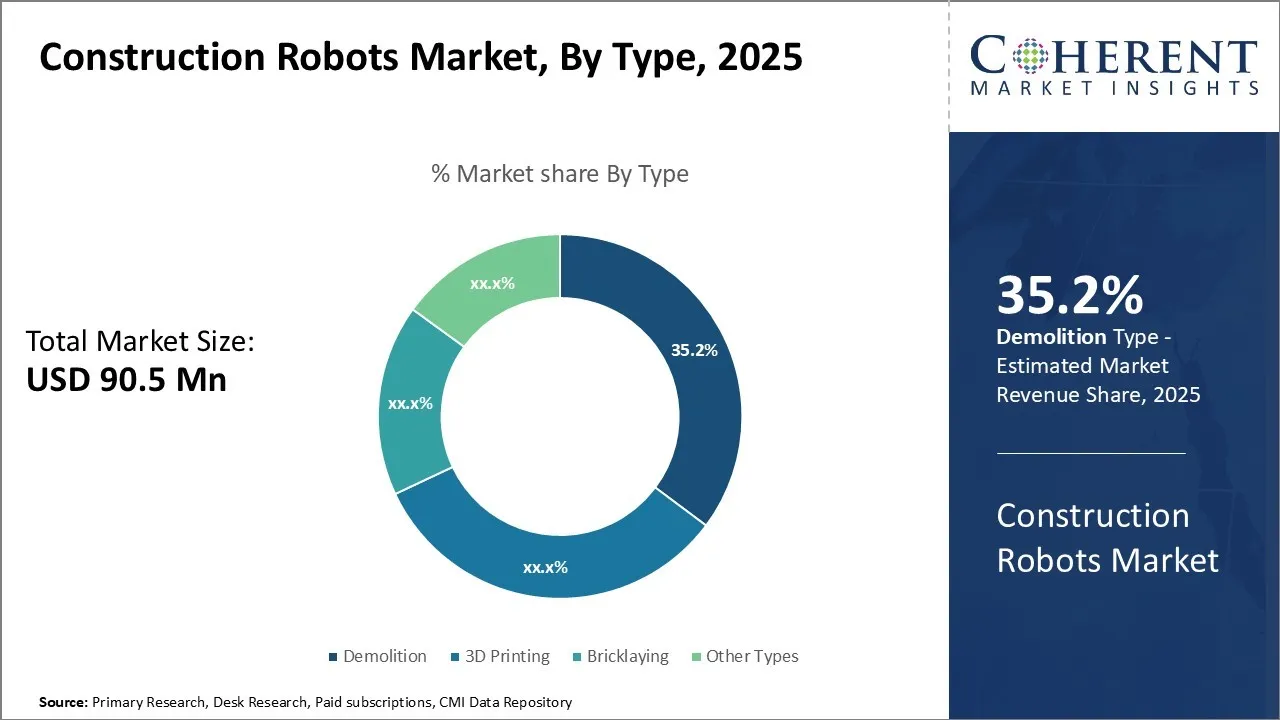
Construction Robots Market Insights, By Type
Based on Type, the market is segmented into Demolition, Bricklaying, 3D Printing, and Other Types (Exoskeletons and Masonry). Out of which, Demolition is expected to dominate the global market over the forecast period and this is attributed to the increase in number of partnership activities among market players. Bricklaying segment is also expected to witness significant growth in the near future and this is owing to the growing use of bricklaying robots in the industry. Bricklaying robots offer various advantages due to which the adoption of this technology is growing all over the world. This in turn is expected to support growth of the segment.
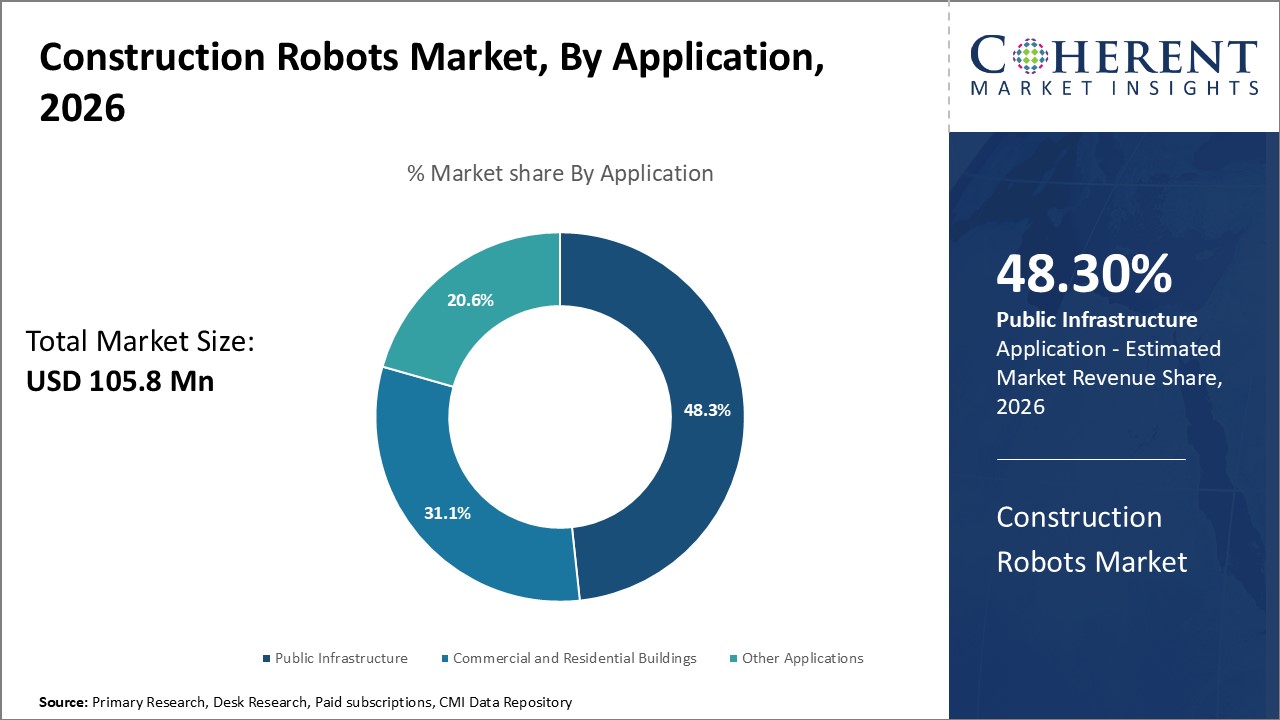
Construction Robots Market Insights, By Application
Based on Application, the market is segmented into Public Infrastructure, Commercial and Residential Buildings, Other Applications. Out of which, Public Infrastructure is expected to dominate the global market over the forecast period and this is attributed to the rise in use of construction robots in public infrastructure such as hospitals.
For instance, VA hospital renovation in Pennsylvania, was known to a complicated project, as it included removal of a part of an existing floor and developing a 10 ft deep pit for the new elevator in the solid rock under. This was further carried out with the use of construction robots. Thus, such operations and use of construction robots in public infrastructure is driving the market growth.
Commercial and Residential Buildings segment is also expected to witness significant growth in the near future and this is owing to the growing number of commercial and residential building construction projects around the world. Various companies, such Fastbrick Technologies Limited are developing many commercial and residential projects in multiple nations. Their construction robotic technology is increasingly being used in the industry, as they offer various advantages.
For instance, Hadrian X of Fastbrick Technologies is capable of working with precision in different environmental conditions. It can develop an average-sized residential place every two days. Thus, such factors are, in turn expected, to support growth of the segment.
Regional Insights

North America Construction Robots Market Analysis and Trends
North America is projected to gain strongest share in the global construction robots’ market over the forecast period. This is attributed to steady technological advancements in the region, shortage of skilled labor, and growing automation across various sectors. This, in turn, is creating demand for construction robots and driving the economic growth of the region. Moreover, growing construction industry of the U.S. and Canada is also likely to drive growth of the global construction robots’ market over the forecast period.
Asia Pacific Construction Robots Market Analysis and Trends
Asia Pacific is also expected to witness robust growth in the global construction robots’ market over the forecast period, owing to rise in adoption of these technologies, increasing industrial automation, and rise in growth of industries integrating robotics and other technologies such as logistics, manufacturing, as well as construction. Thus, rapidly growing construction industry in several countries across the region is projected to create demand for construction robots, which is likely to drive the market growth.
Construction Robots Market Dominating Countries
United States Construction Robots Market Analysis and Trend
The United States leads the construction robots market due to its intensive investment in automaton, the lack of skilled workers in the construction sector, and access to large technology suppliers. The country is aggressively accepting robotics in demolition, concrete printing, and site surveying, especially in the large commercial and infrastructure developments.
Japan Construction Robots Market Analysis and Trend
Japan has dominated the robotics sector for decades and continues to be a dominant player in the construction robots market. As it has an aging population and limited available manpower, the country is highly dependent on robots for precision work in residential and commercial developments. Japanese businesses are also pioneering compact, high-powered robots solely created for urban construction.
Germany Construction Robots Market Analysis and Trend
Germany is a pioneering market in the European continent, with a legacy for engineering excellence and manufacturing automation. Robotics is being applied by the nation in prefabrication, bricklaying, and structural operations, particularly in smart city and infrastructure projects. There are high German standards for efficiency and quality, and the nation is a prominent supporter of construction robotics.
China Construction Robots Market Analysis and Trend
China is rapidly growing its role in the construction robots market, driven by its massive urbanization, government infrastructure expenditures, and growing local robotics industry. China not only is investing in deploying and manufacturing construction robots but also deploying them primarily for residential high-density housing and mass public projects.
Market Report Scope
Construction Robots Market Report Coverage
| Report Coverage | Details | ||
|---|---|---|---|
| Base Year: | 2025 | Market Size in 2026: | USD 105.8 Mn |
| Historical Data for: | 2020 To 2024 | Forecast Period: | 2026 To 2033 |
| Forecast Period 2026 to 2033 CAGR: | 16.9% | 2033 Value Projection: | USD 315.0 Mn |
| Geographies covered: |
| ||
| Segments covered: |
| ||
| Companies covered: | Ekso Bionics, Brokk AB, COBOD International AS, Husqvarna AB, Apis Cor, Construction Robotics LLC, Dusty Robotics, Fastbrick Robotics Ltd., and Advanced Construction Robotics Inc. | ||
| Growth Drivers: |
| ||
| Restraints & Challenges: |
| ||
Global Construction Robots Market: Key Developments
- At WOC 2025, RIC Technology demonstrated its next-generation 3D construction robot, RIC‑PRIMUS, which can print up to 32 feet-high structural wall sections over three stories. Live-printing demonstrations at the event were conducted using Spec‑Mix materials—a clear movement towards scalable commercial robotic building.
- In 2024, RIC Robotics unveiled Zyrex, a 20-foot-tall general-purpose construction robot powered by AI designed to perform heavy-duty work (e.g., demolition, handling of materials) as well as precision trades like welding and carpentry. Both autonomous and battery operated, Zyrex costs less than $1 million and will offer leasing options less than $20,000/month. It will have a prototype in early 2026.
Analyst View
- The market for construction robots is witnessing unprecedented activity fueled by severe labor shortages in advanced economies and the sector's desperate requirement for increased productivity and safety levels. Older workforces in strategic markets such as North America and Europe are fueling rapid adoption of robotic assistance in operations from laying bricks and pouring concrete to demolition and inspection processes.
- Increasing construction expenses and stringent safety requirements are forcing contractors to adopt automation technology that reduces human exposure to dangerous environments while ensuring reliable quality results. The marriage of artificial intelligence and machine learning attributes is transforming robotic performance, allowing for adaptive responses to intricate construction conditions.
- Yet, high up-front capital expenditures and a shortage of technical resources among conventional construction firms pose major hurdles to broad application. The highly dispersed nature of the construction industry, with many small-to-medium-sized firms, also adds to the challenges of standardization initiatives and strategies for deploying technology.
- Asia-Pacific ranks as the region of most rapid growth, driven by China and India's huge infrastructure development programs, complemented by Japan's sophisticated robotics manufacturing base. Rapid urbanization in the region, as well as government encouragement for automation technologies, provide conducive market conditions.
Speak to the analyst
Want personalized insights?
Take the findings above to one of our principal consultants, or have the report rebuilt around the segments, geographies and competitors you actually track.
Market Segmentation
- Global Construction Robots Market, By Type (Revenue, USD Mn, 2021 - 2033)
- Demolition
- Bricklaying
- 3D Printing
- Other Types (Exoskeletons and Masonry)
- Global Construction Robots Market, By Application (Revenue, USD Mn, 2021 - 2033)
- Public Infrastructure
- Commercial and Residential Buildings
- Other Applications
- Global Construction Robots Market, By Geography (Revenue, USD Mn, 2021 - 2033)
- North America
- U.S.
- Canada
- Latin America
- Brazil
- Argentina
- Mexico
- Rest of Latin America
- Europe
- Germany
- U.K.
- Spain
- France
- Italy
- Russia
- Rest of Europe
- Asia Pacific
- China
- India
- Japan
- Australia
- South Korea
- ASEAN
- Rest of Asia Pacific
- Middle East
- GCC Countries
- Israel
- Rest of Middle East
- Africa
- South Africa
- North Africa
- Central Africa
- Company Profiles:
- Brokk AB
- Husqvarna AB
- Construction Robotics LLC
- Fastbrick Robotics Ltd.
- Advanced Construction Robotics Inc.
- Dusty Robotics
- Apis Cor
- COBOD International AS
- Ekso Bionics
Sources
Primary Research Interviews
- Construction company executives and project managers
- Robotics manufacturers and technology providers
- Construction equipment rental companies
- Academic researchers specializing in construction automation
- Others
Databases
- Global Construction Database (GCD)
- Robotics Industry Database (RID)
- Construction Technology Market Intelligence
- International Federation of Robotics (IFR) Statistical Database
- Others
Magazines
- Construction Equipment Magazine
- Robotics Business Review
- Construction Technology Magazine
- Automation World
- Others
Journals
- Journal of Construction Engineering and Management
- Automation in Construction
- Robotics and Computer Integrated Manufacturing
- Others
Newspapers
- Construction Dive
- Engineering News Record (ENR)
- The Construction Index
- Construction Week
- Others
Associations
- Associated General Contractors of America (AGC)
- International Association for Automation and Robotics in Construction (IAARC)
- Construction Industry Institute (CII)
- Robotics Industries Association (RIA)
- Others
Public Domain Sources
- U.S. Bureau of Labor Statistics construction data
- International Federation of Robotics (IFR) reports
- Government construction and infrastructure databases
- Patent databases for construction robotics
- Others
Proprietary Elements
- CMI Data Analytics Tool
- Proprietary CMI Existing Repository of information for last 8 years
*Definition: Construction robots are automated machines that complete tasks on construction sites. Some of these tasks are incredibly repetitive and difficult for humans to do. Construction robots are transforming the way construction projects are managed. They reduce cost, improve efficiency, and help projects meet schedules without compromising quality.
Get access to 250+ pages report
Every segment, forecast, competitor profile and data table behind the analysis above — available for instant download.
- ESOMAR Member
- ISO 9001:2015 Certified
- D-U-N-S Registered
- GDPR & CCPA Compliant
Missing comfort of reading report in your local language? Find your preferred language:
Transform your Strategy with Exclusive Trending Reports
Frequently Asked Questions
The Construction Robots Market size is estimated to be valued at USD 105.8 Mn in 2026, and is expected to reach USD 315.0 Mn by 2033.
The future of construction robotics is poised for rapid growth, driven by labor shortages, urbanization, and demand for automation, with increasing adoption of robots for 3D printing, bricklaying, inspection, and site automation.
Construction robots typically cost between $50,000 and $500,000, depending on their function, complexity, and level of autonomy.
The CAGR of the global Market is projected to be 16.9% from 2026 to 2033.
Rapidly growing urbanization around the world and stringent regulations by government regarding worker’s safety are fuelling the growth of market.
The Demolition segment is the leading component segment in the market.
High cost of setting up and equipment and unpredictable layout of construction sites are the major factors restraining growth of the market.