

Global Forklift Battery Market Size and Forecast – 2026 To 2033
The global forklift battery market is expected to grow from USD 6.50 Bn in 2026 to USD 11 Bn by 2033, registering a compound annual growth rate (CAGR) of 7.5% from 2026 to 2033. The global forklift battery market is driven by increasing warehouse automation and smart logistics. On June 30, 2025, Amazon announced the deployment of its one millionth robot across its fulfillment network and launched DeepFleet, a new AI foundation model designed to optimize robot movement and warehouse traffic. (Source: Amazon)
Key Takeaways of the Global Forklift Battery Market
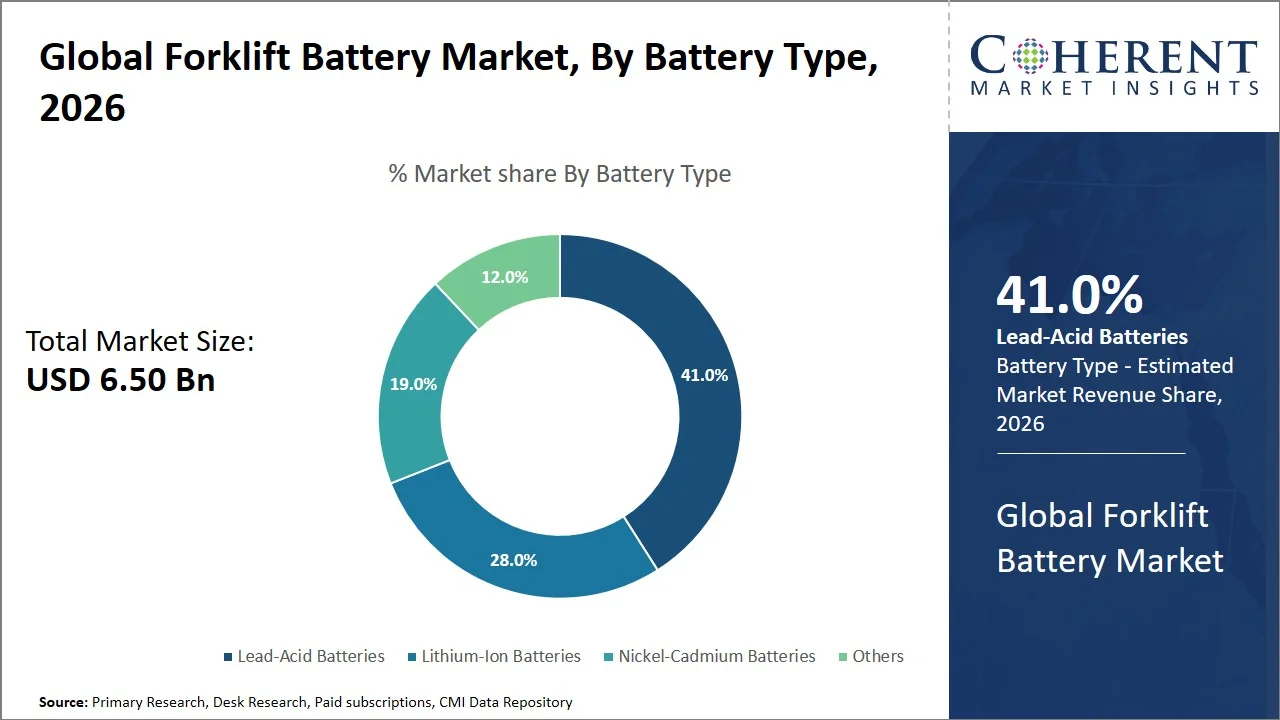
- The lead-acid batteries segment is expected to account for 41.0 % of the global forklift battery market share in 2026. Development of fast charging and opportunity charging capabilities is a major factor driving the growth of the segment. On July 10, 2025, Hyster announced product of the year honors for its onboard charging solution, with Plant Engineering magazine recognizing the solution with a bronze award in the electrical, power and lighting category. (Source: Hyster)
- The warehousing segment is estimated to capture 32.0 % of the market share in 2026. Increasing integration of robotics and automation in warehouses is a prime factor driving the growth of the segment. On March 17, 2026, DHL Supply Chain announced the deployment of SVT Robotics' SOFTBOT platform across its global warehouse network. With more than 8,000 collaborative robots already active across its global operations, the new plug-and-play platform allows DHL to deploy robotics integrations up to 12 times faster than traditional custom coding setups, setting the stage for the logistics giant to fast-track future automation rollouts. (Source: DHL)
- The logistics segment is estimated to capture 33.0 % of the market share in 2026. Growing development of palleting applications for logistics operation is driving the growth of the segment. On June 17, 2025, NewCold launched Corby 3, reinforcing the organization’s commitment to delivering high-efficiency cold chain solutions for the frozen food industry. The Corby expansion adds over 33,000 pallet positions to NewCold’s UK network, bringing the total across the three facilities to over 185,000 pallet positions. (Source: NewCold)
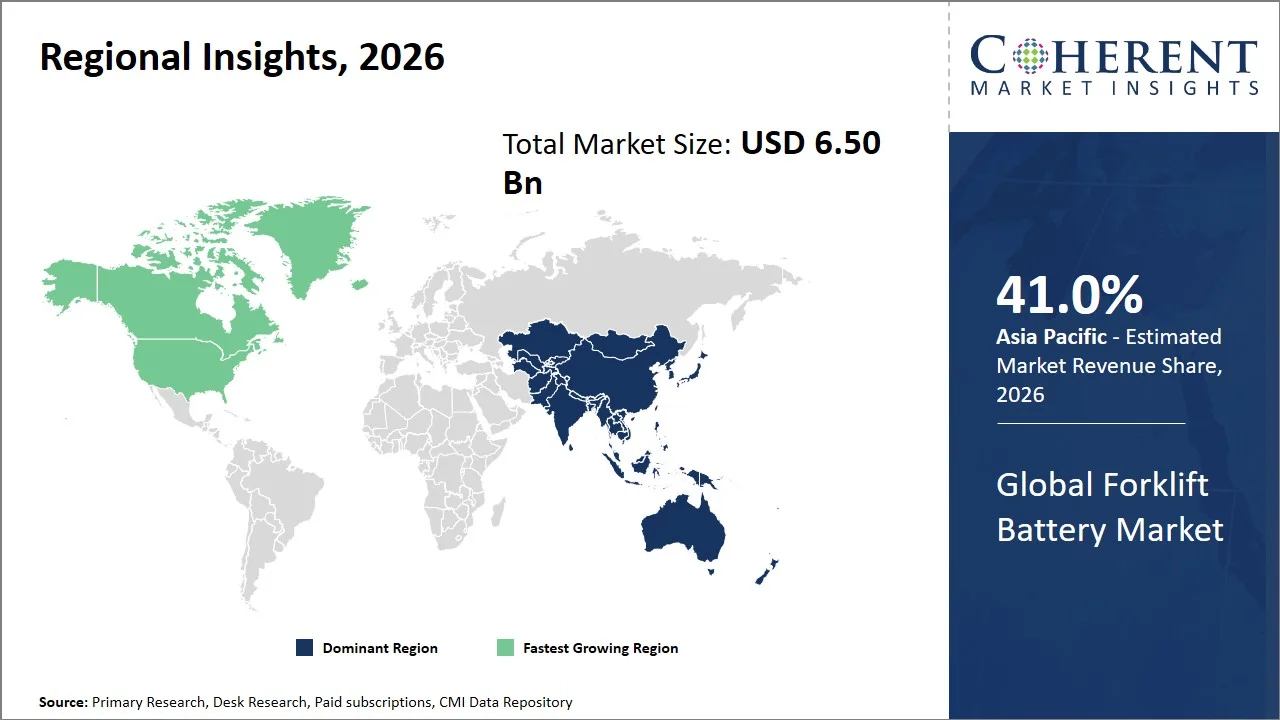
- Asia Pacific is expected to dominate the forklift battery market in 2026 with a market share of 41.0 %. Technological development of battery management systems in Asia Pacific is a major growth factor for the regional market. On February 23, 2026, MaxVolt Energy announced a strategic collaboration with the Indian Institute of Technology Roorkee to develop advanced, AI-enabled battery systems tailored for electric vehicles and energy storage applications. This partnership brings together MaxVolt's industry experience in battery technologies and IIT Roorkee's research capabilities in artificial intelligence and electronics to create next-generation Battery Management Systems (BMS) that improve safety, efficiency, thermal stability, and overall performance. (Source: MaxVolt Energy)
- North America is expected to account for 27.0 % share in 2026 and is projected to record the fastest growth over the forecast period. Expansion of cold-storage logistics facilities is prime driver for the growth of the regional market. Americold Realty Trust and EQT announced the formation of a new joint venture with EQT's Active Core Infrastructure fund focused on the ownership, operation, and potential development of high-quality cold storage warehouse facilities in North America. (Source: EQT)
- Rapid Shift from Lead-Acid to Lithium-Ion Batteries: The warehouse operators and logistics companies are slowly transitioning from the traditional lead-acid batteries to lithium-ion batteries due to their longer life span, higher energy efficiency, faster charging, and less maintenance. Opportunity charging during breaks in the workday is also possible with lithium-ion batteries, decreasing downtime and increasing fleet productivity.
- Integration of Smart Battery Management Systems (BMS) and IoT Connectivity: Manufacturers are integrating advanced battery management systems, telematics, and IoT-enabled monitoring solutions in forklift batteries. These devices offer real-time data on battery health, temperature, charge cycles, energy consumption and predicted maintenance needs.
Segmental Insights
Why Do Lead-Acid Batteries Dominate the Global Forklift Battery Market?
The lead-acid batteries segment is expected to account for 41.0% of the global forklift battery market share in 2026. The fundamental factor that helps lead-acid batteries maintain their dominance in the forklift battery market is that their upfront purchase costs are much lower than that of lithium-ion batteries. Many warehouses and manufacturing and distribution centers, especially in cost sensitive and developing markets, emphasize reducing capital expenditure while expanding or replacing fleets of forklifts. The increased acceptance of lithium-ion technology notwithstanding, lead-acid batteries are a proven, stable and affordable power supply at significantly lower purchase cost and continue to be the choice of a huge installed base of electric forklifts. On November 9, 2024, IPower Batteries launched graphene series lead-acid batteries. The company claimed its new battery variants have been tested by ICAT for AIS0156 and have been awarded the Type Approval Certificate TAC for their innovative graphene series lead-acid technology. (Source: Ipower Batteries)
- Current Industry Events of 2026
- Market Size Estimation
- Regional Breakdown
- Competitive Landscape
- Customer Intelligence
- Segmental Analysis
- Pricing Analysis
- Key Market Drivers, Challenges & Future Trends
- Customized Insights Section
Why is Warehousing the Most Widespread Application?
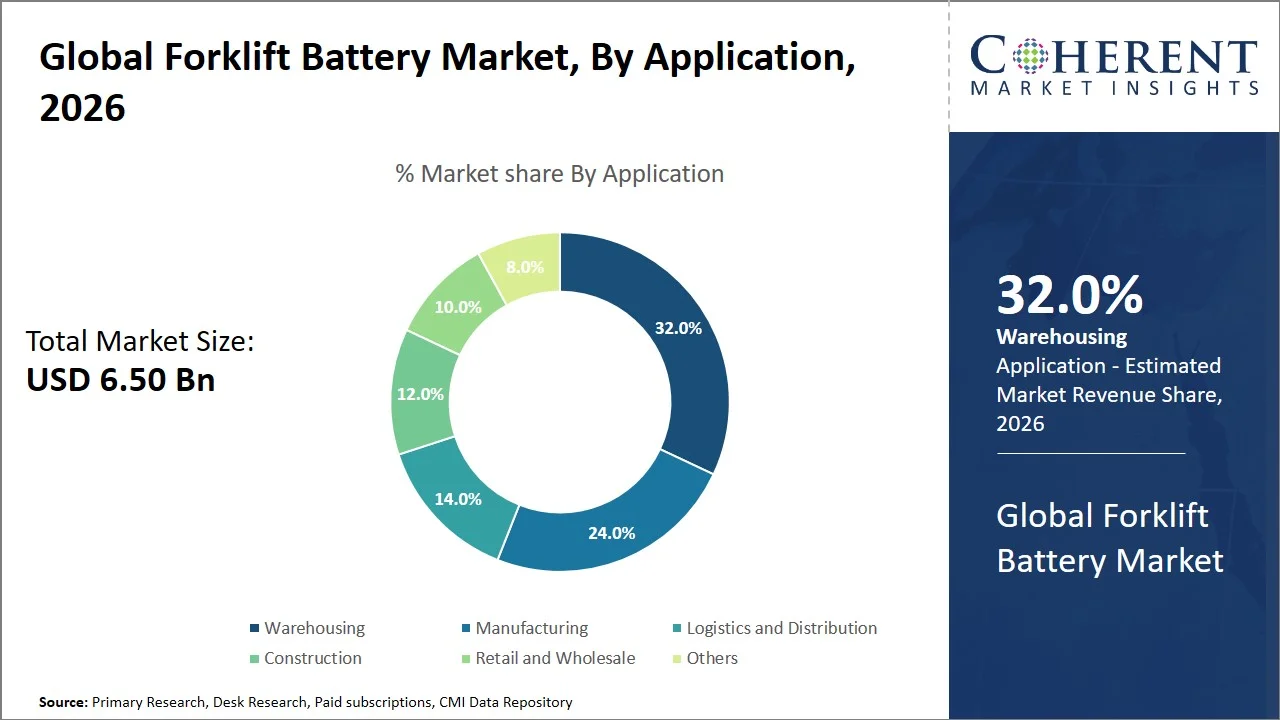
The warehousing segment is expected to account for 32.0% of the global forklift battery market share in 2026. Warehousing is the largest application category as warehouses need to move, store, retrieve and transfer items on a continual basis during day to day operations . Forklifts are a crucial part of moving pallets, inventory, and shipments at distribution centers and fulfillment facilities, driving a strong demand for batteries. The increasing rise of e-commerce and third-party logistics (3PL) operations has further expanded the use of forklifts in warehouses, making this industry the largest consumer of forklift batteries in the world. On June 26, 2025, Amazon India announced the launch of 5 new fulfilment centers (FCs), adding to its robust operations network in India. The expansion brings the very first Amazon FCs in Indore, Bhubaneshwar, Kochi and Rajpura and another one in Delhi-NCR. With over 1.8 million cubic feet of combined storage space, these FCs will lead to faster delivery of customer orders while also creating thousands of local job opportunities in the region. (Source: Amazon)
Logistics Dominate the Global Forklift Battery Market
The logistics segment is expected to account for 33.0% of the global forklift battery market share in 2026. The logistics industry holds a large proportion of the forklift battery market, with the growth of e-commerce fulfillment centers, distribution hubs and supply chain operations around the world. Electric forklifts are widely relied upon in these facilities to load, unload, sort and move goods, creating constant need for forklift batteries. The sector’s market power is demonstrated by the rising worldwide package volumes and warehouse throughput that are compelling logistics operators to invest more in bigger forklift fleets and battery replacements. On February 24, 2025, leading global logistics service provider, the Rhenus Group opened a state-of-the-art warehouse facility that supports storage and fulfillment of over 7,000 IKEA products. The 180,000 square feet facility is the first fully outsourced Central Distribution Centre (CDC) for IKEA, with sustainable features and leading technology for seamless doorstep delivery to the Delhi NCR, India. (Source: Rhenus)
Currents Events and their Impact
Current Events | Description and its Impact |
EU Batteries Regulation (EU) 2023/1542 |
|
European Commission Waste Battery Recycling Rules (2025) |
|
(Source: European Union, European Commission)
Forklift Battery Market Dynamics
Market Drivers
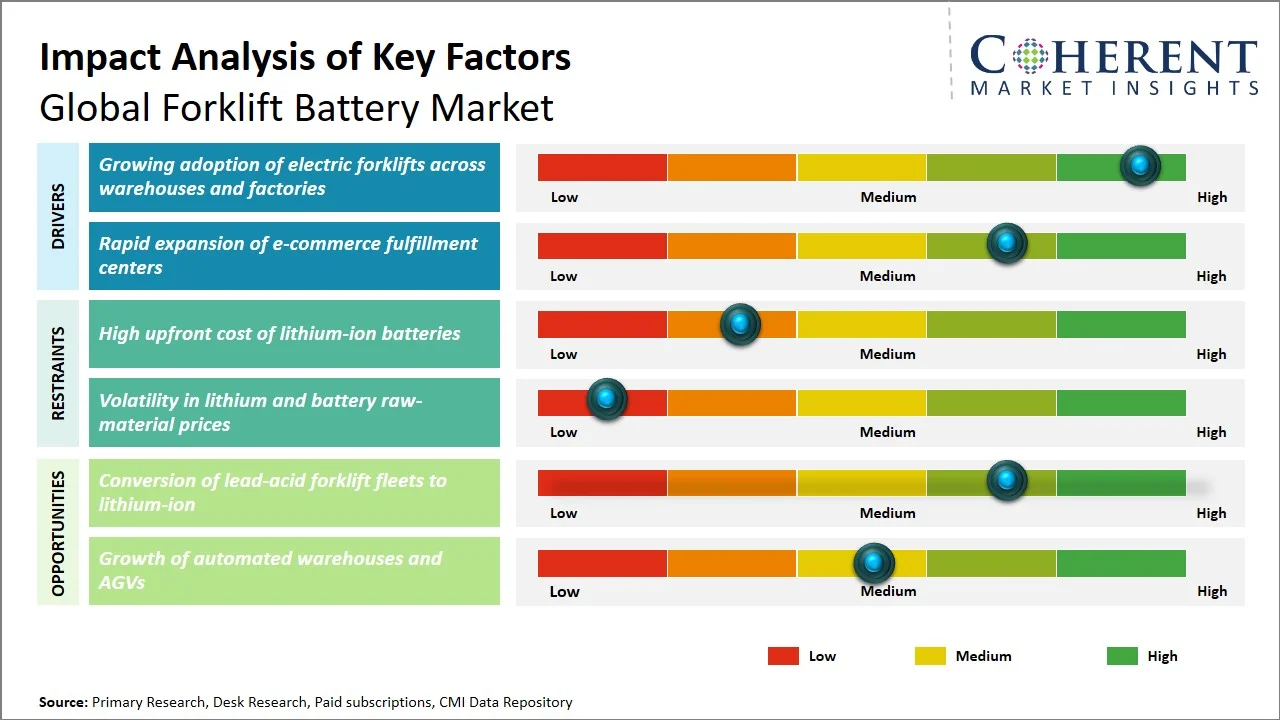
Growing adoption of electric forklifts across warehouses and factories
The adoption of electric forklifts in warehouses and factories is a major driver of the forklift battery market, as companies are looking for cleaner and more energy efficient material handling solutions. Electric forklifts are ideal for interior industrial applications since they have cheaper running costs, require less maintenance, operate more quietly and produce zero on-site pollutants compared to internal combustion engine forklifts. This, combined with the growth of e-commerce fulfillment centers, automated warehouses and sustainability programs, is driving companies to transition from traditional forklifts to electric versions, which is boosting the demand for industrial batteries, especially advanced lithium-ion and lead-acid systems.
On May 14, 2026, Godrej Enterprises Group introduced India’s first Multi‑Ion battery technology for electric forklifts through its Material Handling Equipment (MHE) business, one of the market leaders in India’s material handling segment. The launch addresses the growing need for efficient, reliable, and sustainable energy solutions as India’s manufacturing, logistics, and warehousing sectors scale rapidly, to enable 25% lower total cost of ownership, higher equipment uptime, and cleaner industrial operations, with a battery designed to last through the full operational life of the forklift. (Source: Godrej Enterprises Group)
Rapid expansion of e-commerce fulfillment centers
Rapid growth of e-commerce fulfillment centers is greatly increasing the demand for forklift batteries, as online retailers and third-party logistics providers continue to invest in bigger and more sophisticated storage networks. Extensive use of electric forklifts is made in these facilities for 24/7 inventory movement, pallet handling, loading, unloading and order fulfillment operations. As the worldwide sales of e-commerce is increasing and firms want to provide shorter delivery times, the requirement for efficient material-handling equipment and reliable battery systems is also growing, thereby driving the higher use of forklift batteries across the distribution and fulfillment centers globally.
On June 10, 2026, Amazon opened a new fulfilment center in Northampton and announced plans for a second major site in nearby Kettering, taking its investment in a single county (U.K.) to more than USD 1 billion and creating more than 4,000 jobs. (Source: Amazon)
Emerging Trends
- Growing Demand from Automated Warehouses and Autonomous Material Handling: The proliferation of automated warehouses, automated guided vehicles (AGVs), and autonomous forklifts is fueling the demand for high-performance battery systems that can sustain 24/7 operations. Current logistics centers demand batteries that provide reliable power, fast charging and simple integration into automated fleet management platforms.
- Development of Fast-Charging, Opportunity-Charging, and Battery-as-a-Service (BaaS) Models: Fleet operators are looking for more charging flexibility to enhance equipment uptime. Battery suppliers are working on ultra-fast charging, researching wireless charging and developing opportunity-charging systems that allow forklifts to recharge during short idle times.
Regional Insights
Why is Asia Pacific a Strong Market for Forklift Batteries?
Asia Pacific is expected to account for a market share of 41.0% in 2026. Asia Pacific’s development is driven by more than 1.5 million battery-operated forklifts in use throughout manufacturing, shipping and warehousing sectors. China alone added over 800,000 forklifts in a single year, while Japan has more than 250,000 units in operation and India has topped 200,000 battery-powered forklifts. The region is also the world’s lithium-ion battery production hub, with battery providers like as BYD, CATL, GS Yuasa, and LG Energy Solution providing batteries for electric material-handling fleets utilized by Alibaba, JD.com, and other manufacturing clusters around the region.
On April 23, 2026, Envision AESC broke ground on a large-scale battery production plant in Ibaraki Prefecture, Japan. The project is a significant investment in sophisticated battery production capacity and is projected to meet increasing regional demand for industrial electrification, including material handling equipment and forklift battery applications.
Why Does the North America Forklift Battery Market Exhibit High Growth?
North America is projected to account for 27.0% of the global forklift battery market and is expected to register the fastest growth. North America is witnessing a fast adoption of lithium-ion systems in high-throughput distribution centers and automated warehouses. Major retailers and logistics operators are boosting the electrification of their forklift fleets to allow multi-shift operations, with lithium-ion batteries removing the need for battery-swapping and cutting downtime. One significant example is Walmart’s proposal to spend as much as USD 200 million on autonomous forklifts via Fox Robotics to be used across distribution centers, creating extra need for sophisticated battery systems that can support automated warehouse operations. Electrovaya Inc., a leading lithium-ion battery technology and manufacturing firm, announced that battery system assembly activities have begun at the firm’s Jamestown, New York, U.S. facility. These businesses will continue to grow as demand for Electrovaya’s battery solutions increases. (Source: Electrovaya)
Global Forklift Battery Market Outlook for Key Countries
Why is China Emerging as a Major Hub in the Forklift Battery Market?
China is the largest market for forklift batteries in the world and the primary manufacturer of lithium-ion battery cells for electric forklifts. The country has a huge manufacturing base in the provinces of Guangdong and Jiangsu, where businesses like BYD and CATL create much of the world’s lithium battery output. Growth is fueled by large-scale warehouse development and manufacturing automation, with the logistics networks of Alibaba and JD.com increasingly powered by electric forklifts with lithium-ion batteries. China’s robust local battery ecosystem and government-backed industrial electrification initiatives continue to drive forklift battery adoption.
Is the U.S. the Next Growth Engine for the Forklift Battery Market?
The U.S. represents the vast bulk of North American forklift battery demand and is among the fastest adopters of lithium-ion-powered material-handling equipment. Demand is focused on e-commerce fulfillment centers, retail distribution hubs and automotive production plants, where operators are moving from lead-acid batteries to fast-charging lithium-ion systems to support 24/7 warehouse operations. Walmart and Amazon are among the companies still pouring money into warehouse automation and manufacturers such as EnerSys, Flux Power and Electrovaya are increasing their lithium-ion forklift battery supplies to large fleet owners.
Japan Forklift Battery Market Analysis and Trends
Japan’s highly automated industrial industry and its excellent logistics infrastructure make it one of the most technologically advanced forklift battery marketplaces. In the major logistical hubs of Tokyo, Osaka and Nagoya, vast fleets of lithium-ion-powered forklifts are used in port operations, car production and just-in-time supply chains. Japanese firms like GS Yuasa and Toyota Industries are continuing to invest in innovative battery technology, and fleet operators are progressively switching from conventional lead-acid systems to lithium-ion batteries to increase operational efficiency and minimize maintenance requirements.
South Korea Forklift Battery Market Analysis and Trends
The South Korea forklift battery market is supported by the country’s world-competitive battery manufacturing sector and export-oriented industrial economy. LG Energy Solution and Samsung SDI, major battery producers, deliver innovative lithium-ion technologies that allow the electrification of forklifts in the electronics, automotive and logistics sectors. Demand for high-performance batteries is being fueled by the increasing adoption of automated material handling systems in South Korean warehouses and manufacturing plants, which need to operate continuously in multi-shifts and smart warehouse environments.
India Forklift Battery Market Analysis and Trends
India is emerging as one of the fastest growing forklift battery markets in Asia Pacific driven by the growth of organized storage, e-commerce logistics, FMCG distribution and automobile manufacturing. The country is witnessing an increasing localization of lithium-ion battery production with Amara Raja Energy & Mobility signing a technology licensing deal with Gotion to produce lithium-ion cells in India and Exide Industries investing in local lithium-ion battery manufacturing plants. Major industrial states are seeing a faster shift from old lead-acid batteries to lithium-ion powered forklift fleets due to rising investments in logistics parks, fulfillment centers and industrial corridors.
Global Forklift Battery Market - Electric Forklift Installed Base
Region | Estimated Electric Forklift Installed Base (Million Units) |
Asia Pacific | 5.2 |
North America | 2.1 |
Europe | 2.0 |
Latin America | 0.6 |
Middle East & Africa | 0.6 |
Global Forklift Battery Market – E-commerce Warehouse Capacity Additions
Region | Existing E-commerce Warehouse Capacity (Million sq. ft.) | Capacity Added in 2025 (Million sq. ft.) | Growth Rate |
Asia Pacific | 2,150 | 260 | 12.1% |
North America | 1,850 | 180 | 9.7% |
Europe | 980 | 95 | 9.7% |
Latin America | 280 | 32 | 11.4% |
Middle East & Africa | 190 | 25 | 13.2% |
How is the Conversion of Lead-Acid Forklift Fleets to Lithium-Ion Creating New Growth Opportunities in the Forklift Battery Market?
The replacement demand from warehouses, industrial facilities and logistics operators wanting greater operational efficiency is a major driver, and the conversion of current lead-acid forklift fleets to lithium-ion technology is opening up huge potential opportunities for the forklift battery market. Lithium-ion systems can charge faster, allow for opportunity charging during breaks, have a longer service life, higher energy efficiency and lower maintenance needs than lead-acid batteries, allowing facilities to reduce downtime and boost fleet productivity. As many organizations look to cut operating costs, maximize warehouse space by removing battery-changing rooms and meet sustainability targets, the shift is to retrofit or replace lead-acid powered forklifts with lithium-ion battery solutions, generating a robust aftermarket revenue stream for battery manufacturers, integrators and charging infrastructure providers.
On April 1, 2025, Electrovaya Inc, a leading lithium-ion battery technology and manufacturing company, announced that it has received a purchase order valued at approximately USD 8.7 million. The batteries will be used by a leading Fortune 500 retailer in the U.S. for powering material handling electric vehicles in three existing warehouse sites. (Source: Electrovaya)
Market Players, Key Development, and Competitive Intelligence
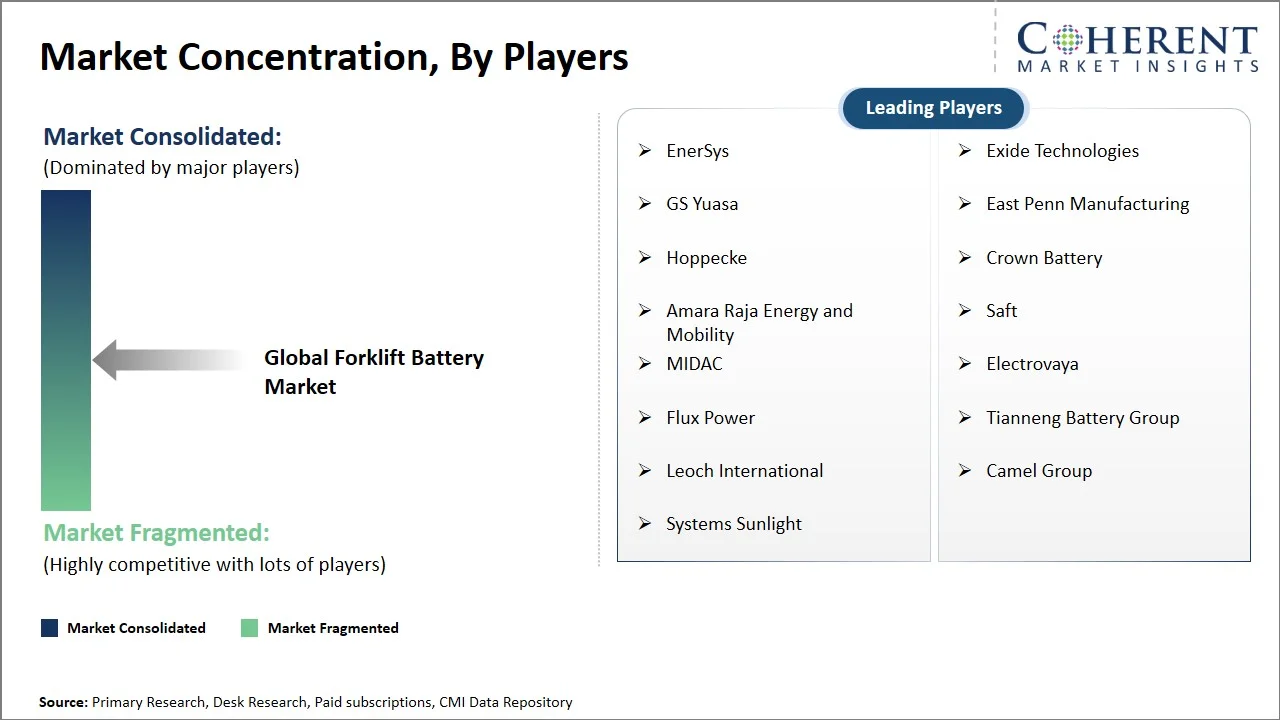
Key Developments
- On September 4, 2025, EnerSys announced the addition of new models to their line of NexSys TPPL batteries, covering even more material handling equipment applications. NexSys TPPL batteries feature proprietary thin plate pure lead (TPPL) maintenance-free battery technology, designed to be opportunity charged between shifts and during work breaks to maximize productive uptime while minimizing operating costs.
- On August 26, 2025, Toyota Material Handling announced it is expanding its energy solutions portfolio with the introduction of Toyota's new 5/35 Lithium-ion Batteries. The introduction of this lithium-ion battery line highlights the continued innovation across Toyota Material Handling North America (TMHNA), which operationally unites and supports the strengths of both the Toyota and Raymond brands to deliver integrated energy solutions.
Competitive Landscape
The global forklift battery market is characterized by the presence of established battery manufacturers, industrial power solution providers and rising lithium-ion players competing on technology, performance, charging efficiency and lifetime cost. Companies such as EnerSys, Exide Technologies, GS Yuasa, Electrovaya, Flux Power and Amara Raja Energy & Mobility are expanding the portfolio of lithium-ion products, strategic partnerships with forklift OEMs, investments in battery management technologies and products innovation to enhance their market position. Lead-acid options are being displaced by high performance lithium-ion systems, smart battery solutions and integrated energy-management platforms built for automated warehouse settings in this arena.
Market Report Scope
Forklift Battery Market Report Coverage
| Report Coverage | Details | ||
|---|---|---|---|
| Base Year: | 2025 | Market Size in 2026: | USD 6.50 Bn |
| Historical Data for: | 2020 To 2024 | Forecast Period: | 2026 To 2033 |
| Forecast Period 2026 to 2033 CAGR: | 7.5% | 2033 Value Projection: | USD 11 Bn |
| Geographies covered: |
| ||
| Segments covered: |
| ||
| Companies covered: | EnerSys, Exide Technologies, GS Yuasa, East Penn Manufacturing, Hoppecke, Crown Battery, Amara Raja Energy and Mobility, Saft, MIDAC, Electrovaya, Flux Power, Tianneng Battery Group, Leoch International, Camel Group, Systems Sunlight | ||
| Growth Drivers: |
| ||
| Restraints & Challenges: |
| ||
Analyst Opinion (Expert Opinion)
- The forklift battery market is in a structural change from traditional lead-acid technology to lithium-ion and intelligent energy-storage technologies. The market is driven by the rapid electrification of material-handling equipment, growth in e-commerce fulfillment infrastructure, and rising adoption of warehouse automation technology. Companies who can offer increased battery performance, rapid-charging capabilities, digital monitoring features and robust after-sales support networks will be in a better position to take future market share.
- The market is predicted to expand steadily throughout the projected period, driven by the growing preference for electric forklifts in logistics, manufacturing, retail distribution, and industrial warehousing applications. Opportunities are expected to emerge in fleet replacement programs, lithium-ion retrofits of existing forklifts, automated warehouse growth, and the emergence of Battery-as-a-Service (BaaS) business models. Advancements in battery chemistry, fast-charging infrastructure, recycling technologies, and government regulations promoting industrial electrification and sustainable material-handling operations across the globe are projected to further assist market expansion.
Speak to the analyst
Want personalized insights?
Take the findings above to one of our principal consultants, or have the report rebuilt around the segments, geographies and competitors you actually track.
Market Segmentation
- Battery Type Insights (Revenue, USD Billion, 2021 - 2033)
- Lead-Acid Batteries
- Lithium-Ion Batteries
- Nickel-Cadmium Batteries
- Others
- Application Insights (Revenue, USD Billion, 2021 - 2033)
- Warehousing
- Manufacturing
- Logistics and Distribution
- Construction
- Retail and Wholesale
- Others
- End User Insights (Revenue, USD Billion, 2021 - 2033)
- Logistics
- Automotive
- Food and Beverage
- Chemical
- Retail
- Manufacturing Industries
- Others
- Regional Insights (Revenue, USD Billion, 2021 – 2033)
- North America
- U.S.
- Canada
- Latin America
- Brazil
- Argentina
- Mexico
- Rest of Latin America
- Europe
- Germany
- U.K.
- Spain
- France
- Italy
- Russia
- Rest of Europe
- Asia Pacific
- China
- India
- Japan
- Australia
- South Korea
- ASEAN
- Rest of Asia Pacific
- Middle East
- GCC Countries
- Israel
- Rest of Middle East
- Africa
- South Africa
- North Africa
- Central Africa
- North America
- Key Players Insights
- EnerSys
- Exide Technologies
- GS Yuasa
- East Penn Manufacturing
- Hoppecke
- Crown Battery
- Amara Raja Energy and Mobility
- Saft
- MIDAC
- Electrovaya
- Flux Power
- Tianneng Battery Group
- Leoch International
- Camel Group
- Systems Sunlight
Sources
Primary Research Interviews
- Forklift battery manufacturers and suppliers
- Material handling equipment distributors
- Warehouse and logistics facility managers
- Industrial battery technology experts
Magazines
- Material Handling & Logistics
- Modern Materials Handling
- Industrial Equipment News
- Battery Industry Magazine
Journals
- Journal of Power Sources
- International Journal of Industrial Engineering
- Materials Handling Engineering
Associations
- Industrial Truck Association (ITA)
- Material Handling Industry of America (MHIA)
- Battery Council International (BCI)
- International Warehouse Logistics Association (IWLA)
Public Domain Sources
- U.S. Department of Energy reports
- European Commission industrial statistics
- International Energy Agency publications
- World Trade Organization trade data
Proprietary Elements
- CMI Data Analytics Tool
- Proprietary CMI Existing Repository of information for last 10 years
Get access to 250+ pages report
Every segment, forecast, competitor profile and data table behind the analysis above — available for instant download.
- ESOMAR Member
- ISO 9001:2015 Certified
- D-U-N-S Registered
- GDPR & CCPA Compliant
Missing comfort of reading report in your local language? Find your preferred language:
Transform your Strategy with Exclusive Trending Reports
Frequently Asked Questions
The global forklift battery market is expected to stand at USD 6.50 Bn in 2026 and is expected to reach USD 11 Bn by 2033.
The CAGR of the global forklift battery market is projected to be 7.5% from 2026 to 2033.
Growing adoption of electric forklifts across warehouses and factories and rapid expansion of e-commerce fulfillment centers are the major factors driving the growth of the global forklift battery market.
In terms of battery type, the lead-acid batteries segment is estimated to dominate the market revenue share in 2026.
E-commerce expansion increases the need for forklifts in fulfillment centers and distribution warehouses.
They support electric forklifts that produce zero on-site emissions during operation.
High upfront cost of lithium-ion batteries and volatility in lithium and battery raw-material prices are the major factors hampering the growth of the global forklift battery market.