

Global Freeze-Dried Candy Market Size and Forecast – 2026 To 2033
The Global Freeze-Dried Candy Market is estimated to be valued at USD 1.42 Bn in 2026 and is projected to reach USD 2.31 Bn by 2033, registering a compound annual growth rate (CAGR) of 7.20% during 2026–2033. Consumer interest in unusual confectionery textures and the replacement of traditional chewy textures with crispy alternatives, and increased retail and e-commerce access all contribute to the market's growth. Freeze-drying technology enables manufacturers to produce lightweight, crunchy products with low moisture content and with better shelf stability.
In October 2025, the National Confectioners Association (NCA) reported that younger consumers increasingly favored confectionery innovations, particularly freeze-dried and liquid-filled candies. Its consumer research also found that Gen Z spending on non-chocolate candy increased by 47% year over year, highlighting opportunities for manufacturers targeting younger buyers with differentiated confectionery formats.
Key Takeaways of the Global Freeze-Dried Candy Market
- Chewy Candies & Taffy are estimated to expand at a 7.0% CAGR during 2026–2033 and account for 53.8% of the global freeze-dried candy market in 2026. During freeze-drying, their original chewy texture transforms into a light, crispy structure offering a unique snacking experience. In August 2025, Ferrara released the SweeTARTS and Spree varieties in freeze-dried format, bringing tried and tested chewy confectionery offerings to the crunchy form.
- Sweet flavor-profile candies are projected to register an estimated 6.8% CAGR through 2033, capturing 41.1% of global freeze-dried candy market revenue in 2026. Caramel- and sugar-forward flavors can encourage consumers to try these products and freeze-drying is a good way to add texture variation without altering the consumer expectations. Mars unveiled M&M'S POP'd Caramel in October 2025, a crispy, airy format featuring its iconic caramel taste.
- Single-Serve Packs are expected to grow at a 7.4% CAGR up to 2033 and capture 51.6% share in the global freeze-dried candy market in 2026 Smaller packs encourage impulse purchases and reduce exposure to humidity after opening after opening, keeping crunch. In August 2025, Andersen's Crazy Candy added Fizzy Mountain Mist to its freeze-dried range, offered in an approximately one-ounce pack.
- North America is projected to record an estimated 6.9% CAGR through 2033 while retaining 44.3% of global freeze-dried candy market in 2026. Grocery and convenience stores enable established candy brands to introduce new textures to consumers more quickly. In March 2025, Hershey revealed a line of established fruit flavors that will be ready for general purchase in U.S. retail locations, including Jolly Rancher Freeze Dried.
- Europe is expected to achieve an indicative 8.6% CAGR through 2033, alongside a 26.7% global freeze-dried candy market share in 2026. Its specialist sweets retailers offer emerging brands a route to test unusual textures before securing wider distribution. In April 2025, British confectioner Langtins presented its Noomz freeze-dried sweets range to trade buyers at Birmingham's Food & Drink Expo.
Segmental Insights
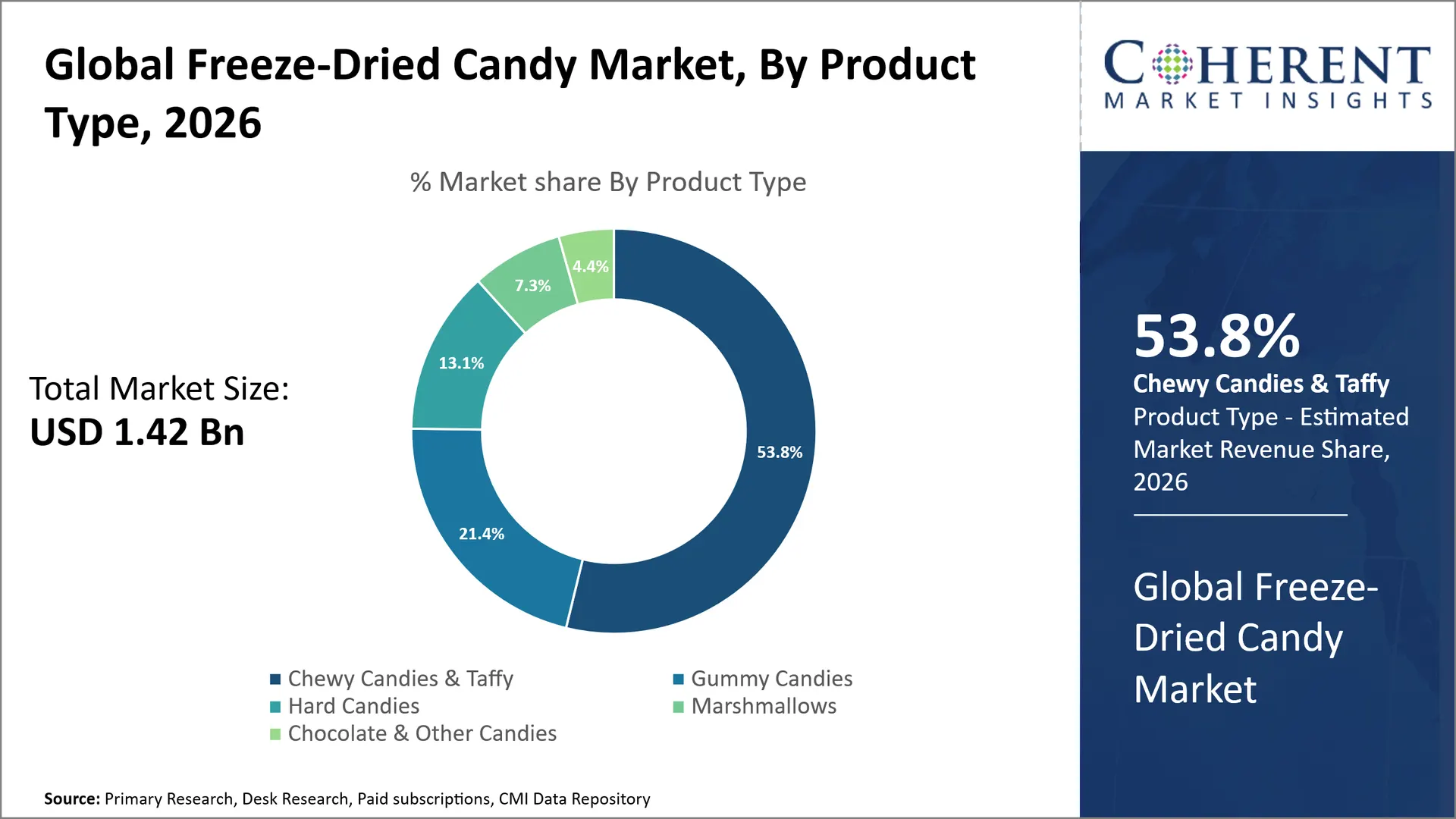
Why Do Chewy Candies & Taffy Dominate the Global Freeze-Dried Candy Market?
Chewy Candies & Taffy are expected to account for 53.8% of the global freeze-dried candy market in 2026, leading the product-type category. They can expand during the vacuum process in order to make bigger, crisp confections from a known confectionery base. This can allow for product extensions that don't require new candy recipes, such as taffy and soft chews. Consumers also know the original flavors, aiding retailers in describing the new format at the shelf. The manufacturing problem is choosing formulations that will expand in a consistent manner, with minimal cracks and inconsistencies in drying between batches. In October 2024, Sow Good introduced Taffy Bombs, a freeze-dried saltwater taffy product, within its new confectionery collection. The launch demonstrated how conventional taffy production can supply a differentiated freeze-dried range without requiring an unfamiliar starting ingredient.
- Current Industry Events of 2026
- Market Size Estimation
- Regional Breakdown
- Competitive Landscape
- Customer Intelligence
- Segmental Analysis
- Pricing Analysis
- Key Market Drivers, Challenges & Future Trends
- Customized Insights Section
Why Does Sweet Represent the Largest Flavor Profile in the Global Freeze-Dried Candy Market?
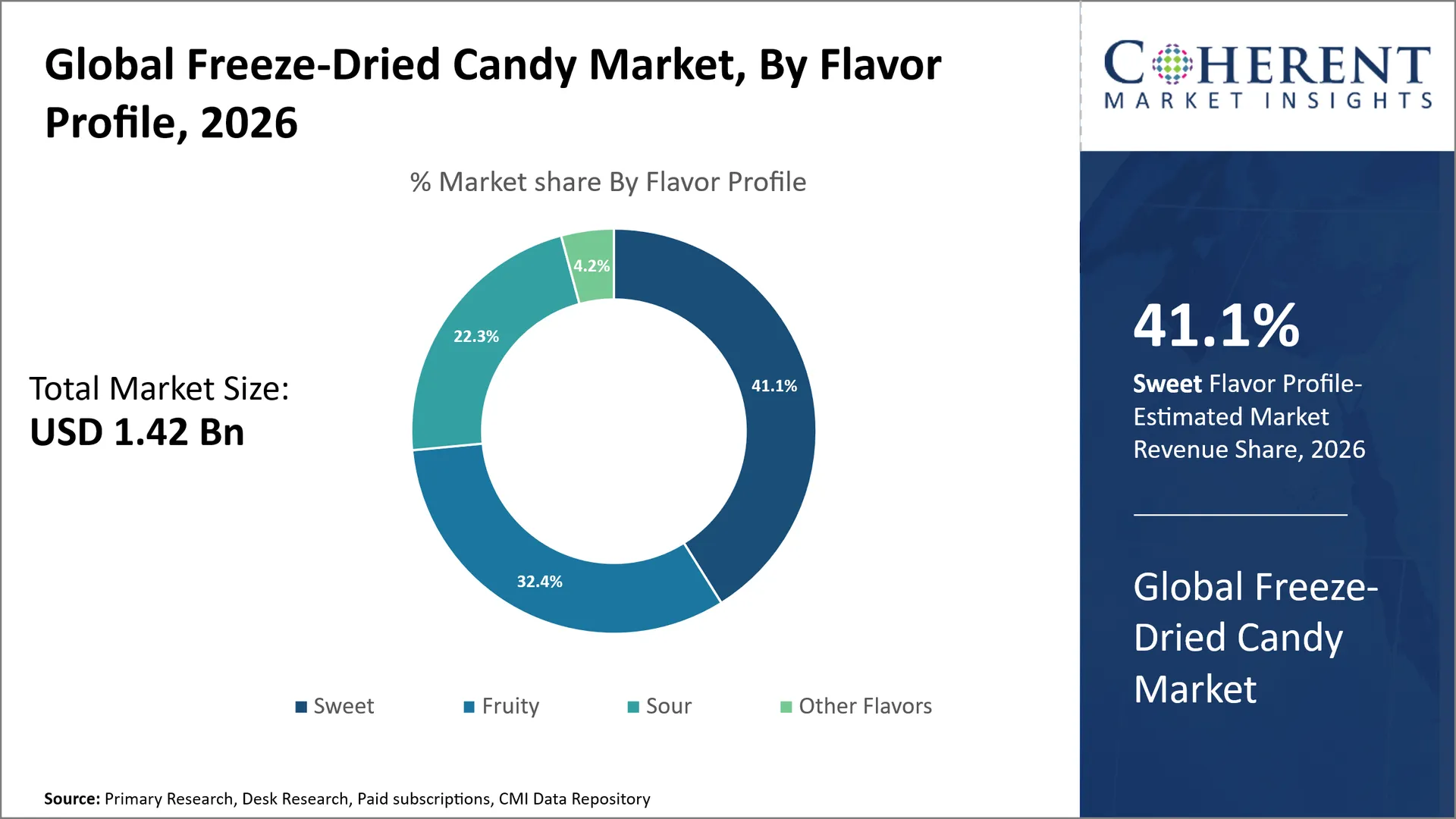
Sweet is expected to represent 41.1% of the global freeze-dried candy market in 2026, making it the largest flavor-profile category. This segment benefits from familiar sweet flavor profiles, such as vanilla, caramel, marshmallow style. These give an easy option for those at home and traditional candy consumers who may not be interested in biting into something extremely tart. Manufacturers are able to create diverse mixes that can be flavored in different ways but do not need to rely on high levels of acidity to achieve a coating. Retailers also can better showcase these items along with well-known candies rather than limiting them to novelty sections. In January 2025, United Food Brands launched its new Tasty Vibes freeze-dried candy line featuring a sweet and a sour sweet option. This assortment strategy is an example of how suppliers can provide different flavours of the same product format.
Why Do Single-Serve Packs Dominate the Packaging Type Category of the Global Freeze-Dried Candy Market?
Single-Serve Packs are expected to be the largest packaging category with 51.6% share of the global freeze-dried candy market in 2026. They do not necessarily have the lowest price/gram, but the most important commercial advantage is that their purchase price is not too high. Narrow checkout displays are the ideal place for consumers to make fast buying choices, and smaller portions of candy are easier to sample and sell at a premium price. Retailers can thus provide a broader range of product options without assigning full shelf space to each product. Smaller size formats can be used by manufacturers to sell to convenience stores, kiosks, and travel retail outlets, and determine which types are worth being sold in larger packs. In May 2025, according to the National Confectioners Association, Schuster Products introduced a 0.70-ounce flow-wrap version of Face Twisters Freeze Dried Sour Candy Bitz for checkout merchandising, with a suggested retail price of US$1.99–2.49. The launch shows how pack size and merchandising location can jointly support consumer trial.
Current Events and Their Impact
Current Event | Description and Its Impact |
January 2025 – U.S. FDA Revocation of FD&C Red No. 3 Authorization |
|
January 2026 – Canada's Front-of-Package Nutrition Labeling Requirements |
|
August 2026 – EU Packaging and Packaging Waste Regulation Implementation |
|
Global Freeze-Dried Candy Market Dynamics
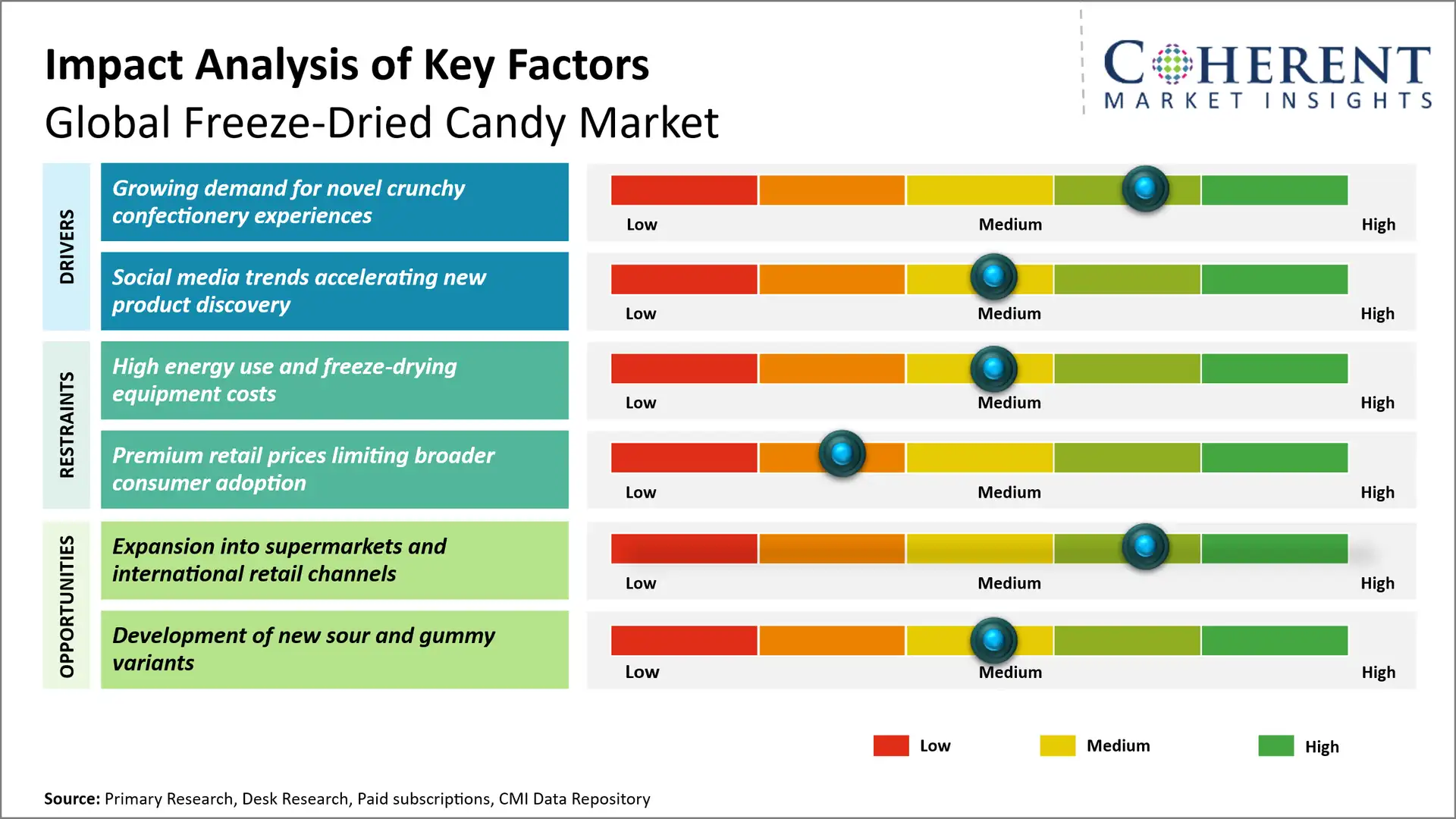
Key Market Drivers
- Growing Demand for Novel Crunchy Confectionery Experiences: Freeze-drying alters the texture of traditional candies and generates crisp, light confections with the same taste, but a new texture. It enables the manufacturer to make and sell larger and longer confectionery lines and provide the retailer with unique products to place on premium shelf. This trend could be advantageous to producers who have good texture control and formulation skills. In May 2026, YumEarth showcased Organic Freeze Dried Giggles at the Sweets & Snacks Expo, introducing a crunchy version of its established fruit-flavored confectionery while maintaining its allergy-friendly product positioning.
- Social Media Trends Accelerating New Product Discovery: Visual demonstrations of candy expansion, distinctive crunching sounds, and product-tasting videos attract consumer attention to unfamiliar formats of freeze dried candy. Creator-led promotion can help build brand recognition for smaller brands, even before they receive big advertising campaigns. When customers engage online, it translates to a retail trial and that's good for manufacturers, especially when it's younger shoppers. In April 2025, content creator-backed 1UP Candy announced its Crunchy Freeze-Dried Sour Strips, introducing four flavors through a product range designed around visually distinctive textures and strong digital appeal.
Emerging Market Trends
- Seasonal and Occasion-Specific Freeze-Dried Candy Assortments: Confectionery manufacturers are in a more advantageous position today to create and market limited-run candy assortments that coincide with holidays, special events and gift giving opportunities. Seasonal flavor offerings, decorative forms and themed packaging can provide the opportunity to enhance product assortments without necessarily increasing core portfolios.
Impact: Premium pricing may be possible if production runs are short and there may be better utilization of the shelf if purchased during a season. Retailers have the option to gauge customer interest before they agree to a regular inventory.
Relevance to the Market: It may be useful for specialized candy manufacturers and custom product manufacturers who are able to manufacture flexibly. Seasonal assortment planning could be a more formal merchandising approach over the forecast period.
- Greater Emphasis on Ingredient Transparency and Naturally Derived Colors: Ingredient composition is one of the key factors to consider in developing differentiated freeze-dried confectionery. While keeping the same appearance and taste, manufacturers can try out naturally derived colors, clearly listed flavoring ingredients to suit dietary preferences.
Impact: The positioning of ingredients could benefit brands in reaching more discriminating consumers and helping them differentiate their products from traditional flavor combinations. But reformulation may involve re-testing to maintain an equivalent product expansion and texture.
Relevance to the Market: Ingredient suppliers and confection specialist producers may be interested in adapting recipes to be compatible with each other. The formulation ability can be more and more significant in high-quality retail lines.
Key Restraining Factors
- High Processing and Production Costs: Vacuum equipment, controlled thermal cycles, and long processing times are needed for industrial freeze-drying. They raise the amount of capital investment, processing expenses and make it hard for smaller producers to offer competitive pricing without adequate production quantities.
- Moisture Sensitivity and Product Breakage: Freeze-dried candies can become soft if exposed to moisture in the air. They are also brittle and may break easily during handling. For manufacturers, this is a balancing act between protecting the product and handling costs as well as quality.
Regional Insights
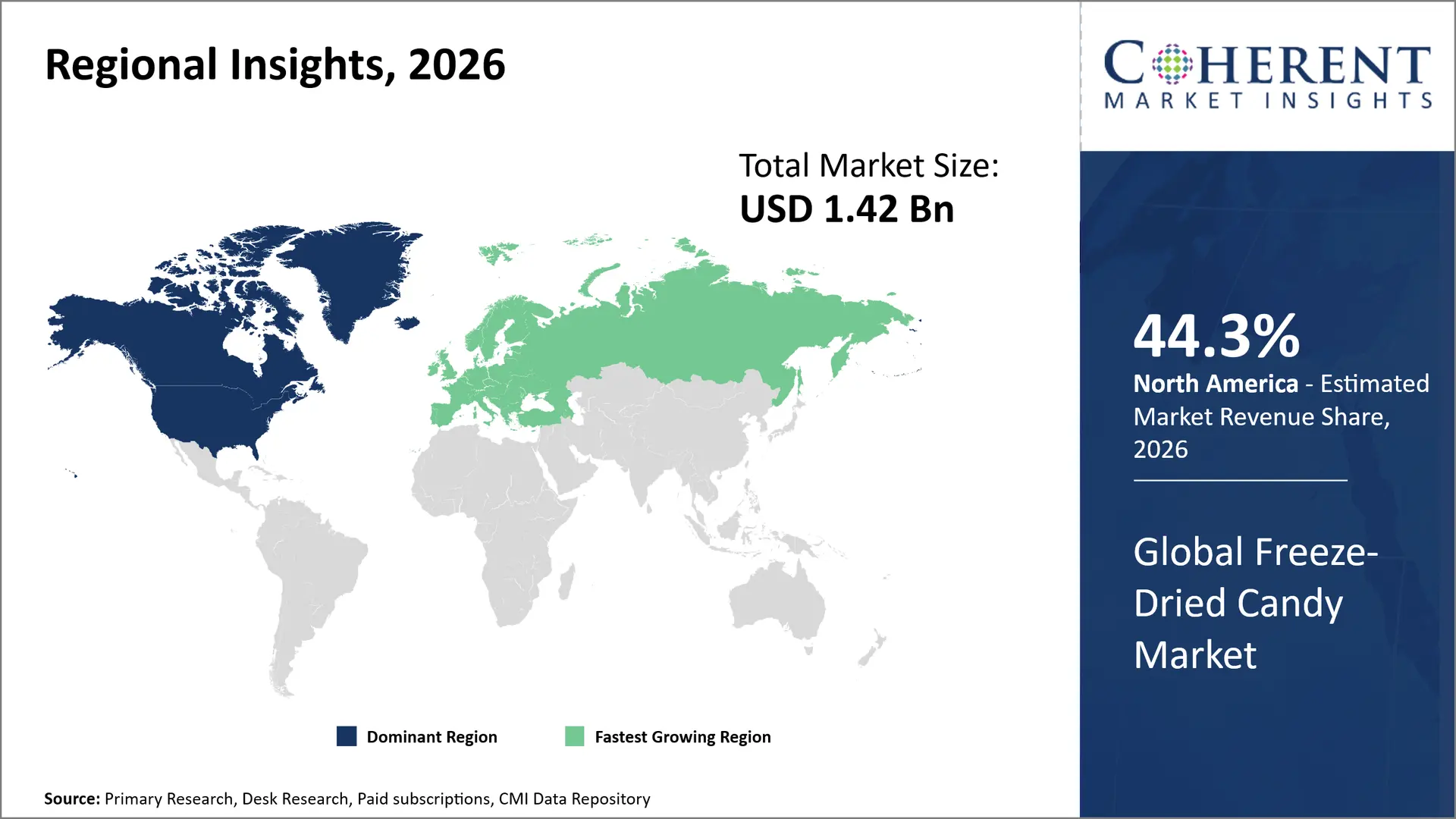
Why Does North America Dominate the Global Freeze-Dried Candy Market?
North America is expected to account for 44.3% of the global freeze-dried candy market in 2026, supported by specialty producers capable of expanding from local manufacturing into high-traffic retail destinations. The area has already established confectionery supply paths, special wholesalers and entertainment opportunities that offer other distribution points. They are places where customers will make impulse buys and where manufacturers can place the freeze-dried candy so that it can be sold as an experiential confection. In June 2026, Kentucky-based Freezin' with Aubrie expanded distribution of its freeze-dried treats to Walt Disney World, building on existing placements at regional attractions and specialty retailers. This development illustrates how North American businesses can extend their commercial reach through destination-based retail partnerships while reducing dependence on conventional supermarket distribution.
Why Is Europe Emerging as the Fastest-Growing Region in the Global Freeze-Dried Candy Market?
Europe is estimated to account for 26.7% share of the global freeze-dried candy market in 2026 and will be the fastest growing region during the forecast period. Specialty confectionery stores can expand if they can create locally oriented product lines and brands. Retailers can have narrower lines, test consumer preferences and try out flavors before they begin to expand distribution. In September 2026, Spain-based AmericanCandy launched its own line of freeze-dried gummies, alongside its imported candy goods sold in its Benidorm store and online. The development demonstrates how European retailers can shift from the resale of imported products to the development of proprietary confectionery offerings, opening up opportunities for differentiated pricing, stronger brand recognition and greater control over product assortments.
Global Freeze-Dried Candy Market Outlook for Key Countries
Why Is the U.S. a Key Market for the Global Freeze-Dried Candy Market?
The United States continues to be a major global market for freeze-dried candy as independent manufacturers continue to grow their business via direct-to-consumer platforms, specialty wholesalers and online marketplaces. These channels provide a way for smaller producers to assess consumer acceptance of their products before they go ahead and invest heavily in production. Fragile confectionery can be damaged in transit, so efficient fulfillment and consistent product quality are of utmost importance. Snack Food & Wholesale Bakery reported in July 2026 that Michigan-based A’s Sweets & Treats had expanded to Temu, with more than 10,000 orders since its storefront launch in February. It’s an indicator of the developing commercial opportunity for smaller U.S. manufacturers who want to touch more customers but don't want to invest in a large brick-and-mortar store network.
Why Is Germany a Strategic Country in the Global Freeze-Dried Candy Market?
Germany holds strategic importance in the global freeze-dried candy market due to the presence of established domestic confectionery manufacturers who can transform established candy portfolios into unique crunchy products. Specialized confectionery retail channels in the country create opportunities to introduce premium formats while retaining familiar brand identities. Manufacturers also have to comply with European ingredient declarations, allergen labeling and food safety regulations. Crunchies Sour Mix is a 75-gram freeze-dried product of fruit-flavored coated chewy candies distributed by Hitchies, a German confectionery company, via its consumer and business sales channels. This demonstrates how domestic brands can extend their confectionery portfolios to cover different textures. Looking forward, opportunities in Germany will come down to disciplined pricing, good retailer partnerships and products that can sustain purchases beyond the initial novelty appeal.
Why Is India Important in the Global Freeze-Dried Candy Market?
India offers an emerging opportunity for global freeze-dried candy market owing to its direct-to-consumer distribution and locally adapted flavors. Regional taste preferences and popular fruit-flavored confections can be leveraged by domestic brands to differentiate their products. But product positioning is important for commercial success, due to the relatively high processing costs, and price sensitivity. Nam Nam is an Indian confectionery brand with an online catalogue with various watermelon flavored candies and freeze dried Fruity Shellshocks. The company’s range shows that domestic businesses are able to provide non-standard confectionery formats with familiar candy flavors. To reach its long-term potential, India needs affordable production, reliable packaging and a stronger presence in specialist retail. This would allow manufacturers to reach more accessible consumer groups, rather than being limited to niche online customers.
Why Does China Support Growth in the Global Freeze-Dried Candy Market?
China's export-oriented confectionery production, customized product development and contract production all make a contribution to the worldwide freeze-dried candy market. It offers international brands access to special candy formats without the need for special freeze-drying facilities. Chinese suppliers are also capable of providing formulation customization solutions and packaging solutions to international distributors. In October 2025, MiniCrush, the manufacturer from China, announced its freeze-dried chocolate innovation in the 138th Canton Fair in Guangzhou. The move shows China's capability to go beyond the typical gummy and marshmallow items and into specialized freeze-dried confectionary. The country's competitiveness in the international private label supply chains can be further improved with continued investment in export compliant formulations, food safety certifications and processing consistency.
Why Is Brazil an Important Growth Market for the Global Freeze-Dried Candy Market?
Brazil is a growing global freeze-dried candy market with near-term opportunities focused on specialty e-commerce and differentiated confectionery assortments. Online retailers allow niche products to be sold to consumers without the need for wide supermarket distribution. However, confectionery that is sensitive to humidity needs to be packaged in protective packaging and stored under suitable conditions. Imported products may have higher landed costs. CrocFruta is a Brazilian retailer that offers a 150g box of Balas Crocantes Liofilizadas among its extensive range of freeze-dried products. This demonstrates the presence of candy-specific offerings in the country's specialty snack retail scene. To grow the market in the future it will be essential to have competitive pricing, consistent product quality and higher consumer awareness of freeze-dried confectionery compared to traditional dried fruit snacks.
Product Innovation and Freeze-Drying Process Landscape in the Global Freeze-Dried Candy Market
Capability | Primary Application | Technical Function | Commercial Significance |
Industrial Vacuum Freeze-Drying | Chewy candies, gummies, and marshmallows | Removes moisture under vacuum to create porous, crisp confectionery structures. | Enables unique candy textures to be made commercially. |
Controlled Freezing and Product Preparation | Product-specific candy processing | Changes the conditions of preparation depending on the moisture characteristics, dimensions and composition of the candy. | Helps improve batch consistency and limit unwanted structural changes |
Programmable Vacuum and Thermal Cycles | Automated freeze-drying operations | Controls drying time, temperature and pressure for various confectionery formulations. | Increases the efficiency of the use of production equipment and repeatability of processes |
Water Activity Measurement | Finished-product quality control | Measures the available moisture to determine product stability and susceptibility to texture deterioration. | Supports moisture specifications and more consistent product release decisions |
Humidity-Controlled Packaging Environments | Post-drying handling and packing | Limits moisture exposure between removal from the dryer and final sealing | Reduces the risk of premature softening and quality deterioration |
High-Barrier Flexible Packaging and Heat Sealing | Retail pouches and confectionery packs | Uses moisture-resistant packaging structures and controlled seals to protect finished candy | Supports texture retention, distribution reliability, and shelf-life management |
How Are Dessert Customization and Foodservice Applications Creating New Growth Opportunities in the Global Freeze-Dried Candy Market?
Besides the traditional wrapped candy, another possible avenue is the use of freeze dried candy as a textural and decorative element in desserts. Ice cream parlors, bakeries, dessert cafes, and specialty beverage spots can all add crunchy candy pieces to sundaes, milkshakes, cake decorations, and custom dessert products.
This capability allows manufacturers to make smaller, consistent pieces designed for foodservice handling and portion control, unlike traditional candy, which is mostly sold for direct consumption.
For commercial success, it is important to have consistent particle sizes, the right combinations of flavors and packaging which protects the product from moisture during storage. Manufacturers can supply dessert operators with bulk foodservice packs, custom assortments and ingredient supply agreements.
Operators, however, would need to add moisture-sensitive pieces near the end of service to maintain the texture. Specialist manufacturers can offer this opportunity to professional kitchens, able to tailor formulations and packaging.
New players in this market should focus on application testing, competitive bulk pricing, reliable fulfillment, and partnerships with dessert distributors before investing in dedicated production capacity.
Market Players, Key Developments, and Competitive Intelligence
Key Developments
- In January 2026, Schuster Products' Face Twisters brand was featured with its Freeze Dried Sour Candy Bitz range, including different pouch sizes and retail display formats. This development demonstrates how manufacturers can adapt freeze-dried confectionery for different retail placements and impulse-purchase occasions.
- In January 2026, Sow Good Inc announced the completion of a strategic asset sale and an exclusive distribution agreement with Trea Grove. The transaction moved the company toward a more asset-light operating structure, highlighting how specialized freeze-dried candy businesses are reassessing manufacturing ownership, operating expenses, and distribution economics.
- In December 2024, Kervan Gıda introduced its Bebeto Freeze Crunchy range, comprising freeze-dried peach rings, watermelon candies, and marshmallows. The development demonstrates the company's extension of established soft confectionery formats into freeze-dried products, providing additional assortment options and supporting differentiation across multiple candy categories.
Competitive Landscape
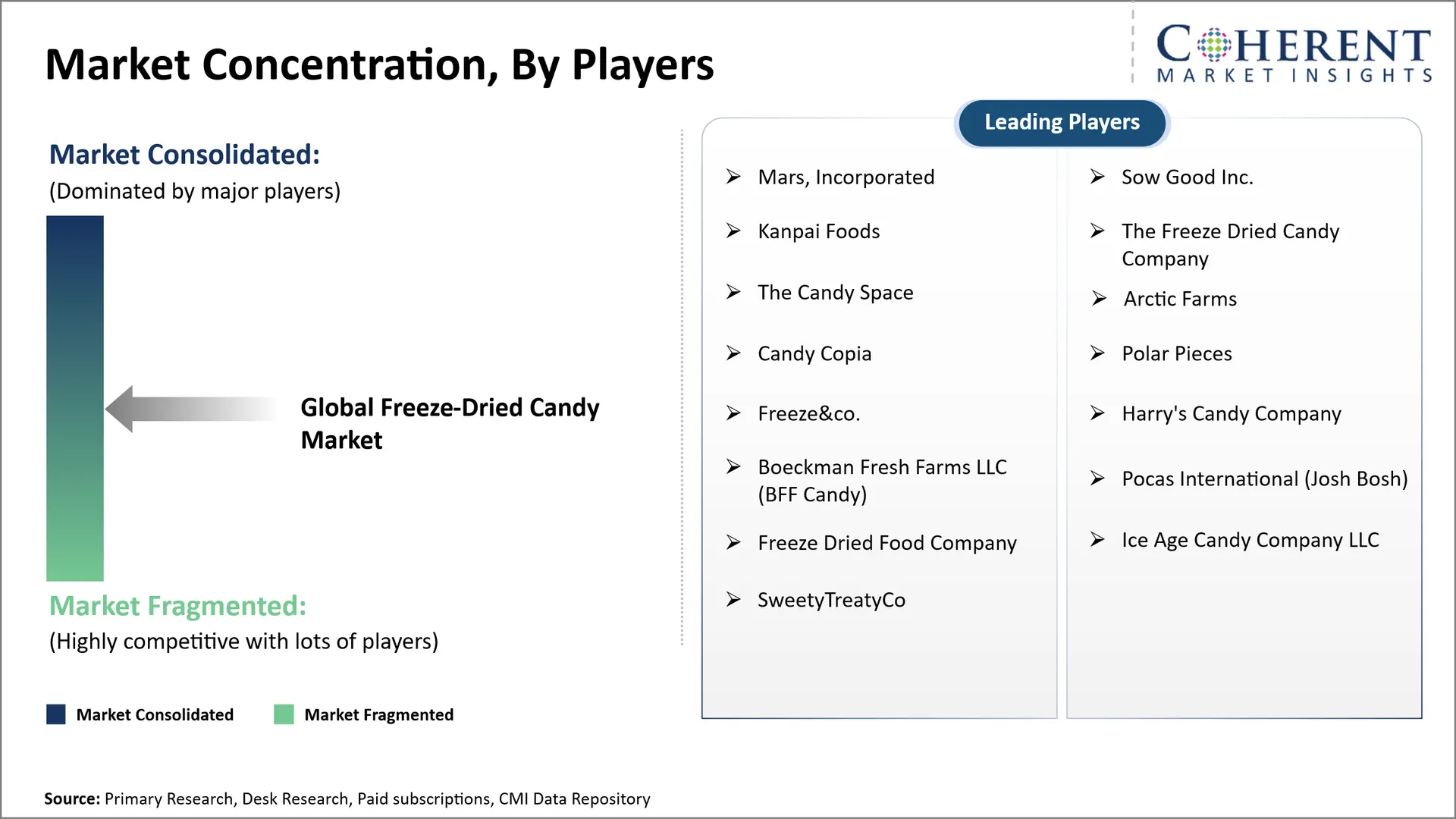
The global freeze-dried candy market is fragmented, consisting of established confectionery manufacturers, specialized freeze-drying companies, regional candy producers, and private-label suppliers. The competition is based mainly on texture consistency, formulation quality, manufacturing efficiency, pricing and dependable retail supply. Smaller brands can differentiate themselves through specialized product lines and flexible production. Larger brands, meanwhile, benefit from established distribution networks. Regulatory compliance and operational cost control are becoming more important competitive issues.
Key focus areas include
- Manufacturing Efficiency: Improving batch throughput and reducing processing losses to control unit production costs.
- Product Quality: Maintaining consistent shape, flavor intensity, and acceptable levels of breakage across production batches.
- Pricing Competitiveness: Managing premium positioning against lower-priced conventional confectionery alternatives.
- Supply Reliability: Maintaining consistent inventory availability and predictable fulfillment for retail partners.
- Quality Assurance: Applying food safety controls, traceability systems, and standardized finished-product specifications.
- Private-Label Manufacturing: Developing customized confectionery assortments for retailers seeking differentiated store brands.
- Geographic Market Access: Building distribution partnerships and adapting labeling, packaging, and formulations to destination-market requirements.
Market Report Scope
Global Freeze-Dried Candy Market Report Coverage | |||
Report Coverage | Details | ||
Base Year | 2025 | Market Size in 2026: | USD 1.42 Bn |
Historical Data For: | 2020 to 2024 | Forecast Period: | 2026 to 2033 |
Forecast Period 2026 To 2033 CAGR: | 7.20% | 2033 Value Projection: | USD 2.31 Bn |
Geographies covered: |
| ||
Segments covered: |
| ||
Companies covered: | Mars, Incorporated, Sow Good Inc., Kanpai Foods, The Freeze Dried Candy Company, The Candy Space, Arctic Farms, Candy Copia, Polar Pieces, Freeze&co., Harry's Candy Company, Boeckman Fresh Farms LLC (BFF Candy), Pocas International (Josh Bosh), Freeze Dried Food Company, Ice Age Candy Company LLC, SweetyTreatyCo | ||
Growth Drivers: |
| ||
Restraints & Challenges: |
| ||
Analyst Opinion (Expert Opinion)
- Future Market Direction: The freeze-dried candy market will probably shift from rapid product experimentation to a more disciplined approach to portfolio management. Retailers will increasingly prioritize products with consistent sales performance as opposed to getting people excited at the front end. Those manufacturers who can spot the best-selling assortments and drop the poorer products quickly should be in a better position to protect their profitability and hold on to their shelf space.
- Transformative Trend or Disruption: Shared manufacturing platforms could change the way smaller confectionery brands approach the freeze-dried candy category. Access to specialized processing via contract manufacturers could reduce upfront capital needs, freeing up brands to concentrate on product development and customer acquisition. But third-party production may lead to issues of availability of capacity, confidentiality, and consistency of quality.
- Strategic Priorities, Risks and Recommendations: Manufacturers should focus on formulation reliability, production efficiency and packaging validation before expanding their product ranges. Better decisions on commercialization can be made through investment in consumer testing and stronger retailer relationships. Companies can lower operational exposure by limiting speculative equipment expansion, monitoring production costs and establishing dependable ingredient and packaging supply arrangements.
Speak to the analyst
Want personalized insights?
Take the findings above to one of our principal consultants, or have the report rebuilt around the segments, geographies and competitors you actually track.
Market Segmentation
- Product Type Insights (Revenue, USD Bn, 2021 - 2033)
- Chewy Candies & Taffy
- Gummy Candies
- Hard Candies
- Marshmallows
- Chocolate & Other Candies
- Flavor Profile Insights (Revenue, USD Bn, 2021 - 2033)
- Sweet
- Fruity
- Sour
- Other Flavors
- Packaging Type Insights (Revenue, USD Bn, 2021 - 2033)
- Single-Serve Packs
- Multi-Serve & Family Packs
- Consumer Age Group Insights (Revenue, USD Bn, 2021 - 2033)
- Children & Teenagers (Below 18)
- Young Adults (18–34)
- Adults (35 & Above)
- Distribution Channel Insights (Revenue, USD Bn, 2021 - 2033)
- Supermarkets & Hypermarkets
- Online Retail
- Convenience Stores
- Specialty Candy Stores & Others
- Regional Insights (Revenue, USD Bn, 2021 - 2033)
- North America
- U.S.
- Canada
- Latin America
- Brazil
- Argentina
- Mexico
- Rest of Latin America
- Europe
- Germany
- U.K.
- Spain
- France
- Italy
- Russia
- Rest of Europe
- Asia Pacific
- China
- India
- Japan
- Australia
- South Korea
- ASEAN
- Rest of Asia Pacific
- Middle East
- GCC Countries
- Israel
- Rest of Middle East
- Africa
- South Africa
- North Africa
- Central Africa
- North America
- Key Players Insights
- Mars, Incorporated
- Sow Good Inc.
- Kanpai Foods
- The Freeze Dried Candy Company
- The Candy Space
- Arctic Farms
- Candy Copia
- Polar Pieces
- Freeze&co.
- Harry's Candy Company
- Boeckman Fresh Farms LLC (BFF Candy)
- Pocas International (Josh Bosh)
- Freeze Dried Food Company
- Ice Age Candy Company LLC
- SweetyTreatyCo
Sources
Primary Research Interviews
- Freeze-dried candy manufacturers, confectionery processors, and contract manufacturers
- Freeze-drying equipment suppliers, candy brands, retailers, distributors, and packaging manufacturers
Stakeholders
- Confectionery manufacturers, ingredient suppliers, and freeze-drying technology providers
- Supermarkets, specialty candy retailers, e-commerce platforms, and wholesalers
End-use Sectors
- Retail confectionery, specialty snacks, gifting, and impulse purchases
- Foodservice, dessert manufacturers, and online confectionery retail
Regulatory and Industry Bodies
- U.S. Food and Drug Administration (FDA)
- European Food Safety Authority (EFSA)
- Food Safety and Standards Authority of India (FSSAI)
- European Commission (EC)
Databases
- UN Comtrade and ITC Trade Map
- Eurostat and USDA FoodData Central
- National Confectioners Association (NCA) industry publications
- Circana and NielsenIQ retail sales databases
Magazines and Journals
- Food Chemistry
- Journal of Food Engineering
- LWT – Food Science and Technology
- Drying Technology
Associations
- National Confectioners Association (NCA)
- CAOBISCO – European Chocolate, Biscuits and Confectionery Association
- Professional Manufacturing Confectioners Association (PMCA)
- Institute of Food Technologists (IFT)
Public Domain Sources
- Confectionery product launches, manufacturer annual reports, and retail distribution announcements
- Freeze-drying process studies, equipment specifications, and packaging research
- Candy consumption surveys, ingredient pricing, and confectionery trade statistics
Key Standards and Regulations
- U.S. FDA Food Safety Modernization Act (FSMA)
- U.S. FDA 21 CFR Part 101 – Food Labeling
- EU Regulation (EU) No 1169/2011 – Food Information to Consumers
- India's Food Safety and Standards (Labelling and Display) Regulations, 2020
- ISO 22000 – Food Safety Management Systems
- Codex Alimentarius – General Principles of Food Hygiene (CXC 1-1969)
Proprietary Elements
- CMI Data Analytics Tool
- Proprietary research repository, supported by primary interviews, confectionery demand modeling, freeze-dried candy consumption analysis, product pricing assessments, retail channel analysis, and competitive intelligence
Get access to 250+ pages report
Every segment, forecast, competitor profile and data table behind the analysis above — available for instant download.
- ESOMAR Member
- ISO 9001:2015 Certified
- D-U-N-S Registered
- GDPR & CCPA Compliant
Frequently Asked Questions
The CAGR of global freeze-dried candy market is projected to be 7.20% from 2026 to 2033.
The global freeze-dried candy market is estimated to be valued at USD 1.42 Bn in 2026 and is projected to reach USD 2.31 Bn by 2033.
Freeze-dried candy is often created using vacuum freeze-drying, controlled freezing, programmable temperature and pressure systems and moisture-barrier packaging.
Supermarkets, hypermarkets, online retail platforms, convenience stores and specialty candy stores are the main distribution channels for freeze-dried candy.
Manufacturers have opportunities in private-label manufacturing, customized flavor development, foodservice applications and specialty confectionery partnerships.
Freeze-drying is the removal of moisture in a vacuum that creates a light, crunchy texture. Proper moisture-resistant packaging helps maintain product crispness and shelf stability.
Growing demand for novel crunchy confectionery experiences and social media trends accelerating new product discovery are the major factors supporting growth of global freeze-dried candy market.